


 Скачать презентацию Depression the Rise of Fascism Worldwide depression
65af7db7b465c152eb949b94855fbcda.ppt
- Количество слайдов: 37
 Depression & the Rise of Fascism Worldwide depression Inflation & unemployment Changes in Government Mussolini (Italy) & Hitler (Germany) bring Fascism The League of Nations fails to stop Italy, Germany & Japan (Appeasement) The march to war (WWII)
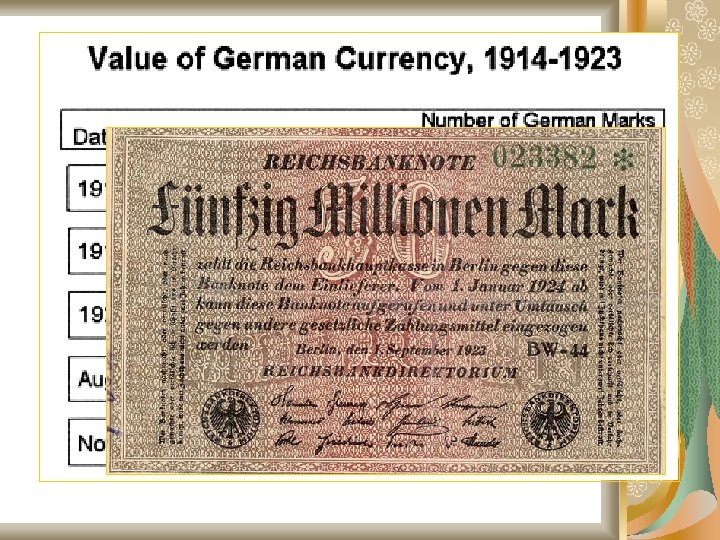 The German Mark
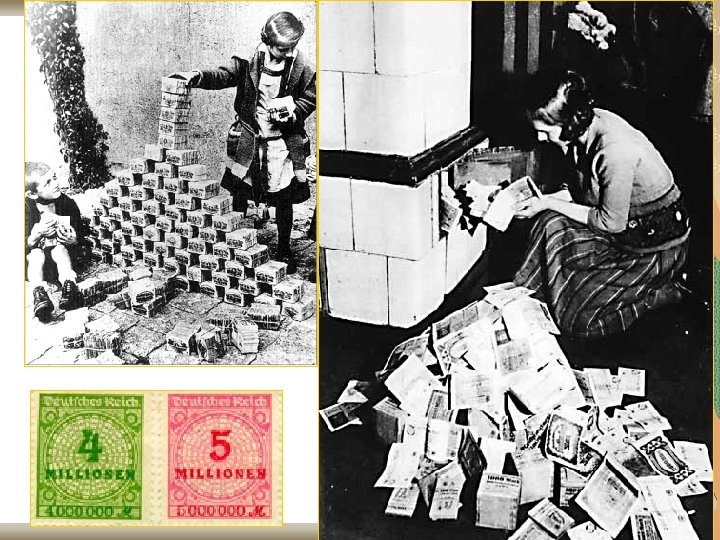 The German Mark
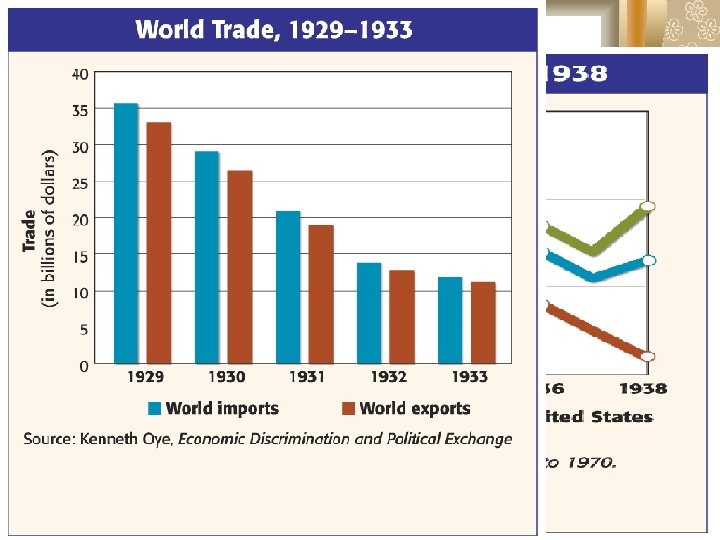 Postwar Uncertainty Ø 1929 - the US stock market crashes and now Everyone is economically suffering. ØWho takes advantage? ØItaly- Mussolini takes advantage of the disorder and rules as a Fascist (believed in extreme nationalism, and total control). Image NEXT
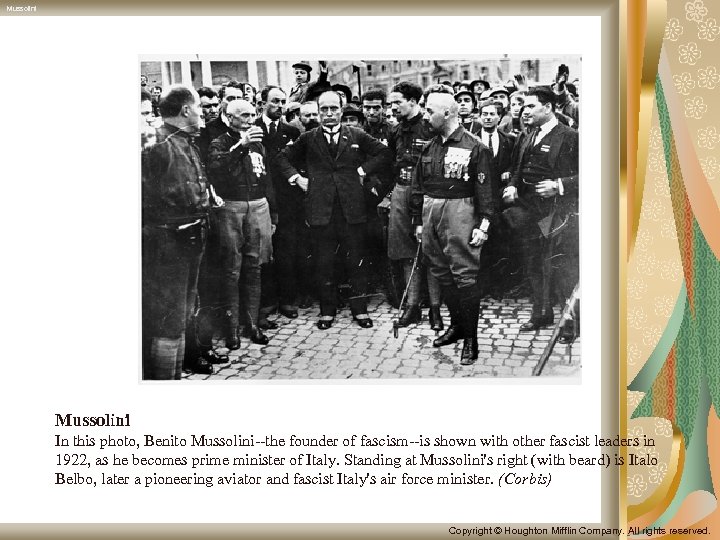 Mussolini In this photo, Benito Mussolini--the founder of fascism--is shown with other fascist leaders in 1922, as he becomes prime minister of Italy. Standing at Mussolini's right (with beard) is Italo Belbo, later a pioneering aviator and fascist Italy's air force minister. (Corbis) Copyright © Houghton Mifflin Company. All rights reserved.
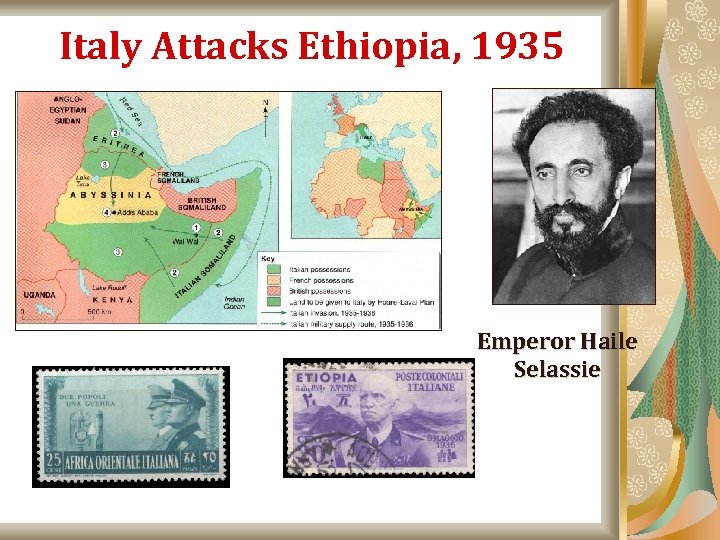 Italy Attacks Ethiopia, 1935 Emperor Haile Selassie
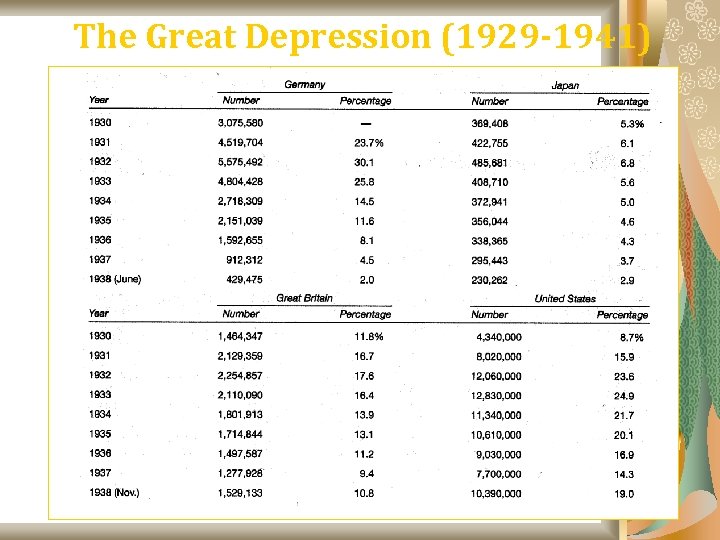 The Great Depression (1929 -1941)
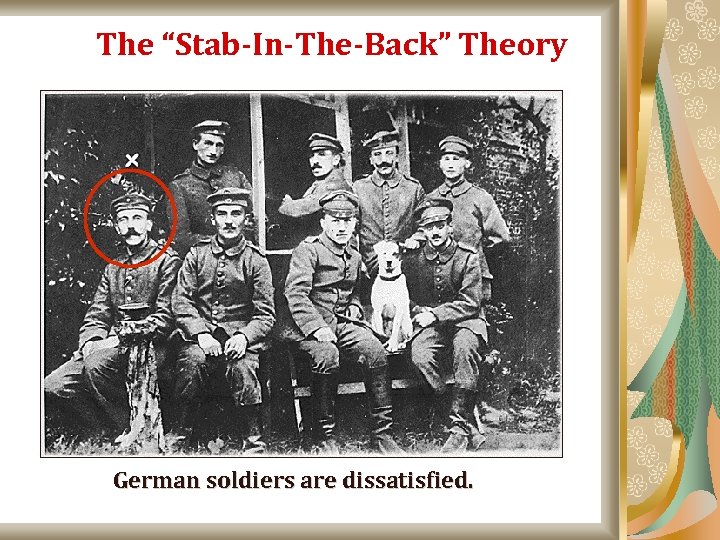 The “Stab-In-The-Back” Theory German soldiers are dissatisfied.
 Germany -Germany raised taxes to pay its war debt. People hated this. They also blamed the gov’t for their problems. -Hitler and his Nazis party take advantage of this and offer the German people, work, pride, and a chance to make up for the loss of war (WWI) -Fascism- Militant leader who emphasizes total loyalty (derived from the Roman symbol the fasces). (A type of Totalitarianism) NEXT
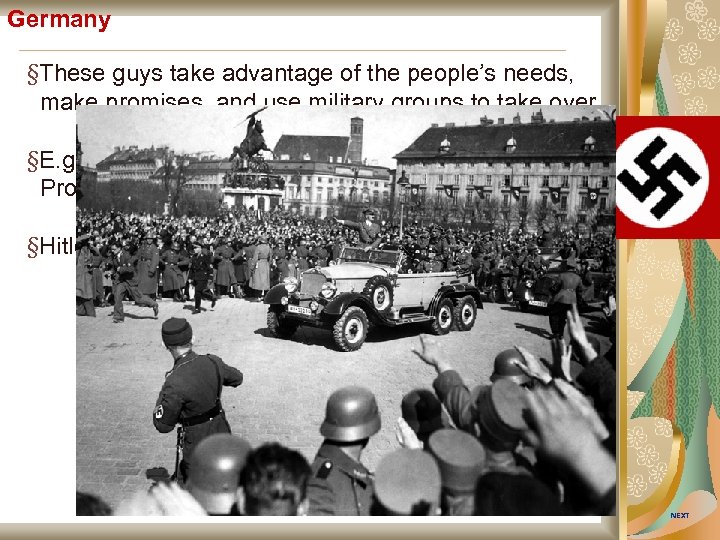 Germany §These guys take advantage of the people’s needs, make promises, and use military groups to take over. §E. g. Nazis and Brown-shirts. Promises include: Pride, jobs, money, order. §Hitler is arrested for attempting to take over the gov’t. NEXT
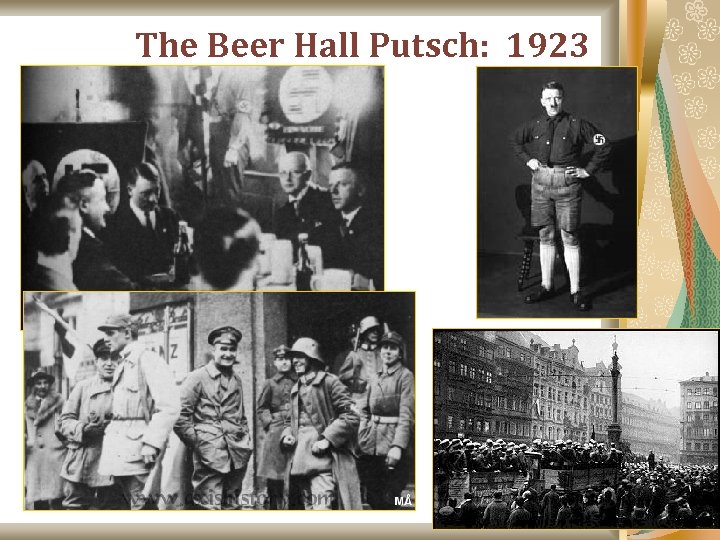 The Beer Hall Putsch: 1923
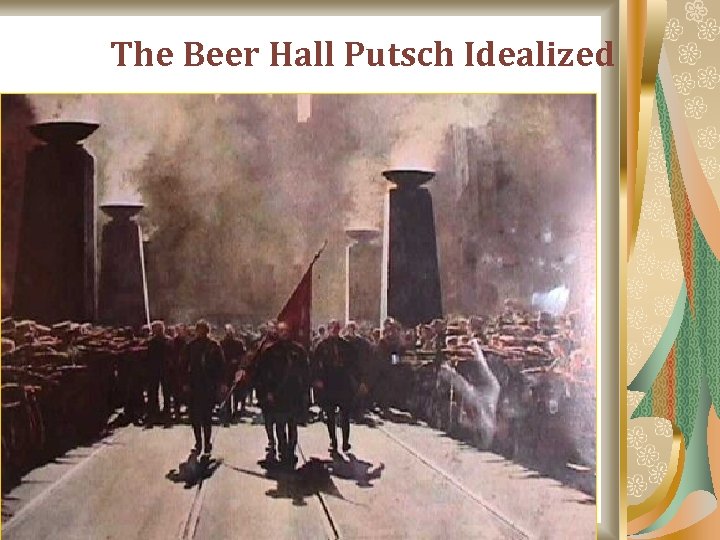 The Beer Hall Putsch Idealized
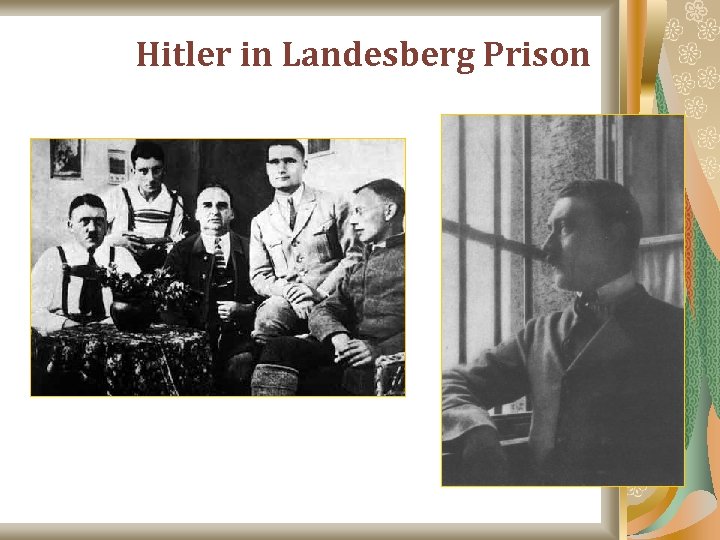 Hitler in Landesberg Prison
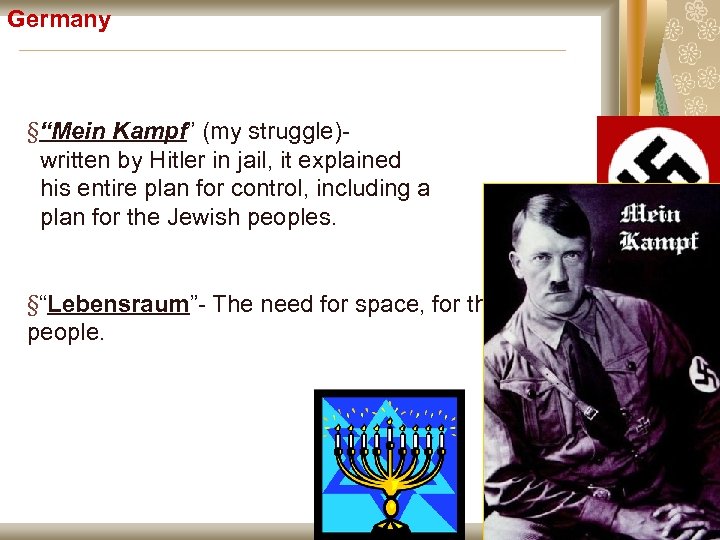 Germany §“Mein Kampf” (my struggle)written by Hitler in jail, it explained his entire plan for control, including a plan for the Jewish peoples. §“Lebensraum”- The need for space, for the German people. NEXT
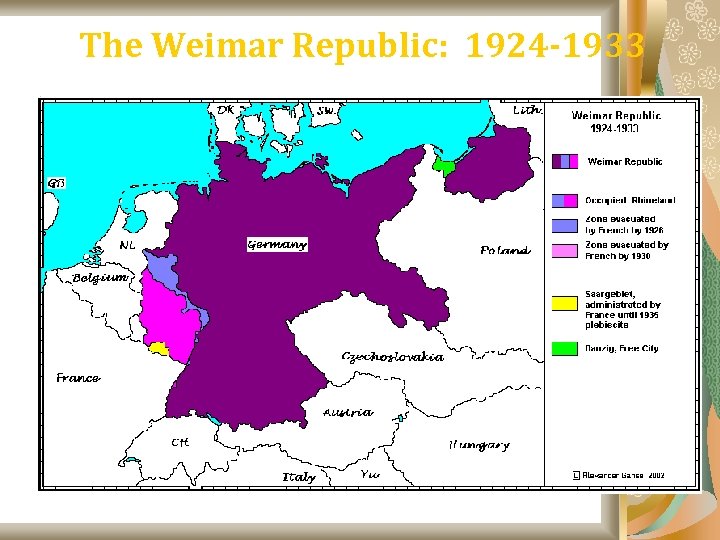 The Weimar Republic: 1924 -1933
![Weimar Germany: Political Representation [1920 -1933]](https://present5.com/presentation/65af7db7b465c152eb949b94855fbcda/image-16.jpg "Weimar Germany: Political Representation [1920 -1933]") Weimar Germany: Political Representation [1920 -1933]
Weimar Germany: Political Representation [1920 -1933]
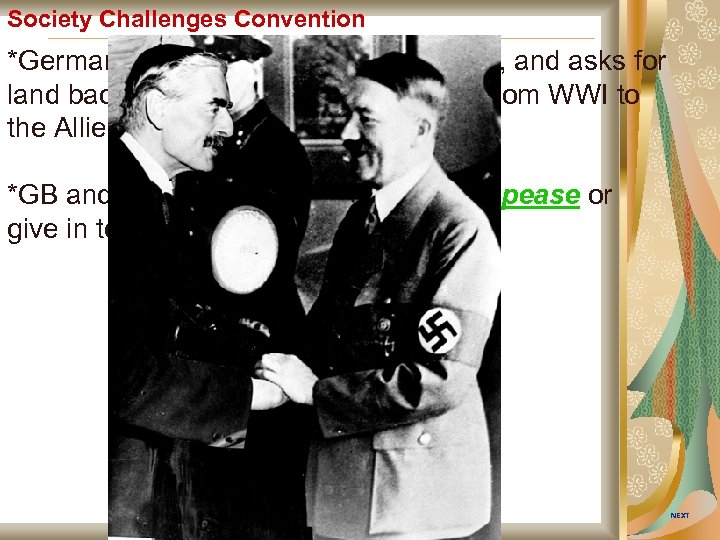 Society Challenges Convention *Germany starts to build an Army, Navy, and asks for land back. Oh, and he stops paying $ from WWI to the Allies *GB and the others fear war, so they appease or give in to Germany to avoid war. Why? NEXT
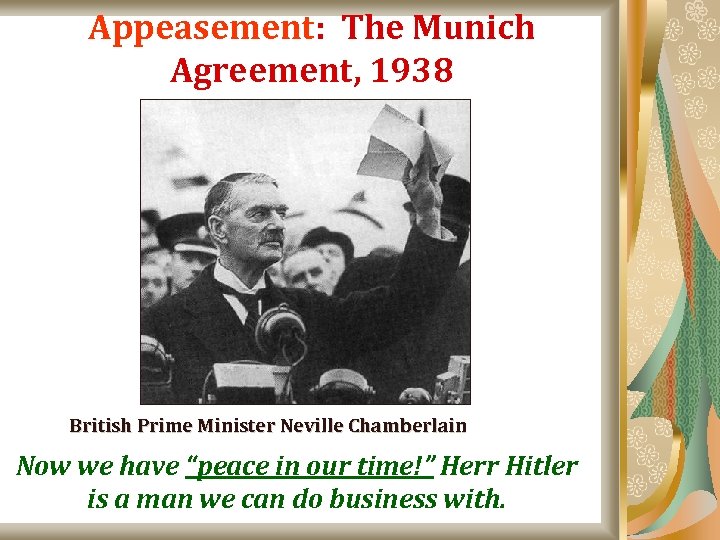 Appeasement: The Munich Agreement, 1938 British Prime Minister Neville Chamberlain Now we have “peace in our time!” Herr Hitler is a man we can do business with.
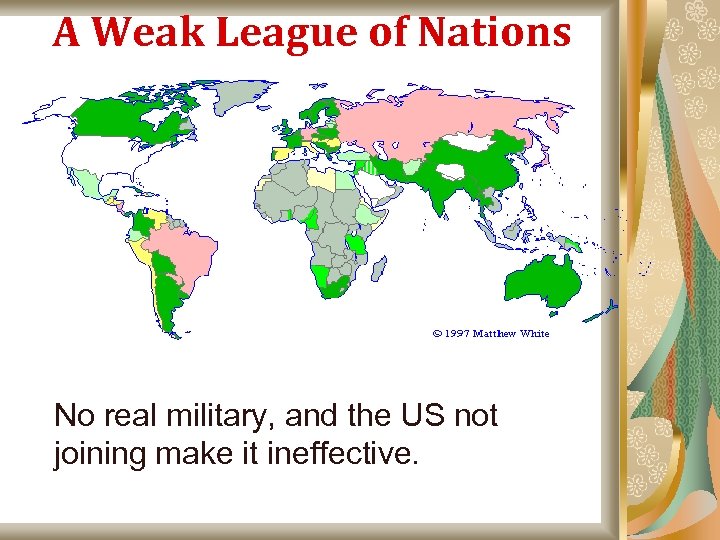 A Weak League of Nations No real military, and the US not joining make it ineffective.
 Society Challenges Convention *GB and the others fear war, so they appease or give in to Germany to avoid war. Why? *No real military, and the US not joining make it ineffective *Hitler takes the Rhineland, so no one stops him, then he takes Austria, then Czechoslovakia and then Poland, and the League of Nations does nothing. *US is following isolationism, , GB and France are afraid, and Russia is not ready (Remember Stalin purged all the officers? !) NEXT
 On the path to war Hitler becomes Fuhrer (1933) and Defies Versailles Treaty • In 1935, Hitler begins rebuilding the German army. • In 1936, Germany occupies Rhineland Germany annexes neighboring territory (Czech, Austria & finally Poland) • Britain urges appeasement, a policy of giving in to aggression • Germany, Italy, and Japan—the Axis Powers—form an alliance
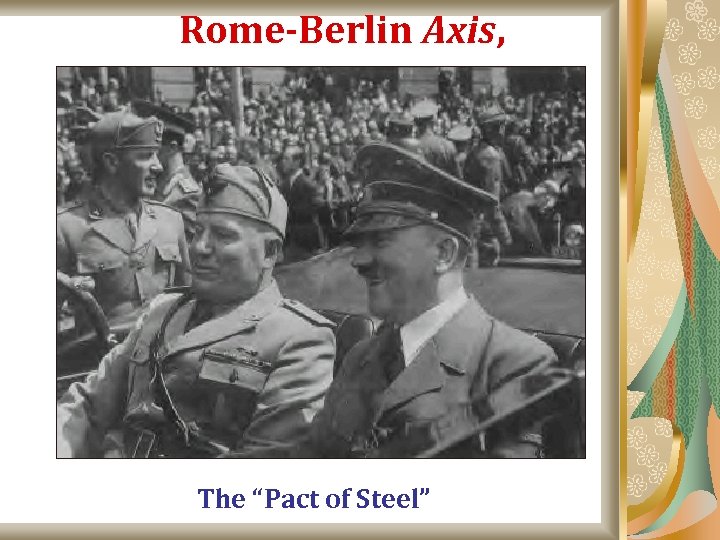 Rome-Berlin Axis, The “Pact of Steel”
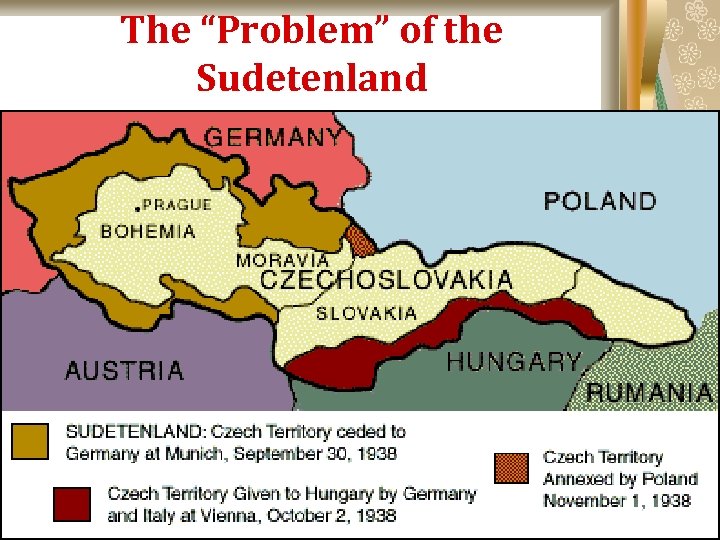 The “Problem” of the Sudetenland
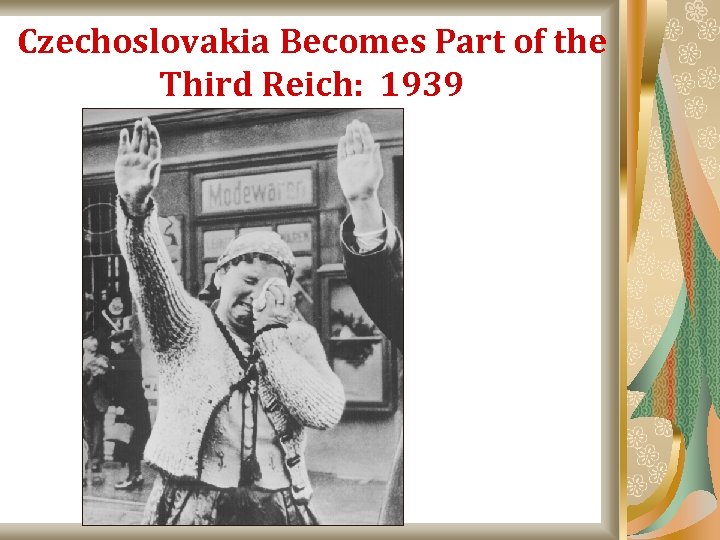 Czechoslovakia Becomes Part of the Third Reich: 1939
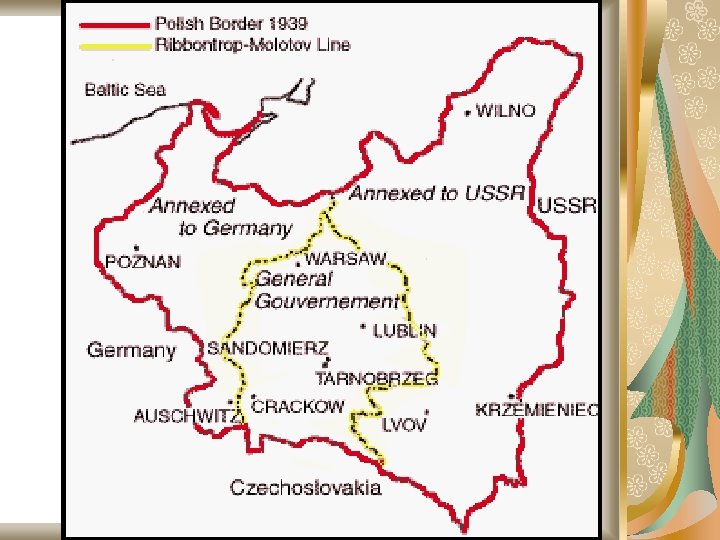
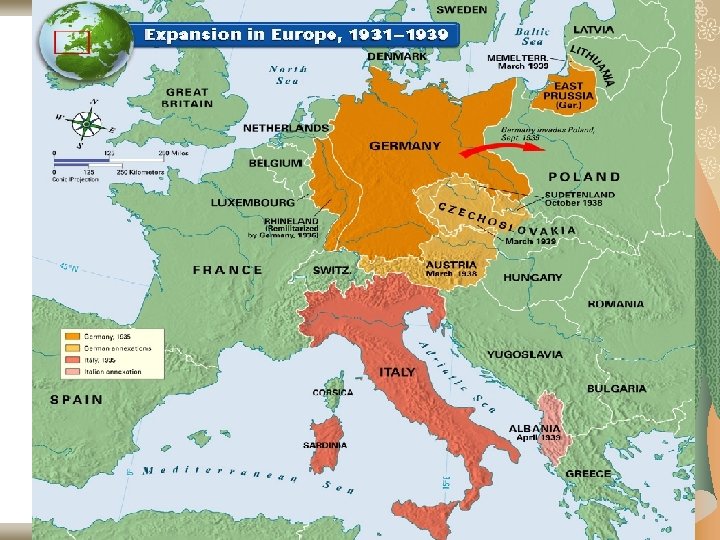
 On the path to war! 1936 -He takes the Sudetenland! 1938 -He takes Czechoslovakia! 1939 -He annexes Austria! He takes the Balkans!! He takes Albania!!! In 1939 Stalin (USSR) and Hitler agree to divide Poland between the 2 of them!!! ***Lies, tricks and fear are tools***
 On the path to war Stalin and Hitler even sign a “non-aggression pact which says they would not attack each other. In 1939, Hitler Invades Poland Japan- Hirohito becomes Emperor, Imperialism is pushed, Japan takes what it needs. 1931 - Japan invades China for more natural resources- this is the beginning. NEXT
 Japan Justifies its Invasion of China Japanese Militarism Japanese militarism had deep roots. Fukuzawa Yukichi, one of the chief Meiji reformers observed well before Japan’s war on China of 1894 -1895: “One hundred volumes of International Law are not the equal of a few cannon; a handful of treaties of friendship are not worth a basket of gun powder. Cannon and gunpowder are not aids for the enforcement of given moral principles; they are the implements for the creation of morality where none exists. ” When Inukai Tsuyoshi became premier late in 1931, the military already had the dominant voice in Japan’s government. Although the Emperor was effectively powerless, he warned Inukai about the military when he asked him to form a cabinet. “The army’s interference in domestic and foreign politics, and its willfulness, is a state of affairs which, for the good of the nation, we must view with apprehension. ” Sources: J. K. Fairbank, E. O. Reischauer, and A. M. Craig, Easy Asia: The Modern Transformation and R. Storry, A History of Modern Japan
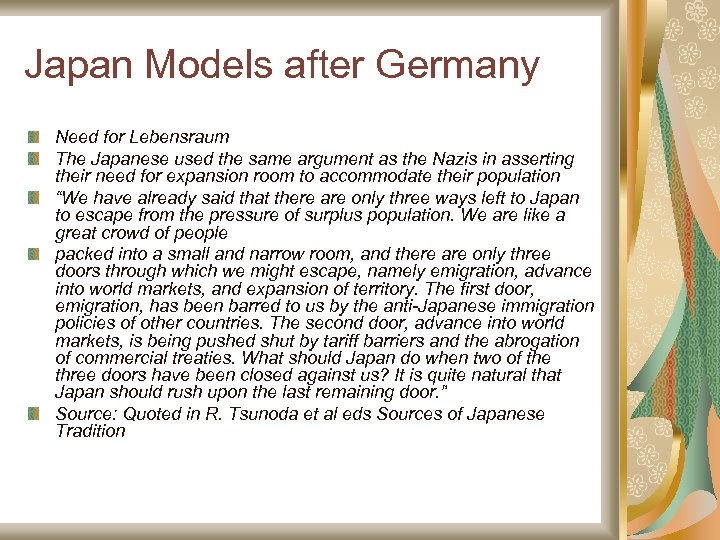 Japan Models after Germany Need for Lebensraum The Japanese used the same argument as the Nazis in asserting their need for expansion room to accommodate their population “We have already said that there are only three ways left to Japan to escape from the pressure of surplus population. We are like a great crowd of people packed into a small and narrow room, and there are only three doors through which we might escape, namely emigration, advance into world markets, and expansion of territory. The first door, emigration, has been barred to us by the anti-Japanese immigration policies of other countries. The second door, advance into world markets, is being pushed shut by tariff barriers and the abrogation of commercial treaties. What should Japan do when two of the three doors have been closed against us? It is quite natural that Japan should rush upon the last remaining door. ” Source: Quoted in R. Tsunoda et al eds Sources of Japanese Tradition
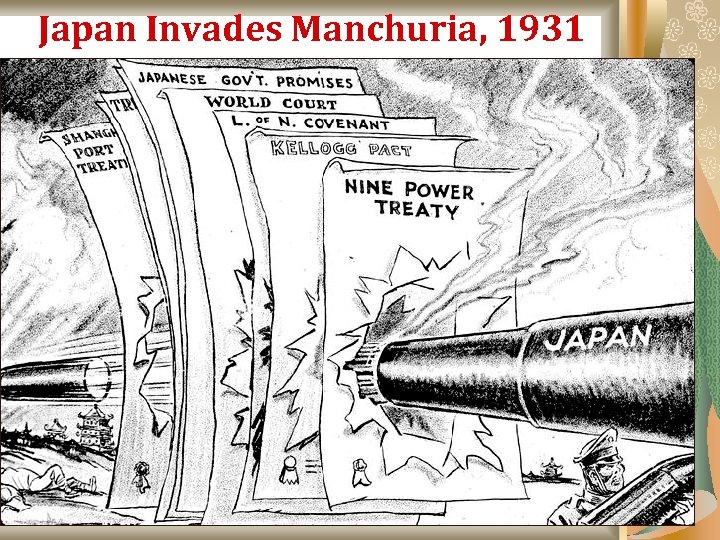 Japan Invades Manchuria, 1931
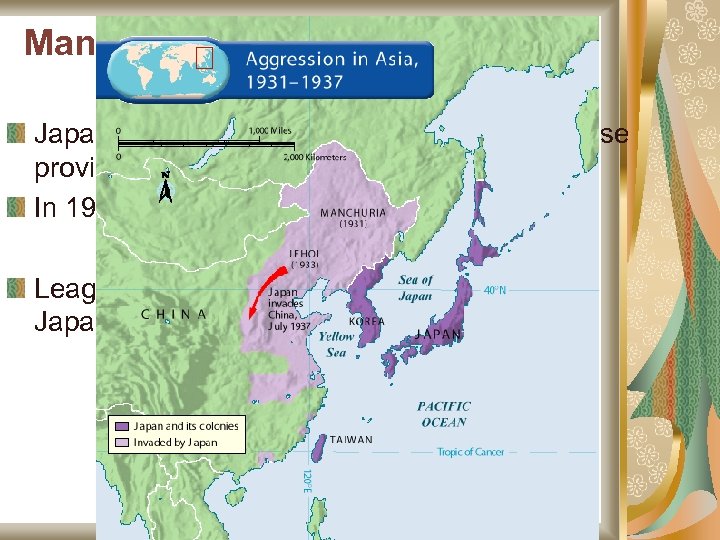 Manchuria Japan has investments in Manchuria, a Chinese province In 1931, Japanese army seizes Manchuria League of Nations protests Japan’s actions; Japan withdraws from League
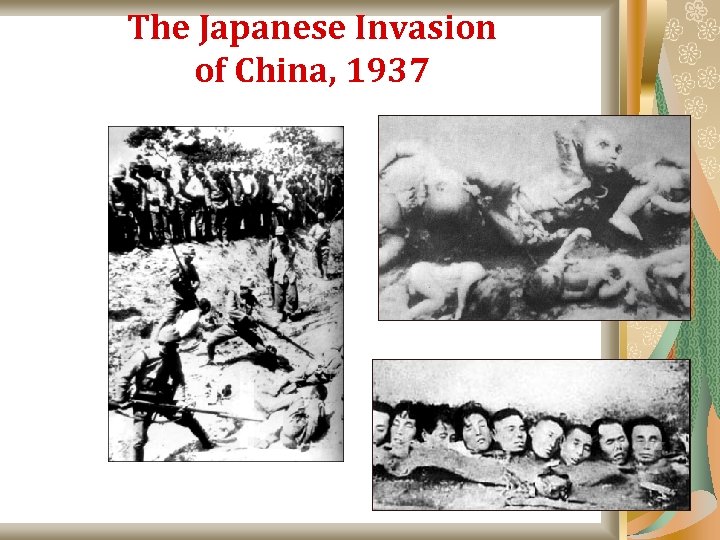 The Japanese Invasion of China, 1937
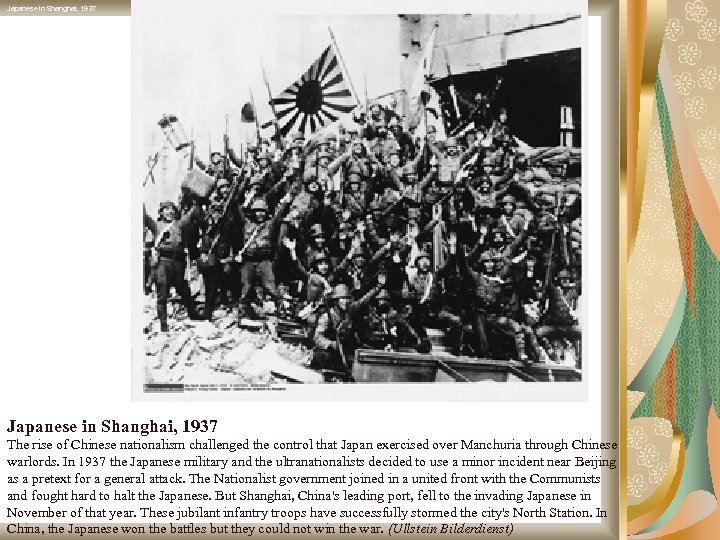 Japanese in Shanghai, 1937 The rise of Chinese nationalism challenged the control that Japan exercised over Manchuria through Chinese warlords. In 1937 the Japanese military and the ultranationalists decided to use a minor incident near Beijing as a pretext for a general attack. The Nationalist government joined in a united front with the Communists and fought hard to halt the Japanese. But Shanghai, China's leading port, fell to the invading Japanese in November of that year. These jubilant infantry troops have successfully stormed the city's North Station. In China, the Japanese won the battles but they could not win the war. (Ullstein Bilderdienst)
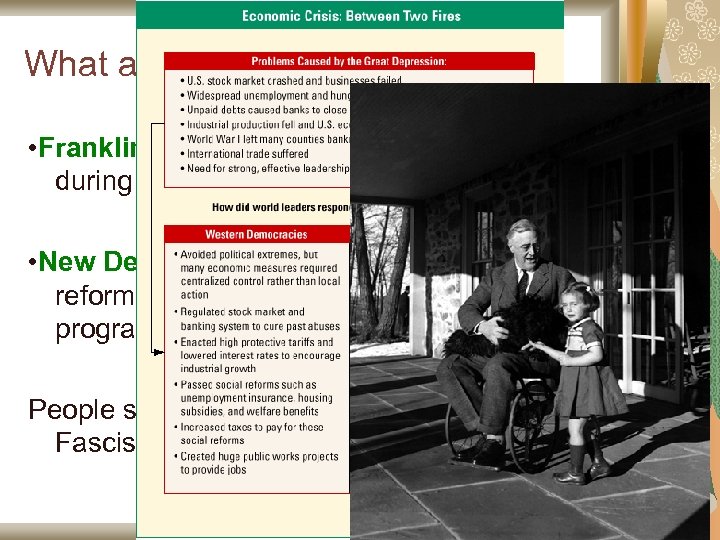 What about the US? • Franklin D. Roosevelt—American president during Depression • New Deal—Roosevelt’s program of government reform to improve economy (a Socialist program) People start choosing between Democracy and Fascism
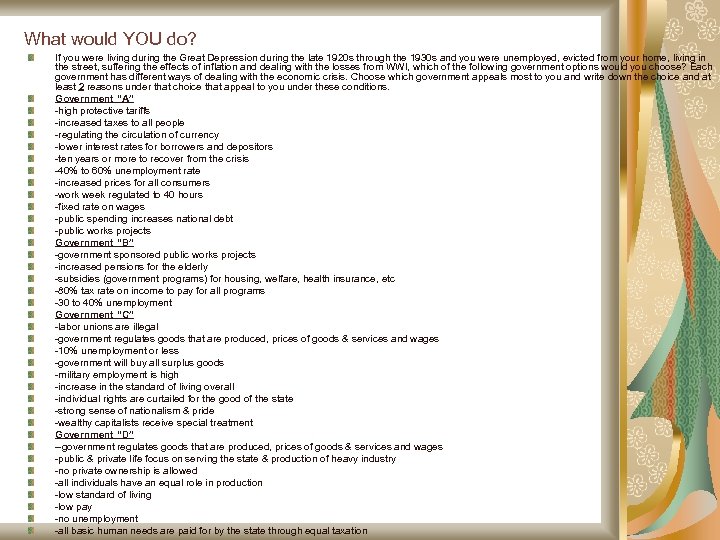 What would YOU do? If you were living during the Great Depression during the late 1920 s through the 1930 s and you were unemployed, evicted from your home, living in the street, suffering the effects of inflation and dealing with the losses from WWI, which of the following government options would you choose? Each government has different ways of dealing with the economic crisis. Choose which government appeals most to you and write down the choice and at least 2 reasons under that choice that appeal to you under these conditions. Government “A” -high protective tariffs -increased taxes to all people -regulating the circulation of currency -lower interest rates for borrowers and depositors -ten years or more to recover from the crisis -40% to 60% unemployment rate -increased prices for all consumers -work week regulated to 40 hours -fixed rate on wages -public spending increases national debt -public works projects Government “B” -government sponsored public works projects -increased pensions for the elderly -subsidies (government programs) for housing, welfare, health insurance, etc -80% tax rate on income to pay for all programs -30 to 40% unemployment Government “C” -labor unions are illegal -government regulates goods that are produced, prices of goods & services and wages -10% unemployment or less -government will buy all surplus goods -military employment is high -increase in the standard of living overall -individual rights are curtailed for the good of the state -strong sense of nationalism & pride -wealthy capitalists receive special treatment Government “D” --government regulates goods that are produced, prices of goods & services and wages -public & private life focus on serving the state & production of heavy industry -no private ownership is allowed -all individuals have an equal role in production -low standard of living -low pay -no unemployment -all basic human needs are paid for by the state through equal taxation
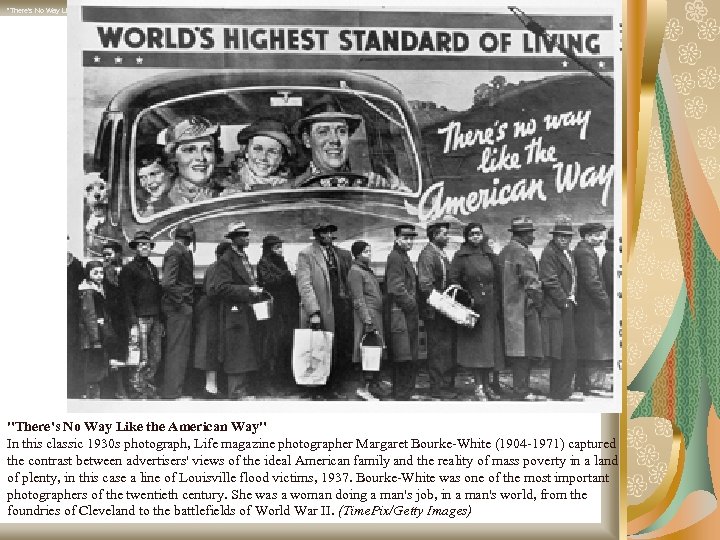 "There's No Way Like the American Way" In this classic 1930 s photograph, Life magazine photographer Margaret Bourke-White (1904 -1971) captured the contrast between advertisers' views of the ideal American family and the reality of mass poverty in a land of plenty, in this case a line of Louisville flood victims, 1937. Bourke-White was one of the most important photographers of the twentieth century. She was a woman doing a man's job, in a man's world, from the foundries of Cleveland to the battlefields of World War II. (Time. Pix/Getty Images)