


 Скачать презентацию Depression statuses and related predictors in later life
4ed4a822a4d8542d6e84a28ab1696b1e.ppt
- Количество слайдов: 18
 Depression statuses and related predictors in later life: A 10 -year follow-up study in Israel Rabia Khalaila, RN, MPH, PHD Director, Department of Nursing Zefat Academic College Zefat, Israel
 Background Depression, which is widespread in later life, takes various forms. These include persistent, intermittent, recovery, recurrent, onset, and incidence depression over time. Among older people, depression may lead to poor quality of life, numerous illnesses (e. g. , cancer, and cardiac disease), cognitive dysfunction and functional disability; as well as to increased mortality ; and suicide rates. Page 2
 Background A growing body of recent longitudinal studies has investigated the mechanisms and interrelationships between risk factors -1. socioeconomic resources 2. health related factors 3. health behaviors -- and depression patterns among older people. Page 3
 Background Socio-economic status, which is the major contributing factor to depression among older persons, is a multidimensional concept. It includes three types of resources: 1. material standard of living (e. g. , household income), 2. skills (e. g. , educational level, and employment status), 3. and social relationships (marital status, family support, and participation in social activities). Page 4
 Background According to longitudinal studies, low socio-economic status is associated with a high risk of late-life depression; whereas, long-term improvement in socio -economic measures would be expected to reduce depressive symptoms. Health-related factors and health behaviors are also important risk factors for depression in older adults. However, no longitudinal study has been conducted thus far in Israel on the predictors of depression statuses. Page 5
 Background Such research on this topic in Israel is needed due to the unique disparities that exist in many aspects of life in this country. The incidence of depression has been found to be significantly higher among older Israeli Arabs than among their Jewish counterparts. Page 6
 Aims The aim of the current study was to investigate the factors associated with depression statuses in a tenyear follow-up of community-dwelling older adults in Israel. 1. To examine the relationships between SES and depression statuses 2. To examine the relationships between healthrelated factors and depression statuses. 3. To examine the relationships between health behaviors and depression statuses. Page 7
 Methods Longitudinal data were used from the Israeli sample of the SHARE (Survey of Health, Aging and Retirement in Europe), assessing the depressive symptoms in 1, 042 respondents, aged 50 or above, at three time points: 2004/2005 (Wave I); 2009/2010 (Wave II); and 2014/2015 (Wave III). Multinomial logistic regression was used to determine the relationships among independent variables and depression statuses (no depression, intermittent depression, or persistent depression). Page 8
 Measures Dependent variable: depression statuses 1. without depression (Reference Category), 2. or with intermittent (at least one wave) 3. or persistent depression (at three waves). Page 9
 Measures Independent variables: 1. Socioeconomic variable: family Income, education, marital status, number of children, employment, social activities. 2. Health-related factors include four measures: selfperceived health, physical health (chronic disease), obesity, functional disability, and cognitive dysfunction. 3. Two health behaviors were addressed in Wave I: smoking, and physical inactivity 4. Demographic characteristics were obtained in Wave I: gender; ethnicity (1 = Arab; 0 = Jewish); and age (0 = 50 – 64 years old; (1 = 65 – 74; and (2) 75 years old or more. Page 10
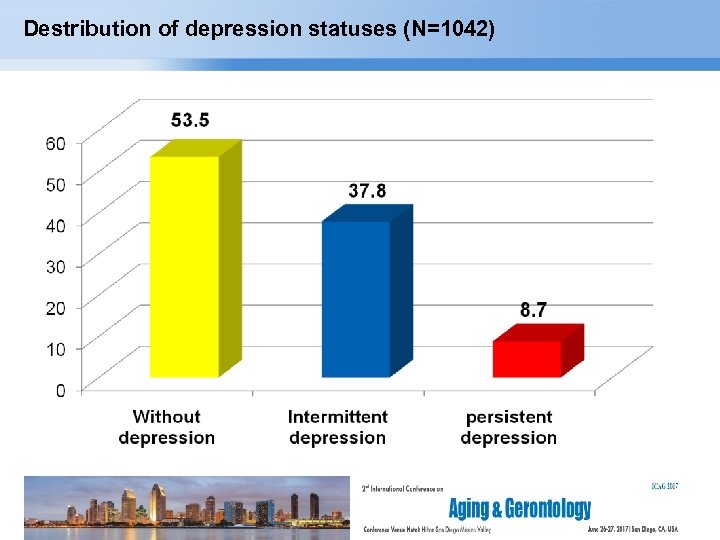 Destribution of depression statuses (N=1042) Page 11
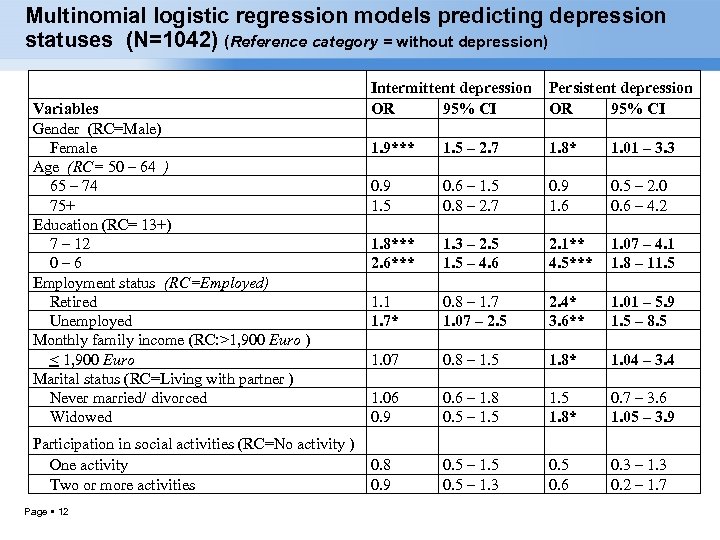 Multinomial logistic regression models predicting depression statuses (N=1042) (Reference category = without depression) Variables Gender (RC=Male) Female Age (RC= 50 – 64 ) 65 – 74 75+ Education (RC= 13+) 7 – 12 0– 6 Employment status (RC=Employed) Retired Unemployed Monthly family income (RC: >1, 900 Euro ) < 1, 900 Euro Marital status (RC=Living with partner ) Never married/ divorced Widowed Participation in social activities (RC=No activity ) One activity Two or more activities Page 12 Intermittent depression OR 95% CI Persistent depression OR 95% CI 1. 9*** 1. 5 – 2. 7 1. 8* 1. 01 – 3. 3 0. 9 1. 5 0. 6 – 1. 5 0. 8 – 2. 7 0. 9 1. 6 0. 5 – 2. 0 0. 6 – 4. 2 1. 8*** 2. 6*** 1. 3 – 2. 5 1. 5 – 4. 6 2. 1** 4. 5*** 1. 07 – 4. 1 1. 8 – 11. 5 1. 1 1. 7* 0. 8 – 1. 7 1. 07 – 2. 5 2. 4* 3. 6** 1. 01 – 5. 9 1. 5 – 8. 5 1. 07 0. 8 – 1. 5 1. 8* 1. 04 – 3. 4 1. 06 0. 9 0. 6 – 1. 8 0. 5 – 1. 5 1. 8* 0. 7 – 3. 6 1. 05 – 3. 9 0. 8 0. 9 0. 5 – 1. 5 0. 5 – 1. 3 0. 5 0. 6 0. 3 – 1. 3 0. 2 – 1. 7
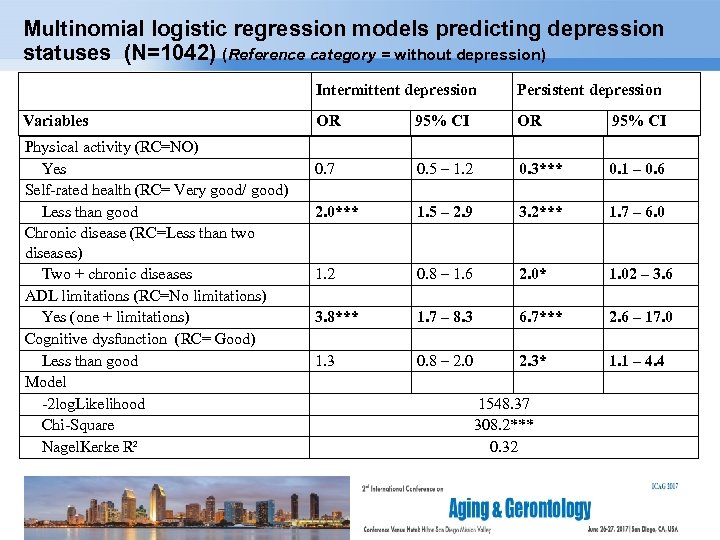 Multinomial logistic regression models predicting depression statuses (N=1042) (Reference category = without depression) Intermittent depression Variables Physical activity (RC=NO) Yes Self-rated health (RC= Very good/ good) Less than good Chronic disease (RC=Less than two diseases) Two + chronic diseases ADL limitations (RC=No limitations) Yes (one + limitations) Cognitive dysfunction (RC= Good) Less than good Model -2 log. Likelihood Chi-Square Nagel. Kerke R² Page 13 Persistent depression OR 95% CI 0. 7 0. 5 – 1. 2 0. 3*** 0. 1 – 0. 6 2. 0*** 1. 5 – 2. 9 3. 2*** 1. 7 – 6. 0 1. 2 0. 8 – 1. 6 2. 0* 1. 02 – 3. 6 3. 8*** 1. 7 – 8. 3 6. 7*** 2. 6 – 17. 0 1. 3 0. 8 – 2. 0 2. 3* 1. 1 – 4. 4 1548. 37 308. 2*** 0. 32
 Conclusion The current study shows that, as in other countries, socioeconomic indicators, as well as health behaviors and healthrelated factors affect depression statuses at various levels in older adults in Israel. Modifying education and employment status in the present older cohort in Israeli is no longer feasible. However, improving such opportunities earlier in life could have a long-term positive impact on reducing depression inequalities in the future older adults Page 14
 Conclusion Almost half of the participants in sample of Israeli adults reported experiencing intermittent or persistent depression over time. According to our findings, depression is common among older people in Israel. Low socio-economic resources, poor health measures, health behaviours, and demographic variables were all found to affect the prevalence of intermittent or persistent depression over time. Page 15
 Conclusion These findings highlight the need for intervention programs focused on improving physical, functional, cognitive and subjective health, to prevent the development of depressive symptoms. Interventions to increase physical activity among older adults might contribute to decreasing the risk of persistent depression. Page 16
 Conclusion Future studies should also explore the complex mechanisms whereby socioeconomic factors and health measures impact and interrelate with respect to the development of depressive symptoms over time. Page 17
 Thank you! rabeikh@zefat. ac. il Page 18