 Скачать презентацию DEPRESSION AND OTHER MOOD DISORDERS OBJECTIVES Know
1c3ad68754c3c7ca37eb0f5e028aeb76.ppt
- Количество слайдов: 55



DEPRESSION AND OTHER MOOD DISORDERS
OBJECTIVES Know and understand: • Incidence and morbidity of depressive disorders among older adults • Diagnostic criteria for depression and mania • Treatment options for older adults with depression or mania • Actions and side effects of drugs for depression and mania in older adults Slide 2
TOPICS COVERED • Epidemiology • Diagnosis • Clinical Course • Suicide • Treatment: Psychotherapy, Drugs, ECT • Managing Non-response • Treating Bipolar Disorder Slide 3
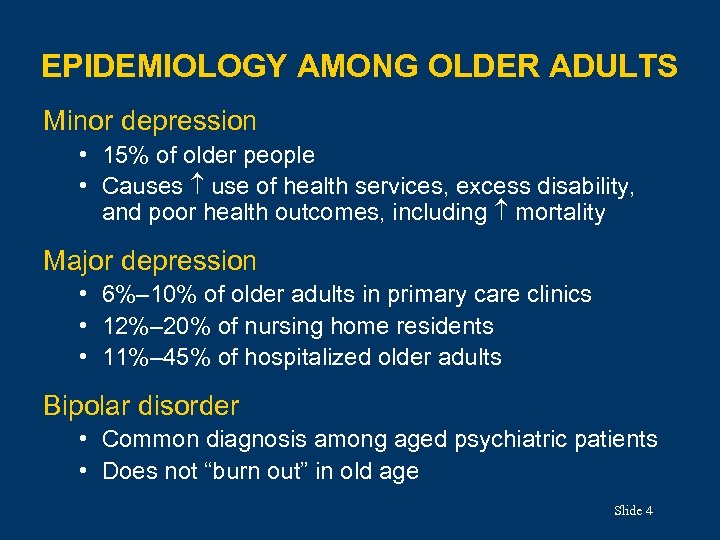
EPIDEMIOLOGY AMONG OLDER ADULTS Minor depression • 15% of older people • Causes use of health services, excess disability, and poor health outcomes, including mortality Major depression • 6%– 10% of older adults in primary care clinics • 12%– 20% of nursing home residents • 11%– 45% of hospitalized older adults Bipolar disorder • Common diagnosis among aged psychiatric patients • Does not “burn out” in old age Slide 4
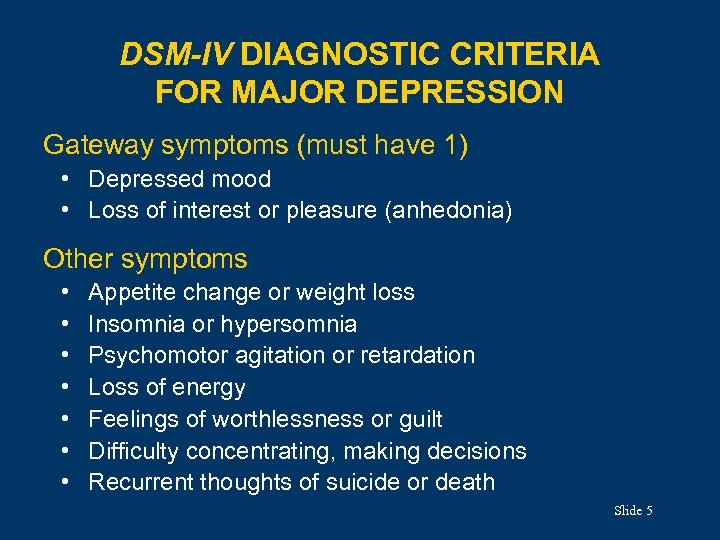
DSM-IV DIAGNOSTIC CRITERIA FOR MAJOR DEPRESSION Gateway symptoms (must have 1) • Depressed mood • Loss of interest or pleasure (anhedonia) Other symptoms • • Appetite change or weight loss Insomnia or hypersomnia Psychomotor agitation or retardation Loss of energy Feelings of worthlessness or guilt Difficulty concentrating, making decisions Recurrent thoughts of suicide or death Slide 5
SCREENING: PHQ-9 9 -item Patient Health Questionnaire (PHQ-9) • 9 items cover diagnostic criteria for major depression • Initial 2 questions can be used for screening • Serial administrations can be used to reliably assess response to treatment • Not reliable in patients with moderate to severe dementia Slide 6
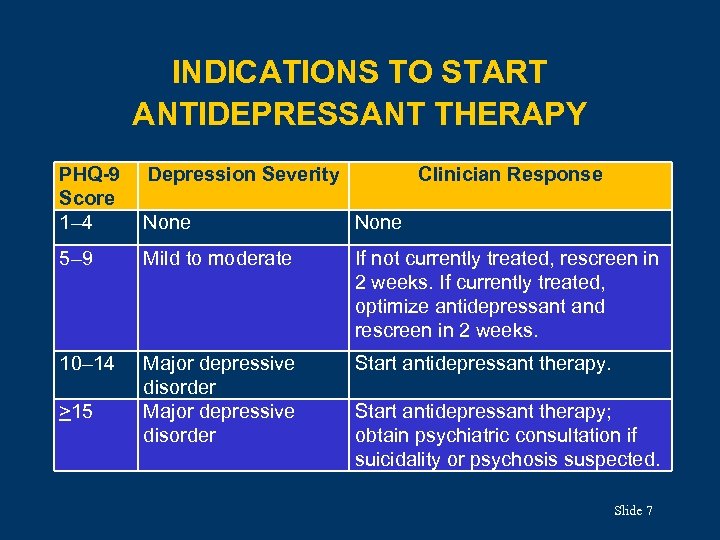
INDICATIONS TO START ANTIDEPRESSANT THERAPY PHQ-9 Score 1– 4 None 5– 9 Mild to moderate If not currently treated, rescreen in 2 weeks. If currently treated, optimize antidepressant and rescreen in 2 weeks. 10– 14 Major depressive disorder Start antidepressant therapy. >15 Depression Severity Clinician Response Start antidepressant therapy; obtain psychiatric consultation if suicidality or psychosis suspected. Slide 7
SCREENING: GERIATRIC DEPRESSION SCALE (GDS) • Yes/No format • Lacks suicidal ideation query • Not useful for assessing treatment response Slide 8
DIAGNOSIS IN OLDER PATIENTS IS DIFFICULT BECAUSE THEY. . . • More often report somatic symptoms • Less often report depressed mood, guilt • May present with “masked” depression cloaked in preoccupation with physical concerns and complicated by overlap of physical and emotional symptoms Slide 9
DIAGNOSTIC CHALLENGES IN MEDICAL SETTINGS • Symptoms of depressive and physical disorders often overlap, eg: Ø Disturbed sleep Ø Fatigue Ø Diminished appetite • Seriously ill or disabled people may focus on thoughts of death or worthlessness, but not suicide • Side effects of drugs for other illnesses may be confused with depressive symptoms Slide 10
HALLMARKS OF PSYCHOTIC DEPRESSION • Patients have sustained paranoid, guilty, or somatic delusions (plausible but inexplicably irrational beliefs) • Among older patients, most commonly seen in those needing inpatient psychiatric care • In primary care, may be seen when patients exhibit unwarranted suspicions, somatic symptoms, or physical preoccupations Slide 11
DIFFERENTIAL DIAGNOSIS Medical illness can mimic depression • Thyroid disease, conditions that promote apathy Dementia has overlapping symptoms • Impaired concentration • Lack of motivation, loss of interest, apathy • Psychomotor retardation • Sleep disturbance Bereavement is different because: • Most disturbing symptoms resolve in 2 months • Not associated with marked functional impairment Slide 12
CLINICAL COURSE IN MAJOR DEPRESSION Recurrence, partial recovery, and chronicity. . . disability use of health care resources morbidity and mortality suicide Slide 13
OLDER ADULTS AND SUICIDE • Older age associated with increasing risk of suicide • One fourth of all suicides occur in people 65 years • Risk factors: depression, physical illness, living alone, white male, alcoholism • Violent suicides (eg, firearms, hanging) are more common than non-violent methods among older adults, despite the potential for drug overdosing Slide 14
STEPS IN TREATING DEPRESSION • Acute — reverse current episode • Continuation — prevent a relapse Ø Continue for 6 months • Maintenance — prevent recurrence Ø Continue for 12– 18 months or indefinitely if hospitalization was required or suicidality or psychosis was present Slide 15
TYPES OF THERAPY FOR DEPRESSION • Psychotherapy • Pharmacotherapy • Electroconvulsive therapy (ECT) Slide 16
PSYCHOTHERAPY • Individualize standard approaches Ø Cognitive-behavioral therapy Ø Interpersonal psychotherapy Ø Problem-solving therapy • Combine with an antidepressant (has been shown to extend remission after recovery) • Watch for depressive syndromes in caregivers, who might benefit from therapy • Supportive psychotherapy Slide 17
PHARMACOTHERAPY Individualize choice of drug on basis of: • Patient’s comorbidities • Drug’s side-effect profile • Patient’s sensitivity to these effects • Drug’s potential for interacting with other medications Slide 18
ANTIDEPRESSANTS • Tricyclic antidepressants • Selective serotonin-reuptake inhibitors • Selective serotonergic and noradrenergic reuptake inhibitors (SSRI/SNRIs) • Others: bupropion, nefazodone, mirtazapine, monoamine oxidase inhibitors, methylphenidate Slide 19
TRICYCLIC ANTIDEPRESSANTS (TCAs) • Secondary amine TCAs most appropriate for older patients are nortriptyline and desipramine • For severe depression with melancholic features • Avoid in the presence of conduction disturbance, heart disease, intolerance to anticholinergic side effects Slide 20
SELECTIVE SEROTONIN-REUPTAKE INHIBITORS (SSRIs) • Citalopram, escitalopram, fluoxetine, paroxetine, sertraline • For mild to moderately severe depression • Side effects: Ø Anxiety, agitation, nausea & diarrhea, sexual effects, pseudoparkinsonism, warfarin effect, other drug interactions, hyponatremia/SIADH Ø Falls and fractures in nursing-home residents Slide 21
BUPROPION • Generally safe & well tolerated • activity of dopamine & norepinephrine • Side effects: Ø Insomnia, anxiety, tremor, myoclonus Ø Associated with 0. 4% risk of seizures • Dose range: 150– 300 mg/day Slide 22
SSRI/SNRIs: VENLAFAXINE • Acts as SSRI at low doses; at higher doses, as SNRI • Effective for major depression & generalized anxiety • Side effects: Ø Nausea Ø Hypertension Ø Sexual dysfunction • Dose range: 75– 300 mg/day Slide 23
SSRI/SNRIs: DESVENLAFAXINE • Active metabolite of venlafaxine • Side effects: Ø Nausea Ø Headache Ø Hypertension • Dose range 25– 50 mg/day Slide 24
SSRI/SNRIs: DULOXETINE • Equally SSRI and SNRI • Effective for major depression and FDAapproved for neuropathic pain • Precautions: drug interactions (CYP 450 1 A 2, 2 D 6 substrate), chronic liver disease, alcoholism, serum transaminase elevation • Dose range: 20– 60 mg/day Slide 25
MIRTAZAPINE • Norepinephrine, 5 -HT 2 , and 5 -HT 3 antagonist • Associated with weight gain, increased appetite • May be used for nursing-home residents with depression & dementia, nighttime agitation, weight loss • Dose range: 15– 45 mg/day • Soluble tablet that dissolves in the mouth (not sublingual) • May be given as single bedtime dose (sedative side effects) Slide 26
MONOAMINE OXIDASE INHIBITORS (MAOIs) • Use if patient is resistant to other antidepressants • Side effects: Ø Orthostatic hypotension, falls Ø Life-threatening hypertensive crisis if taken with tyramine-rich foods, cold remedies (pressor amine) Ø Fatal serotonin syndrome possible if taken with SSRI, meperidine Slide 27
METHYLPHENIDATE • No controlled data demonstrating efficacy for depression • Has been used for decades to treat major depression • May have role in reversing apathy, lack of energy in patients with dementia or disabling medical conditions Slide 28
RESPONSE TO ANTIDEPRESSANTS • Only 50% of patients with major depressive disorder fully respond to initial antidepressant treatment • An additional one third recover when the antidepressant is switched, or augmented with a second antidepressant or psychotherapy • Of patients who do recover, 40%– 60% experience recurrence, depending on the severity of the initial episode and persistence of symptoms Slide 29
MANAGEMENT OF PARTIAL RESPONSE OR NON-RESPONSE • The most common prescribing error is failure to increase the dose to the recommended level within the first 2 weeks of treatment • For non-response or intolerance, switch to another SSRI or another drug class • For partial response to an SSRI, add bupropion or buspirone Slide 30
REASONS TO USE ECT • Effective for treatment of major depression & mania • First-line treatment for patients at serious risk for suicide, life-threatening refusal of food, fluids, medications • Standard for psychotic depression in older adults; response rates 80% Slide 31
COGNITIVE SIDE EFFECTS OF ECT • Anterograde amnesia improves rapidly after treatment • Retrograde amnesia is more persistent; recall of events just before treatment may be lost permanently • Lasting effects not shown in longitudinal studies • Right unilateral treatment: fewer side effects but less effective than bilateral Slide 32
USING ECT • Contraindications are few: Ø Increased intracranial pressure Ø Recent MI or CVA and unstable CAD increase risk of complications • Continue pharmacotherapy following completion of ECT treatment • May use maintenance ECT to prevent relapse Slide 33
DIAGNOSING BIPOLAR DISORDER (1 of 2) • Elevated, irritable, or expansive mood persisting for at least 1 week, plus • Three of the following: Ø Ø Ø Ø Inflated self-esteem, grandiosity Hypersexuality Marked increase in activity Marked decreased need for sleep Pressured speech Racing thoughts, flight of ideas Distractibility Slide 34
DIAGNOSING BIPOLAR DISORDER (2 of 2) • Grandiose or paranoid delusions may be present • Older patients are more likely to have an admixture of depression that presents as irritability Slide 35
TREATMENT OF BIPOLAR DISORDER • Most primary providers refer suspected cases to a psychiatrist due to the frequency of recurrence, psychosis, and suicidality • Family-focused treatment prevents recurrent episodes of illness and delays hospitalization when accompanied by pharmacotherapy • Pharmacotherapy prevents recurrent episodes but is less effective without family-focused treatment • Paradoxically, a depressive episode in any form of bipolar disorder should rarely be treated with an antidepressant Slide 36
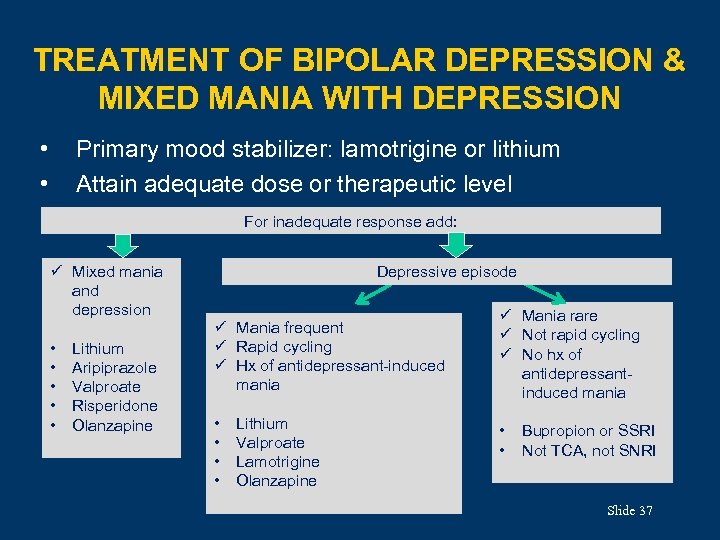
TREATMENT OF BIPOLAR DEPRESSION & MIXED MANIA WITH DEPRESSION • • Primary mood stabilizer: lamotrigine or lithium Attain adequate dose or therapeutic level For inadequate response add: ü Mixed mania and depression • • • Lithium Aripiprazole Valproate Risperidone Olanzapine Depressive episode ü Mania frequent ü Rapid cycling ü Hx of antidepressant-induced mania • • Lithium Valproate Lamotrigine Olanzapine ü Mania rare ü Not rapid cycling ü No hx of antidepressantinduced mania • • Bupropion or SSRI Not TCA, not SNRI Slide 37
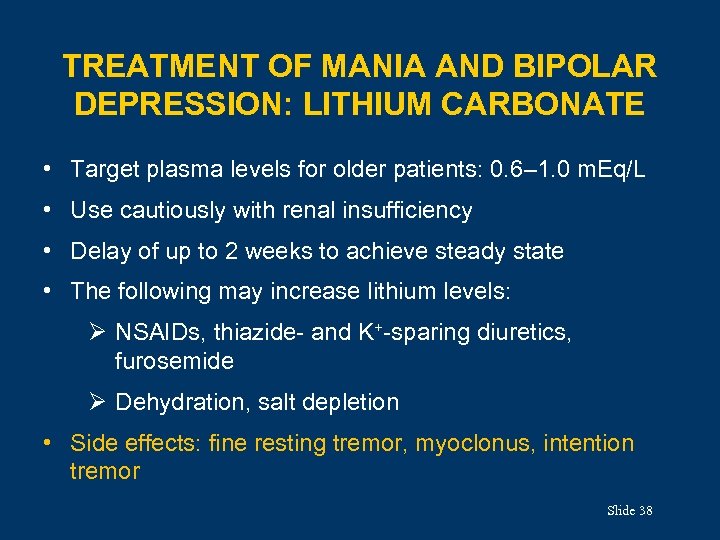
TREATMENT OF MANIA AND BIPOLAR DEPRESSION: LITHIUM CARBONATE • Target plasma levels for older patients: 0. 6– 1. 0 m. Eq/L • Use cautiously with renal insufficiency • Delay of up to 2 weeks to achieve steady state • The following may increase lithium levels: Ø NSAIDs, thiazide- and K+-sparing diuretics, furosemide Ø Dehydration, salt depletion • Side effects: fine resting tremor, myoclonus, intention tremor Slide 38
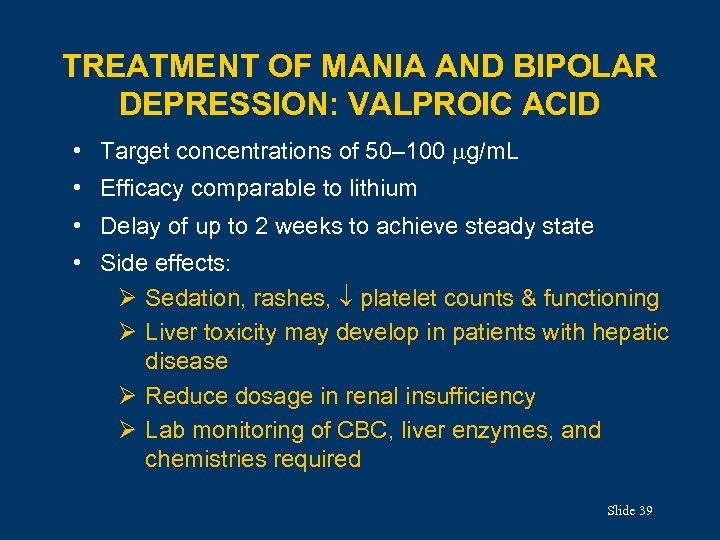
TREATMENT OF MANIA AND BIPOLAR DEPRESSION: VALPROIC ACID • Target concentrations of 50– 100 g/m. L • Efficacy comparable to lithium • Delay of up to 2 weeks to achieve steady state • Side effects: Ø Sedation, rashes, platelet counts & functioning Ø Liver toxicity may develop in patients with hepatic disease Ø Reduce dosage in renal insufficiency Ø Lab monitoring of CBC, liver enzymes, and chemistries required Slide 39
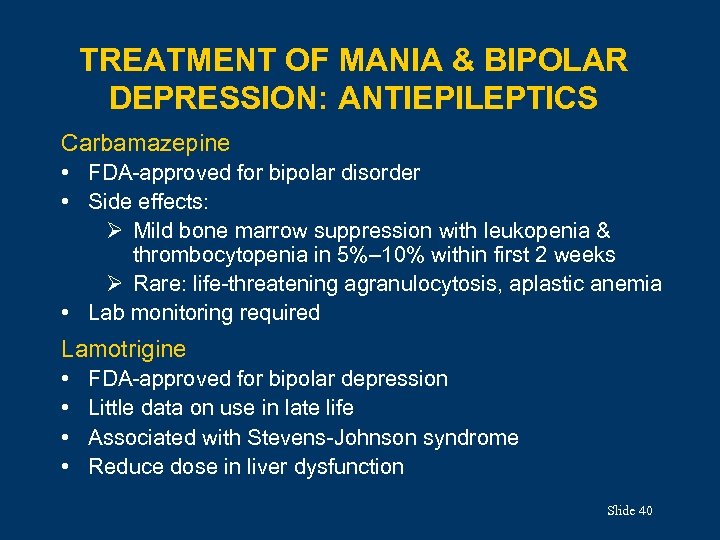
TREATMENT OF MANIA & BIPOLAR DEPRESSION: ANTIEPILEPTICS Carbamazepine • FDA-approved for bipolar disorder • Side effects: Ø Mild bone marrow suppression with leukopenia & thrombocytopenia in 5%– 10% within first 2 weeks Ø Rare: life-threatening agranulocytosis, aplastic anemia • Lab monitoring required Lamotrigine • • FDA-approved for bipolar depression Little data on use in late life Associated with Stevens-Johnson syndrome Reduce dose in liver dysfunction Slide 40
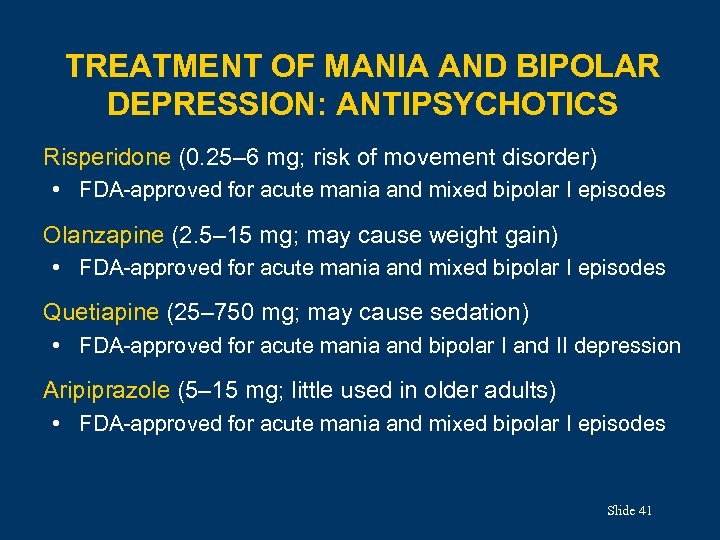
TREATMENT OF MANIA AND BIPOLAR DEPRESSION: ANTIPSYCHOTICS Risperidone (0. 25– 6 mg; risk of movement disorder) • FDA-approved for acute mania and mixed bipolar I episodes Olanzapine (2. 5– 15 mg; may cause weight gain) • FDA-approved for acute mania and mixed bipolar I episodes Quetiapine (25– 750 mg; may cause sedation) • FDA-approved for acute mania and bipolar I and II depression Aripiprazole (5– 15 mg; little used in older adults) • FDA-approved for acute mania and mixed bipolar I episodes Slide 41
SUMMARY (1 of 3) • In older adults, depression is Ø Common (especially “minor” depression) Ø Associated with morbidity Ø Difficult to diagnose because of atypical presentation, more somatic concerns, overlap with symptoms of other illnesses • Differential diagnosis: medical illnesses, dementia, bereavement Slide 42
SUMMARY (2 of 3) • Suicide is a serious concern in depressed older patients, particularly older white males • Treatment (acute & preventive) should be individualized and may include: Ø Psychotherapy Ø Pharmacotherapy Ø ECT • Choice of antidepressant should be based on comorbidities, side-effect profiles, patient sensitivity, potential drug interactions Slide 43
SUMMARY (3 of 3) • Bipolar disorder is common in older psychiatric patients and may be treated with lithium, or antiepileptic or antipsychotic agents • Family-focused treatment improves the results of pharmacotherapy • Patients who do not respond to usual treatment for depression or mania should be referred to a geriatric psychiatrist Slide 44
QUESTION 1 (1 of 2) Which of the following statements regarding treatment for major depressive disorder is true? A. Most older adults with the diagnosis are treated by a psychiatrist. B. In older adults on an effective dosage of antidepressants, the response rate is close to 80% after 8 weeks. C. Risk of recurrence or relapse is higher in patients who did not reach full remission. D. Augmentation with a second agent is not appropriate after a partial response to one antidepressant. E. Psychosocial interventions have little impact on rate of remission or risk of recurrence. Slide 45
QUESTION 1 (2 of 2) Which of the following statements regarding treatment for major depressive disorder is true? A. Most older adults with the diagnosis are treated by a psychiatrist. B. In older adults on an effective dosage of antidepressants, the response rate is close to 80% after 8 weeks. C. Risk of recurrence or relapse is higher in patients who did not reach full remission. D. Augmentation with a second agent is not appropriate after a partial response to one antidepressant. E. Psychosocial interventions have little impact on rate of remission or risk of recurrence. Slide 46
CASE 1 (1 of 4) • An 82 -year-old woman comes to the office because she is fatigued and worried that she is terminally ill. • She is recently widowed and lives alone. • History includes dyslipidemia, hypertension, and obesity; she has no psychiatric history. • Medications are furosemide, simvastatin, propranolol, and aspirin. • At her last visit 2 months ago, she was concerned that she had cancer; extensive evaluation was negative. • Since then, she has lost 6. 8 kg (15 lb). Slide 47
CASE 1 (2 of 4) • Another set of tests are negative. • The patient reluctantly agrees to try citalopram 40 mg, even though she insists that she is not depressed and is instead worried about her health. • After 8 weeks, she is not sleeping, has lost an additional 8. 2 kg (18 lb), and rarely leaves her house. • She denies any desire to die—on the contrary, she fears death—yet, more and more often, she wishes for “this torture to be over. ” Slide 48
CASE 1 (3 of 4) Which of the following is the most appropriate next step? A. Add mirtazapine 15 mg at bedtime. B. Switch to another antidepressant. C. Increase citalopram to 60 mg. D. Admit to psychiatric inpatient unit for electroconvulsive therapy. E. Add risperidone 0. 5 mg at bedtime. Slide 49
CASE 1 (4 of 4) Which of the following is the most appropriate next step? A. Add mirtazapine 15 mg at bedtime. B. Switch to another antidepressant. C. Increase citalopram to 60 mg. D. Admit to psychiatric inpatient unit for electroconvulsive therapy. E. Add risperidone 0. 5 mg at bedtime. Slide 50
CASE 2 (1 of 4) • A 75 -year-old man comes to the office with several vague complaints and concerns. • He is retired and has been married for 50 years. • Over the past 6 months, he has come to the office repeatedly and has become increasingly homebound. • He describes leg weakness, fatigue, and overall malaise that prevent him from engaging in oncepleasurable activities. • He has become fearful of driving and of being alone. Slide 51
CASE 2 (2 of 4) • The patient’s sleep and appetite are poor: he has lost approximately 4. 5 kg (10 lb). • His history includes hypertension and spinal stenosis. • Major depressive disorder is diagnosed, and a trial of an antidepressant is begun. Slide 52
CASE 2 (3 of 4) Which of the following is characteristic of late-life major depressive disorder? A. Strong family history of mood disorder B. Sudden onset of symptoms C. Preferential response to treatment with firstgeneration antidepressants D. Higher prevalence of somatic symptoms Slide 53
CASE 2 (4 of 4) Which of the following is characteristic of late-life major depressive disorder? A. Strong family history of mood disorder B. Sudden onset of symptoms C. Preferential response to treatment with firstgeneration antidepressants D. Higher prevalence of somatic symptoms Slide 54
ACKNOWLEDGMENTS Editor: Annette Medina-Walpole, MD GRS 7 Chapter Author: Gary Kennedy, MD GRS 7 Question Writer: Benoit H. Mulsant, MD Pharmacotherapy Editor: Judith L. Beizer, Pharm. D Medical Writers: Beverly A. Caley Faith Reidenbach Managing Editor: Andrea N. Sherman, MS Copyright © 2010 American Geriatrics Society Slide 55
Скачать презентацию DEPRESSION AND OTHER MOOD DISORDERS OBJECTIVES Know
1c3ad68754c3c7ca37eb0f5e028aeb76.ppt