


 Скачать презентацию Depolarisation Effects at the ILC Cockcroft Institute L
b76d040e86ca460420039e2a09d010a9.ppt
- Количество слайдов: 13
 Depolarisation Effects at the ILC Cockcroft Institute L I Malysheva on behalf of he. Li. Cal collaboration 08/01/07 Cockcroft The University of Liverpool/Cockcroft Institute L I Malysheva
 he. Li. Cal L. I. Malysheva 1, 2, I. R. Bailey 1, 2, D. P. Barber 3, 2, 1, E. Baynham 6, A. Birch 1, 5, T. Bradshaw 6, A. Brummitt 6, S. Carr 6, J. A. Clarke 1, 2, 5, P. Cooke 1, 2, J. B. Dainton 1, 2, Y. Ivanyushenkov 6, L. J. Jenner 1, 2, A. Lintern 6, O. B. Malyshev 1, 5, G. A. Moortgat-Pick 1, 4, J. Rochford 6, P. Schmid 3 and D. J. Scott 1, 2, 5 1 Cockcroft Institute, 2 Department of Physics, University of Liverpool, 3 DESY, Deutsches Electronen Synchrotron, 4 Institute of Particle Physics Phenomenology, University of Durham, 5 CCLRC ASTe. C Daresbury Laboratory. 6 CCLRC Rutherford Appleton Laboratory 08/01/07 Cockcroft The University of Liverpool/Cockcroft Institute L I Malysheva
 Introduction n n International Linear Collider (ILC)----new life of an old idea. A high intensity polarised e+ beam is essential for realising the total physics potential of the ILC (http: //www. ippp. dur. ac. uk/~gudrid/source/) Delivery of the beam polarisation to the interaction region must be robust and without loss of intensity Reliable software tools are required to optimise the machine for polarisation as well as luminosity 08/01/07 Cockcroft The University of Liverpool/Cockcroft Institute L I Malysheva
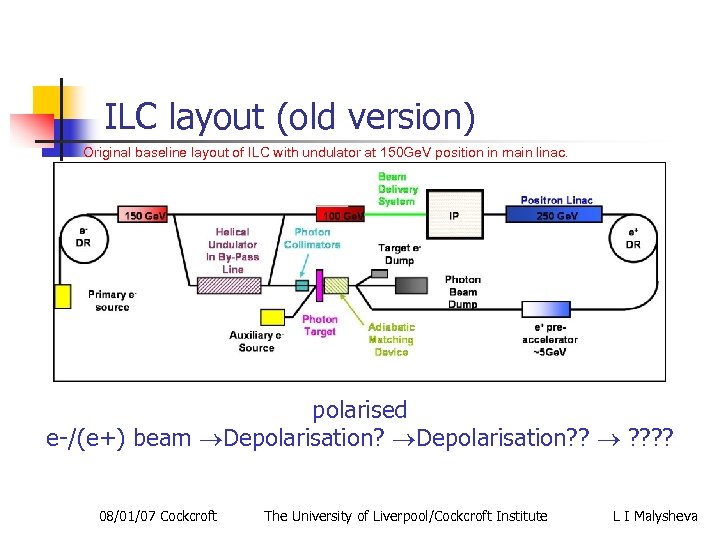 ILC layout (old version) Original baseline layout of ILC with undulator at 150 Ge. V position in main linac. polarised e-/(e+) beam Depolarisation? ? 08/01/07 Cockcroft The University of Liverpool/Cockcroft Institute L I Malysheva
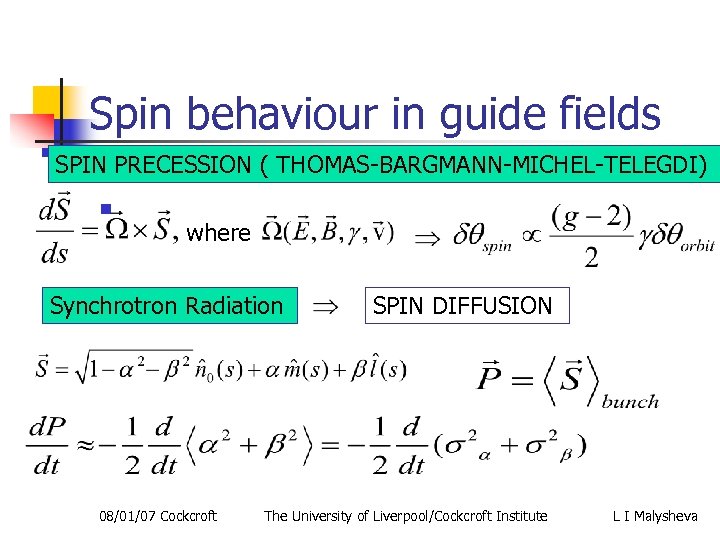 Spin behaviour in guide fields SPIN PRECESSION ( THOMAS-BARGMANN-MICHEL-TELEGDI) n where Synchrotron Radiation 08/01/07 Cockcroft SPIN DIFFUSION The University of Liverpool/Cockcroft Institute L I Malysheva
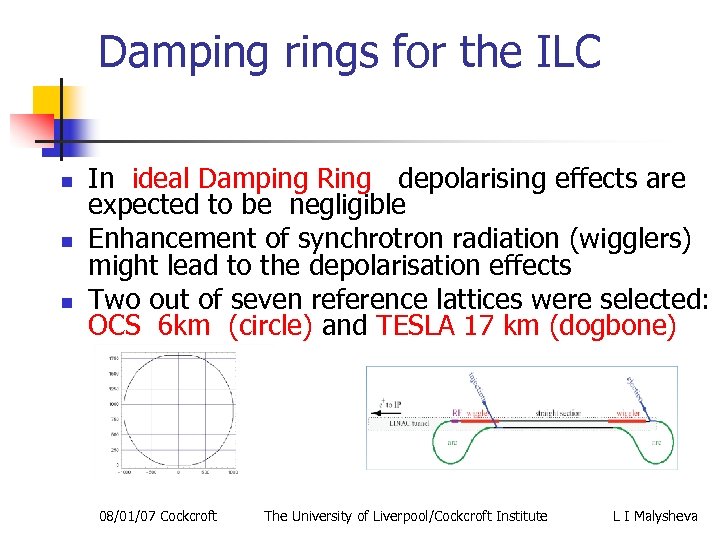 Damping rings for the ILC n n n In ideal Damping Ring depolarising effects are expected to be negligible Enhancement of synchrotron radiation (wigglers) might lead to the depolarisation effects Two out of seven reference lattices were selected: OCS 6 km (circle) and TESLA 17 km (dogbone) 08/01/07 Cockcroft The University of Liverpool/Cockcroft Institute L I Malysheva
 DAMPING RING damping time (msec) n S –T effect negligible n No equilibrium polarisation (evolution of spin distribution over a few damping times) n MERLIN and SLICKTRACK n 08/01/07 Cockcroft STORAGE RING n storage time (hours) S –T effect significant Equilibrium polarisation (depolarisation rate can be “measured” ) n More then 10 different codes available n n (Handbook of Accelerator Physics and Engineering) The University of Liverpool/Cockcroft Institute L I Malysheva
 Computer Simulation n n Misalignments were introduced STEP 1 (SLICK): linearised orbital and spin motion. Reference point as well as an energy scan STEP 2 (SLICKTRACK): Monte-Carlo simulation of the effects of synchrotron radiation, i. e. evolution of the spin distribution over a few damping times including full 3 -D spin motion NO significant depolarising effects have been detected confirming the earlier works 08/01/07 Cockcroft The University of Liverpool/Cockcroft Institute L I Malysheva
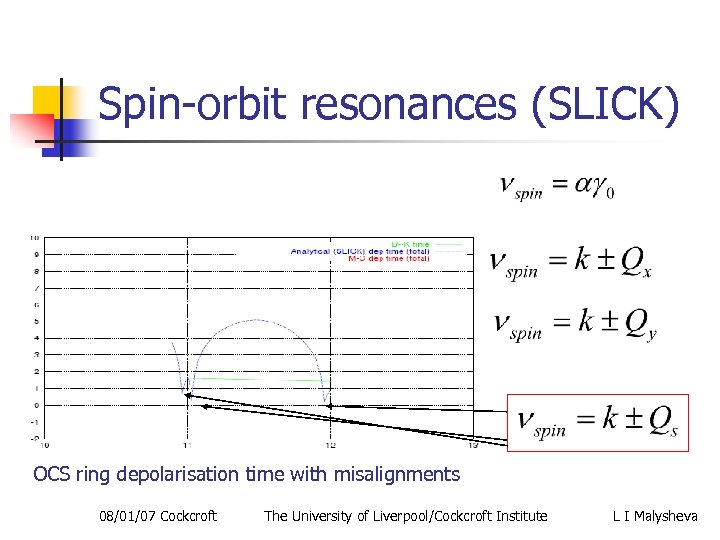 Spin-orbit resonances (SLICK) n n Spin tune on the closed orbit : First order resonances: OCS ring depolarisation time with misalignments 08/01/07 Cockcroft The University of Liverpool/Cockcroft Institute L I Malysheva
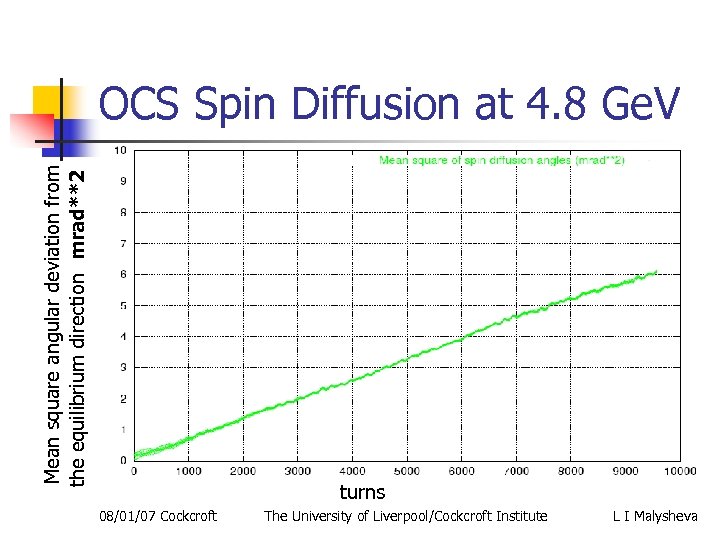 Mean square angular deviation from the equilibrium direction mrad**2 OCS Spin Diffusion at 4. 8 Ge. V turns 08/01/07 Cockcroft The University of Liverpool/Cockcroft Institute L I Malysheva
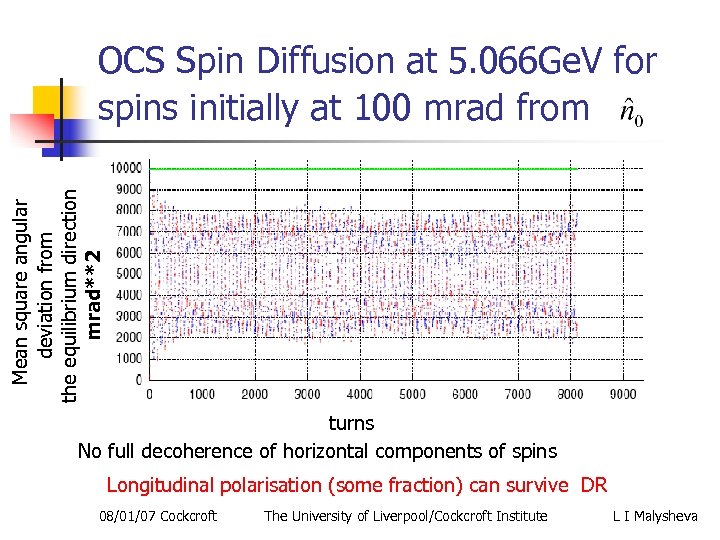 Mean square angular deviation from the equilibrium direction mrad**2 OCS Spin Diffusion at 5. 066 Ge. V for spins initially at 100 mrad from turns No full decoherence of horizontal components of spins Longitudinal polarisation (some fraction) can survive DR 08/01/07 Cockcroft The University of Liverpool/Cockcroft Institute L I Malysheva
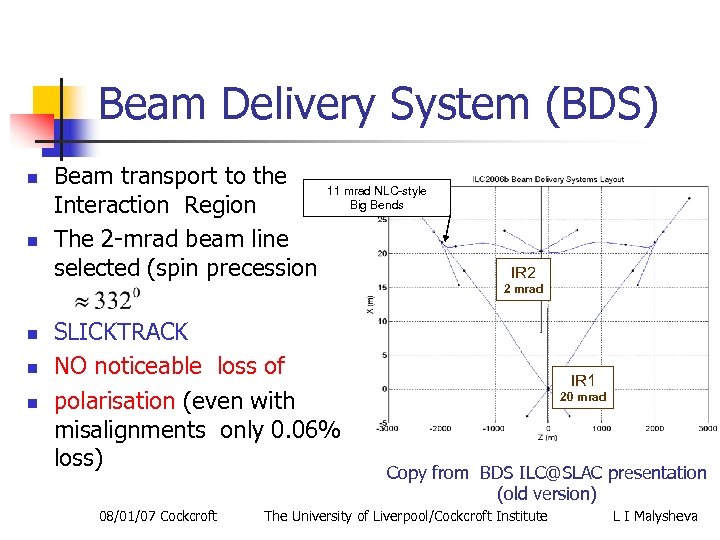 Beam Delivery System (BDS) n n Beam transport to the Interaction Region The 2 -mrad beam line selected (spin precession 11 mrad NLC-style Big Bends IR 2 2 mrad n n n SLICKTRACK NO noticeable loss of polarisation (even with misalignments only 0. 06% loss) 08/01/07 Cockcroft IR 1 20 mrad Copy from BDS ILC@SLAC presentation (old version) The University of Liverpool/Cockcroft Institute L I Malysheva
 Conclusions and Plans Loss of polarisation in DR and BDS is insignificant. n DR: New lattice design + NEW LAYOUT!! we will maintain a rolling study to include extra effects as necessary n BDS: NEW LAYOUT (Valencia, November 2006) n Include non-linear optics (Collaboration with E. Forest) n Linac simulations n 08/01/07 Cockcroft The University of Liverpool/Cockcroft Institute L I Malysheva