Скачать презентацию Deployment logistics and systems engineering PILOT Design
85c73e0167340a88da2bd466af80ff8d.ppt
- Количество слайдов: 26
 Deployment, logistics and systems engineering
 PILOT Design Study • Main functions of conceptual design study for PILOT for feasibility, costing and risk assessment purposes. • In order to properly capture the full lifetime facility cost, it is necessary to investigate and plan the operations of the complete facility as well as the telescope itself. • Systems engineering approach
 Systems Engineering Systems engineering is an interdisciplinary approach and means to enable the realization of successful systems … [an] integrated, ‘holistic’ view of the complete system, intended to ensure that the delivered system meets requirements. INCOSE (International Council on Systems Engineering)
 Systems Engineering • Integrated, multidisciplinary, ‘holistic’ view of complete system, intended to ensure that the delivered system meets requirements • Not just nice words to keep in mind while doing ‘old style’ engineering – now a formalised methodology – ISO/IEC 15288, Second edition, 2008 • Systems and software engineering – System life cycle processes – INCOSE Systems Engineering Handbook, Version 3. 1, August 2007
 Systems Engineering • • Formal documentation structure Full system design – system boundary definition Interface management (external) Requirements management (identification, validation, verification) All requirements to be traceable Documentation structure grows to map susbsystem design Interface management (internal) Document control (numbering, version control)
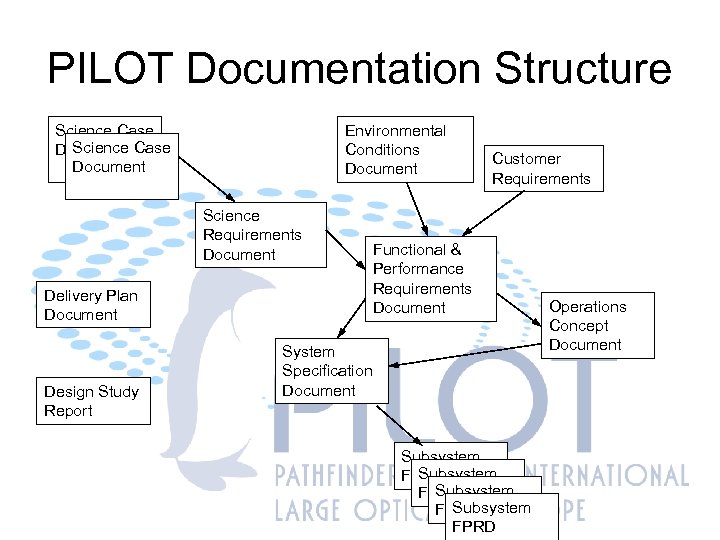 PILOT Documentation Structure Science Case Science Document Case Document Environmental Conditions Document Science Requirements Document Delivery Plan Document Design Study Report Customer Requirements Functional & Performance Requirements Document System Specification Document Subsystem FPRD Operations Concept Document
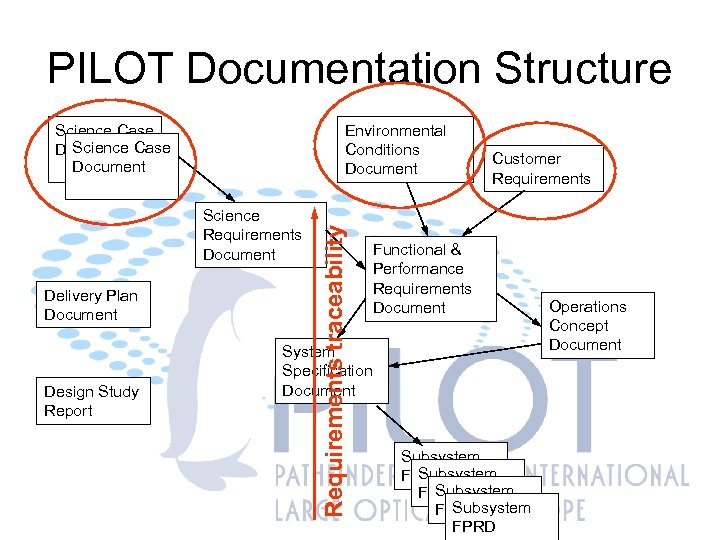 PILOT Documentation Structure Environmental Conditions Document Science Requirements Document Delivery Plan Document Design Study Report Requirements traceability Science Case Science Document Case Document Customer Requirements Functional & Performance Requirements Document System Specification Document Subsystem FPRD Operations Concept Document
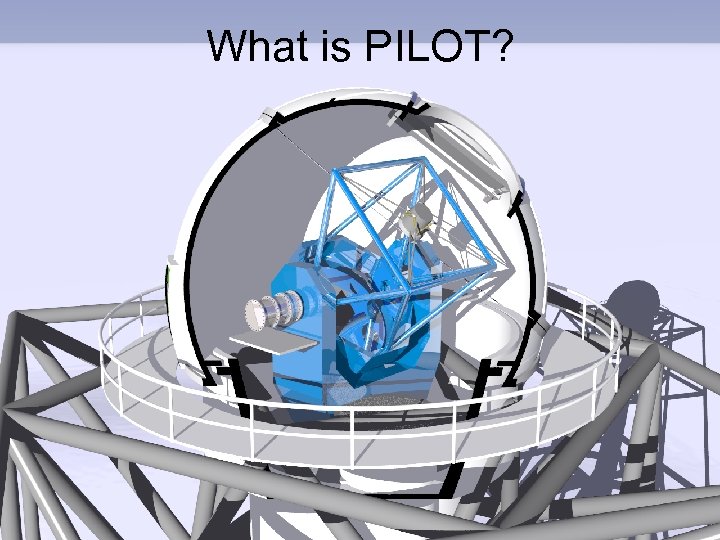 What is PILOT?

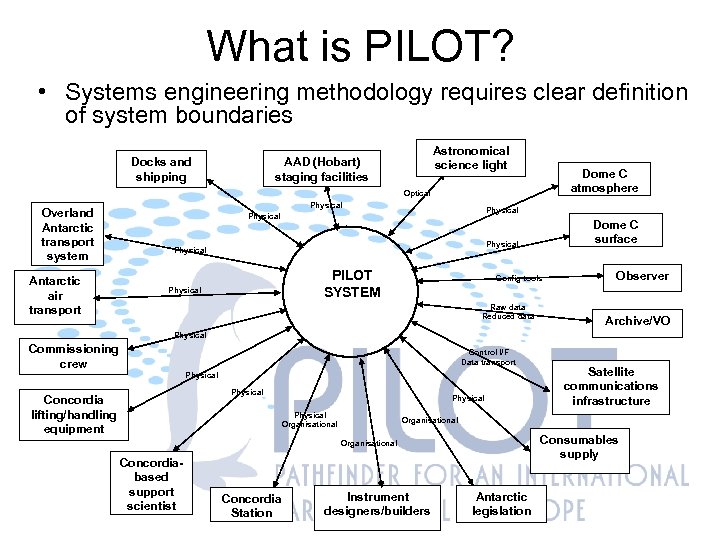 What is PILOT? • Systems engineering methodology requires clear definition of system boundaries Astronomical science light Physical Docks and shipping AAD (Hobart) staging facilities Dome C atmosphere Optical Overland Antarctic transport system Antarctic air transport Physical Dome C surface Physical PILOT SYSTEM Physical Config tools Raw data Reduced data Observer Archive/VO Physical Commissioning crew Control I/F Data transport Physical Concordia lifting/handling equipment Physical Organisational Consumables supply Organisational Concordiabased support scientist Concordia Station Satellite communications infrastructure Instrument designers/builders Antarctic legislation
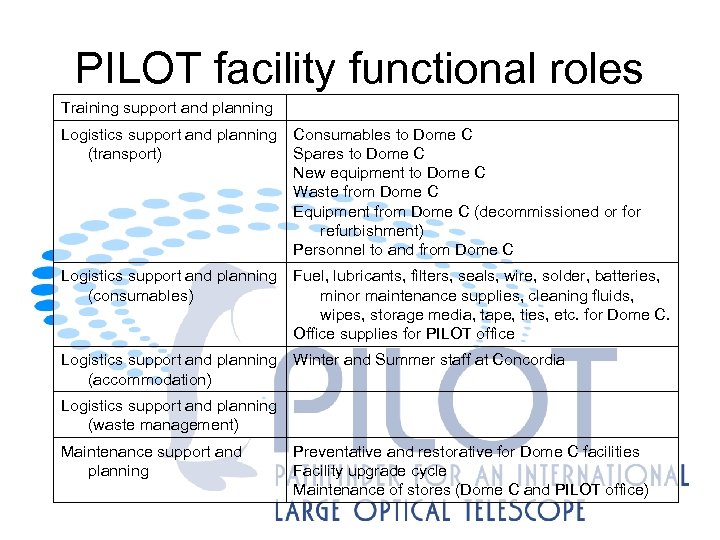 PILOT facility functional roles Training support and planning Logistics support and planning (transport) Consumables to Dome C Spares to Dome C New equipment to Dome C Waste from Dome C Equipment from Dome C (decommissioned or for refurbishment) Personnel to and from Dome C Logistics support and planning (consumables) Fuel, lubricants, filters, seals, wire, solder, batteries, minor maintenance supplies, cleaning fluids, wipes, storage media, tape, ties, etc. for Dome C. Office supplies for PILOT office Logistics support and planning (accommodation) Winter and Summer staff at Concordia Logistics support and planning (waste management) Maintenance support and planning Preventative and restorative for Dome C facilities Facility upgrade cycle Maintenance of stores (Dome C and PILOT office)
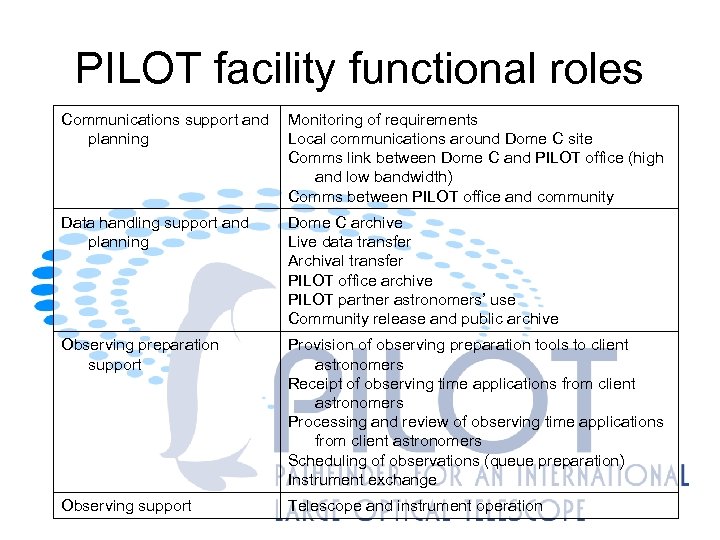 PILOT facility functional roles Communications support and planning Monitoring of requirements Local communications around Dome C site Comms link between Dome C and PILOT office (high and low bandwidth) Comms between PILOT office and community Data handling support and planning Dome C archive Live data transfer Archival transfer PILOT office archive PILOT partner astronomers’ use Community release and public archive Observing preparation support Provision of observing preparation tools to client astronomers Receipt of observing time applications from client astronomers Processing and review of observing time applications from client astronomers Scheduling of observations (queue preparation) Instrument exchange Observing support Telescope and instrument operation
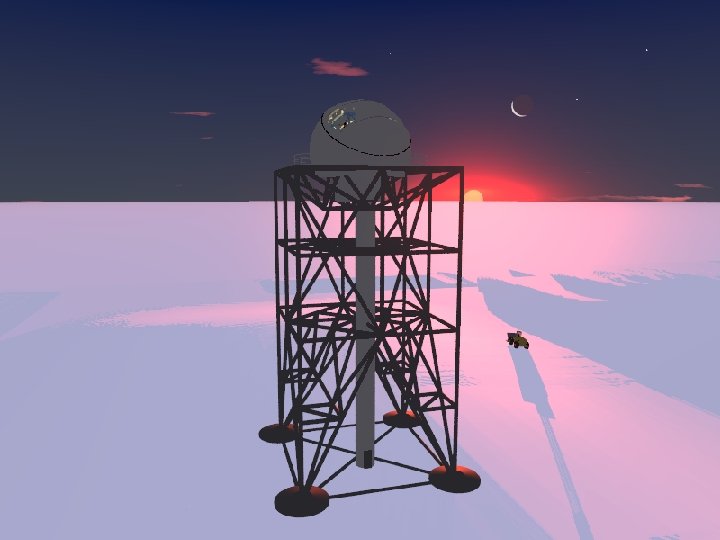
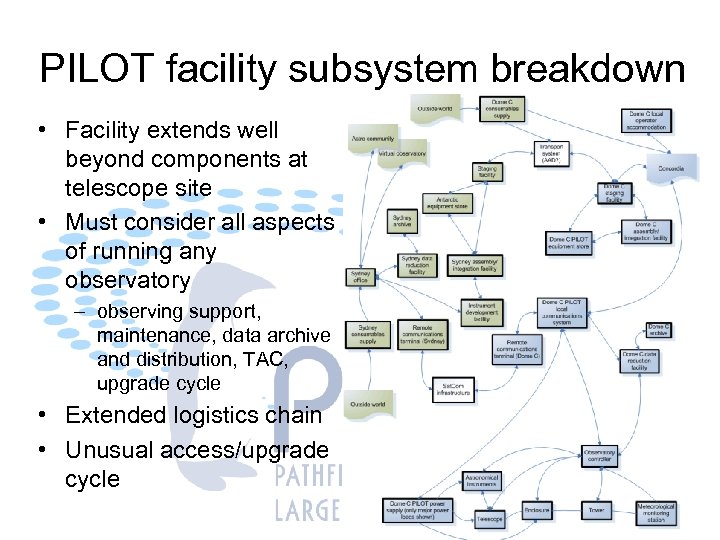 PILOT facility subsystem breakdown • Facility extends well beyond components at telescope site • Must consider all aspects of running any observatory – observing support, maintenance, data archive and distribution, TAC, upgrade cycle • Extended logistics chain • Unusual access/upgrade cycle
 Unusual elements of PILOT system design for Dome C • • • Site characteristics and facilities Physical access Communications Observing model Organisational model Commissioning/decommissioning
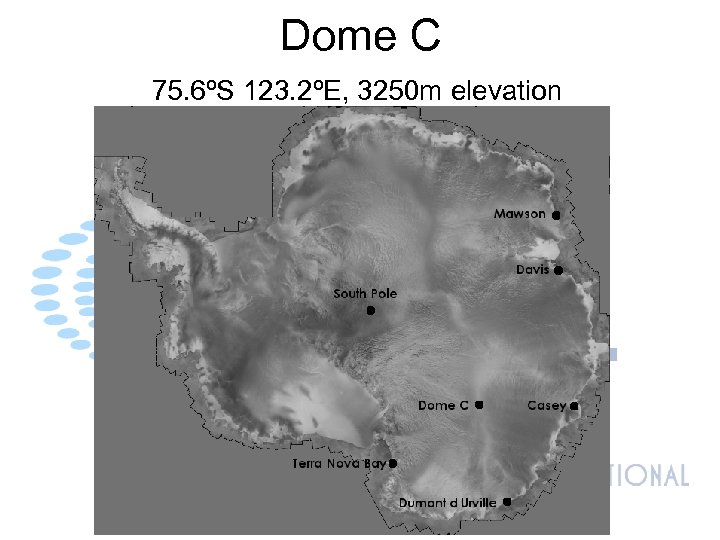 Dome C 75. 6ºS 123. 2ºE, 3250 m elevation
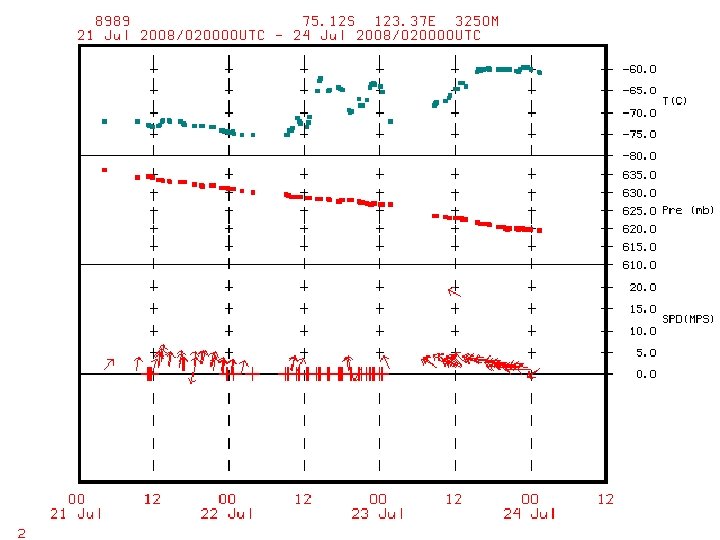 Dome C
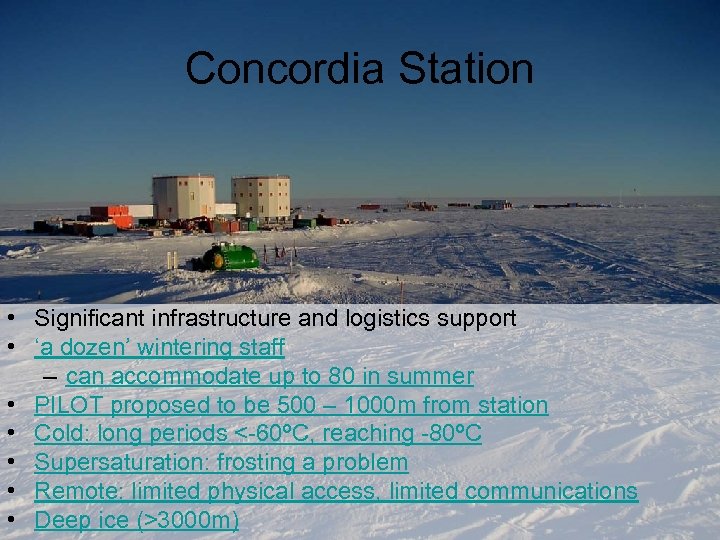 Concordia Station • Significant infrastructure and logistics support • ‘a dozen’ wintering staff – can accommodate up to 80 in summer • PILOT proposed to be 500 – 1000 m from station • Cold: long periods <-60ºC, reaching -80ºC • Supersaturation: frosting a problem • Remote: limited physical access, limited communications • Deep ice (>3000 m)
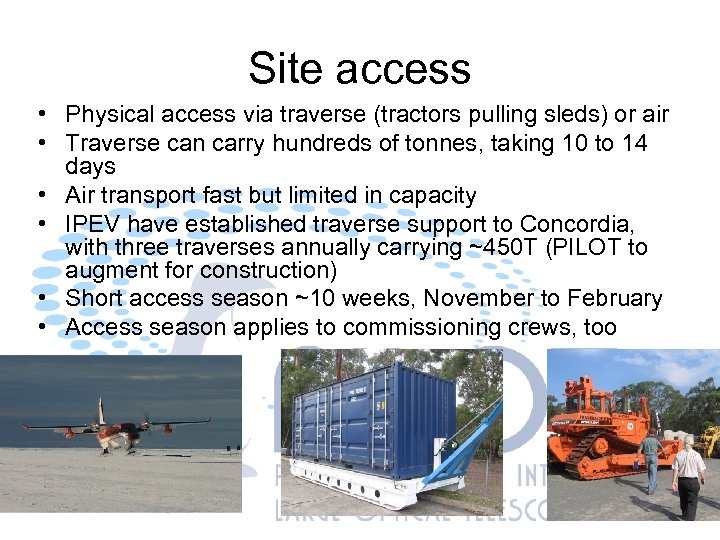 Site access • Physical access via traverse (tractors pulling sleds) or air • Traverse can carry hundreds of tonnes, taking 10 to 14 days • Air transport fast but limited in capacity • IPEV have established traverse support to Concordia, with three traverses annually carrying ~450 T (PILOT to augment for construction) • Short access season ~10 weeks, November to February • Access season applies to commissioning crews, too
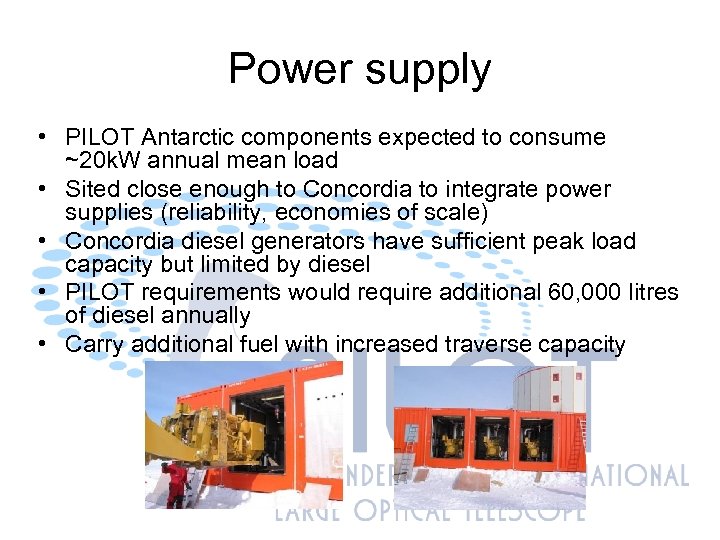 Power supply • PILOT Antarctic components expected to consume ~20 k. W annual mean load • Sited close enough to Concordia to integrate power supplies (reliability, economies of scale) • Concordia diesel generators have sufficient peak load capacity but limited by diesel • PILOT requirements would require additional 60, 000 litres of diesel annually • Carry additional fuel with increased traverse capacity
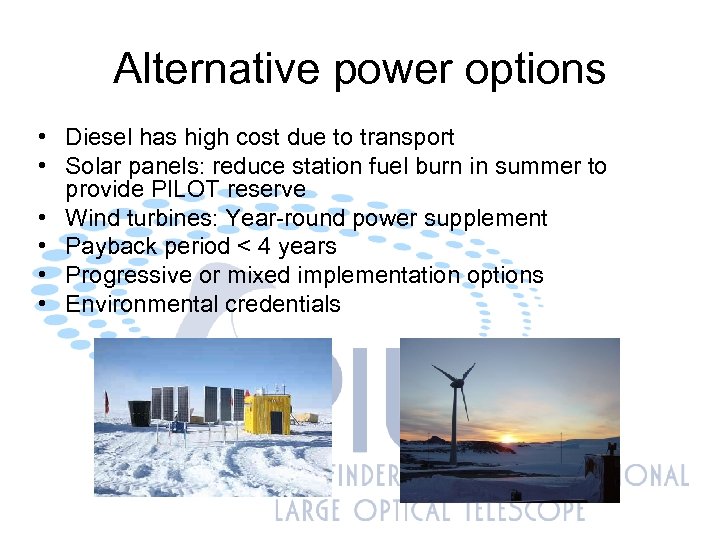 Alternative power options • Diesel has high cost due to transport • Solar panels: reduce station fuel burn in summer to provide PILOT reserve • Wind turbines: Year-round power supplement • Payback period < 4 years • Progressive or mixed implementation options • Environmental credentials
 Communications • No overland communications link • All data via satellite or physical carriage of media • Two main satellite options: – Iridium (2400 bps @ $1/min) – Geostationary, 128 kbps (limited coverage due to low elevation angles from 75ºS) • Iridium broadband option planned rollout later 2008 • Will not be possible to transmit all PILOT raw data • Close remote control of telescope impractical
 Queue-based robotic observing • PILOT’s strengths in large surveys (wide field good seeing) • Surveys well-suited to queue-based observing • Limited winter access even for PILOT operator at Concordia • Limited access and communications also suggest queuebased observing • Robotic operation proposed • Intelligent queue scheduler local to the telescope, responsive to variations in observing conditions
 Queue-based robotic observing • Observation scripts transmitted via satellite • Wintertime instrument exchanges limited to those that can be simply automated (e. g. switching tertiary mirror to select Nasmyth port) • Limited data reduction done in data pipeline for QA • Observation reports and quality monitoring data transmitted back via satellite • Full data archive physically carried out by air annually
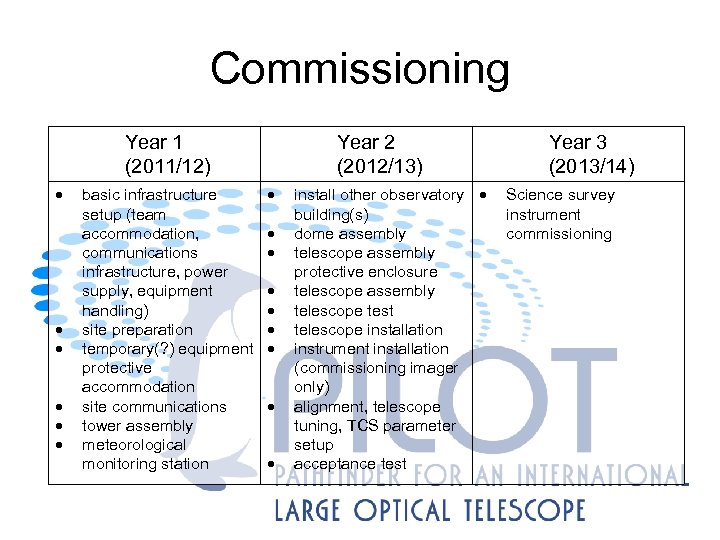 Commissioning Year 1 (2011/12) basic infrastructure setup (team accommodation, communications infrastructure, power supply, equipment handling) site preparation temporary(? ) equipment protective accommodation site communications tower assembly meteorological monitoring station Year 2 (2012/13) install other observatory building(s) dome assembly telescope assembly protective enclosure telescope assembly telescope test telescope installation instrument installation (commissioning imager only) alignment, telescope tuning, TCS parameter setup acceptance test Year 3 (2013/14) Science survey instrument commissioning
 Decommissioning • • Part of systems engineering approach Legislated Antarctic responsibilities Nominal 10 -year lifetime Dismantling and carriage out of structures similar to carriage in for commissioning • No particular site restoration difficulties (deep ice) • Possible handover to future facilities (interferometer? submillimetre? )