 Скачать презентацию Deploying Renewables Principles for Effective Policies Dr Paolo
b6431a9a83efb3ac9dc66708358a5f3d.ppt
- Количество слайдов: 14



Deploying Renewables: Principles for Effective Policies Dr. Paolo Frankl Head, Renewable Energy Unit International Energy Agency Press Conference, OECD Berlin, 29 September 2008 © OECD/IEA - 2008
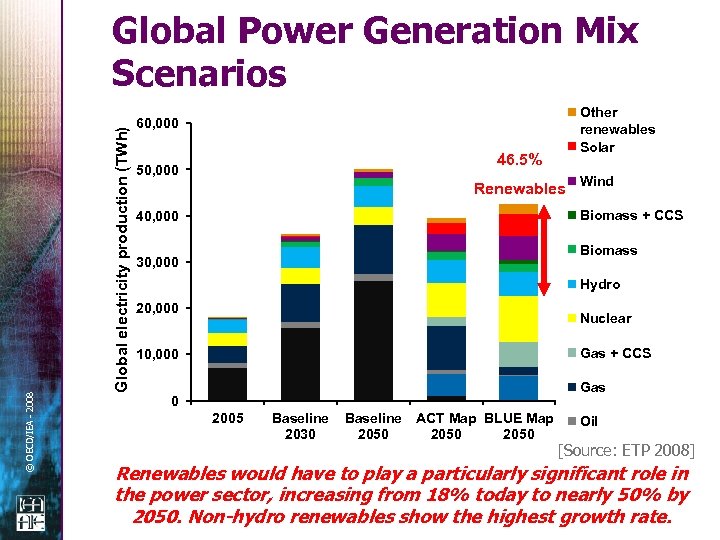
Global electricity production (TWh) © OECD/IEA - 2008 Global Power Generation Mix Scenarios Other renewables Solar 60, 000 46. 5% 50, 000 Renewables Wind Biomass + CCS 40, 000 Biomass 30, 000 Hydro 20, 000 Nuclear Gas + CCS 10, 000 Gas 0 2005 Baseline 2030 Baseline ACT Map BLUE Map 2050 Oil [Source: ETP 2008] Renewables would have to play a particularly significant role in the power sector, increasing from 18% today to nearly 50% by 2050. Non-hydro renewables show the highest growth rate.
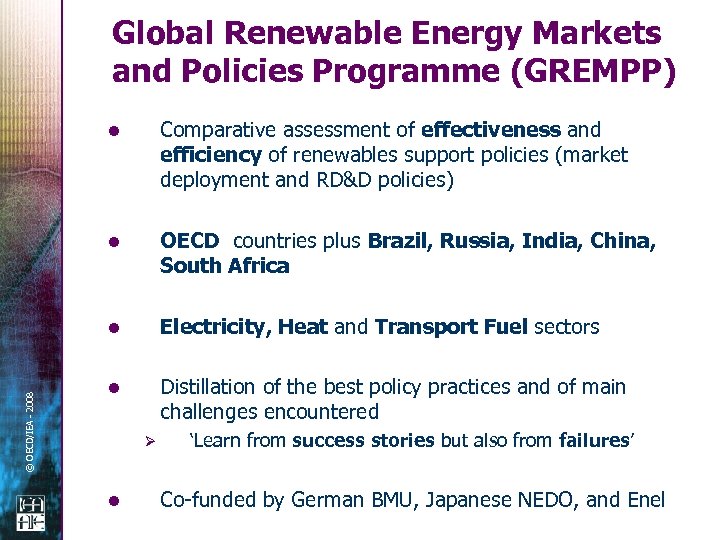
Global Renewable Energy Markets and Policies Programme (GREMPP) Comparative assessment of effectiveness and efficiency of renewables support policies (market deployment and RD&D policies) l OECD countries plus Brazil, Russia, India, China, South Africa l © OECD/IEA - 2008 l Electricity, Heat and Transport Fuel sectors l Distillation of the best policy practices and of main challenges encountered Ø l ‘Learn from success stories but also from failures’ Co-funded by German BMU, Japanese NEDO, and Enel
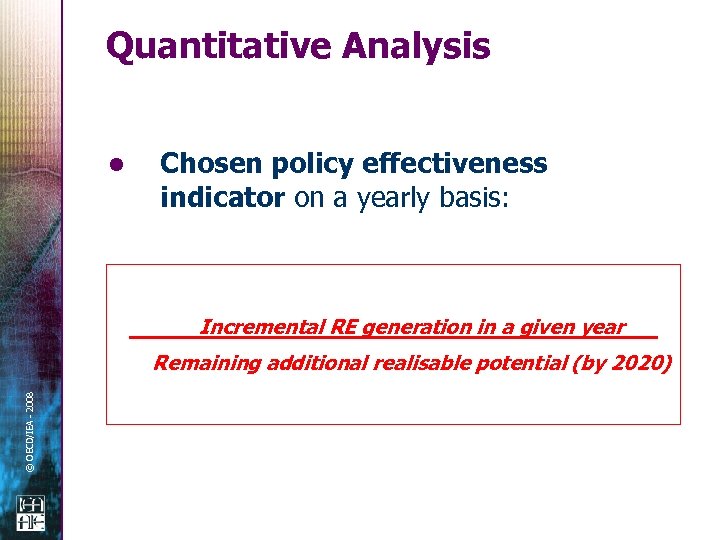
Quantitative Analysis l Chosen policy effectiveness indicator on a yearly basis: Incremental RE generation in a given year © OECD/IEA - 2008 Remaining additional realisable potential (by 2020)
© OECD/IEA - 2008 Achieved (by 2005) and Additional realisable mid-term potential (by 2020) for RES-Electricity Achieved (2005) and additional realisable mid-term (up to 2020) potential for RES -Electricity by country (OECD+BRICS) – in absolute terms (TWh) Source: IEA & EEG, 2008
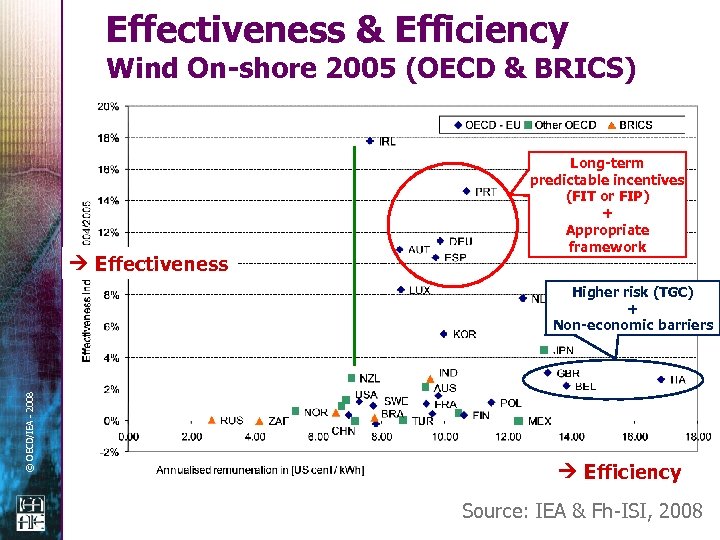
Effectiveness & Efficiency Wind On-shore 2005 (OECD & BRICS) Effectiveness Long-term predictable incentives (FIT or FIP) + Appropriate framework © OECD/IEA - 2008 Higher risk (TGC) + Non-economic barriers Efficiency Source: IEA & Fh-ISI, 2008
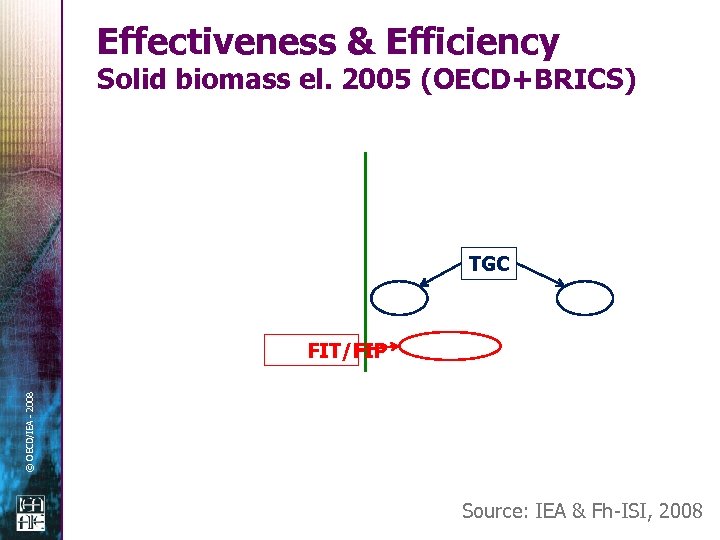
Effectiveness & Efficiency Solid biomass el. 2005 (OECD+BRICS) TGC © OECD/IEA - 2008 FIT/FIP Source: IEA & Fh-ISI, 2008
Effectiveness & Efficiency Solar PV 2005 (OECD & BRICS) © OECD/IEA - 2008 FIT Source: IEA & Fh-ISI, 2008
© OECD/IEA - 2008 Main Lessons Learnt and Conclusions
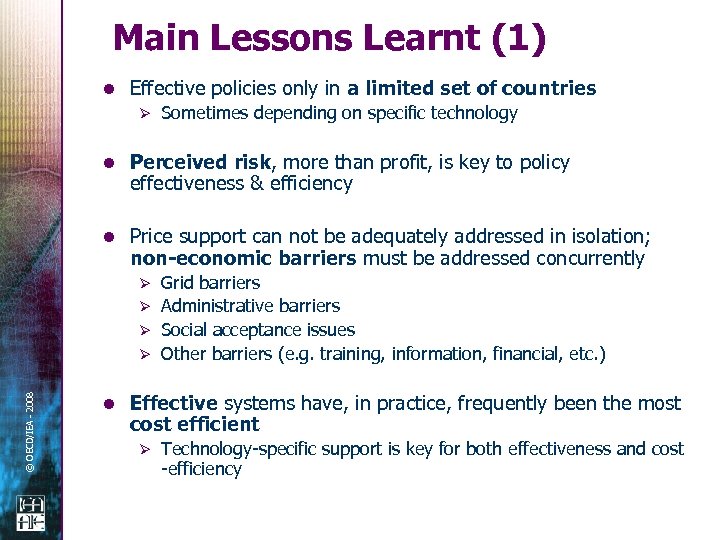
Main Lessons Learnt (1) l Effective policies only in a limited set of countries Ø Sometimes depending on specific technology l Perceived risk, more than profit, is key to policy effectiveness & efficiency l Price support can not be adequately addressed in isolation; non-economic barriers must be addressed concurrently Grid barriers Ø Administrative barriers Ø Social acceptance issues Ø Other barriers (e. g. training, information, financial, etc. ) © OECD/IEA - 2008 Ø l Effective systems have, in practice, frequently been the most cost efficient Ø Technology-specific support is key for both effectiveness and cost -efficiency
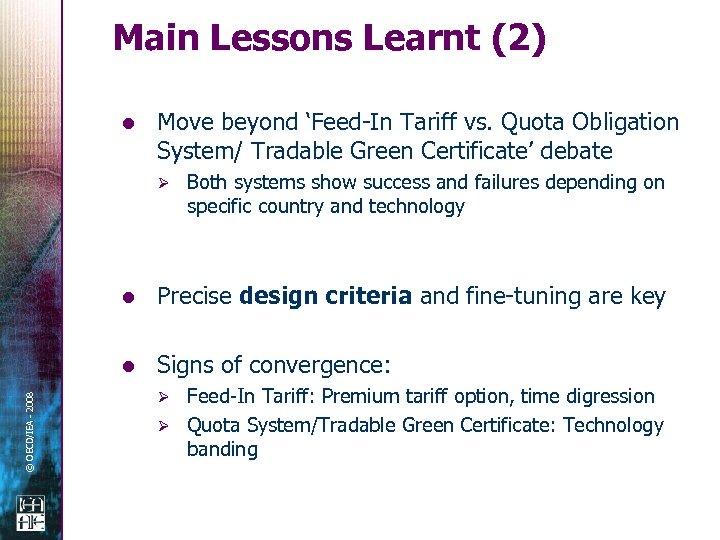
Main Lessons Learnt (2) l Move beyond ‘Feed-In Tariff vs. Quota Obligation System/ Tradable Green Certificate’ debate Ø Both systems show success and failures depending on specific country and technology Precise design criteria and fine-tuning are key l © OECD/IEA - 2008 l Signs of convergence: Feed-In Tariff: Premium tariff option, time digression Ø Quota System/Tradable Green Certificate: Technology banding Ø
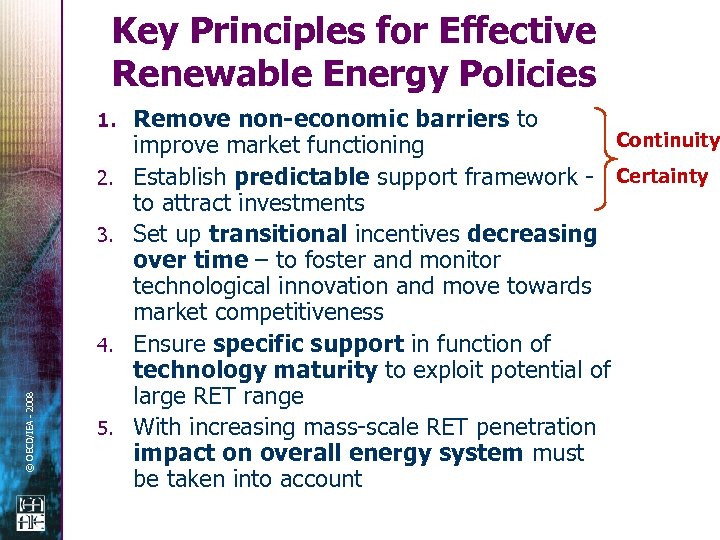
Key Principles for Effective Renewable Energy Policies 1. 2. 3. © OECD/IEA - 2008 4. 5. Remove non-economic barriers to Continuity improve market functioning Establish predictable support framework - Certainty to attract investments Set up transitional incentives decreasing over time – to foster and monitor technological innovation and move towards market competitiveness Ensure specific support in function of technology maturity to exploit potential of large RET range With increasing mass-scale RET penetration impact on overall energy system must be taken into account
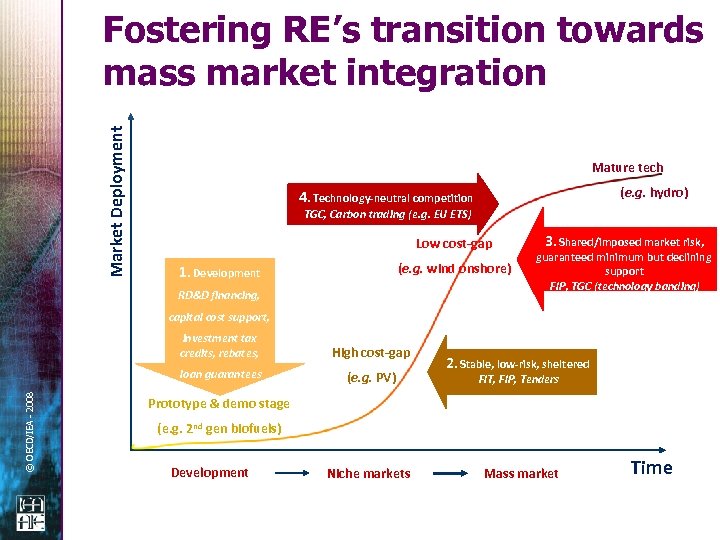
Market Deployment Fostering RE’s transition towards mass market integration Mature tech (e. g. hydro) 4. Technology-neutral competition TGC, Carbon trading (e. g. EU ETS) Low cost-gap (e. g. wind onshore) 1. Development RD&D financing, 3. Shared/imposed market risk, guaranteed minimum but declining support FIP, TGC (technology banding) capital cost support, High cost-gap loan guarantees © OECD/IEA - 2008 investment tax credits, rebates, (e. g. PV) 2. Stable, low-risk, sheltered FIT, FIP, Tenders Prototype & demo stage (e. g. 2 nd gen biofuels) Development Niche markets Mass market Time
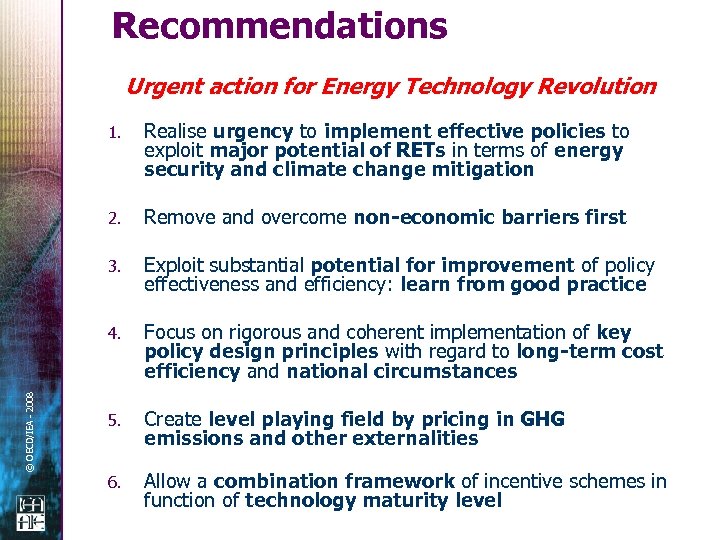
Recommendations Urgent action for Energy Technology Revolution Realise urgency to implement effective policies to exploit major potential of RETs in terms of energy security and climate change mitigation 2. Remove and overcome non-economic barriers first 3. Exploit substantial potential for improvement of policy effectiveness and efficiency: learn from good practice 4. © OECD/IEA - 2008 1. Focus on rigorous and coherent implementation of key policy design principles with regard to long-term cost efficiency and national circumstances 5. Create level playing field by pricing in GHG emissions and other externalities 6. Allow a combination framework of incentive schemes in function of technology maturity level
Скачать презентацию Deploying Renewables Principles for Effective Policies Dr Paolo
b6431a9a83efb3ac9dc66708358a5f3d.ppt