


 Скачать презентацию Dependent Types for Termination Verification Hongwei Xi University
cbe2f8759974b5bd882b6ab687533bf7.ppt
- Количество слайдов: 25
 Dependent Types for Termination Verification Hongwei Xi University of Cincinnati 1
 Overview Motivation n n Program error detection at compile-time Compilation certification Termination Verification for Dependent ML n n Theoretical development Practical applications Conclusion 2
 Program Error Detection Unfortunately one often pays a price for [languages which impose no disciplines of types] in the time taken to find rather inscrutable bugs — anyone who mistakenly applies CDR to an atom in LISP and finds himself absurdly adding a property list to an integer, will know the symptoms. -- Robin Milner A Theory of Type Polymorphism in Programming Therefore, a stronger type discipline allows for capturing more program errors at compile-time. 3
 Some Advantages of Types Detecting program errors at compile-time Enabling compiler optimizations Facilitating program verification n n Using types to encode program properties Verifying the encoded properties through typechecking Serving as program documentation n Unlike informal comments, types are formally verified and can thus be fully trusted 4
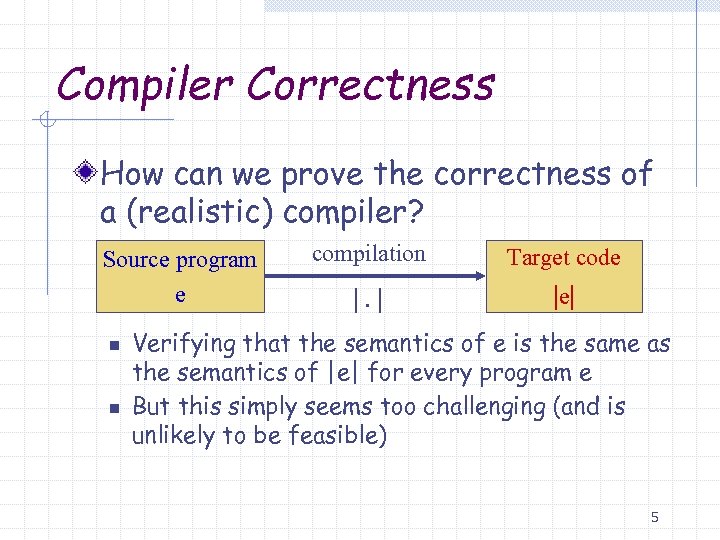 Compiler Correctness How can we prove the correctness of a (realistic) compiler? Source program e n n compilation Target code |. | |e | Verifying that the semantics of e is the same as the semantics of |e| for every program e But this simply seems too challenging (and is unlikely to be feasible) 5
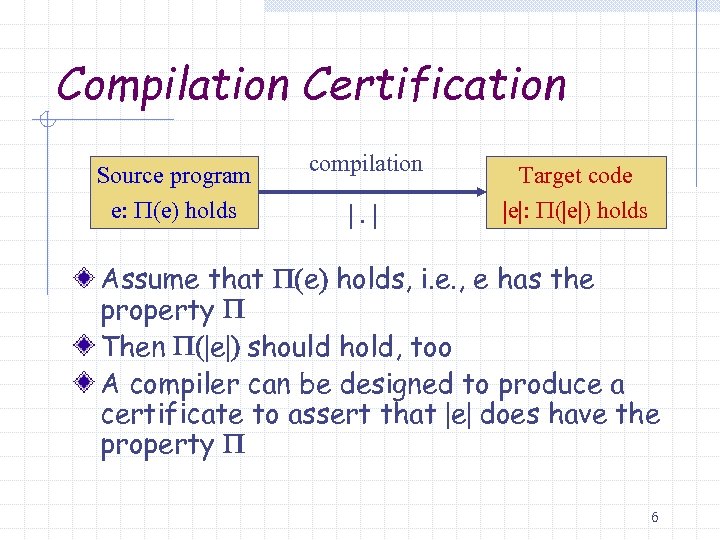 Compilation Certification Source program e: P(e) holds compilation |. | Target code |e|: P(|e|) holds Assume that P(e) holds, i. e. , e has the property P Then P(|e|) should hold, too A compiler can be designed to produce a certificate to assert that |e| does have the property P 6
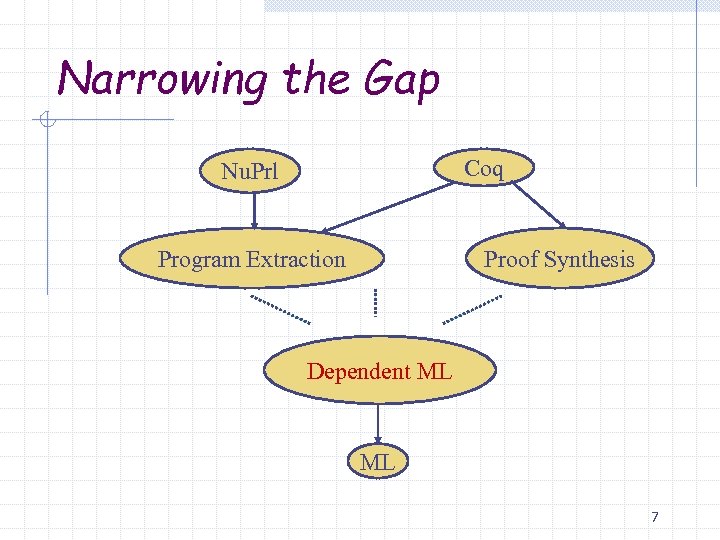 Narrowing the Gap Coq Nu. Prl Program Extraction Proof Synthesis Dependent ML ML 7
 Termination Verification Termination n is a liveness property can not be verified at run-time is often proven with a well-founded metric that decreases whenever a recursive function call is made 8
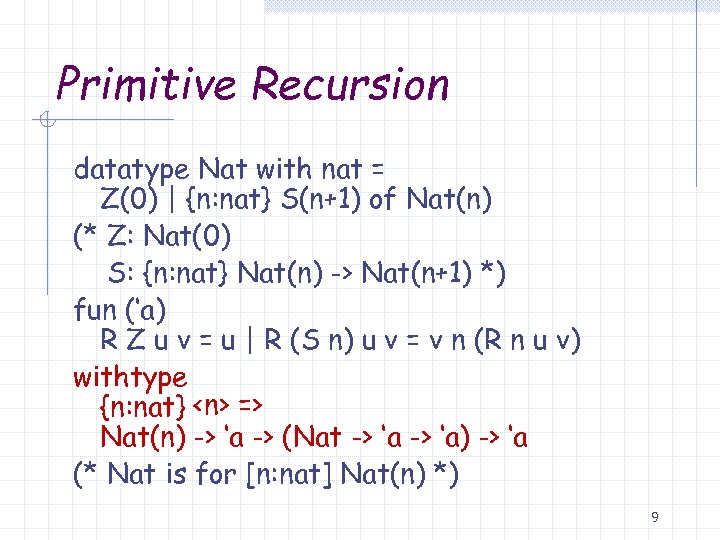 Primitive Recursion datatype Nat with nat = Z(0) | {n: nat} S(n+1) of Nat(n) (* Z: Nat(0) S: {n: nat} Nat(n) -> Nat(n+1) *) fun (‘a) R Z u v = u | R (S n) u v = v n (R n u v) withtype {n: nat}
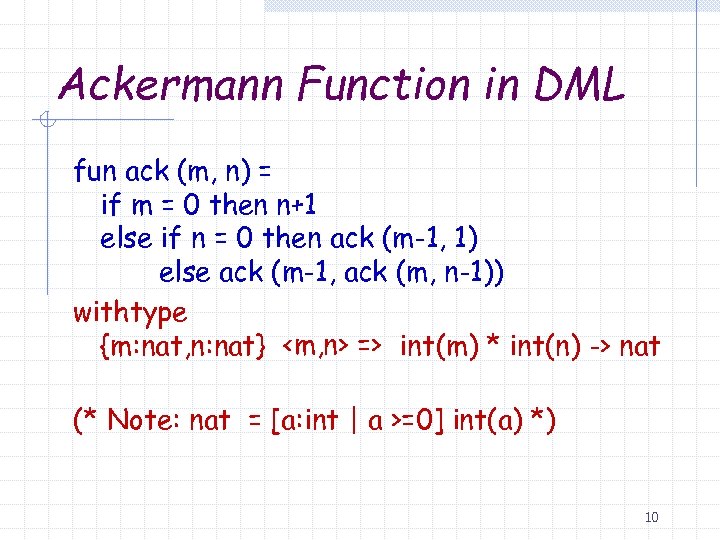 Ackermann Function in DML fun ack (m, n) = if m = 0 then n+1 else if n = 0 then ack (m-1, 1) else ack (m-1, ack (m, n-1)) withtype {m: nat, n: nat}
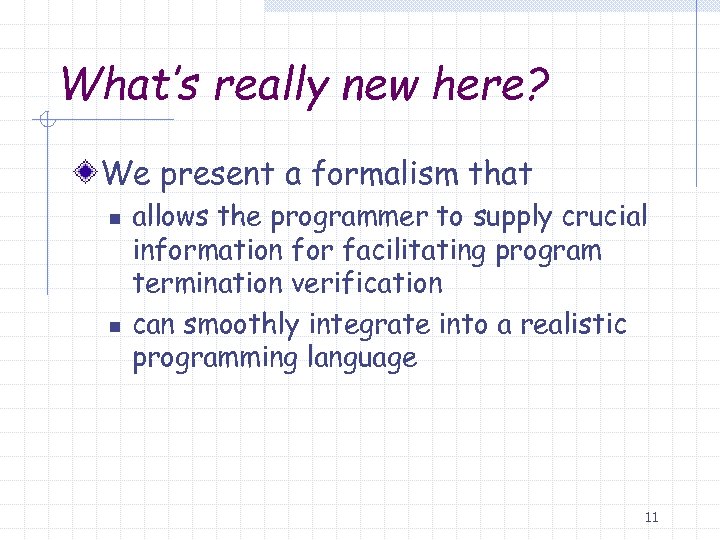 What’s really new here? We present a formalism that n n allows the programmer to supply crucial information for facilitating program termination verification can smoothly integrate into a realistic programming language 11
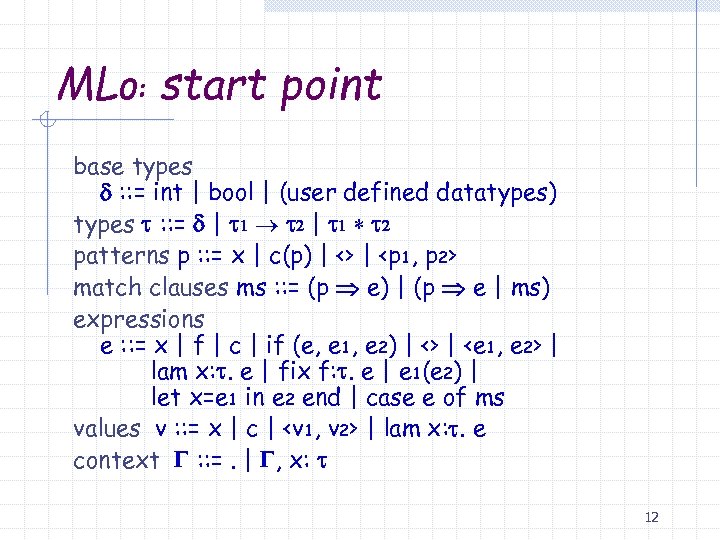 ML 0: start point base types d : : = int | bool | (user defined datatypes) types t : : = d | t 1 t 2 | t 1 * t 2 patterns p : : = x | c(p) | <> |
match clauses ms : : = (p e) | (p e | ms) expressions e : : = x | f | c | if (e, e 1, e 2) | <> |
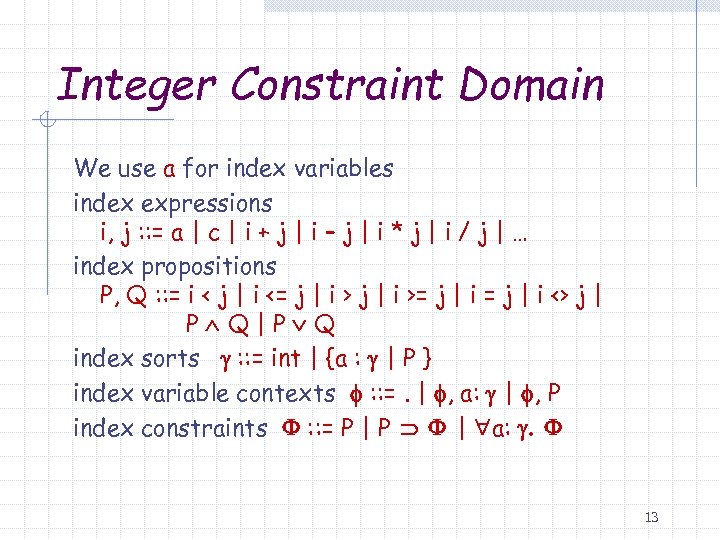 Integer Constraint Domain We use a for index variables index expressions i, j : : = a | c | i + j | i – j | i * j | i / j | … index propositions P, Q : : = i < j | i <= j | i >= j | i <> j | P Q|P Q index sorts g : : = int | {a : g | P } index variable contexts f : : =. | f, a: g | f, P index constraints F : : = P | P F | a: g. F 13
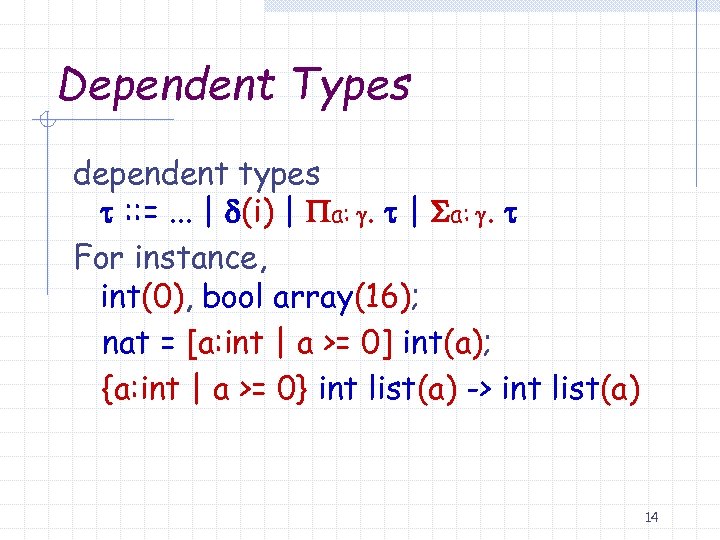 Dependent Types dependent types t : : =. . . | d(i) | Pa: g. t | Sa: g. t For instance, int(0), bool array(16); nat = [a: int | a >= 0] int(a); {a: int | a >= 0} int list(a) -> int list(a) 14
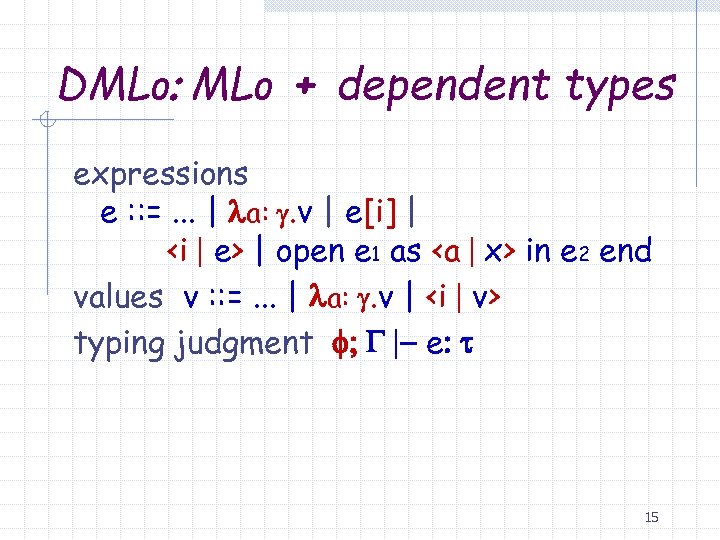 DML 0: ML 0 + dependent types expressions e : : =. . . | la: g. v | e[i] | | open e 1 as in e 2 end values v : : =. . . | la: g. v | typing judgment f; G |- e: t 15
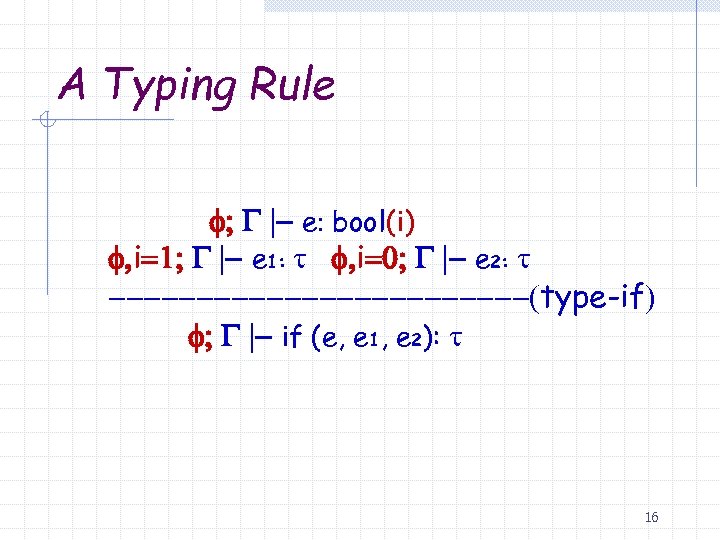 A Typing Rule f; G |- e: bool(i) f, i=1; G |- e 1: t f, i=0; G |- e 2: t ------------(type-if) f; G |- if (e, e 1, e 2): t 16
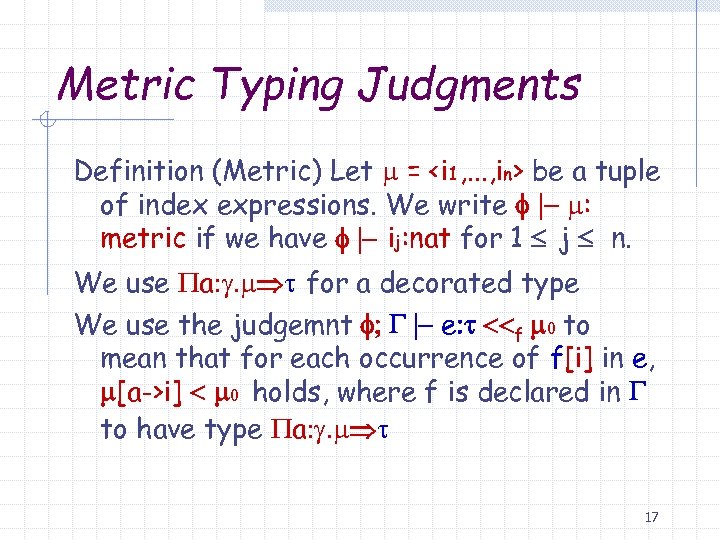 Metric Typing Judgments Definition (Metric) Let m = be a tuple of index expressions. We write f |- m: metric if we have f |- ij: nat for 1 j n. We use Pa: g. m t for a decorated type We use the judgemnt f; G |- e: t <
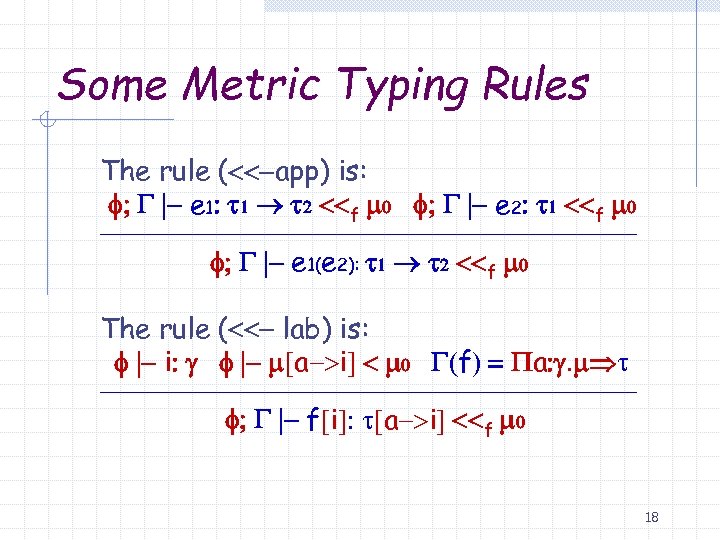 Some Metric Typing Rules The rule (<<-app) is: f; G |- e 1: t 1 t 2 <
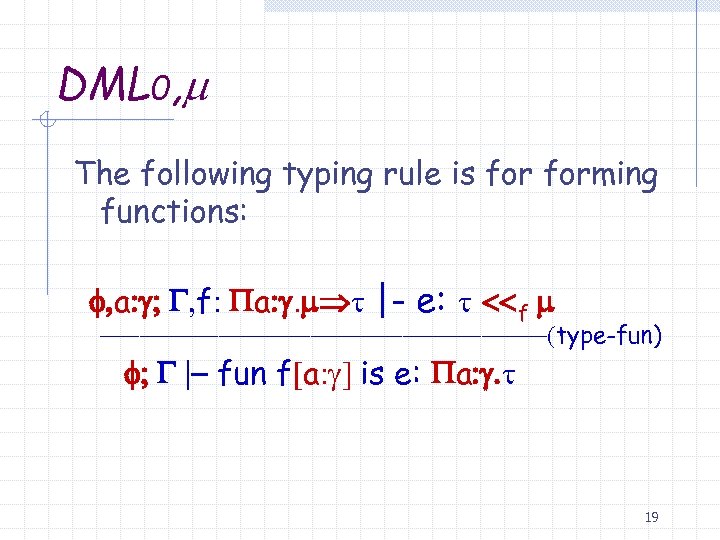 DML 0, m The following typing rule is forming functions: f, a: g; G, f: Pa: g. m t |- e: t <
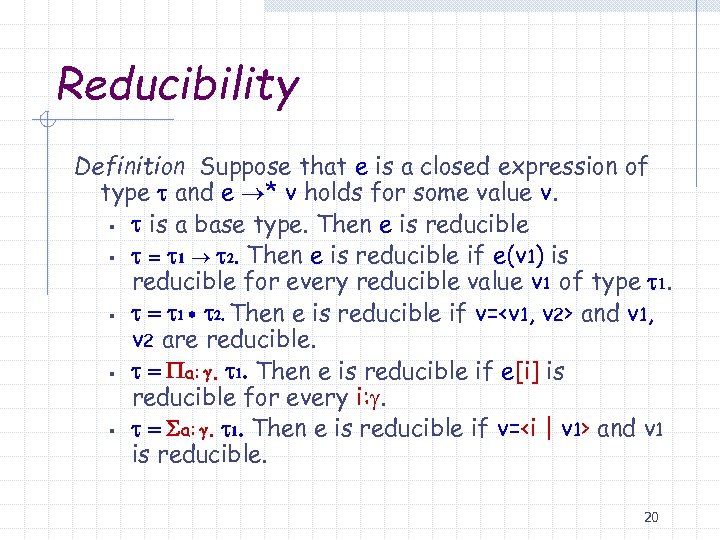 Reducibility Definition Suppose that e is a closed expression of type t and e * v holds for some value v. § t is a base type. Then e is reducible § t = t 1 t 2. Then e is reducible if e(v 1) is reducible for every reducible value v 1 of type t 1. § t = t 1 * t 2. Then e is reducible if v=
![m-reducibility Definition Let e be a well-typed closed function fun f[a: g]: m t](https://present5.com/presentation/cbe2f8759974b5bd882b6ab687533bf7/image-21.jpg "m-reducibility Definition Let e be a well-typed closed function fun f[a: g]: m t") m-reducibility Definition Let e be a well-typed closed function fun f[a: g]: m t is v and m 0 be a closed metric. e is m 0 -reducible if e[i] is reducible for each i: g satisfying m[a->i] < m 0. Theorem Every closed expression e is reducible if it is well-typed in DML 0, m 21
m-reducibility Definition Let e be a well-typed closed function fun f[a: g]: m t is v and m 0 be a closed metric. e is m 0 -reducible if e[i] is reducible for each i: g satisfying m[a->i] < m 0. Theorem Every closed expression e is reducible if it is well-typed in DML 0, m 21
![Quicksort in DML fun qs [] = [] | qs (x : : xs)](https://present5.com/presentation/cbe2f8759974b5bd882b6ab687533bf7/image-22.jpg "Quicksort in DML fun qs [] = [] | qs (x : : xs)") Quicksort in DML fun qs [] = [] | qs (x : : xs) = par (x, xs, []) withtype {n: nat}
Quicksort in DML fun qs [] = [] | qs (x : : xs) = par (x, xs, []) withtype {n: nat}
 Contributions Novel type system design to facilitate termination verification Unobtrusive programming Theoretical foundation Prototype implementation and evaluation 23
 Some Closely Related Work Termination and Reduction Checking in Logic Framework, Pientka and Pfenning Termination Analysis for Mercury, Speirs, Somogyi and SØndergarrd Proving correctness of reactive systems using sized types, Hughes, Pareto and Sabry. Cost recurrences for DML programs, Bernd Grobauer. 24
 End of the Talk Thank You! Questions? 25