


 Скачать презентацию Dependency structure and cognition Richard Hudson Depling 2013
ba1eb8e1793f40c76a15fdd7d05b2ea4.ppt
- Количество слайдов: 34
 Dependency structure and cognition Richard Hudson Depling 2013, Prague 1
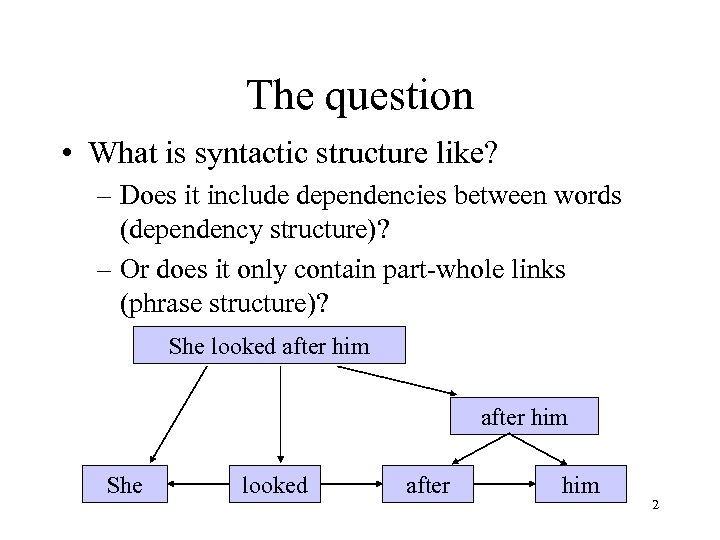 The question • What is syntactic structure like? – Does it include dependencies between words (dependency structure)? – Or does it only contain part-whole links (phrase structure)? She looked after him 2
 Relevant evidence: familiarity • University courses teach only one approach. • School grammar sometimes offers one. – Usually dependency structure – even in the USA • Reed-Kellogg sentence-diagramming – especially in Europe – and especially in the Czech Republic! 3
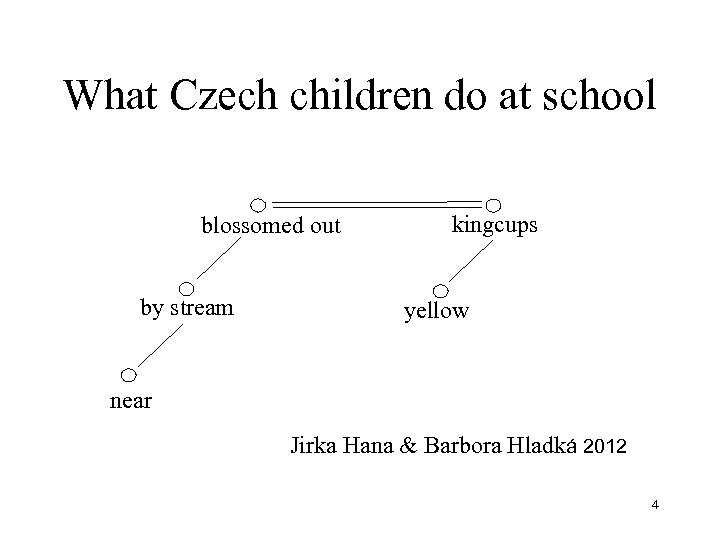 What Czech children do at school blossomed out by stream kingcups yellow near Jirka Hana & Barbora Hladká 2012 4
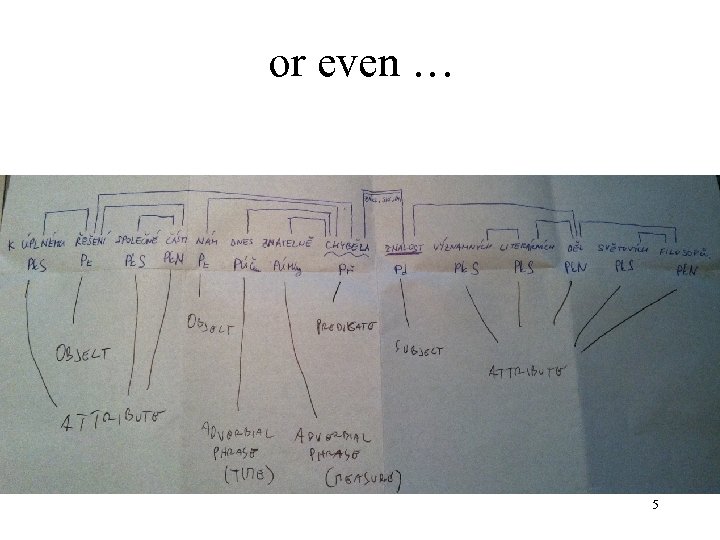 or even … 5
 Relevant evidence: convenience • Dependency structure is popular in computational linguistics. • Maybe because of its simplicity: – few nodes – little but orthographic words • Good for lexical cooccurrence relations 6
 Relevant evidence: cognition • • • Language competence is memory Language processing is thinking Memory and thinking are part of cognition So what do we know about cognition? A. Very generally, cognition is not simple – so maybe syntactic structures aren't in fact simple? 7
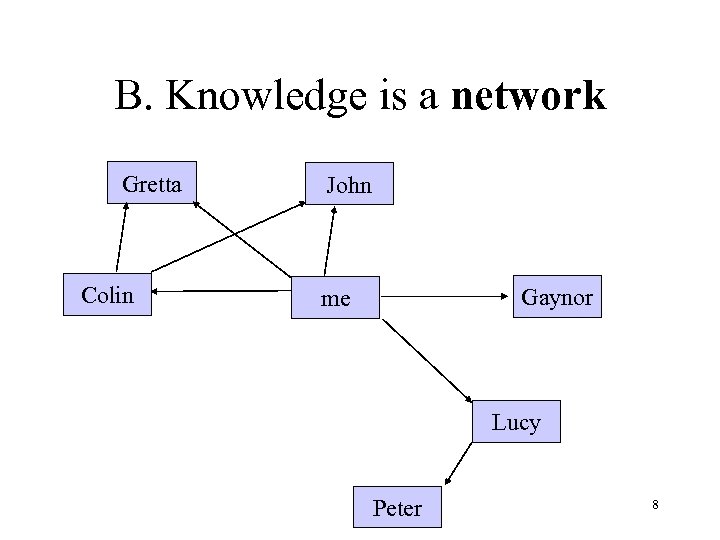 B. Knowledge is a network Gretta Colin John Gaynor me Lucy Peter 8
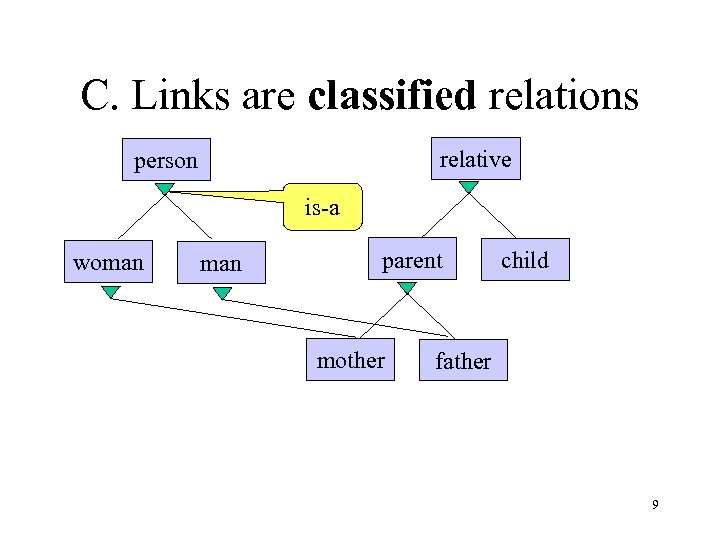 C. Links are classified relations relative person is-a woman parent mother child father 9
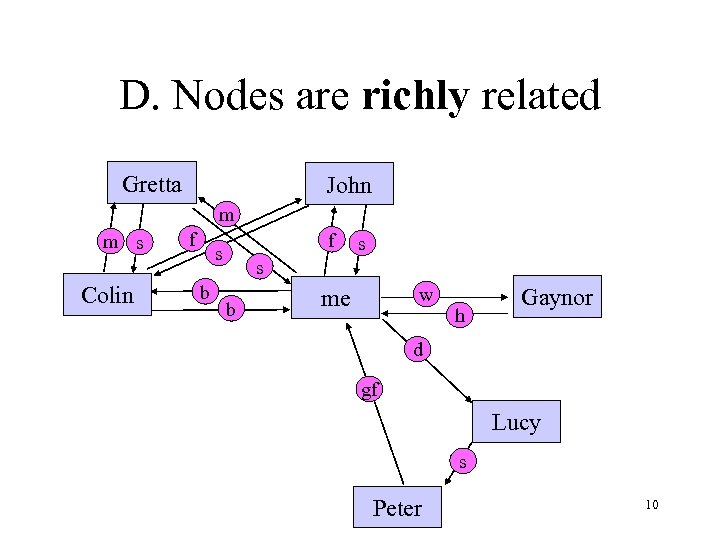 D. Nodes are richly related Gretta John m m s Colin f f s b s s b w me h Gaynor d gf Lucy s Peter 10
 E. Is-a allows default inheritance • Is-a forms taxonomies. – e. g. 'linguist is-a person', 'Dick is-a linguist' • Properties 'inherit' down a taxonomy. • But only 'by default' – exceptions are ok. – e. g. birds (normally) fly – but penguins don't. 11
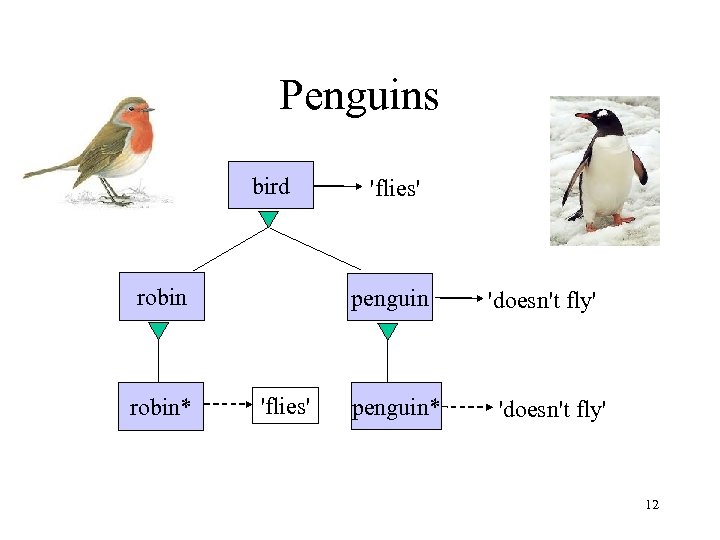 Penguins bird robin* 'flies' penguin* 'doesn't fly' 12
 Cognitivism • 'Cognitivism' – 'Language is an example of ordinary cognition' • So all our general cognitive abilities are available for language – and we have no special language abilities. • Cognitivism matters for linguistic theory. 13
 Some consequences of cognitivism 1. 2. 3. 4. 5. 6. Word-word dependencies are real. 'Deep' and 'surface' properties combine. Mutual dependency is ok. Dependents create new word tokens. Extra word tokens allow raising. But lowering may be ok too. 14
 1. Word-word dependencies are real • Do word-word dependencies exist (in our minds)? – Why not? – Compare social relations between individuals. • What about phrases? – Why not? – But maybe only their boundaries are relevant? – They're not classified, so no unary branching. 15
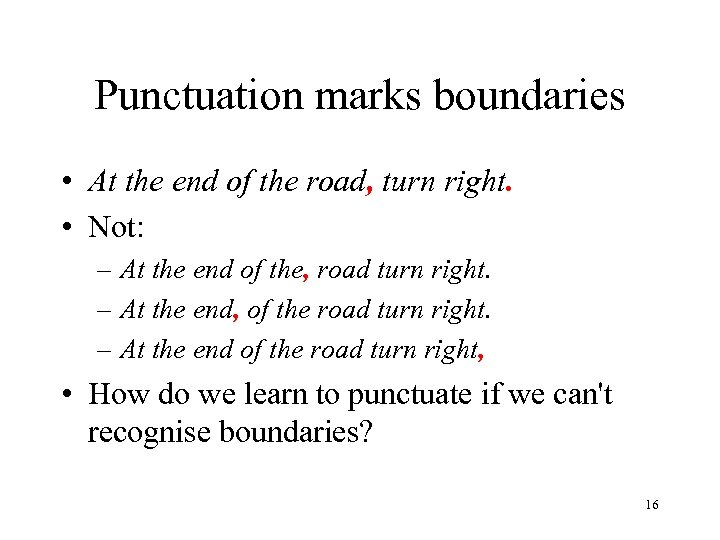 Punctuation marks boundaries • At the end of the road, turn right. • Not: – At the end of the, road turn right. – At the end, of the road turn right. – At the end of the road turn right, • How do we learn to punctuate if we can't recognise boundaries? 16
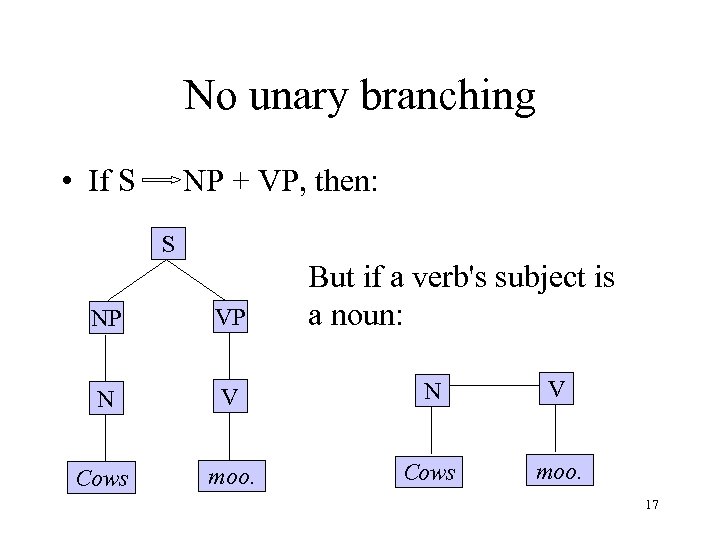 No unary branching • If S NP + VP, then: S But if a verb's subject is a noun: NP VP N V Cows moo. 17
 2. 'Deep' and 'surface' properties combine. • Dependencies are relational concepts. • Concepts record bundles of properties that tend to coincide – e. g. 'bird': beak, flying, feathers, two legs, eggs – 'mother': bearer, carer • So one dependency has many properties: – semantic, syntactic, morphosyntactic – e. g. 'subject' …. 18
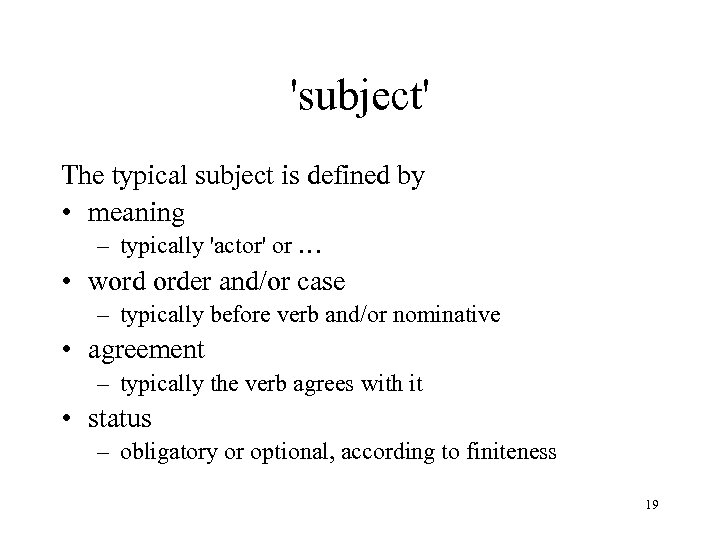 'subject' The typical subject is defined by • meaning – typically 'actor' or … • word order and/or case – typically before verb and/or nominative • agreement – typically the verb agrees with it • status – obligatory or optional, according to finiteness 19
 So … • Cognition suggests that 'deep' and 'surface' properties should be combined – not separated • They are in harmony by default – but exceptionally they may be out of harmony – this is allowed by default inheritance 20
 3. Mutual dependency is ok. • Mutual dependency is formally impossible in standard notation • And is formally impossible in phrase structure theory • So if it exists, we need to – resist PS theory – change the standard notation 21
 Mutual dependency exists • I wonder who came? • Who is subject of came, – so who depends on came. • But who depends on wonder • and came can be omitted: – e. g. Someone came – I wonder who. • So came depends on who. 22
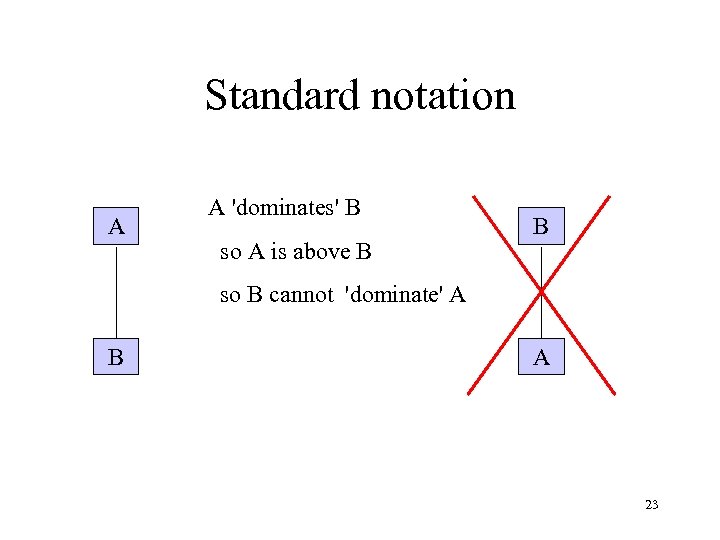 Standard notation A A 'dominates' B so A is above B B so B cannot 'dominate' A B A 23
 4. Dependents create new word tokens. • General cognition: – every exemplar needs a mental node. – no node carries contradictory properties. – so some exemplars need two nodes. • E. g. when we re-classify things. – NB we can remember both classifications 24
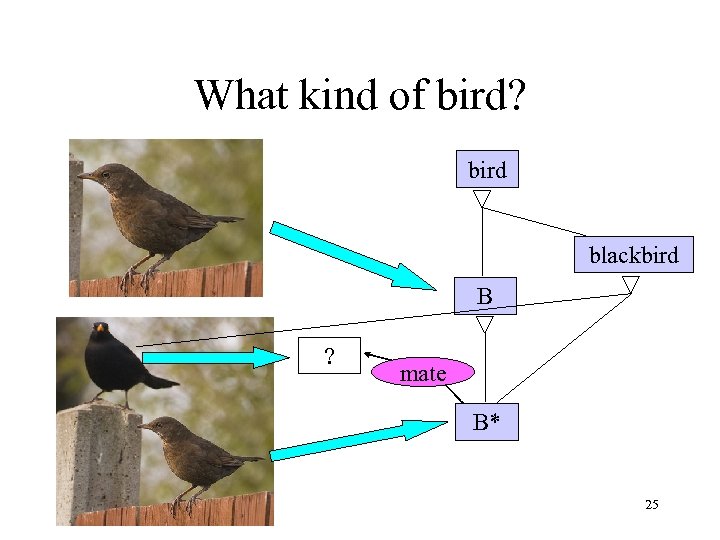 What kind of bird? bird blackbird B ? mate B* 25
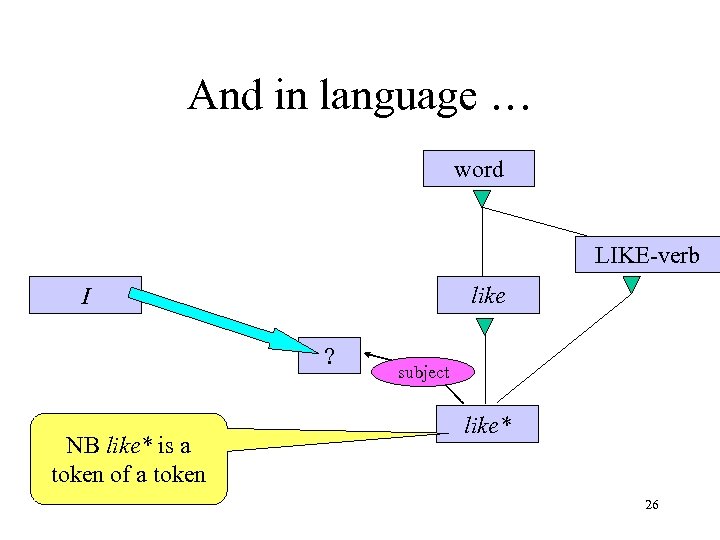 And in language … word LIKE-verb like I ? NB like* is a token of a token subject like* 26
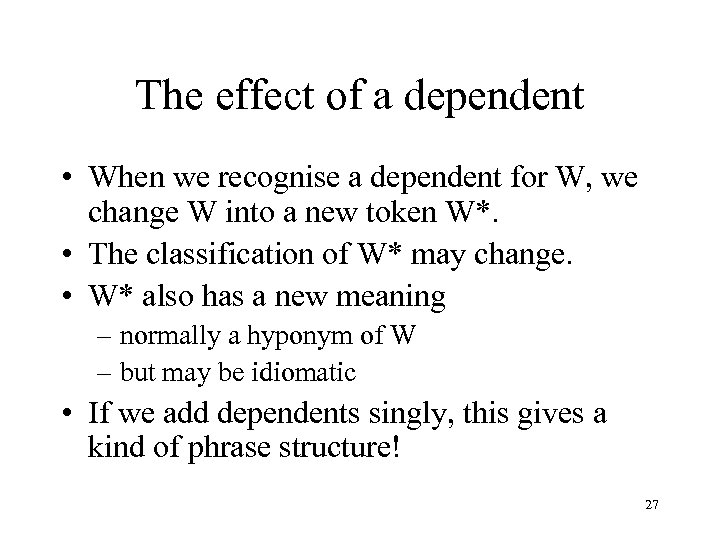 The effect of a dependent • When we recognise a dependent for W, we change W into a new token W*. • The classification of W* may change. • W* also has a new meaning – normally a hyponym of W – but may be idiomatic • If we add dependents singly, this gives a kind of phrase structure! 27
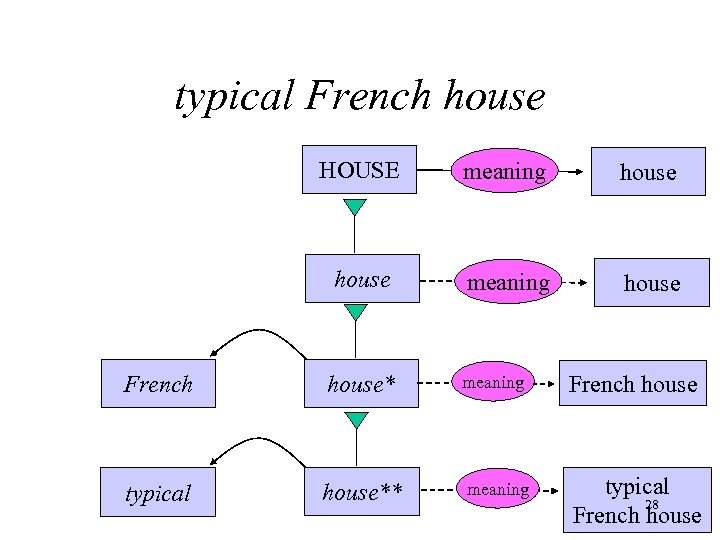 typical French house HOUSE meaning house French house* meaning French house typical house** meaning typical 28 French house
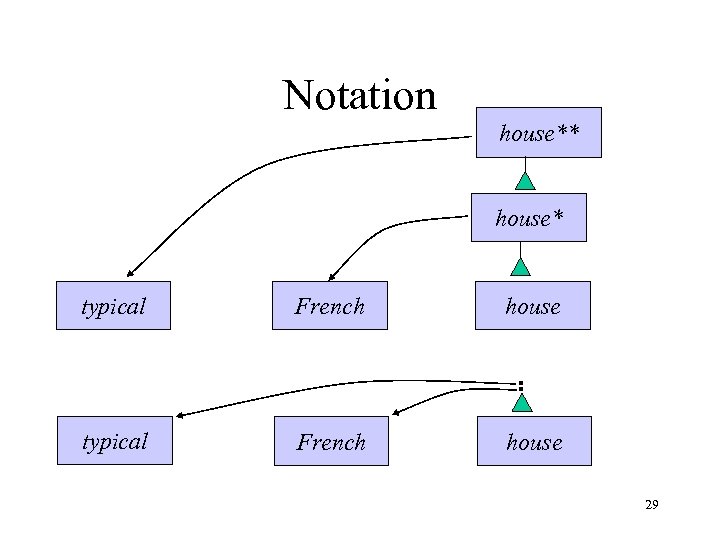 Notation house** house* typical French house 29
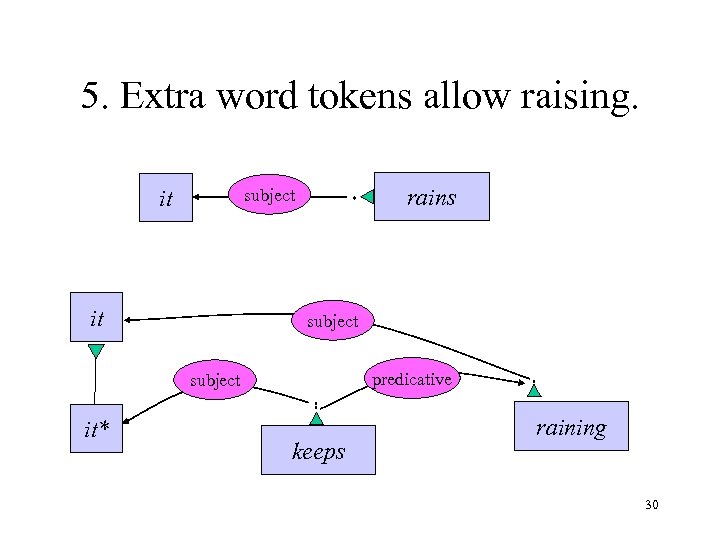 5. Extra word tokens allow raising. it rains subject it subject predicative subject it* keeps raining 30
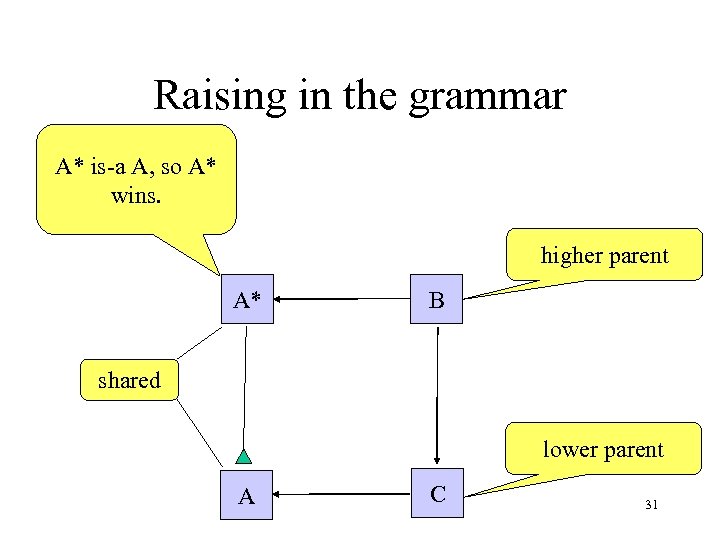 Raising in the grammar A* is-a A, so A* wins. higher parent A* B shared lower parent A C 31
 6. But lowering may be ok too. • Raising is helpful for processing – the higher parent is nearer to the sentence root. • But sometimes lowering is helpful too – e. g. if it allows a new meaning-unit. • Eine Concorde gelandet ist hier nie. a Concorde landed has here never. A-Concorde-landing has never happened here. 32
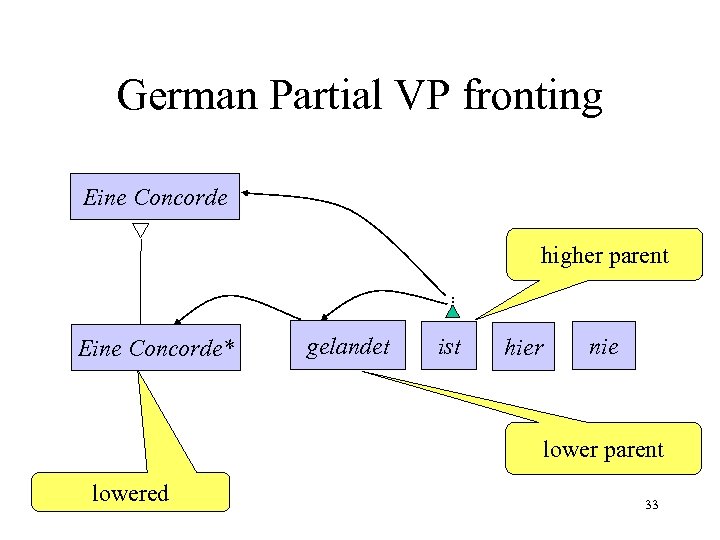 German Partial VP fronting Eine Concorde higher parent Eine Concorde* gelandet ist hier nie lower parent lowered 33
 Conclusions • Language is just part of cognition. • So syntactic dependencies are: – psychologically real – rich (combining 'deep' and 'surface' properties) – complex (e. g. mutual, multiple). • And dependency combines with – default inheritance – multiple tokens 34