 Скачать презентацию Dependency Network Based Real-time Query Expansion Jiaqi Zou
f53b70664938592ad0bdc3262a6f10a9.ppt
- Количество слайдов: 25



Dependency Network Based Real-time Query Expansion Jiaqi Zou, Xiaojie Wang Center for Intelligence Science and Technology, BUPT

Outline • Introduction – What is RTQE? – Benefits of RTQE – Related Research – Improvements in our work • Method – Query Intention – Dependency Relation Network – RTQE Method
Outline • Experiments – Test of operation numbers – Test of expansion success percentage – Test of retrieval performance – Comparison with Bing • Conclusion
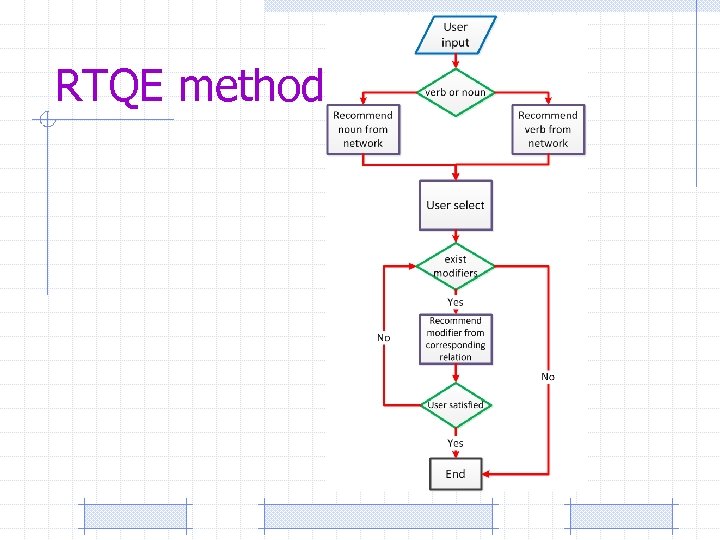
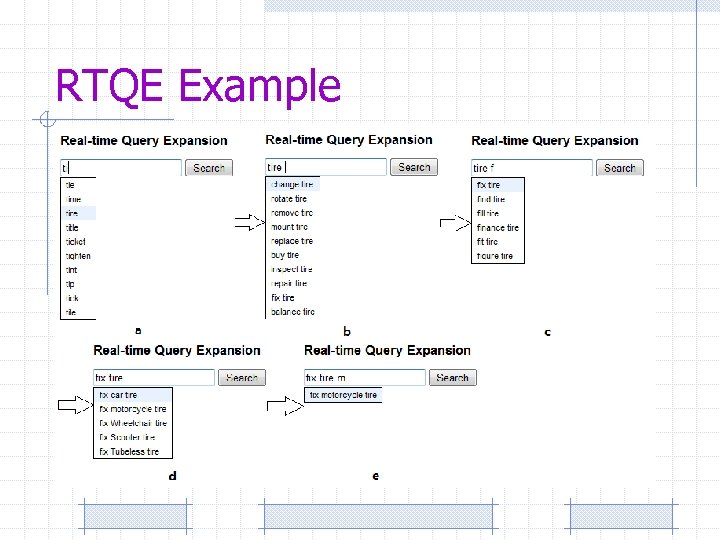
Introduction- What is RTQE? • RTQE is a kind of query expansion. • RTQE methods expand queries at the same time when users type queries into the search box.
Introduction- Benefits of RTQE • RTQE reduces user’s keystrokes and time to perform a query, especially useful for mobile device users. • RTQE improves the query quality.
Related Research • Most widely used method: string matching method using query log. • Little work on RTQE takes query intention into account. – Strohmaier et al. suggested that explicit queries containing at least one verb word might reflect possible user intentions.
Improvements in our work • Represent query intention better. • Construct a RTQE method which expands components of possible user query intentions. • This RTQE method improves the retrieval performance.
Query Intention • Task-oriented classification of query intention: – Navigational – Informational – Transactional • Duan et al. suggested dependency related verb-noun pairs are good representation of informational and transactional query intentions.
Query Intention • Verb-noun pair is not sufficient to represent query intention, other parts like attributes of noun are also very important. • New representation: Verb-Attributes-Noun • Example: buy new car tire, cook Chinese food
Dependency Relation Network • To do query intention related RTQE, we built a dependency relation network which is a collection of numbers of query intentions. • Steps: – Do dependency parsing on large corpus. – Extract all the verb-attributes-noun structures. – Combine these structures to be the Network.
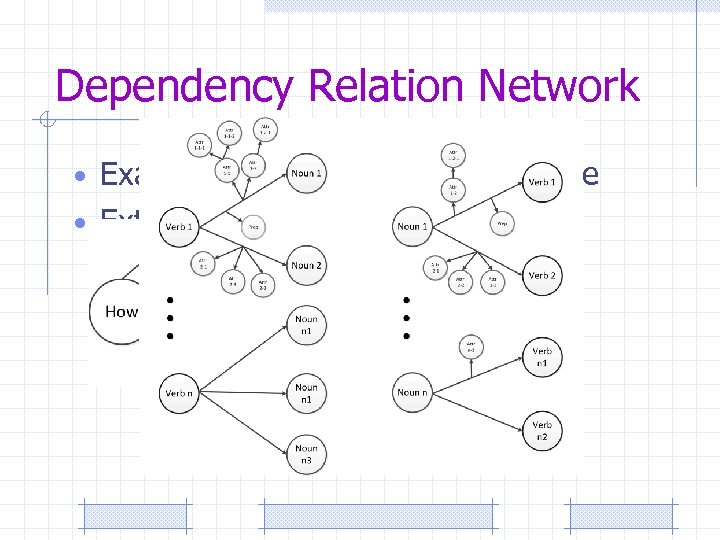
Dependency Relation Network • Example : How to change a car tire • Extracted : change car tire
RTQE method
RTQE Example

Experiments • Corpus: www. ehow. com – 915, 000 articles – 20 categories(Health, Cars, Food&Drink, etc)
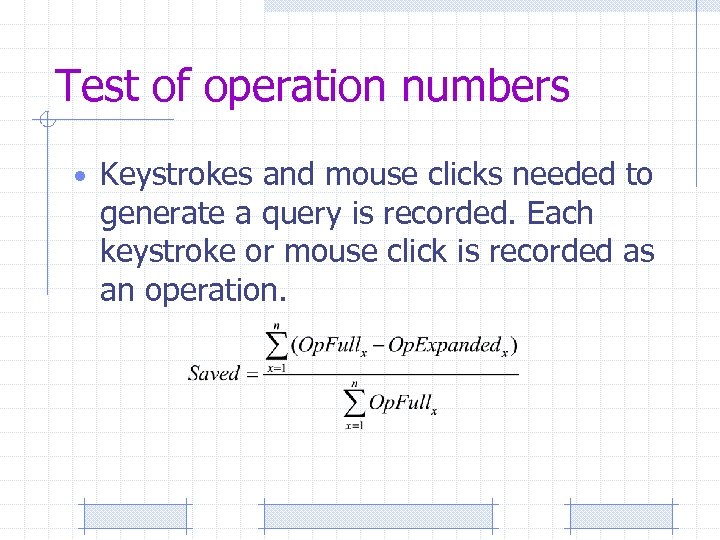
Test of operation numbers • Keystrokes and mouse clicks needed to generate a query is recorded. Each keystroke or mouse click is recorded as an operation.
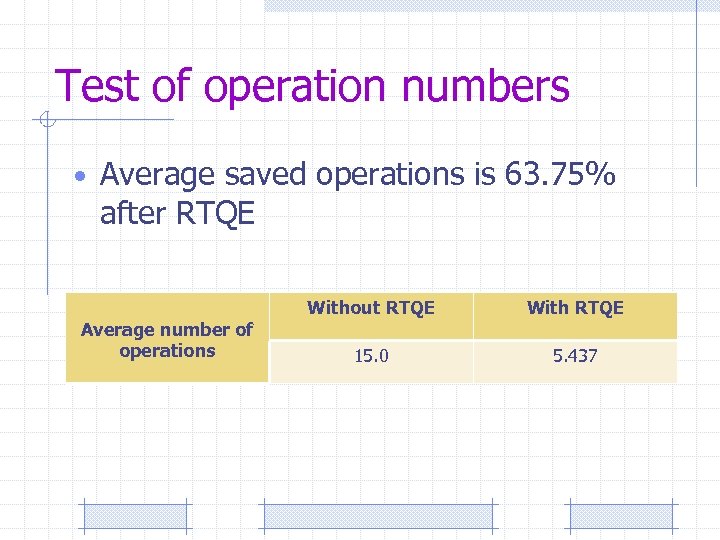
Test of operation numbers • Average saved operations is 63. 75% after RTQE Average number of operations Without RTQE With RTQE 15. 0 5. 437
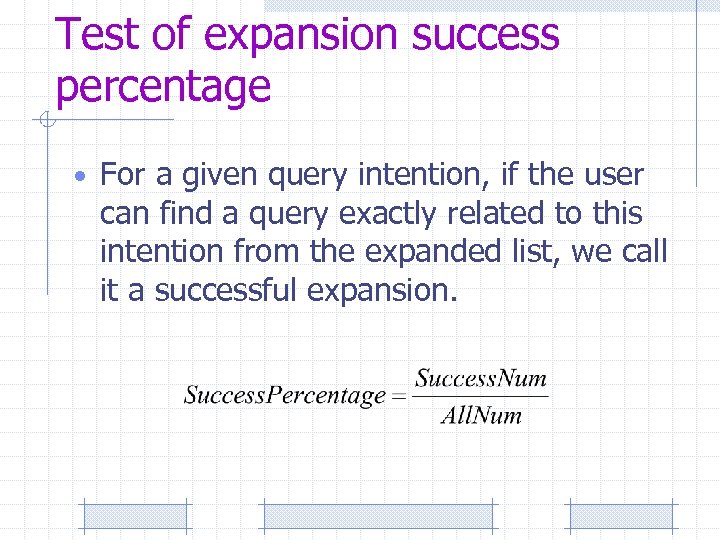
Test of expansion success percentage • For a given query intention, if the user can find a query exactly related to this intention from the expanded list, we call it a successful expansion.
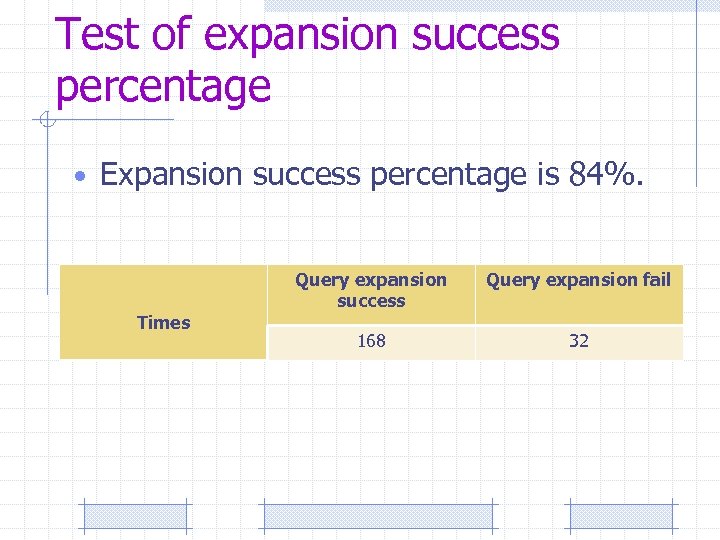
Test of expansion success percentage • Expansion success percentage is 84%. Times Query expansion success Query expansion fail 168 32
Test of retrieval performance • We compare the retrieval performance of the three: – original query user typed in – the query after verb-noun expansion – the query after verb-attributes-noun expansion. • We use precision and n. DCG score for evaluation.
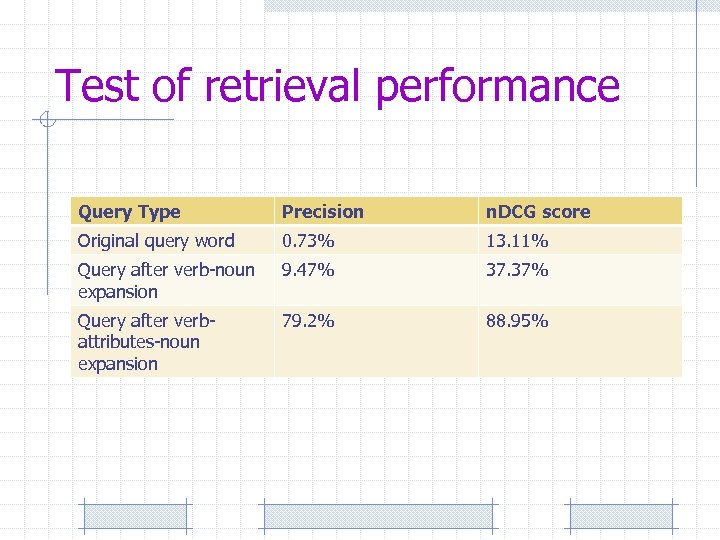
Test of retrieval performance Query Type Precision n. DCG score Original query word 0. 73% 13. 11% Query after verb-noun expansion 9. 47% 37. 37% Query after verbattributes-noun expansion 79. 2% 88. 95%
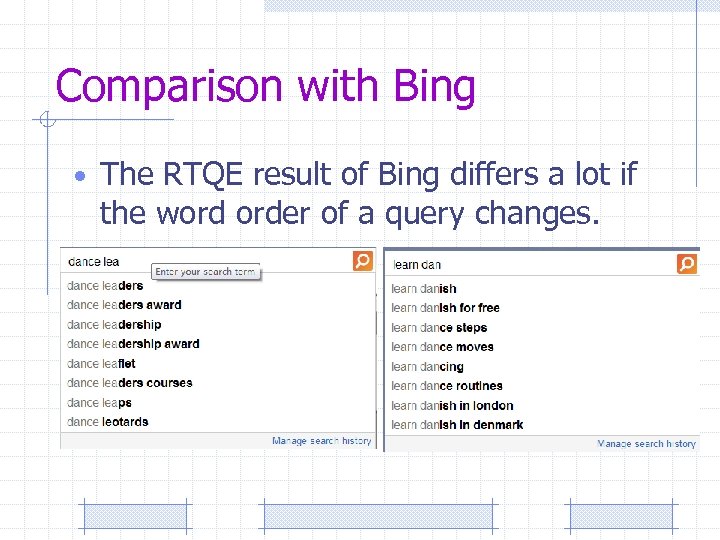
Comparison with Bing • The RTQE result of Bing differs a lot if the word order of a query changes.
Comparison with Bing • Categories the RTQE result of Bing into 3 groups: – NOT: cannot get correct recommendations – NORMAL: get correct recommendations only in normal word order – ALL: can get correct recommendations both in normal order and other word orders
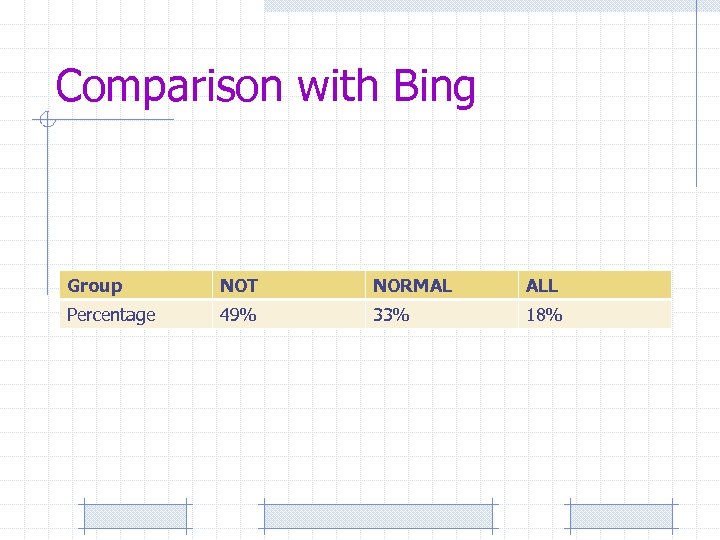
Comparison with Bing Group NOT NORMAL ALL Percentage 49% 33% 18%
Conclusion • Presented a novel RTQE method using a dependency relation network. • This RTQE method is proved to be effective in representing user query intention and hence improve retrieval performance.

Thank you!
Скачать презентацию Dependency Network Based Real-time Query Expansion Jiaqi Zou
f53b70664938592ad0bdc3262a6f10a9.ppt