 Скачать презентацию Dependability Lessons from Internetty Systems An Overview Stanford
b6788919edfc257e461dc5d38f064724.ppt
- Количество слайдов: 30



Dependability Lessons from Internetty Systems: An Overview Stanford University CS 444 A / UC Berkeley CS 294 -4 Recovery-Oriented Computing, Autumn 01 Armando Fox, fox@cs. stanford. edu
Concepts Overview n Trading consistency for availability: Harvest, yield, and the DQ principle; TACT n Runtime fault containment: virtualization and its uses n Orthogonal mechanisms: timeouts, end-to-end checks, statistical detection of performance failures n State management, hard and soft state n Revealed truths: end-to-end argument (Saltzer), software pitfalls (Leveson), and their application to dependability n Many, many supplementary readings about these topics © 2001 Stanford
Consistency/Availability Tradeoff: CAP principle (this formulation due to Brewer): n In a networked/distributed storage system, you can have any 2 of consistency, high availability, partition resilience. l l Databases favor C and A over P l n Internet systems favor A and P over C Surely other examples Generalization: can you trade some of one for more of another? (hint: yes) © 2001 Stanford
Consistency/Availability: Harvest/Yield n Yield: probability of completing a query n Harvest: (application-specific) fidelity of the answer l l Precision? l n Fraction of data represented? Semantic proximity? Harvest/yield questions: l l n When can we trade harvest for yield to improve availability? How to measure harvest “threshold” below which response is not useful? Application decomposition to improve “degradation tolerance” (and therefore availability) © 2001 Stanford
Generalization: TACT (Yu & Vahdat) n Model: distributed database using anti-entropy to approach consistency n “Conit” captures app-specific consistency unit (think: ADU of consistency) l l n Airline reservation: all seats on 1 flight Newsgroup: all articles in 1 group Bounds on 3 kinds of inconsistency l l Order error (write(s) may be missing, or arrive out-of-order) l n Numerical error (value is inaccurate) Staleness (value may be out-of-date) “Consistency cost” of operations can be characterized in © 2001 terms of conits, and bounds on inconsistency enforced Stanford
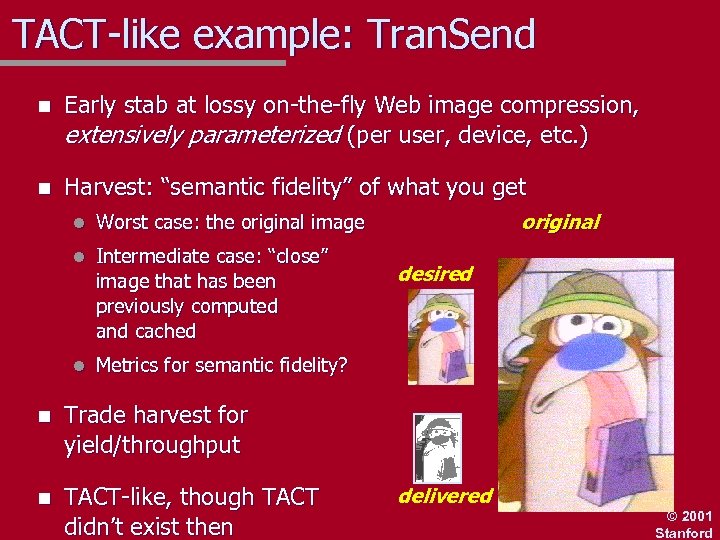
TACT-like example: Tran. Send n Early stab at lossy on-the-fly Web image compression, extensively parameterized (per user, device, etc. ) n Harvest: “semantic fidelity” of what you get l l Intermediate case: “close” image that has been previously computed and cached l original Worst case: the original image Metrics for semantic fidelity? n Trade harvest for yield/throughput n TACT-like, though TACT didn’t exist then desired delivered © 2001 Stanford
Another special case: DQ Principle n Model: read-mostly database striped across many machines n Idea: Data/Query x Queries/Sec = Data/Sec n Goal: design system so that D/Q or Q/S are tunable l Then you can decide how partial failure affects users l In practice, Internet systems constraint is offered load of Q/S, so failures affect D/Q for each user l Can use some replication of most common data to mitigate effects of reducing D/Q © 2001 Stanford
Fault Containment n Uses of software based fault isolation and VM technology l Protecting the “real” hardware (now will also be used for ASP’s) l Hypervisor-based F/T n Orthogonal mechanisms for fault containment n …and enforcing your assumptions © 2001 Stanford
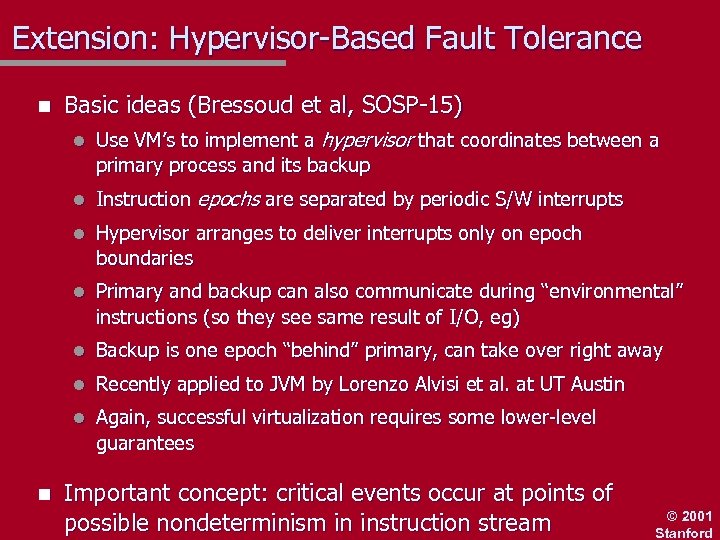
Extension: Hypervisor-Based Fault Tolerance n Basic ideas (Bressoud et al, SOSP-15) l l Instruction epochs are separated by periodic S/W interrupts l Hypervisor arranges to deliver interrupts only on epoch boundaries l Primary and backup can also communicate during “environmental” instructions (so they see same result of I/O, eg) l Backup is one epoch “behind” primary, can take over right away l Recently applied to JVM by Lorenzo Alvisi et al. at UT Austin l n Use VM’s to implement a hypervisor that coordinates between a primary process and its backup Again, successful virtualization requires some lower-level guarantees Important concept: critical events occur at points of possible nondeterminism in instruction stream © 2001 Stanford
Orthogonal Mechanisms n Bunker mentality: Design with unexpected failure in mind l l Keep your own house in order, but be prepared to be shot if outside monitoring sees something wrong l n Minimize assumptions made of rest of system Design systems to allow independent failure In real life (hardware) l l n Mechanical interlock systems Microprocessor hardware timeouts In real life (software) l Security and safety l Deadlock detection and shootdown © 2001 Stanford
Examples of Orthogonality n examples of orthogonality l l IP firewalls l Deadlock detection & recovery in databases - Note: not deadlock l Hardware orthogonal security - Fuses and hardware interlocks; recall the Therac-25 l n Software fault isolation/virtualization Theme: you don’t know why something went wrong, only that something went wrong; and you can usually do fault containment avoidance! What’s appealing about orthogonal mechanisms? l Small state space - Behavior simple to predict (usually) l Allows us to enforce at least some simple invariants - and invariants are your friends © 2001 Stanford
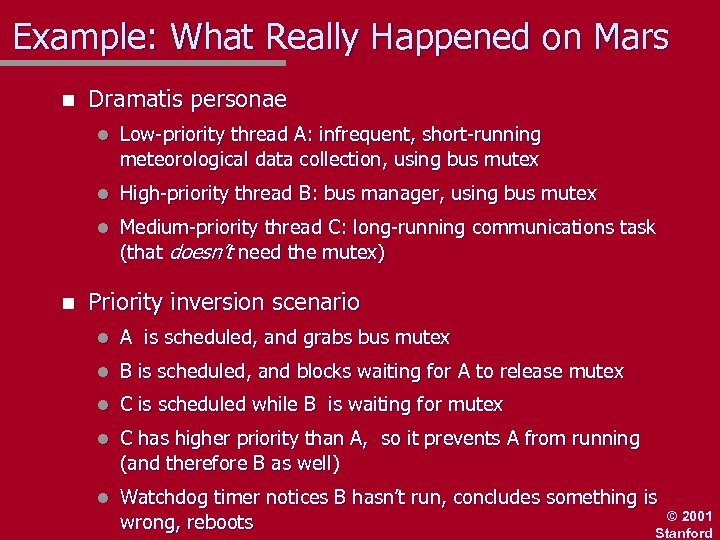
Example: What Really Happened on Mars n Dramatis personae l l High-priority thread B: bus manager, using bus mutex l n Low-priority thread A: infrequent, short-running meteorological data collection, using bus mutex Medium-priority thread C: long-running communications task (that doesn’t need the mutex) Priority inversion scenario l A is scheduled, and grabs bus mutex l B is scheduled, and blocks waiting for A to release mutex l C is scheduled while B is waiting for mutex l C has higher priority than A, so it prevents A from running (and therefore B as well) l Watchdog timer notices B hasn’t run, concludes something is © 2001 wrong, reboots Stanford
On Enforcing Your Assumptions n Orthogonal mechanisms can be used to enforce assumptions about system behavior l l n Infer failure of a peer -> shoot it Assume peers will respond within a specific time -> use timeout to force Why is this important? l Response to a detected condition may be inappropriate if assumptions are incorrect © 2001 Stanford
Enforcing Invariants Made Easier n Some other possible replies to fopen(): l l “How about a stale copy” (AFS server down, cached copy available, freshness questionable) l n “Maybe later” (NFS soft mount failed this time) “Took too long, you consumed too many resources, try again later” (like “HTTP server too busy”) Essence of the “MIT approach” vs “New Jersey approach” l Weaken the guarantee/illusion offered by subsystem l Force higher-level app to deal with being told “no” l Perhaps wrappers or other mechanisms will be developed to simplify this l Makes system more robust: simpler --> easier to understand, plus instills “bunker mentality” in (good) programmers © 2001 Stanford
Soft State n Soft state and announce/listen n Soft state and its relation to robustness n An example of using soft state for managing partial failures © 2001 Stanford
Loose coupling with soft state n Announce/listen + soft state, vs. hard state l l If receiver “forgets” state, just wait for next message l n “sender” continually sends state messages to “receiver”, who may or may not reply/ack Example: setting a variable on the server Assumptions & challenges l Assumption: messages may get lost, receiver may be down, etc. l Messages must be idempotent (this is a big one) l May not work for real-time-constrained activities n Or may require hysteresis to avoid oscillation © 2001 Stanford
Uses of Soft State n Wide-area Internet protocols, esp. multicast routing n Scalable Reliable Multicast (SRM) l l State “repairs” are multicast l n Members of a group session each have soft copies of group state New members can ask for “fast replay” to catch up Related concept: expiration-based schemes l Web caching: expiration bounds staleness l Leases: expiration bounds unavailability of a locked resource due to node failure © 2001 Stanford
Soft State Pros and Cons 1. No special recovery code l l 2. Recovery == restart “Recovery” paths exercised during normal operation Leaving the group (or dying) doesn’t require special code l Timeouts/expirations mean no garbage collection l “Passive” entities will not consume system resources 3. Staleness or other imprecision in answer 4. Possible lack of atomicity/ordering of state updates Next: Exploiting soft state/approximate values for failure masking… © 2001 Stanford
Software Pitfalls (Leveson, Ch. 2) n Unlike hardware, software is purely abstract design l Unlike hardware, software doesn’t “fail” l Design unconstrained by physical laws l Cost of modifying design hidden by lack of physical constraints l Real state space includes what the hardware and other software doing, and includes states that don’t correspond to states in the abstract model n Software as a discrete (vs. analog) state system l Effect of small perturbation on an analog system vs. on a software discrete system l Software can “fail” in a way that is completely unrelated to how the environment/inputs were perturbed © 2001 Stanford
Software Pitfalls, cont’d. n Exploding some common myths l “Reuse of software increases safety” - or, it perpetuates the same (hidden) bugs (e. g. Therac-25) l “Formal verification can remove all software-related errors” unless software/system fails in a way that is outside its design point (e. g. overload/thrashing) l “GP computers + software more cost effective [compared to a dedicated purpose-designed system]” - Space Shuttle software costs ~$100 M/year to maintain © 2001 Stanford
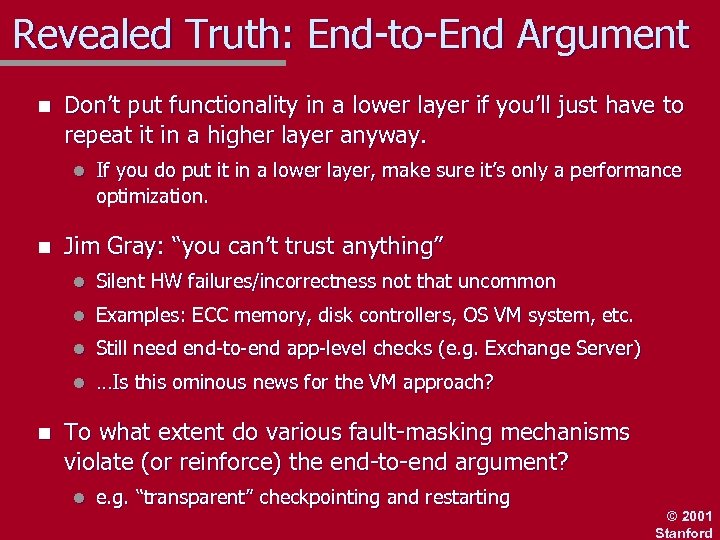
Revealed Truth: End-to-End Argument n Don’t put functionality in a lower layer if you’ll just have to repeat it in a higher layer anyway. l n If you do put it in a lower layer, make sure it’s only a performance optimization. Jim Gray: “you can’t trust anything” l l Examples: ECC memory, disk controllers, OS VM system, etc. l Still need end-to-end app-level checks (e. g. Exchange Server) l n Silent HW failures/incorrectness not that uncommon …Is this ominous news for the VM approach? To what extent do various fault-masking mechanisms violate (or reinforce) the end-to-end argument? l e. g. “transparent” checkpointing and restarting © 2001 Stanford
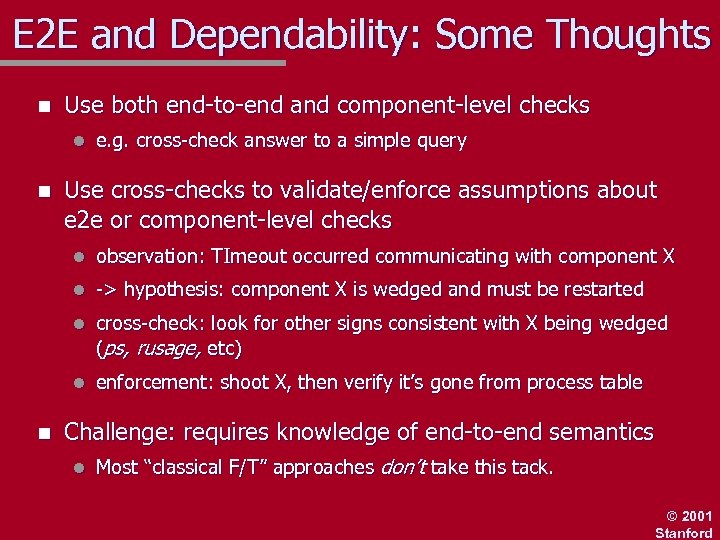
E 2 E and Dependability: Some Thoughts n Use both end-to-end and component-level checks l n e. g. cross-check answer to a simple query Use cross-checks to validate/enforce assumptions about e 2 e or component-level checks l l -> hypothesis: component X is wedged and must be restarted l cross-check: look for other signs consistent with X being wedged (ps, rusage, etc) l n observation: TImeout occurred communicating with component X enforcement: shoot X, then verify it’s gone from process table Challenge: requires knowledge of end-to-end semantics l Most “classical F/T” approaches don’t take this tack. © 2001 Stanford
Other readings (will be on Web) n Virtualization and sandboxing: other readings l l Disco: Running Commodity OS’s on Scalable Multiprocessors (Bugnion et al. , ACM TOCS 15(4) and SOSP-16) l Recursive Virtual Machines in Fluke (Ford et al. , OSDI 96) l Efficient Software-Based Fault Isolation (Lucco & Wahbe, 1993) l n Hypervisor-Based Fault Tolerance (Bressoud et al. , SOSP-15) JANUS: an environment for running untrusted helper apps (Goldberg et al. , USENIX 1996 Security Conference) Harvest, yield, consistency, availability l Harvest, Yield, and Scalable Tolerant Systems (Fox & Brewer, Hot. OS-VII) l TACT (Yu & Vahdat, SOSP-18 and others) © 2001 Stanford
Other readings n Reliability in cluster based servers l Lessons From Giant-Scale Services (Brewer, IEEE Internet Computing; draft on Web) l Cluster-based Scalable Network Services (Fox, Brewer et al, SOSP 16) © 2001 Stanford
Putting It All Together Berkeley SNS/TACC: an application-level example of several of these techniques in action: n Supervisor-based redundancy for both availability and performance n Loose coupling and announce/listen to circumvent SPF for supervisor n Orthogonal mechanisms to account for legacy code vagaries n Normal-operation and failure-recovery code paths are the same © 2001 Stanford
TACC/SNS n Specialized cluster runtime to host Web-like workloads l l n TACC: transformation, aggregation, caching and customization-elements of an Internet service Build apps from composable modules, Unix-pipeline-style Goal: complete separation of *ility concerns from application logic l Legacy code encapsulation, multiple language support l Insulate programmers from nasty engineering © 2001 Stanford
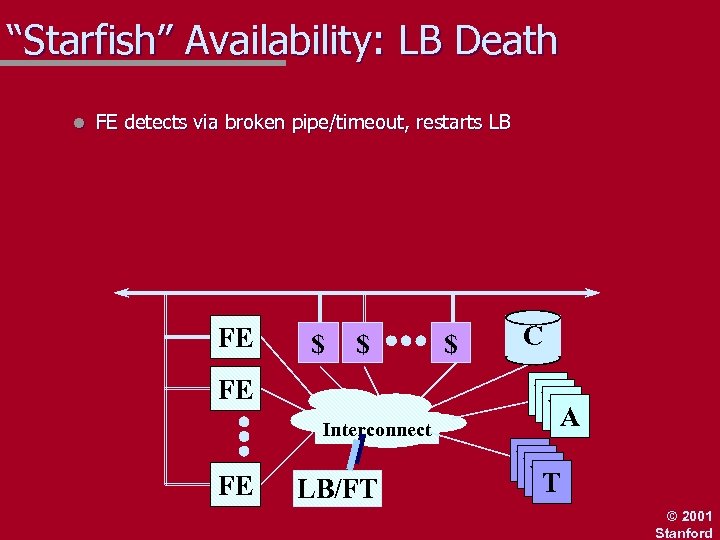
“Starfish” Availability: LB Death l FE detects via broken pipe/timeout, restarts LB FE $ $ FE Interconnect FE LB/FT $ C W W W A W W W T © 2001 Stanford
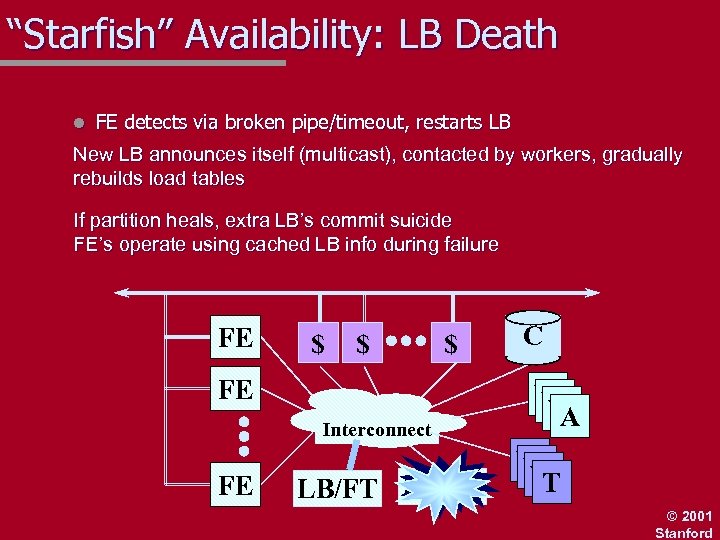
“Starfish” Availability: LB Death l FE detects via broken pipe/timeout, restarts LB New LB announces itself (multicast), contacted by workers, gradually rebuilds load tables If partition heals, extra LB’s commit suicide FE’s operate using cached LB info during failure FE $ $ $ FE Interconnect FE LB/FT C W W W A W W W T © 2001 Stanford
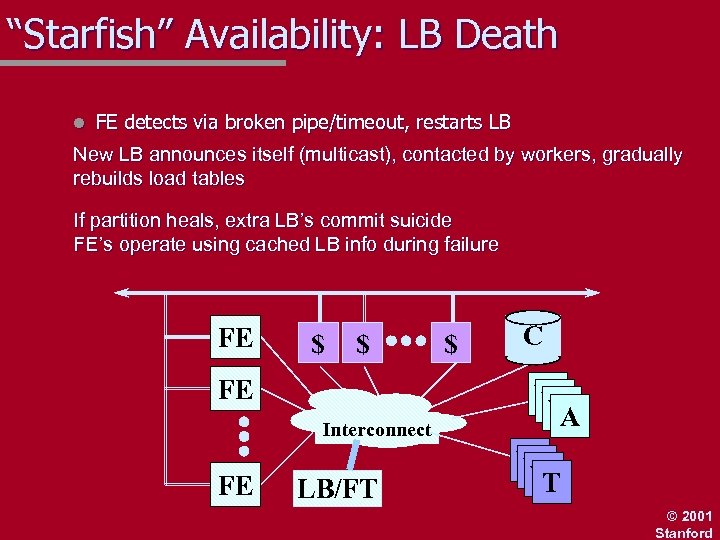
“Starfish” Availability: LB Death l FE detects via broken pipe/timeout, restarts LB New LB announces itself (multicast), contacted by workers, gradually rebuilds load tables If partition heals, extra LB’s commit suicide FE’s operate using cached LB info during failure FE $ $ FE Interconnect FE LB/FT $ C W W W A W W W T © 2001 Stanford
SNS Availability Mechanisms n Soft state everywhere l l n Multicast based announce/listen to refresh the state Idea stolen from multicast routing in the Internet! Process peers watch each other l l Because of multicast level of indirection, don’t need a location directory for resources l n Because of no hard state, “recovery” == “restart” Timeouts and restarts everywhere Load balancing, hot updates, migration are “easy” l Shoot down a worker, and it will recover l Upgrade == install new software, shoot down old l Mostly graceful degradation © 2001 Stanford
Скачать презентацию Dependability Lessons from Internetty Systems An Overview Stanford
b6788919edfc257e461dc5d38f064724.ppt