


 Скачать презентацию DEPARTMENTAL PROFILE 2009 for NAAC Peer Team n
18d49a5eff011201792a6de7fb58f75b.ppt
- Количество слайдов: 21
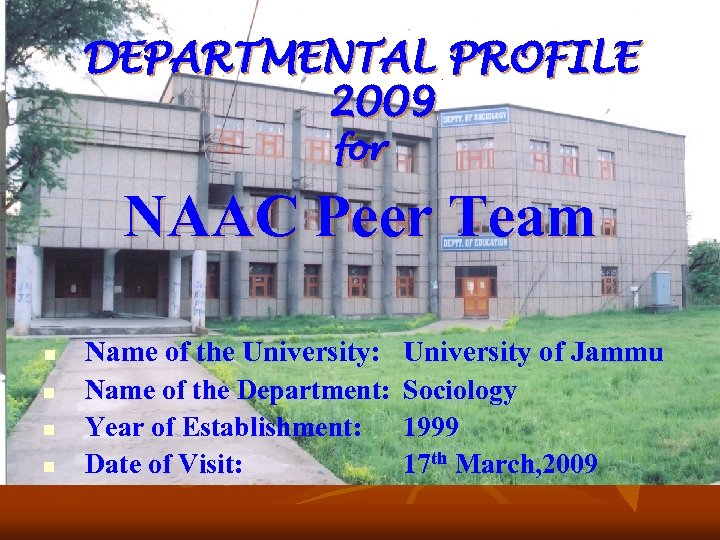 DEPARTMENTAL PROFILE 2009 for NAAC Peer Team n n Name of the University: Name of the Department: Year of Establishment: Date of Visit: University of Jammu Sociology 1999 17 th March, 2009
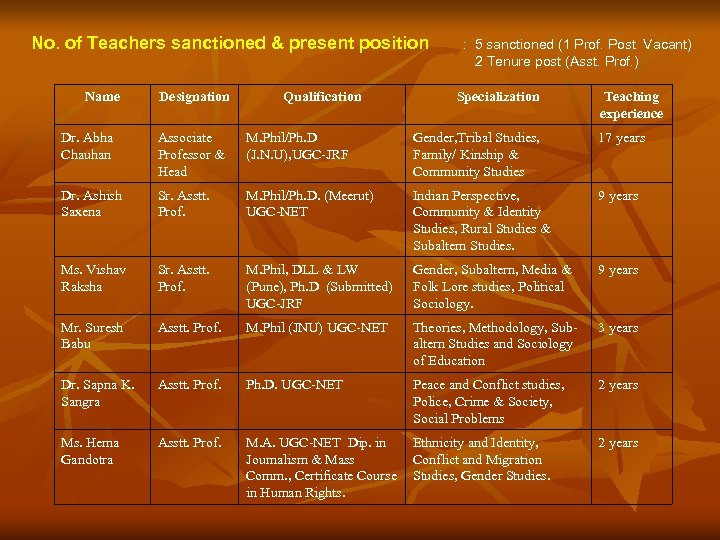 No. of Teachers sanctioned & present position Qualification : 5 sanctioned (1 Prof. Post Vacant) 2 Tenure post (Asst. Prof. ) Name Designation Specialization Teaching experience Dr. Abha Chauhan Associate Professor & Head M. Phil/Ph. D (J. N. U), UGC-JRF Gender, Tribal Studies, Family/ Kinship & Community Studies 17 years Dr. Ashish Saxena Sr. Asstt. Prof. M. Phil/Ph. D. (Meerut) UGC-NET Indian Perspective, Community & Identity Studies, Rural Studies & Subaltern Studies. 9 years Ms. Vishav Raksha Sr. Asstt. Prof. M. Phil, DLL & LW (Pune), Ph. D (Submitted) UGC-JRF Gender, Subaltern, Media & Folk Lore studies, Political Sociology. 9 years Mr. Suresh Babu Asstt. Prof. M. Phil (JNU) UGC-NET Theories, Methodology, Subaltern Studies and Sociology of Education 3 years Dr. Sapna K. Sangra Asstt. Prof. Ph. D. UGC-NET Peace and Conflict studies, Police, Crime & Society, Social Problems 2 years Ms. Hema Gandotra Asstt. Prof. M. A. UGC-NET Dip. in Ethnicity and Identity, Journalism & Mass Conflict and Migration Comm. , Certificate Course Studies, Gender Studies. in Human Rights. 2 years
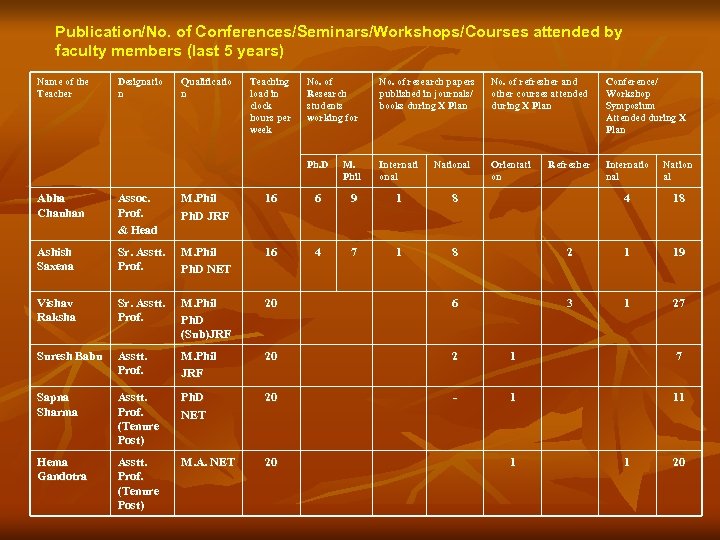 Publication/No. of Conferences/Seminars/Workshops/Courses attended by faculty members (last 5 years) Name of the Teacher Designatio n Qualificatio n Teaching load in clock hours per week No. of Research students working for No. of research papers published in journals/ books during X Plan No. of refresher and other courses attended during X Plan Conference/ Workshop Symposium Attended during X Plan Ph. D M. Phil Internati onal Orientati on Internatio nal Nation al 4 18 National Refresher Abha Chauhan Assoc. Prof. & Head M. Phil Ph. D JRF 16 6 9 1 8 Ashish Saxena Sr. Asstt. Prof. M. Phil Ph. D NET 16 4 7 1 8 2 1 19 Vishav Raksha Sr. Asstt. Prof. M. Phil Ph. D (Sub)JRF 20 6 3 1 27 Suresh Babu Asstt. Prof. M. Phil JRF 20 2 1 7 Sapna Sharma Asstt. Prof. (Tenure Post) Ph. D NET 20 - 1 11 Hema Gandotra Asstt. Prof. (Tenure Post) M. A. NET 20 1 1 20
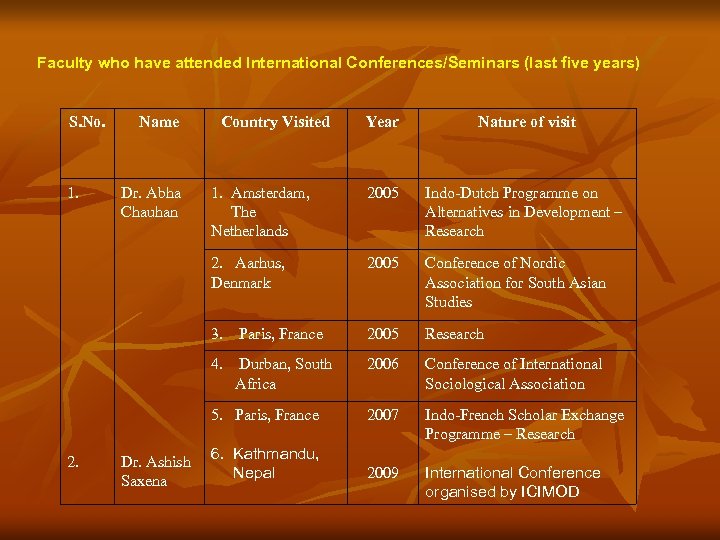 Faculty who have attended International Conferences/Seminars (last five years) S. No. 2005 Indo-Dutch Programme on Alternatives in Development – Research 2005 Conference of Nordic Association for South Asian Studies 2005 Research 2006 Conference of International Sociological Association 5. Paris, France Dr. Ashish Saxena 1. Amsterdam, The Netherlands 4. Durban, South Africa 2. Nature of visit 3. Paris, France Dr. Abha Chauhan Year 2. Aarhus, Denmark 1. Name Country Visited 2007 Indo-French Scholar Exchange Programme – Research 6. Kathmandu, Nepal 2009 International Conference organised by ICIMOD
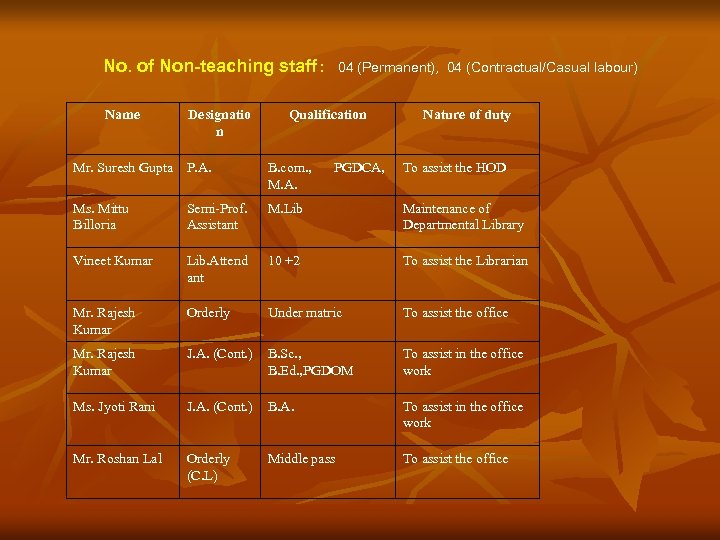 No. of Non-teaching staff : Name Designatio n 04 (Permanent), 04 (Contractual/Casual labour) Qualification PGDCA, Nature of duty Mr. Suresh Gupta P. A. B. com. , M. A. To assist the HOD Ms. Mittu Billoria Semi-Prof. Assistant M. Lib Maintenance of Departmental Library Vineet Kumar Lib. Attend ant 10 +2 To assist the Librarian Mr. Rajesh Kumar Orderly Under matric To assist the office Mr. Rajesh Kumar J. A. (Cont. ) B. Sc. , B. Ed. , PGDOM To assist in the office work Ms. Jyoti Rani J. A. (Cont. ) B. A. To assist in the office work Mr. Roshan Lal Orderly (C. L) Middle pass To assist the office
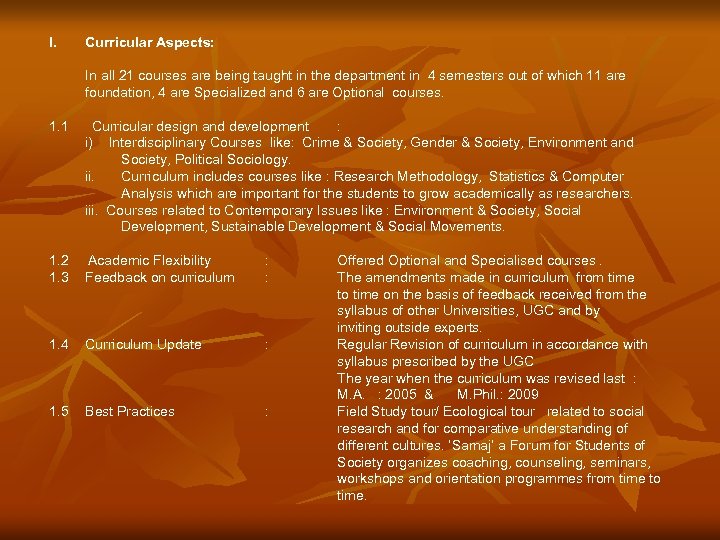 I. Curricular Aspects: In all 21 courses are being taught in the department in 4 semesters out of which 11 are foundation, 4 are Specialized and 6 are Optional courses. 1. 1 Curricular design and development : i) Interdisciplinary Courses like: Crime & Society, Gender & Society, Environment and Society, Political Sociology. ii. Curriculum includes courses like : Research Methodology, Statistics & Computer Analysis which are important for the students to grow academically as researchers. iii. Courses related to Contemporary Issues like : Environment & Society, Social Development, Sustainable Development & Social Movements. 1. 2 1. 3 Academic Flexibility Feedback on curriculum : : 1. 4 Curriculum Update : 1. 5 Best Practices : Offered Optional and Specialised courses. The amendments made in curriculum from time to time on the basis of feedback received from the syllabus of other Universities, UGC and by inviting outside experts. Regular Revision of curriculum in accordance with syllabus prescribed by the UGC The year when the curriculum was revised last : M. A. : 2005 & M. Phil. : 2009 Field Study tour/ Ecological tour related to social research and for comparative understanding of different cultures. ‘Samaj’ a Forum for Students of Society organizes coaching, counseling, seminars, workshops and orientation programmes from time to time.
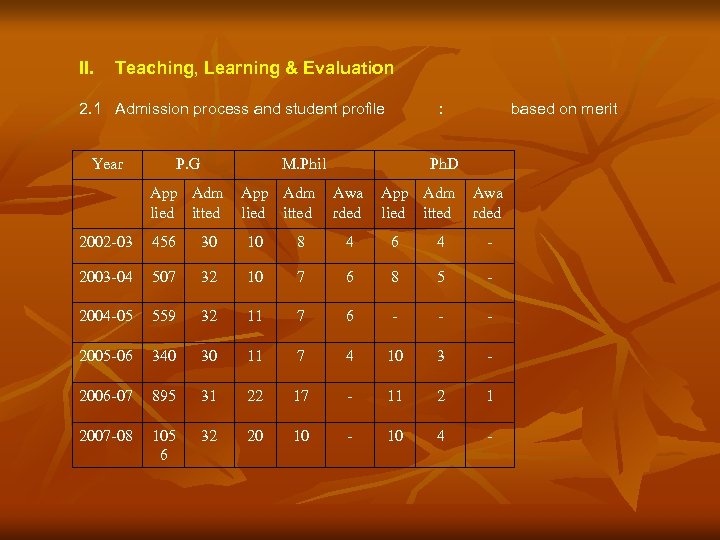 II. Teaching, Learning & Evaluation 2. 1 Admission process and student profile Year P. G : M. Phil App Adm lied itted based on merit Ph. D App Adm lied itted Awa rded 2002 -03 456 30 10 8 4 6 4 - 2003 -04 507 32 10 7 6 8 5 - 2004 -05 559 32 11 7 6 - - - 2005 -06 340 30 11 7 4 10 3 - 2006 -07 895 31 22 17 - 11 2 1 2007 -08 105 6 32 20 10 - 10 4 -
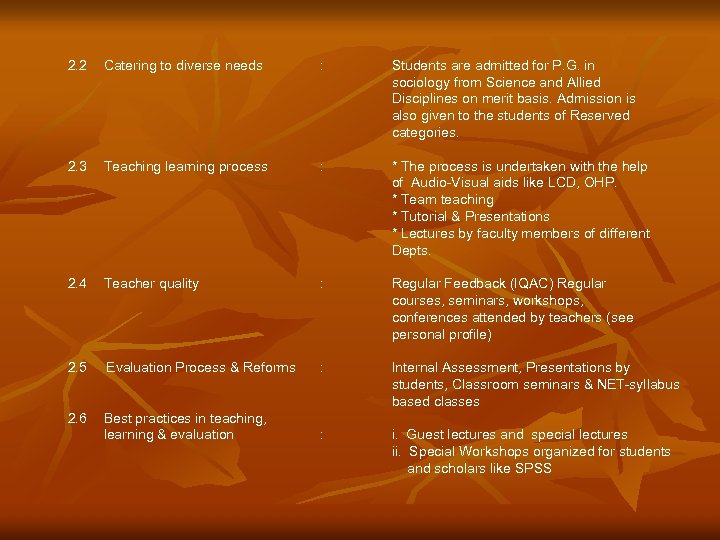 2. 2 Catering to diverse needs : Students are admitted for P. G. in sociology from Science and Allied Disciplines on merit basis. Admission is also given to the students of Reserved categories. 2. 3 Teaching learning process : * The process is undertaken with the help of Audio-Visual aids like LCD, OHP. * Team teaching * Tutorial & Presentations * Lectures by faculty members of different Depts. 2. 4 Teacher quality : Regular Feedback (IQAC) Regular courses, seminars, workshops, conferences attended by teachers (see personal profile) 2. 5 Evaluation Process & Reforms : Internal Assessment, Presentations by students, Classroom seminars & NET-syllabus based classes 2. 6 Best practices in teaching, learning & evaluation : i. Guest lectures and special lectures ii. Special Workshops organized for students and scholars like SPSS
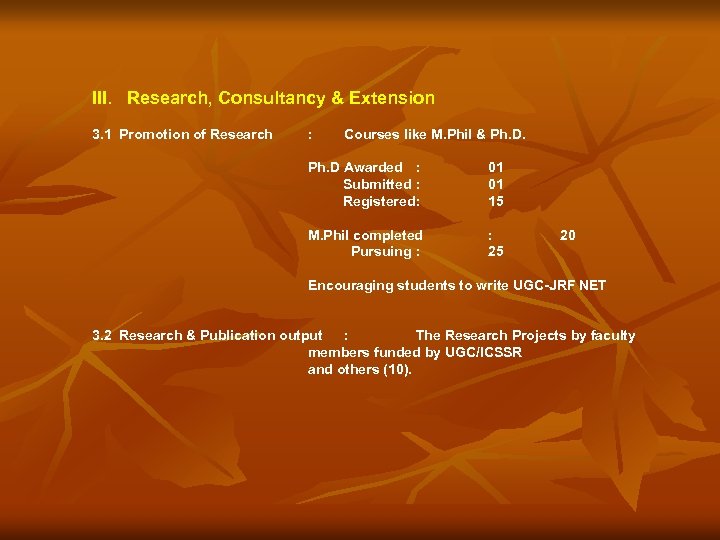 III. Research, Consultancy & Extension 3. 1 Promotion of Research : Courses like M. Phil & Ph. D Awarded : Submitted : Registered: 01 01 15 M. Phil completed Pursuing : : 25 20 Encouraging students to write UGC-JRF NET 3. 2 Research & Publication output : The Research Projects by faculty members funded by UGC/ICSSR and others (10).
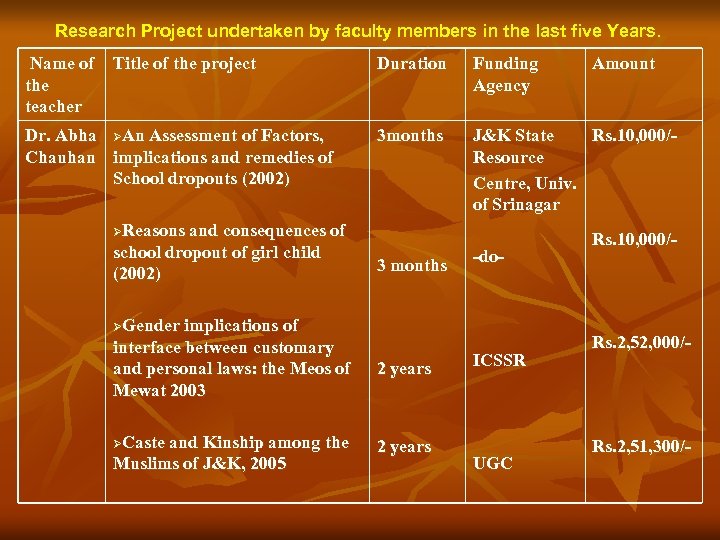 Research Project undertaken by faculty members in the last five Years. Name of the teacher Title of the project Duration Funding Agency Dr. Abha ØAn Assessment of Factors, Chauhan implications and remedies of School dropouts (2002) 3 months J&K State Rs. 10, 000/Resource Centre, Univ. of Srinagar ØReasons and consequences of school dropout of girl child (2002) implications of interface between customary and personal laws: the Meos of Mewat 2003 3 months -do- ØGender ØCaste and Kinship among the Muslims of J&K, 2005 2 years ICSSR UGC Amount Rs. 10, 000/- Rs. 2, 52, 000/- Rs. 2, 51, 300/-
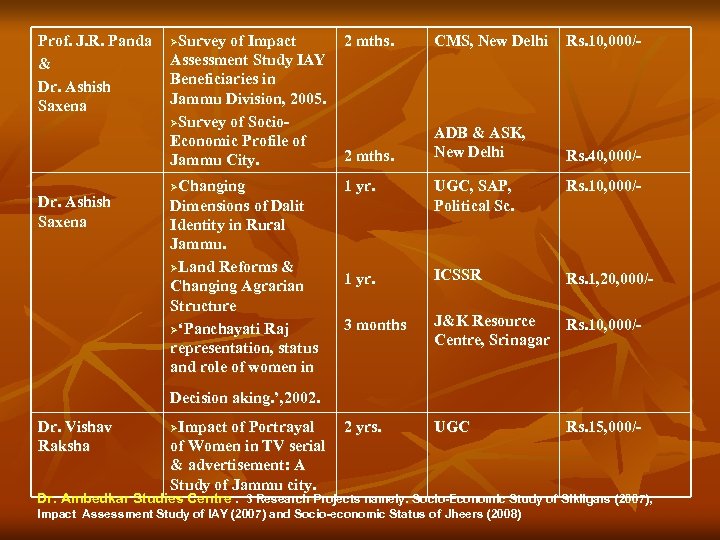 Prof. J. R. Panda & Dr. Ashish Saxena ØSurvey of Impact Assessment Study IAY Beneficiaries in Jammu Division, 2005. ØSurvey of Socio. Economic Profile of Jammu City. 2 mths. CMS, New Delhi Rs. 10, 000/- 2 mths. ADB & ASK, New Delhi Rs. 40, 000/- ØChanging 1 yr. UGC, SAP, Political Sc. Rs. 10, 000/- 1 yr. ICSSR Rs. 1, 20, 000/- 3 months J&K Resource Rs. 10, 000/Centre, Srinagar 2 yrs. UGC Dimensions of Dalit Identity in Rural Jammu. ØLand Reforms & Changing Agrarian Structure Ø‘Panchayati Raj representation, status and role of women in Decision aking. ’, 2002. Dr. Vishav Raksha ØImpact of Portrayal of Women in TV serial & advertisement: A Study of Jammu city. Rs. 15, 000/- Dr. Ambedkar Studies Centre : 3 Research Projects namely: Socio-Economic Study of Sikligars (2007), Impact Assessment Study of IAY (2007) and Socio-economic Status of Jheers (2008)
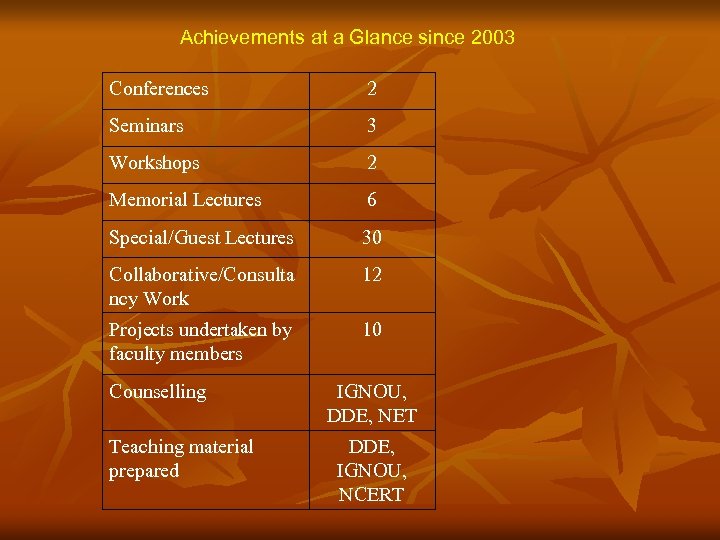 Achievements at a Glance since 2003 Conferences 2 Seminars 3 Workshops 2 Memorial Lectures 6 Special/Guest Lectures 30 Collaborative/Consulta ncy Work 12 Projects undertaken by faculty members 10 Counselling Teaching material prepared IGNOU, DDE, NET DDE, IGNOU, NCERT
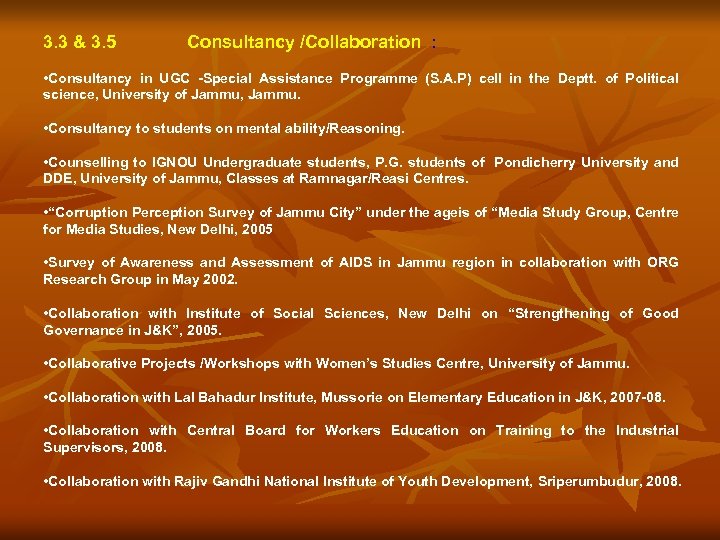 3. 3 & 3. 5 Consultancy /Collaboration : • Consultancy in UGC -Special Assistance Programme (S. A. P) cell in the Deptt. of Political science, University of Jammu, Jammu. • Consultancy to students on mental ability/Reasoning. • Counselling to IGNOU Undergraduate students, P. G. students of Pondicherry University and DDE, University of Jammu, Classes at Ramnagar/Reasi Centres. • “Corruption Perception Survey of Jammu City” under the ageis of “Media Study Group, Centre for Media Studies, New Delhi, 2005 • Survey of Awareness and Assessment of AIDS in Jammu region in collaboration with ORG Research Group in May 2002. • Collaboration with Institute of Social Sciences, New Delhi on “Strengthening of Good Governance in J&K”, 2005. • Collaborative Projects /Workshops with Women’s Studies Centre, University of Jammu. • Collaboration with Lal Bahadur Institute, Mussorie on Elementary Education in J&K, 2007 -08. • Collaboration with Central Board for Workers Education on Training to the Industrial Supervisors, 2008. • Collaboration with Rajiv Gandhi National Institute of Youth Development, Sriperumbudur, 2008.
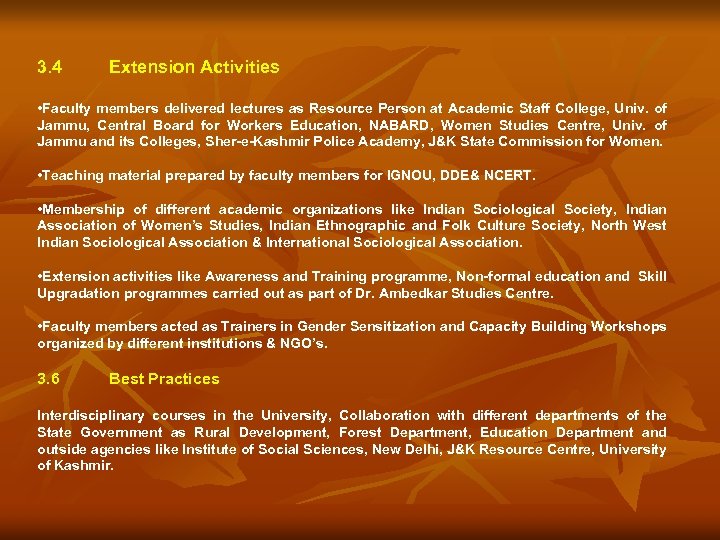 3. 4 Extension Activities • Faculty members delivered lectures as Resource Person at Academic Staff College, Univ. of Jammu, Central Board for Workers Education, NABARD, Women Studies Centre, Univ. of Jammu and its Colleges, Sher-e-Kashmir Police Academy, J&K State Commission for Women. • Teaching material prepared by faculty members for IGNOU, DDE& NCERT. • Membership of different academic organizations like Indian Sociological Society, Indian Association of Women’s Studies, Indian Ethnographic and Folk Culture Society, North West Indian Sociological Association & International Sociological Association. • Extension activities like Awareness and Training programme, Non-formal education and Skill Upgradation programmes carried out as part of Dr. Ambedkar Studies Centre. • Faculty members acted as Trainers in Gender Sensitization and Capacity Building Workshops organized by different institutions & NGO’s. 3. 6 Best Practices Interdisciplinary courses in the University, Collaboration with different departments of the State Government as Rural Development, Forest Department, Education Department and outside agencies like Institute of Social Sciences, New Delhi, J&K Resource Centre, University of Kashmir.
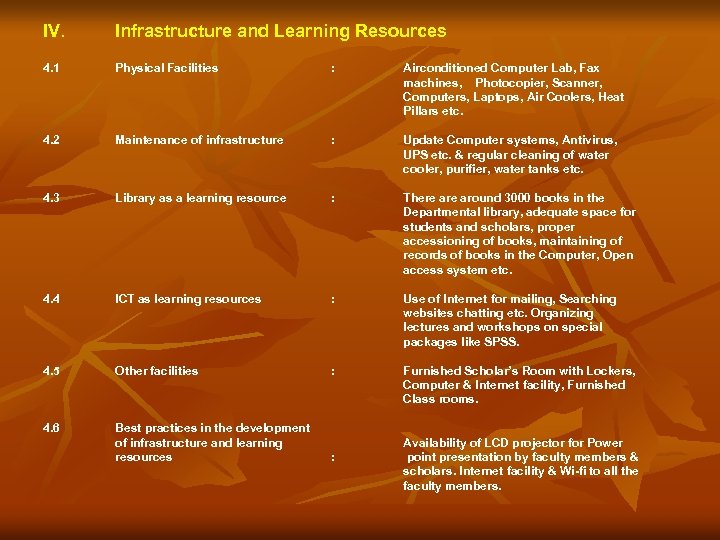 IV. Infrastructure and Learning Resources 4. 1 Physical Facilities : Airconditioned Computer Lab, Fax machines, Photocopier, Scanner, Computers, Laptops, Air Coolers, Heat Pillars etc. 4. 2 Maintenance of infrastructure : Update Computer systems, Antivirus, UPS etc. & regular cleaning of water cooler, purifier, water tanks etc. 4. 3 Library as a learning resource : There around 3000 books in the Departmental library, adequate space for students and scholars, proper accessioning of books, maintaining of records of books in the Computer, Open access system etc. 4. 4 ICT as learning resources : Use of Internet for mailing, Searching websites chatting etc. Organizing lectures and workshops on special packages like SPSS. 4. 5 Other facilities : Furnished Scholar’s Room with Lockers, Computer & Internet facility, Furnished Class rooms. 4. 6 Best practices in the development of infrastructure and learning resources : Availability of LCD projector for Power point presentation by faculty members & scholars. Internet facility & Wi-fi to all the faculty members.
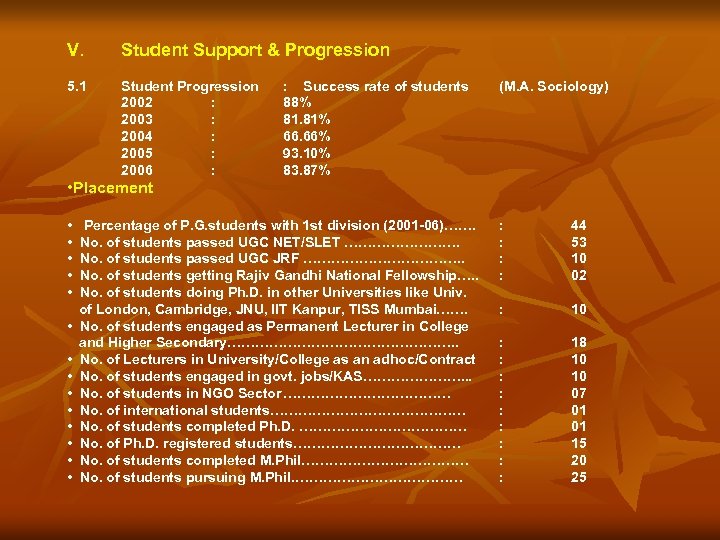 V. Student Support & Progression 5. 1 Student Progression 2002 : 2003 : 2004 : 2005 : 2006 : : Success rate of students 88% 81. 81% 66. 66% 93. 10% 83. 87% (M. A. Sociology) • Placement • • • • Percentage of P. G. students with 1 st division (2001 -06)……. No. of students passed UGC NET/SLET …………. No. of students passed UGC JRF ………………. . No. of students getting Rajiv Gandhi National Fellowship…. . No. of students doing Ph. D. in other Universities like Univ. of London, Cambridge, JNU, IIT Kanpur, TISS Mumbai……. No. of students engaged as Permanent Lecturer in College and Higher Secondary……………………. . No. of Lecturers in University/College as an adhoc/Contract No. of students engaged in govt. jobs/KAS…………………. . . No. of students in NGO Sector ……………… No. of international students………………… No. of students completed Ph. D. ……………… No. of Ph. D. registered students……………… No. of students completed M. Phil……………… No. of students pursuing M. Phil. ……………… : : 44 53 10 02 : 10 : : : : : 18 10 10 07 01 01 15 20 25
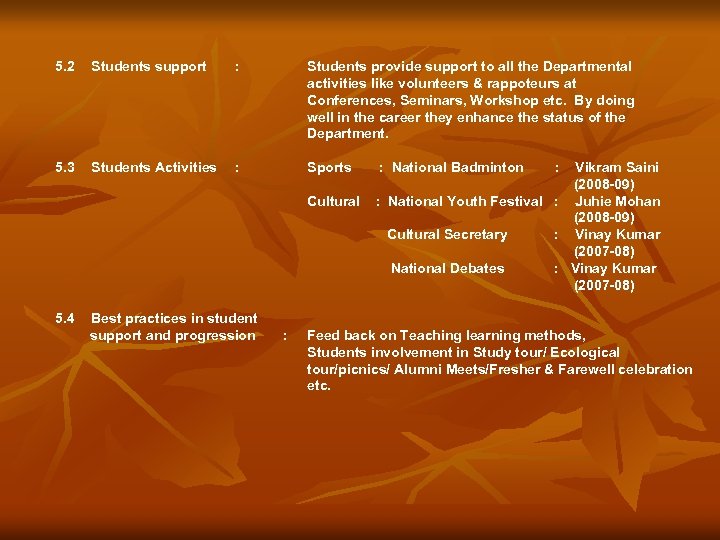 5. 2 Students support : Students provide support to all the Departmental activities like volunteers & rappoteurs at Conferences, Seminars, Workshop etc. By doing well in the career they enhance the status of the Department. 5. 3 Students Activities : Sports Cultural 5. 4 Best practices in student support and progression : : National Badminton : Vikram Saini (2008 -09) : National Youth Festival : Juhie Mohan (2008 -09) Cultural Secretary : Vinay Kumar (2007 -08) National Debates : Vinay Kumar (2007 -08) Feed back on Teaching learning methods, Students involvement in Study tour/ Ecological tour/picnics/ Alumni Meets/Fresher & Farewell celebration etc.
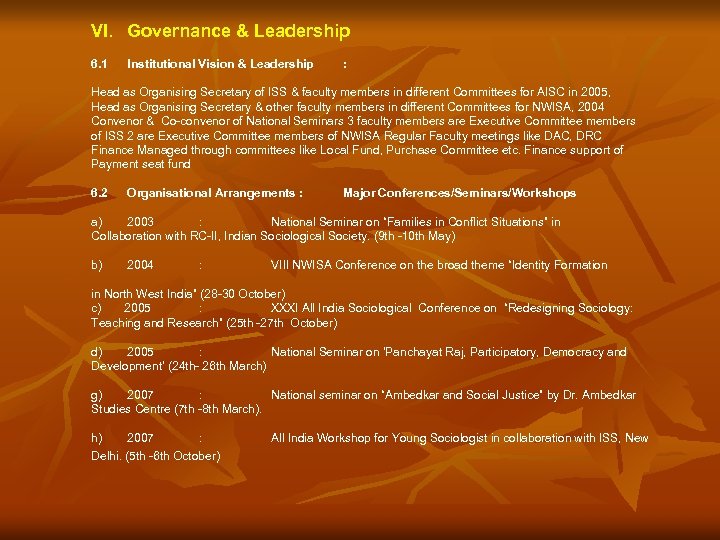 VI. Governance & Leadership 6. 1 Institutional Vision & Leadership : Head as Organising Secretary of ISS & faculty members in different Committees for AISC in 2005, Head as Organising Secretary & other faculty members in different Committees for NWISA, 2004 Convenor & Co-convenor of National Seminars 3 faculty members are Executive Committee members of ISS 2 are Executive Committee members of NWISA Regular Faculty meetings like DAC, DRC Finance Managed through committees like Local Fund, Purchase Committee etc. Finance support of Payment seat fund 6. 2 Organisational Arrangements : Major Conferences/Seminars/Workshops a) 2003 : National Seminar on “Families in Conflict Situations” in Collaboration with RC-II, Indian Sociological Society. (9 th -10 th May) b) 2004 : VIII NWISA Conference on the broad theme “Identity Formation in North West India” (28 -30 October) c) 2005 : XXXI All India Sociological Conference on “Redesigning Sociology: Teaching and Research” (25 th -27 th October) d) 2005 : National Seminar on ‘Panchayat Raj, Participatory, Democracy and Development’ (24 th- 26 th March) g) 2007 : National seminar on “Ambedkar and Social Justice” by Dr. Ambedkar Studies Centre (7 th -8 th March). h) 2007 : Delhi. (5 th -6 th October) All India Workshop for Young Sociologist in collaboration with ISS, New
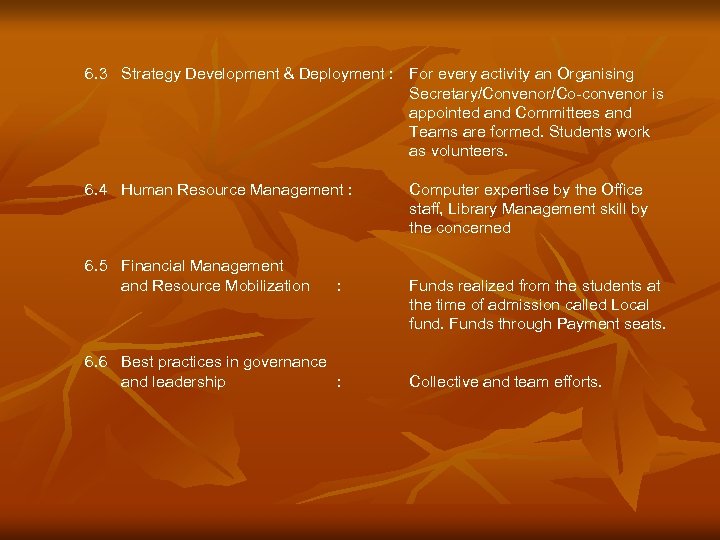 6. 3 Strategy Development & Deployment : For every activity an Organising Secretary/Convenor/Co-convenor is appointed and Committees and Teams are formed. Students work as volunteers. 6. 4 Human Resource Management : Computer expertise by the Office staff, Library Management skill by the concerned 6. 5 Financial Management and Resource Mobilization : 6. 6 Best practices in governance and leadership : Funds realized from the students at the time of admission called Local fund. Funds through Payment seats. Collective and team efforts.
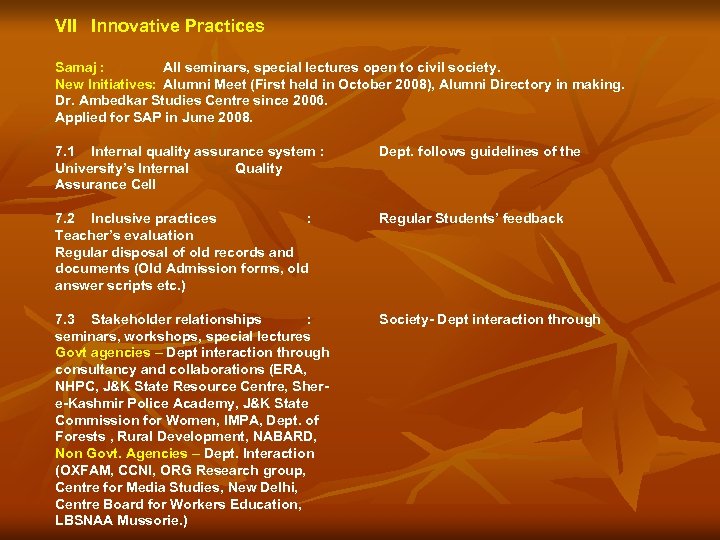 VII Innovative Practices Samaj : All seminars, special lectures open to civil society. New Initiatives: Alumni Meet (First held in October 2008), Alumni Directory in making. Dr. Ambedkar Studies Centre since 2006. Applied for SAP in June 2008. 7. 1 Internal quality assurance system : University’s Internal Quality Assurance Cell Dept. follows guidelines of the 7. 2 Inclusive practices : Teacher’s evaluation Regular disposal of old records and documents (Old Admission forms, old answer scripts etc. ) Regular Students’ feedback 7. 3 Stakeholder relationships : seminars, workshops, special lectures Govt agencies – Dept interaction through consultancy and collaborations (ERA, NHPC, J&K State Resource Centre, Shere-Kashmir Police Academy, J&K State Commission for Women, IMPA, Dept. of Forests , Rural Development, NABARD, Non Govt. Agencies – Dept. Interaction (OXFAM, CCNI, ORG Research group, Centre for Media Studies, New Delhi, Centre Board for Workers Education, LBSNAA Mussorie. ) Society- Dept interaction through
 Thank You