


 Скачать презентацию Department of the Environment Near Road NO 2
20bfb947ffd0b1436a461f4d67f91757.ppt
- Количество слайдов: 10
 Department of the Environment Near Road NO 2 Monitoring Update MWAQC Technical Advisory Committee January 10, 2012
 Background q NO 2 NAAQS revised 1/22/2010 q 1 -hour level set at 100 ppb q Monitoring required in urban area near major roadways where maximum concentrations are expected by Jan. 1, 2013 q One near road monitor for areas with population > 300, 000, additional monitor for areas with population > 2. 5 million q Two monitors required for the DC/MD/VA CBSA and two monitors in the Baltimore CBSA
 Build and Hold Plan q In response to concerns raised by NACAA and CASAC over the expeditious deployment schedule and resource/budgetary issues facing the States and EPA has developed the Build and Hold plan q Initial deployment of near road monitors now limited to areas with population > 1 million (subset of original requirements), one monitor per area. q Monitors to be deployed over two years (2013 and 2014) q Goal is to establish a sufficient base of monitors across the country so ambient concentrations can be assessed before deciding on whether to implement the full network
 Build and Hold Plan q Build and Hold now means one monitor in the DC/MD/VA CBSA and one monitor in the Baltimore CBSA, both by Jan. 1, 2013 q No formal revision to the existing monitoring requirements at this time q EPA and States left vulnerable to legal action
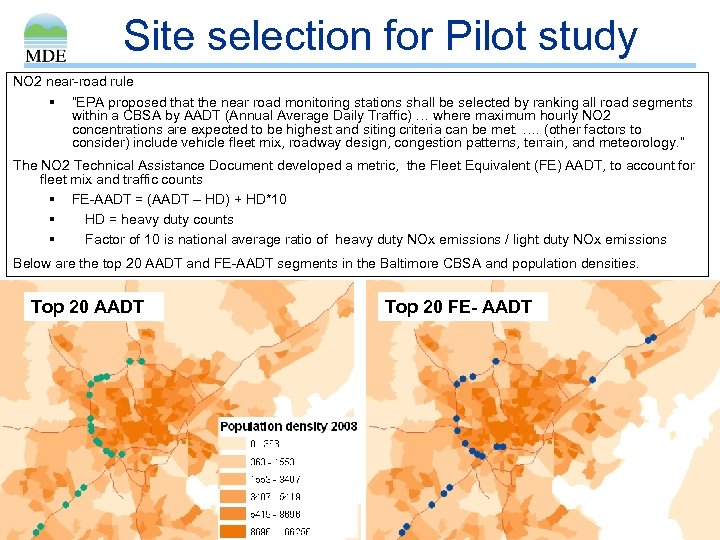 Site selection for Pilot study NO 2 near-road rule § “EPA proposed that the near road monitoring stations shall be selected by ranking all road segments within a CBSA by AADT (Annual Average Daily Traffic) … where maximum hourly NO 2 concentrations are expected to be highest and siting criteria can be met. …. (other factors to consider) include vehicle fleet mix, roadway design, congestion patterns, terrain, and meteorology. ” The NO 2 Technical Assistance Document developed a metric, the Fleet Equivalent (FE) AADT, to account for fleet mix and traffic counts § FE-AADT = (AADT – HD) + HD*10 § HD = heavy duty counts § Factor of 10 is national average ratio of heavy duty NOx emissions / light duty NOx emissions Below are the top 20 AADT and FE-AADT segments in the Baltimore CBSA and population densities. Top 20 AADT Top 20 FE- AADT
 Comparing AADT to FE-AADT rank
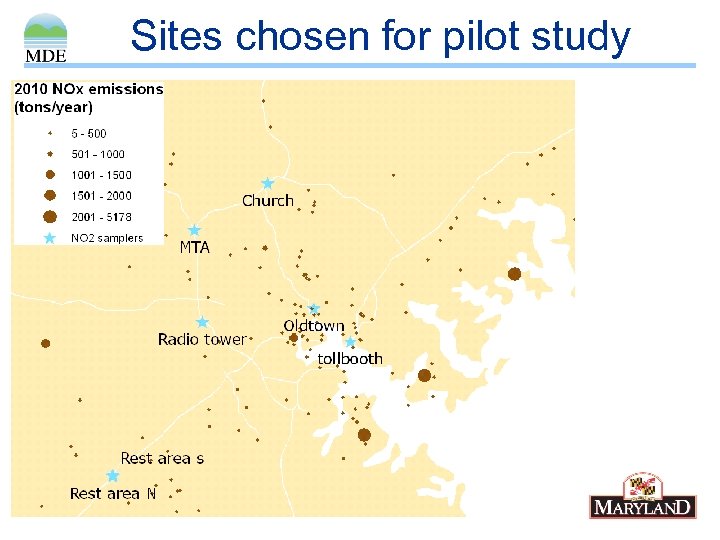 Sites chosen for pilot study
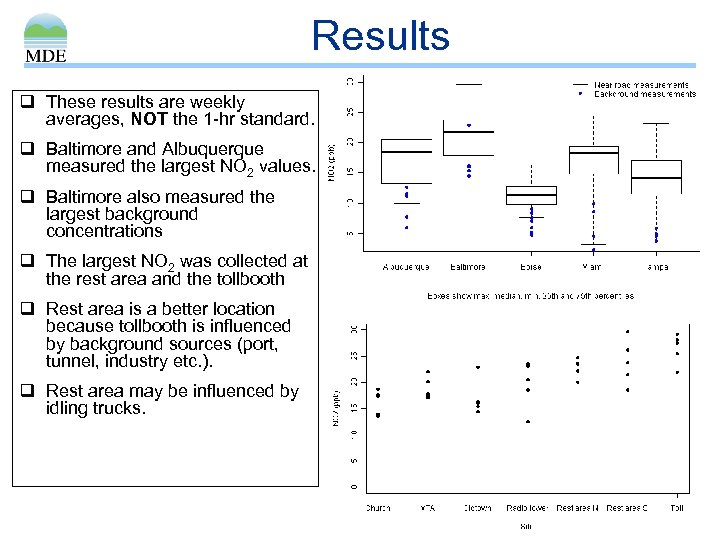 Results q These results are weekly averages, NOT the 1 -hr standard. q Baltimore and Albuquerque measured the largest NO 2 values. q Baltimore also measured the largest background concentrations q The largest NO 2 was collected at the rest area and the tollbooth q Rest area is a better location because tollbooth is influenced by background sources (port, tunnel, industry etc. ). q Rest area may be influenced by idling trucks.
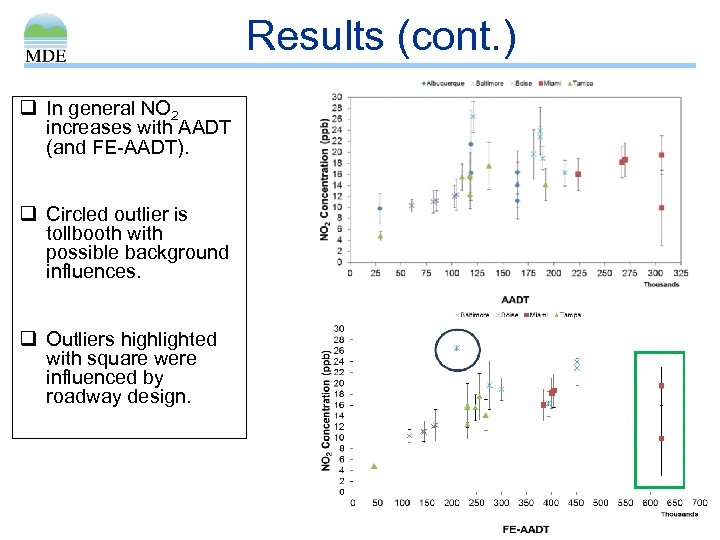 Results (cont. ) q In general NO 2 increases with AADT (and FE-AADT). q Circled outlier is tollbooth with possible background influences. q Outliers highlighted with square were influenced by roadway design.
 Near road pilot study extension q We found slightly higher NO 2 at the tollbooth site than at the rest area site. This is likely due to background sources. q Our plans are to locate a permanent monitor at the rest area site.