


 Скачать презентацию Department of Political and Social Sciences Education as
7ad882ae07844621f8a124317f60e87b.ppt
- Количество слайдов: 32
 Department of Political and Social Sciences Education as the great equalizer? Education as a social elevator? Fabrizio Bernardi, EUI "Inequalities”
Dondena 10 -year Anniversary Workshop Milan 29/4/2016
Department of Political and Social Sciences Education as the great equalizer? Education as a social elevator? Fabrizio Bernardi, EUI "Inequalities”
Dondena 10 -year Anniversary Workshop Milan 29/4/2016
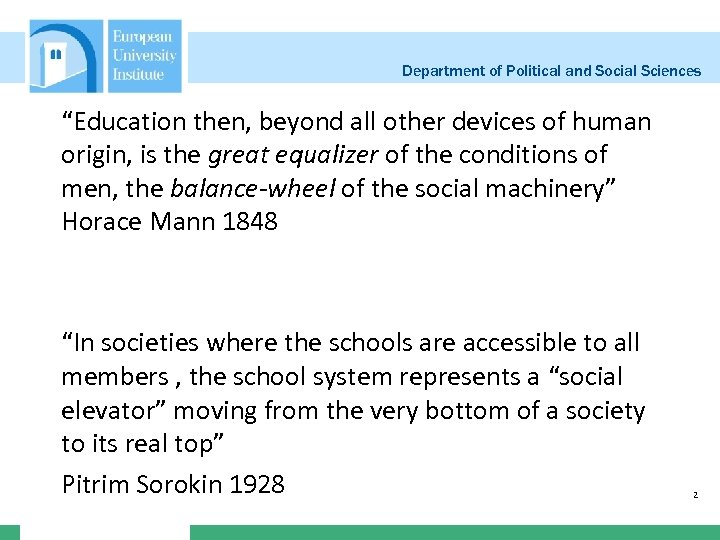 Department of Political and Social Sciences “Education then, beyond all other devices of human origin, is the great equalizer of the conditions of men, the balance-wheel of the social machinery” Horace Mann 1848 “In societies where the schools are accessible to all members , the school system represents a “social elevator” moving from the very bottom of a society to its real top” Pitrim Sorokin 1928 2
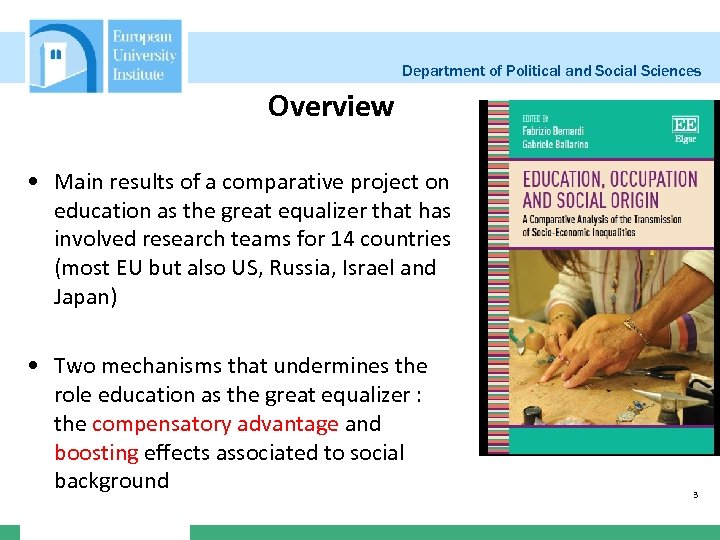 Department of Political and Social Sciences Overview • Main results of a comparative project on education as the great equalizer that has involved research teams for 14 countries (most EU but also US, Russia, Israel and Japan) • Two mechanisms that undermines the role education as the great equalizer : the compensatory advantage and boosting effects associated to social background 3
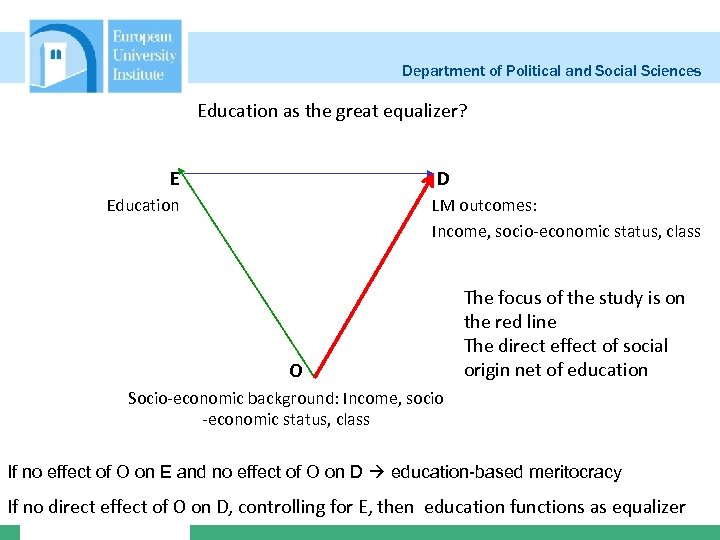 Department of Political and Social Sciences Education as the great equalizer? E D Education LM outcomes: Income, socio-economic status, class O The focus of the study is on the red line The direct effect of social origin net of education Socio-economic background: Income, socio -economic status, class If no effect of O on E and no effect of O on D education-based meritocracy If no direct effect of O on D, controlling for E, then education functions as equalizer
 Department of Political and Social Sciences Research questions 1. Is there a direct effect of social origins (DESO) on labour market success over and above the effect of own education? Also critical case to test the education based meritocracy claim 1. Does DESO vary depending on the level of education achieved and, more precisely, is it weaker among those with higher education? 5
 Department of Political and Social Sciences Why a direct of effect of social origin (DESO)? 5 possible mechanisms: • differences in productivity; non-cognitive skills (eg. , communication skills) or personality characteristics (eg. , assertiveness) not captured by education • Social networks: access to information • Career aspirations; those from higher social standing are more careeroriented and more willing and able to take risky choice that, later on, pay off in terms of higher earnings. • Favouritism refers to employers’ preferences to hire for better jobs those who come from high SES families, all other conditions being equal and/or direct influence of the parents. • direct inheritance of the family business. 6
 Department of Political and Social Sciences RQ 2: A weaker effect of social origin among those with higher education? Is university education the great equalizer? – More meritocratic labour market for university degree holders (Hout 1988); less favouritism, social networks – Life course effect; less social networks – Positive selection of those with working class origins; unobserved productivity 7
 Department of Political and Social Sciences Variables and methods Dependent variables: ISEI (International socio-economic index; 90= Judge, 16 farm labourer) and earnings (net and log) – Earnings: trends toward increasing inequality within occupations – Occupation based measure (ISEI): less measurement error, better predictor of life-chances and life-long earnings Key independent variables: Parental ISEI (dominance principle) Own education (defined with most detailed classification in each country) but no correlation between #levels and size of DESO Control for gender, age (and self-employment) 8
 Department of Political and Social Sciences Variables and methods • We focus on the first and current job. In the analysis for current job we control for age and age squared. • Models: OLS and quantile regression for earnings • Age selection 28 -65. 9
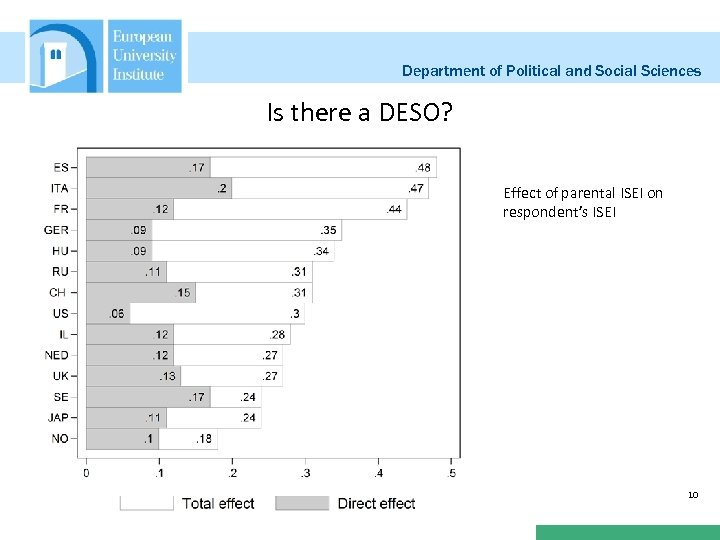 Department of Political and Social Sciences Is there a DESO? Effect of parental ISEI on respondent’s ISEI 10
 Department of Political and Social Sciences Father-son gross association for occupational status is btw. 2 and. 4 in all countries. When education is controlled for (grey bars), the association decreases by 1/2 to 3/4. So the main impact of family background goes through education. However, the remaining direct effect is not trivial. In most countries DESO lies between. 10 and. 15. 11
 Department of Political and Social Sciences A 65 points variation in parental ISEI (i. e. having a parent who is a medical doctor instead of an unskilled worker) is associated on average with an increase of 6 -10 points in own ISEI, net of achieved education. Such a difference is the one separating, for instance, a university professor from a high school one, or a taxi driver from a windows cleaner. 12
 Department of Political and Social Sciences Some benchmarking: In US, net of education being black is associated on average to 4 ISEI points penalty. In Norway, Spain, the UK, net of education the gender penalty is 2 ISEI points. Gender and race inequalities receive (rightly) a lot of attention from research and policymakers, while social background inequality often is overlooked 13
 Department of Political and Social Sciences Results concerning earnings are less clear, because of measurement problems: family income (US)/individual income; annual (France)/monthly (UK); gross (NO)/net (UK) etc. However, a DESO on (log)earnings is found in all countries (Except Israel and Germany). Its magnitude varies btw. 005 and. 0005, with a number of countries (eg Spain and UK) around. 003. In this case, a difference in parental ISEI of 65 points (medical doctor versus unskilled labourer), is associated to an increase in monthly earnings of about 20% (65*. 003). For instance: 1. 500€ + 300€. Again, not a trivial difference. 14
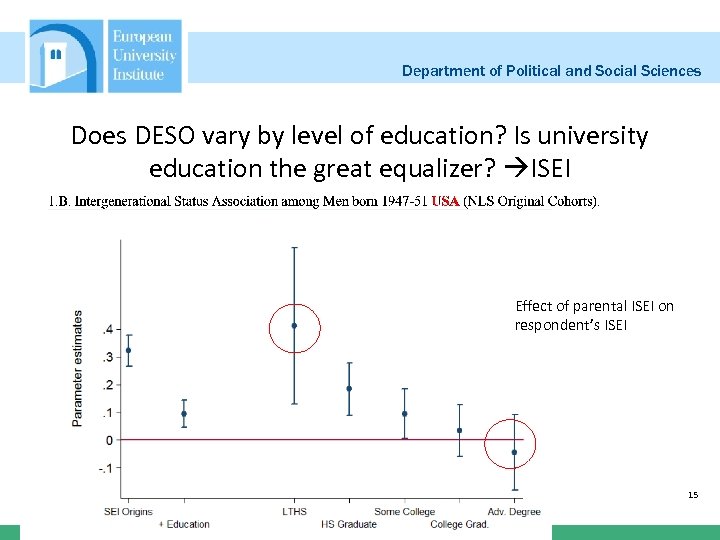 Department of Political and Social Sciences Does DESO vary by level of education? Is university education the great equalizer? ISEI Effect of parental ISEI on respondent’s ISEI 15
 Department of Political and Social Sciences 16
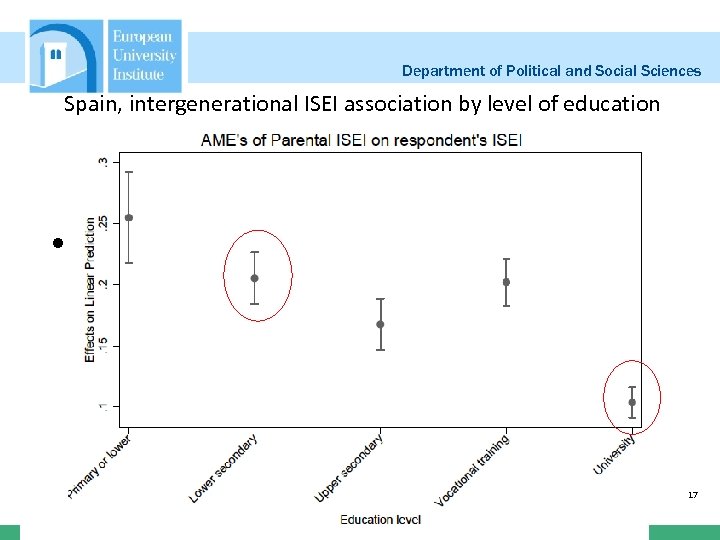 Department of Political and Social Sciences Spain, intergenerational ISEI association by level of education • Here spain 17
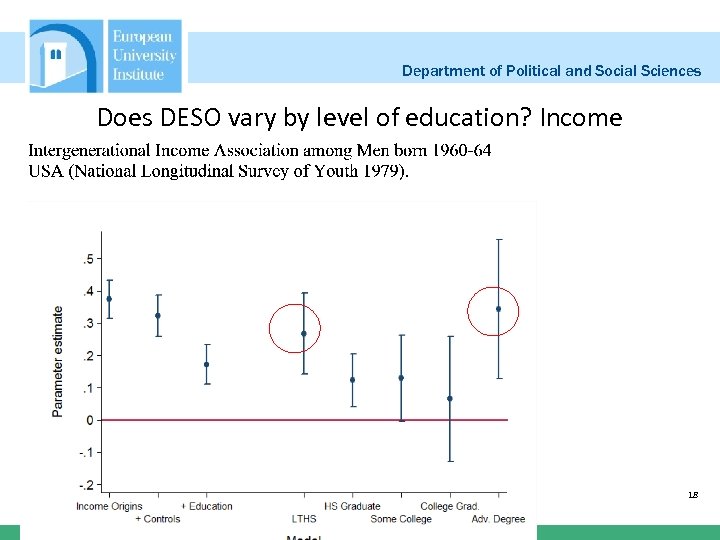 Department of Political and Social Sciences Does DESO vary by level of education? Income 18
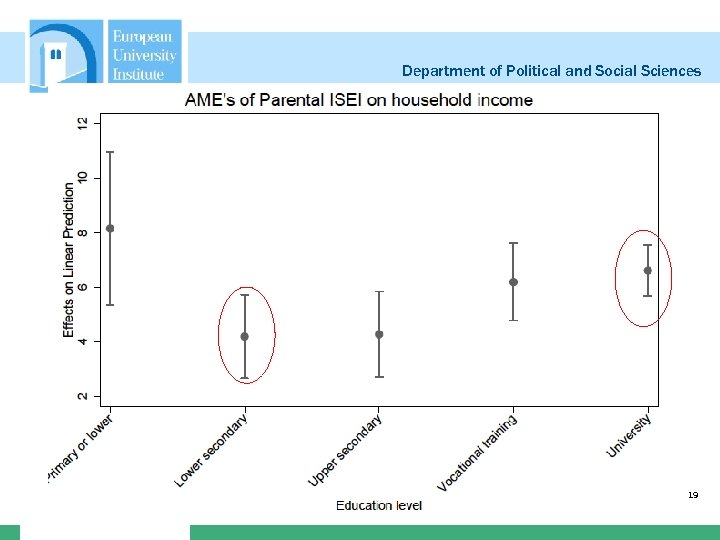 Department of Political and Social Sciences Household income; Spain 19
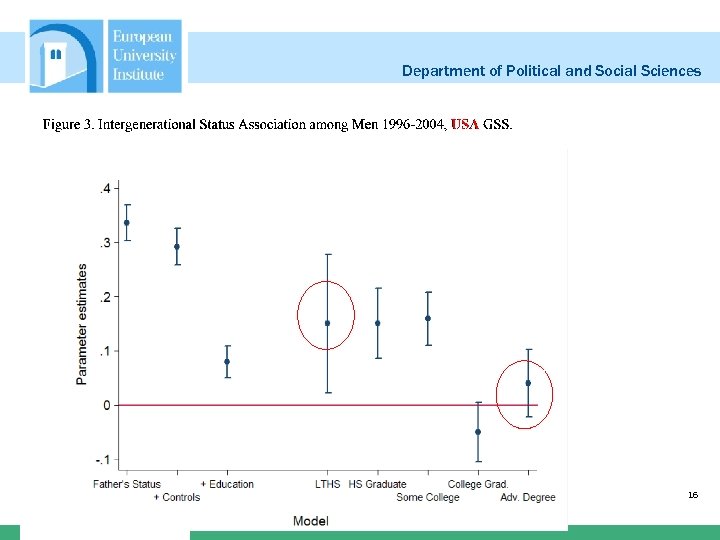
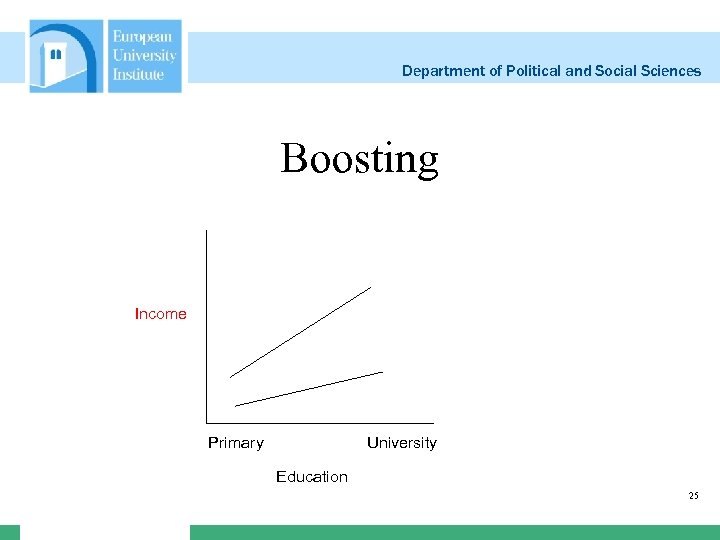
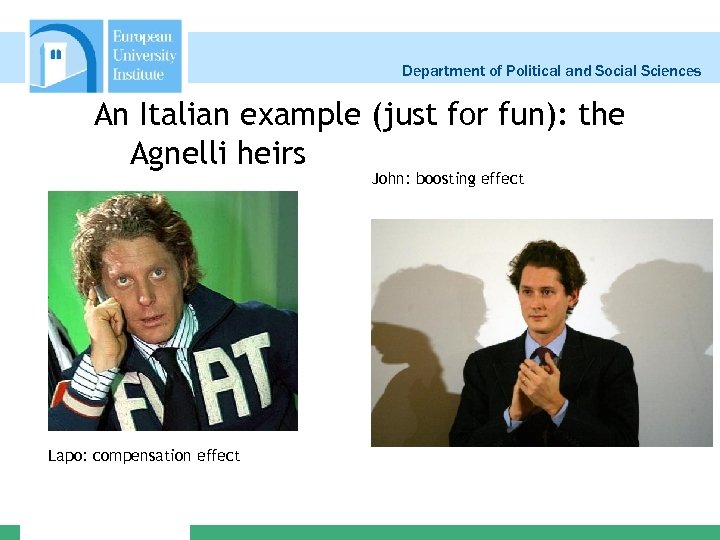
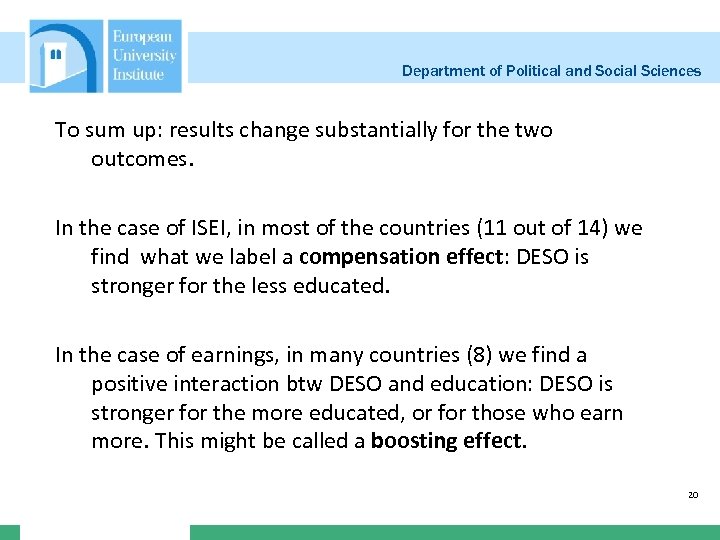 Department of Political and Social Sciences To sum up: results change substantially for the two outcomes. In the case of ISEI, in most of the countries (11 out of 14) we find what we label a compensation effect: DESO is stronger for the less educated. In the case of earnings, in many countries (8) we find a positive interaction btw DESO and education: DESO is stronger for the more educated, or for those who earn more. This might be called a boosting effect. 20
 Department of Political and Social Sciences With respect to the idea that market for university degree holders is more meritocratii, we take a different view. Social mobility theories: 1. Downward mobility avoidance (Boudon) 2. Effectively maintained inequality (Lucas) 1. Stronger DESO among subjects with low educational attainment to avoid downward mobility compensatory effect 2. Stronger DESO among those with high educational attainment to maximize returns boosting effect 21
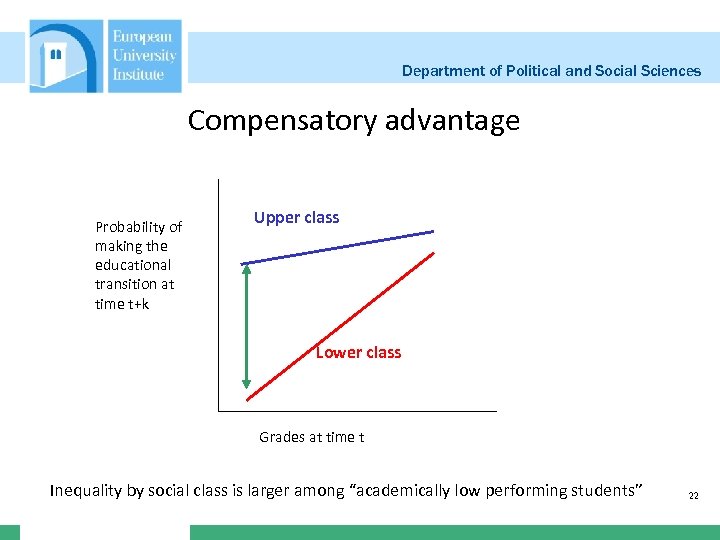 Department of Political and Social Sciences Compensatory advantage Probability of making the educational transition at time t+k Upper class Lower class Grades at time t Inequality by social class is larger among “academically low performing students” 22
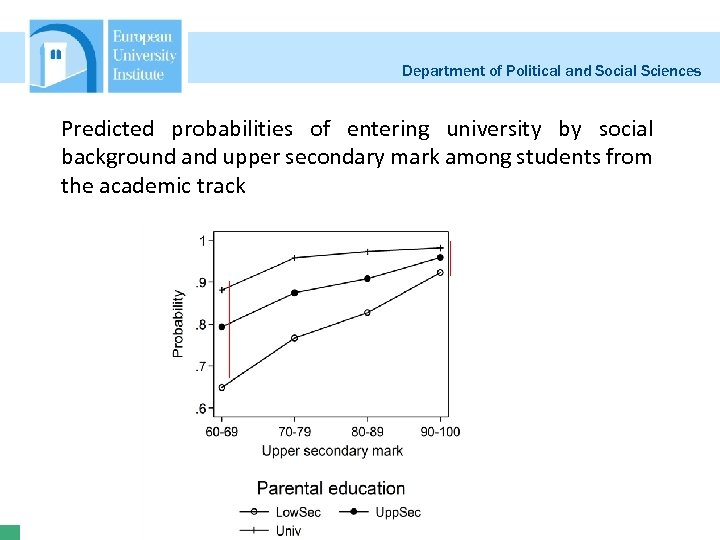 Department of Political and Social Sciences Predicted probabilities of entering university by social background and upper secondary mark among students from the academic track 23
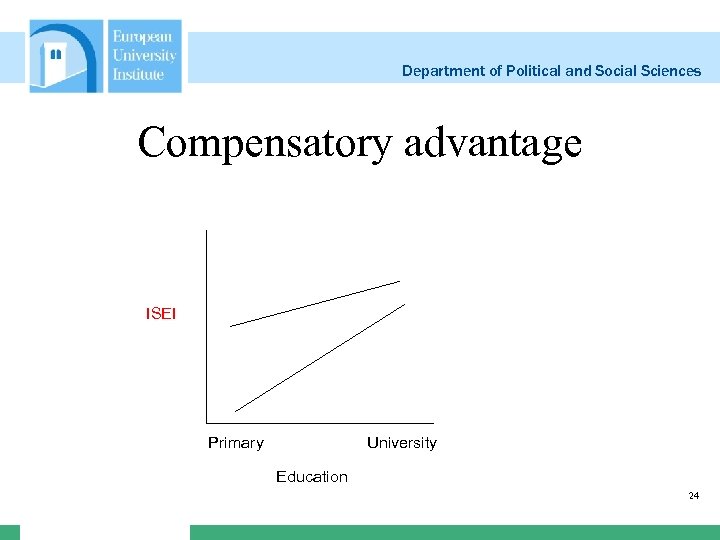 Department of Political and Social Sciences Compensatory advantage ISEI Primary University Education 24
 Department of Political and Social Sciences Boosting Income Primary University Education 25
 Department of Political and Social Sciences An Italian example (just for fun): the Agnelli heirs John: boosting effect Lapo: compensation effect
 Conclusions Department of Political and Social Sciences • Our results question the idea of education as great equalizer and social elevator • For low educational achievers from better-off families, the elevators still moves up some floors and allow them to avoid downward mobility and to reach more “decent” occupations • In case of high educational attainment, those from better off families profit from a boosting effect in terms of income 27
 Department of Political and Social Sciences • School and university perform many major societal functions • But they can not alone win the battle for more equality/efficiency 28
 Department of Political and Social Sciences Thank you! 29
 Department of Political and Social Sciences • A new analysis for Spain based on parental occupation fixed effect” (166 occupations) 30
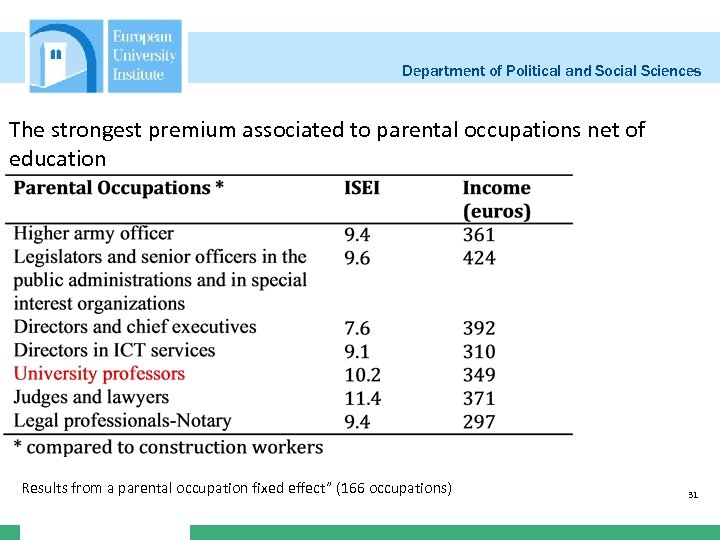 Department of Political and Social Sciences The strongest premium associated to parental occupations net of education Results from a parental occupation fixed effect” (166 occupations) 31
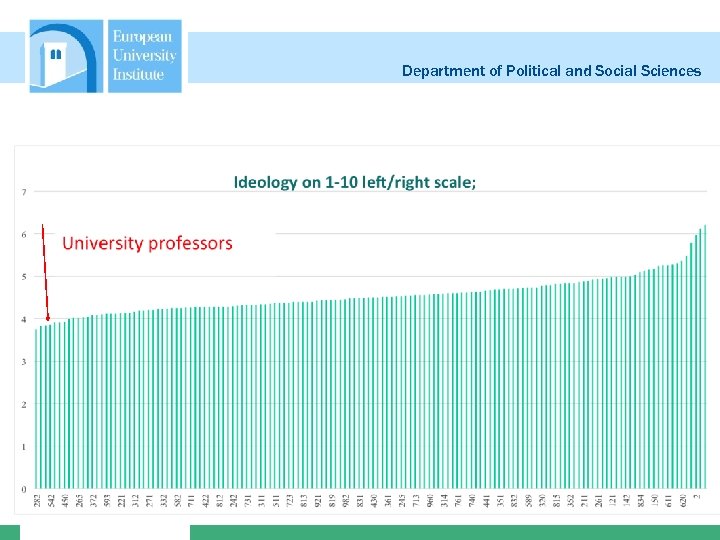 Department of Political and Social Sciences 32