


 Скачать презентацию Department of Mechanical Engineering The University of Sheffield
Hodzic Cytec Summit Giic presentation Sep 2009.ppt
- Количество слайдов: 40
 Department of Mechanical Engineering The University of Sheffield Stress analysis versus modes of fracture in composites Dr. Alma Hodzic Composite Systems Innovation Centre Aerospace Engineering, Department of Mechanical Engineering a. hodzic@sheffield. ac. uk 1
 Location 2
 3 Ø Major long-term Industrial partnerships with: Rolls-Royce Airbus Boeing BAe Systems DSTL European Space Agency EADS Smiths Industries Glaxo. Smith. Kline ICI, Unilever Astra. Zeneca, Novartis, Qineti. Q, IBM…. Cytec Engineered Materials
 Faculty of Engineering Ø Automatic Control & Systems Engineering (5*A) Ø Electronic and Electrical Engineering (5*A) Ø Engineering Materials (5*A) Ø Mechanical Engineering (5 A) • Aerospace Engineering Ø Computer Science (5 B) Ø Civil and Structural Engineering (5 B) Ø Chemical and Process Engineering (4 B) Ø The total research income > £ 40 mil pa 4
 RR UTCs, AMRC and Cam. Tec Ø Four R-R UTCs are located at Uo. S ØAdvanced Manufacturing Centre with Boeing ØCAMTe. C with Boeing 5
 The Polymer Centre ØEstablished in June 2001 Ø 41 Academic staff, >140 Researchers ØMore than £ 12 M funding Focus on Speciality Polymers q. Synthesis q. Structure q. Properties q. Processing q. Characterisation q. Applications 6
 Home of the Composites Group The Kroto Research Institute: A £ 20 M multidisciplinary investment The Kroto Research Institute 7
![Giic Summit Problem Statement 8 Crack running in the INTERLAMINAR region [Desired] Crack running](https://present5.com/presentation/430264356_449857749/image-8.jpg "Giic Summit Problem Statement 8 Crack running in the INTERLAMINAR region [Desired] Crack running") Giic Summit Problem Statement 8 Crack running in the INTERLAMINAR region [Desired] Crack running in the INTRALAMINAR region [Undesired] • We have found out that some particles are able to deliver excellent toughening as constantly demonstrated by the superior CAI and low damage area that can be achieved using this technology, if compared with standard commercial interlaminar particles. • However, despite the good CAI, Giic performance could not be improved consistently. • What can we do to keep the crack in the interlaminar region?
Giic Summit Problem Statement 8 Crack running in the INTERLAMINAR region [Desired] Crack running in the INTRALAMINAR region [Undesired] • We have found out that some particles are able to deliver excellent toughening as constantly demonstrated by the superior CAI and low damage area that can be achieved using this technology, if compared with standard commercial interlaminar particles. • However, despite the good CAI, Giic performance could not be improved consistently. • What can we do to keep the crack in the interlaminar region?
 Key Questions 1. Why is the crack slipping from the interlaminar region to the intralaminar region? What is the main cause for this to happen? 1. 2. 3. 4. 2. Is our interlaminar region “too tough”? Is the modulus of our particles too high or inadequate? Can the fibre matrix interface strength be playing a role? Is it related to test? (We are using the ENF method, to evaluate Giic – we know that propagation is not stable). If the test is important why do some materials work better than others? What happens in real life? 1. 2. 3. 9 How does the Giic test method (ENF) compare with real life structure problems (i. e. cobonded structures/ structures having radii…etc. )? How does Giic correlate to other properties? Literature provides correlations to CAI (that in our case does not seem to apply). What about Gic, ILS, CILS? How should our particles and resin be designed to maximise Giic while keeping the balance of the other properties?
 10 Question • How is the laminate stress related to fracture toughness?
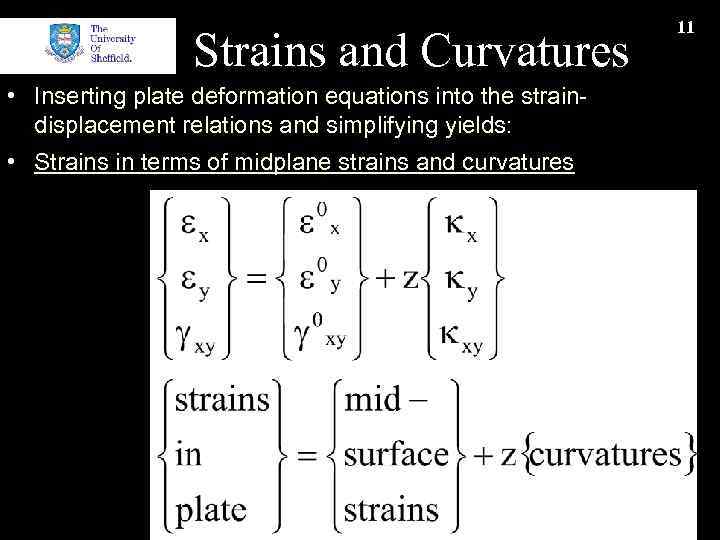 Strains and Curvatures • Inserting plate deformation equations into the straindisplacement relations and simplifying yields: • Strains in terms of midplane strains and curvatures 11
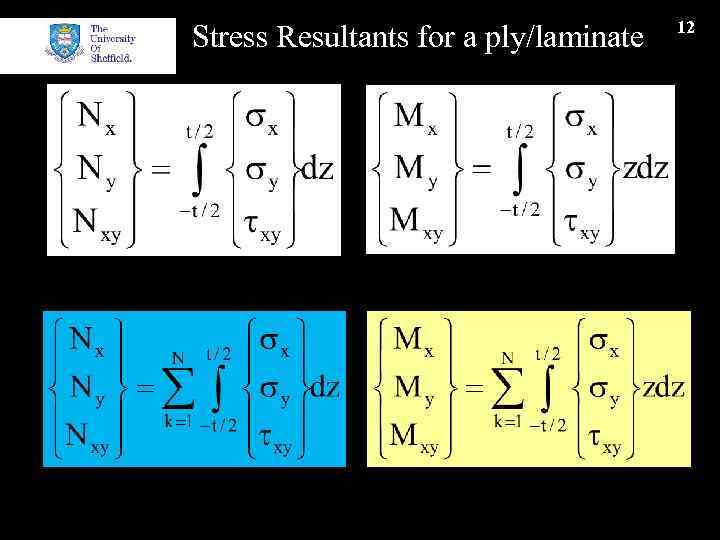 Stress Resultants for a ply/laminate 12
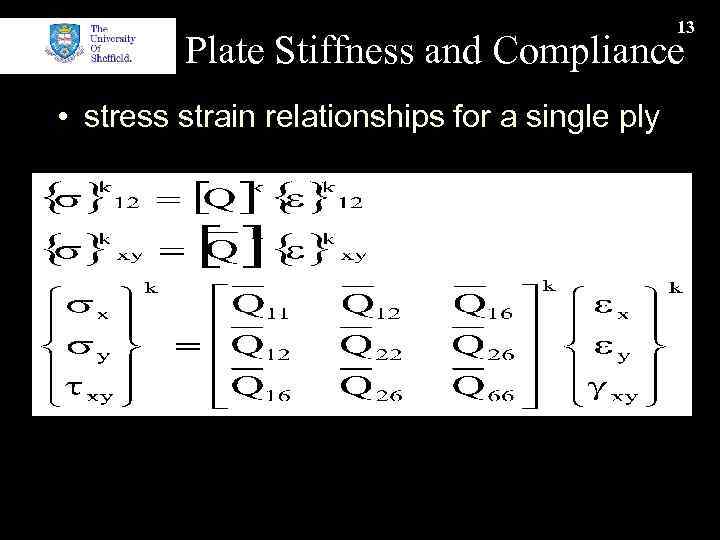 13 Plate Stiffness and Compliance • stress strain relationships for a single ply
 Laminate Stiffness and Compliance • Inserting plate stiffness relationships into laminate stress and moment resultant equations in terms of strains and curvatures 14
 ABD Matrices Ü Coefficients 15 Aij, Bij, Dij are functions of thickness, orientation, stacking sequence and material properties of each layer Ü [A] =in-plane stiffness matrix Ü [D] = bending stiffness • where i, j =1, 2, 6 matrix • zk is the coordinate of the top and bottom of ply surface Ü [B] =bending-extension • 18 Constants coupling matrix
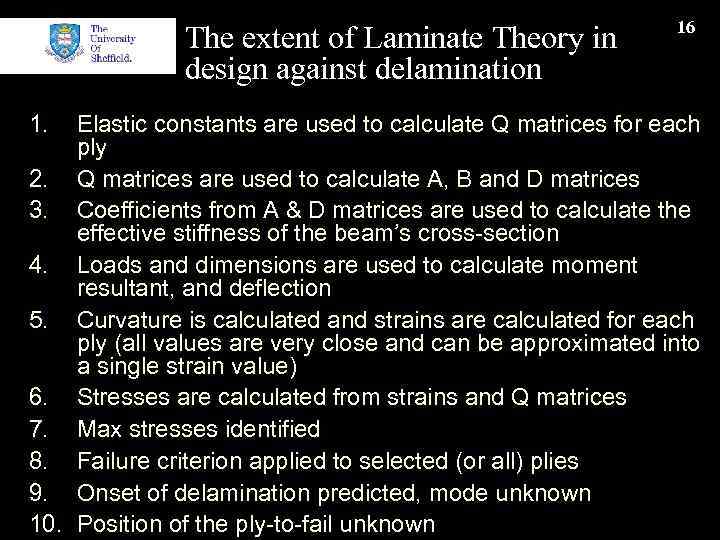 The extent of Laminate Theory in design against delamination 1. 16 Elastic constants are used to calculate Q matrices for each ply 2. Q matrices are used to calculate A, B and D matrices 3. Coefficients from A & D matrices are used to calculate the effective stiffness of the beam’s cross-section 4. Loads and dimensions are used to calculate moment resultant, and deflection 5. Curvature is calculated and strains are calculated for each ply (all values are very close and can be approximated into a single strain value) 6. Stresses are calculated from strains and Q matrices 7. Max stresses identified 8. Failure criterion applied to selected (or all) plies 9. Onset of delamination predicted, mode unknown 10. Position of the ply-to-fail unknown
 17 Question • What is a crack, what are the parameters of crack propagation?
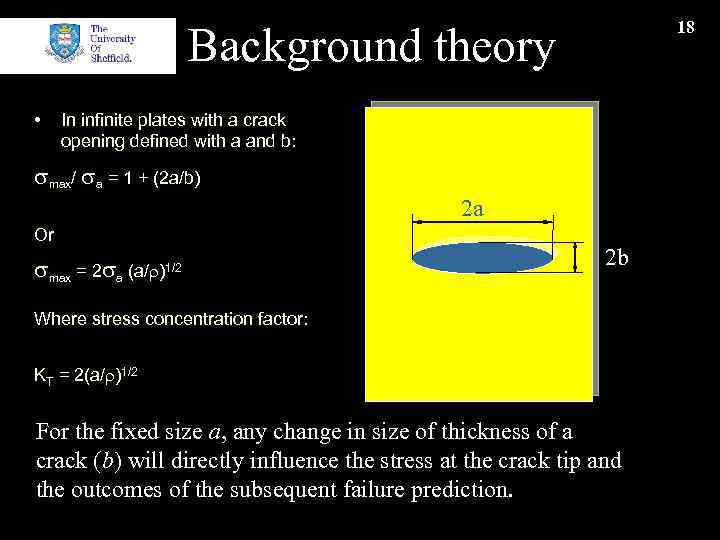 18 Background theory • In infinite plates with a crack opening defined with a and b: smax/ sa = 1 + (2 a/b) 2 a Or smax = 2 sa (a/r)1/2 2 b Where stress concentration factor: KT = 2(a/r)1/2 For the fixed size a, any change in size of thickness of a crack (b) will directly influence the stress at the crack tip and the outcomes of the subsequent failure prediction.
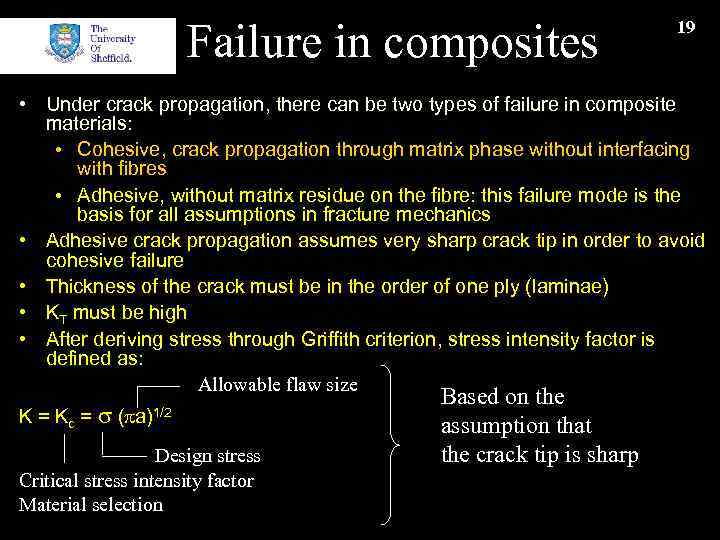 Failure in composites 19 • Under crack propagation, there can be two types of failure in composite materials: • Cohesive, crack propagation through matrix phase without interfacing with fibres • Adhesive, without matrix residue on the fibre: this failure mode is the basis for all assumptions in fracture mechanics • Adhesive crack propagation assumes very sharp crack tip in order to avoid cohesive failure • Thickness of the crack must be in the order of one ply (laminae) • KT must be high • After deriving stress through Griffith criterion, stress intensity factor is defined as: Allowable flaw size K = Kc = s (pa)1/2 Design stress Critical stress intensity factor Material selection Based on the assumption that the crack tip is sharp
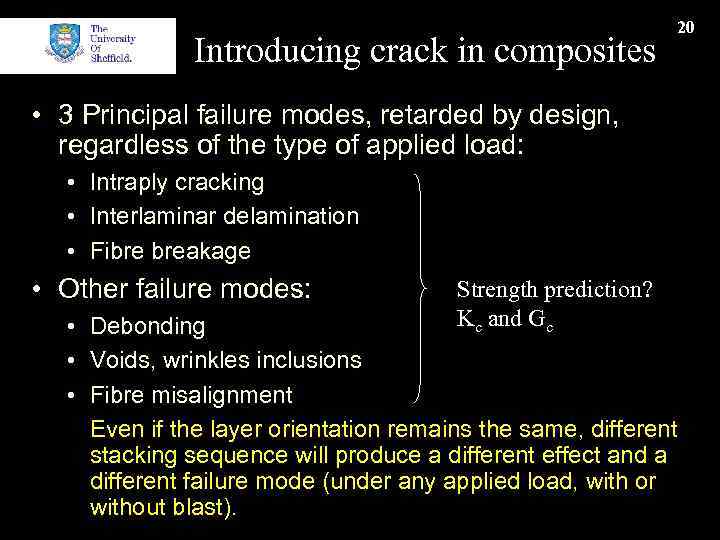 Introducing crack in composites 20 • 3 Principal failure modes, retarded by design, regardless of the type of applied load: • Intraply cracking • Interlaminar delamination • Fibre breakage • Other failure modes: Strength prediction? Kc and Gc • Debonding • Voids, wrinkles inclusions • Fibre misalignment Even if the layer orientation remains the same, different stacking sequence will produce a different effect and a different failure mode (under any applied load, with or without blast).
 Delamination • Major life-limiting failure process in composite laminate • Produced by: • Out-of-plane loading • Eccentricities in load paths • Discontinuities in the structure • Consequences: • Stiffness loss • Local stress concentration • Local instability Buckling failure under compression 21
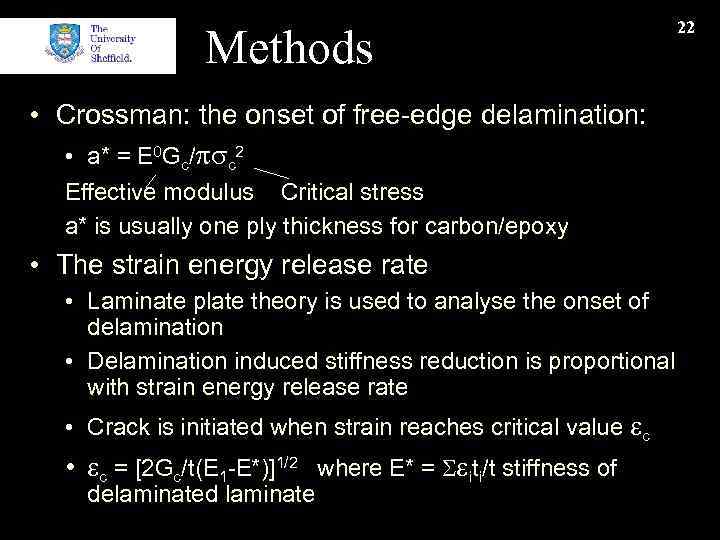 Methods • Crossman: the onset of free-edge delamination: • a* = E 0 Gc/psc 2 Effective modulus Critical stress a* is usually one ply thickness for carbon/epoxy • The strain energy release rate • Laminate plate theory is used to analyse the onset of delamination • Delamination induced stiffness reduction is proportional with strain energy release rate • Crack is initiated when strain reaches critical value ec • ec = [2 Gc/t(E 1 -E*)]1/2 where E* = Seiti/t stiffness of delaminated laminate 22
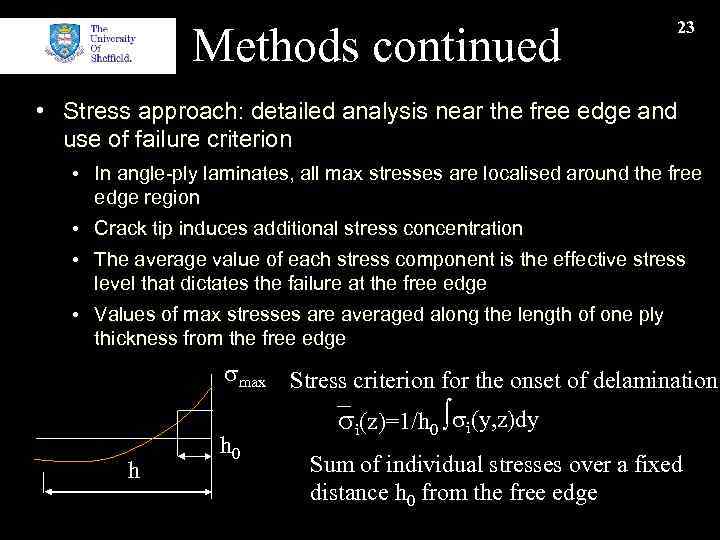 Methods continued 23 • Stress approach: detailed analysis near the free edge and use of failure criterion • In angle-ply laminates, all max stresses are localised around the free edge region • Crack tip induces additional stress concentration • The average value of each stress component is the effective stress level that dictates the failure at the free edge • Values of max stresses are averaged along the length of one ply thickness from the free edge smax h h 0 Stress criterion for the onset of delamination si(z)=1/h 0 si(y, z)dy Sum of individual stresses over a fixed distance h 0 from the free edge
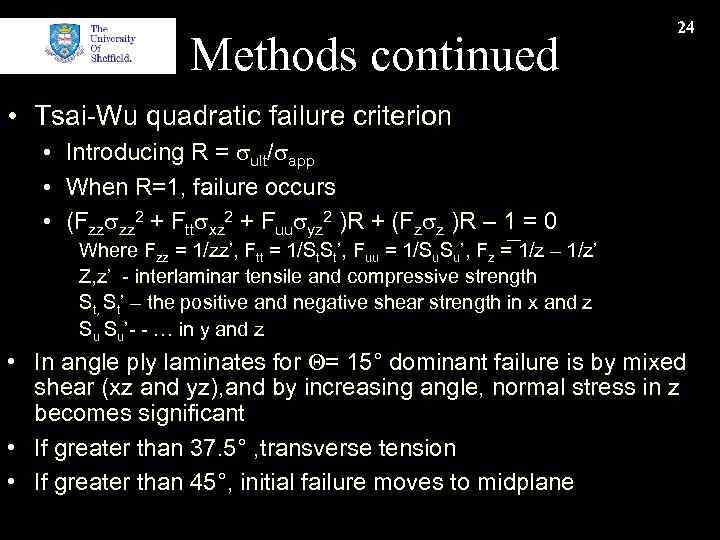 Methods continued 24 • Tsai-Wu quadratic failure criterion • Introducing R = sult/sapp • When R=1, failure occurs • (Fzzszz 2 + Fttsxz 2 + Fuusyz 2 )R + (Fzsz )R – 1 = 0 Where Fzz = 1/zz’, Ftt = 1/St. St’, Fuu = 1/Su. Su’, Fz = 1/z – 1/z’ Z, z’ - interlaminar tensile and compressive strength St, St’ – the positive and negative shear strength in x and z Su Su’- - … in y and z • In angle ply laminates for = 15° dominant failure is by mixed shear (xz and yz), and by increasing angle, normal stress in z becomes significant • If greater than 37. 5° , transverse tension • If greater than 45°, initial failure moves to midplane
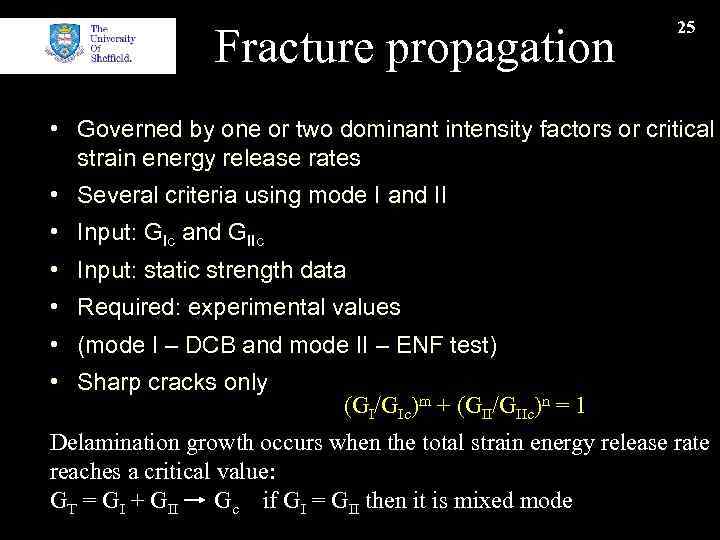 Fracture propagation 25 • Governed by one or two dominant intensity factors or critical strain energy release rates • Several criteria using mode I and II • Input: GIc and GIIc • Input: static strength data • Required: experimental values • (mode I – DCB and mode II – ENF test) • Sharp cracks only (GI/GIc)m + (GII/GIIc)n = 1 Delamination growth occurs when the total strain energy release rate reaches a critical value: GT = GI + GII Gc if GI = GII then it is mixed mode
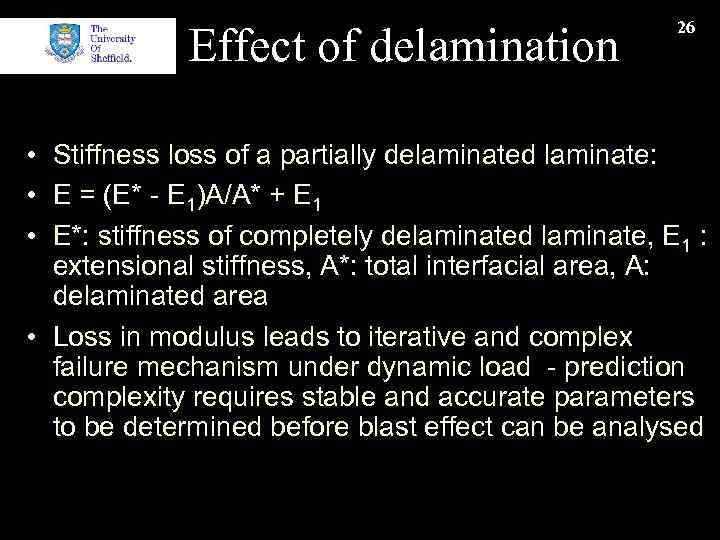 Effect of delamination 26 • Stiffness loss of a partially delaminated laminate: • E = (E* - E 1)A/A* + E 1 • E*: stiffness of completely delaminated laminate, E 1 : extensional stiffness, A*: total interfacial area, A: delaminated area • Loss in modulus leads to iterative and complex failure mechanism under dynamic load - prediction complexity requires stable and accurate parameters to be determined before blast effect can be analysed
 27 Question • Giic: is it related to the interface?
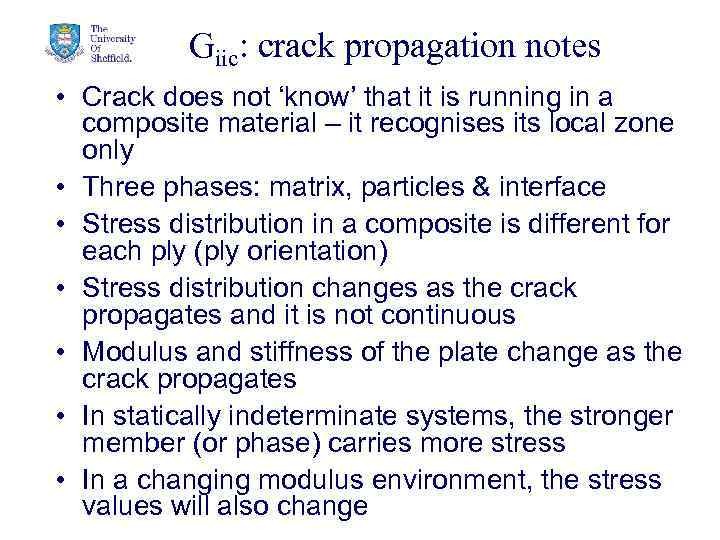 Giic: crack propagation notes 28 • Crack does not ‘know’ that it is running in a composite material – it recognises its local zone only • Three phases: matrix, particles & interface • Stress distribution in a composite is different for each ply (ply orientation) • Stress distribution changes as the crack propagates and it is not continuous • Modulus and stiffness of the plate change as the crack propagates • In statically indeterminate systems, the stronger member (or phase) carries more stress • In a changing modulus environment, the stress values will also change
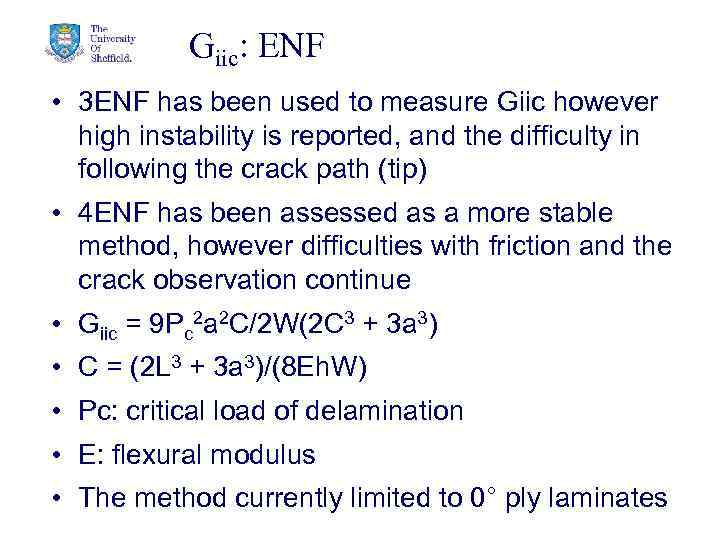 Giic: ENF • 3 ENF has been used to measure Giic however high instability is reported, and the difficulty in following the crack path (tip) • 4 ENF has been assessed as a more stable method, however difficulties with friction and the crack observation continue • Giic = 9 Pc 2 a 2 C/2 W(2 C 3 + 3 a 3) • C = (2 L 3 + 3 a 3)/(8 Eh. W) • Pc: critical load of delamination • E: flexural modulus • The method currently limited to 0° ply laminates 29
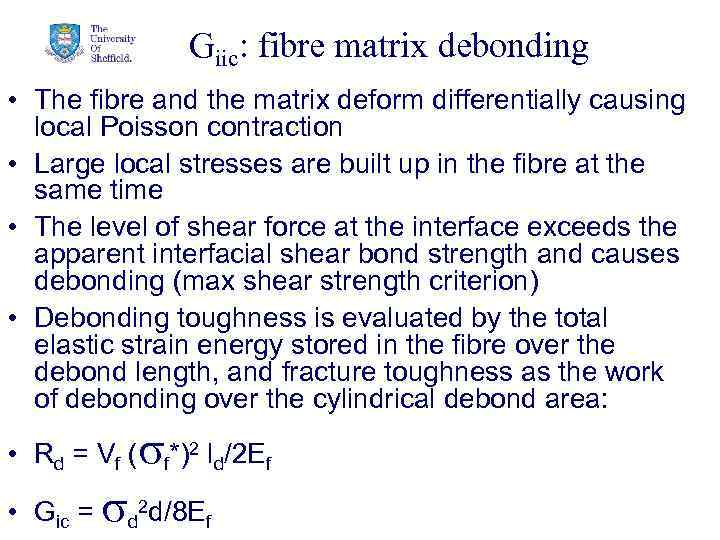 Giic: fibre matrix debonding 30 • The fibre and the matrix deform differentially causing local Poisson contraction • Large local stresses are built up in the fibre at the same time • The level of shear force at the interface exceeds the apparent interfacial shear bond strength and causes debonding (max shear strength criterion) • Debonding toughness is evaluated by the total elastic strain energy stored in the fibre over the debond length, and fracture toughness as the work of debonding over the cylindrical debond area: • Rd = Vf (sf*)2 ld/2 Ef • Gic = sd 2 d/8 Ef
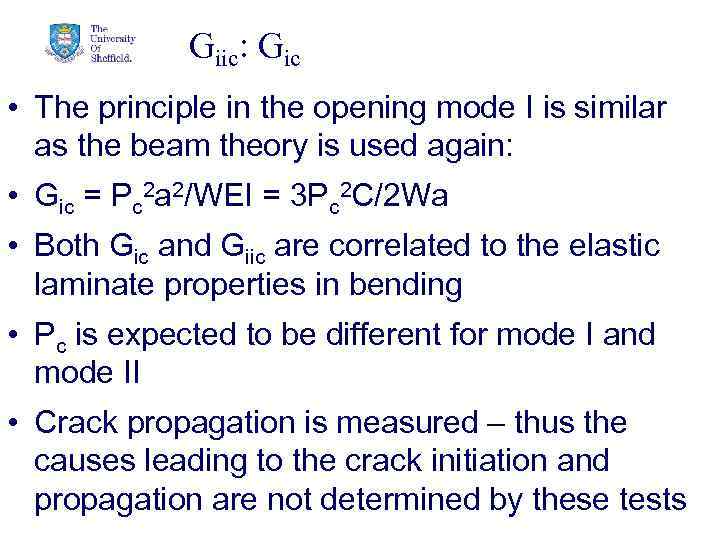 Giic: Gic 31 • The principle in the opening mode I is similar as the beam theory is used again: • Gic = Pc 2 a 2/WEI = 3 Pc 2 C/2 Wa • Both Gic and Giic are correlated to the elastic laminate properties in bending • Pc is expected to be different for mode I and mode II • Crack propagation is measured – thus the causes leading to the crack initiation and propagation are not determined by these tests
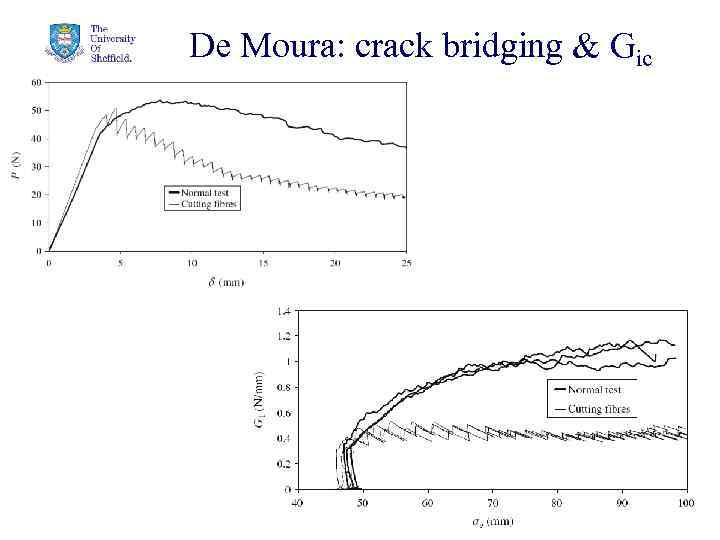 De Moura: crack bridging & Gic 32
 Giic: ENF vs. multidirectional plies 33 • Multidirectional lay-ups: crack branching and deviations from central plane observed • No dependence on the delaminating interface • Recent round-robin test report on 0/90 and angle ply laminates identified 50% invalid tests in the report due to: Deviation from the mid-plane Delamination oscillation between adjacent 0 plies Friction contribution which may vary between 2 -20% as reported in various studies Matrix cracking in angle-ply laminates introduces coupling between extension and shear
 Giic: ENF vs. Real life structures 34 • Giic reported higher for multidirectional composites, with the same initiation value • Premature yielding and intraply failure • Locally mode I dominated with 45 degree microcracks growth from the thickness direction • Contradictory data reports for angle ply laminates • In a study by Tao & Sun, delamination always ‘jumped’ to 0°/ interface in ENF
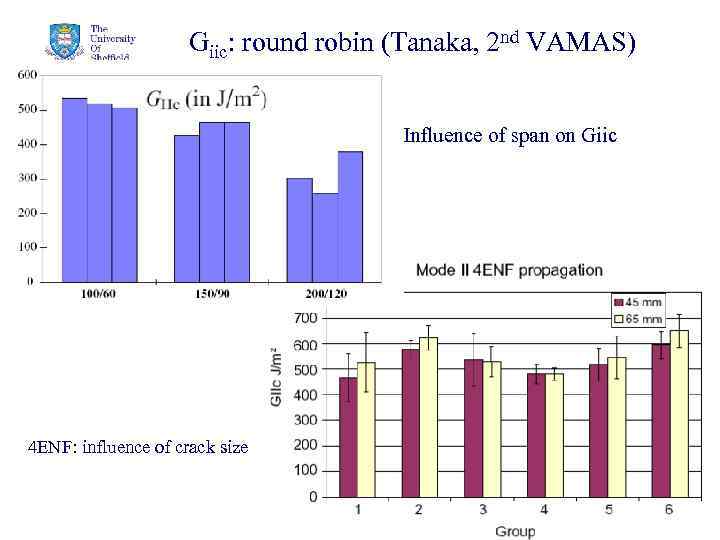 Giic: round robin (Tanaka, 2 nd VAMAS) Influence of span on Giic 4 ENF: influence of crack size 35
 Giic: Inter-intra jumping • Two adjacent lamina with two different fibre angles induce extensional and bending stiffness mismatch • In combination with the matrix, this region becomes sensitive to delamination at interfaces • Crack front propagation does not correlate to failure criteria which are ply-stress determined • Crack front is ‘attracted’ to the highest stress value in the vicinity of the crack • The zone of influence: ply thickness 36
 37 Question • Why is Giic sometimes correlated with CIA?
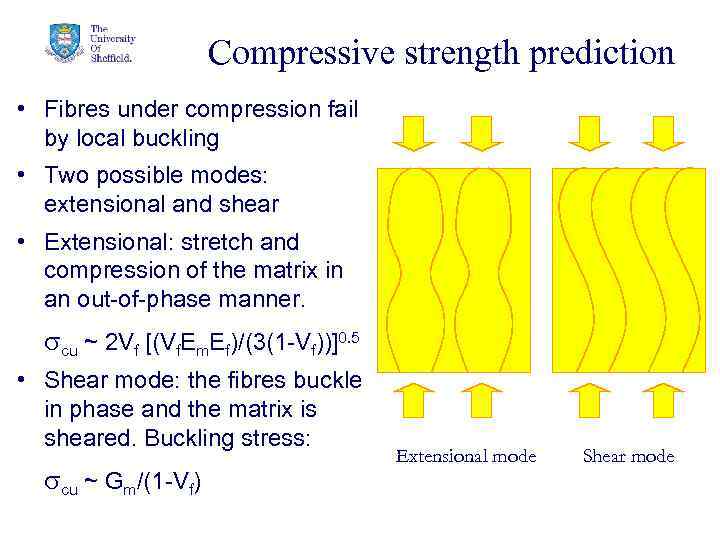 Compressive strength prediction • Fibres under compression fail by local buckling • Two possible modes: extensional and shear • Extensional: stretch and compression of the matrix in an out-of-phase manner. scu ~ 2 Vf [(Vf. Em. Ef)/(3(1 -Vf))]0. 5 • Shear mode: the fibres buckle in phase and the matrix is sheared. Buckling stress: scu ~ Gm/(1 -Vf) Extensional mode Shear mode 38
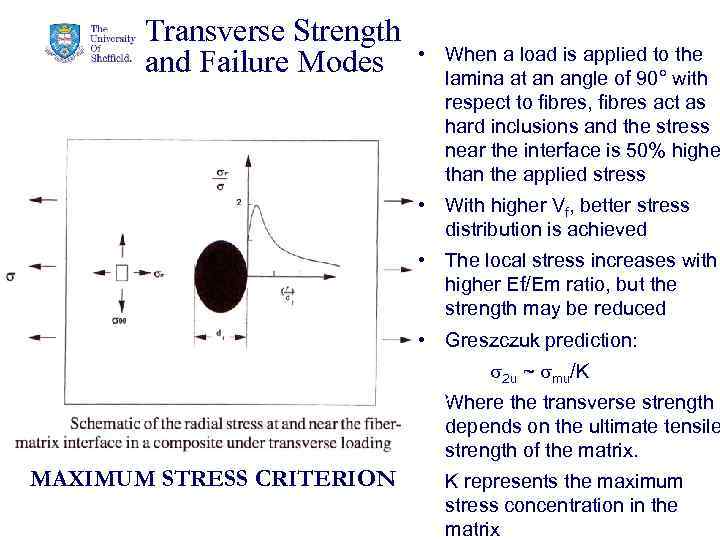 Transverse Strength and Failure Modes 39 • When a load is applied to the lamina at an angle of 90° with respect to fibres, fibres act as hard inclusions and the stress near the interface is 50% highe than the applied stress • With higher Vf, better stress distribution is achieved • The local stress increases with higher Ef/Em ratio, but the strength may be reduced • Greszczuk prediction: s 2 u ~ smu/K Where the transverse strength depends on the ultimate tensile strength of the matrix. MAXIMUM STRESS CRITERION K represents the maximum stress concentration in the matrix
 40 Points for further discussion • Can we assume the elastic properties mismatch a genuine composite phenomenon, ignore causes for intraply failure and focus on prevention by design? • Can Cytec provide any experimental data for discussion and analysis? • To prevent a complete modulus loss in a cracked lamina, should self-healing methodologies be considered?