


 Скачать презентацию Department of Industrial Employment Relations The Integration
aaef3208e236b66c1c01149549908fa6.ppt
- Количество слайдов: 86
 Department of Industrial & Employment Relations The Integration of Third Country Nationals at Their Place of Work in Malta - A Qualitative Study M. FSADNI & Associates Market Research Consultants 21 May 2014
 A The Research Brief
 Research Brief The Objective of this Research Project was twofold: a. to undertake a qualitative research study and present a research report for discussion with social partners and interested stakeholders; b. to present the qualitative research findings in a focused conference.
 B The Research Plan
 The Research Plan ` To address the research project's objectives, the Research Consultants adopted the following Research Plan: § Face-to-face Interviews with 10 Stakeholders § Face-to-face interviews with 100 Third Country Nationals (TCNs) § CATI interviews with 30 Employers of TCNs.
 The Research Plan Face-to-Face interviews with Stakeholders: § § § 4 NGOs with an interest in TCN affairs A government agency with an interest in TCN affairs An NGO representing TCN workers (Filipinos) A leading employer association A large employer who currently employs employees hailing from over 30 nationalities § An HR Manager § A leading trade union § A Sub-Saharan African TCN worker turned 'Self-Employed with Employees' (in Malta).
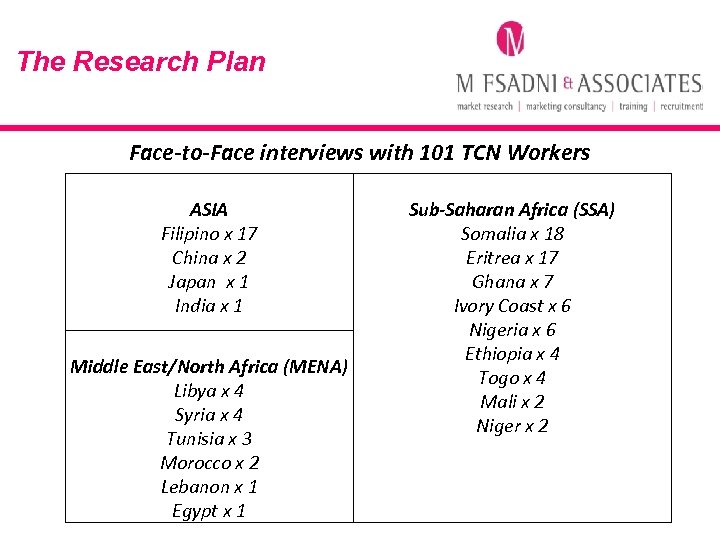 The Research Plan Face-to-Face interviews with 101 TCN Workers ASIA Filipino x 17 China x 2 Japan x 1 India x 1 Middle East/North Africa (MENA) Libya x 4 Syria x 4 Tunisia x 3 Morocco x 2 Lebanon x 1 Egypt x 1 Sub-Saharan Africa (SSA) Somalia x 18 Eritrea x 17 Ghana x 7 Ivory Coast x 6 Nigeria x 6 Ethiopia x 4 Togo x 4 Mali x 2 Niger x 2
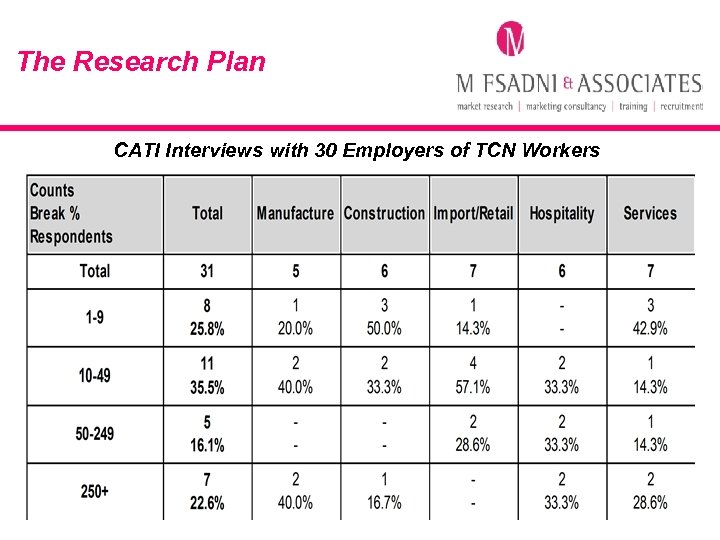 The Research Plan CATI Interviews with 30 Employers of TCN Workers
 The Research Plan Shortcomings of the Primary Research ü The Research Consultant did not encounter any significant difficulties in inviting TCN workers and local employers to participate in the study. ü The majority of TCNs approached, accepted to be interviewed. A small gift was given to each TCN respondent. ü Some 120 local companies were contacted, out of which 31 employers accepted to be interviewed. ü The employers who did not wish to be interviewed, either never employed TCN workers to date or refused to be interviewed, which is typical of the employer cohort.
 C Highlights of the Salient Findings
 Ci Respondent Profile – TCN Workers
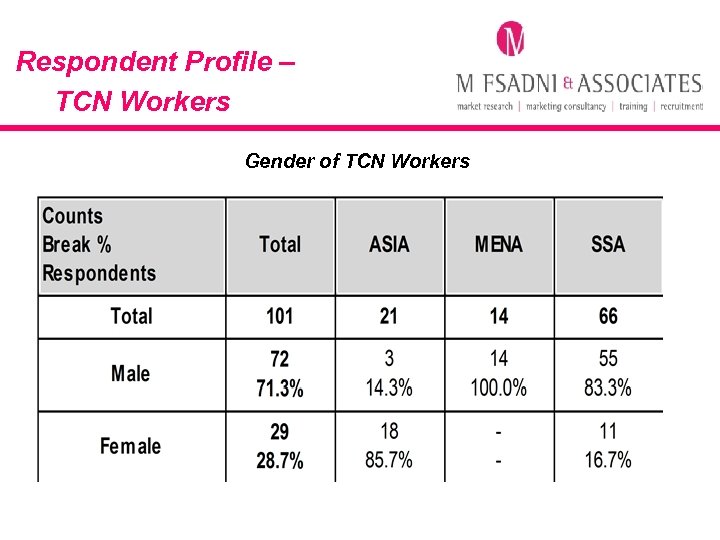 Respondent Profile – TCN Workers Gender of TCN Workers
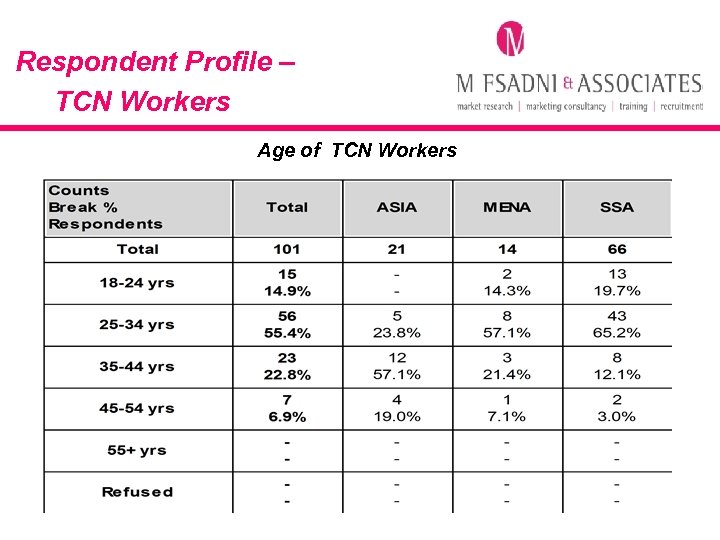 Respondent Profile – TCN Workers Age of TCN Workers
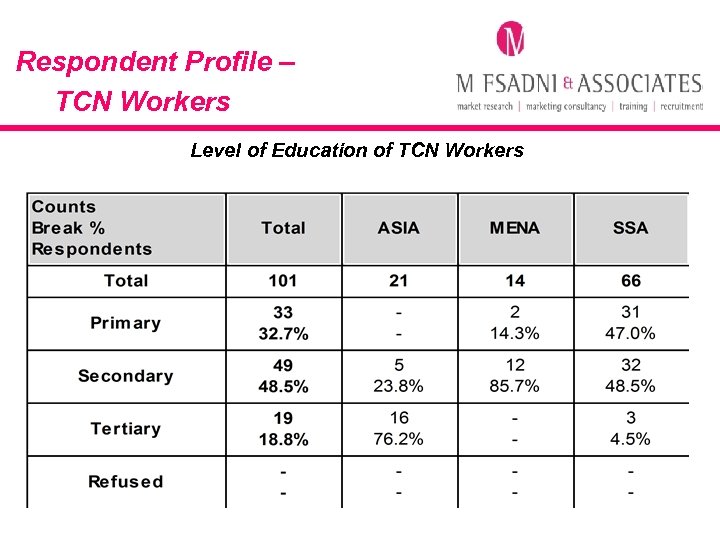 Respondent Profile – TCN Workers Level of Education of TCN Workers
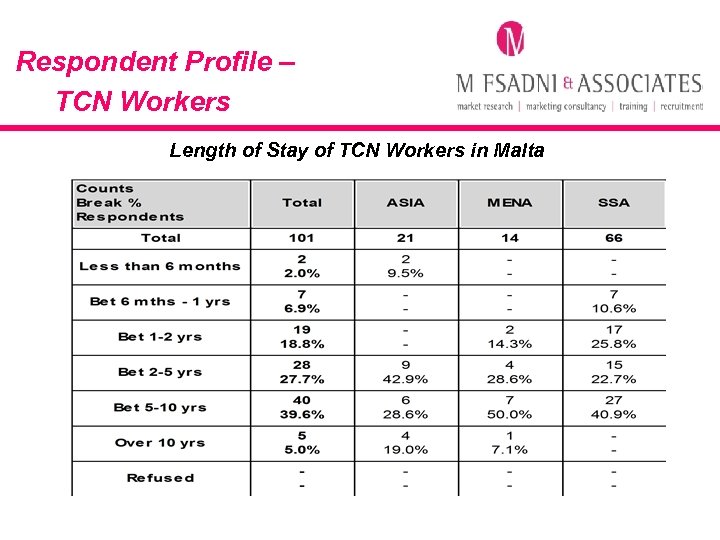 Respondent Profile – TCN Workers Length of Stay of TCN Workers in Malta
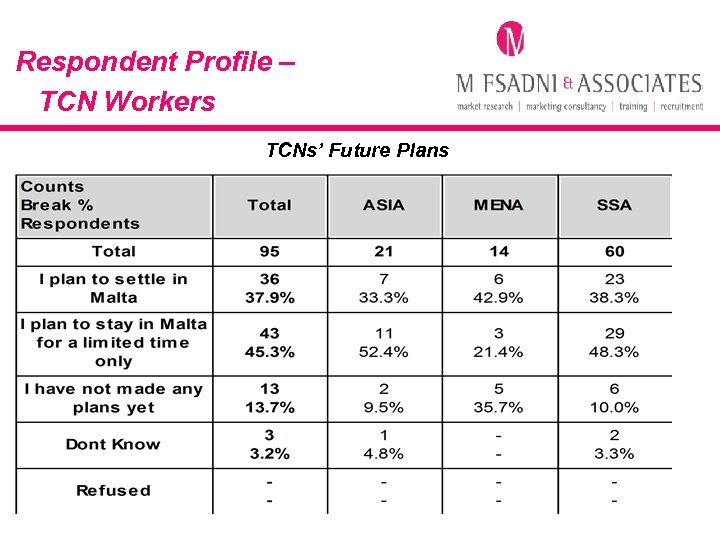 Respondent Profile – TCN Workers TCNs’ Future Plans
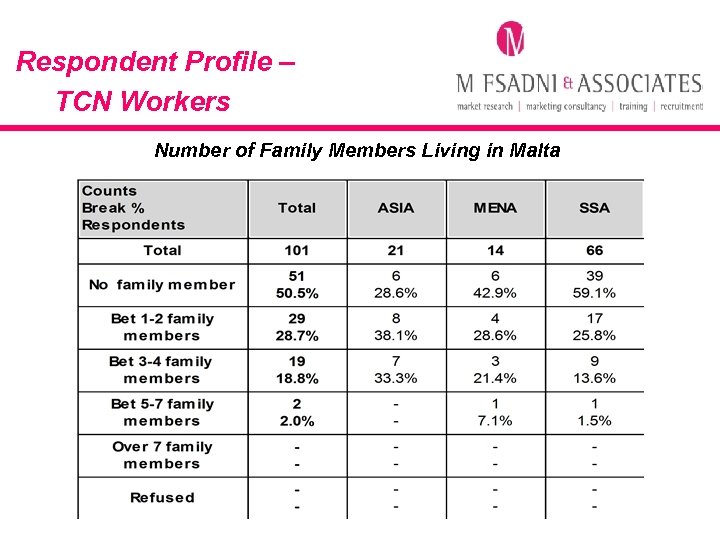 Respondent Profile – TCN Workers Number of Family Members Living in Malta
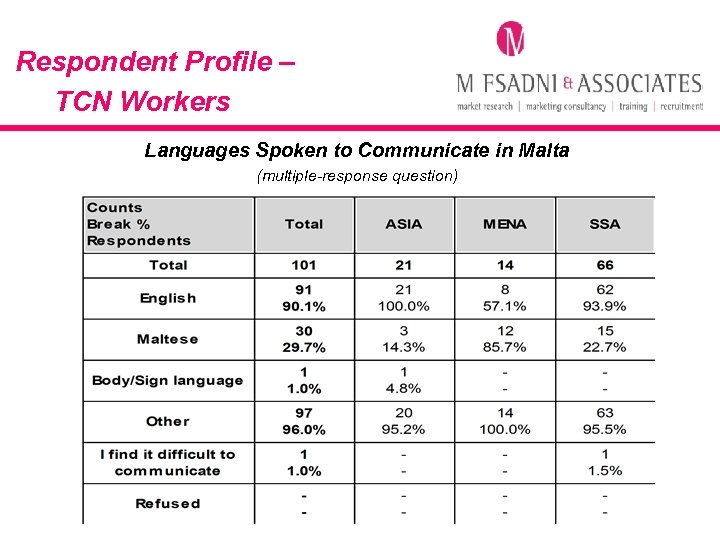 Respondent Profile – TCN Workers Languages Spoken to Communicate in Malta (multiple-response question)
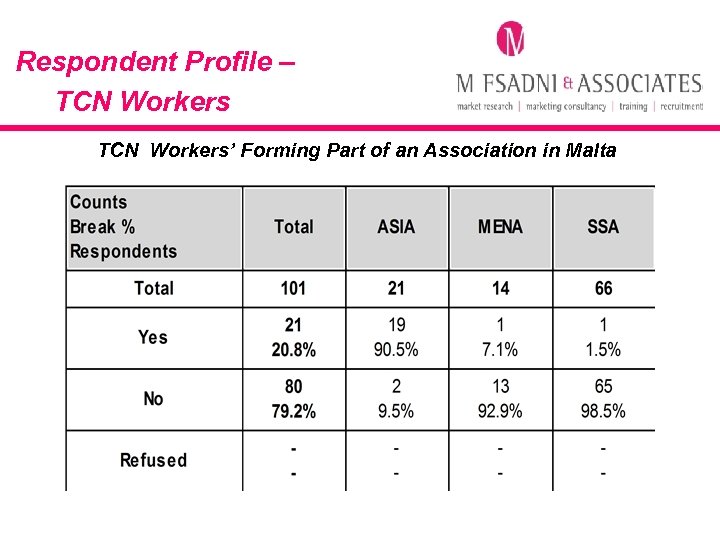 Respondent Profile – TCN Workers’ Forming Part of an Association in Malta
 Cii TCNs‘ Employment in Malta
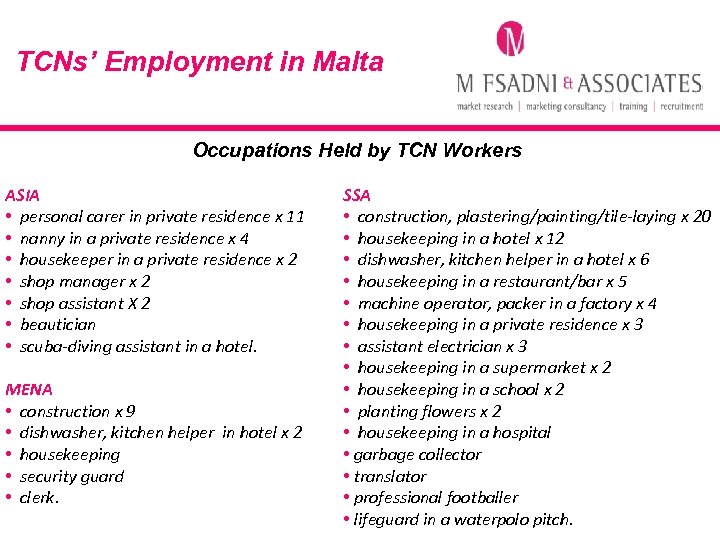 TCNs’ Employment in Malta Occupations Held by TCN Workers ASIA • personal carer in private residence x 11 • nanny in a private residence x 4 • housekeeper in a private residence x 2 • shop manager x 2 • shop assistant X 2 • beautician • scuba-diving assistant in a hotel. MENA • construction x 9 • dishwasher, kitchen helper in hotel x 2 • housekeeping • security guard • clerk. SSA • construction, plastering/painting/tile-laying x 20 • housekeeping in a hotel x 12 • dishwasher, kitchen helper in a hotel x 6 • housekeeping in a restaurant/bar x 5 • machine operator, packer in a factory x 4 • housekeeping in a private residence x 3 • assistant electrician x 3 • housekeeping in a supermarket x 2 • housekeeping in a school x 2 • planting flowers x 2 • housekeeping in a hospital • garbage collector • translator • professional footballer • lifeguard in a waterpolo pitch.
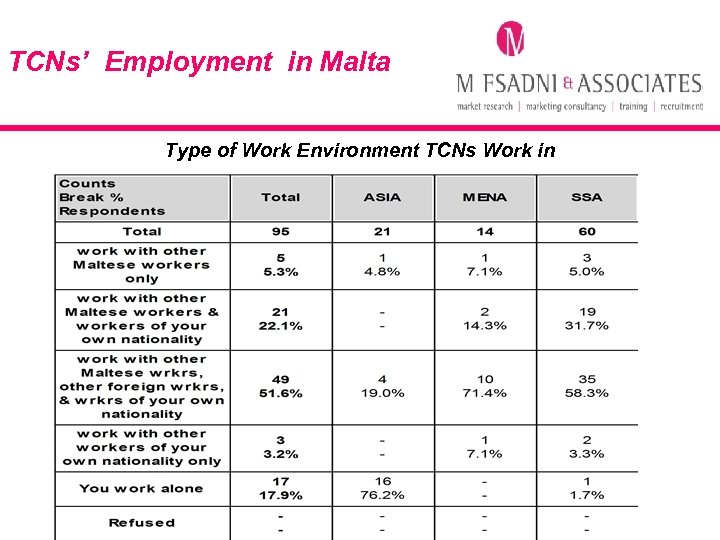 TCNs’ Employment in Malta Type of Work Environment TCNs Work in
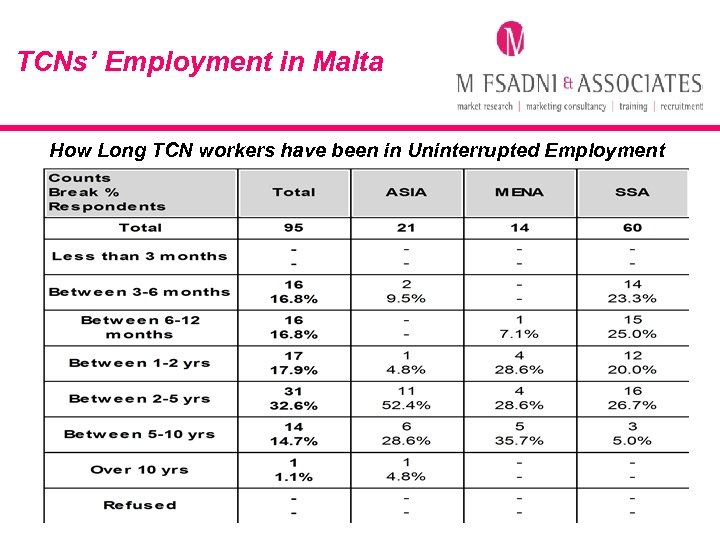 TCNs’ Employment in Malta How Long TCN workers have been in Uninterrupted Employment
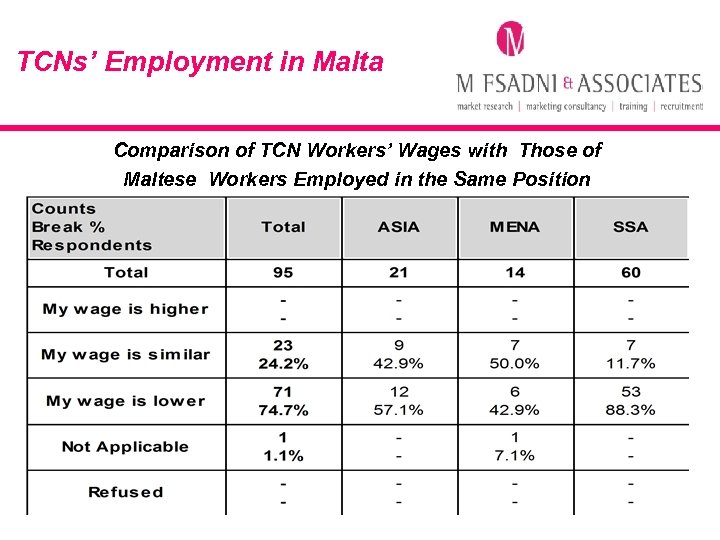 TCNs’ Employment in Malta Comparison of TCN Workers’ Wages with Those of Maltese Workers Employed in the Same Position
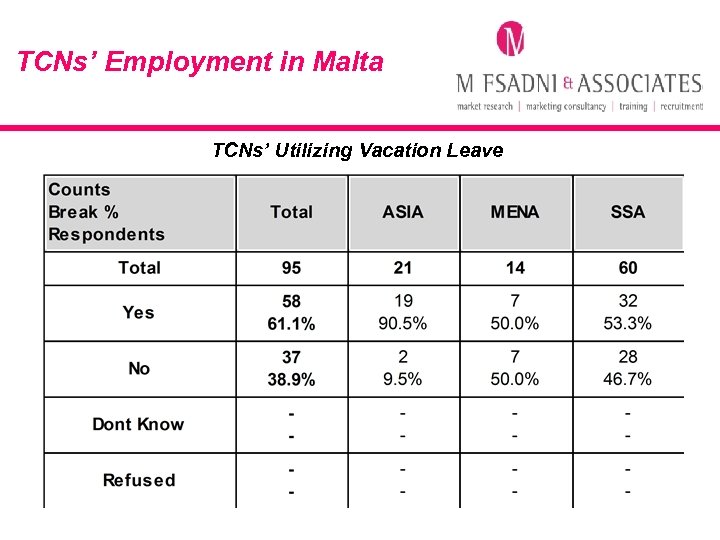 TCNs’ Employment in Malta TCNs’ Utilizing Vacation Leave
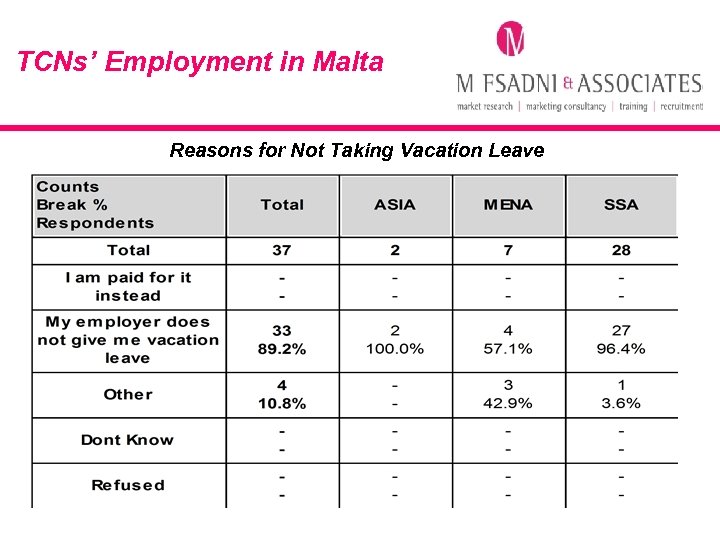 TCNs’ Employment in Malta Reasons for Not Taking Vacation Leave
 Ciii TCNs & Trade Union Membership
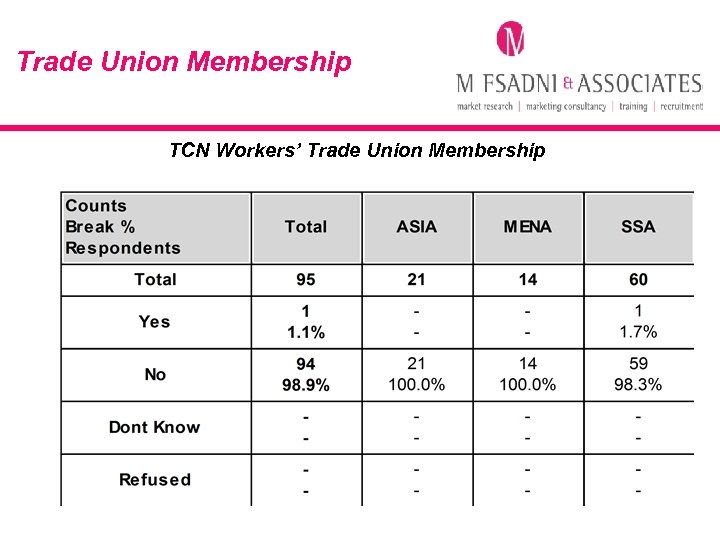 Trade Union Membership TCN Workers’ Trade Union Membership
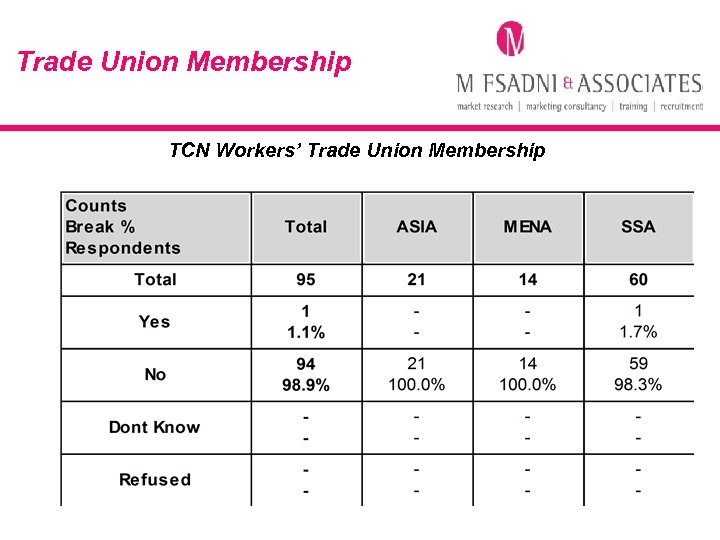 Trade Union Membership TCN Workers’ Trade Union Membership
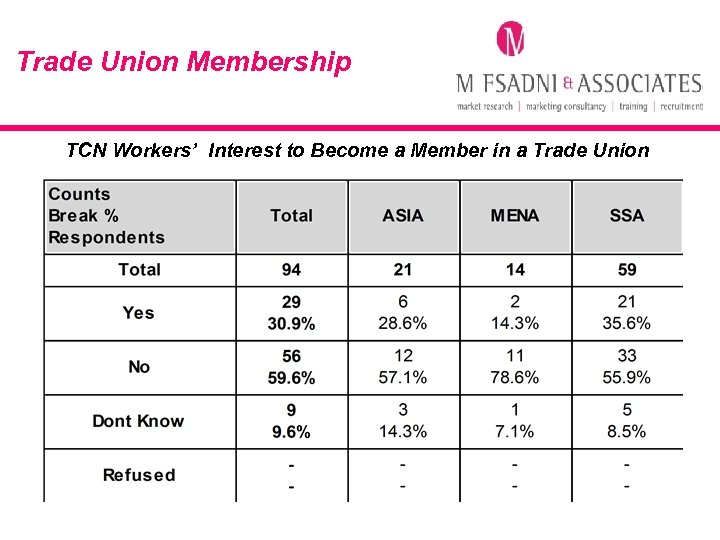 Trade Union Membership TCN Workers’ Interest to Become a Member in a Trade Union
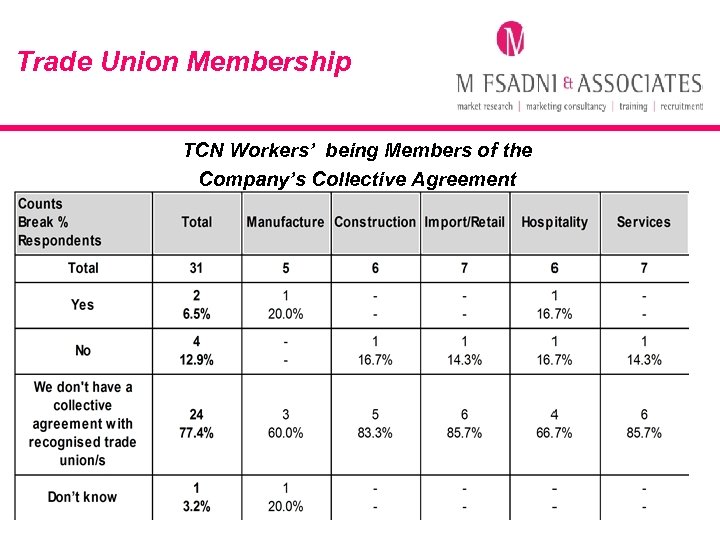 Trade Union Membership TCN Workers’ being Members of the Company’s Collective Agreement
 Civ TCN Workers‘ Training Attendance on Conditions of Employment
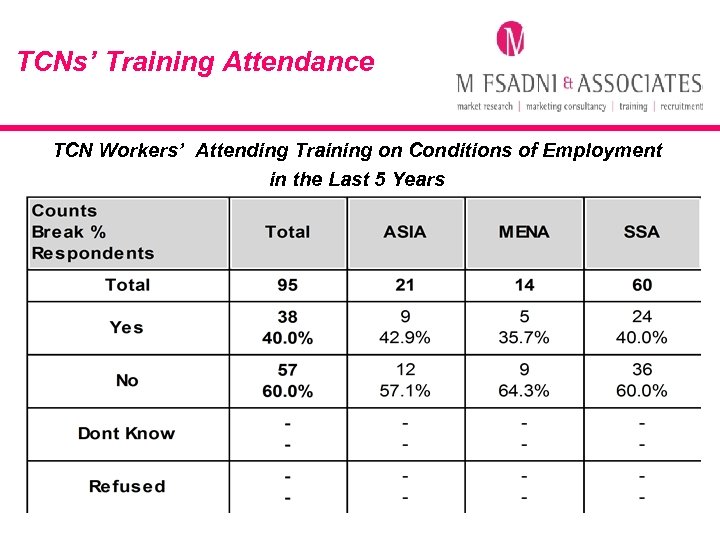 TCNs’ Training Attendance TCN Workers’ Attending Training on Conditions of Employment in the Last 5 Years
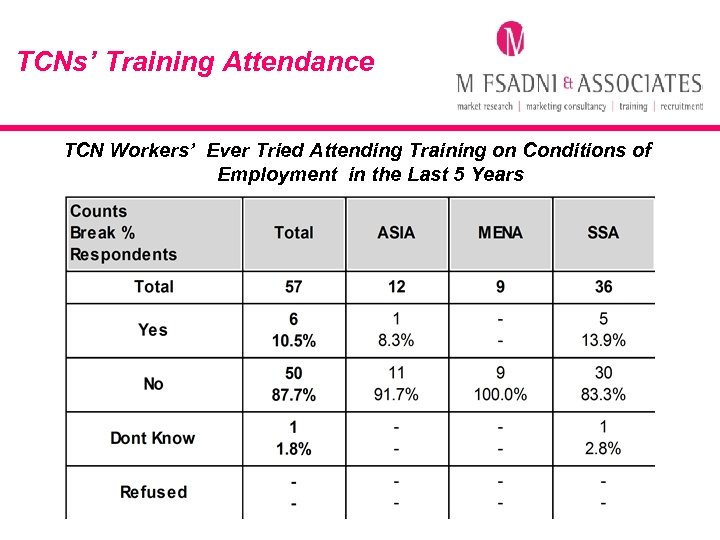 TCNs’ Training Attendance TCN Workers’ Ever Tried Attending Training on Conditions of Employment in the Last 5 Years
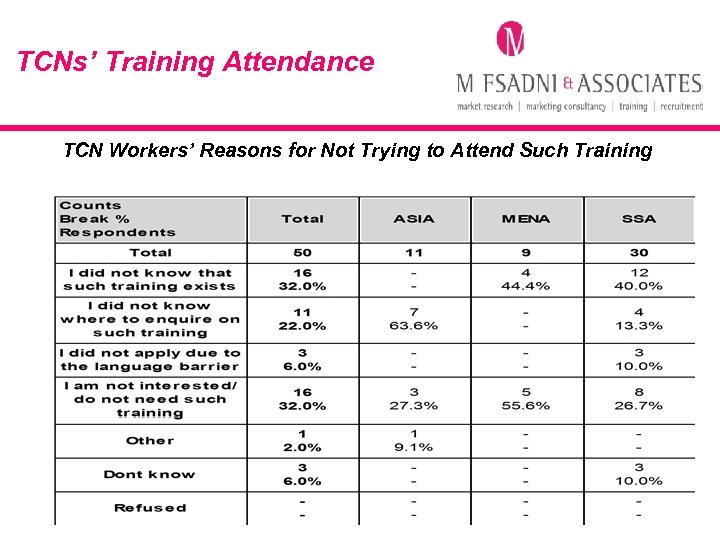 TCNs’ Training Attendance TCN Workers’ Reasons for Not Trying to Attend Such Training
 Cv Employers of TCN Workers – A Respondent Profile
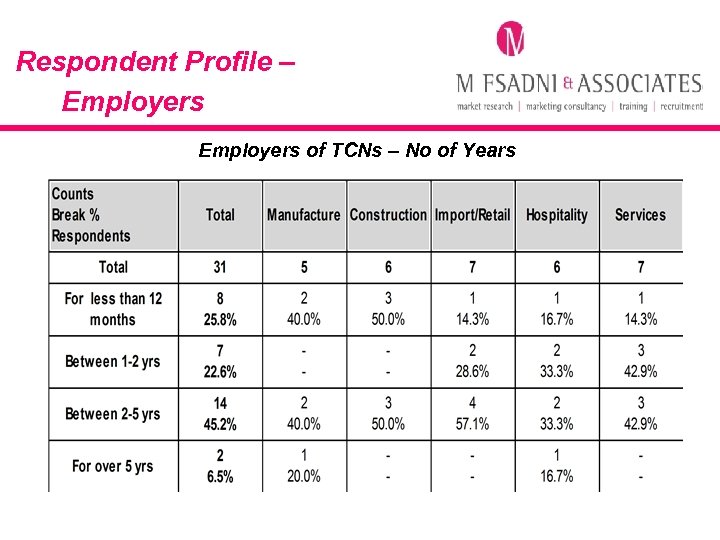 Respondent Profile – Employers of TCNs – No of Years
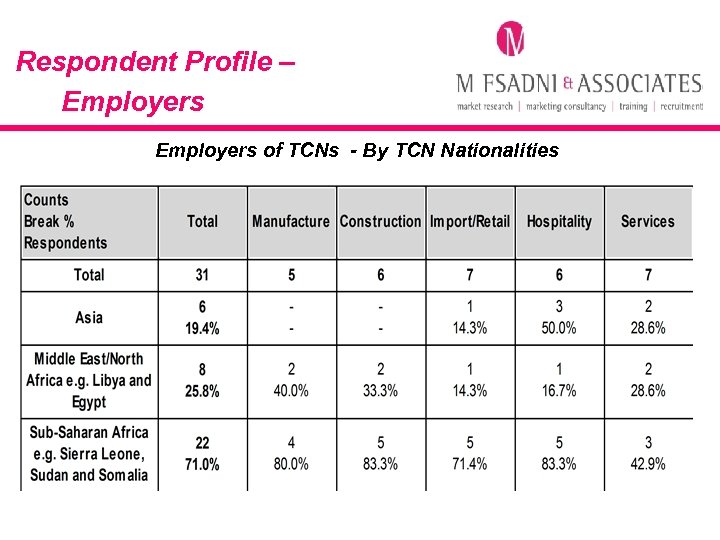 Respondent Profile – Employers of TCNs - By TCN Nationalities
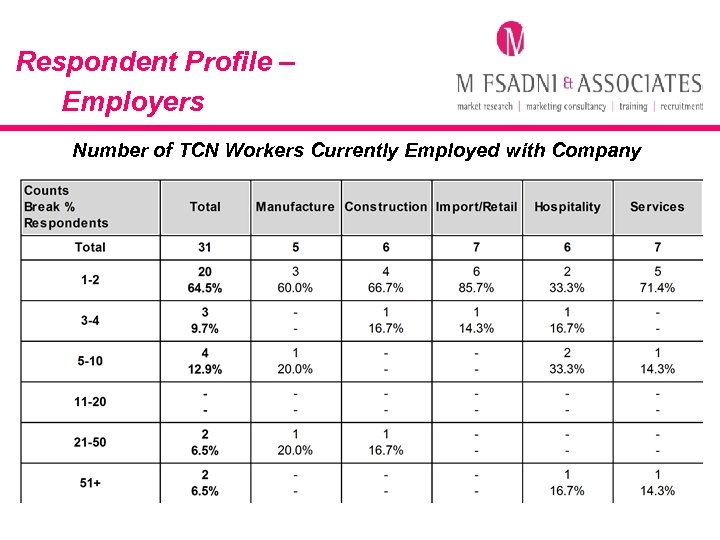 Respondent Profile – Employers Number of TCN Workers Currently Employed with Company
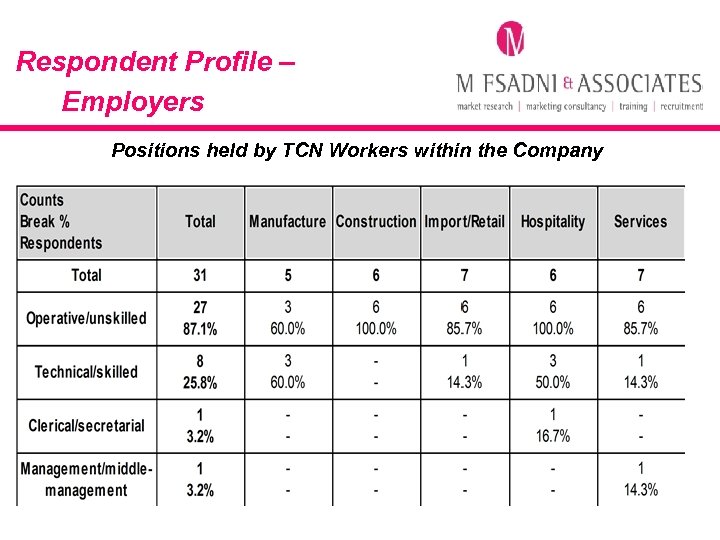 Respondent Profile – Employers Positions held by TCN Workers within the Company
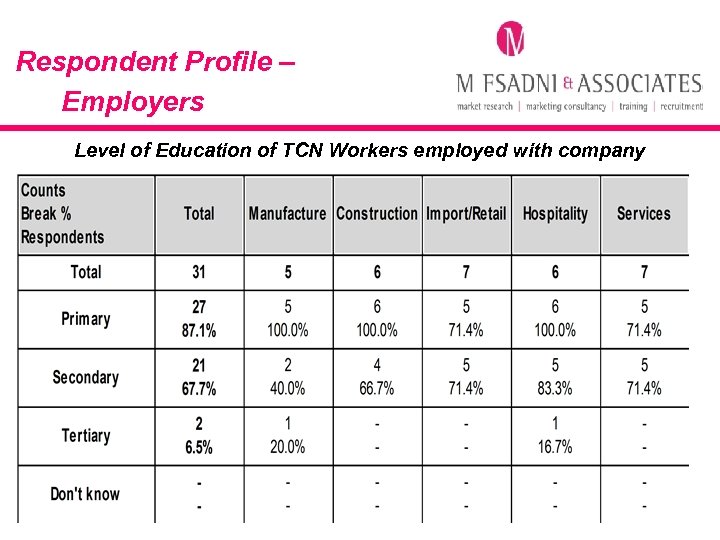 Respondent Profile – Employers Level of Education of TCN Workers employed with company
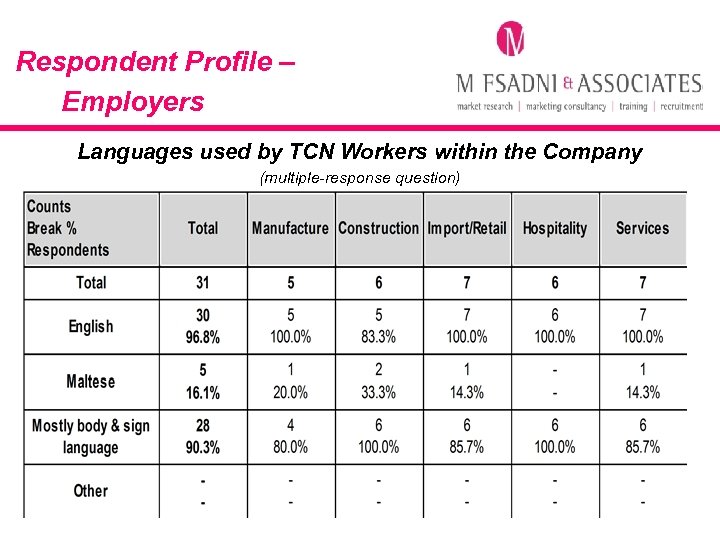 Respondent Profile – Employers Languages used by TCN Workers within the Company (multiple-response question)
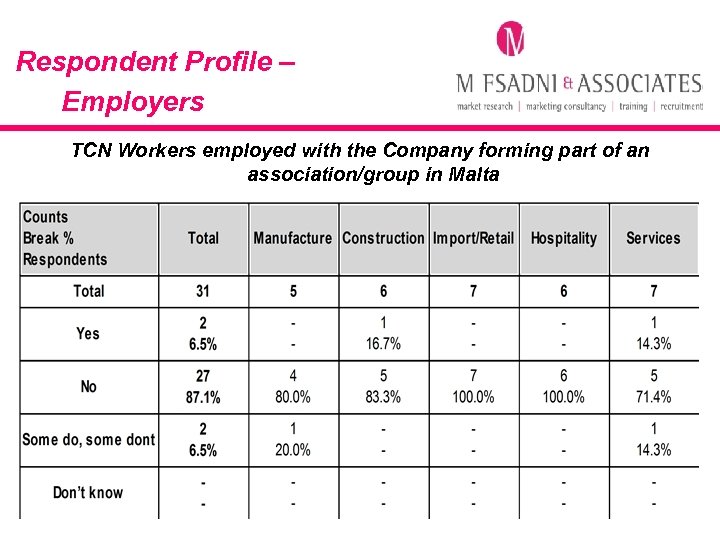 Respondent Profile – Employers TCN Workers employed with the Company forming part of an association/group in Malta
 Cvi Reasons Why Employers Employ TCN Workers
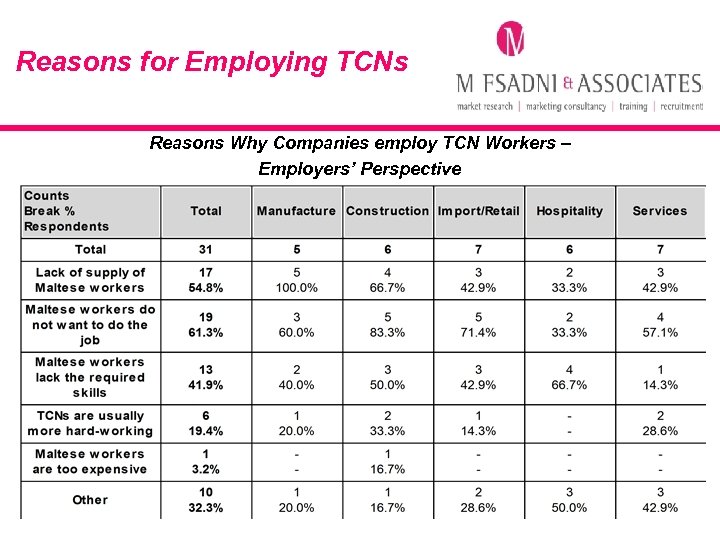 Reasons for Employing TCNs Reasons Why Companies employ TCN Workers – Employers’ Perspective
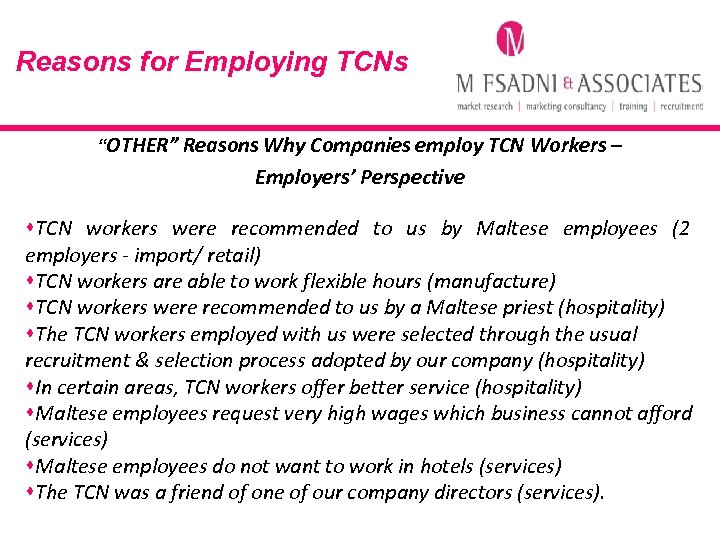 Reasons for Employing TCNs “OTHER” Reasons Why Companies employ TCN Workers – Employers’ Perspective TCN workers were recommended to us by Maltese employees (2 employers - import/ retail) TCN workers are able to work flexible hours (manufacture) TCN workers were recommended to us by a Maltese priest (hospitality) The TCN workers employed with us were selected through the usual recruitment & selection process adopted by our company (hospitality) In certain areas, TCN workers offer better service (hospitality) Maltese employees request very high wages which business cannot afford (services) Maltese employees do not want to work in hotels (services) The TCN was a friend of one of our company directors (services).
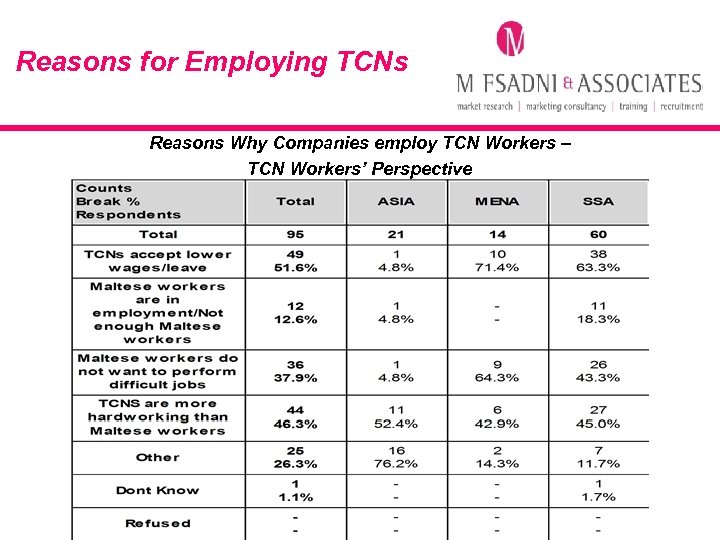 Reasons for Employing TCNs Reasons Why Companies employ TCN Workers – TCN Workers’ Perspective
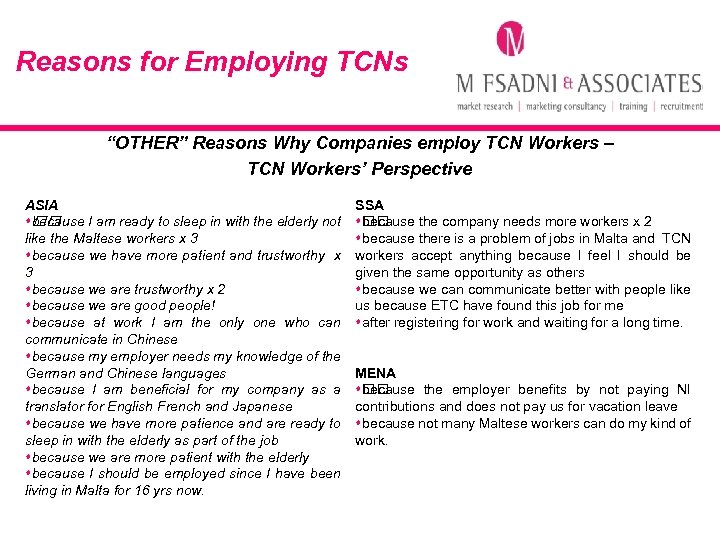 Reasons for Employing TCNs “OTHER” Reasons Why Companies employ TCN Workers – TCN Workers’ Perspective ASIA because I am ready to sleep in with the elderly not like the Maltese workers x 3 because we have more patient and trustworthy x 3 because we are trustworthy x 2 because we are good people! because at work I am the only one who can communicate in Chinese because my employer needs my knowledge of the German and Chinese languages because I am beneficial for my company as a translator for English French and Japanese because we have more patience and are ready to sleep in with the elderly as part of the job because we are more patient with the elderly because I should be employed since I have been living in Malta for 16 yrs now. SSA because the company needs more workers x 2 because there is a problem of jobs in Malta and TCN workers accept anything because I feel I should be given the same opportunity as others because we can communicate better with people like us because ETC have found this job for me after registering for work and waiting for a long time. MENA because the employer benefits by not paying NI contributions and does not pay us for vacation leave because not many Maltese workers can do my kind of work.
 Cvii Reasons for TCNs‘ Needing to Work in Malta
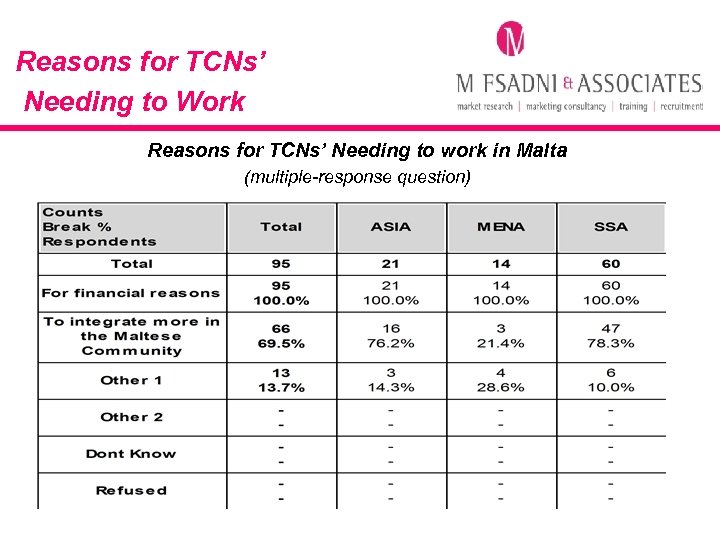 Reasons for TCNs’ Needing to Work Reasons for TCNs’ Needing to work in Malta (multiple-response question)
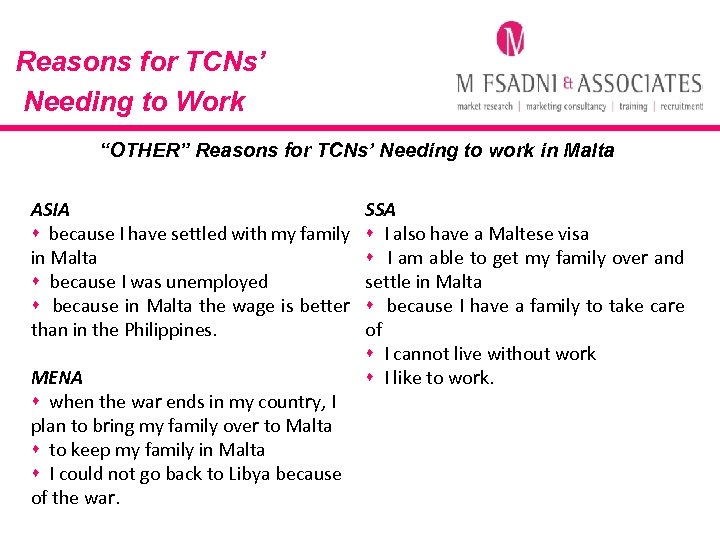 Reasons for TCNs’ Needing to Work “OTHER” Reasons for TCNs’ Needing to work in Malta ASIA because I have settled with my family in Malta because I was unemployed because in Malta the wage is better than in the Philippines. MENA when the war ends in my country, I plan to bring my family over to Malta to keep my family in Malta I could not go back to Libya because of the war. SSA I also have a Maltese visa I am able to get my family over and settle in Malta because I have a family to take care of I cannot live without work I like to work.
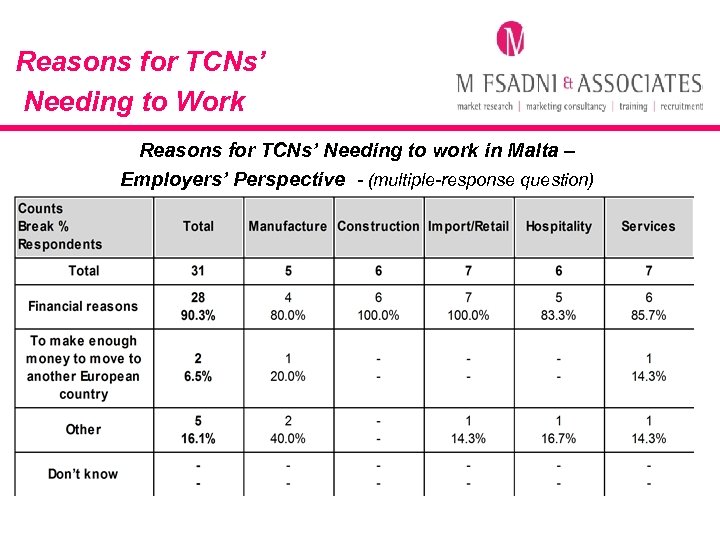 Reasons for TCNs’ Needing to Work Reasons for TCNs’ Needing to work in Malta – Employers’ Perspective - (multiple-response question)
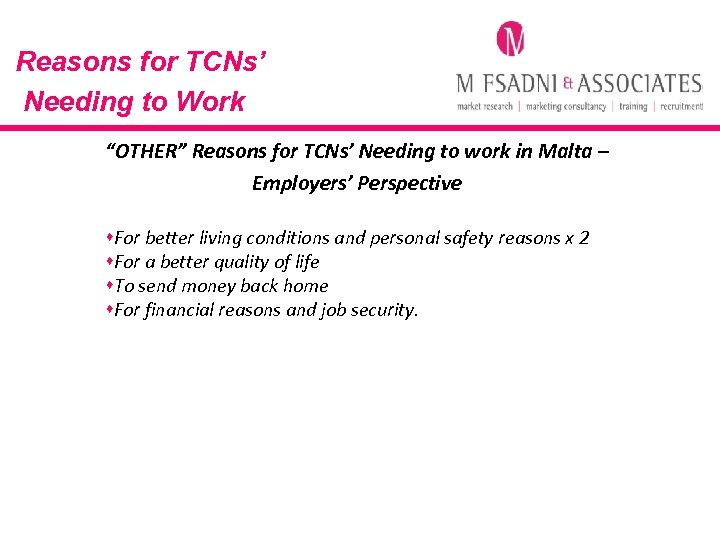 Reasons for TCNs’ Needing to Work “OTHER” Reasons for TCNs’ Needing to work in Malta – Employers’ Perspective For better living conditions and personal safety reasons x 2 For a better quality of life To send money back home For financial reasons and job security.
 Cviii Integration of TCN Workers At the Place of Work
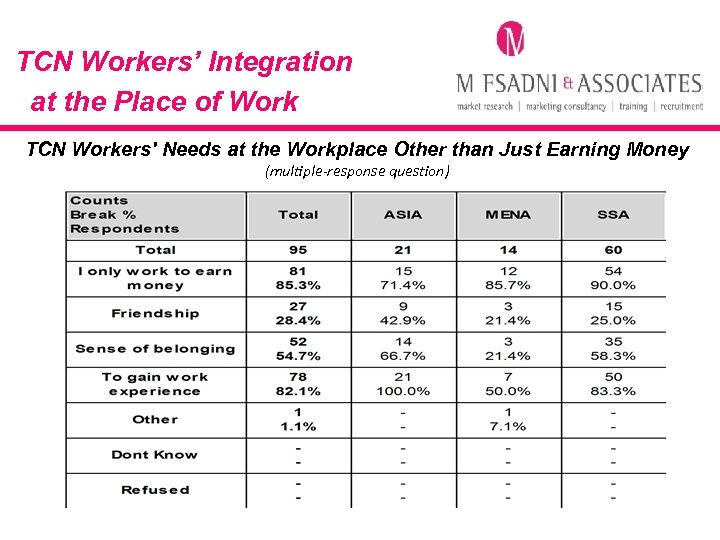 TCN Workers’ Integration at the Place of Work TCN Workers' Needs at the Workplace Other than Just Earning Money (multiple-response question)
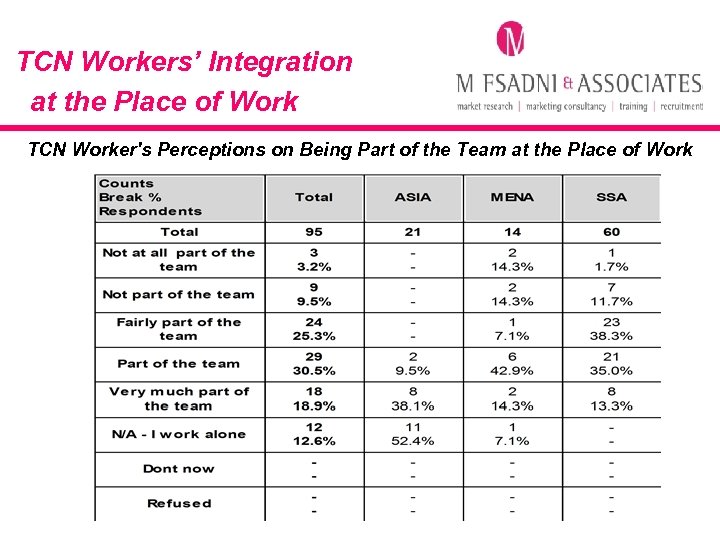 TCN Workers’ Integration at the Place of Work TCN Worker's Perceptions on Being Part of the Team at the Place of Work
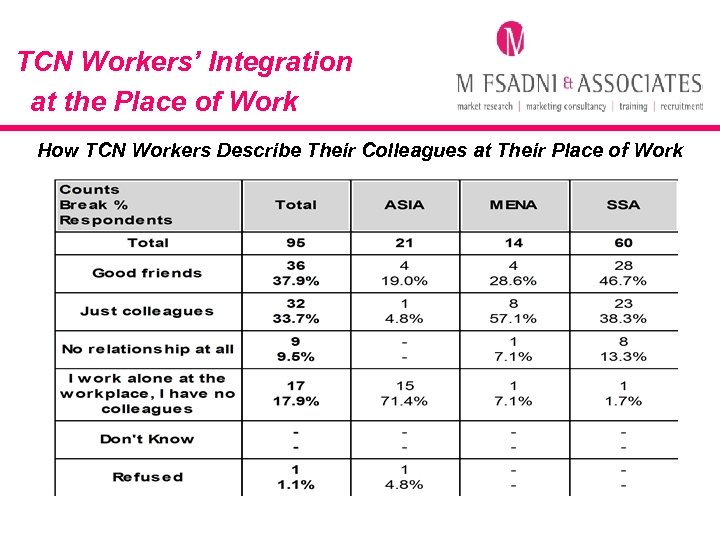 TCN Workers’ Integration at the Place of Work How TCN Workers Describe Their Colleagues at Their Place of Work
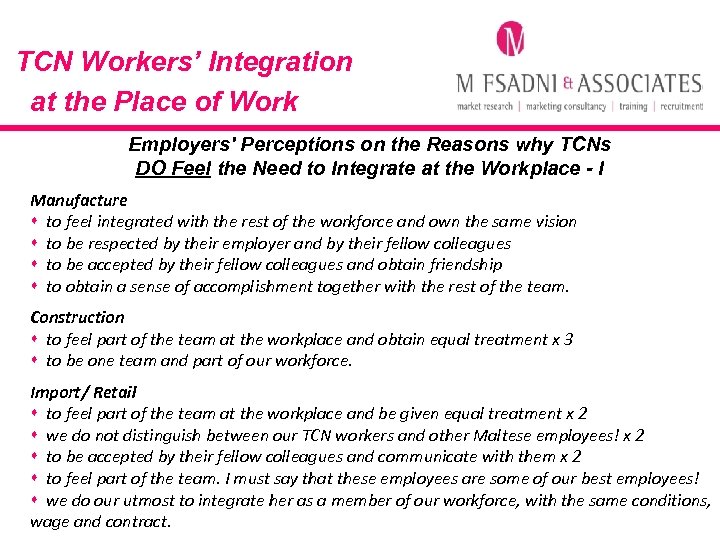 TCN Workers’ Integration at the Place of Work Employers' Perceptions on the Reasons why TCNs DO Feel the Need to Integrate at the Workplace - I Manufacture to feel integrated with the rest of the workforce and own the same vision to be respected by their employer and by their fellow colleagues to be accepted by their fellow colleagues and obtain friendship to obtain a sense of accomplishment together with the rest of the team. Construction to feel part of the team at the workplace and obtain equal treatment x 3 to be one team and part of our workforce. Import/ Retail to feel part of the team at the workplace and be given equal treatment x 2 we do not distinguish between our TCN workers and other Maltese employees! x 2 to be accepted by their fellow colleagues and communicate with them x 2 to feel part of the team. I must say that these employees are some of our best employees! we do our utmost to integrate her as a member of our workforce, with the same conditions, wage and contract.
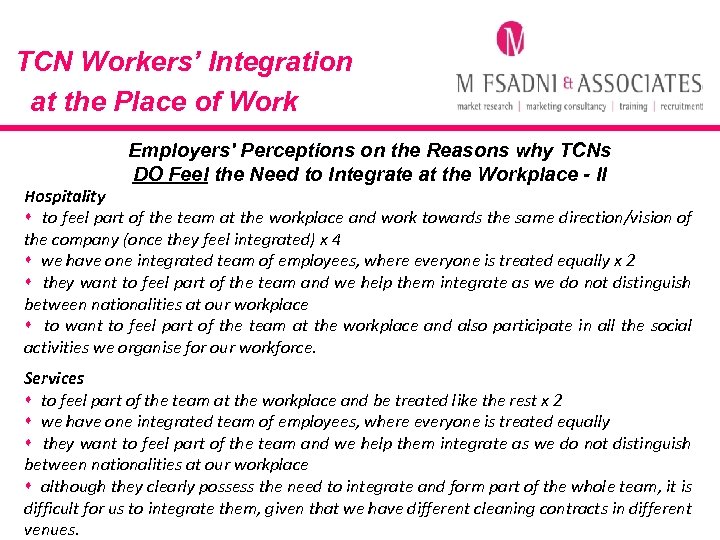 TCN Workers’ Integration at the Place of Work Employers' Perceptions on the Reasons why TCNs DO Feel the Need to Integrate at the Workplace - II Hospitality to feel part of the team at the workplace and work towards the same direction/vision of the company (once they feel integrated) x 4 we have one integrated team of employees, where everyone is treated equally x 2 they want to feel part of the team and we help them integrate as we do not distinguish between nationalities at our workplace to want to feel part of the team at the workplace and also participate in all the social activities we organise for our workforce. Services to feel part of the team at the workplace and be treated like the rest x 2 we have one integrated team of employees, where everyone is treated equally they want to feel part of the team and we help them integrate as we do not distinguish between nationalities at our workplace although they clearly possess the need to integrate and form part of the whole team, it is difficult for us to integrate them, given that we have different cleaning contracts in different venues.
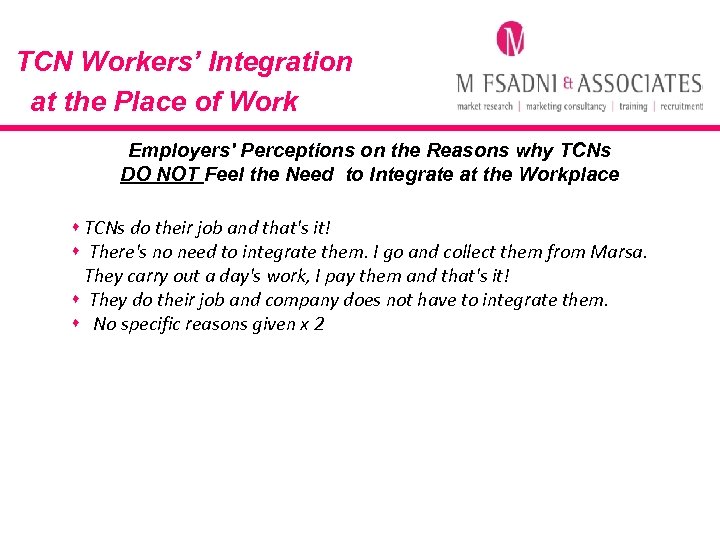 TCN Workers’ Integration at the Place of Work Employers' Perceptions on the Reasons why TCNs DO NOT Feel the Need to Integrate at the Workplace TCNs do their job and that's it! There's no need to integrate them. I go and collect them from Marsa. They carry out a day's work, I pay them and that's it! They do their job and company does not have to integrate them. No specific reasons given x 2
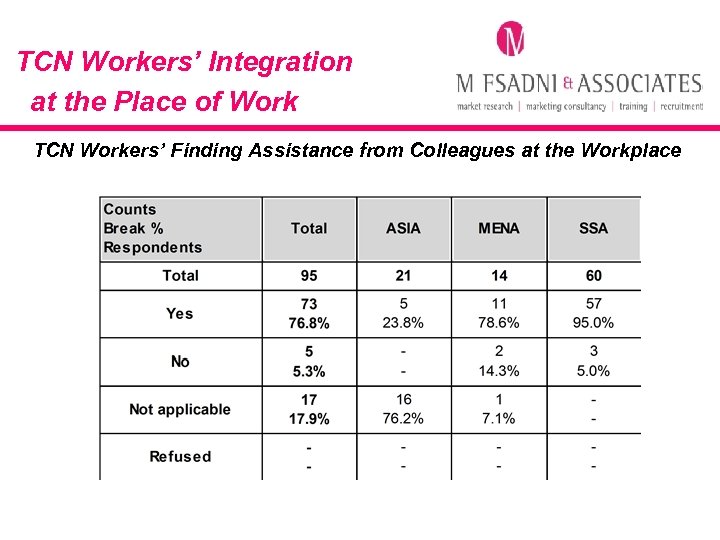 TCN Workers’ Integration at the Place of Work TCN Workers’ Finding Assistance from Colleagues at the Workplace
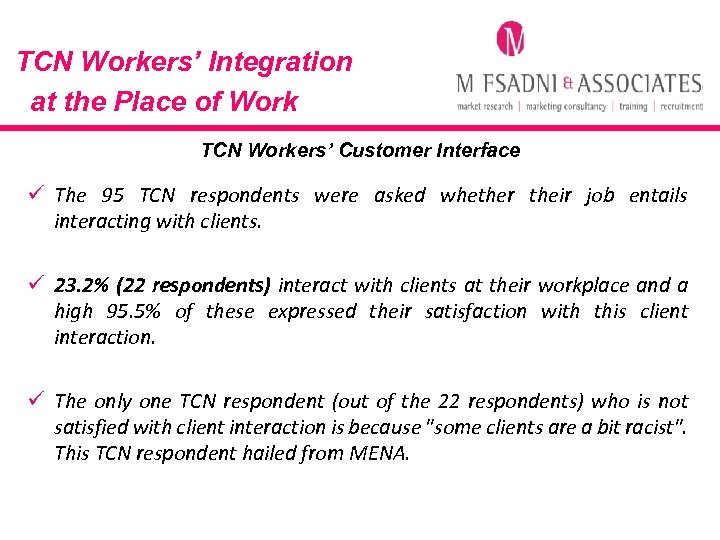 TCN Workers’ Integration at the Place of Work TCN Workers’ Customer Interface ü The 95 TCN respondents were asked whether their job entails interacting with clients. ü 23. 2% (22 respondents) interact with clients at their workplace and a high 95. 5% of these expressed their satisfaction with this client interaction. ü The only one TCN respondent (out of the 22 respondents) who is not satisfied with client interaction is because "some clients are a bit racist". This TCN respondent hailed from MENA.
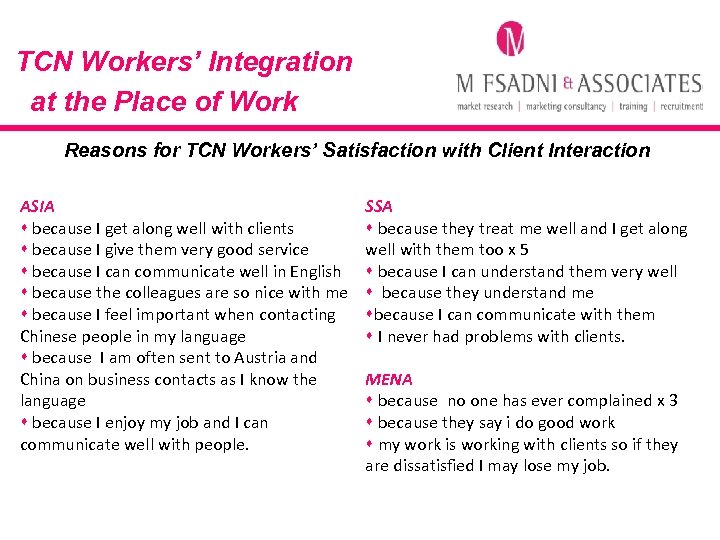 TCN Workers’ Integration at the Place of Work Reasons for TCN Workers’ Satisfaction with Client Interaction ASIA because I get along well with clients because I give them very good service because I can communicate well in English because the colleagues are so nice with me because I feel important when contacting Chinese people in my language because I am often sent to Austria and China on business contacts as I know the language because I enjoy my job and I can communicate well with people. SSA because they treat me well and I get along well with them too x 5 because I can understand them very well because they understand me because I can communicate with them I never had problems with clients. MENA because no one has ever complained x 3 because they say i do good work my work is working with clients so if they are dissatisfied I may lose my job.
 Cix Potential Barriers to TCNs‘ Integration at the Place of Work
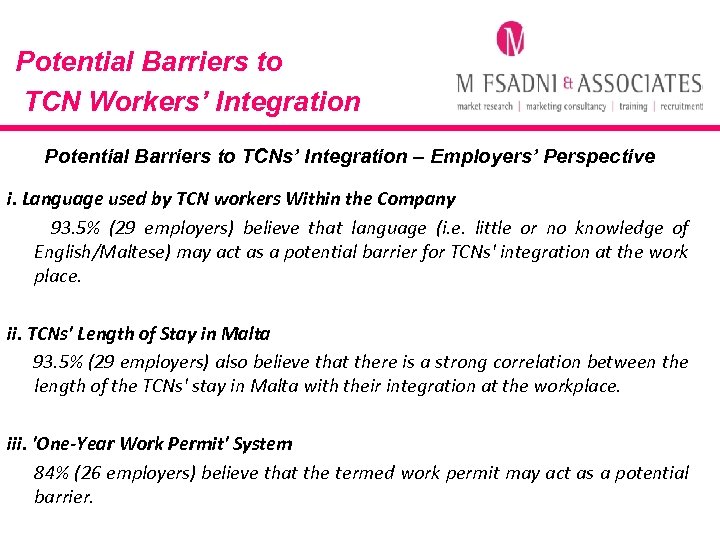 Potential Barriers to TCN Workers’ Integration Potential Barriers to TCNs’ Integration – Employers’ Perspective i. Language used by TCN workers Within the Company 93. 5% (29 employers) believe that language (i. e. little or no knowledge of English/Maltese) may act as a potential barrier for TCNs' integration at the work place. ii. TCNs' Length of Stay in Malta 93. 5% (29 employers) also believe that there is a strong correlation between the length of the TCNs' stay in Malta with their integration at the workplace. iii. 'One-Year Work Permit' System 84% (26 employers) believe that the termed work permit may act as a potential barrier.
 Cx TCNs‘ Wish-Haves & Turn-Offs at the Place of Work
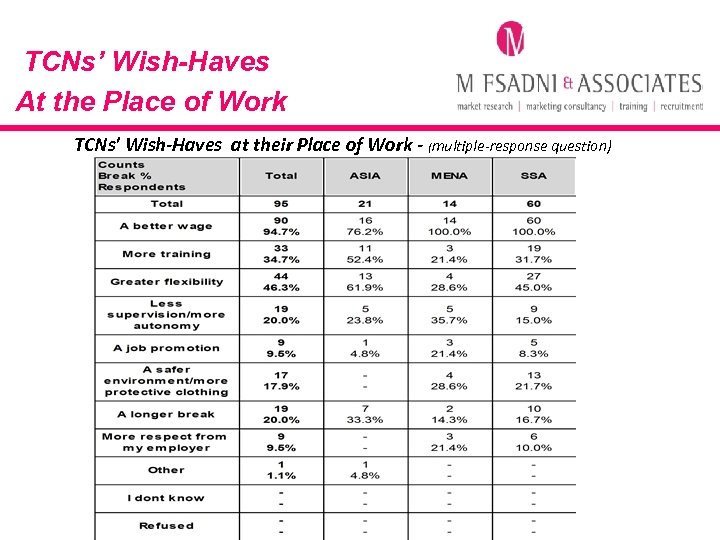 TCNs’ Wish-Haves At the Place of Work TCNs' Wish-Haves at their Place of Work - (multiple-response question)
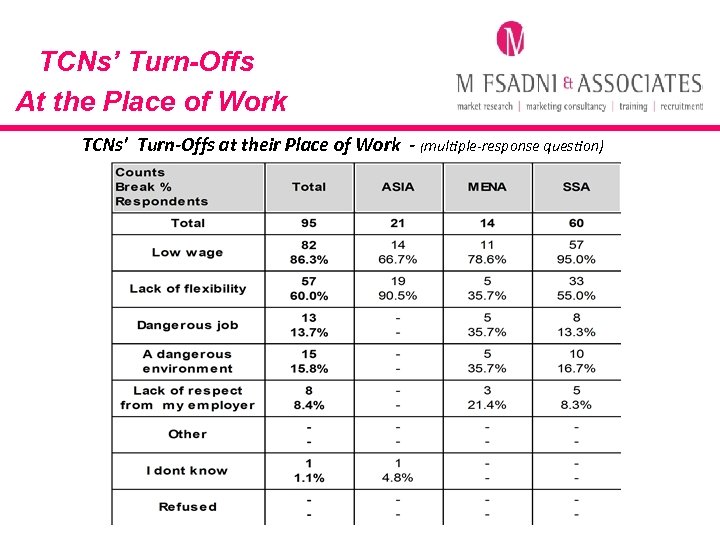 TCNs’ Turn-Offs At the Place of Work TCNs' Turn-Offs at their Place of Work - (multiple-response question)
 Cxi Difficulties Faced by Employers of TCN Workers
 Difficulties Faced by Employers of TCN Workers - I A high 84% (26 employers) expressed their concerns on the difficulties they face as employers of TCN workers. These difficulties/risks are primarily tied to: § ETC's and other government departments' excessive delays and bureaucracy to address work permits and documentation relating to the recruitment of TCN workers. § A case in point: One employer respondent told us … “we applied for TCN work permits in Oct 2013 and we are now in May 2014 and still waiting patiently for ETC to give us a reply on our application!! We believe that two months should suffice to process a work permit application … a seven months’ delay is totally unacceptable! And what about our contractual obligations with our clients? “
 Difficulties Faced by Employers of TCN Workers - II § Employers need to renew their TCN workers' registration every three months, and present an updated police conduct certificate every time and other documentation. This process is too time-consuming and bureaucratic. § Some Heads of Department at ETC are not at all flexible and are too bureaucratic! § Employers’ cry for help to be allowed to operate on a level playing field and for those operators working illegally and paying below minimum-wages to be monitored and checked by the local authorities.
 Cxii Employers & TCN Workers Seeking Assistance from Public Authorities
 TCNs Seeking Assistance from Public Authorities TCN Workers’ Awareness of Salient Public Authorities The TCN worker respondents were asked to indicate whether they have ever heard of the following Public Authorities. ü ü 90. 5% (86 respondents) have heard of ETC 45. 3% (43 respondents) have heard of OHSA 29. 5% (28 respondents) have heard of DIER 22. 1% (21 respondents) have heard of NCPE.
 TCNs Seeking Assistance from Public Authorities The Government Authorities TCN Workers would seek Assistance From If They have a Problem at their Place of Work ASIA I would go to ETC x 5 I would go to the Labour Office or to the ETC x 2 I would go to the Filipino Workers Association x 2 First I would go to our Filipino Workers Association and then I go to ETC x 2 I would go to ETC or the Social Services Dept I would go to the Ministry or to the ETC I would go to my Manager or to the ETC I would go to the Labour Office (DIER) I would inform the Police I would go to my Manager MENA I would contact ETC x 5 I would go to my Manager at work. SSA I would go to my Manager at work x 16 I would contact ETC x 8 I would inform the Police x 5 I would go the Social Services Dept I would go to the Social Services Dept or the ETC I would inform the Refugee Commissioner I would inform a lawyer engaged in defending human rights I would look for another job.
 Employers Seeking Assistance from Public Authorities Suggestions on specific assistance programmes Government should provide Employers of TCN workers - I ü The process of issuing of work permits by ETC should be made more efficient and less bureaucratic. ü Government entities in general should provide a better and more efficient service and reduce unnecessary bureaucracy! ü ETC should shortlist applicants who are currently registering for work well before forwarding their CVs to companies seeking to recruit individuals. This ETC's shortcoming is causing frustration and a waste of time/ money for private sector employers who are genuinely seeking to recruit new employees. ü Government must monitor and check companies who employ TCN workers on precarious conditions.
 Employers Seeking Assistance from Public Authorities Suggestions on specific assistance programmes Government should provide Employers of TCN workers - II ü Government should provide more assistance to local employers who genuinely work hard and who generate employment for Maltese and TCN workers. ü Increase ‘culture awareness’ to TCNs by offering them training on Maltese work standards, values, cultural norms, etc. ü ETC/ Government should be more pro-active vis-à-vis encouraging unemployed Maltese individuals and those registering for work to find work and should remove all those individuals registering for work (and receiving unemployment benefits) who do not want to work!
 Employers Seeking Assistance from Public Authorities The Need for a Specific Integration Policy The Employer respondents were asked whether existing policies/ systems in Malta are adequately structured for TCNs working in Malta or not. ü Some 2 in 3 Employers (65. 5% - 20 employers) believe that existing policies/ systems are adequately structured for all workers, whilst 1 in 3 do not agree that existing policies/ systems are adequate (35. 5% - 11 employers). ü Although the majority of the employers did emphasize the importance of the enhancing existing Government assistance programmes for Employers of TCN workers, a significant 84% (26 employers) do not believe that there is a need for a specific integration policy related to TCNs at the place of work in Malta.
 D Diversity Management in Malta Best Practice Case Study – “The Grand Hotel Excelsior“
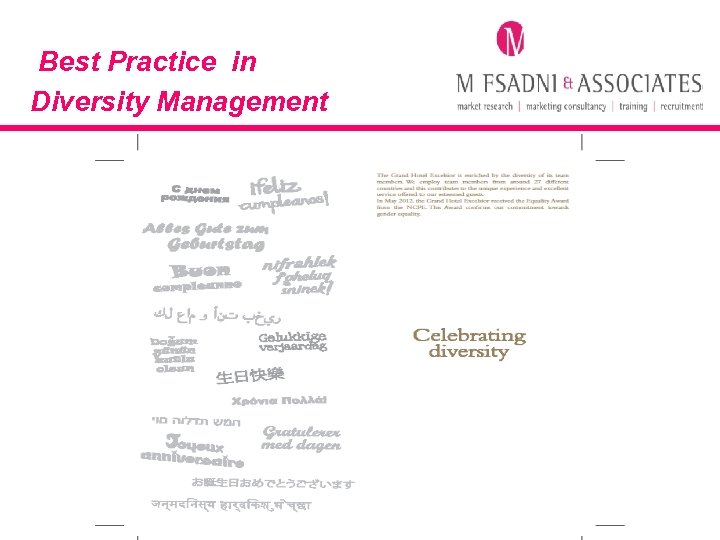
 Best Practice in Diversity Management At present, The Grand Hotel Excelsior in Floriana employs some 31 different nationalities at different levels of its organigram: Albanian Armenian British Bulgarian Chinese Czech Eritrean Ethiopian French Ghanaian Hungarian Icelandic Indian Irish Italian Ivorian Lebanese Lithuanian Maltese Moroccan Nigerian Philippine Russian Senegalese Slovak Spanish Togolese Thai Tunisian Turkish Ukrainian
 Best Practice in Diversity Management
 Best Practice in Diversity Management
 Best Practice in Diversity Management
 Best Practice in Diversity Management
 Best Practice in Diversity Management
 Best Practice in Diversity Management
 I thank you for your attention! Marika Fsadni