Скачать презентацию Department of Homeland Security Science and Technology Overview
1512c25e5cce9551fa3d6f67d2586333.ppt
- Количество слайдов: 24
 Department of Homeland Security Science and Technology Overview – January 2005 Dr. Mary Ellen Hynes Deputy, Critical Infrastructure Protection Portfolio Plans, Programs, and Budgets Science and Technology U. S. Department of Homeland Security
 Outline § DHS Overview § Science and Technology (S&T) Overview § The S&T Portfolios for Research, Development, Testing and Evaluation 2
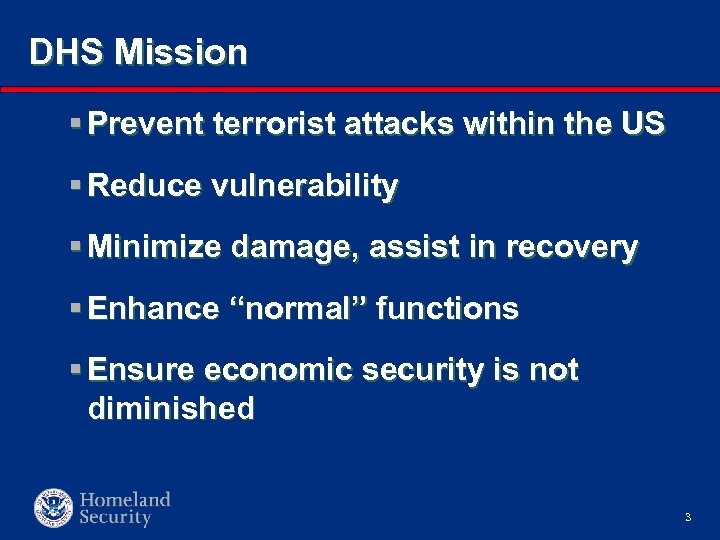 DHS Mission § Prevent terrorist attacks within the US § Reduce vulnerability § Minimize damage, assist in recovery § Enhance “normal” functions § Ensure economic security is not diminished 3
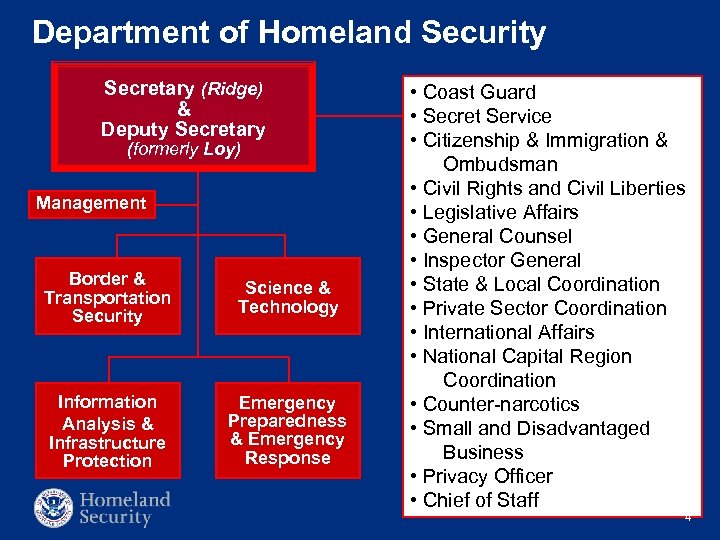 Department of Homeland Security Secretary (Ridge) & Deputy Secretary (formerly Loy) Management Border & Transportation Security Science & Technology Information Analysis & Infrastructure Protection Emergency Preparedness & Emergency Response • Coast Guard • Secret Service • Citizenship & Immigration & Ombudsman • Civil Rights and Civil Liberties • Legislative Affairs • General Counsel • Inspector General • State & Local Coordination • Private Sector Coordination • International Affairs • National Capital Region Coordination • Counter-narcotics • Small and Disadvantaged Business • Privacy Officer • Chief of Staff 4
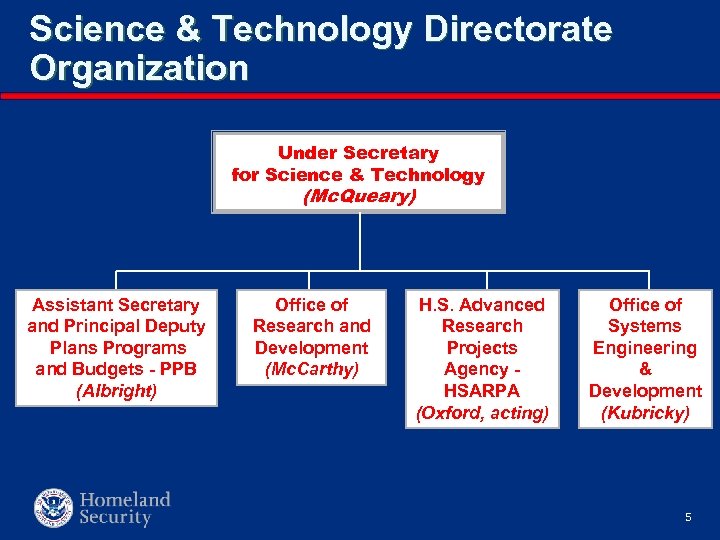 Science & Technology Directorate Organization Under Secretary for Science & Technology (Mc. Queary) Assistant Secretary and Principal Deputy Plans Programs and Budgets - PPB (Albright) Office of Research and Development (Mc. Carthy) H. S. Advanced Research Projects Agency HSARPA (Oxford, acting) Office of Systems Engineering & Development (Kubricky) 5
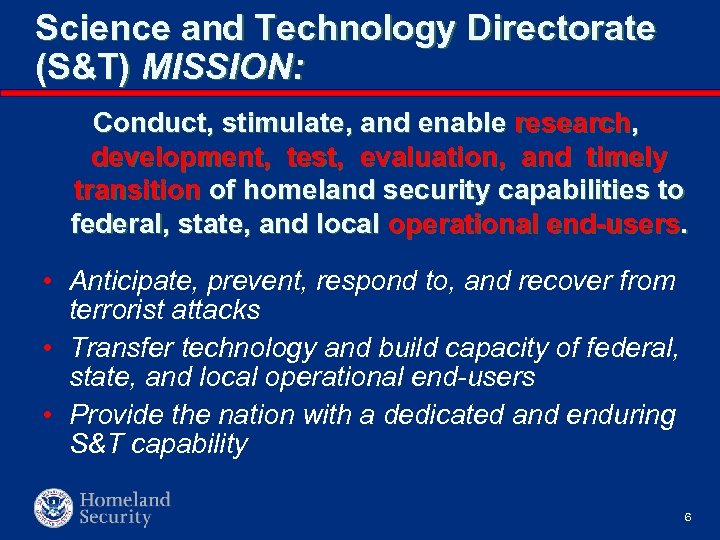 Science and Technology Directorate (S&T) MISSION: Conduct, stimulate, and enable research, development, test, evaluation, and timely transition of homeland security capabilities to federal, state, and local operational end-users. • Anticipate, prevent, respond to, and recover from terrorist attacks • Transfer technology and build capacity of federal, state, and local operational end-users • Provide the nation with a dedicated and enduring S&T capability 6
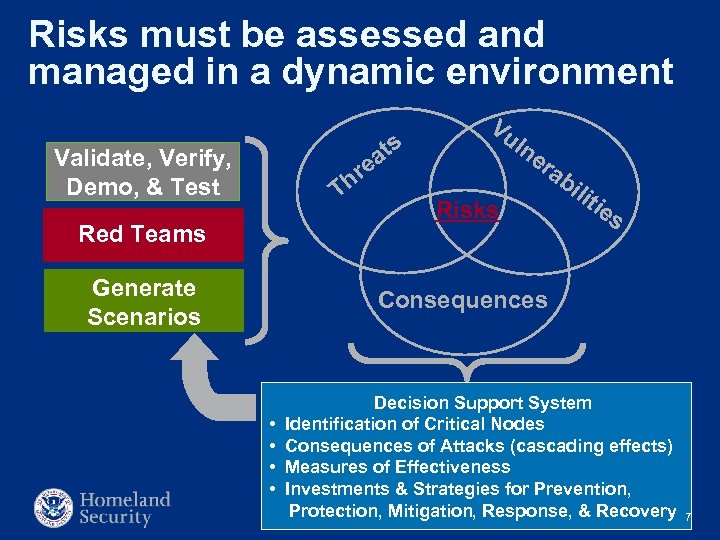 Risks must be assessed and managed in a dynamic environment Validate, Verify, Demo, & Test s at Vu ln re Th Red Teams Generate Scenarios er a Risks bi lit ie s Consequences • • Decision Support System Identification of Critical Nodes Consequences of Attacks (cascading effects) Measures of Effectiveness Investments & Strategies for Prevention, Protection, Mitigation, Response, & Recovery 7
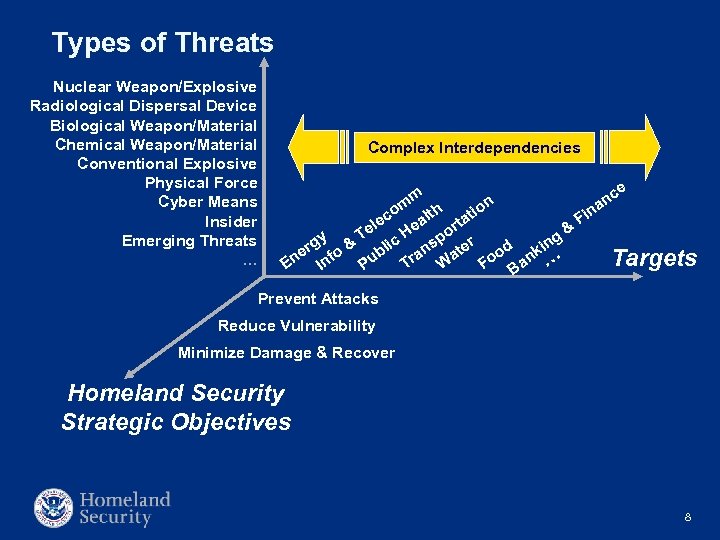 Types of Threats Nuclear Weapon/Explosive Radiological Dispersal Device Biological Weapon/Material Chemical Weapon/Material Conventional Explosive Physical Force Cyber Means Insider Emerging Threats … Complex Interdependencies m e n m n co alth tatio Fi le e r & y & Te ic H spo r g in l rg d n te ne Info Pub Tra Wa Foo ank … E B c an Targets Prevent Attacks Reduce Vulnerability Minimize Damage & Recover Homeland Security Strategic Objectives 8
 S&T Research Agenda v Bio-Countermeasures v Chemical Countermeasures v Radiological and Nuclear Countermeasures v Explosives Countermeasures v Standards v Threat and Vulnerability, Testing and Assessment v Critical Infrastructure Protection v Cyber Security v Conventional Missions 9
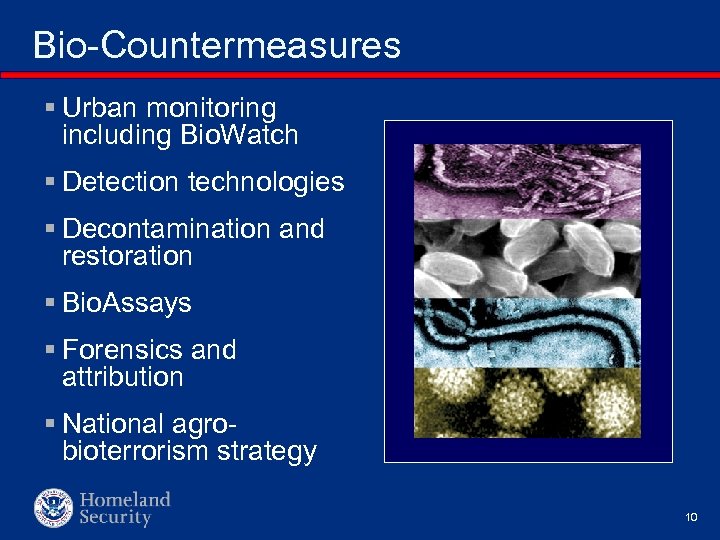 Bio-Countermeasures § Urban monitoring including Bio. Watch § Detection technologies § Decontamination and restoration § Bio. Assays § Forensics and attribution § National agrobioterrorism strategy 10
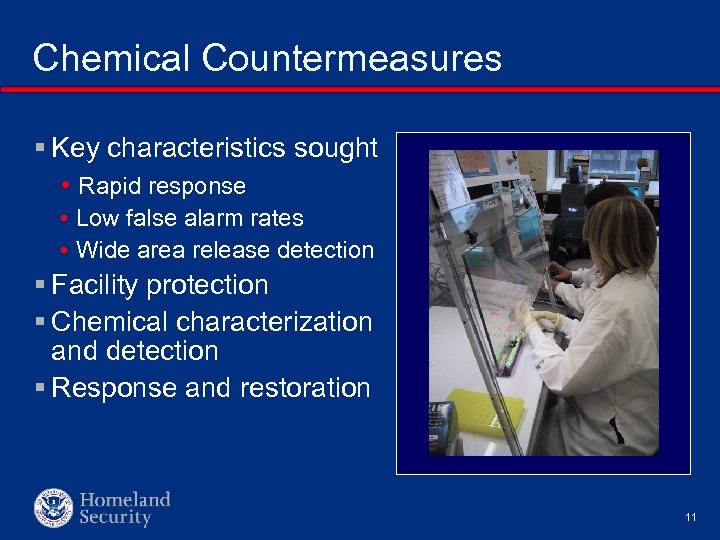 Chemical Countermeasures § Key characteristics sought • Rapid response • Low false alarm rates • Wide area release detection § Facility protection § Chemical characterization and detection § Response and restoration 11
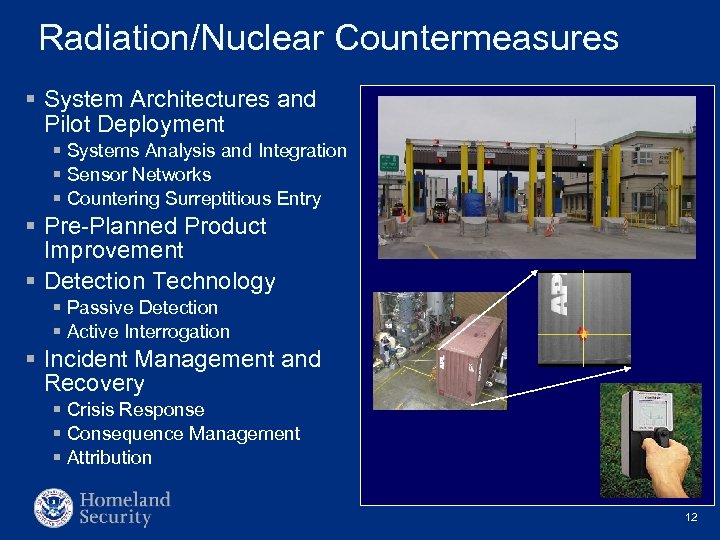 Radiation/Nuclear Countermeasures § System Architectures and Pilot Deployment § Systems Analysis and Integration § Sensor Networks § Countering Surreptitious Entry § Pre-Planned Product Improvement § Detection Technology § Passive Detection § Active Interrogation § Incident Management and Recovery § Crisis Response § Consequence Management § Attribution 12
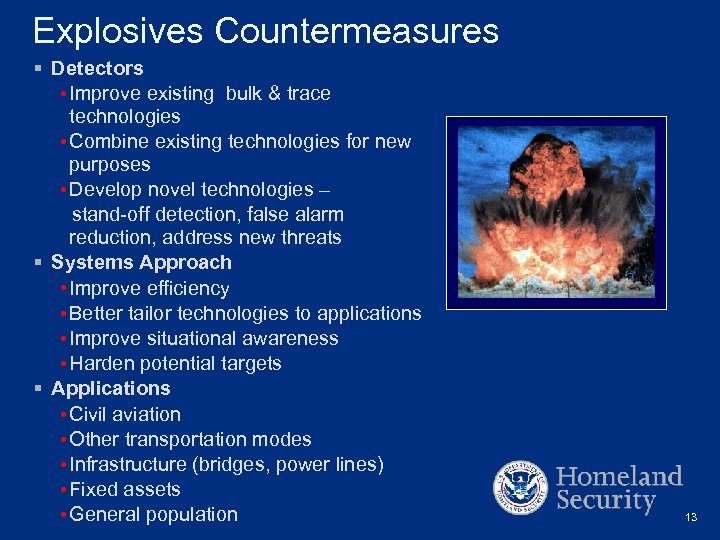 Explosives Countermeasures § Detectors • Improve existing bulk & trace technologies • Combine existing technologies for new purposes • Develop novel technologies – stand-off detection, false alarm reduction, address new threats § Systems Approach • Improve efficiency • Better tailor technologies to applications • Improve situational awareness • Harden potential targets § Applications • Civil aviation • Other transportation modes • Infrastructure (bridges, power lines) • Fixed assets • General population 13
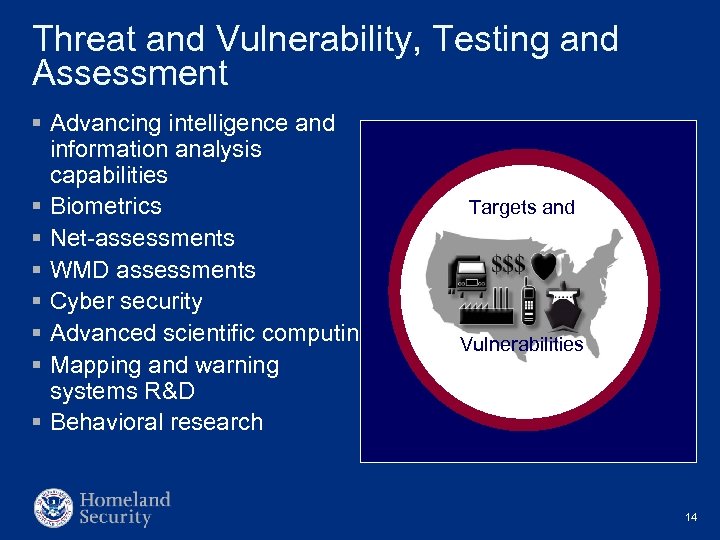 Threat and Vulnerability, Testing and Assessment § Advancing intelligence and information analysis capabilities § Biometrics § Net-assessments § WMD assessments § Cyber security § Advanced scientific computing § Mapping and warning systems R&D § Behavioral research Targets and Vulnerabilities 14
 Critical Infrastructure Protection The National Strategy for Homeland Security identifies 14 sectors and key assets that will be protected: § Agriculture § Information and Telecommunications § Food § Energy § Water § Transportation § Public Health § Emergency Services § Banking and Finance § Government § Chemical Industry and Hazardous Materials § Defense Industrial Base § Postal and Shipping § Key Assets: National Monuments and Icons, Nuclear Power Plants, Dams, Government Facilities, Commercial Key Assets Most of US Infrastructure is privately owned 15
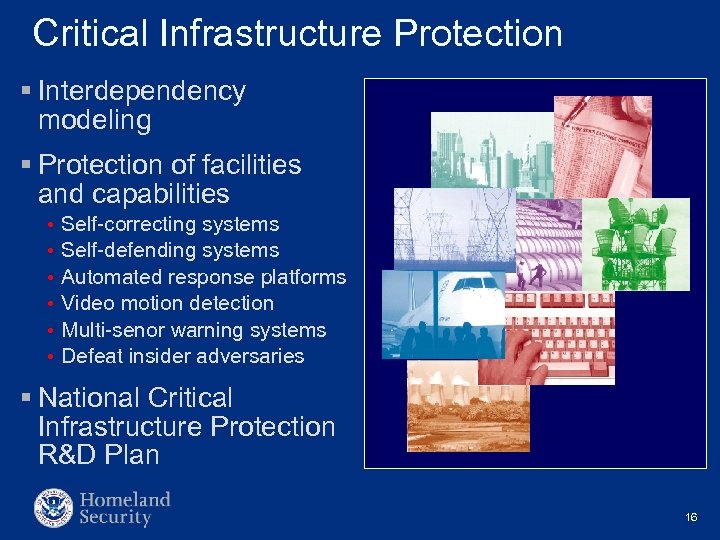 Critical Infrastructure Protection § Interdependency modeling § Protection of facilities and capabilities • • • Self-correcting systems Self-defending systems Automated response platforms Video motion detection Multi-senor warning systems Defeat insider adversaries § National Critical Infrastructure Protection R&D Plan 16
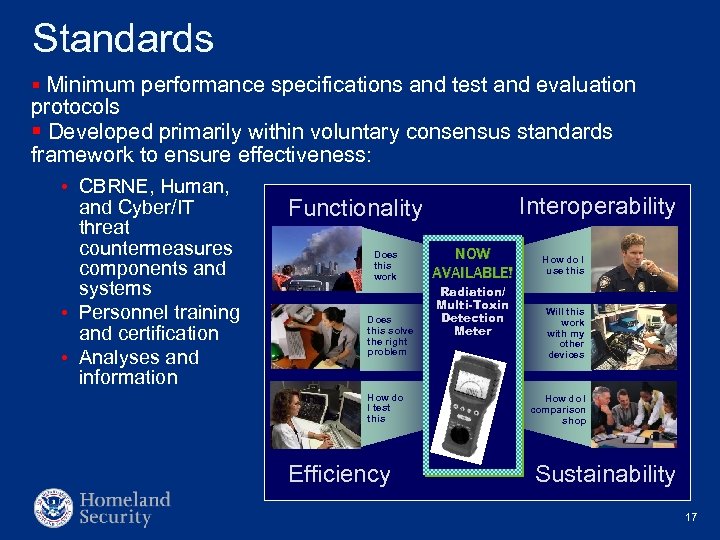 Standards § Minimum performance specifications and test and evaluation protocols § Developed primarily within voluntary consensus standards framework to ensure effectiveness: • CBRNE, Human, and Cyber/IT threat countermeasures components and systems • Personnel training and certification • Analyses and information Interoperability Functionality Does this work Does this solve the right problem How do I test this Efficiency NOW AVAILABLE! Radiation/ Multi-Toxin Detection Meter How do I use this Will this work with my other devices How do I comparison shop Sustainability 17
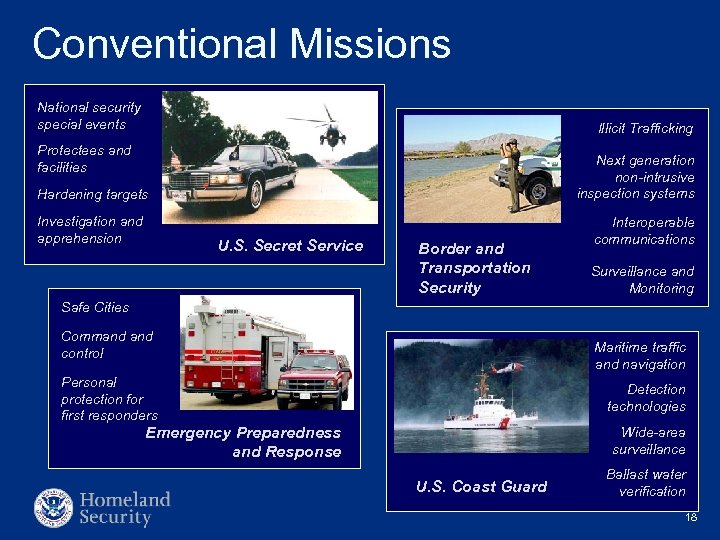 Conventional Missions National security special events Illicit Trafficking Protectees and facilities Next generation non-intrusive inspection systems Hardening targets Investigation and apprehension U. S. Secret Service Border and Transportation Security Interoperable communications Surveillance and Monitoring Safe Cities Command control Maritime traffic and navigation Personal protection for first responders Detection technologies Emergency Preparedness and Response Wide-area surveillance U. S. Coast Guard Ballast water verification 18
 Office of Research and Development § Intramural programs, conducted by federal research laboratories • DOE National Labs § University programs • Scholars and Fellows • University Centers of Expertise 19
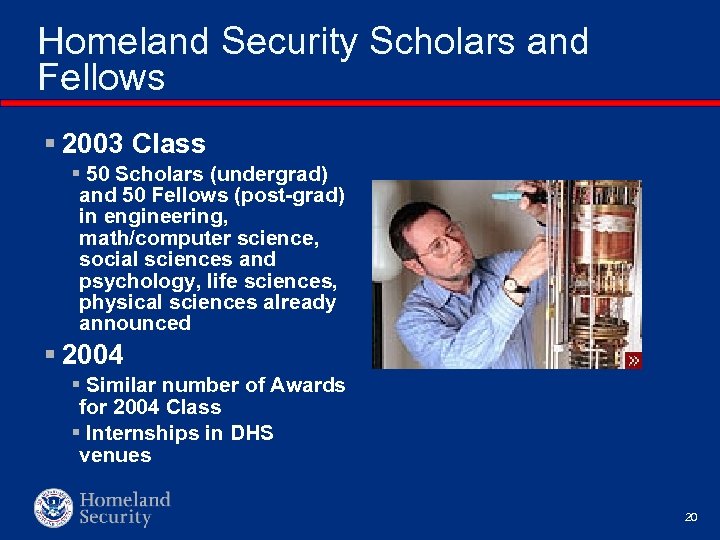 Homeland Security Scholars and Fellows § 2003 Class § 50 Scholars (undergrad) and 50 Fellows (post-grad) in engineering, math/computer science, social sciences and psychology, life sciences, physical sciences already announced § 2004 § Similar number of Awards for 2004 Class § Internships in DHS venues 20
 Homeland Security University Centers of Excellence § Mission focused and designed to exploit multi-disciplinary university environment § Responsive to identified scientific and knowledge gaps § Complementary to other project activities § Center design requires active partnerships and outreach to industry, local government and labs § Current Centers: § Risk-based economic modeling : University of Southern California § Agricultural bio-security (2): Texas A&M and University of Minnesota (exotic animal diseases and food safety) § Next Center: § Behavioral and Social Aspects of Terrorism and Counterterrorism 21
 Homeland Security Advanced Research Projects Agency (HSARPA) - Extramural § HSARPA BAAs / RAs / etc. § White papers → Full proposals § Small Business Innovative Research – FY 2004 (Pre-solicitiation notice posted 29 September at www. eps. gov/spg) § Website to register products for DHS purchase § Technical Support Working Group (TSWG) § § 6 to 24 months Rapid prototyping Commercial adaptation Cooperative development § For HSARPA research funding opportunities, monitor: www. dhs. gov or www. bids. tswg. gov 22
 System Engineering & Development § Transition maturing technologies to commercialization 23