


 Скачать презентацию DEPARTMENT OF HIGHER EDUCATION AND TRAINING TRANSFORMATION PLAN
73d474fcf42de825d9a54e0525b0614d.ppt
- Количество слайдов: 68
 DEPARTMENT OF HIGHER EDUCATION AND TRAINING TRANSFORMATION PLAN OF THE UNIVERSITY OF CAPE TOWN AND STELLENBOSCH UNIVERSITY Presentation to the Portfolio Committee on Higher Education and Training 24 June 2015
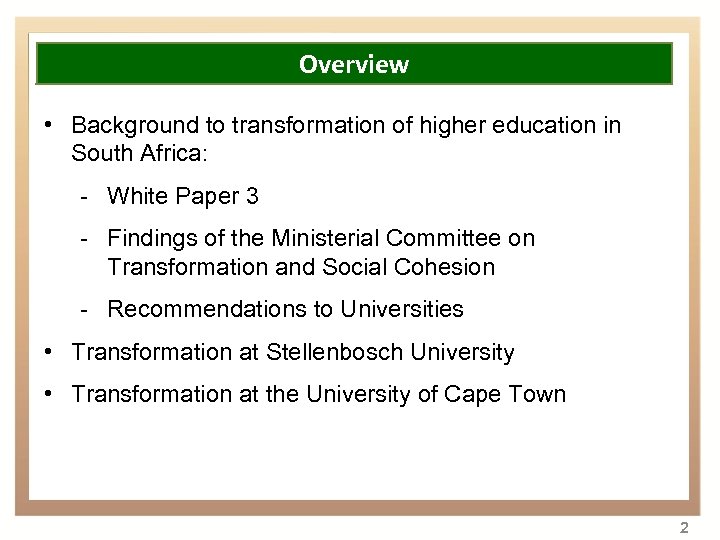 Overview • Background to transformation of higher education in South Africa: - White Paper 3 ü White Paper 3; - Findings of the Ministerial Committee on ü Findings of and Social Cohesion Committee on Transformation the Ministerial Transformation and Social Cohesion; and - Recommendations to Universities ü Recommendations to Universities. • Transformation at Stellenbosch University • Transformation at the University of Cape Town 2 2
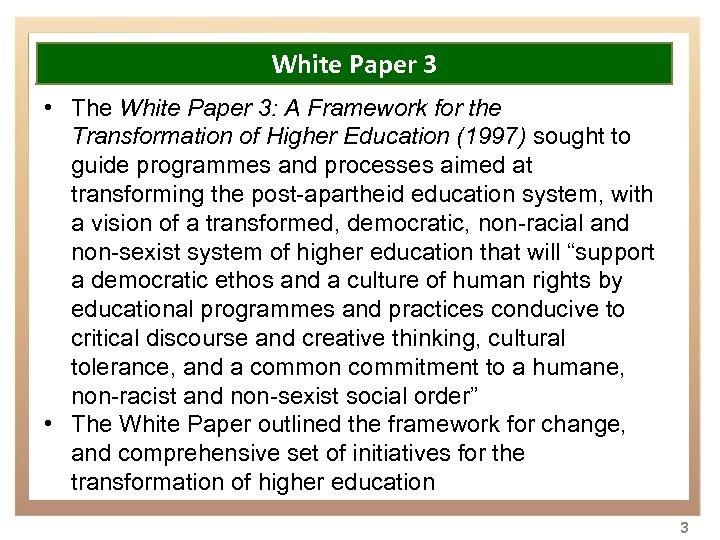 Overview White Paper 3 • The White Paper 3: A Framework for the Transformation transformation of (1997) education • Background to of Higher Education higher sought to in guide Africa: South programmes and processes aimed at transforming the post-apartheid education system, with ü White Paper 3; a vision of a transformed, democratic, non-racial and non-sexist system of higher education that will “support ü Findings of the Ministerial Committee on a democratic ethosand Social Cohesion; and Transformation and a culture of human rights by educational programmes and practices conducive to ü Recommendations to Universities. critical discourse and creative thinking, cultural tolerance, and at Stellenbosch University • Transformationa common commitment to a humane, non-racist and non-sexist social order” • Transformation at the University of Cape Town • The White Paper outlined the framework for change, and comprehensive set of initiatives for the transformation of higher education 3 3
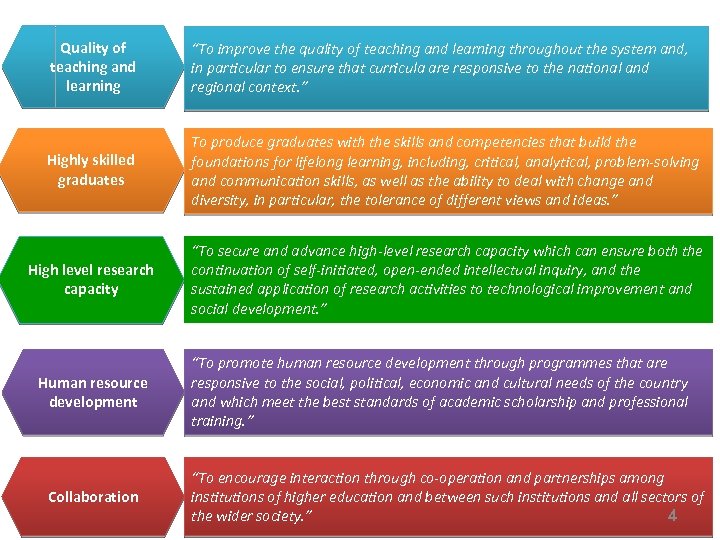 Quality of teaching and learning “To improve the quality of teaching and learning throughout the system and, in particular to ensure that curricula are responsive to the national and regional context. ” Highly skilled graduates To produce graduates with the skills and competencies that build the foundations for lifelong learning, including, critical, analytical, problem-solving and communication skills, as well as the ability to deal with change and diversity, in particular, the tolerance of different views and ideas. ” High level research capacity “To secure and advance high-level research capacity which can ensure both the continuation of self-initiated, open-ended intellectual inquiry, and the sustained application of research activities to technological improvement and social development. ” Human resource development Collaboration “To promote human resource development through programmes that are responsive to the social, political, economic and cultural needs of the country and which meet the best standards of academic scholarship and professional training. ” “To encourage interaction through co-operation and partnerships among institutions of higher education and between such institutions and all sectors of 4 the wider society. ”
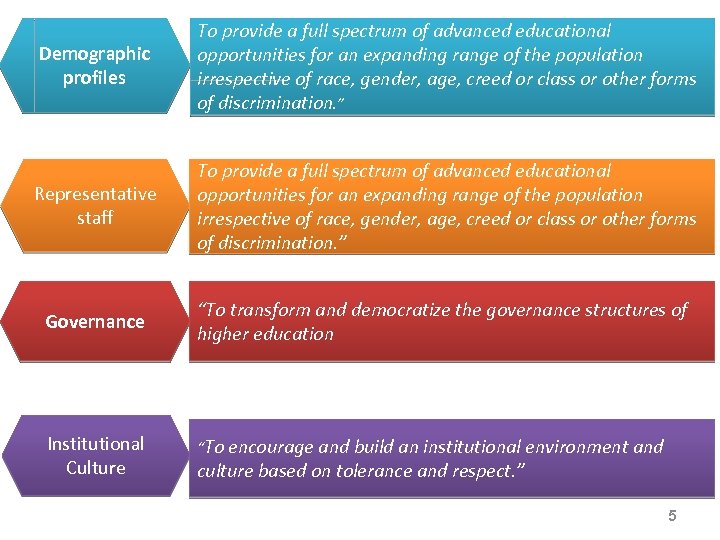 Demographic profiles To provide a full spectrum of advanced educational opportunities for an expanding range of the population irrespective of race, gender, age, creed or class or other forms of discrimination. ” Representative staff To provide a full spectrum of advanced educational opportunities for an expanding range of the population irrespective of race, gender, age, creed or class or other forms of discrimination. ” Governance “To transform and democratize the governance structures of higher education Institutional Culture “To encourage and build an institutional environment and culture based on tolerance and respect. ” 5
 Overview Committee on Transformation and Social Cohesion • Background to transformation Education, Ms Naledi in In March 2008, then Minister of of higher education Pandor, appointed a Ministerial Committee on South Africa: Transformation and Social Cohesion and Elimination of ü White Paper 3; Discrimination in Public Higher Education, headed by Professor Crain of Soudien, to “investigate discrimination in on ü Findings the Ministerial Committee public higher education institutions, with a focus on racism Transformation and Social Cohesion; and to make appropriate recommendations to combat discrimination and to promote social cohesion” ü Recommendations to Universities. • The Committee was asked to report on the nature and extent • Transformation at Stellenbosch University of racism in public higher education, particularly the university residences, as well as other forms of • Transformation at the University of Cape Town discrimination such as gender, ethnicity and disability and on the steps that have been taken by institutions to combat discrimination 6 6
 Overview Findings of the Soudien Report • The state of transformation in higher education that • Backgroundendemic within institutions and is painfully in racism was to transformation of higher education South Africa: slow • There was little or no internal dialogue between ü White Paper 3; institutional constituencies on issues of transformation, ü Findings of forums which should be facilitating and the institutional the Ministerial Committee on Transformation and Social Cohesion; and such dialogue were quiet • Most institutions adoptto Universities. approach with ü Recommendations the compliance the focus on numerical targets or changing the racial • Transformation at Stellenbosch Universityof the success demography which is not a true measure of transformation • Transformation at the University of Cape Town 7 7
 Overview Findings of the Soudien Report • While institutions have made a of higher education • Background to transformationremarkable progress in in achieving regulatory compliance, and have a range of South Africa: policies in place to address issues of transformation, ü White remain policy implementation and the concerns Paper 3; questions of transforming the institutional culture ü Findings of the Ministerial Committee on • Focus areas: staff experience, Cohesion; and Transformation and Social language, student living and governance ü Recommendations to Universities. • Transformation at Stellenbosch University • Transformation at the University of Cape Town 8 8
 Overview Soudien Report: Staff Experience • Reasons for to transformation of higher education in • Background failure to retain black and women staff was associated South Africa: with institutional culture and discrimination faced by black academics; rather than ü higher salaries the. White Paper 3; offered in the public and private sectors ü Findings of the Ministerial Committee on • The Committee also noted the. Cohesion; and Transformation and Social ‘culture of silence’ that permeated institutions, because of fear of victimisation ü Recommendations put initiatives • While institutions haveto Universities. in place to address issues of staff equity, transformation and discrimination, • Transformation at Stellenbosch University the real-life experiences of staff members, suggested • Transformation at the University of Cape Town that racism remains a problem in many institutions 9 9
 Overview Soudien Report: Staff Experience • Entry of new to transformation of be impeded by the • Background black staff was seen tohigher education in absence of effective mechanisms for monitoring South Africa: appointment processes ü White Paper 3; • Many institutions, despite having impressive transformation of the seemed to struggle to build a on policies, Ministerial Committee ü Findings sense of social cohesion in which all staff members feel Transformation and Social Cohesion; and equally valued ü Recommendations to Universities. – In relation to gender, it was suggested that while • Transformation at Stellenbosch University there is ’formal equality’ between genders, a ‘male dominated’ culture persisted of Cape Town • Transformation at the Universityat SU 10 10
 Overview Soudien Report: Language • The report noted that language is critical to higher education transformation as it impacts institutional culture, • Background to transformation of higher education in access and success South Africa: • In the Historically Afrikaans-medium institutions , where ü White Paper 3; either a parallel medium or a dual medium language policy in place, of language policy required, as a ü Findings the Ministerial Committee on minimum requirement for employment, that staff members Transformation and Social Cohesion; and are proficient in both English and Afrikaans ü Recommendations to Universities. • It was found that even if staff members meet the minimum requirement, they Stellenbosch University • Transformation atmay not feel totally comfortable in Afrikaans, which tends to be the language of • Transformationwithin the institutions. Cape Town communication at the University of • The parallel medium language policy was seen as a main obstacle to transformation because it divides the students 11 11
 Overview Soudien Report: Student Living • At the policy level, all historically white institutions were • Background to transformationresidences education in committed to the integration of of higher South Africa: – first-year places were allocated based in order of priority namely, disability, race, gender, age, ü White Paper 3; financial need and distance from home; while some ü Findings used quota system based. Committee on institutions of the Ministerial on the Transformation and Social of the student demographic composition Cohesion; and • Presence of strong hierarchical structures ü Recommendations to Universities. • Alumni seemed to play an important role in maintaining • Transformation at Stellenbosch University the identity, culture and tradition of the residences • Residence committees were not racially Town • Transformation at the University of Caperepresentative, given their role in placements, as well as in coordinating the residence-based diversity programmes 12 12
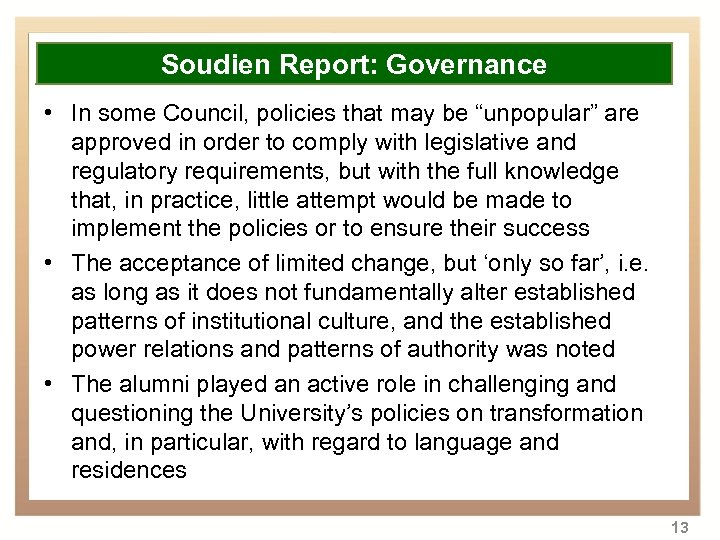 Overview Soudien Report: Governance • In some Council, policies that may be “unpopular” are • Background order to comply with of higher and approved in to transformation legislative education in South Africa: regulatory requirements, but with the full knowledge that, in practice, little attempt would be made to ü White Paper 3; implement the policies or to ensure their success ü Findings of the Ministerial Committee • The acceptance of limited change, but ‘only so far’, i. e. on as Transformation not fundamentally alterand long as it does and Social Cohesion; established patterns of institutionalto Universities. established ü Recommendations culture, and the power relations and patterns of authority was noted • Transformation at Stellenbosch University • The alumni played an active role in challenging and • Transformation at the University of Cape Town questioning the University’s policies on transformation and, in particular, with regard to language and residences 13 13
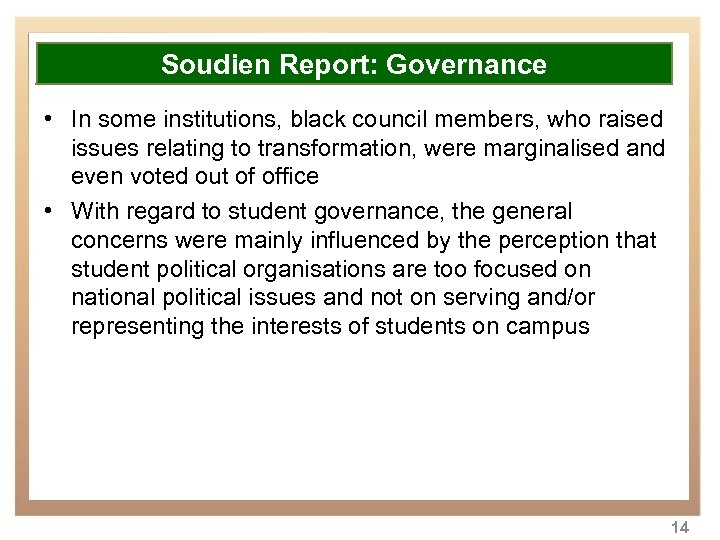 Overview Soudien Report: Governance • In some institutions, black council members, who raised • Background tototransformation of higher education in issues relating transformation, were marginalised and Southvoted out of office even Africa: • With regard to student governance, the general ü White Paper 3; concerns were mainly influenced by the perception that ü Findings of the Ministerial Committee on student political organisations are too focused on Transformation and Social Cohesion; and national political issues and not on serving and/or representing the interests of students on campus ü Recommendations to Universities. • Transformation at Stellenbosch University • Transformation at the University of Cape Town 14 14
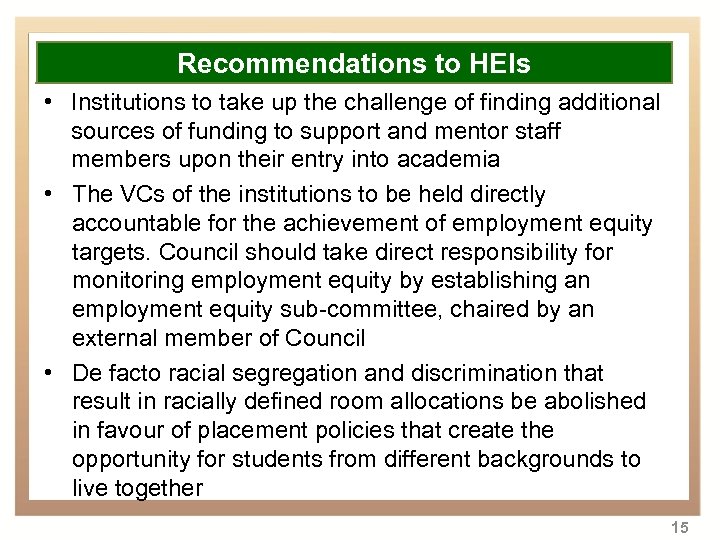 Overview Recommendations to HEIs • Institutions to take up the challenge of finding additional sources of funding to support and higher education in • Background to transformation ofmentor staff members upon South Africa: their entry into academia • The VCs of the institutions to be held directly ü White Paper the accountable for 3; achievement of employment equity targets. Council should take direct responsibility for on ü Findings of the Ministerial Committee monitoring employment equity. Cohesion; and an Transformation and Social by establishing employment equity sub-committee, chaired by an ü Recommendations to Universities. external member of Council • Transformationsegregation and University De facto racial at Stellenbosch discrimination that result in racially defined room allocations be abolished • Transformation at the University of Cape Town in favour of placement policies that create the opportunity for students from different backgrounds to live together 15 15
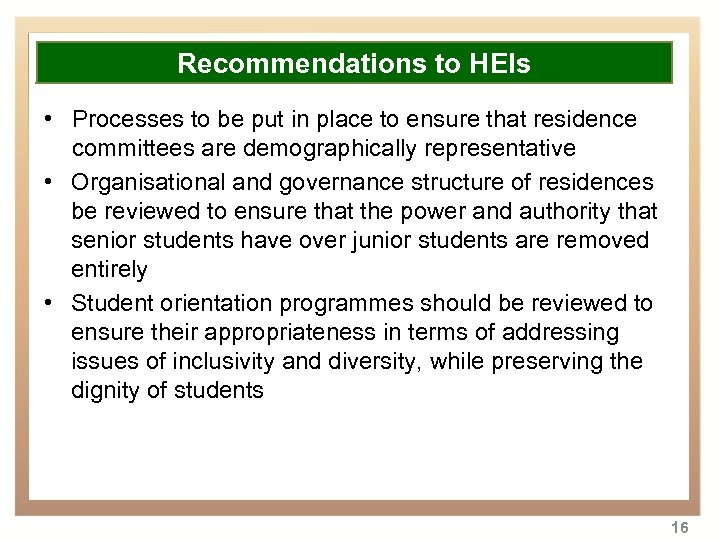 Overview Recommendations to HEIs • Processes to be put in place to ensure that residence • Background are demographically of higher education in committees to transformation representative • South Africa: and governance structure of residences Organisational be White Paperensure that the power and authority that ü reviewed to 3; senior students have over junior students are removed ü Findings of the Ministerial Committee on entirely Transformation and Social Cohesion; and • Student orientation programmes should be reviewed to ü Recommendations to Universities. ensure their appropriateness in terms of addressing issues of inclusivity and diversity, while preserving the • Transformation at Stellenbosch University dignity of students • Transformation at the University of Cape Town 16 16
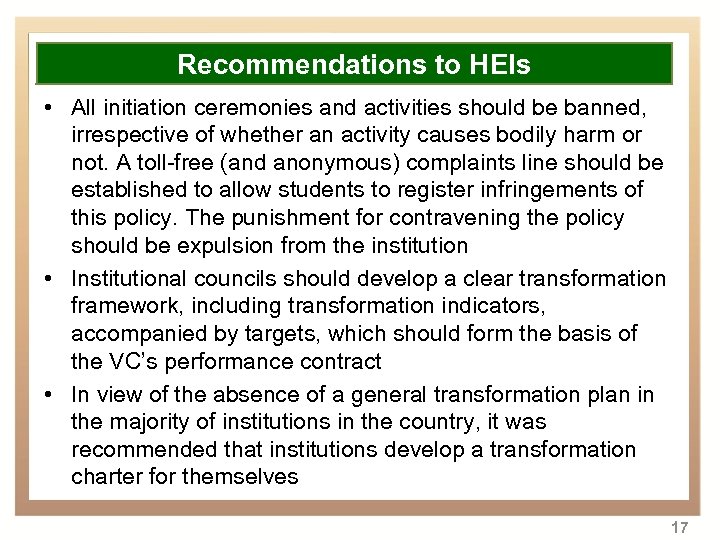 Overview Recommendations to HEIs • All initiation ceremonies and activities should be banned, irrespective whether an activity of higher education • Backgroundofto transformation causes bodily harm or in not. A Africa: South toll-free (and anonymous) complaints line should be established to allow students to register infringements of ü White Paper 3; this policy. The punishment for contravening the policy should be expulsion from the institution Committee ü Findings of the Ministerial on • Institutional councils should develop a clear transformation Transformation and Social Cohesion; and framework, including transformation indicators, ü Recommendations to Universities. accompanied by targets, which should form the basis of the VC’s performance contract • Transformation at Stellenbosch University • In view of the absence of a general transformation plan in • Transformation at the University of Cape was the majority of institutions in the country, it Town recommended that institutions develop a transformation charter for themselves 17 17
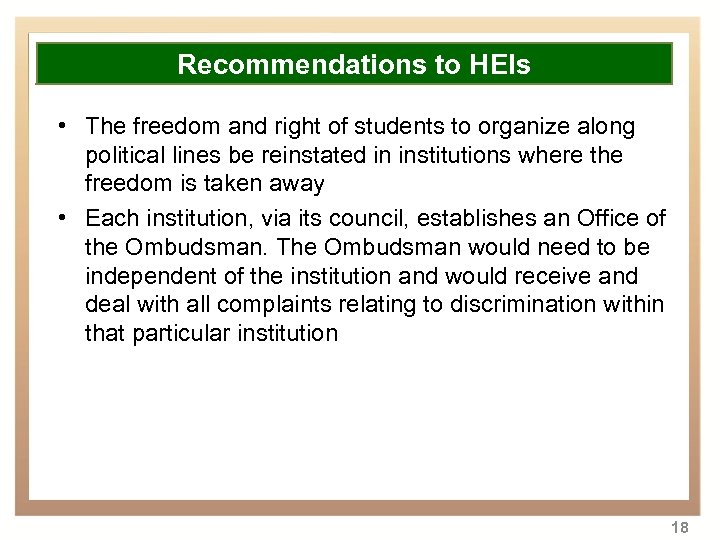 Overview Recommendations to HEIs • The freedom and right of students to organize along • Background to transformation of higher education in political lines be reinstated in institutions where the South Africa: freedom is taken away • ü White Paper 3; via its council, establishes an Office of Each institution, the Ombudsman. the Ministerial Committee ü Findings of The Ombudsman would need to beon independent of the institution. Cohesion; and Transformation and Social and would receive and deal with all complaints relating to discrimination within ü Recommendations to Universities. that particular institution • Transformation at Stellenbosch University • Transformation at the University of Cape Town 18 18
 Overview • Background to transformation of higher education in South Africa: ü White Paper 3; Stellenbosch University (SU) ü Findings of the Ministerial Committee Transformation and Social Cohesion; and on ü Recommendations to Universities. • Transformation at Stellenbosch University • Transformation at the University of Cape Town 19 19
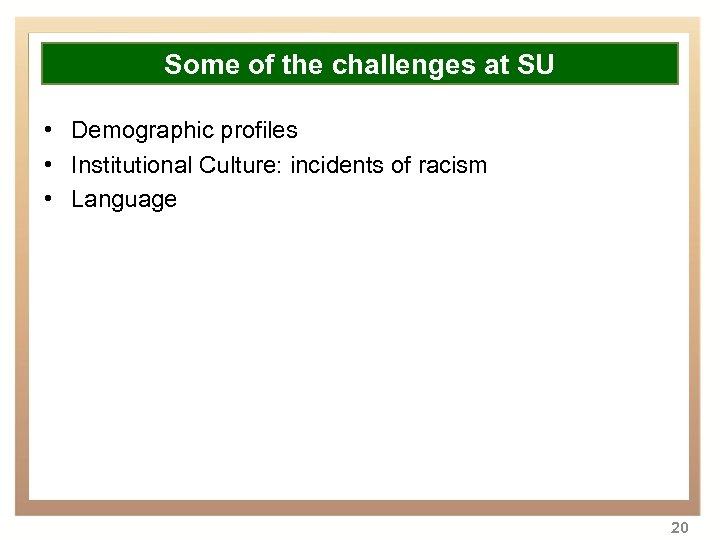 Overview Some of the challenges at SU • • Demographic profiles Background to transformation of higher education in Institutional Culture: incidents of racism South Africa: Language ü White Paper 3; ü Findings of the Ministerial Committee Transformation and Social Cohesion; and on ü Recommendations to Universities. • Transformation at Stellenbosch University • Transformation at the University of Cape Town 20 20
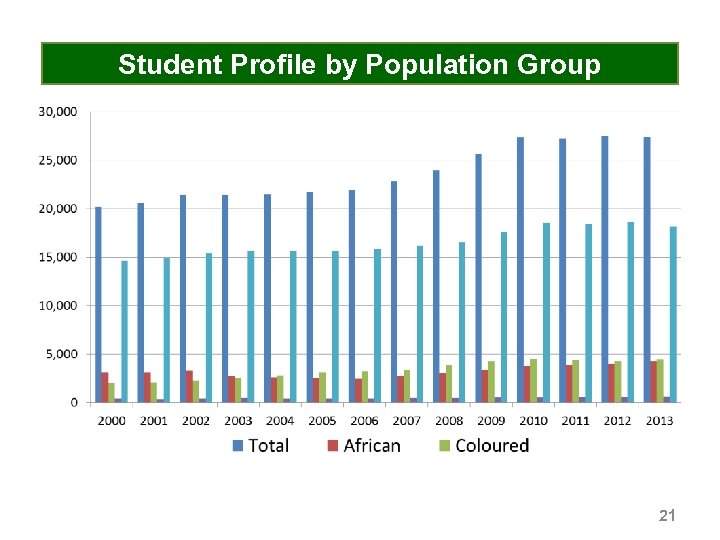 Student Profile by Population Group 21
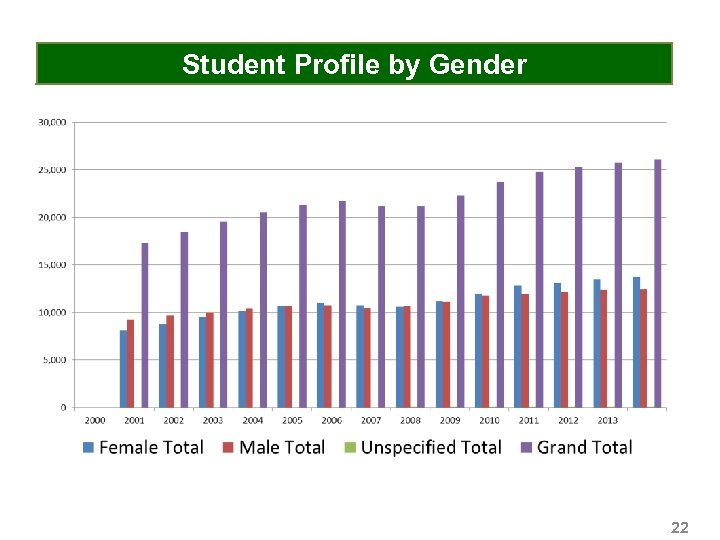 Student Profile by Gender 22
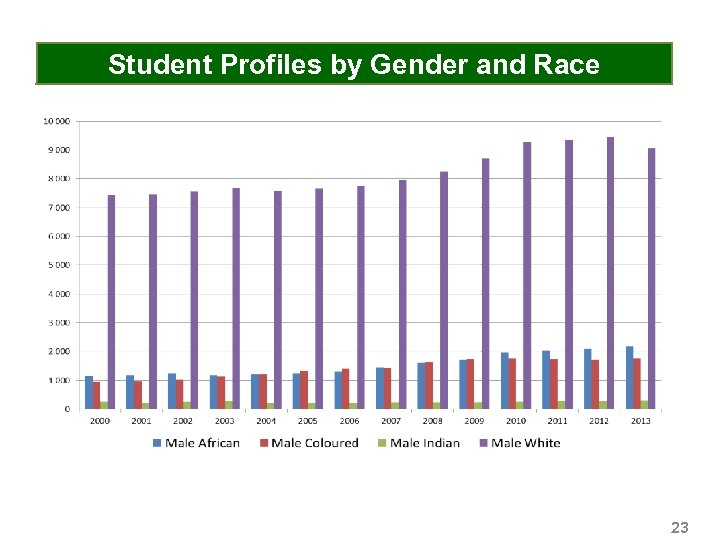 Student Profiles by Gender and Race 23
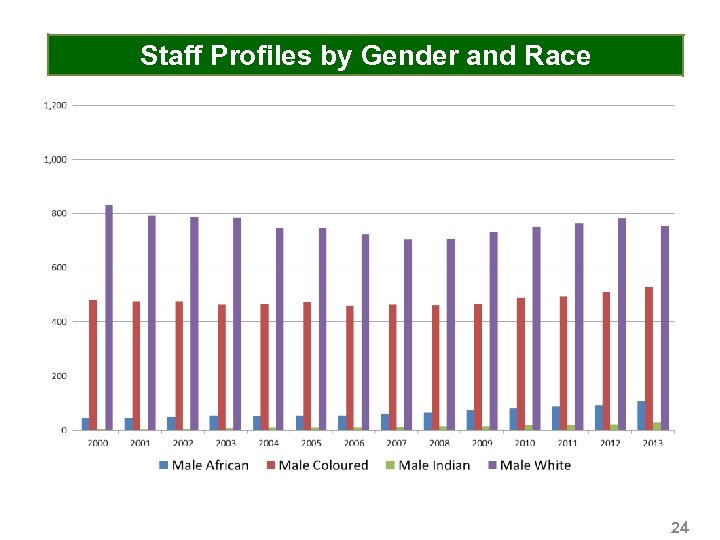 Staff Profiles by Gender and Race 24
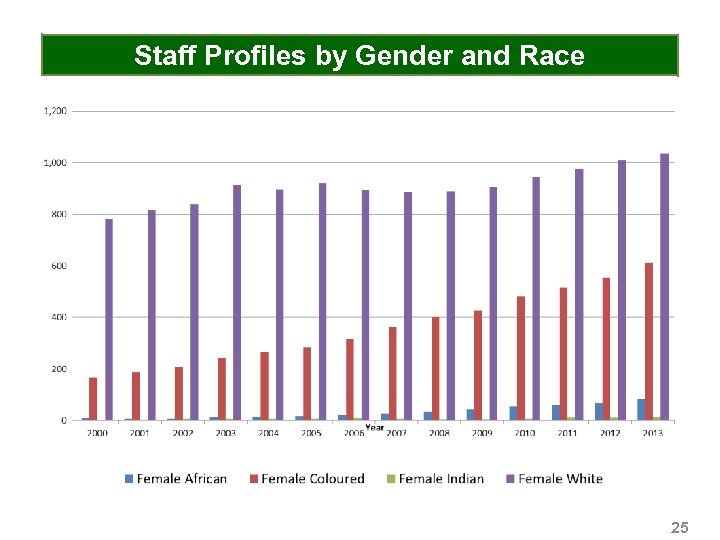 Staff Profiles by Gender and Race 25
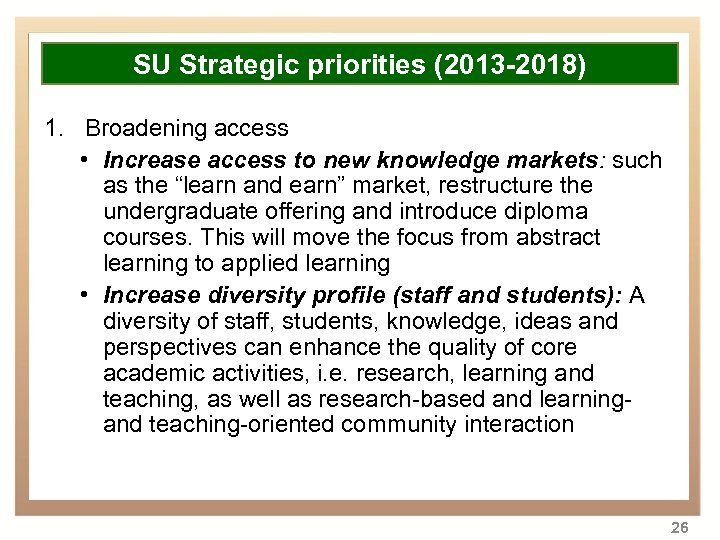 SU Strategic Overview (2013 -2018) priorities 1. Broadening access • Background to transformation of higher education in • Increase South Africa: access to new knowledge markets: such as the “learn and earn” market, restructure the undergraduate ü White Paper 3; offering and introduce diploma courses. This will move the focus from abstract ü Findings to applied learning of the Ministerial Committee on learning • Transformation and profile Cohesion; and Increase diversity Social (staff and students): A diversity of staff, students, knowledge, ideas and ü Recommendations to Universities. perspectives can enhance the quality of core • Transformation at Stellenbosch University academic activities, i. e. research, learning and teaching, as well as research-based and learning • Transformation at the University of Cape Town and teaching-oriented community interaction 26 26
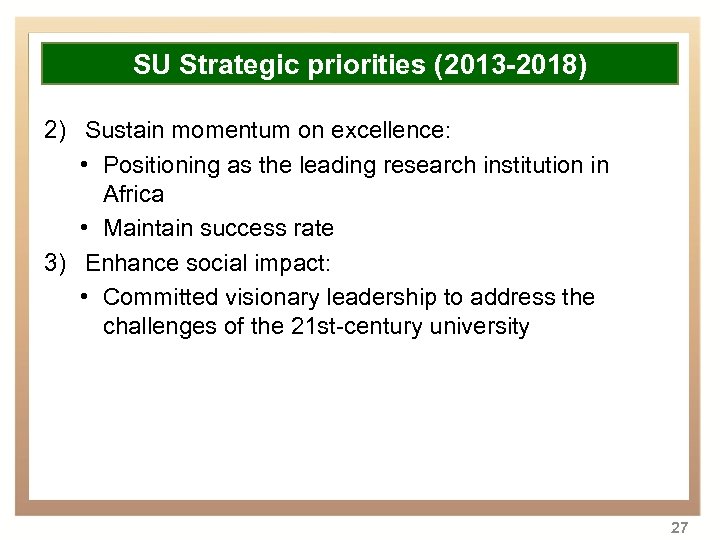 SU Strategic Overview (2013 -2018) priorities 2) Sustain momentum on excellence: • Background to transformation of higher education in • Positioning South Africa: as the leading research institution in Africa ü White Paper 3; • Maintain success rate the 3) ü Findings of impact: Ministerial Committee on Enhance social Transformation and Social Cohesion; and • Committed visionary leadership to address the challenges of the 21 st-century university ü Recommendations to Universities. • Transformation at Stellenbosch University • Transformation at the University of Cape Town 27 27
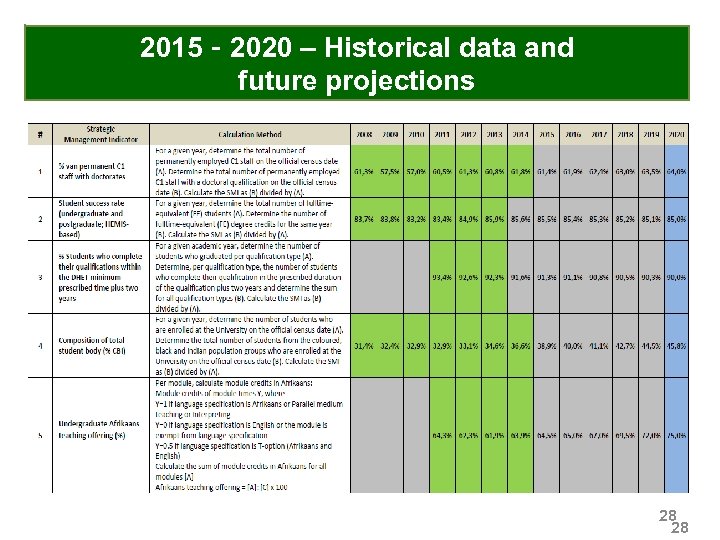 2015‐ 2020 – Historical data and future projections • Background to transformation of higher education in South Africa: ü White Paper 3; ü Findings of the Ministerial Committee Transformation and Social Cohesion; and on ü Recommendations to Universities. • Transformation at Stellenbosch University • Transformation at the University of Cape Town 28 28
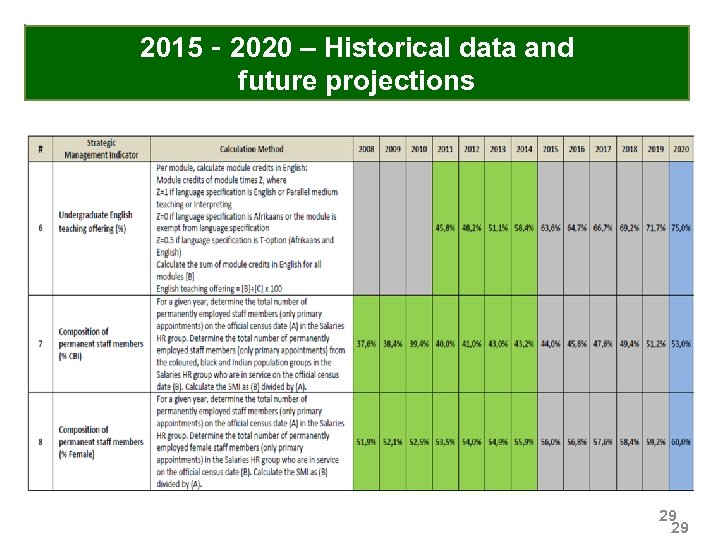 2015‐ 2020 – Historical data and future projections 29 29
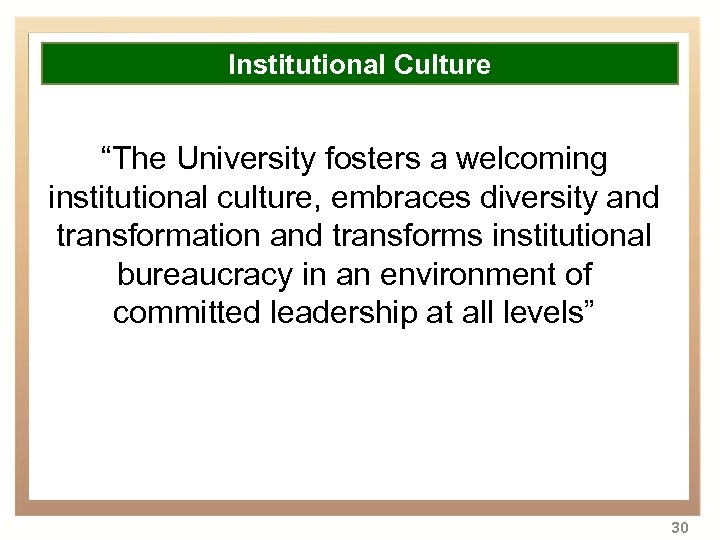 Overview Institutional Culture • Background to transformation of higher education in “The University fosters a welcoming South Africa: institutional culture, embraces diversity and ü White Paper 3; transformation and transforms institutional ü Findings of the Ministerial Committee on bureaucracy in an Cohesion; and Transformation and Socialenvironment of committed leadership at ü Recommendations to Universities. all levels” • Transformation at Stellenbosch University • Transformation at the University of Cape Town 30 30
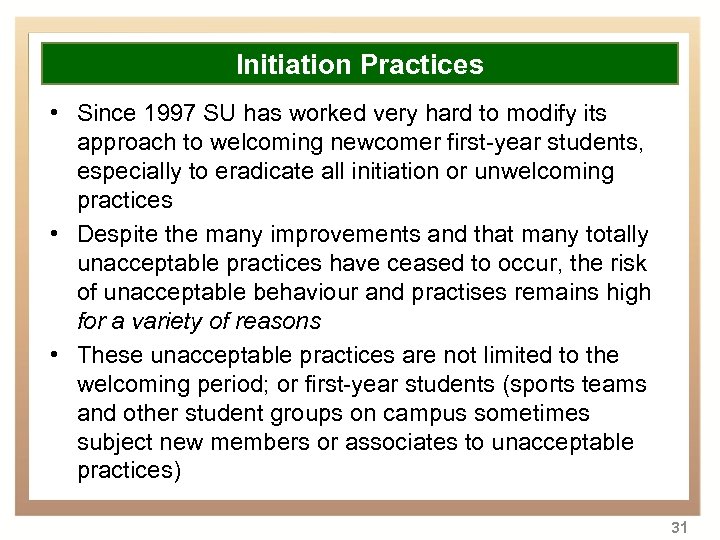 Overview Initiation Practices • Since 1997 SU has worked very hard to modify its • Background welcoming newcomer first-yeareducation in approach to to transformation of higher students, South Africa: eradicate all initiation or unwelcoming especially to practices ü White Paper 3; • Despite the many improvements and that many totally ü Findings of the Ministerial unacceptable practices have ceased to Committeerisk on occur, the of Transformation and Social Cohesion; and unacceptable behaviour and practises remains high for. Recommendations to Universities. ü a variety of reasons • These unacceptable practices are not limited to the • Transformation at Stellenbosch University welcoming period; or first-year students (sports teams • Transformation at the University of Cape Town and other student groups on campus sometimes subject new members or associates to unacceptable practices) 31 31
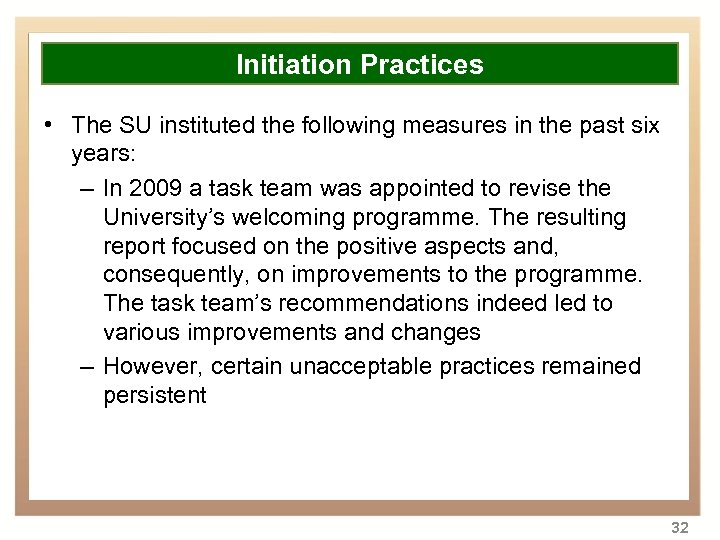 Overview Initiation Practices • The SU instituted the following measures in the past six • Background to transformation of higher education in years: South Africa: – In 2009 a task team was appointed to revise the ü White Paperwelcoming programme. The resulting University’s 3; report focused the Ministerial Committee on ü Findings of on the positive aspects and, consequently, on improvements to the programme. Transformation and Social Cohesion; and The task team’s recommendations indeed led to ü Recommendations to Universities. various improvements and changes – However, certain unacceptable practices • Transformation at Stellenbosch University remained persistent • Transformation at the University of Cape Town 32 32
 Overview Initiation Practices – In 2014, another task team was appointed to gain a better understanding of such of higher education • Background to transformation practices – their naturein as Africa: South well as their origins, why they are so persistent – and then to make recommendations for eradicating ü White practices much more effectively these Paper 3; ü Findings of 2015, the University wrote to the – On 16 January the Ministerial Committee on Transformation and Social Cohesion; and Minister to inform him of the report – Most of the recommendations in the ü Recommendations to Universities. report were implemented for the 2015 intake of first-year • Transformation at Stellenbosch University students • Transformation atstudents in a hospitable, friendly and – welcome new the University of Cape Town dignified way, always respecting their human rights as stipulated in the South African Constitution 33 33
 Overview Initiation Practices • The task team based its activities on certain premises, • Background to transformation be summarised as the key elements of which may of higher education in South Africa: follows: – student success ü White Paper 3; and development (including the development of graduate attributes) ü Findings of the Ministerial Committee on – Transformationapproach instead of a hierarchical a value driven and Social Cohesion; and approach based on power ü Recommendations to Universities. dignified ethos – an inclusive, hospitable, friendly and • Transformation at Stellenbosch University the – co-opting all role-players, and precluding possibility of any first-year students leaving • Transformation at the University of Cape Townthe University because they were treated in an inhospitable, unfriendly or undignified manner 34 34
 Overview Initiation Practices • The University recognises that welcoming practices • Background to transformation to and become must help newcomers to adjust of higher education in South Africa: university life in a way that is entirely free integrated in of any hierarchical power approaches and practices that ü White Paper 3; violate the human dignity of students; such practice ü Findings of should also promotethe Ministerial Committee on academic success Transformation and Social Cohesion; and • The University practices must be abolished for various reasons: ü Recommendations to Universities. – They are inconsistent with our constitutional order • Transformation at Stellenbosch University – The DHET called for the practices to be rooted out, • Transformation at the University of Cape Town and expects universities to help them adjust, integrate and study successfully 35 35
 Overview Initiation Practices • In its Institutional Intent and Strategy 2013– 2018, the • Background to transformation value-driven system. in University expressly opted for a of higher education South Africa: The current knowledge economy and work environment require graduates who are thought leaders and who ü White Paper 3; know how to operate in a value-driven context ü Findings of the Ministerial Committee on – A single unacceptable incident has the potential to Transformation and Social Cohesion; and rupture a whole community ü Recommendations to Universities. • Transformation at Stellenbosch University • Transformation at the University of Cape Town 36 36
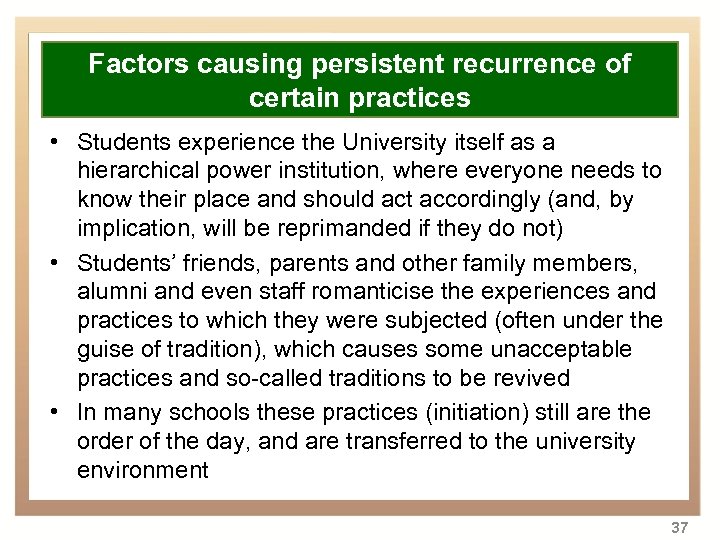 Factors causing Overview recurrence of persistent certain practices • • Background to transformation of itself as education in Students experience the University higher a South Africa: power institution, where everyone needs to hierarchical know their place and should act accordingly (and, by ü White Paper 3; implication, will be reprimanded if they do not) ü Findings of the Committee • Students’ friends, parents Ministerial family members, on and other Transformation and Social Cohesion; and alumni and even staff romanticise the experiences and practices to which they were subjected (often under the ü Recommendations to Universities. guise of tradition), which causes some unacceptable • Transformation at Stellenbosch University practices and so-called traditions to be revived • • Transformation atthese practicesof Cape Town are the In many schools the University (initiation) still order of the day, and are transferred to the university environment 37 37
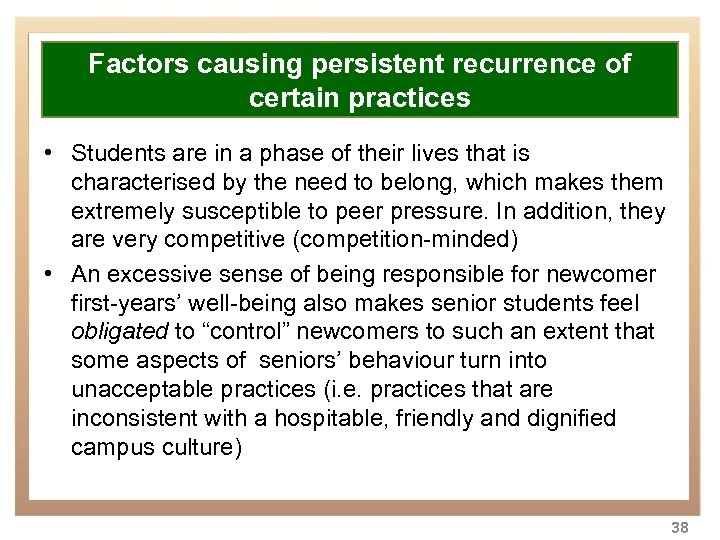 Factors causing Overview recurrence of persistent certain practices • Background in atransformation liveshigher education in • Students are to phase of their of that is South Africa: by the need to belong, which makes them characterised extremely susceptible to peer pressure. In addition, they ü White Paper 3; are very competitive (competition-minded) ü Findings of the Ministerial Committee on • An Transformation and Socialresponsibleand newcomer excessive sense of being Cohesion; for first-years’ well-being also makes senior students feel ü Recommendations to Universities. obligated to “control” newcomers to such an extent that some aspects of Stellenbosch University • Transformation at seniors’ behaviour turn into unacceptable practices (i. e. practices that are • Transformation atathe University of Cape Town inconsistent with hospitable, friendly and dignified campus culture) 38 38
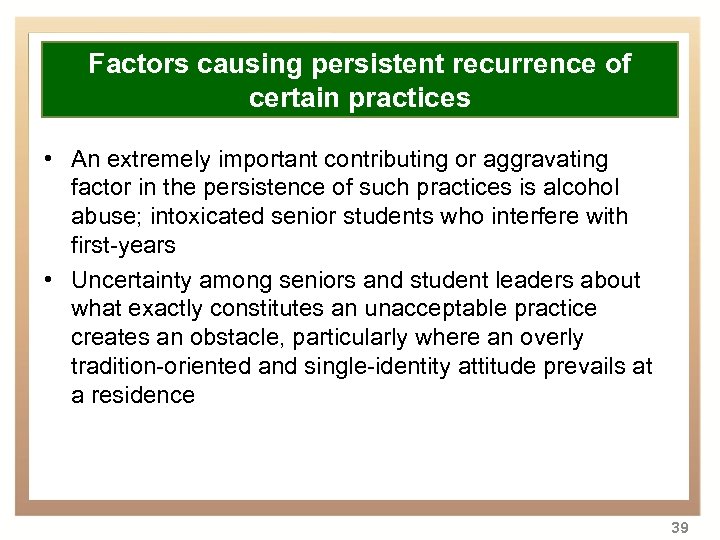 Factors causing Overview recurrence of persistent certain practices • Background to transformation of higher education in • South Africa: important contributing or aggravating An extremely factor in the persistence of such practices is alcohol ü White Paper 3; abuse; intoxicated senior students who interfere with first-years ü Findings of the Ministerial Committee on • Uncertainty amongand Social Cohesion; leaders about Transformation seniors and student and what exactly constitutes an unacceptable practice ü Recommendations to Universities. creates an obstacle, particularly where an overly tradition-oriented Stellenbosch University • Transformation atand single-identity attitude prevails at a residence • Transformation at the University of Cape Town 39 39
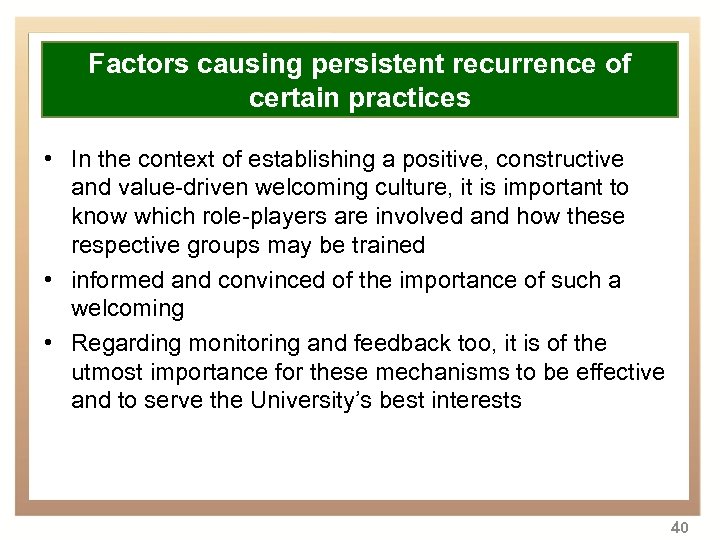 Factors causing Overview recurrence of persistent certain practices • Background to transformation of higher education in • South context of establishing a positive, constructive In the Africa: and value-driven welcoming culture, it is important to ü White Paper 3; know which role-players are involved and how these respective groups may be trained ü Findings of the Ministerial Committee on • informed and convinced of the. Cohesion; and such a Transformation and Social importance of welcoming ü Recommendations to Universities. • Regarding monitoring and feedback too, it is of the • Transformation at Stellenbosch University to be effective utmost importance for these mechanisms and to serve the University’s best interests • Transformation at the University of Cape Town 40 40
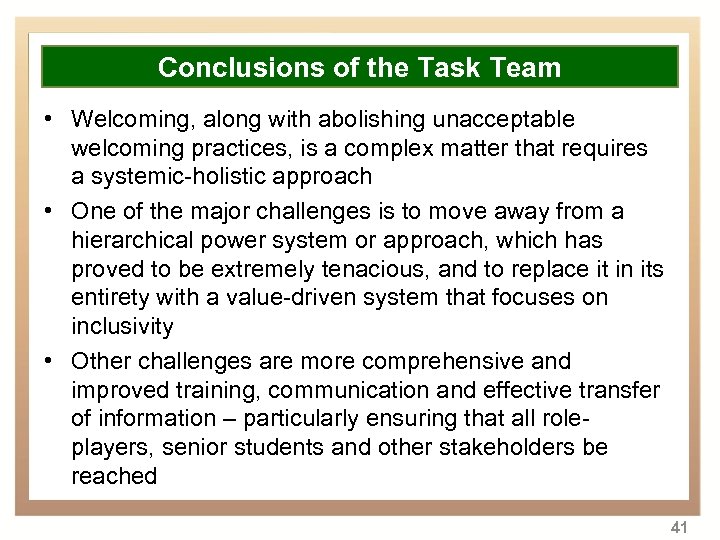 Overview. Task Team Conclusions of the • Welcoming, along with abolishing unacceptable • Background to transformation of matter that requires in welcoming practices, is a complex higher education South Africa: a systemic-holistic approach • One of the major challenges is to move away from a ü White Paper 3; hierarchical power system or approach, which has ü Findings of the Ministerial Committee on proved to be extremely tenacious, and to replace it in its Transformation and Social Cohesion; and entirety with a value-driven system that focuses on inclusivity ü Recommendations to Universities. • Other challenges Stellenbosch University • Transformation at are more comprehensive and improved training, communication and effective transfer • Transformation at the University of Cape Town of information – particularly ensuring that all roleplayers, senior students and other stakeholders be reached 41 41
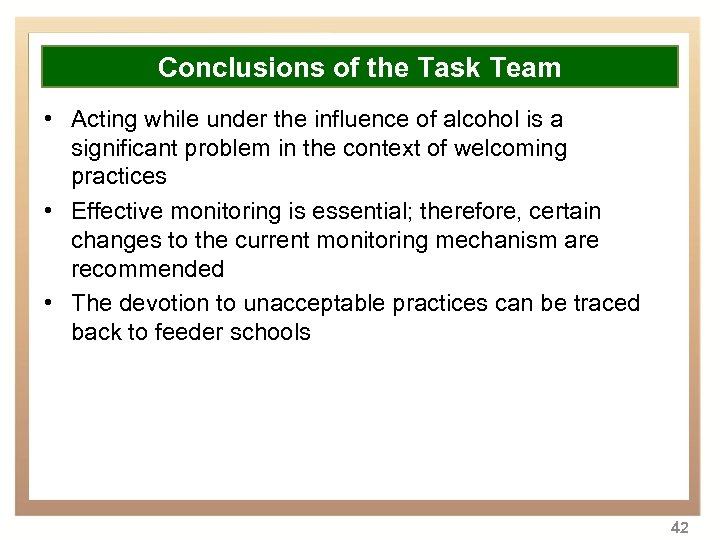 Overview. Task Team Conclusions of the • Acting while under the influence of alcohol is a • Background to transformation of welcoming significant problem in the context of higher education in South Africa: practices • Effective Paper 3; is essential; therefore, certain ü White monitoring changes to the current monitoring mechanism are ü Findings of the Ministerial Committee on recommended Transformation and Social Cohesion; and • The devotion to unacceptable practices can be traced ü Recommendations back to feeder schoolsto Universities. • Transformation at Stellenbosch University • Transformation at the University of Cape Town 42 42
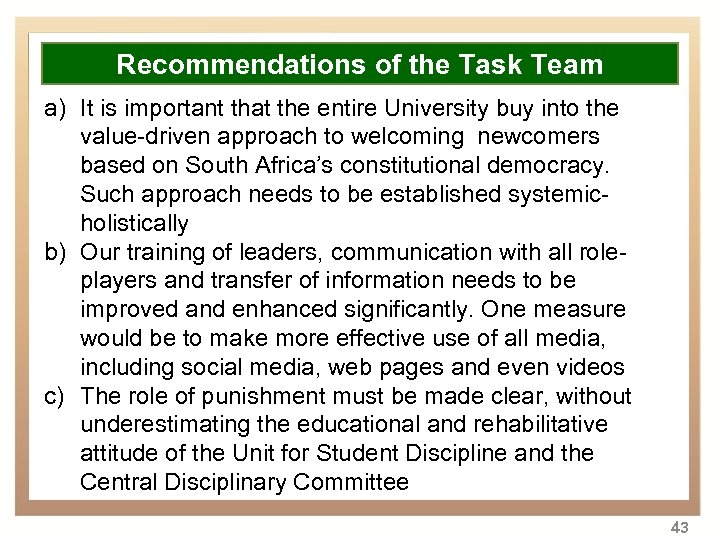 Overview Recommendations of the Task Team a) It is important that the entire University buy into the value-driven approach to welcoming newcomers • Background to transformation of higher education in based on South Africa’s constitutional democracy. South Africa: Such approach needs to be established systemicü White Paper 3; holistically b) ü Findings ofof the communication Committee on Our training leaders, Ministerial with all roleplayers and transfer of. Social Cohesion; and be Transformation and information needs to improved and enhanced significantly. One measure ü Recommendations to Universities. of all media, would be to make more effective use including social media, web pages and even videos • Transformation at Stellenbosch University c) The role of punishment must be made clear, without • Transformation at the University of Cape Town underestimating the educational and rehabilitative attitude of the Unit for Student Discipline and the Central Disciplinary Committee 43 43
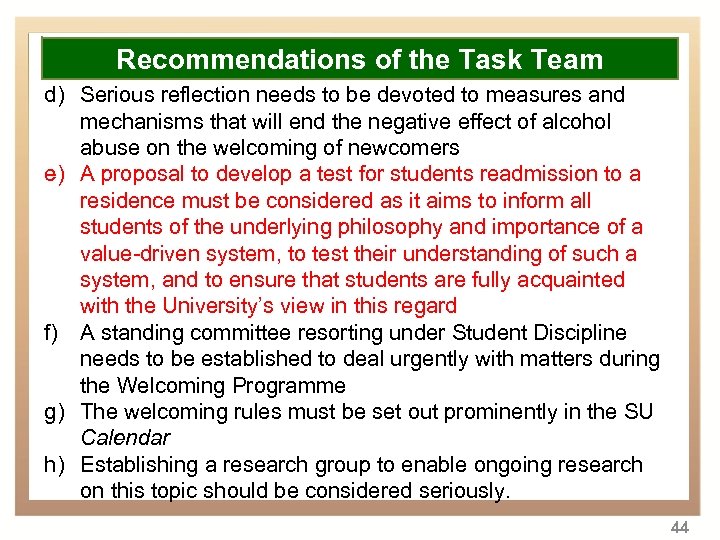 Overview Recommendations of the Task Team d) Serious reflection needs to be devoted to measures and mechanisms that will end the negative effect of alcohol • Background welcoming of newcomers abuse on the to transformation of higher education in e) South Africa: develop a test for students readmission to a A proposal to residence must be considered as it aims to inform all ü White Paper 3; students of the underlying philosophy and importance of a value-driven of to test their understanding of such ü Findings system, the Ministerial Committee a on system, and to ensure that students are fully acquainted Transformation and Social Cohesion; and with the University’s view in this regard f) ü standing committee resorting under Student Discipline A Recommendations to Universities. needs to be established to deal urgently with • Transformation at Stellenbosch University matters during the Welcoming Programme g) The welcoming at the University of prominently • Transformation rules must be set out Cape Townin the SU Calendar h) Establishing a research group to enable ongoing research on this topic should be considered seriously. 44 44
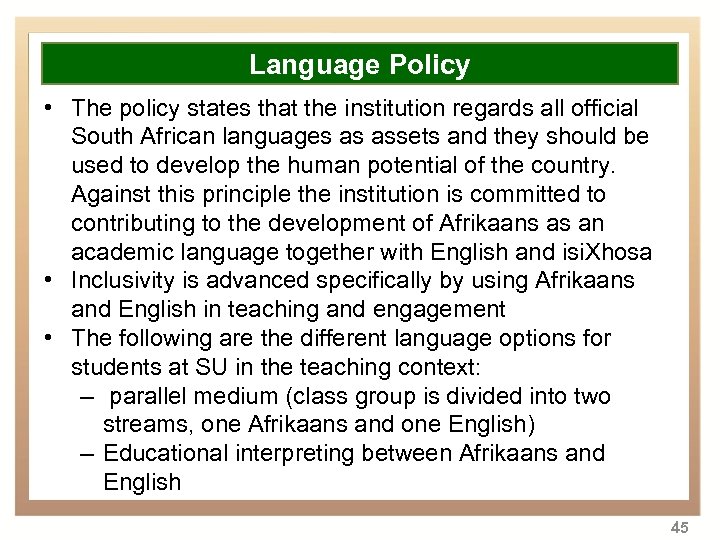 Overview Language Policy • The policy states that the institution regards all official South African languages as assets higher should be • Background to transformation of and theyeducation in used Africa: Southto develop the human potential of the country. Against this principle the institution is committed to ü White Paper 3; contributing to the development of Afrikaans as an academic language the Ministerial Committee on together with English and isi. Xhosa ü Findings of • Inclusivity is advanced Social Cohesion; and Transformation and specifically by using Afrikaans and English in teaching and engagement ü Recommendations to Universities. • The following are the different language options for students at SU at Stellenbosch University • Transformation in the teaching context: – parallel medium (class group is divided into two • Transformation at the University of Cape Town streams, one Afrikaans and one English) – Educational interpreting between Afrikaans and English 45 45
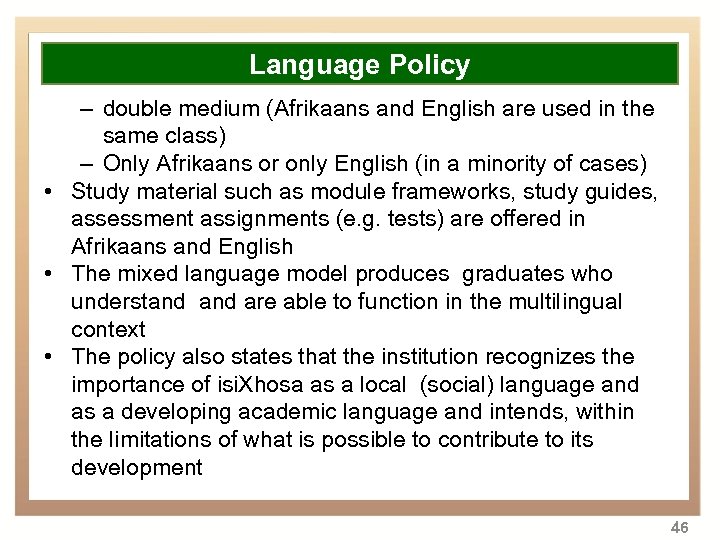 Overview Language Policy • • • – double medium (Afrikaans and English are used in the same class) Background to transformation of higher education in – Only Afrikaans or only English (in a minority of cases) South Africa: Study material such as module frameworks, study guides, ü White Paper 3; assessment assignments (e. g. tests) are offered in Afrikaans and English ü Findings of the Ministerial Committee on The mixed language model produces graduates who Transformation and Social Cohesion; and understand are able to function in the multilingual ü Recommendations to Universities. context The policy also states that the institution recognizes the Transformation at Stellenbosch University importance of isi. Xhosa as a local (social) language and Transformation at the University of Cape Town within as a developing academic language and intends, the limitations of what is possible to contribute to its development 46 46
 Overview • Background to transformation of higher education in South Africa: ü White Paper 3; University of Cape Town (UCT) ü Findings of the Ministerial Committee Transformation and Social Cohesion; and on ü Recommendations to Universities. • Transformation at Stellenbosch University • Transformation at the University of Cape Town 47 47
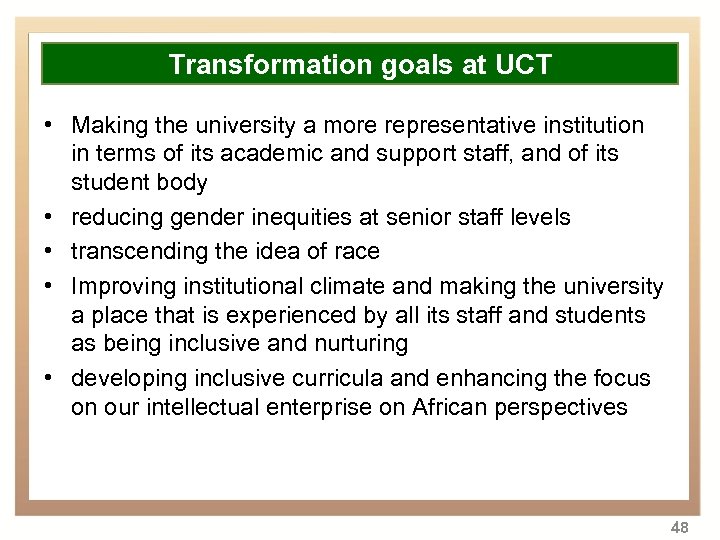 Overview Transformation goals at UCT • Making the university a more representative institution • Background to transformation of higherand of its in terms of its academic and support staff, education in South Africa: student body ü White gender inequities at senior staff levels • reducing Paper 3; • transcending the idea of race ü Findings of the Ministerial Committee on Transformation and Social and making the • Improving institutional climate Cohesion; and university a place that is experienced by all its staff and students ü Recommendations to Universities. as being inclusive and nurturing • Transformation at Stellenbosch University • developing inclusive curricula and enhancing the focus on our intellectual enterprise on of Cape Town • Transformation at the University African perspectives 48 48
 Overview Some of the challenges at UCT • • Demographic profiles Background to transformation of higher education in Institutional Culture South Africa: Access (Admissions Policy) ü White Paper 3; ü Findings of the Ministerial Committee Transformation and Social Cohesion; and on ü Recommendations to Universities. • Transformation at Stellenbosch University • Transformation at the University of Cape Town 49 49
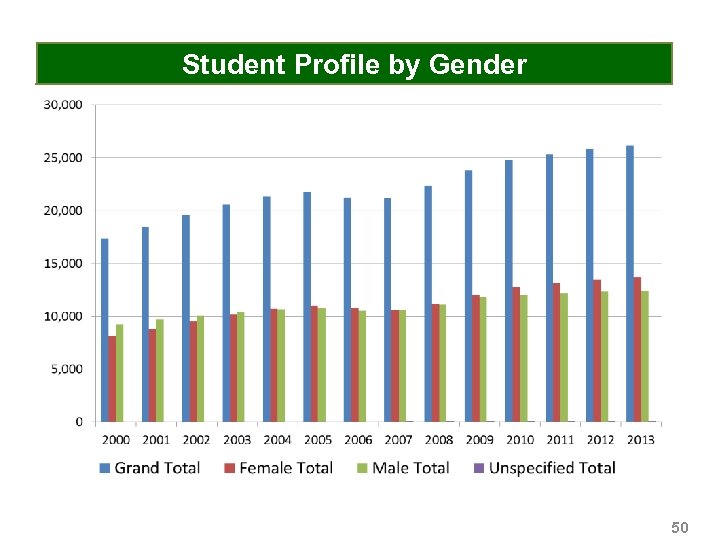 Student Profile by Gender 50
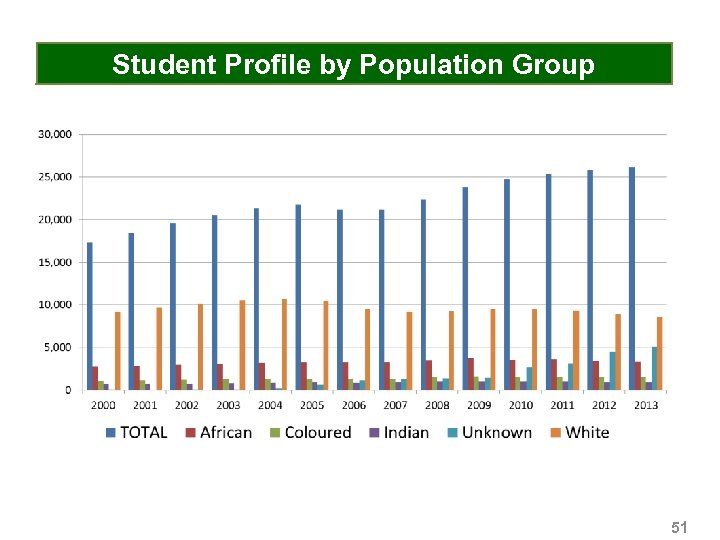 Student Profile by Population Group 51
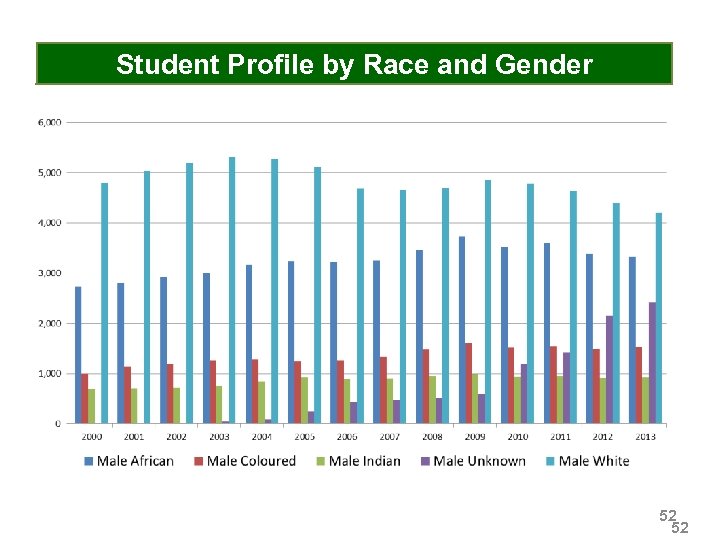 Student Profile by Race and Gender 52 52
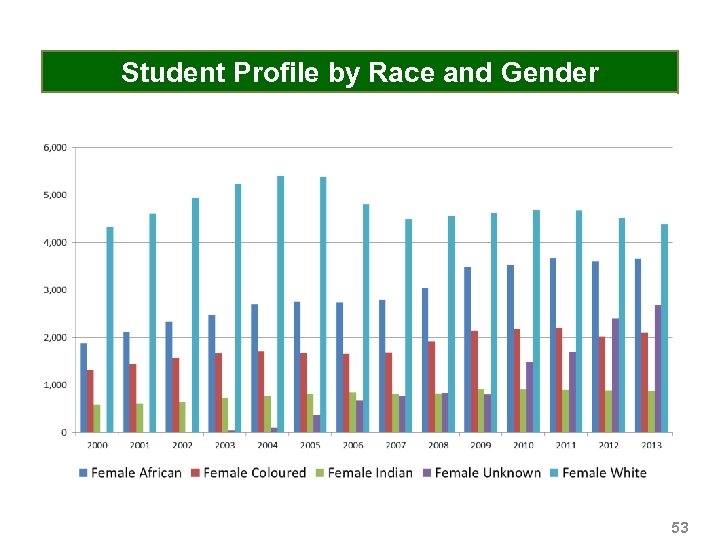 Student Profile by Race and Gender 53
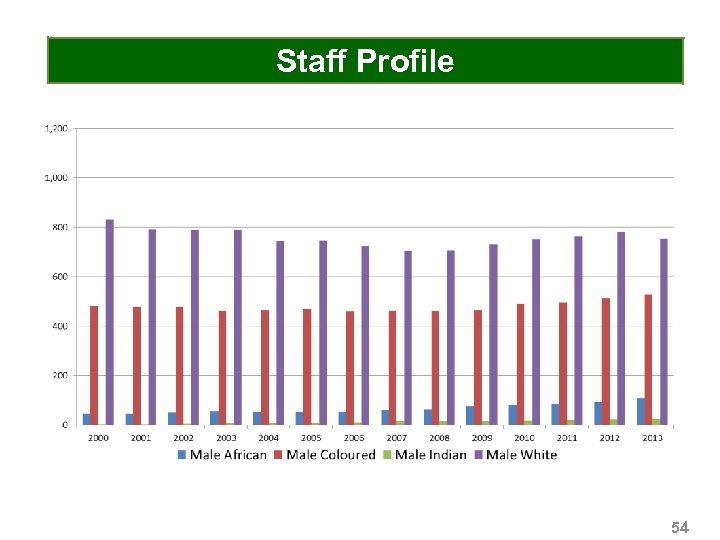 Staff Profile 54
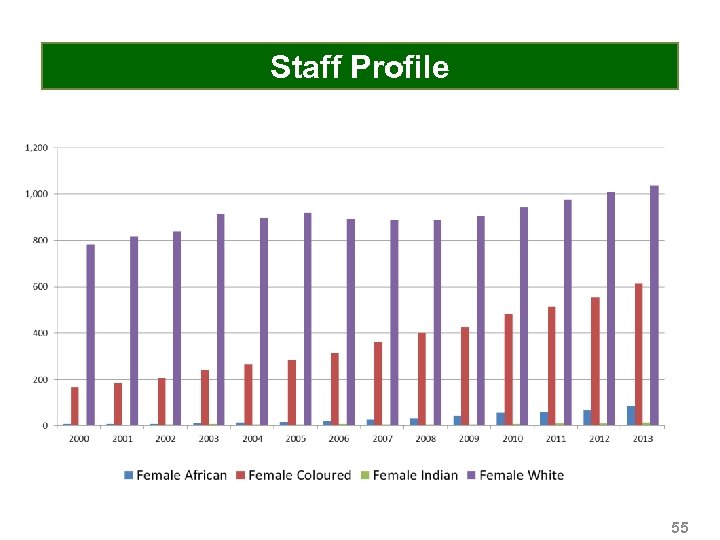 Staff Profile 55
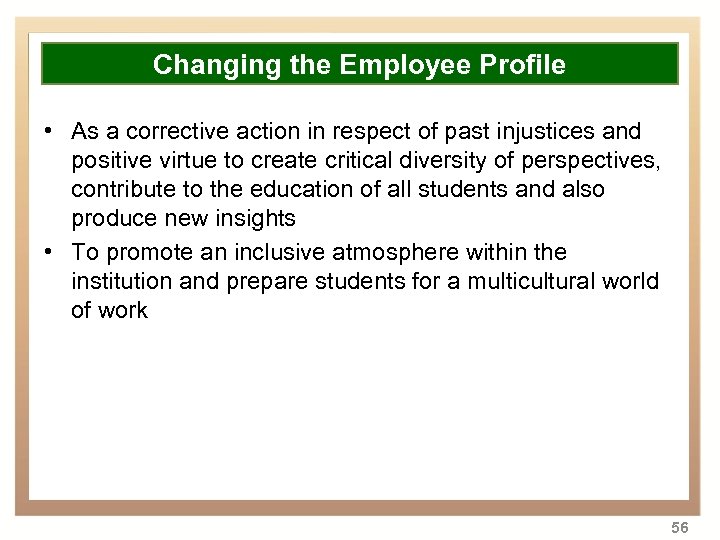 Overview Changing the Employee Profile • As a corrective transformation of higher education • Background to action in respect of past injustices and in positive virtue South Africa: to create critical diversity of perspectives, contribute to the education of all students and also ü White Paper 3; produce new insights • To Findings an of the atmosphere within the inclusive Ministerial Committee on ü promote institution and prepare students for a multicultural world Transformation and Social Cohesion; and of work ü Recommendations to Universities. • Transformation at Stellenbosch University • Transformation at the University of Cape Town 56 56
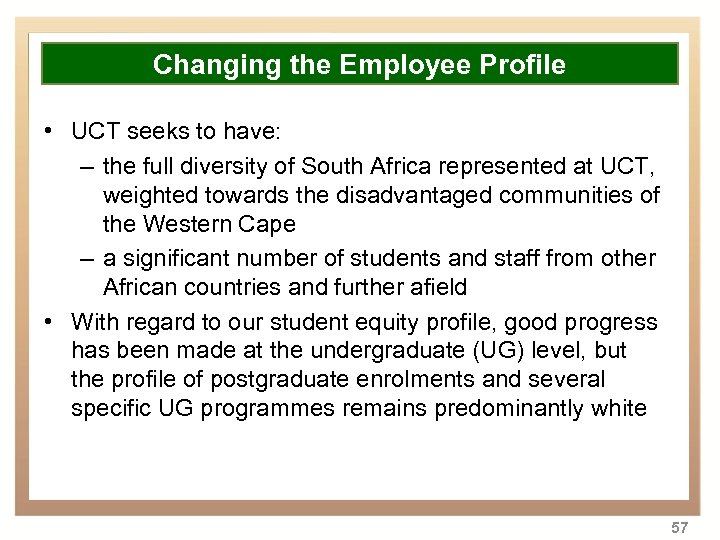 Overview Changing the Employee Profile • UCT seeks have: • Backgroundtoto transformation of higher education in – the full diversity of South Africa represented at UCT, South Africa: weighted towards the disadvantaged communities of ü White Paper Cape the Western 3; ü Findings of the of students and staff from other – a significant number Ministerial Committee on Transformation and Social Cohesion; and African countries and further afield • With regard to our student equity profile, good progress ü Recommendations to Universities. has been made at the undergraduate (UG) level, but • Transformation at Stellenbosch University several the profile of postgraduate enrolments and specific UG programmes remains Cape Town • Transformation at the University ofpredominantly white 57 57
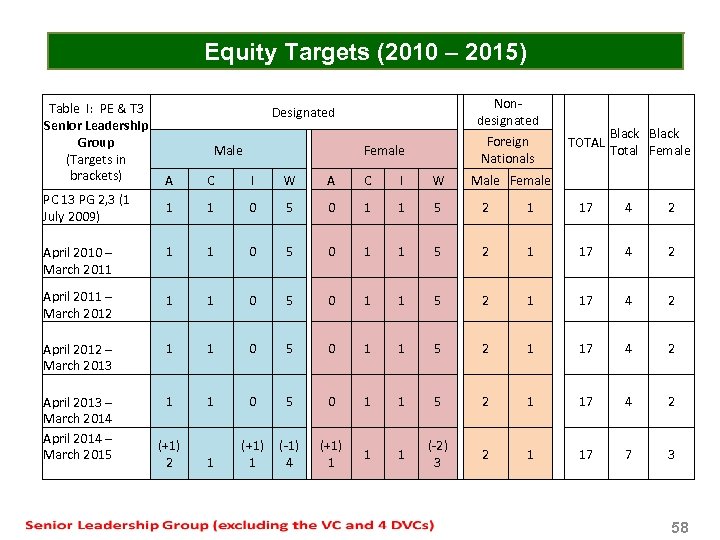 Equity Targets (2010 – 2015) Table I: PE & T 3 Senior Leadership Group (Targets in brackets) A PC 13 PG 2, 3 (1 1 July 2009) 1 April 2010 – March 2011 April 2011 – March 2012 April 2012 – March 2013 April 2013 – March 2014 April 2014 – March 2015 Nondesignated Designated Male Foreign Nationals Female TOTAL Black Total Female C I W A C I W 1 0 5 0 1 1 5 2 1 17 4 2 1 1 0 5 0 1 1 5 2 1 17 4 2 (+1) 2 1 (+1) 1 (-1) 4 (+1) 1 1 1 (-2) 3 2 1 17 7 3 Male Female 58
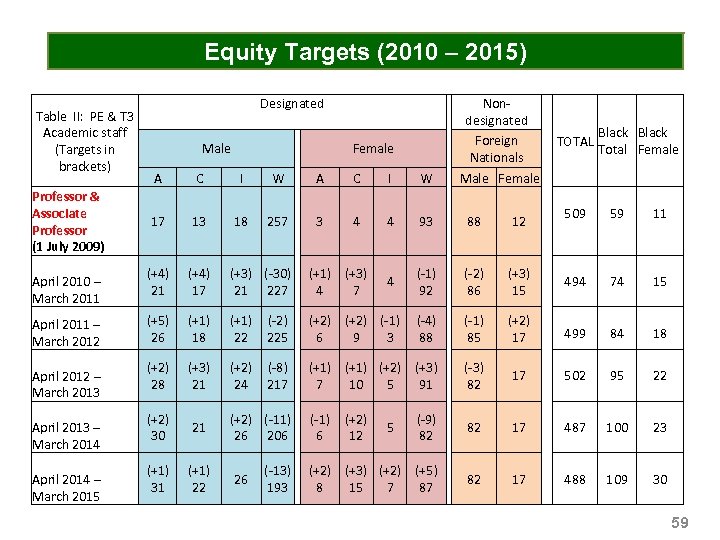 Equity Targets (2010 – 2015) Table II: PE & T 3 Academic staff (Targets in brackets) Professor & Associate Professor (1 July 2009) April 2010 – March 2011 April 2011 – March 2012 April 2012 – March 2013 April 2013 – March 2014 April 2014 – March 2015 Designated Male A C Female I W A 3 13 18 (+4) 21 (+4) 17 (+3) (-30) 21 227 (+1) (+3) 4 7 (+5) 26 (+1) 18 (+1) 22 (-2) 225 (+2) (-1) 6 9 3 (+2) 28 (+3) 21 (+2) 24 (-8) 217 (+2) 30 21 (+2) (-11) 26 206 (+1) 31 (+1) 22 (-13) 193 W TOTAL Black Total Female Male Female 509 59 11 494 74 15 4 93 88 12 4 (-1) 92 (-2) 86 (+3) 15 (-4) 88 (-1) 85 (+2) 17 499 84 18 (+1) (+2) (+3) 7 10 5 91 (-3) 82 17 502 95 22 17 487 100 23 17 488 109 30 (-1) 6 4 I 17 26 257 C Nondesignated Foreign Nationals (+2) 12 5 (-9) 82 (+2) (+3) (+2) (+5) 8 15 7 87 82 82 59
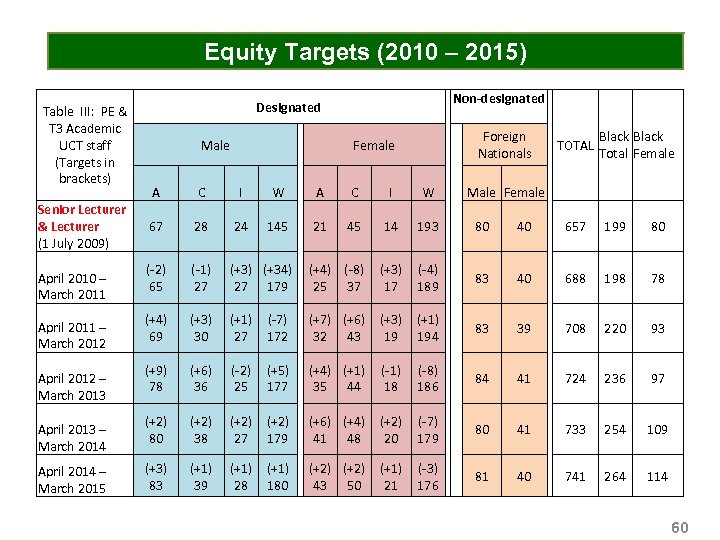 Equity Targets (2010 – 2015) Table III: PE & T 3 Academic UCT staff (Targets in brackets) Senior Lecturer & Lecturer (1 July 2009) April 2010 – March 2011 April 2011 – March 2012 April 2012 – March 2013 April 2013 – March 2014 April 2014 – March 2015 Non-designated Designated Male Female Foreign Nationals TOTAL Black Total Female A C I W Male Female 67 28 24 145 21 45 14 193 80 40 657 199 80 (-2) 65 (-1) 27 (+3) (+34) 27 179 (+4) (-8) 25 37 (+3) 17 (-4) 189 83 40 688 198 78 (+4) 69 (+3) 30 (+1) 27 (-7) 172 (+7) (+6) 32 43 (+3) 19 (+1) 194 83 39 708 220 93 (+9) 78 (+6) 36 (-2) 25 (+5) 177 (+4) (+1) 35 44 (-1) 18 (-8) 186 84 41 724 236 97 (+2) 80 (+2) 38 (+2) 27 (+2) 179 (+6) (+4) 41 48 (+2) 20 (-7) 179 80 41 733 254 109 (+3) 83 (+1) 39 (+1) 28 (+1) (+2) 180 43 50 (+1) 21 (-3) 176 81 40 741 264 114 60
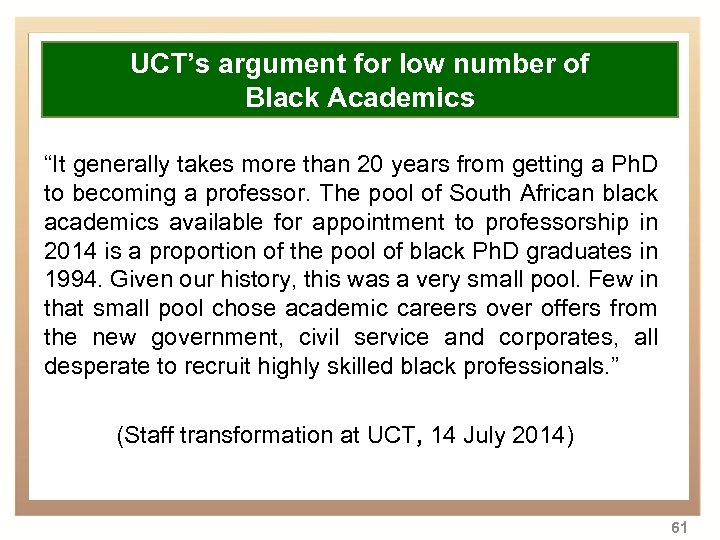 Overview UCT’s argument for low number of Black Academics • Background to transformation of higher education in “It South Africa: more than 20 years from getting a Ph. D generally takes to becoming a professor. The pool of South African black ü White Paper 3; academics available for appointment to professorship in 2014 Findings of ofthe pool of black Ph. D graduates in ü is a proportion the Ministerial Committee on 1994. Transformation and Social Cohesion; and Given our history, this was a very small pool. Few in that small pool chose academic careers over offers from the ü Recommendationscivil. Universities. corporates, all new government, to service and desperate to recruit Stellenbosch University • Transformation athighly skilled black professionals. ” • Transformation at the University of Cape Town (Staff transformation at UCT, 14 July 2014) 61 61
 Overview Improving Organisational Climate • Create and to transformation positive education • Backgroundpromote an affirming, of higherenvironment in that is inclusive South Africa: and owned by all its staff and students • The University aims to focus on treating people equally, ü White Paper 3; overcoming deep beliefs and conditioning that some are better than others, overcoming the stereotypes we hold, ü Findings of the Ministerial Committee on valuing diversity and difference Transformation and Social Cohesion; and ü Recommendations to Universities. • Transformation at Stellenbosch University • Transformation at the University of Cape Town 62 62
 Overview Admissions Policy • The policy is designed to ensure that: • Background to transformation of higher education in – the best students come to UCT South Africa: – UCT builds a diverse student body ü White Paper 3; • The best students are: ü Findings get the top results in school and formal on – those who of the Ministerial Committee Transformationexams (National Senior Certificate school-leaving and Social Cohesion; and [NSC] or equivalent) Universities. ü Recommendations toand National Benchmark Tests [NBTs] • Transformation at Stellenbosch University – those who, despite educational and other • Transformation atdo very well in of Cape Town disadvantage, the University these exams • All undergraduate applicants are required to write the NBTs 63 63
 Overview Admissions Policy • The NBTs are three multiple choice tests written as a • Background to transformation ofand Quantitative combined Academic Literacy (AL) higher education in South Africa: test and a separate Mathematics test Literacy (QL) ü White Papertargets a writer’s capacity to engage – The AL test 3; successfully with the Ministerial Committee ü Findings of the demands of academic study inon the medium of and Social Cohesion; Transformationinstruction of the test and – The QL test targets a writer’s ability to manage ü Recommendationsproblems in a real context that is situations or solve to Universities. relevant to higher education University • Transformation at Stellenbosch study, using basic quantitative information that may be presented • Transformation at the University of Cape Town verbally, graphically, in tabular or symbolic form 64 64
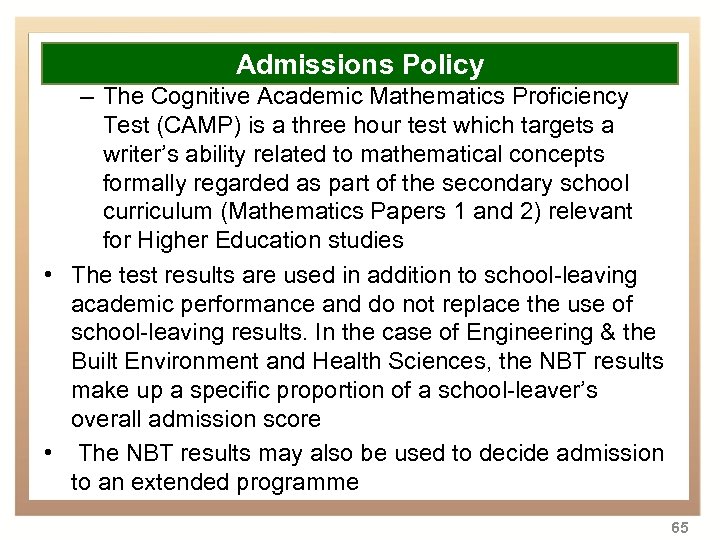 Overview Admissions Policy • • • – The Cognitive Academic Mathematics Proficiency Test (CAMP) is a three hour test which targets a Background to transformation of higher education in writer’s ability related to mathematical concepts South Africa: formally regarded as part of the secondary school curriculum (Mathematics Papers 1 and 2) relevant ü White Paper 3; for Higher Education studies ü Findings of the Ministerial Committee on The test results are used in addition to school-leaving Transformation and Social Cohesion; and academic performance and do not replace the use of ü Recommendations In the case of school-leaving results. to Universities. Engineering & the Built Environment and Health Sciences, the Transformation at Stellenbosch University NBT results make up a specific proportion of a school-leaver’s Transformation at score overall admission the University of Cape Town The NBT results may also be used to decide admission to an extended programme 65 65
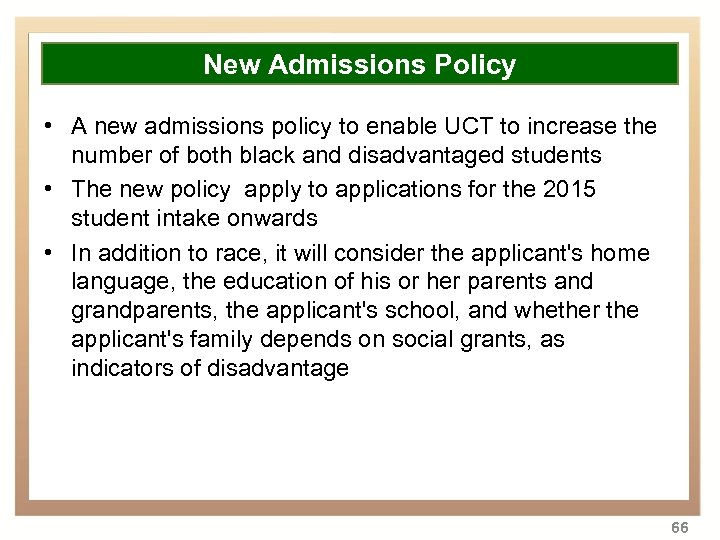 Overview New Admissions Policy • A new admissions policy to enable UCT to increase the • Background to transformation of higher education in number of both black and disadvantaged students South Africa: • The new policy apply to applications for the 2015 ü White Paper 3; student intake onwards • In addition to race, itthe consider the applicant's homeon will Ministerial Committee ü Findings of language, the education of his. Cohesion; and Transformation and Social or her parents grandparents, the applicant's school, and whether the ü Recommendations to Universities. applicant's family depends on social grants, as indicators of disadvantage • Transformation at Stellenbosch University • Transformation at the University of Cape Town 66 66
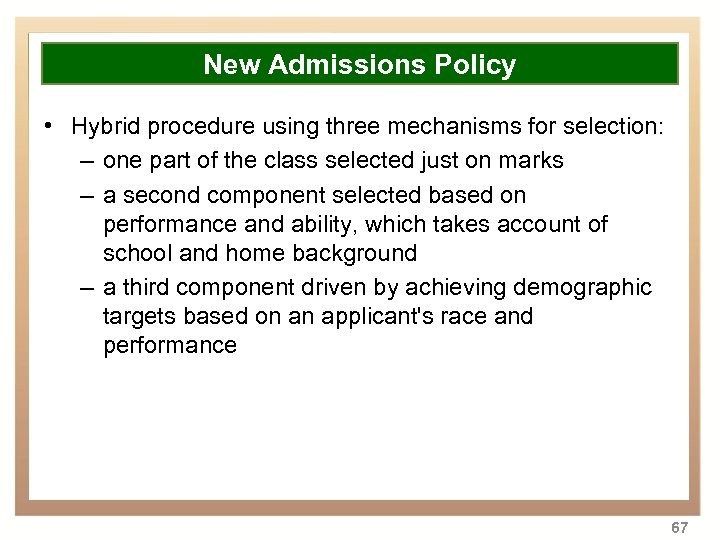 Overview New Admissions Policy • Hybrid procedure using three mechanisms for selection: • Background to transformation of higher education in – one part of South Africa: the class selected just on marks – a second component selected based on ü White Paper 3; ability, which takes account of performance and school and of background ü Findings homethe Ministerial Committee on – Transformation and Social Cohesion; and a third component driven by achieving demographic targets based on an applicant's race ü Recommendations to Universities. and performance • Transformation at Stellenbosch University • Transformation at the University of Cape Town 67 67
 Thank you! Thank You 68