


 Скачать презентацию Department of Environmental Protection Chapter 3 Stormwater Management
b5abc3d0859a8a2a290c820a5378e141.ppt
- Количество слайдов: 38
 Department of Environmental Protection Chapter 3 Stormwater Management Principles and Recommended Control Guidelines Barry A. Newman, M. S. , P. E. Robert G. Traver, Ph. D. , PE, D. AAWRE Department of Civil and Environmental Engineering Director, Villanova Urban Stormwater Partnership 1/8/2007 www. dep. state. pa. us www. villanova. edu/vusp 1
 Department of Environmental Protection Disclaimer • Some of the material that follows is the interpretation of Robert Traver, Ph. D. , of Chapter 3 as a member of DEP’s BMP Manual Oversight committee • Dr. Traver’s contributions do not necessairly represent the view of the VUSP Partners. • Dr. Traver invites you to: – Join VUSP! – Hire the VUSP Partners! 1/8/2007 www. dep. state. pa. us www. villanova. edu/vusp 2
 Department of Environmental Protection BMP Manual Vs Model Ordinance • BMP Manual – Guidance Option and Tools – Living document – Chapter 3 – relates to Ordinance • Model Ordinance – Act 167 start point – Assistance to municipalities – Relates to chapter 3 1/8/2007 www. dep. state. pa. us www. villanova. edu/vusp 3
 Department of Environmental Protection Chapter 3 - Introduction This Chapter provides guidance to counties and municipalities for improving their stormwater management programs. It presents stormwater management principles and recommends site control guidelines to address volume, water quality and flow rate. These guidelines can serve as the basis for municipal stormwater regulation……. All counties and municipalities, regardless of their specific setting, are encouraged to enact the most comprehensive stormwater management ordinances possible. They also should work with their watershed neighbors to integrate their individual municipal actions within the watershed as a whole. 1/8/2007 www. dep. state. pa. us www. villanova. edu/vusp 4
 Department of Environmental Protection Model Ordinance POLICY: The Stormwater Management Program recommends: • to counties that they use the new model ordinance as a template for developing municipal stormwater management ordinances when preparing Act 167 Stormwater Management Plans, • to municipalities without an otherwise suitable stormwater management ordinance that they adapt and enact this model ordinance to meet NPDES MS 4 permitting requirements, • and that other municipalities may adapt and enact the new model ordinance. 1/8/2007 www. dep. state. pa. us www. villanova. edu/vusp 5
 Department of Environmental Protection 10 – Stormwater Guidelines • Manage stormwater as a resource; • Preserve and utilize existing natural features and systems; • Manage stormwater as close to the source as possible; • Protect, maintain, and restore the hydrologic balance of surface and ground water; • Disconnect, decentralize and distribute sources and discharges; • Slow runoff down, don’t speed it up; • Protect, maintain, reclaim, and restore water quality, prevent water quality and quantity problems; • Minimize problems that cannot be avoided; • Integrate stormwater management into the initial site design process; and • Inspect and maintain all BMPs. 1/8/2007 www. dep. state. pa. us www. villanova. edu/vusp 6
 Department of Environmental Protection Recommended Site Control Guidelines Are: • Effective — Prevent the morphologic impacts on streams from increased volumes of runoff during smaller storms. The guidelines will be effective on a site-by-site basis, as well as on a broader watershed-wide scale; Proportional — The stormwater controls will provide approximately the same post -development stormwater performance for all types of development in almost any location; • Equitable — The requirements are based on project characteristics rather than project location so that physically similar projects will have similar storm water controls; Flexible — The diversity among Pennsylvania’s 2, 565 municipalities is accommodated by the guidelines. This diversity in physical conditions presents a major challenge that requires flexibility to achieve a consistent stormwater management program across the state. 1/8/2007 www. dep. state. pa. us www. villanova. edu/vusp 7
 Department of Environmental Protection Recommended Site Control Guidelines • Water Volume – Focus • Impervious and Compacted soils and smaller storms • Baseflow - Water Quality - Stream Bank and Channel Protection • Peak Flows • Flooding (assisted by Volume Reduction) • Water Quality • Additional Guidelines 1/8/2007 www. dep. state. pa. us www. villanova. edu/vusp 8
 Department of Environmental Protection • Volume Controls Goals – Protect stream channel morphology; – Protect and conserve groundwater recharge and ground water recharge areas; – Prevent downstream increases in flooding; and – Preserve the natural hydrologic regime to the greatest extent practicable. • Alternatives – Infiltration; – Capture and Reuse; and – Systems (e. g. vegetation) that provide ET, return rainfall to the atmosphere. 1/8/2007 www. dep. state. pa. us www. villanova. edu/vusp 9
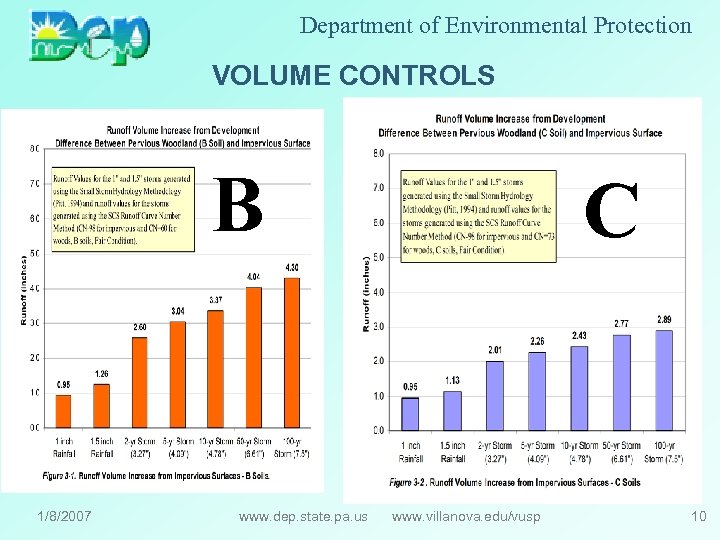 Department of Environmental Protection VOLUME CONTROLS B 1/8/2007 www. dep. state. pa. us C www. villanova. edu/vusp 10
 Department of Environmental Protection Volume Control - CG 1 VS CG 2 Design Storm Method - CG 1 - may require more complex and detailed analyses - provides a greater opportunity to select stormwater controls that require fewer resources to construct and operate Simplified Method - CG 2 - requires fewer computations and less design effort - may produce slightly larger stormwater controls - NOT allowed for regulated activities > one (1) acre - NOT allowed when design of storage facilities is required 1/8/2007 www. dep. state. pa. us www. villanova. edu/vusp 11
 Department of Environmental Protection Volume Control – CG 1 • Do not increase the post-development total runoff volume for all storms equal to or less than the 2 -year / 24 -hour event. – NOTE – the Model Ordinance uses REAL existing • Existing (pre-development) non-forested pervious areas must be considered meadow (good condition) or its equivalent. • Twenty (20) percent of existing impervious area, when present, shall be considered meadow (good condition) in the model for existing conditions 1/8/2007 www. dep. state. pa. us www. villanova. edu/vusp 12
 Department of Environmental Protection CG-1 – Scientific Basis – Designing for the 2 -year event, and smaller, provides stream channel protection and water quality protection for relatively frequent runoff events; – Volume reduction BMPs based on this standard will provide storage capacity to help reduce the increase in peak flow rates for larger runoff events; – In natural perennial streams in Mid-Atlantic States, the bank full stream flow occurs with a period of approximately 1. 5 years. If the runoff volume is not increased for storms equal or smaller than the 2 -year, the fluvial impacts on streams will be reduced; 1/8/2007 www. dep. state. pa. us www. villanova. edu/vusp 13
 Department of Environmental Protection CG-1 – Practical Consideration – The 2 -year 24 -hour events for precipitation and runoff are well defined. – Data and software readily accessible for application of 2 -year 24 hour events in stormwater management calculations. 1/8/2007 www. dep. state. pa. us www. villanova. edu/vusp 14
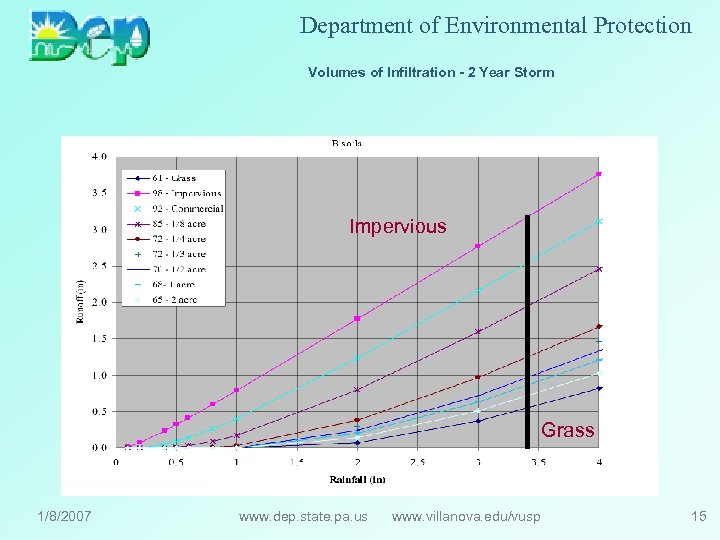 Department of Environmental Protection Volumes of Infiltration - 2 Year Storm Impervious Grass 1/8/2007 www. dep. state. pa. us www. villanova. edu/vusp 15
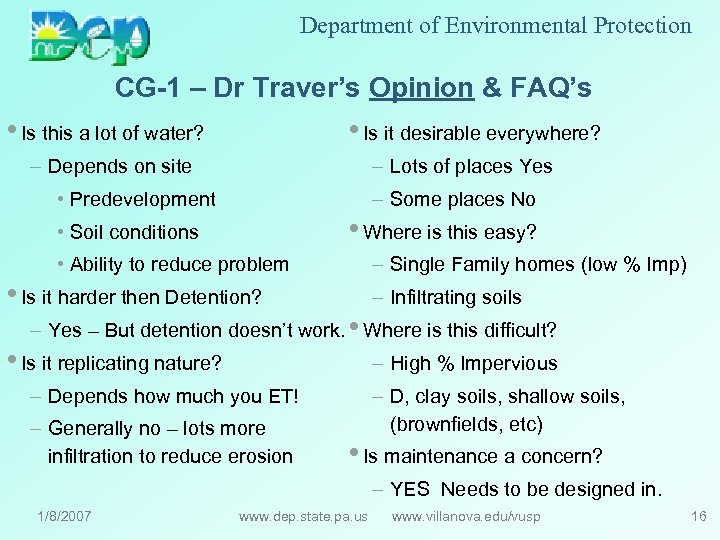 Department of Environmental Protection CG-1 – Dr Traver’s Opinion & FAQ’s • Is this a lot of water? • Is it desirable everywhere? – Depends on site – Lots of places Yes • Predevelopment – Some places No • Where is this easy? • Soil conditions • Ability to reduce problem – Single Family homes (low % Imp) • Is it harder then Detention? – Infiltrating soils • Is it replicating nature? – High % Impervious – Yes – But detention doesn’t work. • Where is this difficult? – Depends how much you ET! – Generally no – lots more infiltration to reduce erosion – D, clay soils, shallow soils, (brownfields, etc) • Is maintenance a concern? – YES Needs to be designed in. 1/8/2007 www. dep. state. pa. us www. villanova. edu/vusp 16
 Department of Environmental Protection CG-2 Note: < one (1) acre regulated activity and requires no design of storage facilities (no routing) • Stormwater facilities shall be sized to capture the first two inches (2”) of runoff from all impervious surfaces. • The first one-inch (1. 0”) of runoff from impervious surfaces shall be permanently removed from the runoff flow – i. e. not be released into the surface Waters of this Commonwealth. Removal options include reuse, evaporation, transpiration, and infiltration. • Wherever possible, infiltration facilities should be designed to accommodate infiltration of the entire permanently removed volume; however, in all cases at least the first one-half inch (0. 5”) of the permanently removed volume should be infiltrated. • Exempt from peak rate control. 1/8/2007 www. dep. state. pa. us www. villanova. edu/vusp 17
 Department of Environmental Protection Considerations on CG-2 • About CG-2 – Use where it makes sense $$$ – Use - retrofits, small disturbed areas – Where you aren't planning to develop a hydrologic model • Is it harder then Detention? – Yes – But detention doesn’t work. • Is it applicable anywhere? – NO! > one (1) acre, or when design of storage facilities is required – Use where you have space • (Pa. DEP Restraint) • Wetlands / Wet ponds – More versatile then CG-1, but lots of times CG-1 is not hard – Believe “environmentally equivalent to CG-1 1/8/2007 – YES < one (1) acre, but CG-1 may produce lower construction cost • Is maintenance a concern? www. dep. state. pa. us – YES Needs to be designed in. www. villanova. edu/vusp 18
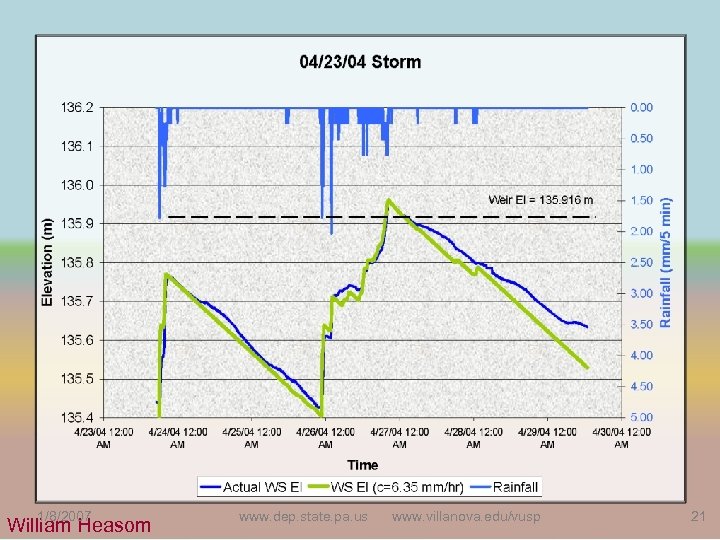
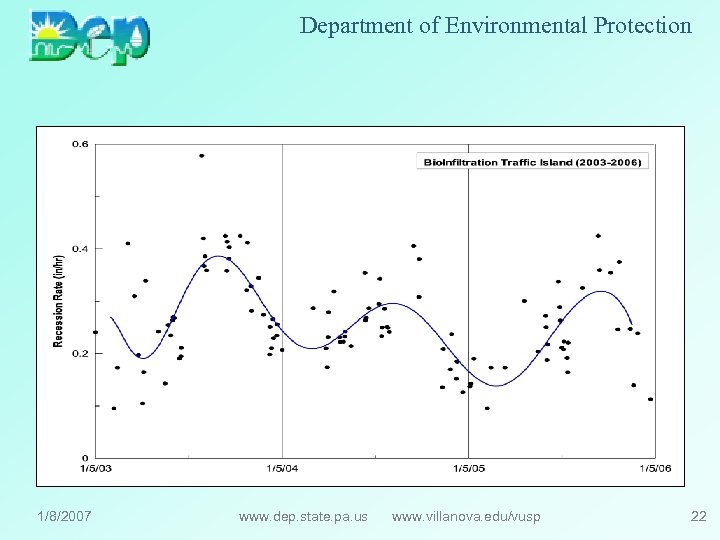
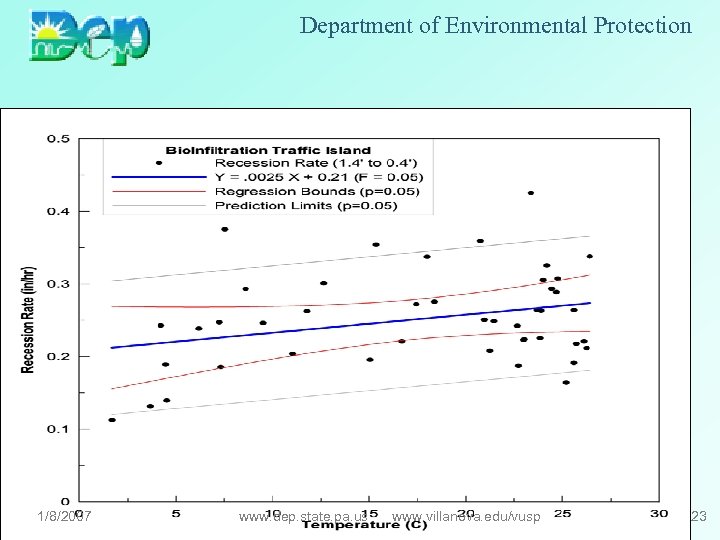
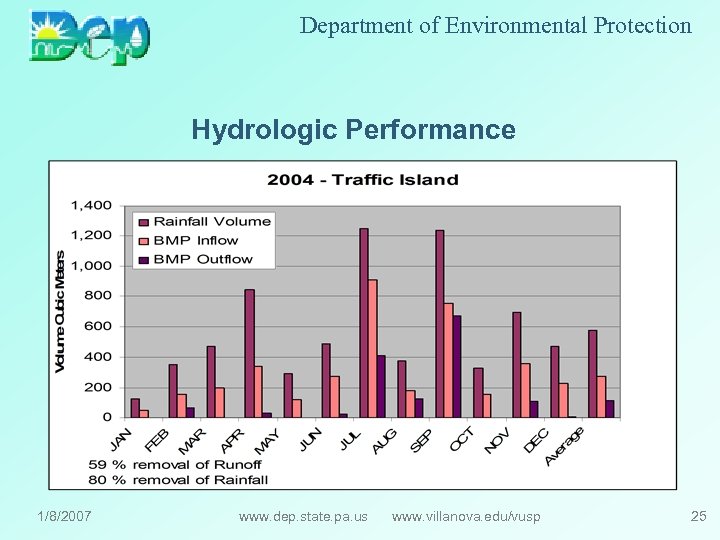
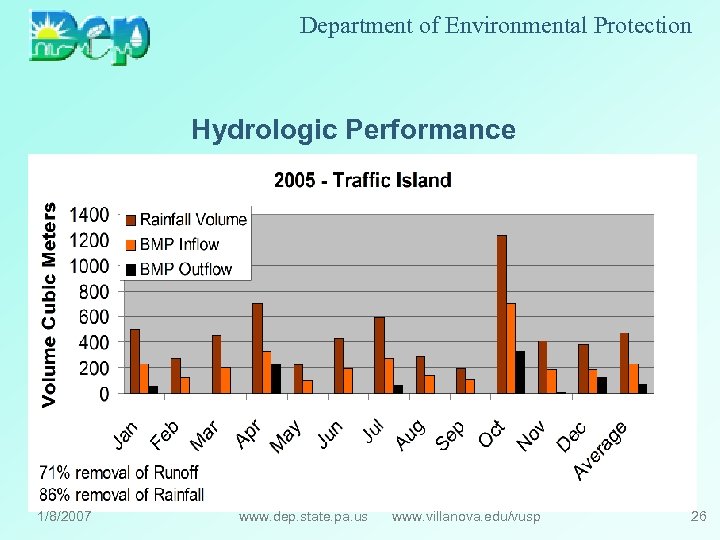
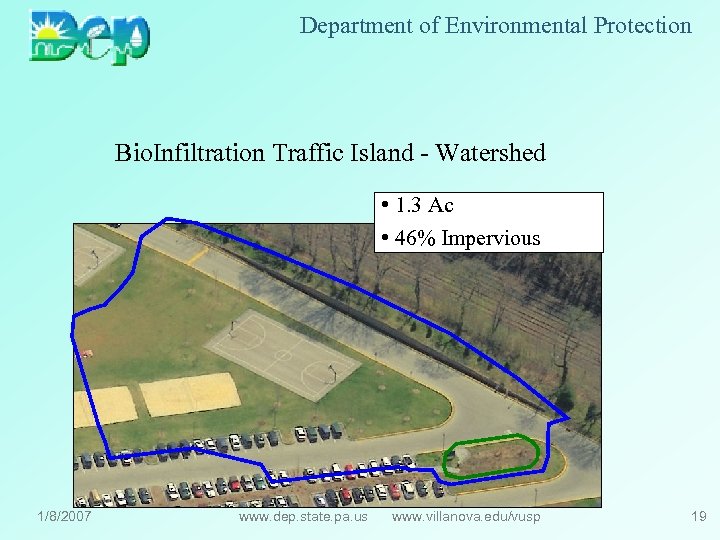 Department of Environmental Protection Bio. Infiltration Traffic Island - Watershed • 1. 3 Ac • 46% Impervious 1/8/2007 www. dep. state. pa. us www. villanova. edu/vusp 19
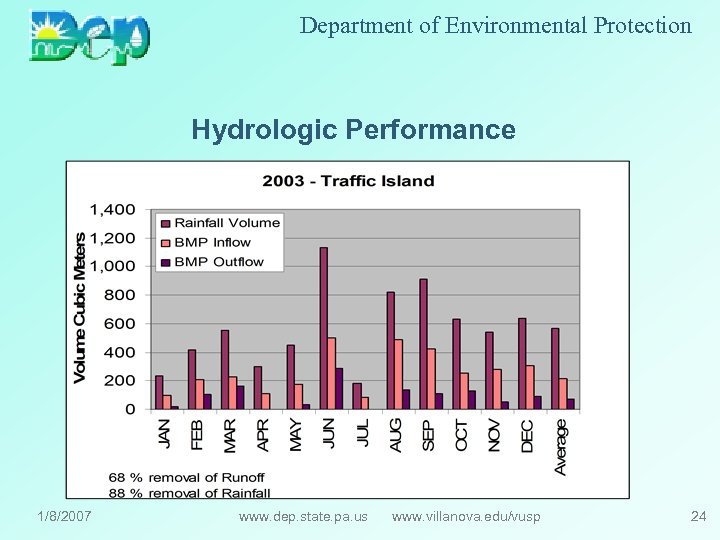
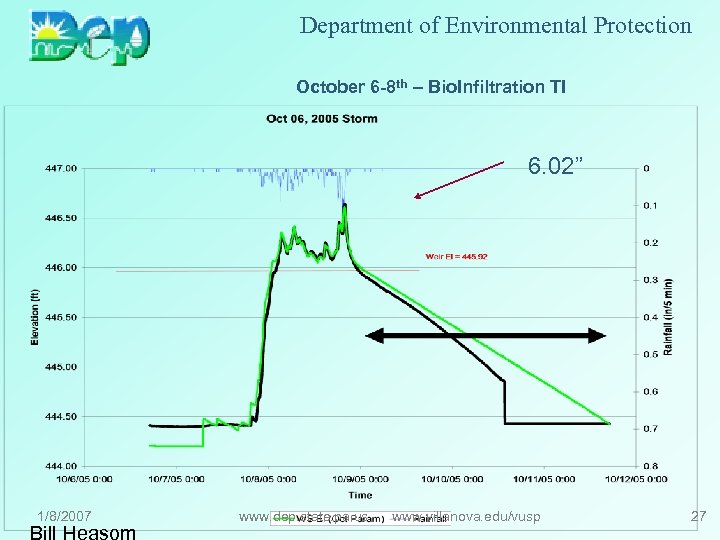
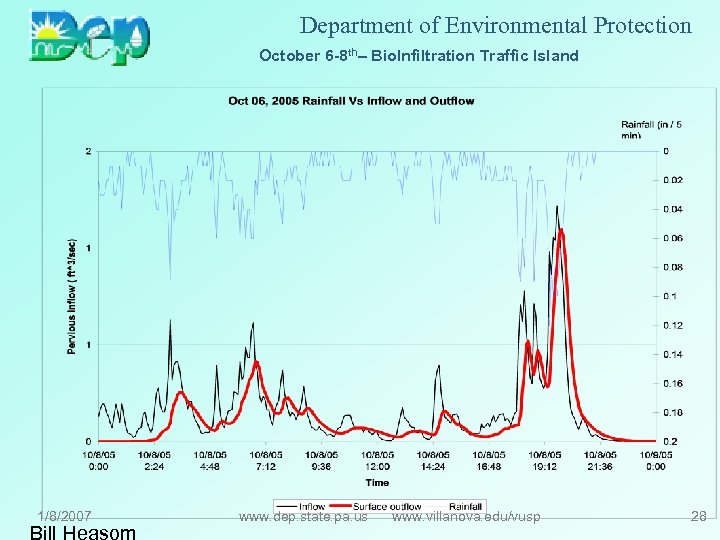
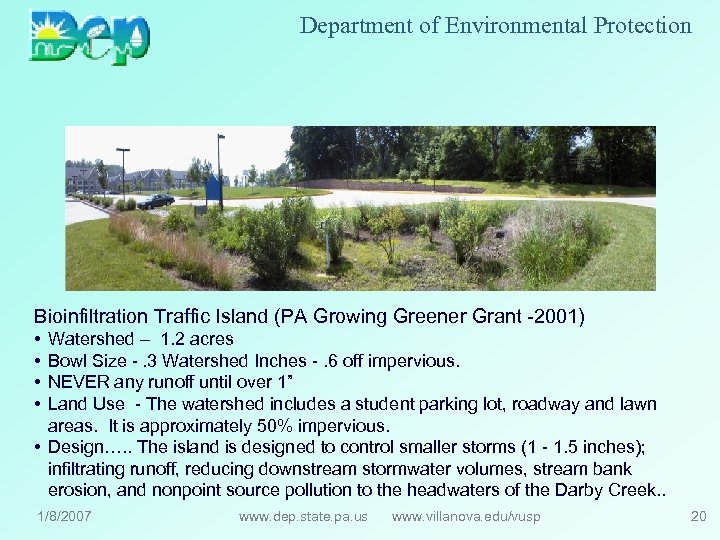 Department of Environmental Protection Bioinfiltration Traffic Island (PA Growing Greener Grant -2001) • • Watershed – 1. 2 acres Bowl Size -. 3 Watershed Inches -. 6 off impervious. NEVER any runoff until over 1” Land Use - The watershed includes a student parking lot, roadway and lawn areas. It is approximately 50% impervious. • Design…. . The island is designed to control smaller storms (1 - 1. 5 inches); infiltrating runoff, reducing downstream stormwater volumes, stream bank erosion, and nonpoint source pollution to the headwaters of the Darby Creek. . 1/8/2007 www. dep. state. pa. us www. villanova. edu/vusp 20
 Department of Environmental Protection 1/8/2007 William Heasom www. dep. state. pa. us www. villanova. edu/vusp 21
 Department of Environmental Protection 1/8/2007 www. dep. state. pa. us www. villanova. edu/vusp 22
 Department of Environmental Protection 1/8/2007 www. dep. state. pa. us www. villanova. edu/vusp 23
 Department of Environmental Protection Hydrologic Performance 1/8/2007 www. dep. state. pa. us www. villanova. edu/vusp 24
 Department of Environmental Protection Hydrologic Performance 1/8/2007 www. dep. state. pa. us www. villanova. edu/vusp 25
 Department of Environmental Protection Hydrologic Performance 1/8/2007 www. dep. state. pa. us www. villanova. edu/vusp 26
 Department of Environmental Protection October 6 -8 th – Bio. Infiltration TI 6. 02” 1/8/2007 Bill Heasom www. dep. state. pa. us www. villanova. edu/vusp 27
 Department of Environmental Protection October 6 -8 th– Bio. Infiltration Traffic Island 1/8/2007 Bill Heasom www. dep. state. pa. us www. villanova. edu/vusp 28
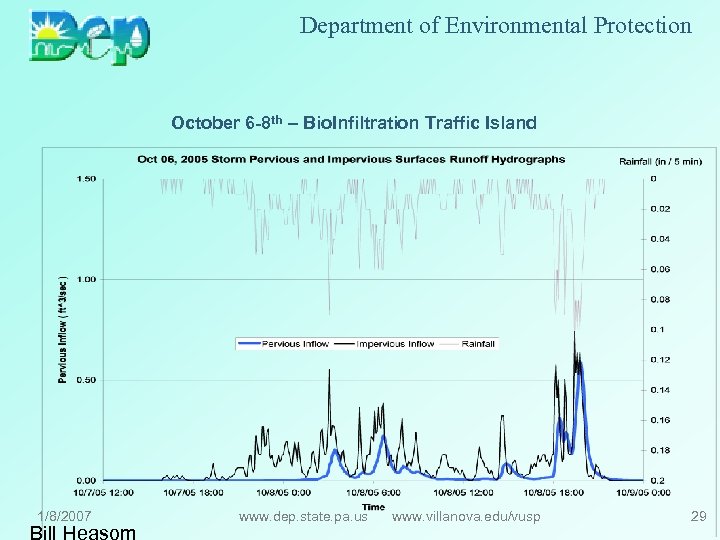 Department of Environmental Protection October 6 -8 th – Bio. Infiltration Traffic Island 1/8/2007 Bill Heasom www. dep. state. pa. us www. villanova. edu/vusp 29
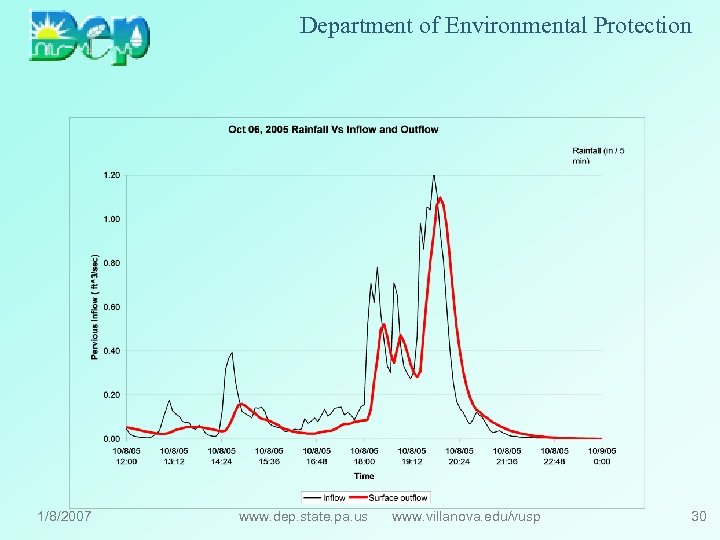 Department of Environmental Protection 1/8/2007 www. dep. state. pa. us www. villanova. edu/vusp 30
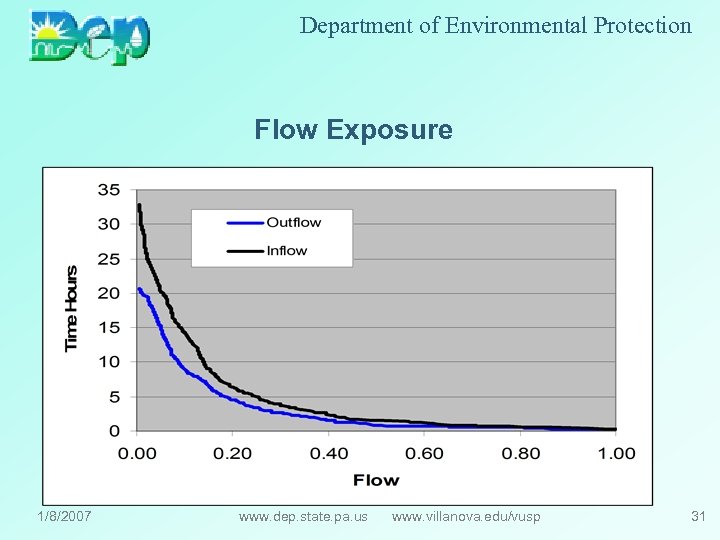 Department of Environmental Protection Flow Exposure 1/8/2007 www. dep. state. pa. us www. villanova. edu/vusp 31
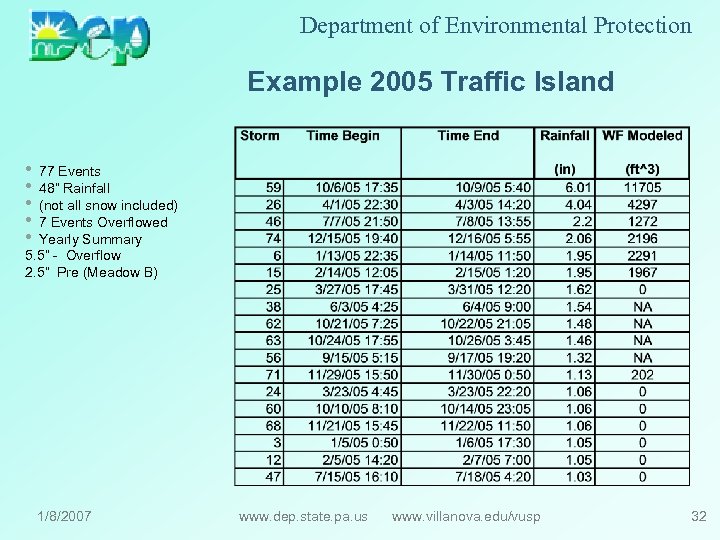 Department of Environmental Protection Example 2005 Traffic Island • 77 Events • 48” Rainfall • (not all snow included) • 7 Events Overflowed • Yearly Summary 5. 5” - Overflow 2. 5” Pre (Meadow B) 1/8/2007 www. dep. state. pa. us www. villanova. edu/vusp 32
 Department of Environmental Protection Comparison to BMP Manual • Design Storm Method – Would not meet criteria if preconstruction land use was all woods or meadow. Probably would as there was paved areas on the original site. • Simplified Method – Would meet the criteria as we get no runoff with less then 2” or rainfall; however, the site is 1. 3 acres so the method does not apply to this case. • Design Standards – Site foot print is MUCH smaller then 1: 5 ratio – Ponding depth is well over one foot. 1/8/2007 www. dep. state. pa. us www. villanova. edu/vusp 33
 Department of Environmental Protection Retention and Detention Considerations • Infiltration areas should be spread out and located in the sections of the site that are most suitable for infiltration. • In all cases, retention and detention facilities should be designed to completely drain water quality volumes over a period of time not less than 24 hours and not more than 72 hours from the end of the design storm. 1/8/2007 www. dep. state. pa. us www. villanova. edu/vusp 34
 Department of Environmental Protection Peak Flow • CG-1, Design Storm Method: Do not increase the peak rate of discharge for the 1 -year through 100 -year events (at minimum); as necessary, provide additional peak rate control as required by applicable and approved Act 167 plans. • CG-2, Simplified Method: Exempt from peak rate control requirement. 1/8/2007 www. dep. state. pa. us www. villanova. edu/vusp 35
 Department of Environmental Protection Water Quality • Achieve an 85 percent reduction in post-development particulate associated pollutant load (as represented by Total Suspended Solids), an 85 percent reduction in post-development total phosphorus loads, and a 50 percent reduction in post-development solute loads (as represented by NO 3 -N), all based on post-development land use. Generally assumed met with CG-1 – CG-2 – may require use of swales, or other “Green” practices” 1/8/2007 www. dep. state. pa. us www. villanova. edu/vusp 36
 Department of Environmental Protection What if I can’t do the Design Storm Method and my project is too __big__ for the Simplified Method? • ALTERNATIVE DESIGN • GET YOUR COUNTY TO DEVELOP A TAILORED ACT 167 PLAN TO YOUR REGIONAL CHARACTERISTICS! • Or… Meet with DEP to discuss problems, and develop an alternative design to meet the site conditions. 1/8/2007 www. dep. state. pa. us – Minimize problem – Start with Simplified Method – Use Bio-Retention / Infiltration and Green Roofs – Use Green Extended Detention – Take credit for infiltration during the storm – Calculate Pollutant Loadings – PE License – Design for Maintenance – DON’T IGNORE THE ISSUES! www. villanova. edu/vusp 37
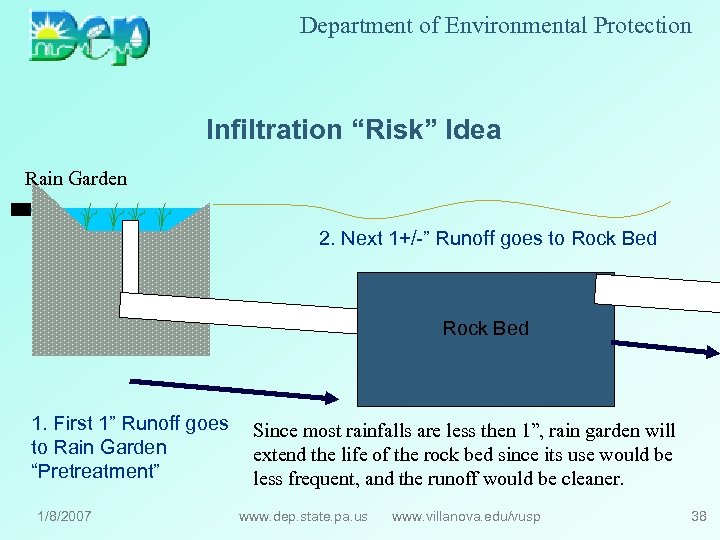 Department of Environmental Protection Infiltration “Risk” Idea Rain Garden 2. Next 1+/-” Runoff goes to Rock Bed 1. First 1” Runoff goes to Rain Garden “Pretreatment” 1/8/2007 Since most rainfalls are less then 1”, rain garden will extend the life of the rock bed since its use would be less frequent, and the runoff would be cleaner. www. dep. state. pa. us www. villanova. edu/vusp 38