


 Скачать презентацию Department of Energy DOE Outlook for ILC Office
b5db1d628b5935909490369d87df85de.ppt
- Количество слайдов: 15
 Department of Energy DOE Outlook for ILC Office of Science P. Grannis, LCFOA 10/16/06 Progress is being made, though its not simple. Lots that could have gone wrong hasn’t! We continue to push the boulder up the Hill Sisyphus, founder of Corinth, was condemned to an eternity of rolling a boulder uphill then watching it roll back down again, for broadcasting the location of Zeus’ latest concubine. And some political advice ? ? His greatest triumph came when the Hades came to claim him personally for the kingdom of the dead. Hades had brought along a pair of handcuffs, a comparative novelty, and Sisyphus expressed such an interest that Hades was persuaded to demonstrate their use - on himself. 1
 Department of Energy The ILC perspective Office of Science The ILC has been endorsed as the highest priority new facility after the LHC by panels worldwide: EPP 2010 Report “The US should launch a major program of R&D, design, industrialization, and management and financing studies of the ILC. Should aim to host ILC. Needed R&D at $500 M level (not including detector R&D and some US specific infrastructure). Secretary Bodman at FNAL, April 2006: “I fully support the possibility of bringing the International Linear Collider to this Lab. … it is a goal worth fighting for. This may turn out to be the most profound new science that we will be seeing in our lifetime. ” CERN Council European strategy: “It is fundamental to complement the results of the LHC with measurements at a linear collider. ” Federation of (Japanese) Diet members to promote the realization of ILC … “As an important international project in the fundamental sciences, the 2 Federation decided to give strong support toward the realization of the ILC. ”
 Department of Energy HEPAP recommendations Office of Science P 5 (Particle Physics Program Prioritization Panel): 1. LHC is our most important near term project. 2. Highest priority for investments toward the future is ILC. Need to participate vigorously in the international R&D. New investments: ~60% ILC and 40% dark matter, dark energy, neutrinos. Advanced Accelerator Research and Development panel: v Early industrial involvement in design and optimization for largescale mass production is critical and should be supported. v Recommend that OHEP and NSF build healthy program to address the fundamental issues of SCRF and cavity properties, materials and surface science. v Increase long-term accelerator science funding to 6% of total 3
 Department of Energy DOE Funding for the ILC Office of Science DOE recognizes that the R&D phase of the ILC will require significant expenditures. The funding levels have been rising, after several years of capped budgets: § FY 05: $23. 7 M § FY 06: $30 M § FY 07(President’s budget): $60 M House markup: same as President’s budget Senate mark: take $15 M from ILC to Dark Energy research. Move $8. 3 M from overall OHEP budget to new Office of High Energy Density Physics (e. g. plasma acceleration research). No appropriation until after election – continuing resolution at FY 06 level. v The FY 08 budget is now under discussion in Administration 4
 Department of Energy DOE Funding for the ILC Office of Science The DOE Office of Science is working actively to establish funding and program direction for the R&D phase of the ILC, and to develop the possibility for the US to be a credible host. Starting in FY 07 (if at President’s budget level), the ILC funds are expected to cover all ILC-specific activities – laboratory ILC R&D, university grants for directed ILC accelerator research, ILC detector R&D, and support of the GDE. In past, the ILC funds were supplemented at the laboratories by other funds for generic research and infrastructure that could also benefit ILC. This will continue, subject to available funding. In future, DOE would like to open a new category of funding for Superconducting RF R&D and Infrastructure. 5
 Department of Energy SCRF R&D Office of Science SCRF will be the basis for new facilities across the broad spectrum of DOE/SC program. ILC pushes the high gradient technology and industrial development that can enable many other applications. v New generation of light sources for research in condensed matter physics, biology, plasmas, materials, environmental studies, chemistry. v Efficient energy recovery linacs (for materials and nuclear science) v Rare isotope accelerators (for nuclear science and astrophysics) v Compact proton linacs (neutron sources, neutrino beams) CATEGORY OF ACCELERATORS WORLD # Basic research ~250 Medical radioisotope production ~200 Radiotherapy >7500 Biomedical studies ~1000 Industrial processing ~1500 Ion Implantation, surface modification >7000 ESTIMATED TOTAL >17, 500 Accelerators have transformed society broadly in past. SCRF will likely find new uses in cancer therapy, radioisotope production, nuclear waste disposal, etc. 6
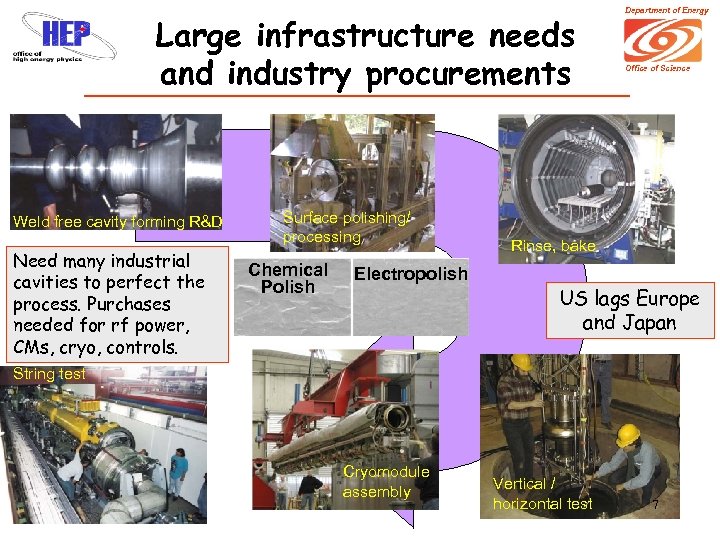 Large infrastructure needs and industry procurements Weld free cavity forming R&D Need many industrial cavities to perfect the process. Purchases needed for rf power, CMs, cryo, controls. Surface polishing/ processing Chemical Polish Electropolish Department of Energy Office of Science Rinse, bake US lags Europe and Japan String test Cryomodule assembly Vertical / horizontal test 7
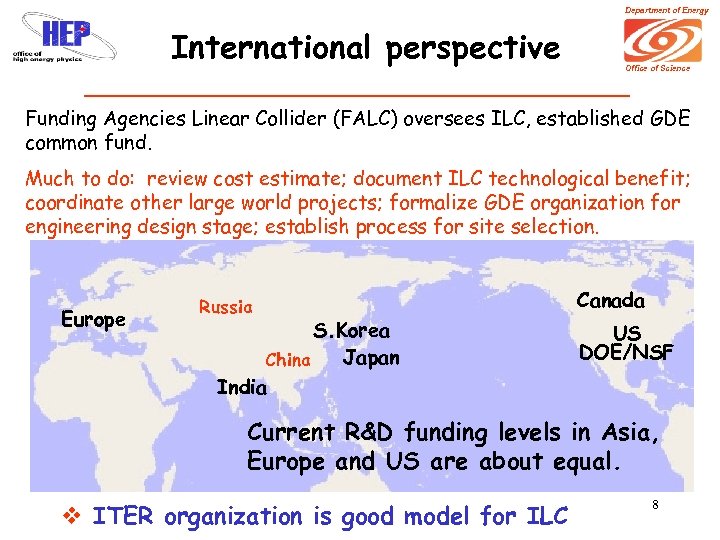 Department of Energy International perspective Office of Science Funding Agencies Linear Collider (FALC) oversees ILC, established GDE common fund. Much to do: review cost estimate; document ILC technological benefit; coordinate other large world projects; formalize GDE organization for engineering design stage; establish process for site selection. Europe Russia S. Korea Japan China India Canada US DOE/NSF Current R&D funding levels in Asia, Europe and US are about equal. v ITER organization is good model for ILC 8
 Department of Energy SBIR/STTR Grants What are they? http: //www. science. doe. gov/sbir OHEP program manager: LK Len (lk. len@science. doe. gov) Office of Science § SBIR = Small Business Innovative Research – need not involve collaboration with labs § STTR = Small Business Technology Transfer – must involve substantial (>30%) collaborative research with labs § Government-wide set-asides (2. 5% for SBIR and 0. 3% for STTR) § Small Business = 500 or fewer employees § Phase I is for up to $100 K for 9 months (feasibility study leading to a Phase II proposal) § Phase II is for up to $750 K over two years § Phase III is funded through other sources of funding, e. g. , venture capitals, etc. 2007 Phase I proposals due Nov. 21, 2006 9
 Department of Energy SBIR 2007 http: //www. science. doe. gov/sbir/ Office of Science Phase I Topics: 29. High Energy Physics Data Acquisition and Processing 30. Accelerator Technology for International Linear Collider a) Superconducting Radiofrequency Systems b) Beam Instrumentation and Feedback Systems c) Magnet and Fast Kicker Technology d) Polarized RF Photocathode Source & Accelerator Magnet Technology 31. Advanced Concepts and Technology for High Energy Accelerators a) New Concepts for Acceleration b) Novel Device and Instrumentation Development c) Inexpensive High Quality Electron Sources d) Computer Software for Control Systems & Advanced Accelerator Modeling 32. RF Accelerator Technology for High Energy Accelerators and Colliders a) Radio Frequency Acceleration Structures b) Radio Frequency Power for Linear Accelerators c) New Concepts/Components - Pulsed Power Modulators and Energy Storage 33. High-Field Superconductor and SC Magnet Technologies for HEP Colliders 10 34. High Energy Physics Detectors
 Department of Energy Summary Office of Science Ø The DOE believes that the ILC is our best candidate for a future high energy physics facility and that a vigorous R&D program to develop it is warranted. DOE recognizes that the funding for the R&D phase must continue to ramp up. Ø The US should seek to host the ILC. Ø The international collaboration to do the R&D and complete a costeffective design has been initiated. Much remains to strengthen and internationalize the ILC organization. Ø The major technical challenges lie in the large scale fabrication of cavities, their assembly into modules, and the rf power systems to drive them. Industrial efforts are key to meeting these challenges. 11
 Department of Energy Office of Science 12
 Importance of Industrialization effort Department of Energy Office of Science DOE understands that bringing major components to reliable and reproducible fabrication in industry is one of the primary needs for funds in the pre-construction phase. For critical SC rf components, US industry is not yet at the level found in Europe and Japan. For the major cost components, we need all the help from industry we can get to learn how to do these in a cost efficient and reliable way. Your insights and guidance are needed to manage the industrialization effort within the overall budget constraints. 13
 Department of Energy US regional needs Office of Science The Linear Collider Steering Group of the Americas has impaneled a group to consider and advise on priorities for those activities which are needed in the US that would support the industrialization and bid to host efforts in the US. These include the development of infrastructure in our laboratories for superconducting rf cavity and cryomodule materials processing and testing, stimulating industry capability in SCRF and the development of a suitable site for ILC in the US. Satoshi Ozaki (BNL) is the chair of this panel. Panel advice is being folded into the FY 07 budget process and is part of the planning for FY 08 and FY 09. 14
 Department of Energy Alphabet soup FALC = Funding Agencies LC (R. Petronzio) ILCSC = International LC Steering Committee (S. Kurokawa) LCSGA = LC Steering Gp Americas (M. Tigner) LCSG Europe LCSG Asia key oversight regional interest accelerator detector/ physics WWS = Office of Science GDE Worldwide Study (Brau, Richard, Yamamoto) ALCPG = = Global Design Effort (B. Barish) ART = Americas Regional Team (G. Dugan) Americas LC Physics Gp (J. Brau, M. Oreglia) Asia RT (M. Nozaki) Europe phys/det Europe RT (B. Foster) Asia phys/det 15