


 Скачать презентацию Department of Education and Science Kazakh University of
англ(Рустам и Толияр).pptx
- Количество слайдов: 13
 Department of Education and Science Kazakh University of International Relations and World Languages Child’s place in birth order and its influence on future career Compiled by: Shadiev Toliyar and Hadzhaev Rustam. Almaty, 2013
 Aim: to answer the question “Why a child’s position in the family influences future career choices. Objectives: make a survey about child’s position in the family and talk about characteristics they have.
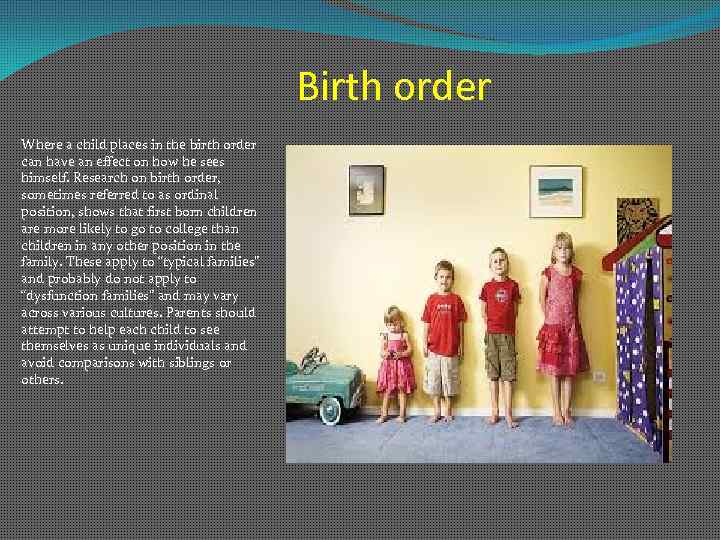 Birth order Where a child places in the birth order can have an effect on how he sees himself. Research on birth order, sometimes referred to as ordinal position, shows that first born children are more likely to go to college than children in any other position in the family. These apply to “typical families” and probably do not apply to “dysfunction families” and may vary across various cultures. Parents should attempt to help each child to see themselves as unique individuals and avoid comparisons with siblings or others.
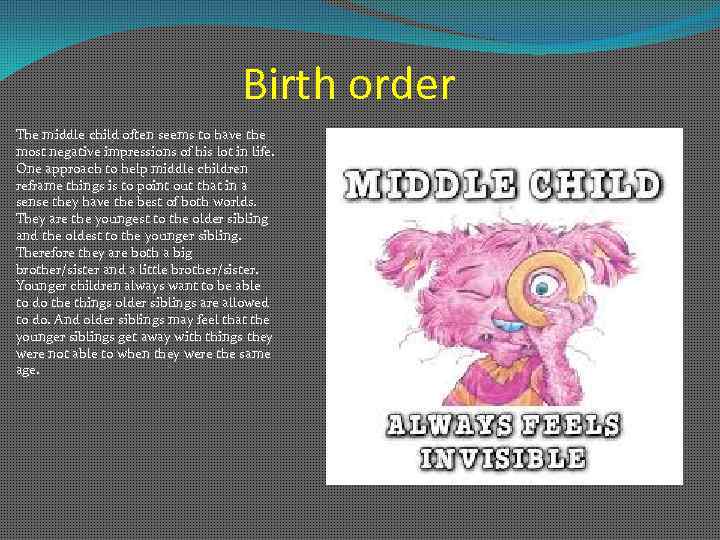 Birth order The middle child often seems to have the most negative impressions of his lot in life. One approach to help middle children reframe things is to point out that in a sense they have the best of both worlds. They are the youngest to the older sibling and the oldest to the younger sibling. Therefore they are both a big brother/sister and a little brother/sister. Younger children always want to be able to do the things older siblings are allowed to do. And older siblings may feel that the younger siblings get away with things they were not able to when they were the same age.
 The following characteristics will not apply to all children in every family. Typical characteristics, however, can be identified: Only child • Child Pampered and spoiled. • Feels incompetent because adults are more capable. • Is center of attention; often enjoys position. May feel special. • Self-centered. • Relies on service from others rather than own efforts • Feels unfairly treated when doesn’t get own way. • May refuse to cooperate. • Plays “divide and conquer” to get own way. Fifty years ago, when only children represented just 10 percent of all kids under age 18, "onlies" were often thought of as lonely, spoiled, and socially inept. But the tide has turned, and as the number of only children climbs, their place in society has risen. Today there are some 14 million only children in America, representing about 20 percent of all kids, according to the U. S. Census Bureau
 First Child • Is only child for period of time; used to being center of attention. • Believes must gain and hold superiority over other children. • Being right, controlling often important. • May respond to birth of second child by feeling unloved and neglected. • Strives to keep or regain parents’ attention through conformity. If this failed, chooses to misbehave. • May develop competent, responsible behavior or become very discouraged. • Sometime strives to protect and help others. • Strives to please. The firstborn is often used to being the center of attention; he has Mom and Dad to himself before siblings arrive (and oldest children enjoy about 3, 000 more hours of quality time with their parents between ages 4 and 13 than the next sibling will get, found a study from Brigham Young University, in Provo, Utah). "Many parents spend more time reading and explaining things to firstborns. It's not as easy when other kids come into the picture, " says Frank Farley, Ph. D. , a psychologist at Temple University, in Philadelphia, who has studied personality and human development for decades.
 Middle Child of Three • Has neither rights of oldest nor privileges of youngest. • Feels life is unfair. • Feels unloved, left out, “squeezed. ” • Feels doesn’t have place in family. • Becomes discouraged and “problem child” or elevates self by pushing down other siblings. • Is adaptable. • Learns to deal with both oldest and youngest sibling. Middleborns are go-with-the-flow types; once a younger sibling arrives, they must learn how to constantly negotiate and compromise in order to "fit in" with everyone. Not surprisingly, Dr. Sulloway notes, mid kids score higher in agreeableness than both their older and younger sibs.
 The Youngest • Behaves like only child. • Feels every one bigger and more capable. • Expects others to do things, make decisions, take responsibility. • Feels smallest and weakest. May not be taken seriously. • Becomes boss of family in getting service and own way. • Develops feelings of inferiority or becomes “speeder” and overtakes older siblings. • Remains “The Baby. ” Places others in service. • If youngest of three, often allies with oldest child against middle child. Lastborns generally aren't the strongest or the smartest in the room, so they develop their own ways of winning attention. They're natural charmers with an outgoing, social personality; no surprise then that many famous actors and comedians are the baby of the family (Stephen Colbert is the youngest of 11!), or that they score higher in "agreeableness" on personality tests than firstborns, according to Dr. Sulloway's research.
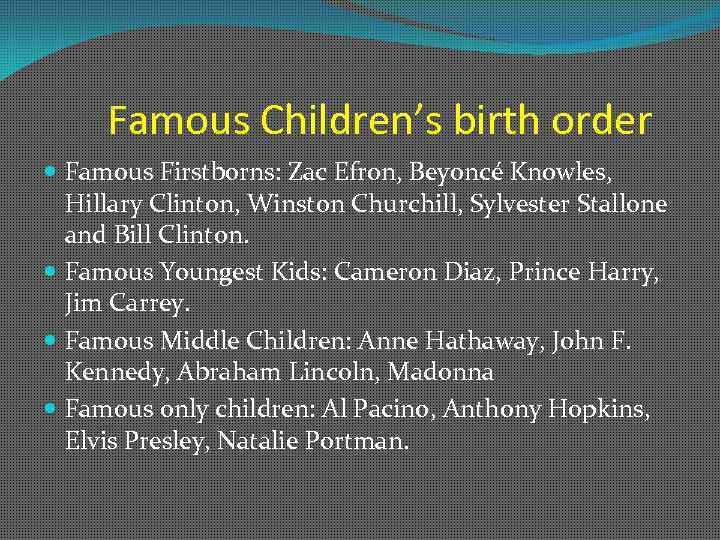 Famous Children’s birth order Famous Firstborns: Zac Efron, Beyoncé Knowles, Hillary Clinton, Winston Churchill, Sylvester Stallone and Bill Clinton. Famous Youngest Kids: Cameron Diaz, Prince Harry, Jim Carrey. Famous Middle Children: Anne Hathaway, John F. Kennedy, Abraham Lincoln, Madonna Famous only children: Al Pacino, Anthony Hopkins, Elvis Presley, Natalie Portman.
 How Birth Order Affects Who You Are?
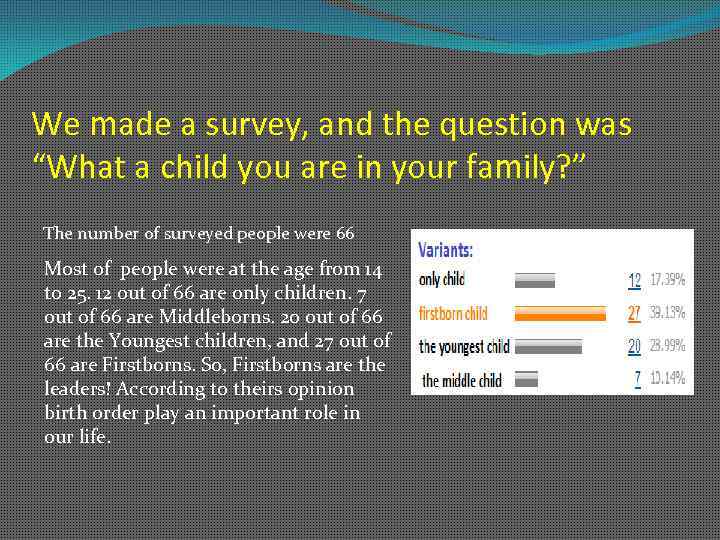 We made a survey, and the question was “What a child you are in your family? ” The number of surveyed people were 66 Most of people were at the age from 14 to 25. 12 out of 66 are only children. 7 out of 66 are Middleborns. 20 out of 66 are the Youngest children, and 27 out of 66 are Firstborns. So, Firstborns are the leaders! According to theirs opinion birth order play an important role in our life.
 Why a child’s position in the family influences future career choices American psychologists have been looking into how a child’s position in the family can affect his or her selected career. It would appear that first born and only children are more likely to be high achievers, pursuing professions such as law, finance, engineering or medicine. According to Professor Frederick Leong, co-author of the psychologists’ report, their tendency is to head towards ‘cognitive and analytical’ work. Professor Leong puts this down to the fact that parents are more likely to be more over protective towards first born or only children. Examples of famous names demonstrating this principle include Anthony Scrivener QC, Sir Winston Churchill and Sir Edward Heath. Younger siblings, on the other hand, are more likely to be destined to take up more creatively based or outdoor based occupations, such as landscape gardening, fashion, music and art as exemplified by Oscar Wilde, Yehudi Menuhin and Madonna. Professor Leong’s overall explanation is that, ‘Parents typically place different demands and have different expectations of children, depending on their birth order. Parents of only children may discourage pursuit of physical or outdoor activities because they are more fearful of physical harm to their child. That may be why only children are more likely to show interest in academic pursuits rather then physical or outdoor activities. And those who are only children will tend to get more time and attention from their parents than children with siblings. ’ He goes on to point out how the converse tends to happen in larger families, ‘As they have more children, parents tend to become more open and relaxed, and that may allow younger children to be more risk-taking. If the first born or only child wants to be a poet, that may concern parents. But by the fourth child parents may not mind as much. ’ The research was led by Ohio State University and published in the Journal of Career Assessment.
 THE END THANK YOU FOR ATTENTION!!!