


 Скачать презентацию Department of Defense AT Level I CONUS Training
1f983f2c57eba1ae3820aa06fb5a4d1d.ppt
- Количество слайдов: 144
 Department of Defense AT Level I CONUS Training Introduction October 2012 1
 About This Training • Designed by JCS in coordination with OSD and Services • Designed to increase awareness of terrorism and improve ability to apply personal protective measures • Meets the annual requirement for Level I antiterrorism training prescribed by Do. DI. 2000. 16 • Complements Web-based and CD-ROM training 2
 Learning Objectives • Understand the terrorist threat • Understand how to employ situation-based measures to lower your vulnerability • Recognize proper responses to threat actions • Understand how to support unit security 3
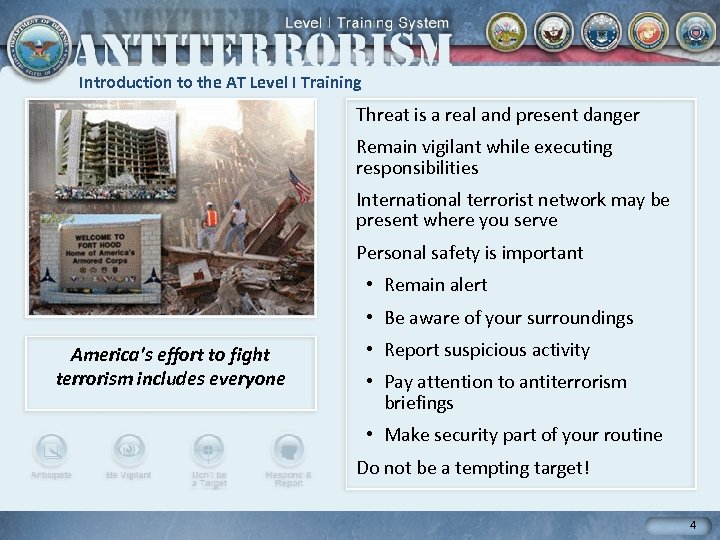 Introduction to the AT Level I Training Threat is a real and present danger Remain vigilant while executing responsibilities International terrorist network may be present where you serve Personal safety is important • Remain alert • Be aware of your surroundings America's effort to fight terrorism includes everyone • Report suspicious activity • Pay attention to antiterrorism briefings • Make security part of your routine Do not be a tempting target! 4
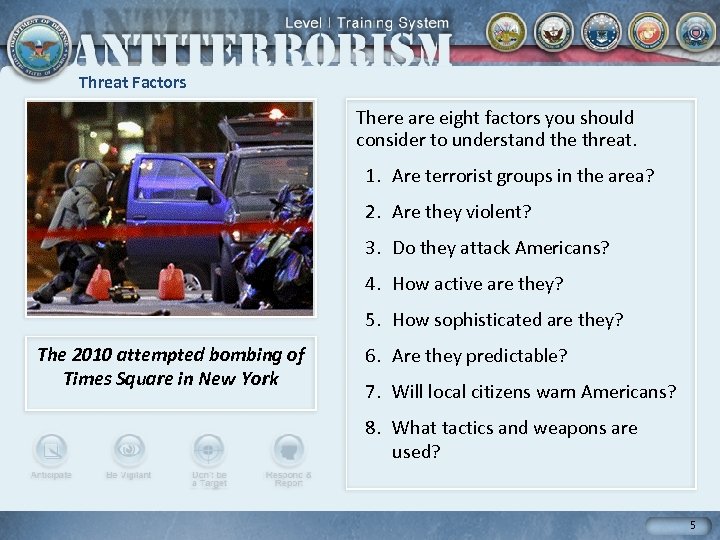 Threat Factors There are eight factors you should consider to understand the threat. 1. Are terrorist groups in the area? 2. Are they violent? 3. Do they attack Americans? 4. How active are they? 5. How sophisticated are they? The 2010 attempted bombing of Times Square in New York 6. Are they predictable? 7. Will local citizens warn Americans? 8. What tactics and weapons are used? 5
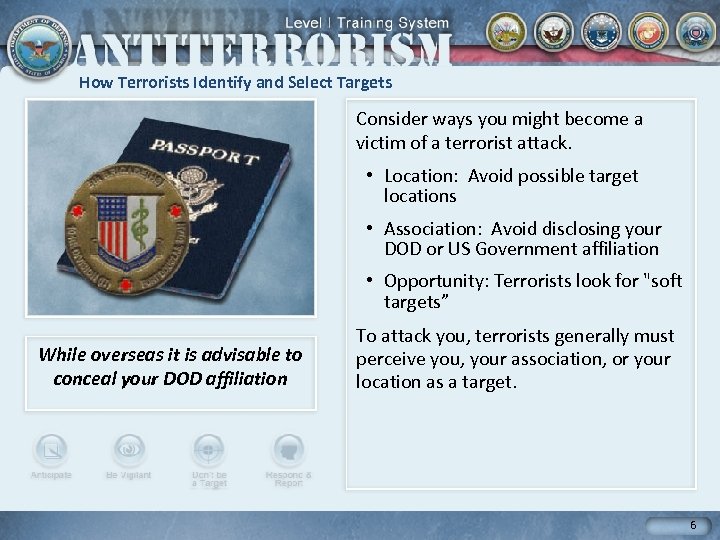 How Terrorists Identify and Select Targets Consider ways you might become a victim of a terrorist attack. • Location: Avoid possible target locations • Association: Avoid disclosing your DOD or US Government affiliation • Opportunity: Terrorists look for "soft targets” While overseas it is advisable to conceal your DOD affiliation To attack you, terrorists generally must perceive you, your association, or your location as a target. 6
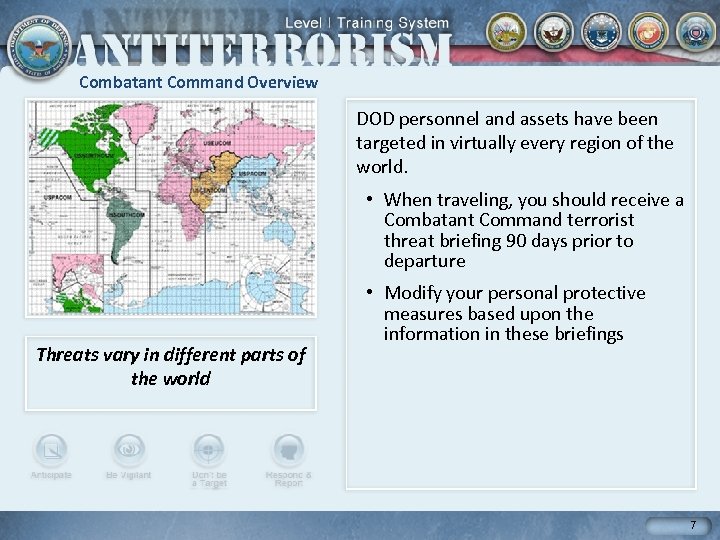 Combatant Command Overview DOD personnel and assets have been targeted in virtually every region of the world. • When traveling, you should receive a Combatant Command terrorist threat briefing 90 days prior to departure Threats vary in different parts of the world • Modify your personal protective measures based upon the information in these briefings 7
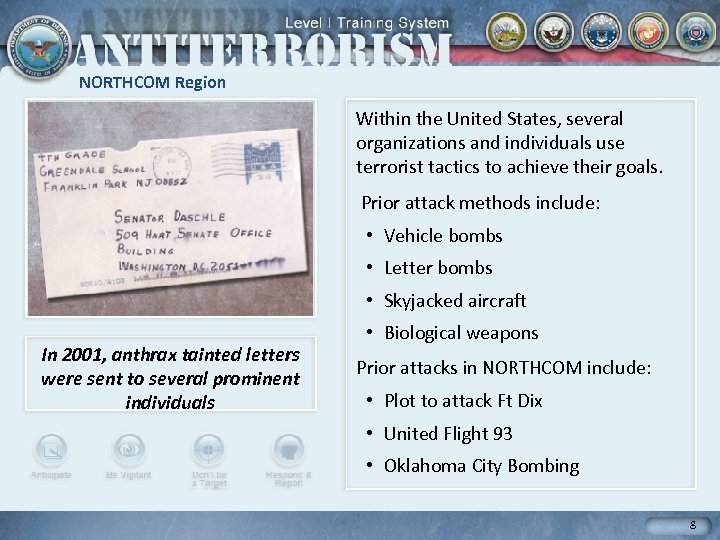 NORTHCOM Region Within the United States, several organizations and individuals use terrorist tactics to achieve their goals. Prior attack methods include: • Vehicle bombs • Letter bombs • Skyjacked aircraft In 2001, anthrax tainted letters were sent to several prominent individuals • Biological weapons Prior attacks in NORTHCOM include: • Plot to attack Ft Dix • United Flight 93 • Oklahoma City Bombing 8
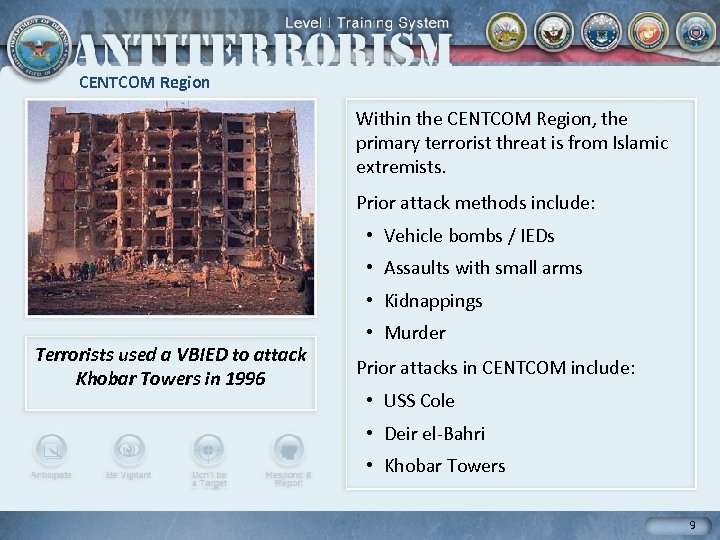 CENTCOM Region Within the CENTCOM Region, the primary terrorist threat is from Islamic extremists. Prior attack methods include: • Vehicle bombs / IEDs • Assaults with small arms • Kidnappings Terrorists used a VBIED to attack Khobar Towers in 1996 • Murder Prior attacks in CENTCOM include: • USS Cole • Deir el-Bahri • Khobar Towers 9
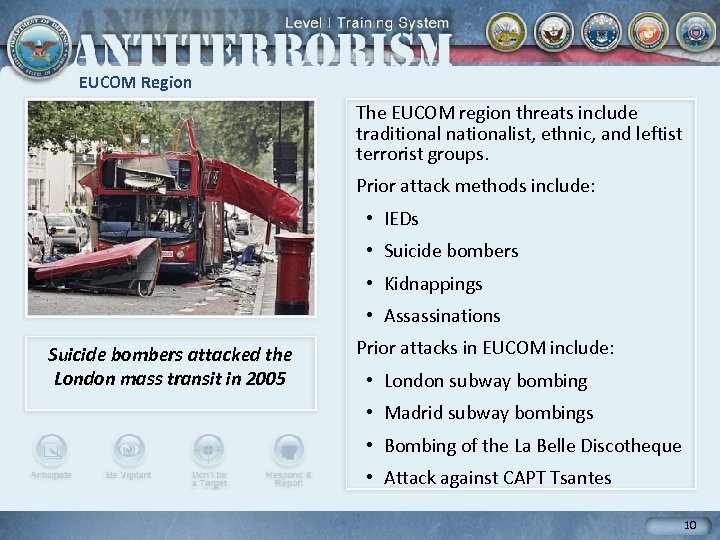 EUCOM Region The EUCOM region threats include traditional nationalist, ethnic, and leftist terrorist groups. Prior attack methods include: • IEDs • Suicide bombers • Kidnappings • Assassinations Suicide bombers attacked the London mass transit in 2005 Prior attacks in EUCOM include: • London subway bombing • Madrid subway bombings • Bombing of the La Belle Discotheque • Attack against CAPT Tsantes 10
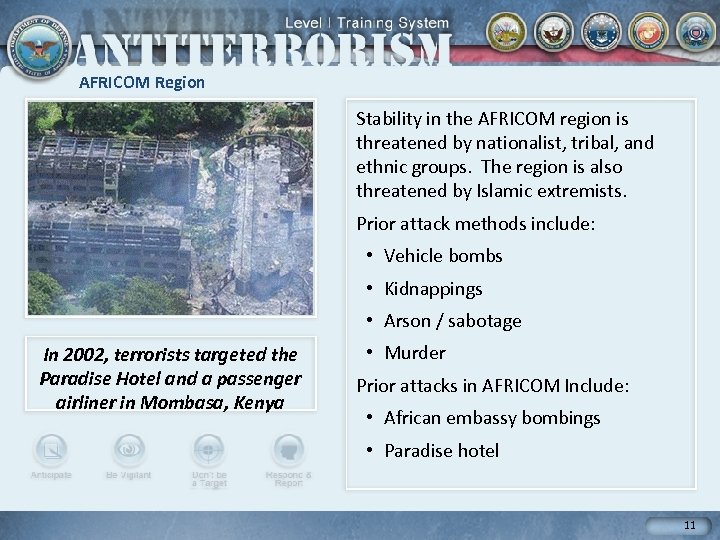 AFRICOM Region Stability in the AFRICOM region is threatened by nationalist, tribal, and ethnic groups. The region is also threatened by Islamic extremists. Prior attack methods include: • Vehicle bombs • Kidnappings • Arson / sabotage In 2002, terrorists targeted the Paradise Hotel and a passenger airliner in Mombasa, Kenya • Murder Prior attacks in AFRICOM Include: • African embassy bombings • Paradise hotel 11
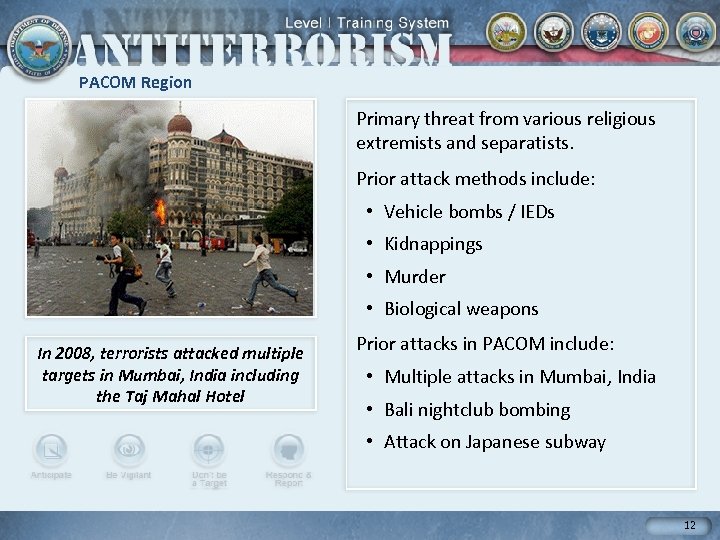 PACOM Region Primary threat from various religious extremists and separatists. Prior attack methods include: • Vehicle bombs / IEDs • Kidnappings • Murder • Biological weapons In 2008, terrorists attacked multiple targets in Mumbai, India including the Taj Mahal Hotel Prior attacks in PACOM include: • Multiple attacks in Mumbai, India • Bali nightclub bombing • Attack on Japanese subway 12
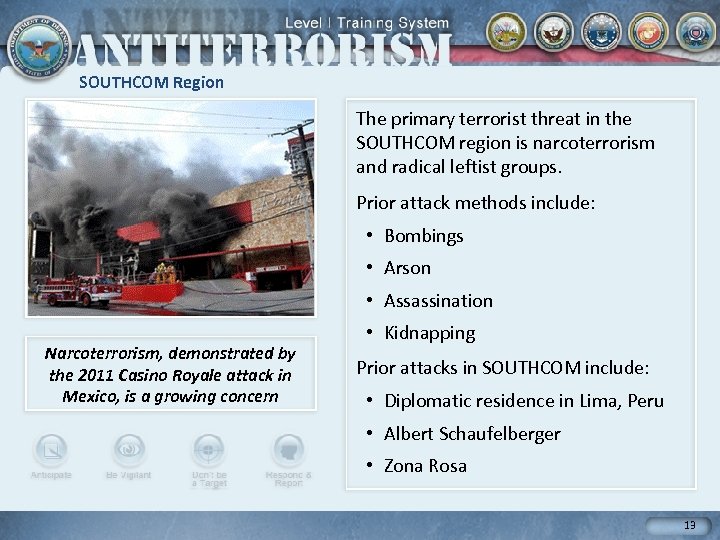 SOUTHCOM Region The primary terrorist threat in the SOUTHCOM region is narcoterrorism and radical leftist groups. Prior attack methods include: • Bombings • Arson • Assassination Narcoterrorism, demonstrated by the 2011 Casino Royale attack in Mexico, is a growing concern • Kidnapping Prior attacks in SOUTHCOM include: • Diplomatic residence in Lima, Peru • Albert Schaufelberger • Zona Rosa 13
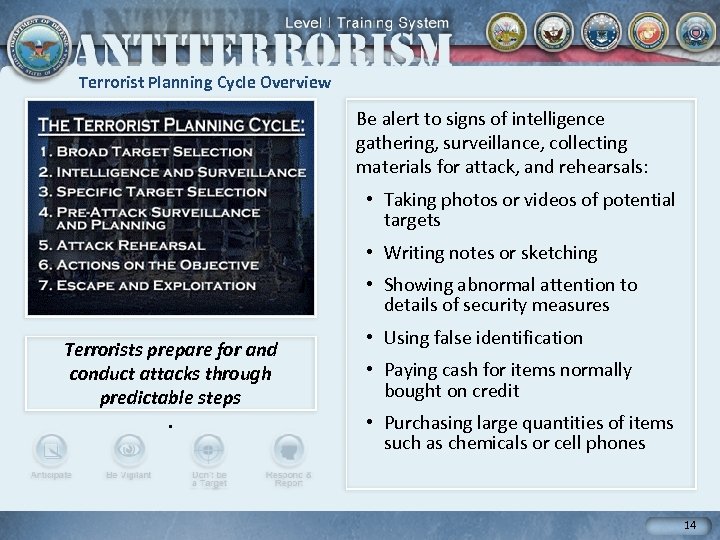 Terrorist Planning Cycle Overview Be alert to signs of intelligence gathering, surveillance, collecting materials for attack, and rehearsals: • Taking photos or videos of potential targets • Writing notes or sketching • Showing abnormal attention to details of security measures Terrorists prepare for and conduct attacks through predictable steps. • Using false identification • Paying cash for items normally bought on credit • Purchasing large quantities of items such as chemicals or cell phones 14
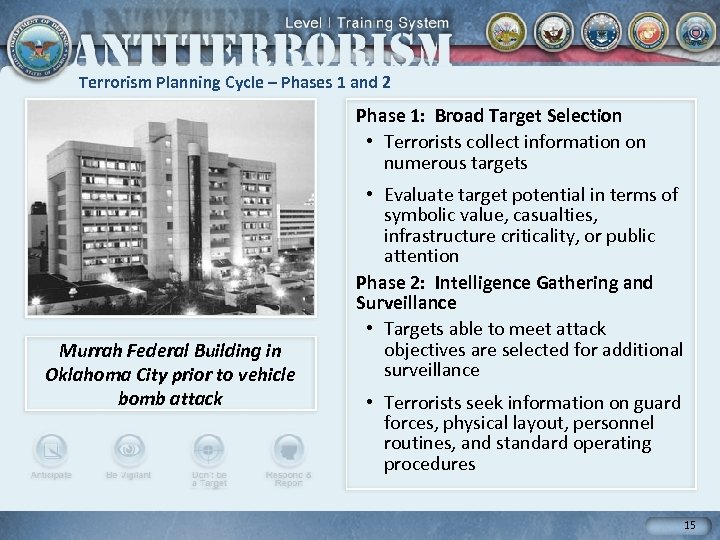 Terrorism Planning Cycle – Phases 1 and 2 Phase 1: Broad Target Selection • Terrorists collect information on numerous targets Murrah Federal Building in Oklahoma City prior to vehicle bomb attack • Evaluate target potential in terms of symbolic value, casualties, infrastructure criticality, or public attention Phase 2: Intelligence Gathering and Surveillance • Targets able to meet attack objectives are selected for additional surveillance • Terrorists seek information on guard forces, physical layout, personnel routines, and standard operating procedures 15
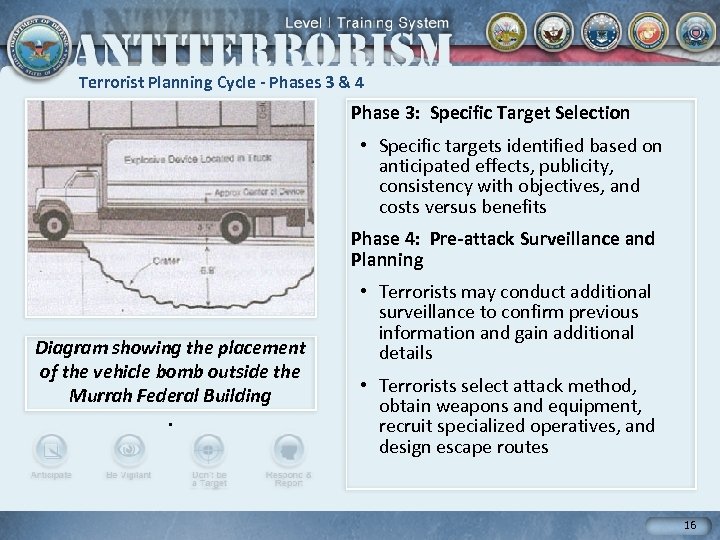 Terrorist Planning Cycle - Phases 3 & 4 Phase 3: Specific Target Selection • Specific targets identified based on anticipated effects, publicity, consistency with objectives, and costs versus benefits Phase 4: Pre-attack Surveillance and Planning Diagram showing the placement of the vehicle bomb outside the Murrah Federal Building. • Terrorists may conduct additional surveillance to confirm previous information and gain additional details • Terrorists select attack method, obtain weapons and equipment, recruit specialized operatives, and design escape routes 16
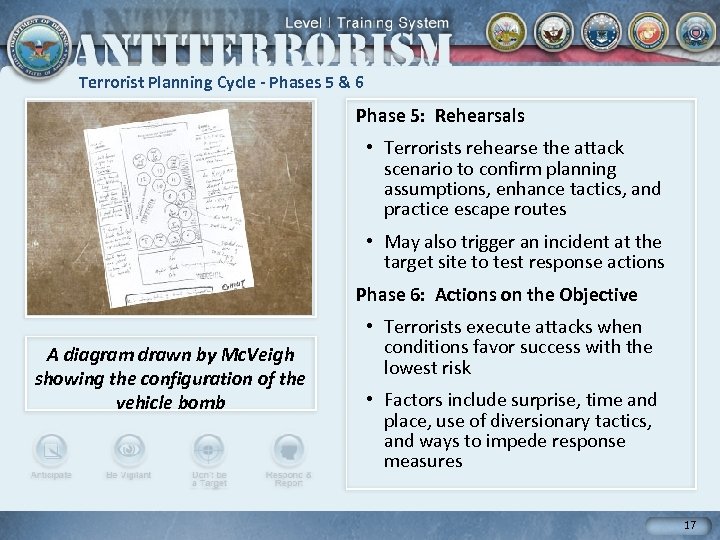 Terrorist Planning Cycle - Phases 5 & 6 Phase 5: Rehearsals • Terrorists rehearse the attack scenario to confirm planning assumptions, enhance tactics, and practice escape routes • May also trigger an incident at the target site to test response actions Phase 6: Actions on the Objective A diagram drawn by Mc. Veigh showing the configuration of the vehicle bomb • Terrorists execute attacks when conditions favor success with the lowest risk • Factors include surprise, time and place, use of diversionary tactics, and ways to impede response measures 17
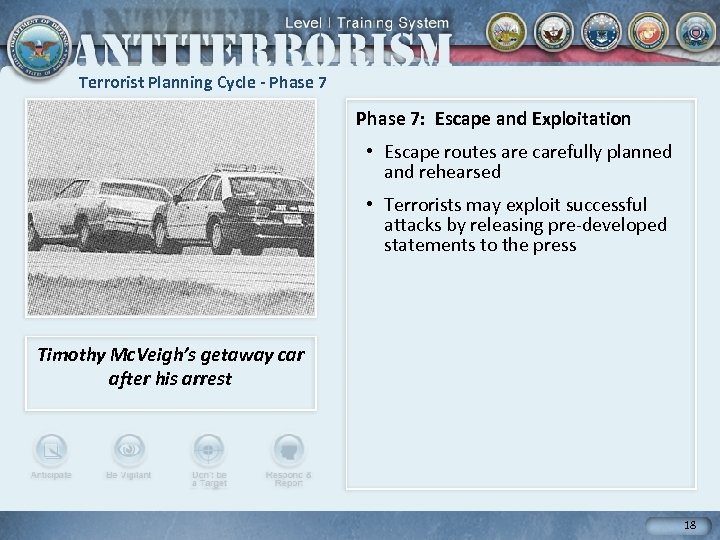 Terrorist Planning Cycle - Phase 7: Escape and Exploitation • Escape routes are carefully planned and rehearsed • Terrorists may exploit successful attacks by releasing pre-developed statements to the press Timothy Mc. Veigh’s getaway car after his arrest 18
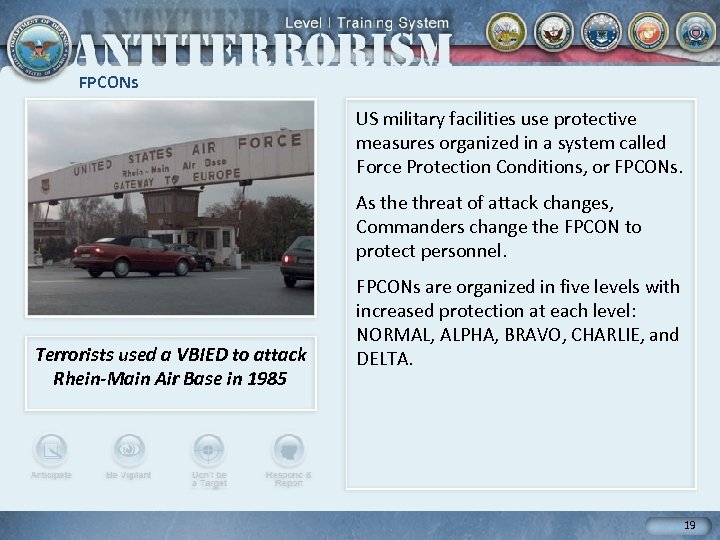 FPCONs US military facilities use protective measures organized in a system called Force Protection Conditions, or FPCONs. As the threat of attack changes, Commanders change the FPCON to protect personnel. Terrorists used a VBIED to attack Rhein-Main Air Base in 1985 FPCONs are organized in five levels with increased protection at each level: NORMAL, ALPHA, BRAVO, CHARLIE, and DELTA. 19
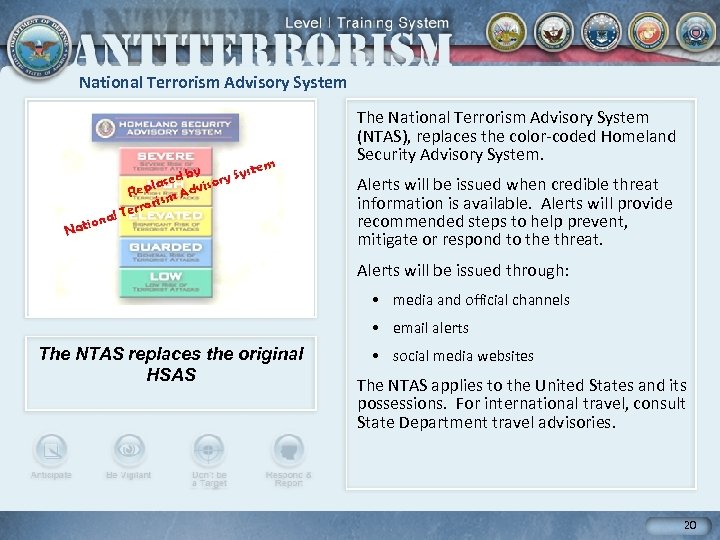 National Terrorism Advisory System The National Terrorism Advisory System (NTAS), replaces the color-coded Homeland Security Advisory System. Alerts will be issued when credible threat information is available. Alerts will provide recommended steps to help prevent, mitigate or respond to the threat. Alerts will be issued through: • media and official channels • email alerts The NTAS replaces the original HSAS • social media websites The NTAS applies to the United States and its possessions. For international travel, consult State Department travel advisories. 20
 Section 2: Situation-Based Training 21
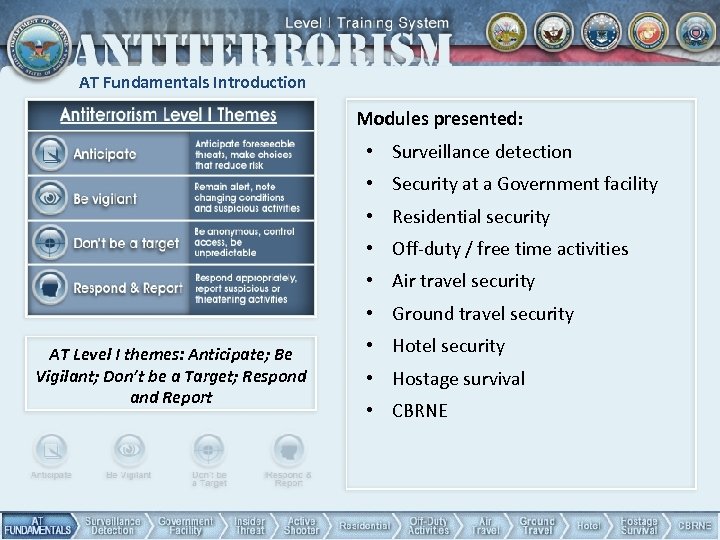 AT Fundamentals Introduction Modules presented: • Surveillance detection • Security at a Government facility • Residential security • Off-duty / free time activities • Air travel security • Ground travel security AT Level I themes: Anticipate; Be Vigilant; Don’t be a Target; Respond and Report • Hotel security • Hostage survival • CBRNE 22
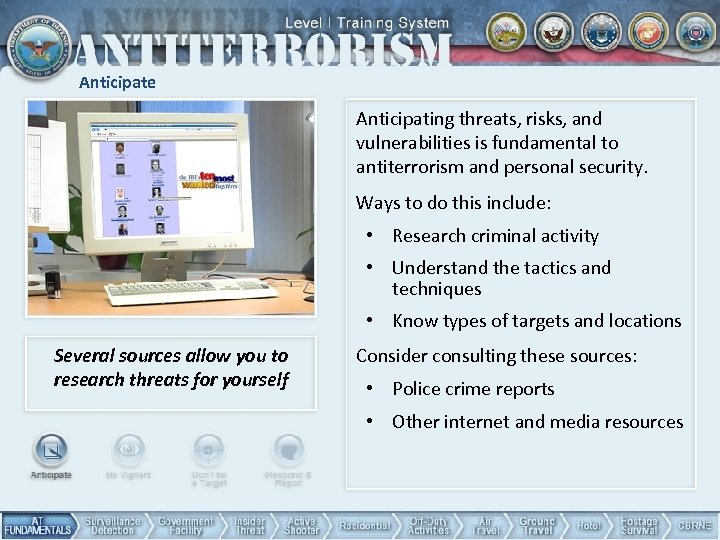 Anticipate Anticipating threats, risks, and vulnerabilities is fundamental to antiterrorism and personal security. Ways to do this include: • Research criminal activity • Understand the tactics and techniques • Know types of targets and locations Several sources allow you to research threats for yourself Consider consulting these sources: • Police crime reports • Other internet and media resources 23
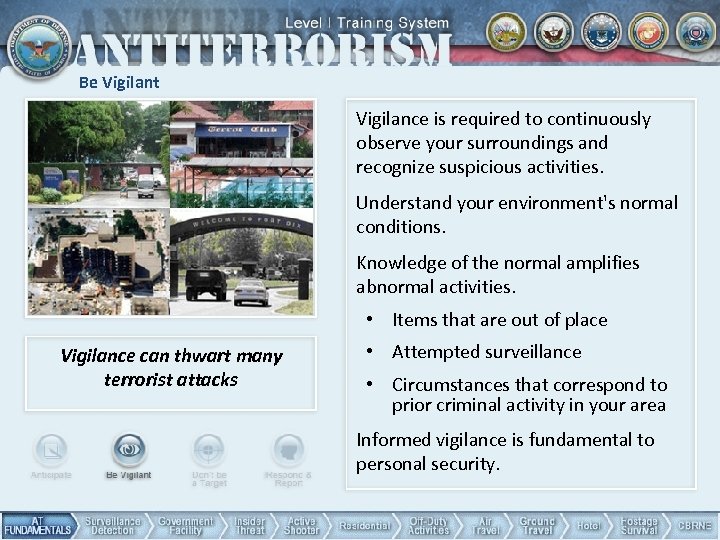 Be Vigilant Vigilance is required to continuously observe your surroundings and recognize suspicious activities. Understand your environment's normal conditions. Knowledge of the normal amplifies abnormal activities. • Items that are out of place Vigilance can thwart many terrorist attacks • Attempted surveillance • Circumstances that correspond to prior criminal activity in your area Informed vigilance is fundamental to personal security. 24
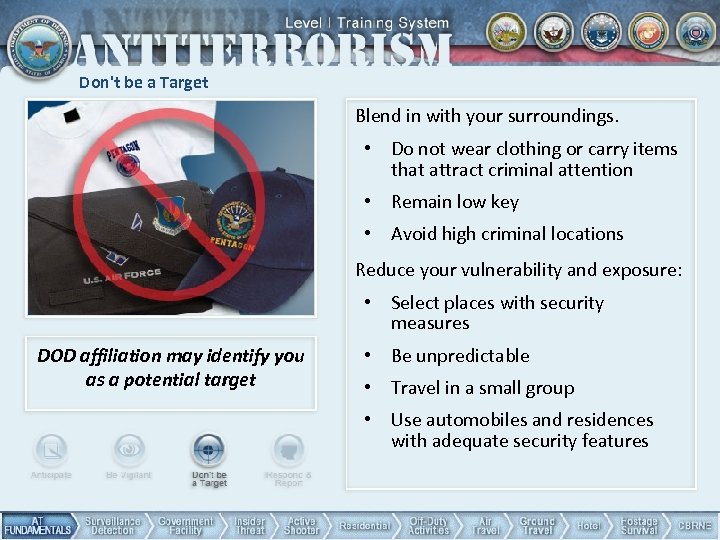 Don't be a Target Blend in with your surroundings. • Do not wear clothing or carry items that attract criminal attention • Remain low key • Avoid high criminal locations Reduce your vulnerability and exposure: • Select places with security measures DOD affiliation may identify you as a potential target • Be unpredictable • Travel in a small group • Use automobiles and residences with adequate security features 25
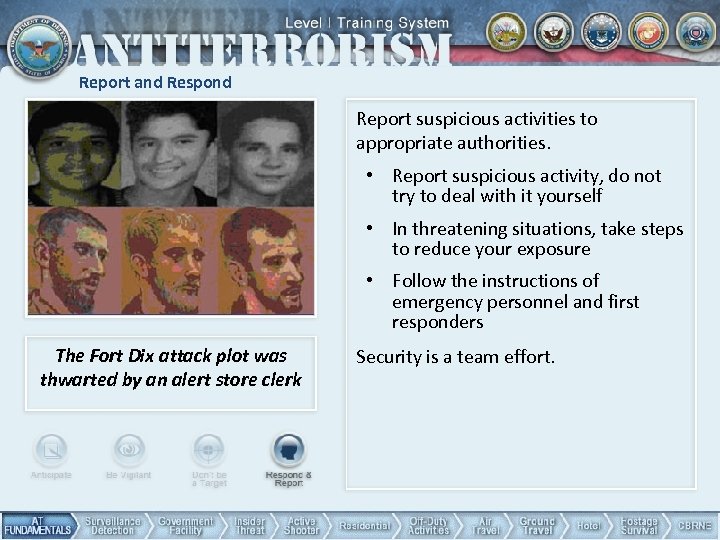 Report and Respond Report suspicious activities to appropriate authorities. • Report suspicious activity, do not try to deal with it yourself • In threatening situations, take steps to reduce your exposure • Follow the instructions of emergency personnel and first responders The Fort Dix attack plot was thwarted by an alert store clerk Security is a team effort. 26
 AT Fundamentals Quiz 1 If you identify a possible surveillance attempt you should try to handle the situation yourself. True False AT Fundamentals quiz question number one 27
 AT Fundamentals Quiz 2 Security is a team effort. True False AT Fundamentals quiz question number two 28
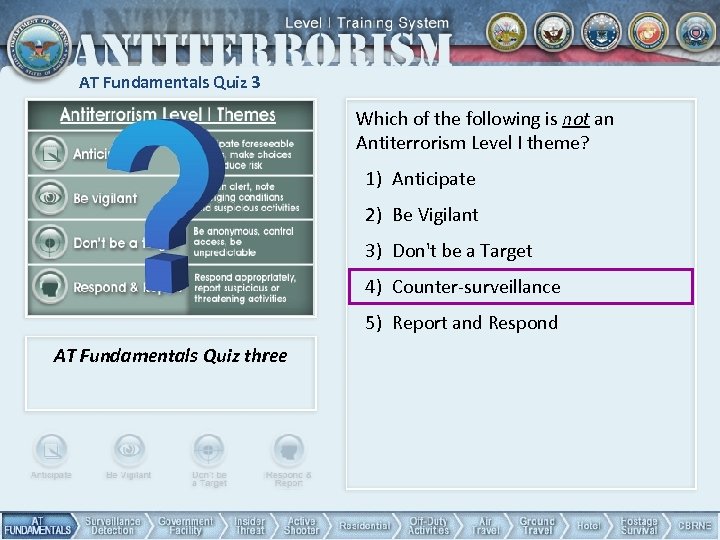 AT Fundamentals Quiz 3 Which of the following is not an Antiterrorism Level I theme? 1) Anticipate 2) Be Vigilant 3) Don't be a Target 4) Counter-surveillance 5) Report and Respond AT Fundamentals Quiz three 29
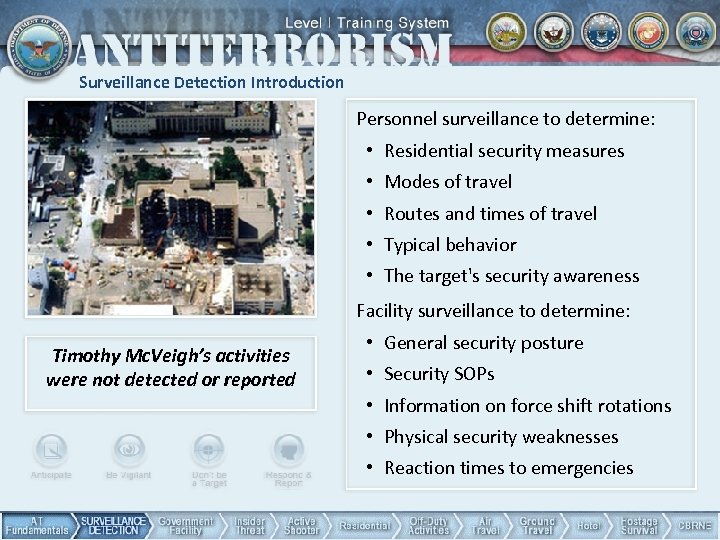 Surveillance Detection Introduction Personnel surveillance to determine: • Residential security measures • Modes of travel • Routes and times of travel • Typical behavior • The target's security awareness Facility surveillance to determine: Timothy Mc. Veigh’s activities were not detected or reported • General security posture • Security SOPs • Information on force shift rotations • Physical security weaknesses • Reaction times to emergencies 30
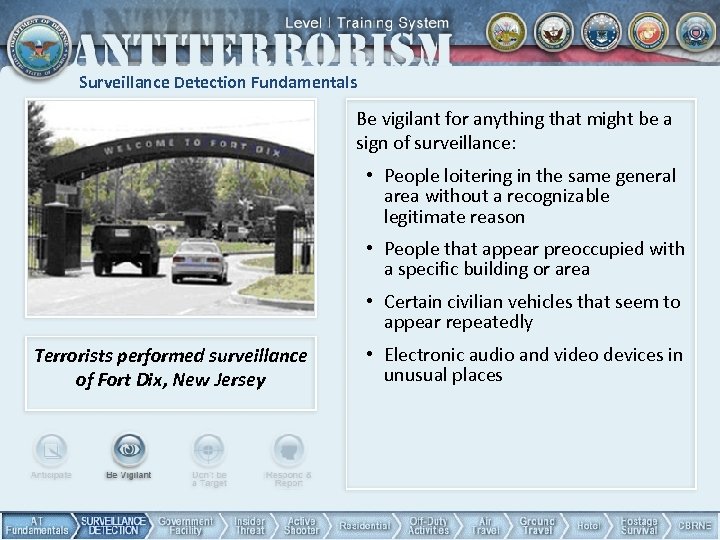 Surveillance Detection Fundamentals Be vigilant for anything that might be a sign of surveillance: • People loitering in the same general area without a recognizable legitimate reason • People that appear preoccupied with a specific building or area • Certain civilian vehicles that seem to appear repeatedly Terrorists performed surveillance of Fort Dix, New Jersey • Electronic audio and video devices in unusual places 31
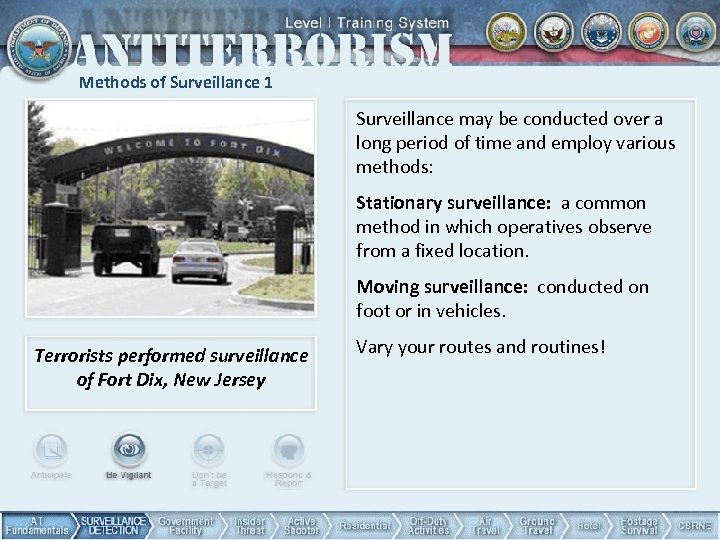 Methods of Surveillance 1 Surveillance may be conducted over a long period of time and employ various methods: Stationary surveillance: a common method in which operatives observe from a fixed location. Moving surveillance: conducted on foot or in vehicles. Terrorists performed surveillance of Fort Dix, New Jersey Vary your routes and routines! 32
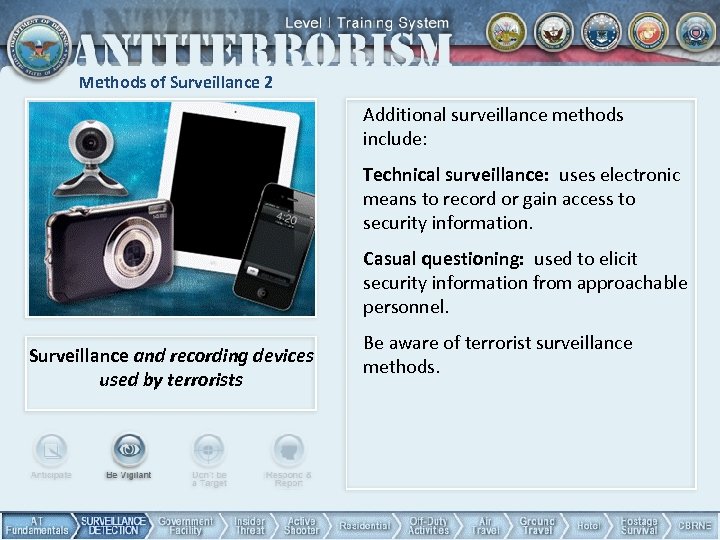 Methods of Surveillance 2 Additional surveillance methods include: Technical surveillance: uses electronic means to record or gain access to security information. Casual questioning: used to elicit security information from approachable personnel. Surveillance and recording devices used by terrorists Be aware of terrorist surveillance methods. 33
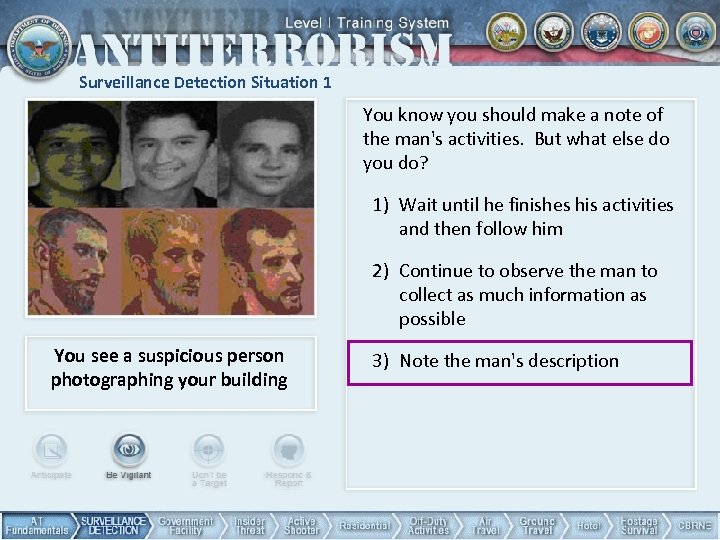 Surveillance Detection Situation 1 You know you should make a note of the man's activities. But what else do you do? 1) Wait until he finishes his activities and then follow him 2) Continue to observe the man to collect as much information as possible You see a suspicious person photographing your building 3) Note the man's description 34
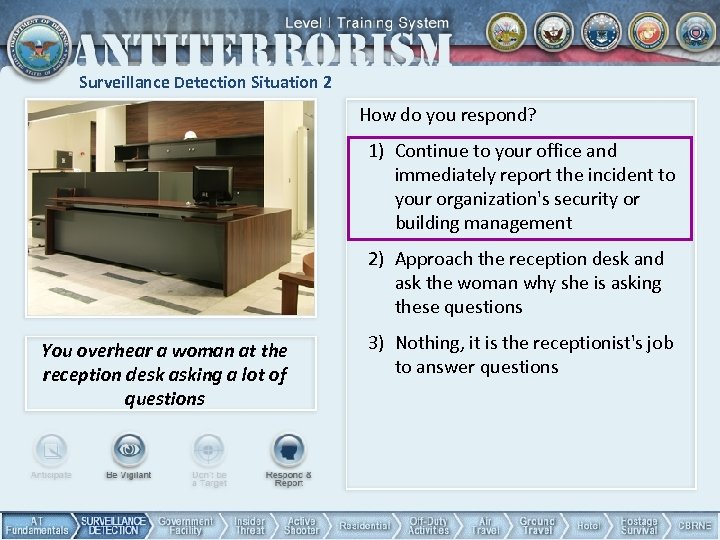 Surveillance Detection Situation 2 How do you respond? 1) Continue to your office and immediately report the incident to your organization's security or building management 2) Approach the reception desk and ask the woman why she is asking these questions You overhear a woman at the reception desk asking a lot of questions 3) Nothing, it is the receptionist's job to answer questions 35
 Surveillance Detection Quiz 1 Surveillance can be performed through either stationary or mobile means. True False Surveillance detection quiz question number one 36
 Surveillance Detection Quiz 2 Electronic audio and video devices are never used by terrorists for surveillance purposes. True False Surveillance detection quiz question number two 37
 Surveillance Detection Quiz 3 What is not a terrorist method of surveillance? 1) Stationary surveillance 2) Moving surveillance 3) Technical surveillance 4) Casual questioning Surveillance detection quiz question number three 5) Breaking and entering to steal valuables 38
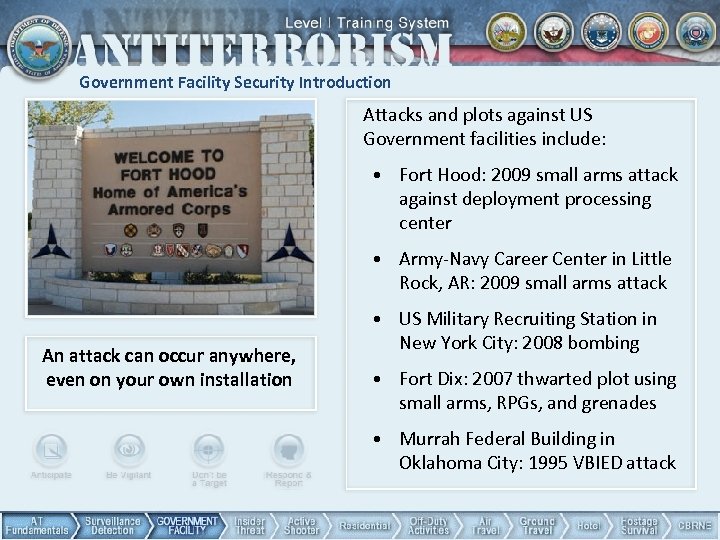 Government Facility Security Introduction Attacks and plots against US Government facilities include: • Fort Hood: 2009 small arms attack against deployment processing center • Army-Navy Career Center in Little Rock, AR: 2009 small arms attack An attack can occur anywhere, even on your own installation • US Military Recruiting Station in New York City: 2008 bombing • Fort Dix: 2007 thwarted plot using small arms, RPGs, and grenades • Murrah Federal Building in Oklahoma City: 1995 VBIED attack 39
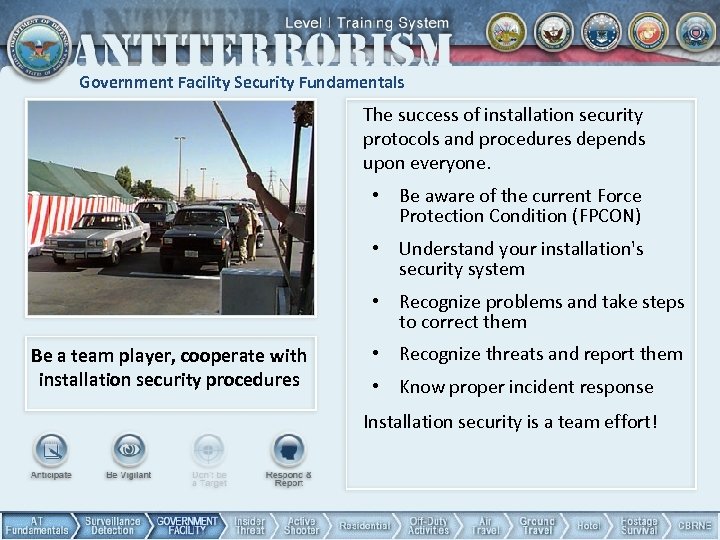 Government Facility Security Fundamentals The success of installation security protocols and procedures depends upon everyone. • Be aware of the current Force Protection Condition (FPCON) • Understand your installation's security system • Recognize problems and take steps to correct them Be a team player, cooperate with installation security procedures • Recognize threats and report them • Know proper incident response Installation security is a team effort! 40
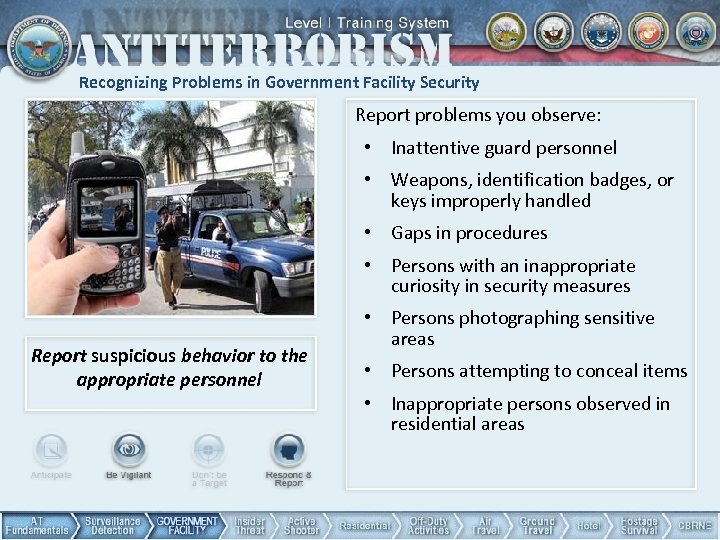 Recognizing Problems in Government Facility Security Report problems you observe: • Inattentive guard personnel • Weapons, identification badges, or keys improperly handled • Gaps in procedures • Persons with an inappropriate curiosity in security measures Report suspicious behavior to the appropriate personnel • Persons photographing sensitive areas • Persons attempting to conceal items • Inappropriate persons observed in residential areas 41
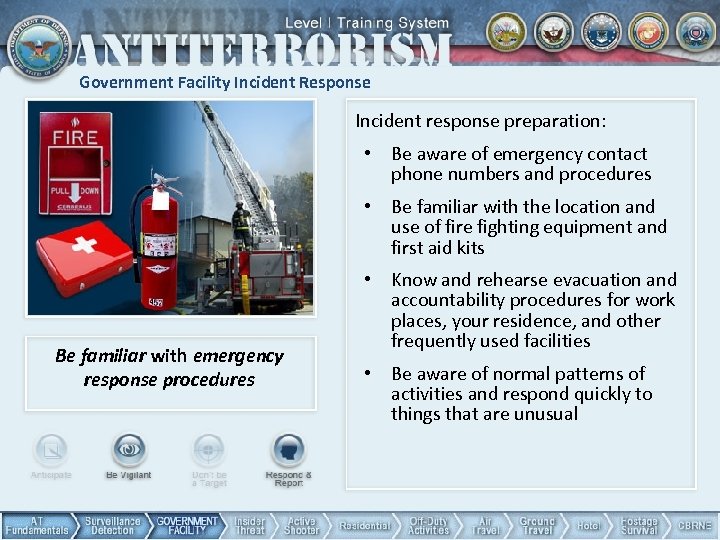 Government Facility Incident Response Incident response preparation: • Be aware of emergency contact phone numbers and procedures • Be familiar with the location and use of fire fighting equipment and first aid kits Be familiar with emergency response procedures • Know and rehearse evacuation and accountability procedures for work places, your residence, and other frequently used facilities • Be aware of normal patterns of activities and respond quickly to things that are unusual 42
 Government Facility Security Situation 1 What do you do to be better prepared for an emergency? 1) Check to see if there are signs with emergency procedures posted 2) Ask your security manager about evacuation and accountability procedures You are at a new facility 3) Observe the operations of the building as you perform your daily duties 43
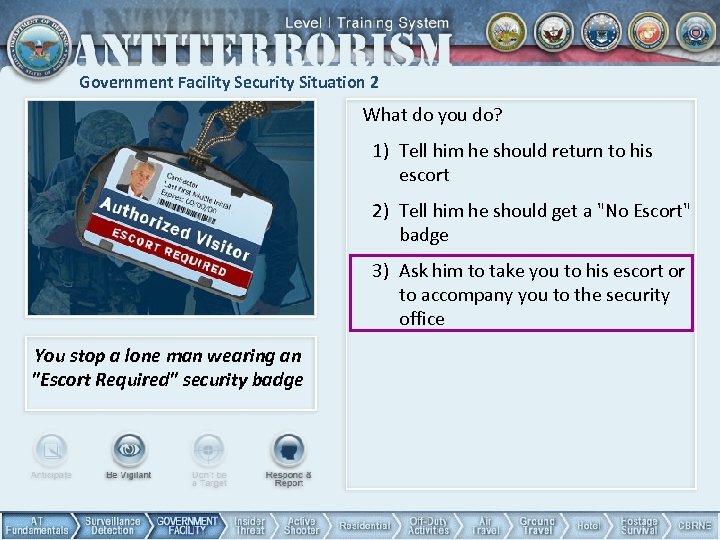 Government Facility Security Situation 2 What do you do? 1) Tell him he should return to his escort 2) Tell him he should get a "No Escort" badge 3) Ask him to take you to his escort or to accompany you to the security office You stop a lone man wearing an "Escort Required" security badge 44
 Government Facility Security Quiz 1 Everyone on an installation has shared responsibility for security. True False Government facility security quiz question number one 45
 Government Facility Security Quiz 2 Persons who have been given access to an installation can be counted on to be of no threat. True False Government facility security quiz question number two 46
 Government Facility Security Quiz 3 Which of these does not pose a risk to security at a government facility: 1) Inattentive guard personnel 2) A visitor showing an unusual interest in details of security procedures 3) A person found in an inappropriate portion of the facility Government facility security quiz question number three 4) An "escort required" visitor found without an escort 5) A person expressing boredom with the US mission 47
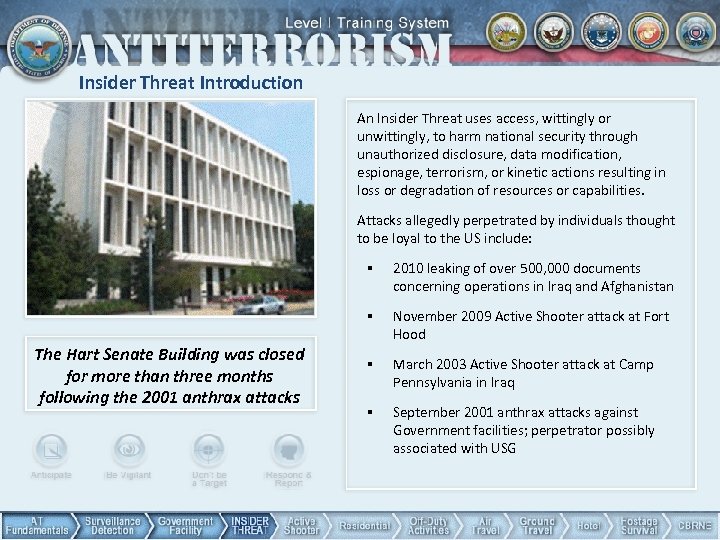 Insider Threat Introduction An Insider Threat uses access, wittingly or unwittingly, to harm national security through unauthorized disclosure, data modification, espionage, terrorism, or kinetic actions resulting in loss or degradation of resources or capabilities. Attacks allegedly perpetrated by individuals thought to be loyal to the US include: § § The Hart Senate Building was closed for more than three months following the 2001 anthrax attacks 2010 leaking of over 500, 000 documents concerning operations in Iraq and Afghanistan November 2009 Active Shooter attack at Fort Hood § March 2003 Active Shooter attack at Camp Pennsylvania in Iraq § September 2001 anthrax attacks against Government facilities; perpetrator possibly associated with USG
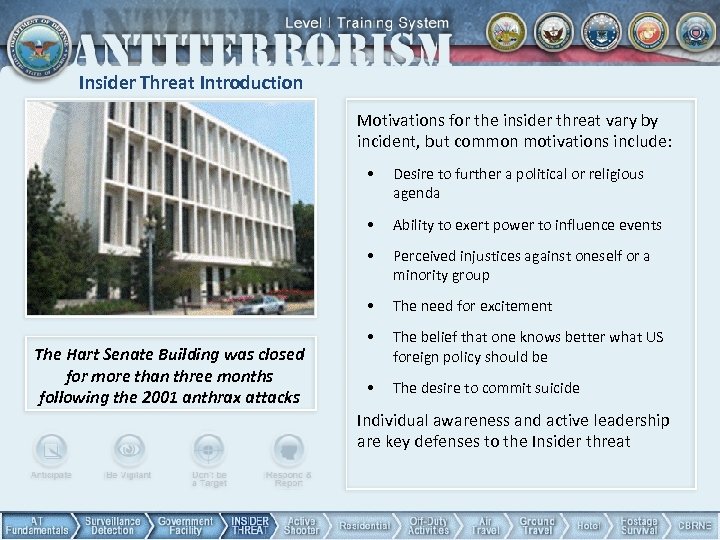 Insider Threat Introduction Motivations for the insider threat vary by incident, but common motivations include: • • Ability to exert power to influence events • Perceived injustices against oneself or a minority group • The Hart Senate Building was closed for more than three months following the 2001 anthrax attacks Desire to further a political or religious agenda The need for excitement • The belief that one knows better what US foreign policy should be • The desire to commit suicide Individual awareness and active leadership are key defenses to the Insider threat
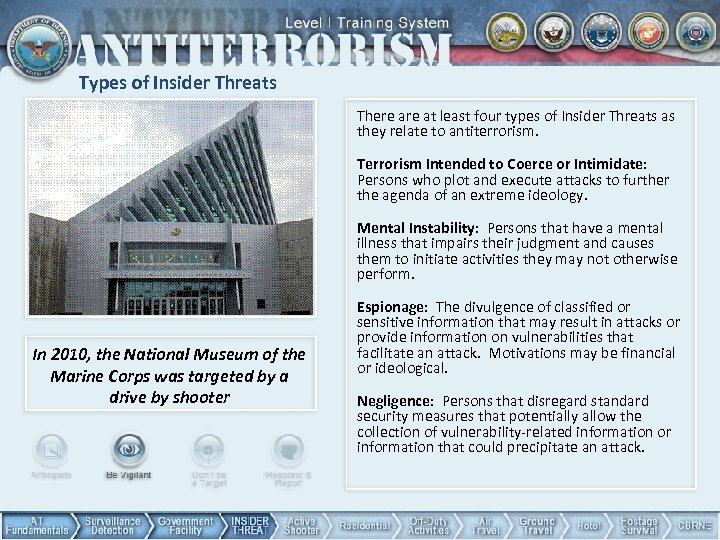 Types of Insider Threats There at least four types of Insider Threats as they relate to antiterrorism. Terrorism Intended to Coerce or Intimidate: Persons who plot and execute attacks to further the agenda of an extreme ideology. Mental Instability: Persons that have a mental illness that impairs their judgment and causes them to initiate activities they may not otherwise perform. In 2010, the National Museum of the Marine Corps was targeted by a drive by shooter Espionage: The divulgence of classified or sensitive information that may result in attacks or provide information on vulnerabilities that facilitate an attack. Motivations may be financial or ideological. Negligence: Persons that disregard standard security measures that potentially allow the collection of vulnerability-related information or information that could precipitate an attack.
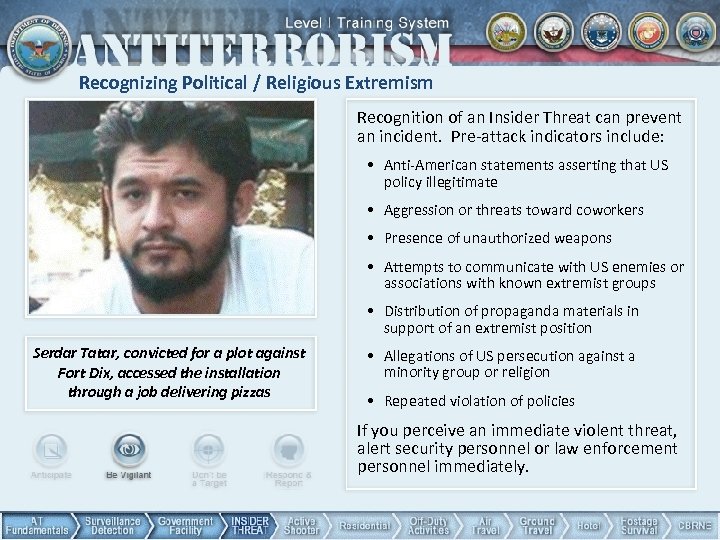 Recognizing Political / Religious Extremism Recognition of an Insider Threat can prevent an incident. Pre-attack indicators include: • Anti-American statements asserting that US policy illegitimate • Aggression or threats toward coworkers • Presence of unauthorized weapons • Attempts to communicate with US enemies or associations with known extremist groups • Distribution of propaganda materials in support of an extremist position Serdar Tatar, convicted for a plot against Fort Dix, accessed the installation through a job delivering pizzas • Allegations of US persecution against a minority group or religion • Repeated violation of policies If you perceive an immediate violent threat, alert security personnel or law enforcement personnel immediately.
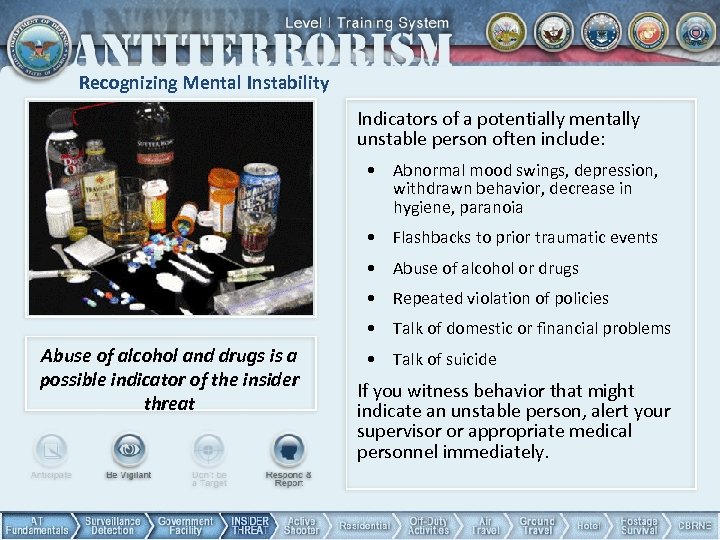 Recognizing Mental Instability Indicators of a potentially mentally unstable person often include: • Abnormal mood swings, depression, withdrawn behavior, decrease in hygiene, paranoia • Flashbacks to prior traumatic events • Abuse of alcohol or drugs • Repeated violation of policies • Talk of domestic or financial problems Abuse of alcohol and drugs is a possible indicator of the insider threat • Talk of suicide If you witness behavior that might indicate an unstable person, alert your supervisor or appropriate medical personnel immediately.
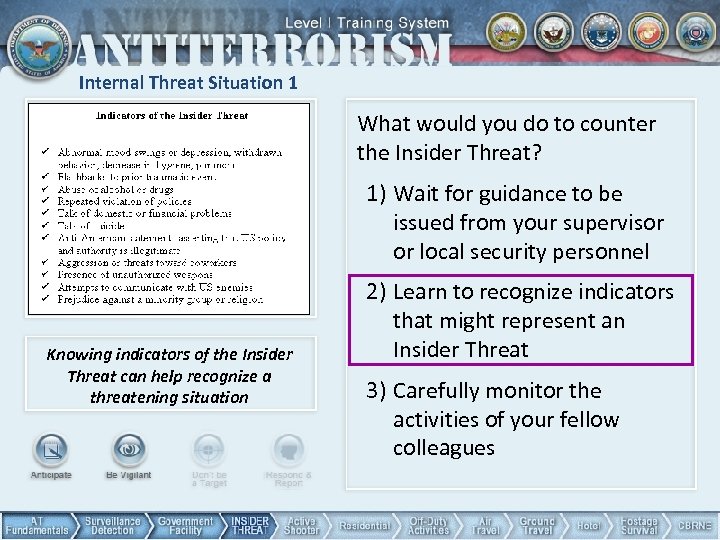 Internal Threat Situation 1 What would you do to counter the Insider Threat? 1) Wait for guidance to be issued from your supervisor or local security personnel Knowing indicators of the Insider Threat can help recognize a threatening situation 2) Learn to recognize indicators that might represent an Insider Threat 3) Carefully monitor the activities of your fellow colleagues
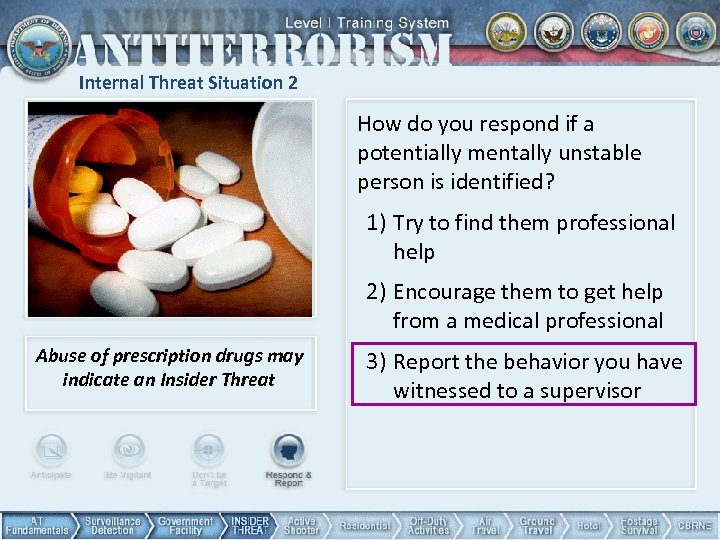 Internal Threat Situation 2 How do you respond if a potentially mentally unstable person is identified? 1) Try to find them professional help 2) Encourage them to get help from a medical professional Abuse of prescription drugs may indicate an Insider Threat 3) Report the behavior you have witnessed to a supervisor
 Internal Threat Quiz 1 Knowing indicators of an unstable person can allow you to identify a potential Insider Threat before an incident? True False Insider Threat quiz question number one
 Internal Threat Quiz 2 From an antiterrorism perspective, espionage and security negligence are considered Insider Threats? True False Insider Threat quiz question number two
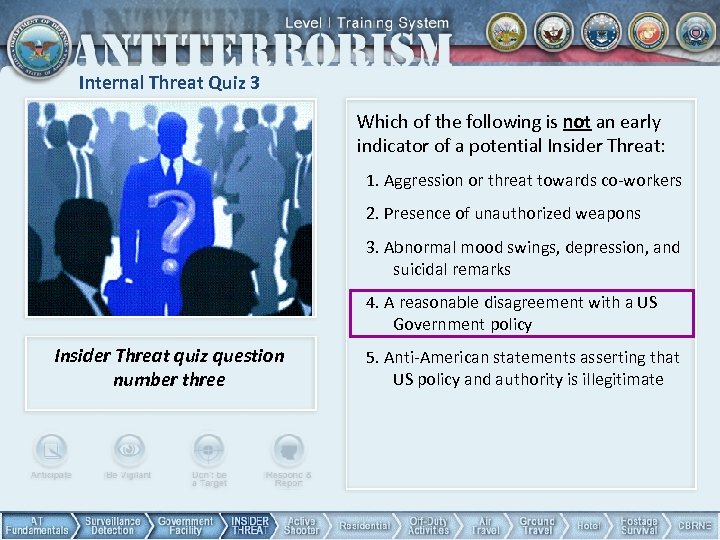 Internal Threat Quiz 3 Which of the following is not an early indicator of a potential Insider Threat: 1. Aggression or threat towards co-workers 2. Presence of unauthorized weapons 3. Abnormal mood swings, depression, and suicidal remarks 4. A reasonable disagreement with a US Government policy Insider Threat quiz question number three 5. Anti-American statements asserting that US policy and authority is illegitimate
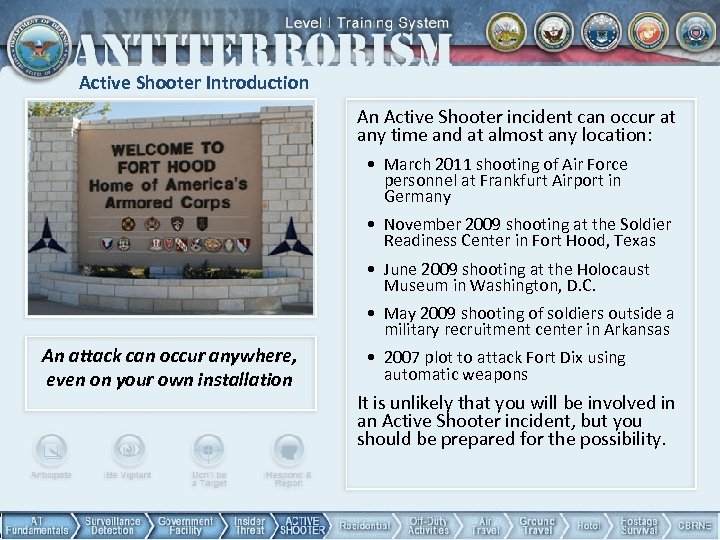 Active Shooter Introduction An Active Shooter incident can occur at any time and at almost any location: • March 2011 shooting of Air Force personnel at Frankfurt Airport in Germany • November 2009 shooting at the Soldier Readiness Center in Fort Hood, Texas • June 2009 shooting at the Holocaust Museum in Washington, D. C. • May 2009 shooting of soldiers outside a military recruitment center in Arkansas An attack can occur anywhere, even on your own installation • 2007 plot to attack Fort Dix using automatic weapons It is unlikely that you will be involved in an Active Shooter incident, but you should be prepared for the possibility.
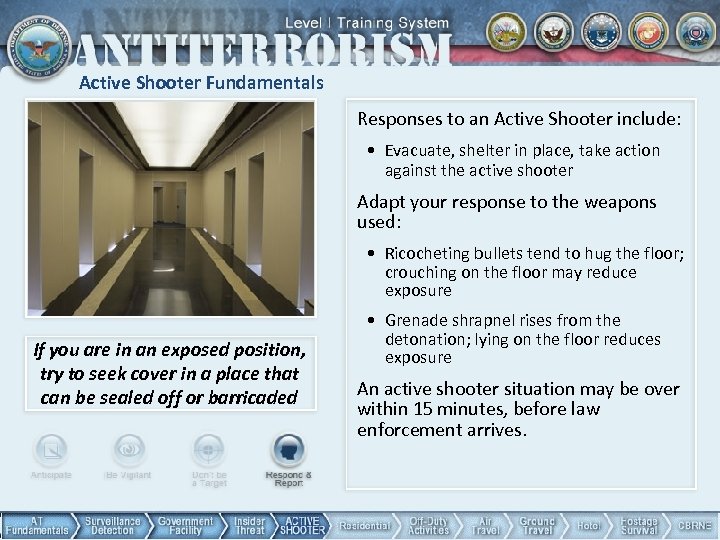 Active Shooter Fundamentals Responses to an Active Shooter include: • Evacuate, shelter in place, take action against the active shooter Adapt your response to the weapons used: • Ricocheting bullets tend to hug the floor; crouching on the floor may reduce exposure If you are in an exposed position, try to seek cover in a place that can be sealed off or barricaded • Grenade shrapnel rises from the detonation; lying on the floor reduces exposure An active shooter situation may be over within 15 minutes, before law enforcement arrives.
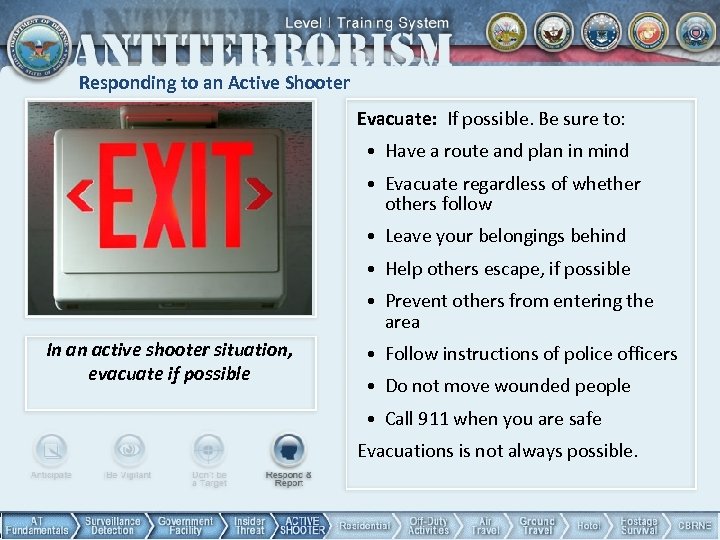 Responding to an Active Shooter Evacuate: If possible. Be sure to: • Have a route and plan in mind • Evacuate regardless of whether others follow • Leave your belongings behind • Help others escape, if possible • Prevent others from entering the area In an active shooter situation, evacuate if possible • Follow instructions of police officers • Do not move wounded people • Call 911 when you are safe Evacuations is not always possible.
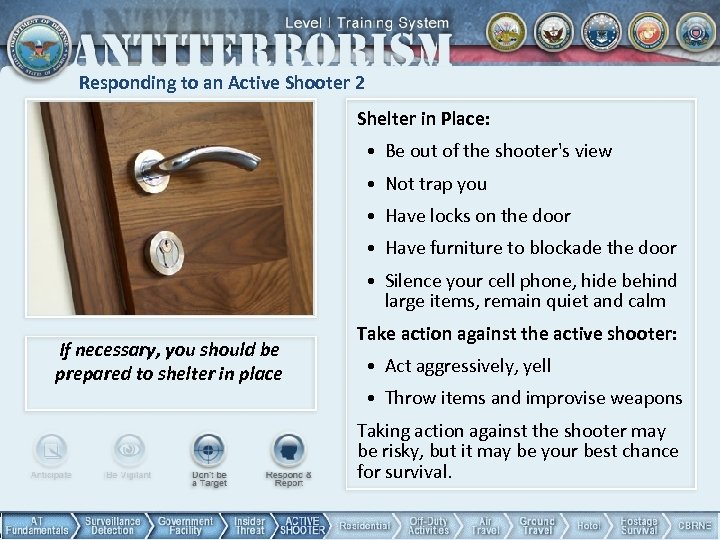 Responding to an Active Shooter 2 Shelter in Place: • Be out of the shooter's view • Not trap you • Have locks on the door • Have furniture to blockade the door • Silence your cell phone, hide behind large items, remain quiet and calm If necessary, you should be prepared to shelter in place Take action against the active shooter: • Act aggressively, yell • Throw items and improvise weapons Taking action against the shooter may be risky, but it may be your best chance for survival.
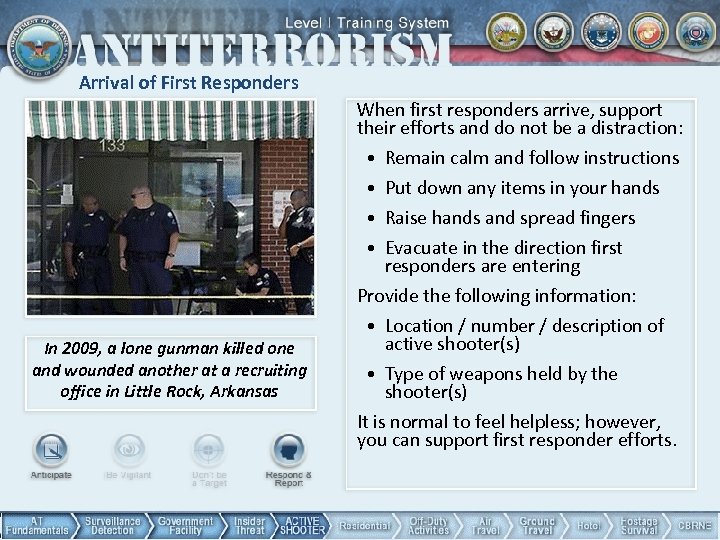 Arrival of First Responders In 2009, a lone gunman killed one and wounded another at a recruiting office in Little Rock, Arkansas When first responders arrive, support their efforts and do not be a distraction: • Remain calm and follow instructions • Put down any items in your hands • Raise hands and spread fingers • Evacuate in the direction first responders are entering Provide the following information: • Location / number / description of active shooter(s) • Type of weapons held by the shooter(s) It is normal to feel helpless; however, you can support first responder efforts.
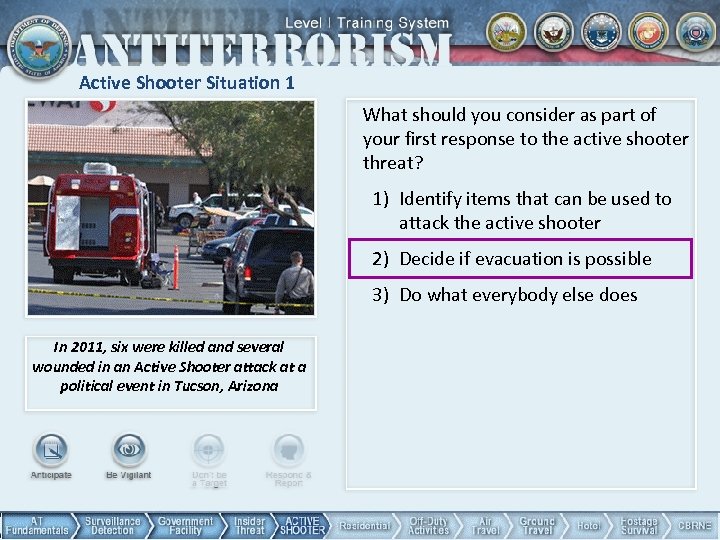 Active Shooter Situation 1 What should you consider as part of your first response to the active shooter threat? 1) Identify items that can be used to attack the active shooter 2) Decide if evacuation is possible 3) Do what everybody else does In 2011, six were killed and several wounded in an Active Shooter attack at a political event in Tucson, Arizona
 Active Shooter Situation 2 What do you do if there is an active shooter threat involving firearms and you have no opportunity to evacuate? 1) Diver for cover and run for the exit at the first opportunity 2) Dive behind something solid and crouch to the floor You consider the Active Shooter Threat 3) Dive behind something solid and lie flat on the floor
 Active Shooter Quiz Question 1 In an Active Shooter incident involving firearms you should immediately lay on the ground? True False Active Shooter Quiz Question 1
 Active Shooter Quiz Question 2 Active resistance should be the immediate response to an active shooter incident True False Active Shooter Quiz Question 2
 Active Shooter Quiz Question 3 Which of the following is not a recommended response to an Active Shooter incident: 1. Look for possible escape routes from the area 2. Look for a place to hide or an area that can be barricaded 3. Find something solid to dive behind Active Shooter Quiz Question 3 4. Provide instructions to arriving emergency response personnel 5. If necessary, actively resist the perpetrator
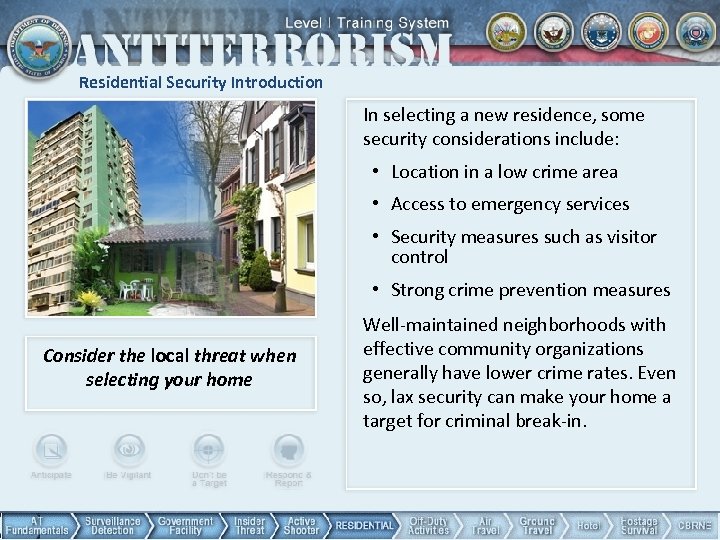 Residential Security Introduction In selecting a new residence, some security considerations include: • Location in a low crime area • Access to emergency services • Security measures such as visitor control • Strong crime prevention measures Consider the local threat when selecting your home Well-maintained neighborhoods with effective community organizations generally have lower crime rates. Even so, lax security can make your home a target for criminal break-in. 68
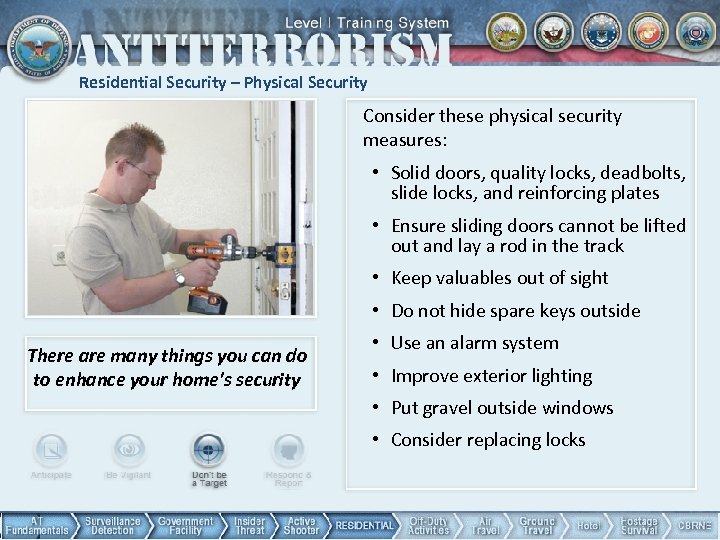 Residential Security – Physical Security Consider these physical security measures: • Solid doors, quality locks, deadbolts, slide locks, and reinforcing plates • Ensure sliding doors cannot be lifted out and lay a rod in the track • Keep valuables out of sight • Do not hide spare keys outside There are many things you can do to enhance your home's security • Use an alarm system • Improve exterior lighting • Put gravel outside windows • Consider replacing locks 69
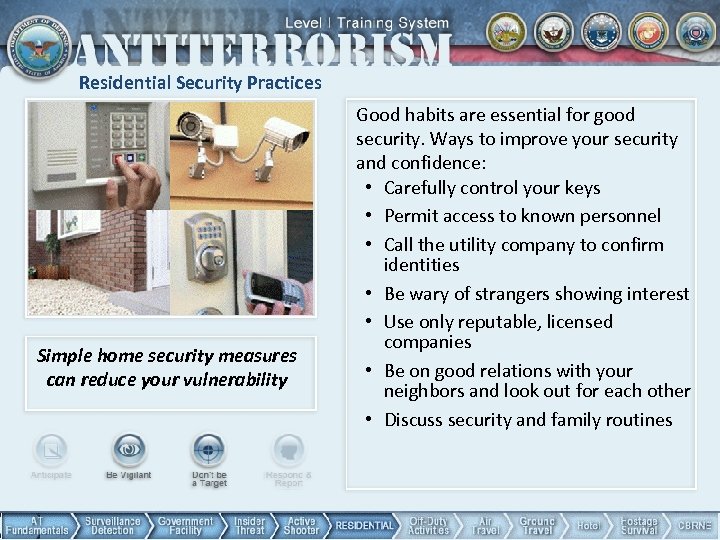 Residential Security Practices Simple home security measures can reduce your vulnerability Good habits are essential for good security. Ways to improve your security and confidence: • Carefully control your keys • Permit access to known personnel • Call the utility company to confirm identities • Be wary of strangers showing interest • Use only reputable, licensed companies • Be on good relations with your neighbors and look out for each other • Discuss security and family routines 70
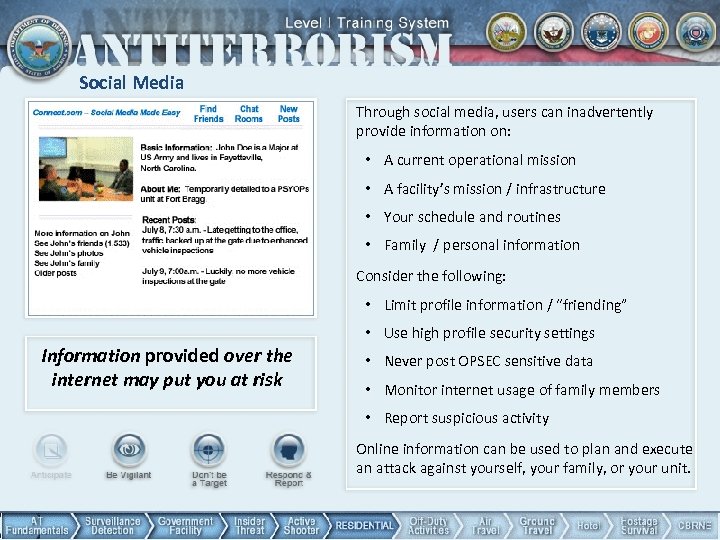 Social Media Through social media, users can inadvertently provide information on: • A current operational mission • A facility’s mission / infrastructure • Your schedule and routines • Family / personal information Consider the following: • Limit profile information / “friending” • Use high profile security settings Information provided over the internet may put you at risk • Never post OPSEC sensitive data • Monitor internet usage of family members • Report suspicious activity Online information can be used to plan and execute an attack against yourself, your family, or your unit. 71
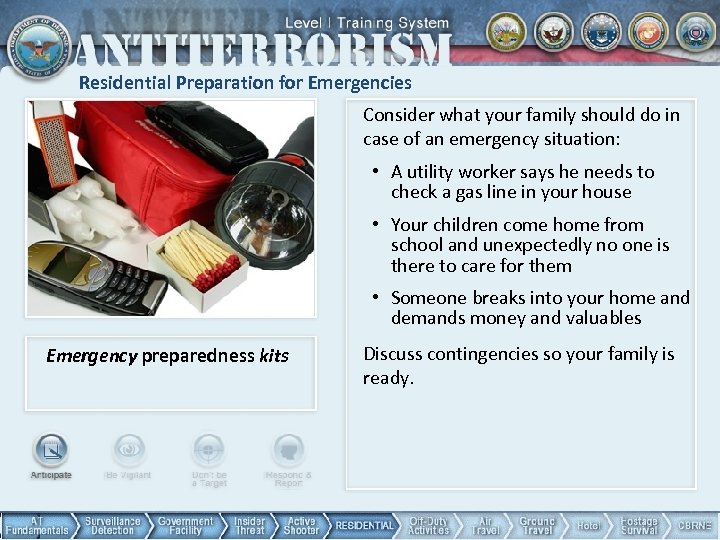 Residential Preparation for Emergencies Consider what your family should do in case of an emergency situation: • A utility worker says he needs to check a gas line in your house • Your children come home from school and unexpectedly no one is there to care for them • Someone breaks into your home and demands money and valuables Emergency preparedness kits Discuss contingencies so your family is ready. 72
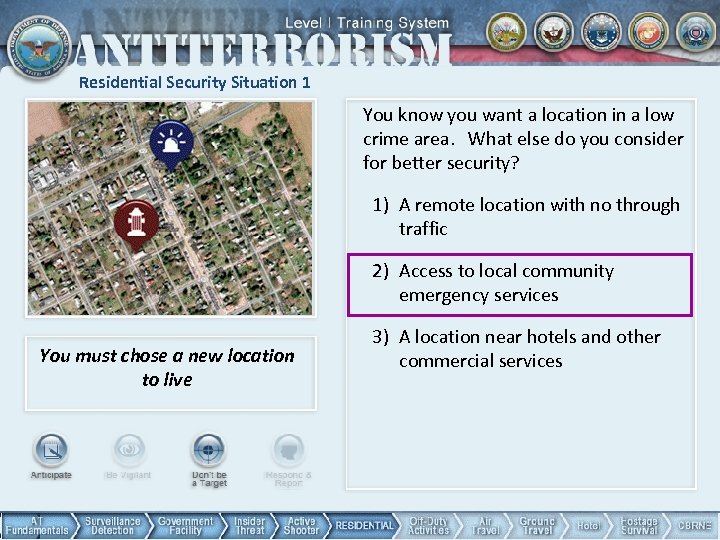 Residential Security Situation 1 You know you want a location in a low crime area. What else do you consider for better security? 1) A remote location with no through traffic 2) Access to local community emergency services You must chose a new location to live 3) A location near hotels and other commercial services 73
 Residential Security Situation 2 What can you do to improve the physical security of your new residence? 1) To ensure family members can get in if lose their key, hide a key near the front porch You want to improve the security of your home 2) Ask your neighbors if there are crime problems in the neighborhood; if not, you do not need to do anything special 3) Make sure windows lock securely and put a dowel or rod in sliding door tracks to keep them from being forced open 74
 Residential Security Situation 3 What do you do? 1) Be on good relations with your neighbors so you can look out for each other 2) Keep a low profile and do not initiate contact with neighbors You are discussing the best way to interact with your new neighbors 3) Feel free to tell your neighbors about your sponsor's work for DOD as a way to boost mutual trust 75
 Residential Security Quiz 1 Home security can be improved with self-help measures like changing locks, securing windows, and improving outdoor lighting. True False Residential security quiz question one 76
 Residential Security Quiz 2 Internet acquaintances can pose a security threat and should be carefully monitored. True False Residential security quiz question two 77
 Residential Security Quiz 3 What is not a physical security consideration for your home? 1) Changing locks to ensure key control 2) Confirming that a cleaning company is reliable and licensed 3) Hiding a key outside to ensure family members can get in if they lose their keys Residential security quiz question three 4) Monitoring internet acquaintances for all family members 5) Having good relations with neighbor and look out for each other 78
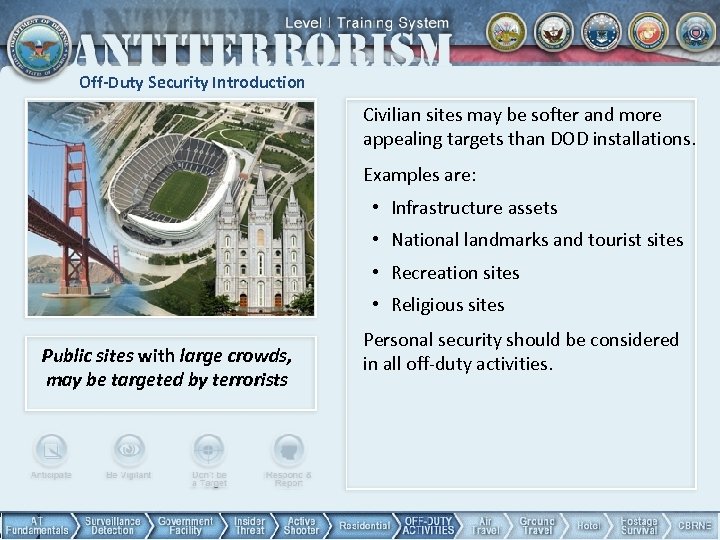 Off-Duty Security Introduction Civilian sites may be softer and more appealing targets than DOD installations. Examples are: • Infrastructure assets • National landmarks and tourist sites • Recreation sites • Religious sites Public sites with large crowds, may be targeted by terrorists Personal security should be considered in all off-duty activities. 79
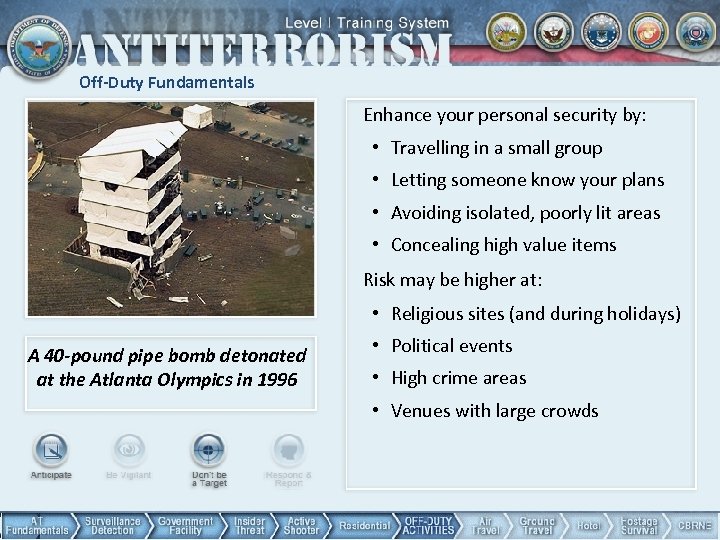 Off-Duty Fundamentals Enhance your personal security by: • Travelling in a small group • Letting someone know your plans • Avoiding isolated, poorly lit areas • Concealing high value items Risk may be higher at: • Religious sites (and during holidays) A 40 -pound pipe bomb detonated at the Atlanta Olympics in 1996 • Political events • High crime areas • Venues with large crowds 80
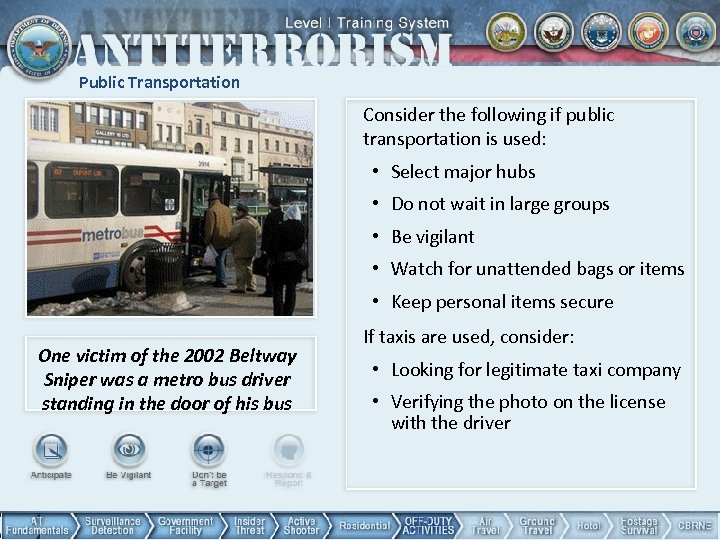 Public Transportation Consider the following if public transportation is used: • Select major hubs • Do not wait in large groups • Be vigilant • Watch for unattended bags or items • Keep personal items secure One victim of the 2002 Beltway Sniper was a metro bus driver standing in the door of his bus If taxis are used, consider: • Looking for legitimate taxi company • Verifying the photo on the license with the driver 81
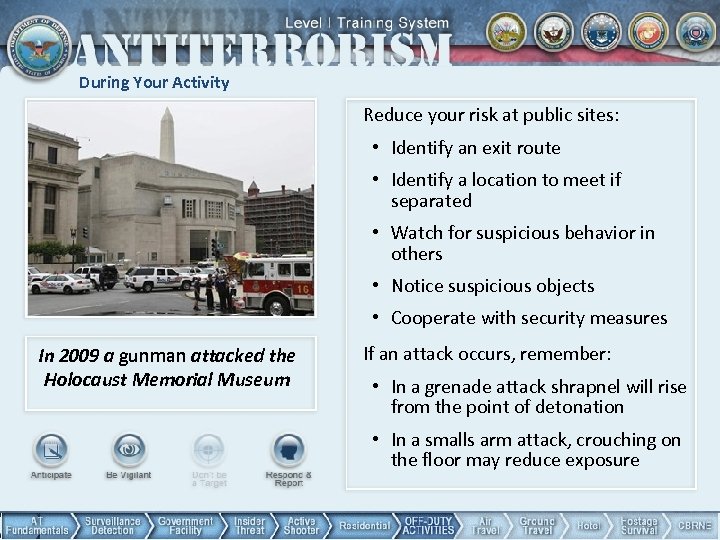 During Your Activity Reduce your risk at public sites: • Identify an exit route • Identify a location to meet if separated • Watch for suspicious behavior in others • Notice suspicious objects • Cooperate with security measures In 2009 a gunman attacked the Holocaust Memorial Museum If an attack occurs, remember: • In a grenade attack shrapnel will rise from the point of detonation • In a smalls arm attack, crouching on the floor may reduce exposure 82
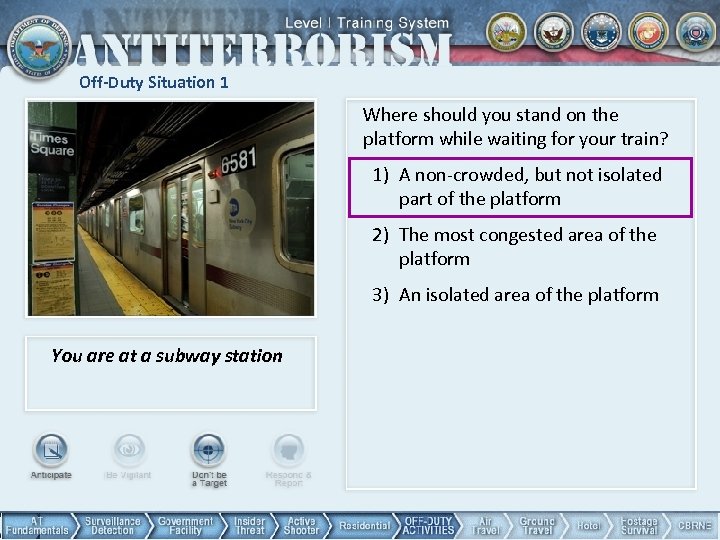 Off-Duty Situation 1 Where should you stand on the platform while waiting for your train? 1) A non-crowded, but not isolated part of the platform 2) The most congested area of the platform 3) An isolated area of the platform You are at a subway station 83
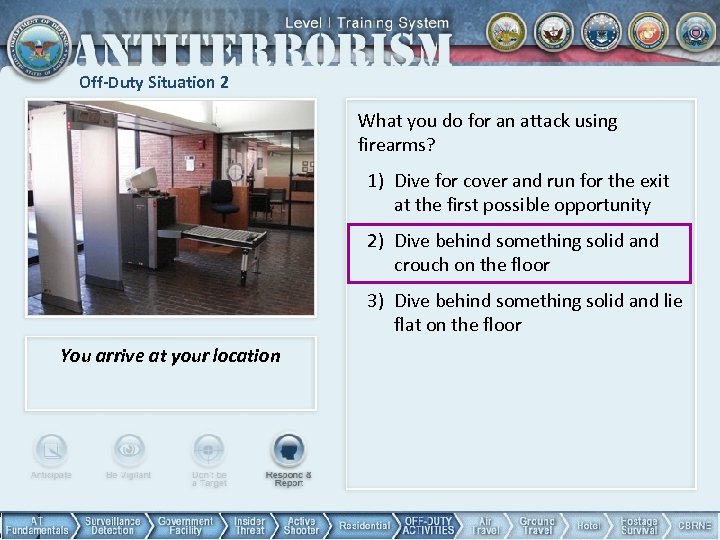 Off-Duty Situation 2 What you do for an attack using firearms? 1) Dive for cover and run for the exit at the first possible opportunity 2) Dive behind something solid and crouch on the floor 3) Dive behind something solid and lie flat on the floor You arrive at your location 84
 Off-Duty Quiz 1 State Department Travel Warnings should be consulted prior to taking trips across the US-Mexican border. True False Off-Duty quiz question one 85
 Off-Duty Quiz 2 Terrorists usually avoid tourist locations since they are not DOD related. True False Off-Duty quiz question two 86
 Off-Duty Quiz 3 Which of the following have not been targeted or plotted against by terrorists or violent individuals? 1) Sporting events 2) Places of religious association 3) Public infrastructure 4) Political events Off-Duty quiz question three 5) None of the above 87
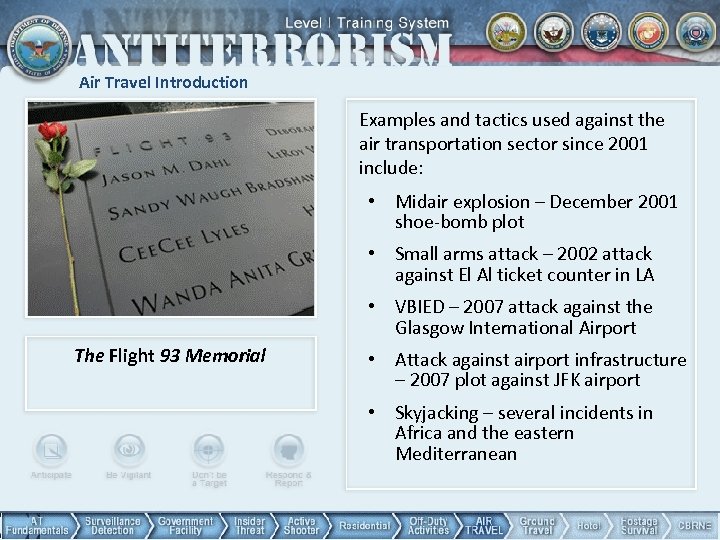 Air Travel Introduction Examples and tactics used against the air transportation sector since 2001 include: • Midair explosion – December 2001 shoe-bomb plot • Small arms attack – 2002 attack against El Al ticket counter in LA • VBIED – 2007 attack against the Glasgow International Airport The Flight 93 Memorial • Attack against airport infrastructure – 2007 plot against JFK airport • Skyjacking – several incidents in Africa and the eastern Mediterranean 88
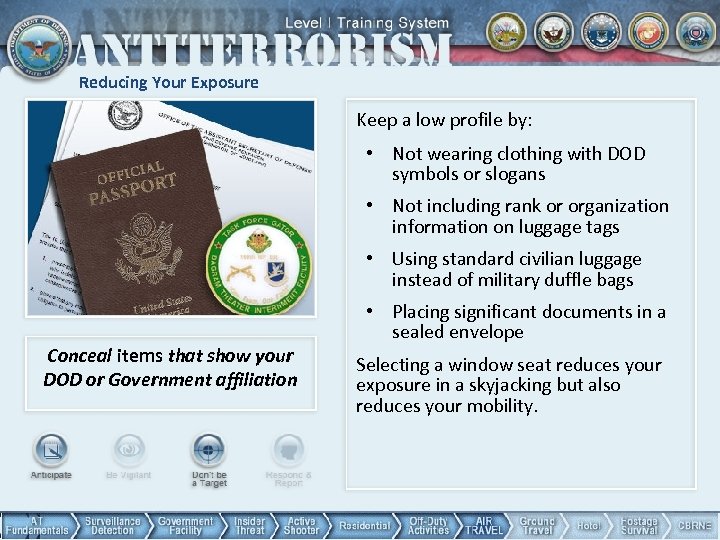 Reducing Your Exposure Keep a low profile by: • Not wearing clothing with DOD symbols or slogans • Not including rank or organization information on luggage tags • Using standard civilian luggage instead of military duffle bags Conceal items that show your DOD or Government affiliation • Placing significant documents in a sealed envelope Selecting a window seat reduces your exposure in a skyjacking but also reduces your mobility. 89
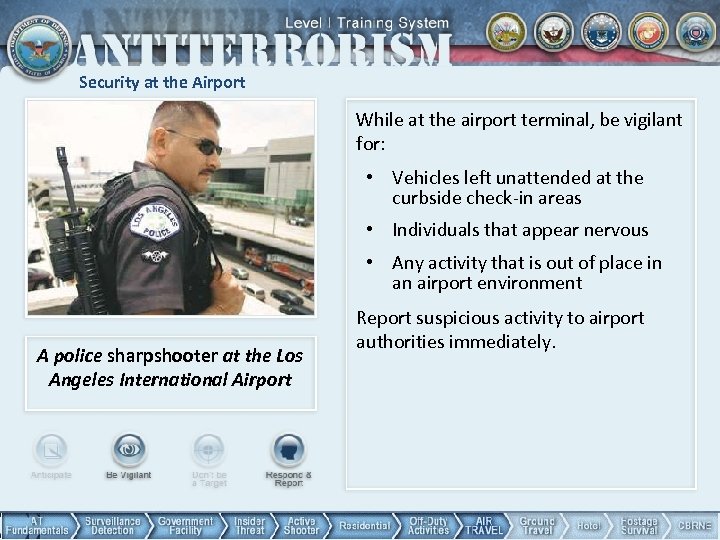 Security at the Airport While at the airport terminal, be vigilant for: • Vehicles left unattended at the curbside check-in areas • Individuals that appear nervous • Any activity that is out of place in an airport environment A police sharpshooter at the Los Angeles International Airport Report suspicious activity to airport authorities immediately. 90
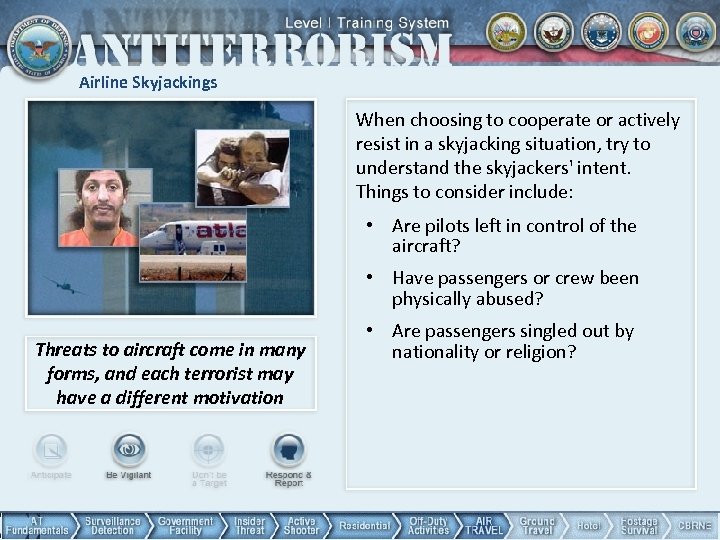 Airline Skyjackings When choosing to cooperate or actively resist in a skyjacking situation, try to understand the skyjackers' intent. Things to consider include: • Are pilots left in control of the aircraft? • Have passengers or crew been physically abused? Threats to aircraft come in many forms, and each terrorist may have a different motivation • Are passengers singled out by nationality or religion? 91
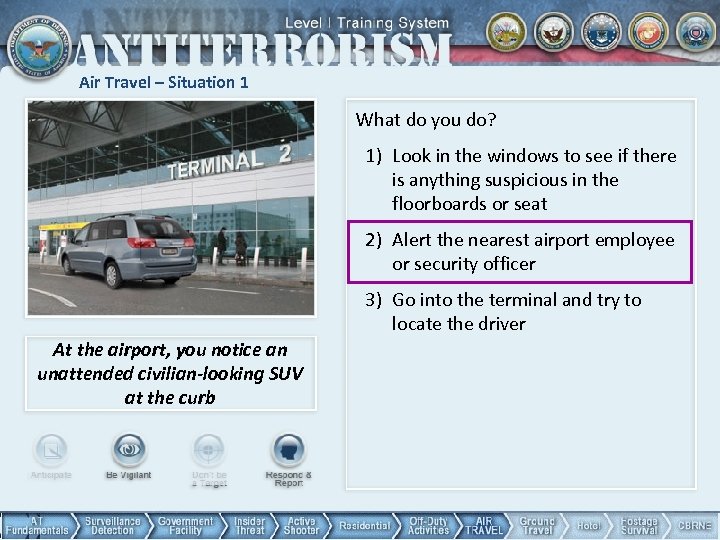 Air Travel – Situation 1 What do you do? 1) Look in the windows to see if there is anything suspicious in the floorboards or seat 2) Alert the nearest airport employee or security officer 3) Go into the terminal and try to locate the driver At the airport, you notice an unattended civilian-looking SUV at the curb 92
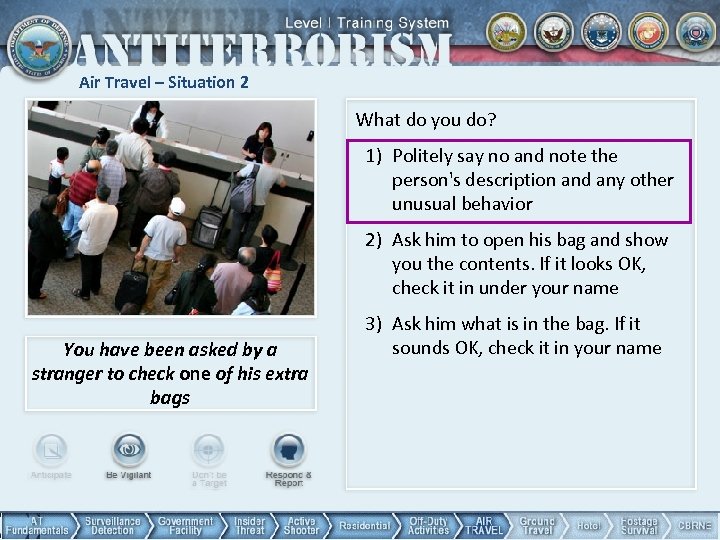 Air Travel – Situation 2 What do you do? 1) Politely say no and note the person's description and any other unusual behavior 2) Ask him to open his bag and show you the contents. If it looks OK, check it in under your name You have been asked by a stranger to check one of his extra bags 3) Ask him what is in the bag. If it sounds OK, check it in your name 93
 Air Travel Quiz 1 In the event of a skyjacking, you should immediately attempt to subdue the skyjackers. True False Air travel quiz question one 94
 Air Travel Quiz 2 The ticketing area is more secure than the area beyond the security check point. True False Air travel quiz question two 95
 Air Travel Quiz 3 Since 9/11, which of the following attack methods has not been attempted against an airport or airline? 1) Small-arms attack 2) VBIED 3) Explosive carried onboard by passenger Air travel quiz question three 4) Chemical or biological attack 5) Skyjacking for purpose of taking hostages 96
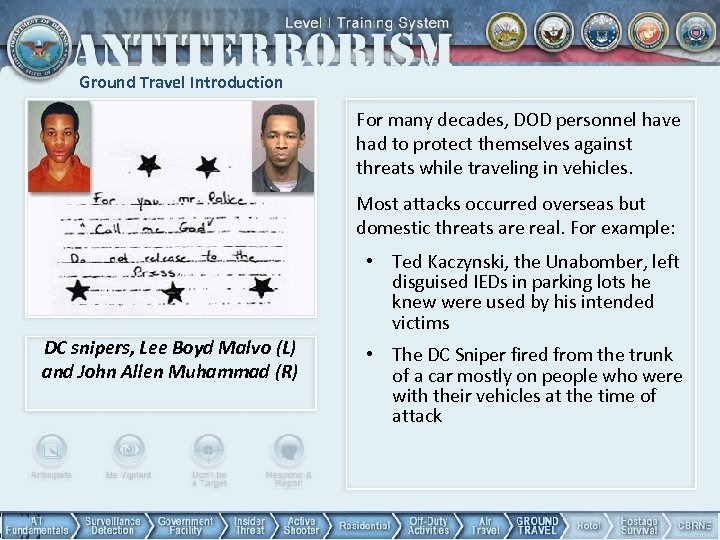 Ground Travel Introduction For many decades, DOD personnel have had to protect themselves against threats while traveling in vehicles. Most attacks occurred overseas but domestic threats are real. For example: • Ted Kaczynski, the Unabomber, left disguised IEDs in parking lots he knew were used by his intended victims DC snipers, Lee Boyd Malvo (L) and John Allen Muhammad (R) • The DC Sniper fired from the trunk of a car mostly on people who were with their vehicles at the time of attack 97
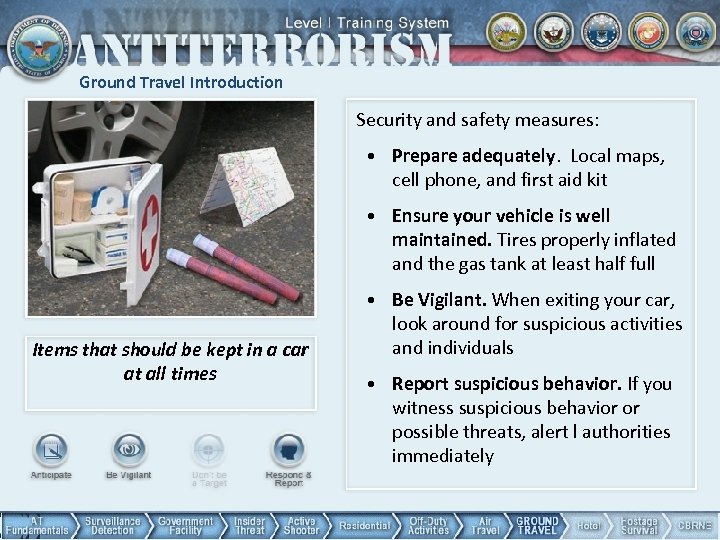 Ground Travel Introduction Security and safety measures: • Prepare adequately. Local maps, cell phone, and first aid kit • Ensure your vehicle is well maintained. Tires properly inflated and the gas tank at least half full Items that should be kept in a car at all times • Be Vigilant. When exiting your car, look around for suspicious activities and individuals • Report suspicious behavior. If you witness suspicious behavior or possible threats, alert l authorities immediately 98
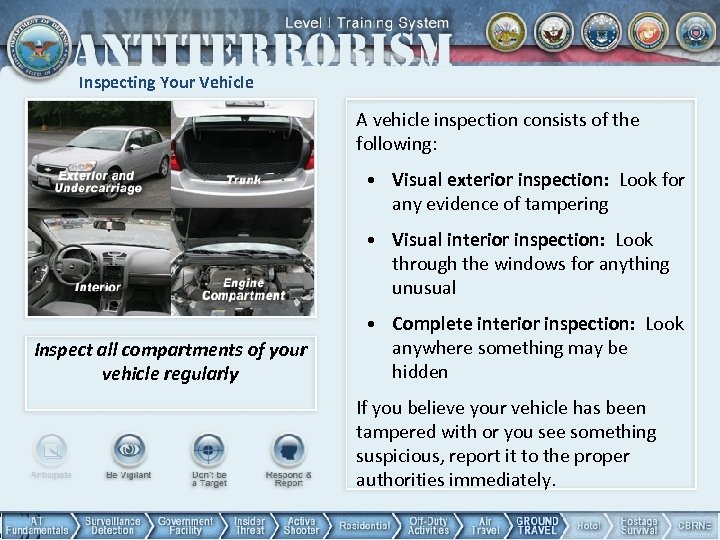 Inspecting Your Vehicle A vehicle inspection consists of the following: • Visual exterior inspection: Look for any evidence of tampering • Visual interior inspection: Look through the windows for anything unusual Inspect all compartments of your vehicle regularly • Complete interior inspection: Look anywhere something may be hidden If you believe your vehicle has been tampered with or you see something suspicious, report it to the proper authorities immediately. 99
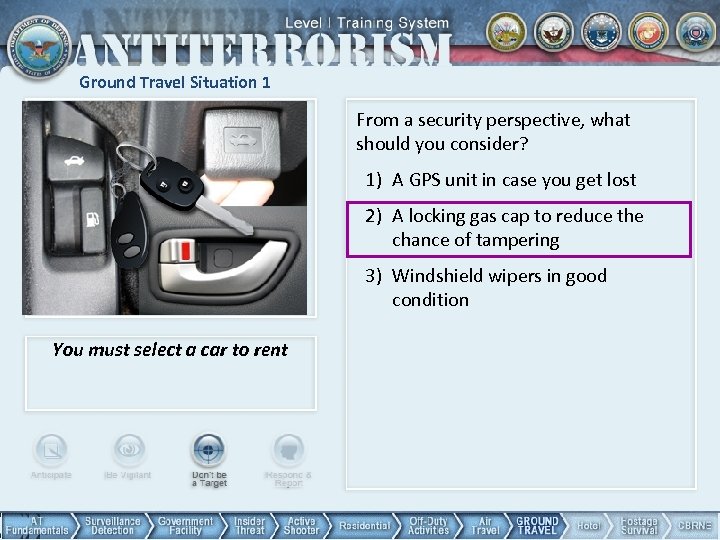 Ground Travel Situation 1 From a security perspective, what should you consider? 1) A GPS unit in case you get lost 2) A locking gas cap to reduce the chance of tampering 3) Windshield wipers in good condition You must select a car to rent 100
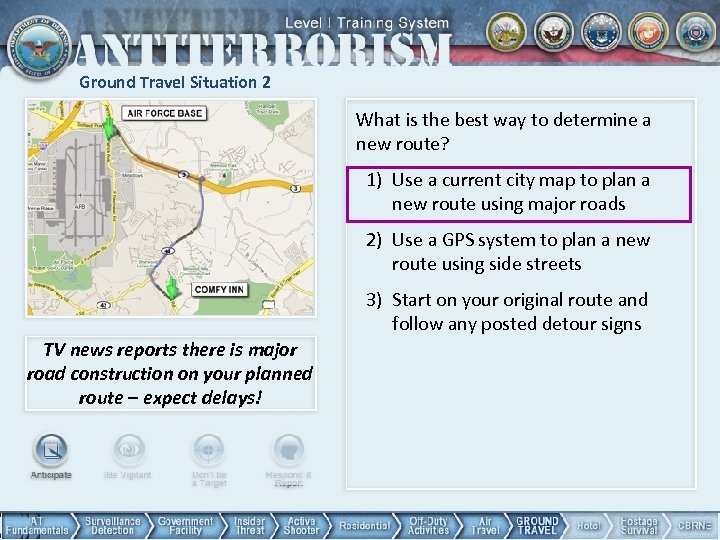 Ground Travel Situation 2 What is the best way to determine a new route? 1) Use a current city map to plan a new route using major roads 2) Use a GPS system to plan a new route using side streets 3) Start on your original route and follow any posted detour signs TV news reports there is major road construction on your planned route – expect delays! 101
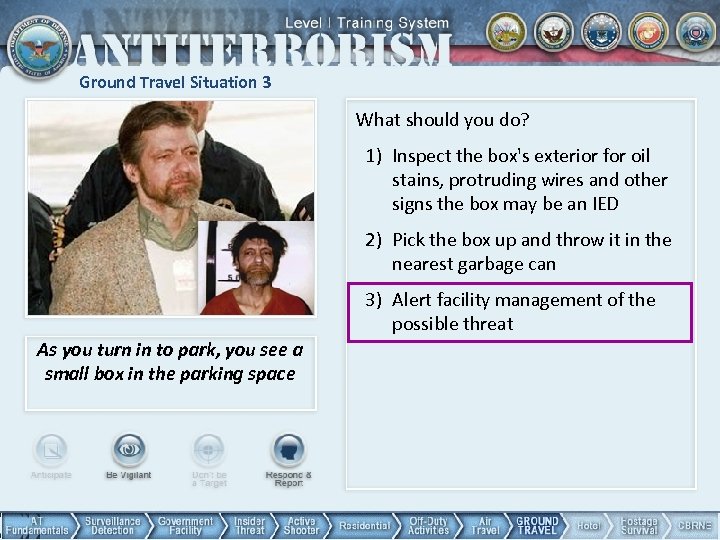 Ground Travel Situation 3 What should you do? 1) Inspect the box's exterior for oil stains, protruding wires and other signs the box may be an IED 2) Pick the box up and throw it in the nearest garbage can 3) Alert facility management of the possible threat As you turn in to park, you see a small box in the parking space 102
 Ground Travel Quiz 1 Keeping a well maintained vehicle is considered a "best practice" from both a security and safety perspective. True False Ground travel quiz question number one 103
 Ground Travel Quiz 2 When possible, it is best to always travel with a cell phone. True False Ground travel quiz question number two 104
 Ground Travel Quiz 3 Which of the following is not a useful vehicle feature from a security perspective? 1) Power locks 2) Air bags 3) Power Windows 4) Internal hood release lever Ground travel quiz question number three 5) Lock on gas cap 105
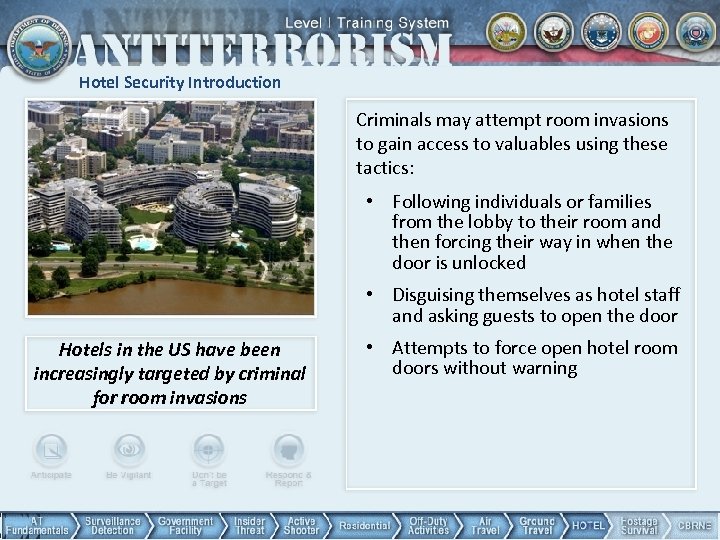 Hotel Security Introduction Criminals may attempt room invasions to gain access to valuables using these tactics: • Following individuals or families from the lobby to their room and then forcing their way in when the door is unlocked • Disguising themselves as hotel staff and asking guests to open the door Hotels in the US have been increasingly targeted by criminal for room invasions • Attempts to force open hotel room doors without warning 106
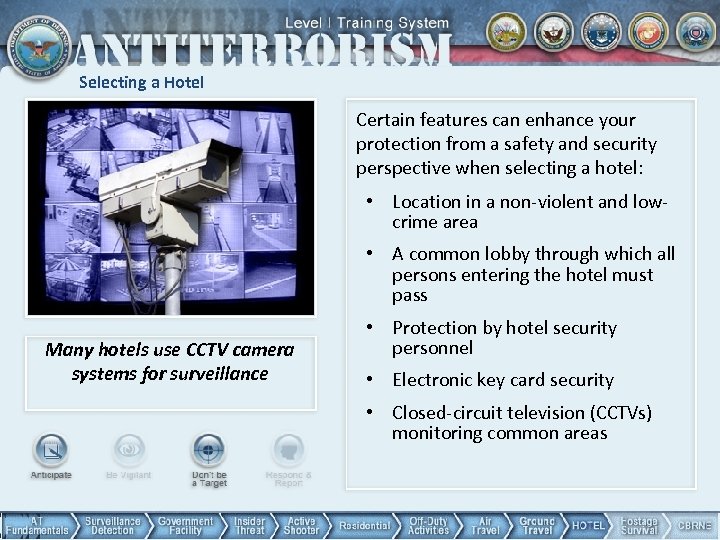 Selecting a Hotel Certain features can enhance your protection from a safety and security perspective when selecting a hotel: • Location in a non-violent and lowcrime area • A common lobby through which all persons entering the hotel must pass Many hotels use CCTV camera systems for surveillance • Protection by hotel security personnel • Electronic key card security • Closed-circuit television (CCTVs) monitoring common areas 107
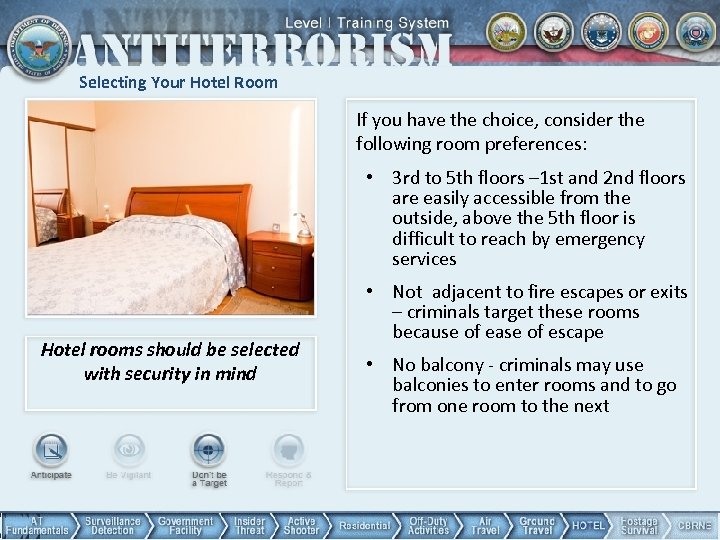 Selecting Your Hotel Room If you have the choice, consider the following room preferences: • 3 rd to 5 th floors – 1 st and 2 nd floors are easily accessible from the outside, above the 5 th floor is difficult to reach by emergency services Hotel rooms should be selected with security in mind • Not adjacent to fire escapes or exits – criminals target these rooms because of ease of escape • No balcony - criminals may use balconies to enter rooms and to go from one room to the next 108
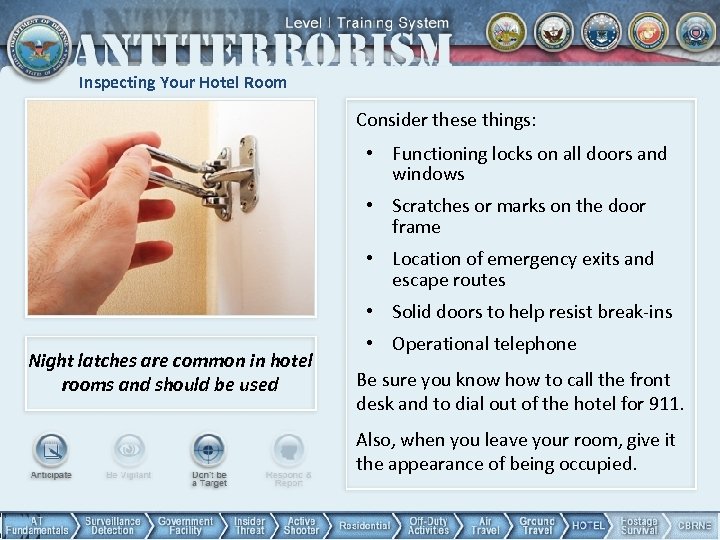 Inspecting Your Hotel Room Consider these things: • Functioning locks on all doors and windows • Scratches or marks on the door frame • Location of emergency exits and escape routes • Solid doors to help resist break-ins Night latches are common in hotel rooms and should be used • Operational telephone Be sure you know how to call the front desk and to dial out of the hotel for 911. Also, when you leave your room, give it the appearance of being occupied. 109
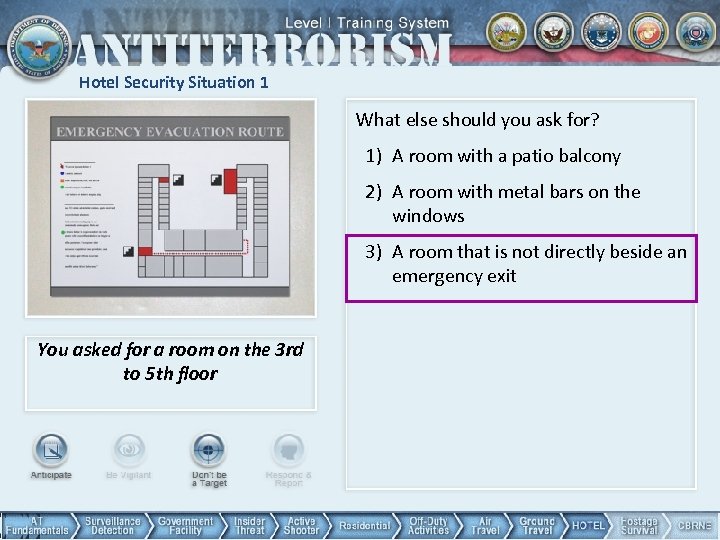 Hotel Security Situation 1 What else should you ask for? 1) A room with a patio balcony 2) A room with metal bars on the windows 3) A room that is not directly beside an emergency exit You asked for a room on the 3 rd to 5 th floor 110
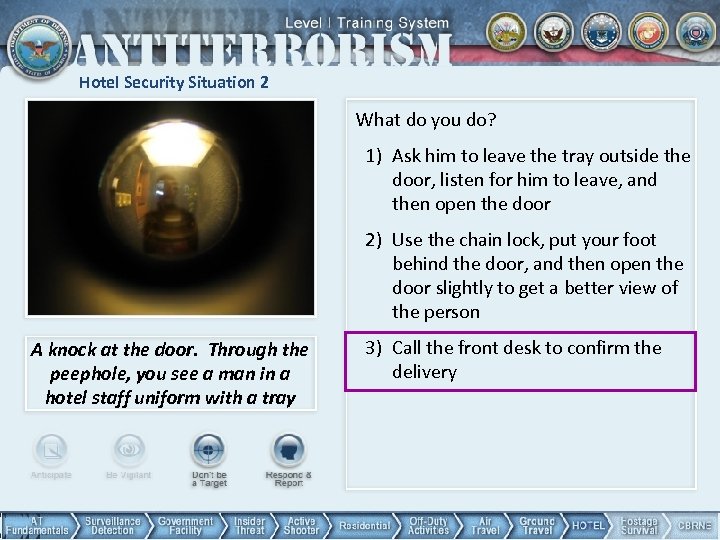 Hotel Security Situation 2 What do you do? 1) Ask him to leave the tray outside the door, listen for him to leave, and then open the door 2) Use the chain lock, put your foot behind the door, and then open the door slightly to get a better view of the person A knock at the door. Through the peephole, you see a man in a hotel staff uniform with a tray 3) Call the front desk to confirm the delivery 111
 Hotel Security Quiz 1 Room invasions are a significant security issue for hotels located in CONUS. True False Hotel security quiz question one 112
 Hotel Security Quiz 2 From a security perspective, the best rooms are directly next to emergency exits. True False Hotel security quiz question two 113
 Hotel Security Quiz 3 What is not a physical security feature you should check when inspecting your hotel room? 1) Lockbox or safe 2) Functioning locks on doors and windows 3) Whether or not the door is solid Hotel security quiz question three 4) Operational telephone 5) Proximity of room to emergency exits 114
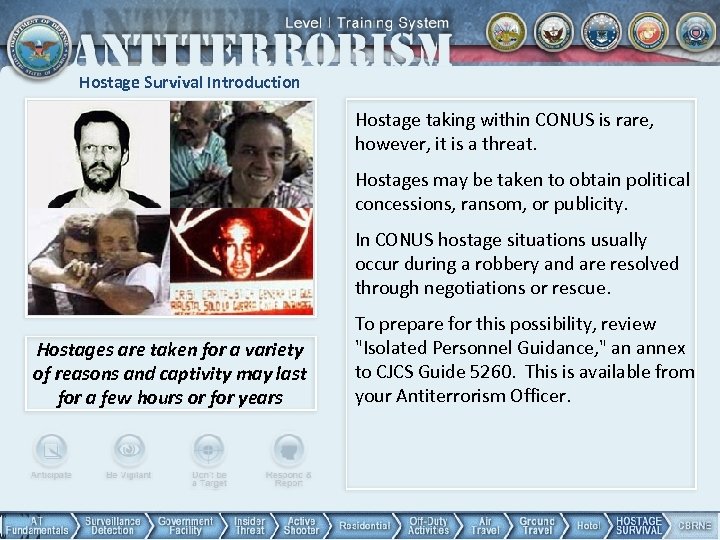 Hostage Survival Introduction Hostage taking within CONUS is rare, however, it is a threat. Hostages may be taken to obtain political concessions, ransom, or publicity. In CONUS hostage situations usually occur during a robbery and are resolved through negotiations or rescue. Hostages are taken for a variety of reasons and captivity may last for a few hours or for years To prepare for this possibility, review "Isolated Personnel Guidance, " an annex to CJCS Guide 5260. This is available from your Antiterrorism Officer. 115
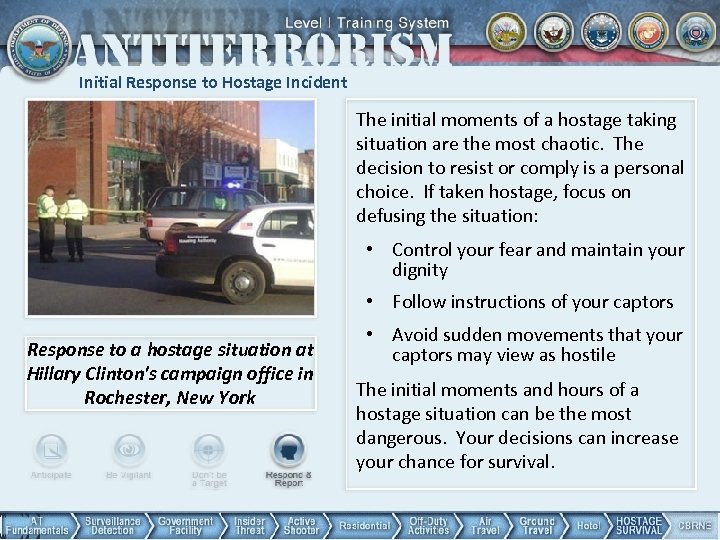 Initial Response to Hostage Incident The initial moments of a hostage taking situation are the most chaotic. The decision to resist or comply is a personal choice. If taken hostage, focus on defusing the situation: • Control your fear and maintain your dignity • Follow instructions of your captors Response to a hostage situation at Hillary Clinton's campaign office in Rochester, New York • Avoid sudden movements that your captors may view as hostile The initial moments and hours of a hostage situation can be the most dangerous. Your decisions can increase your chance for survival. 116
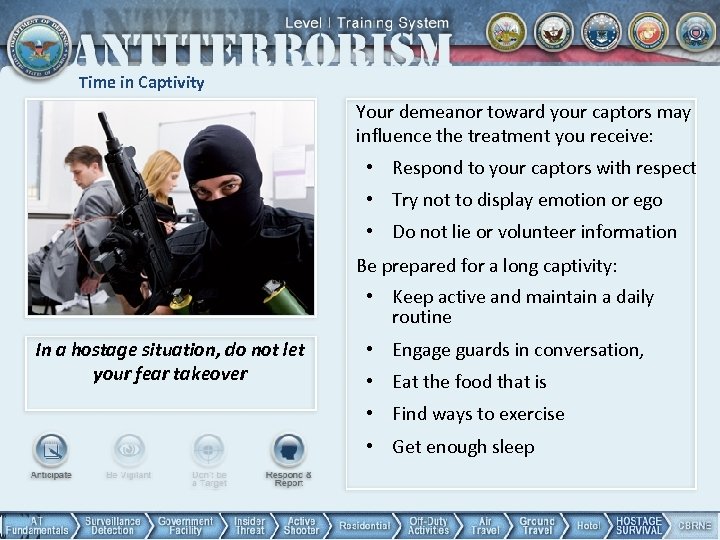 Time in Captivity Your demeanor toward your captors may influence the treatment you receive: • Respond to your captors with respect • Try not to display emotion or ego • Do not lie or volunteer information Be prepared for a long captivity: • Keep active and maintain a daily routine In a hostage situation, do not let your fear takeover • Engage guards in conversation, • Eat the food that is • Find ways to exercise • Get enough sleep 117
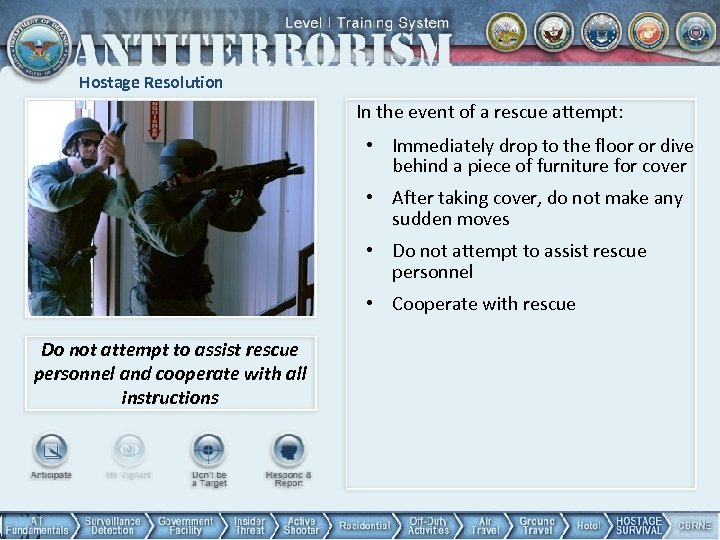 Hostage Resolution In the event of a rescue attempt: • Immediately drop to the floor or dive behind a piece of furniture for cover • After taking cover, do not make any sudden moves • Do not attempt to assist rescue personnel • Cooperate with rescue Do not attempt to assist rescue personnel and cooperate with all instructions 118
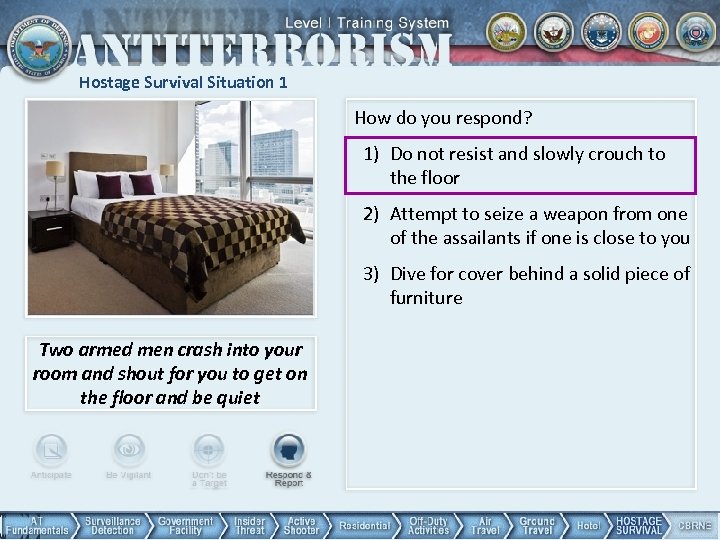 Hostage Survival Situation 1 How do you respond? 1) Do not resist and slowly crouch to the floor 2) Attempt to seize a weapon from one of the assailants if one is close to you 3) Dive for cover behind a solid piece of furniture Two armed men crash into your room and shout for you to get on the floor and be quiet 119
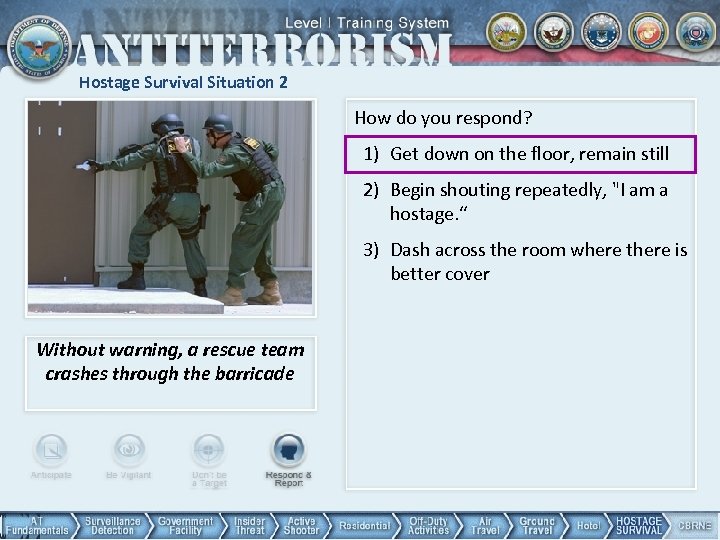 Hostage Survival Situation 2 How do you respond? 1) Get down on the floor, remain still 2) Begin shouting repeatedly, "I am a hostage. “ 3) Dash across the room where there is better cover Without warning, a rescue team crashes through the barricade 120
 Hostage Survival Quiz 1 Reasons for acquiring hostages include publicity, use as a bargaining chip while executing other crimes, the forcing of political concessions, and ransom. True False Hostage survival quiz question one 121
 Hostage Survival Quiz 2 The initial moments of a hostage taking incident can be extremely dangerous. True False Hostage survival quiz question two 122
 Hostage Survival Quiz 3 What should you not do during a hostage rescue attempt? 1) Remain still and low to the ground 2) Encourage others around you to remain calm 3) Try to assist hostage rescue team Hostage survival quiz question three 4) Follow instructions of hostage rescue team 5) Expect to be handcuffed and detained by hostage rescue team 123
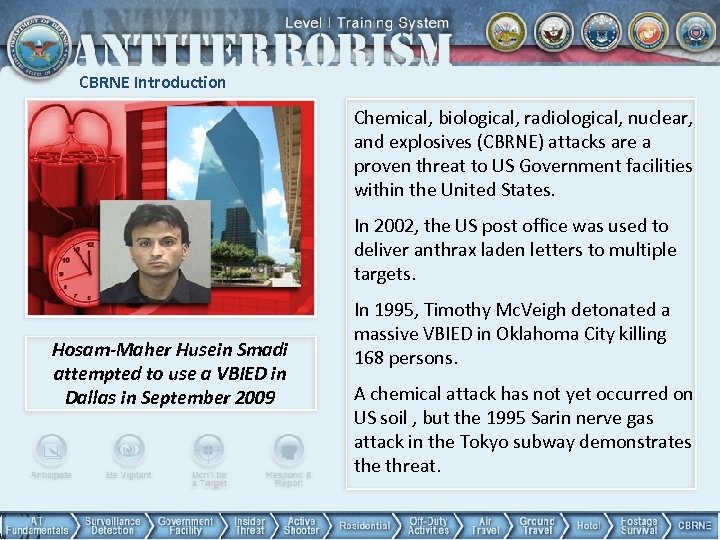 CBRNE Introduction Chemical, biological, radiological, nuclear, and explosives (CBRNE) attacks are a proven threat to US Government facilities within the United States. In 2002, the US post office was used to deliver anthrax laden letters to multiple targets. Hosam-Maher Husein Smadi attempted to use a VBIED in Dallas in September 2009 In 1995, Timothy Mc. Veigh detonated a massive VBIED in Oklahoma City killing 168 persons. A chemical attack has not yet occurred on US soil , but the 1995 Sarin nerve gas attack in the Tokyo subway demonstrates the threat. 124
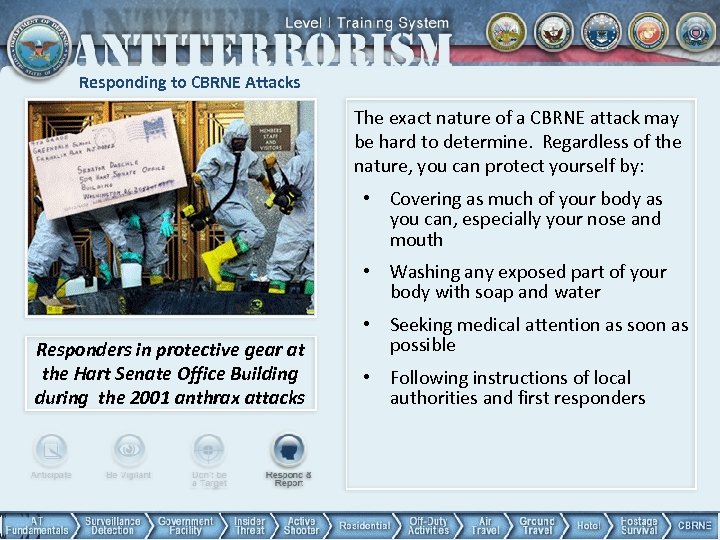 Responding to CBRNE Attacks The exact nature of a CBRNE attack may be hard to determine. Regardless of the nature, you can protect yourself by: • Covering as much of your body as you can, especially your nose and mouth • Washing any exposed part of your body with soap and water Responders in protective gear at the Hart Senate Office Building during the 2001 anthrax attacks • Seeking medical attention as soon as possible • Following instructions of local authorities and first responders 125
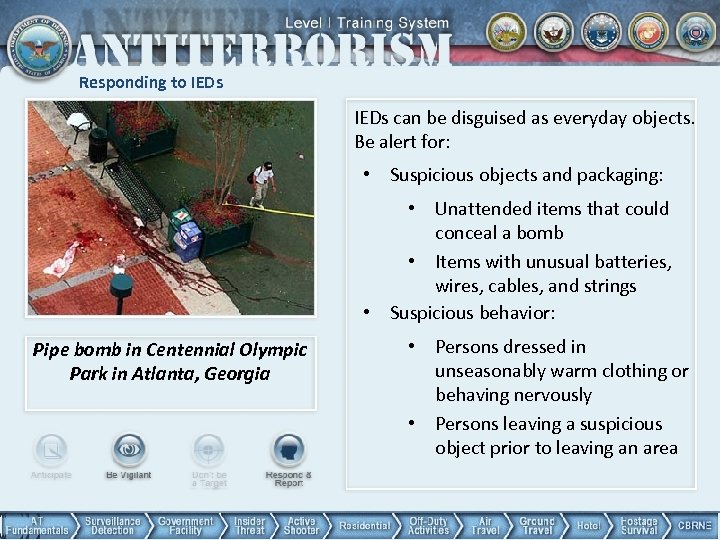 Responding to IEDs can be disguised as everyday objects. Be alert for: • Suspicious objects and packaging: • Unattended items that could conceal a bomb • Items with unusual batteries, wires, cables, and strings • Suspicious behavior: Pipe bomb in Centennial Olympic Park in Atlanta, Georgia • Persons dressed in unseasonably warm clothing or behaving nervously • Persons leaving a suspicious object prior to leaving an area 126
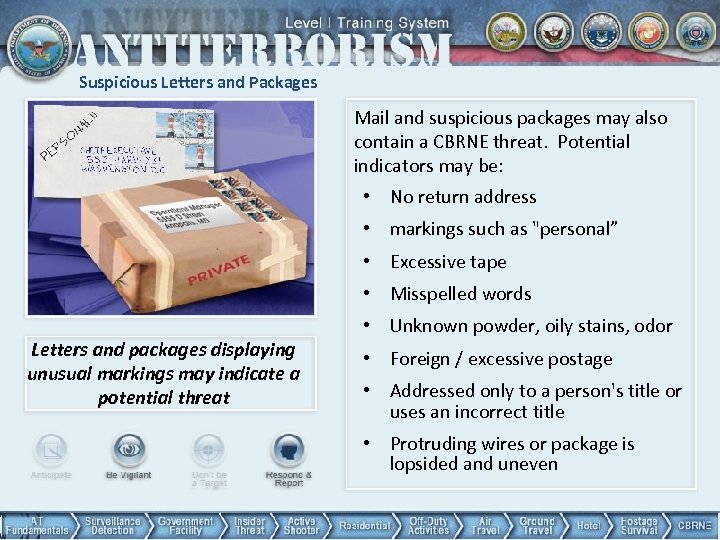 Suspicious Letters and Packages Mail and suspicious packages may also contain a CBRNE threat. Potential indicators may be: • No return address • markings such as "personal” • Excessive tape • Misspelled words Letters and packages displaying unusual markings may indicate a potential threat • Unknown powder, oily stains, odor • Foreign / excessive postage • Addressed only to a person's title or uses an incorrect title • Protruding wires or package is lopsided and uneven 127
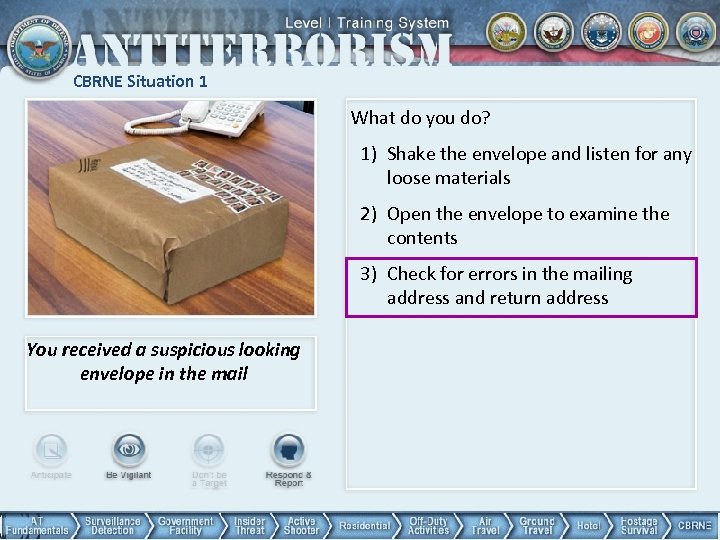 CBRNE Situation 1 What do you do? 1) Shake the envelope and listen for any loose materials 2) Open the envelope to examine the contents 3) Check for errors in the mailing address and return address You received a suspicious looking envelope in the mail 128
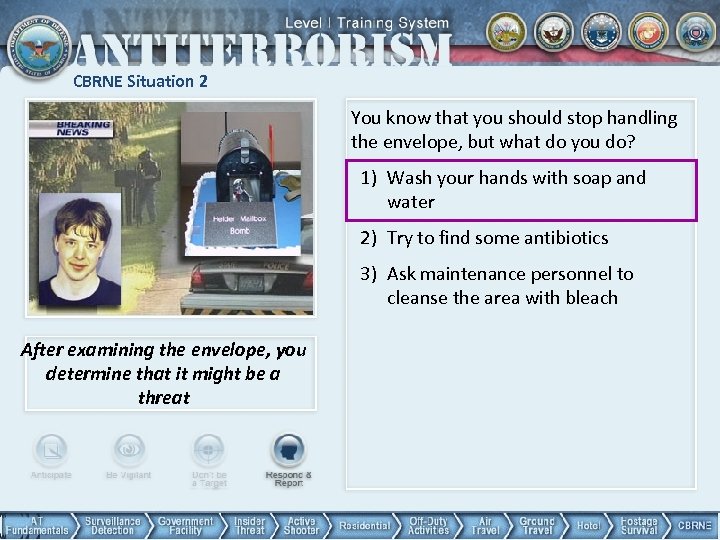 CBRNE Situation 2 You know that you should stop handling the envelope, but what do you do? 1) Wash your hands with soap and water 2) Try to find some antibiotics 3) Ask maintenance personnel to cleanse the area with bleach After examining the envelope, you determine that it might be a threat 129
 CBRNE Quiz 1 Early symptoms of a biological attack may appear the same as common illnesses. True False CBRNE quiz question one 130
 CBRNE Quiz 2 IEDs may come in many forms and may be camouflaged to blend in to the surrounding environment. True False CBRNE quiz question two 131
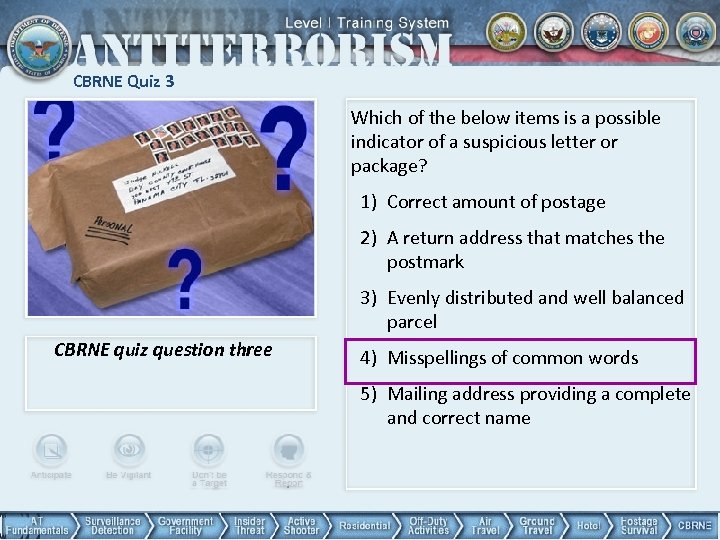 CBRNE Quiz 3 Which of the below items is a possible indicator of a suspicious letter or package? 1) Correct amount of postage 2) A return address that matches the postmark 3) Evenly distributed and well balanced parcel CBRNE quiz question three 4) Misspellings of common words 5) Mailing address providing a complete and correct name 132
 Section 3: Historical Examples 133
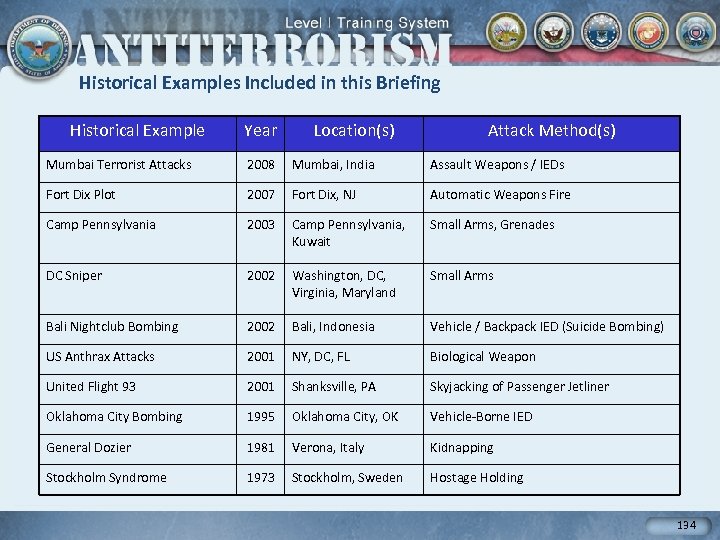 Historical Examples Included in this Briefing Historical Example Year Location(s) Attack Method(s) Mumbai Terrorist Attacks 2008 Mumbai, India Assault Weapons / IEDs Fort Dix Plot 2007 Fort Dix, NJ Automatic Weapons Fire Camp Pennsylvania 2003 Camp Pennsylvania, Kuwait Small Arms, Grenades DC Sniper 2002 Washington, DC, Virginia, Maryland Small Arms Bali Nightclub Bombing 2002 Bali, Indonesia Vehicle / Backpack IED (Suicide Bombing) US Anthrax Attacks 2001 NY, DC, FL Biological Weapon United Flight 93 2001 Shanksville, PA Skyjacking of Passenger Jetliner Oklahoma City Bombing 1995 Oklahoma City, OK Vehicle-Borne IED General Dozier 1981 Verona, Italy Kidnapping Stockholm Syndrome 1973 Stockholm, Sweden Hostage Holding 134
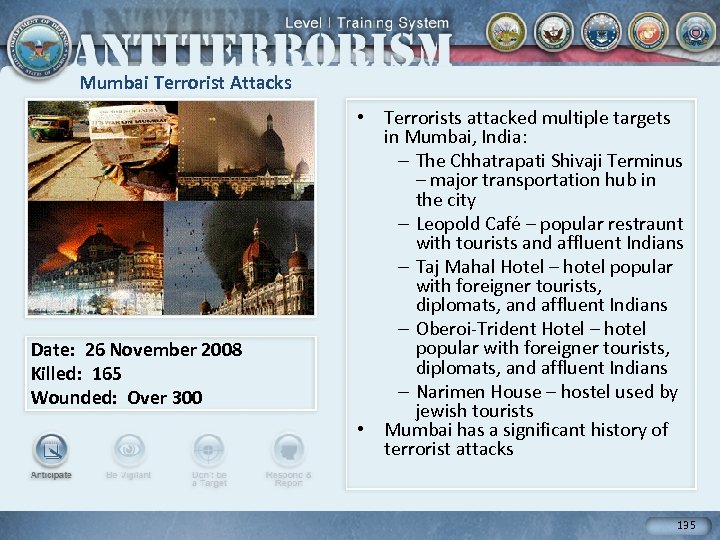 Mumbai Terrorist Attacks Date: 26 November 2008 Killed: 165 Wounded: Over 300 • Terrorists attacked multiple targets in Mumbai, India: – The Chhatrapati Shivaji Terminus – major transportation hub in the city – Leopold Café – popular restraunt with tourists and affluent Indians – Taj Mahal Hotel – hotel popular with foreigner tourists, diplomats, and affluent Indians – Oberoi-Trident Hotel – hotel popular with foreigner tourists, diplomats, and affluent Indians – Narimen House – hostel used by jewish tourists • Mumbai has a significant history of terrorist attacks 135
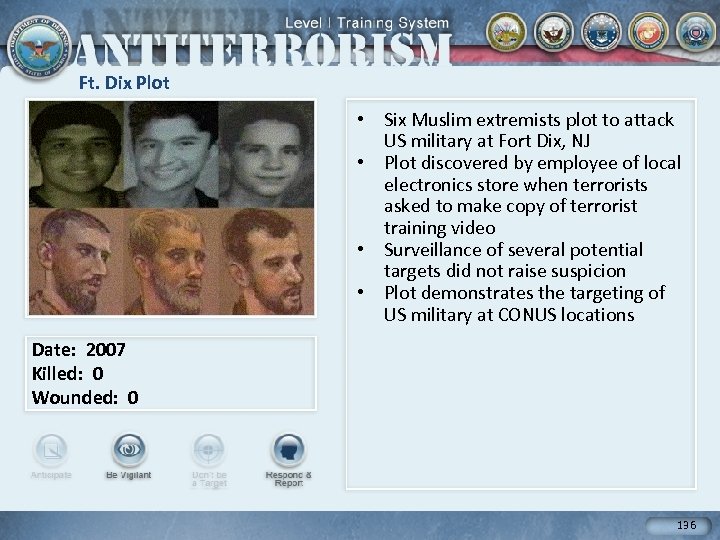 Ft. Dix Plot • Six Muslim extremists plot to attack US military at Fort Dix, NJ • Plot discovered by employee of local electronics store when terrorists asked to make copy of terrorist training video • Surveillance of several potential targets did not raise suspicion • Plot demonstrates the targeting of US military at CONUS locations Date: 2007 Killed: 0 Wounded: 0 136
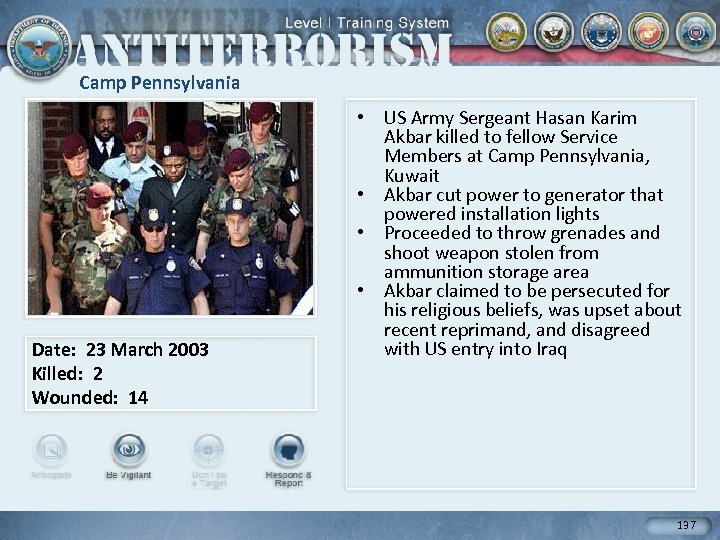 Camp Pennsylvania Date: 23 March 2003 Killed: 2 Wounded: 14 • US Army Sergeant Hasan Karim Akbar killed to fellow Service Members at Camp Pennsylvania, Kuwait • Akbar cut power to generator that powered installation lights • Proceeded to throw grenades and shoot weapon stolen from ammunition storage area • Akbar claimed to be persecuted for his religious beliefs, was upset about recent reprimand, and disagreed with US entry into Iraq 137
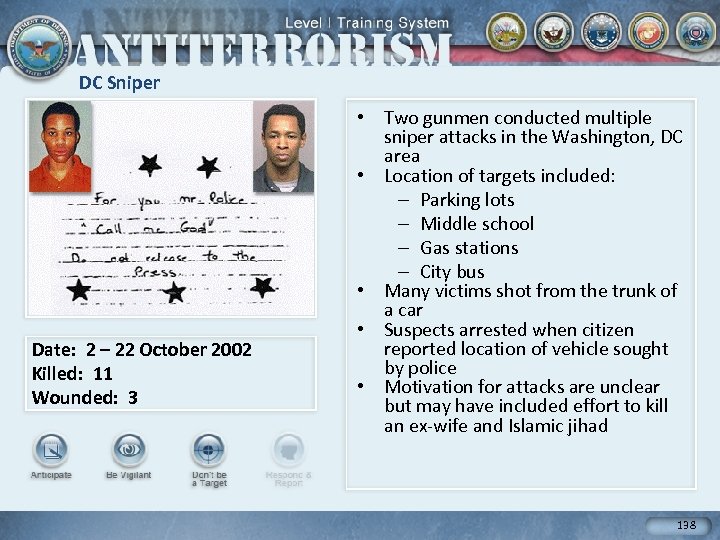 DC Sniper Date: 2 – 22 October 2002 Killed: 11 Wounded: 3 • Two gunmen conducted multiple sniper attacks in the Washington, DC area • Location of targets included: – Parking lots – Middle school – Gas stations – City bus • Many victims shot from the trunk of a car • Suspects arrested when citizen reported location of vehicle sought by police • Motivation for attacks are unclear but may have included effort to kill an ex-wife and Islamic jihad 138
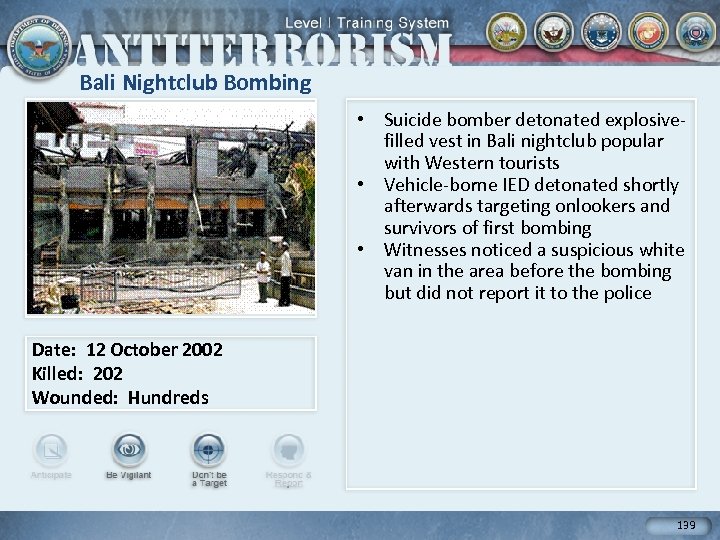 Bali Nightclub Bombing • Suicide bomber detonated explosivefilled vest in Bali nightclub popular with Western tourists • Vehicle-borne IED detonated shortly afterwards targeting onlookers and survivors of first bombing • Witnesses noticed a suspicious white van in the area before the bombing but did not report it to the police Date: 12 October 2002 Killed: 202 Wounded: Hundreds 139
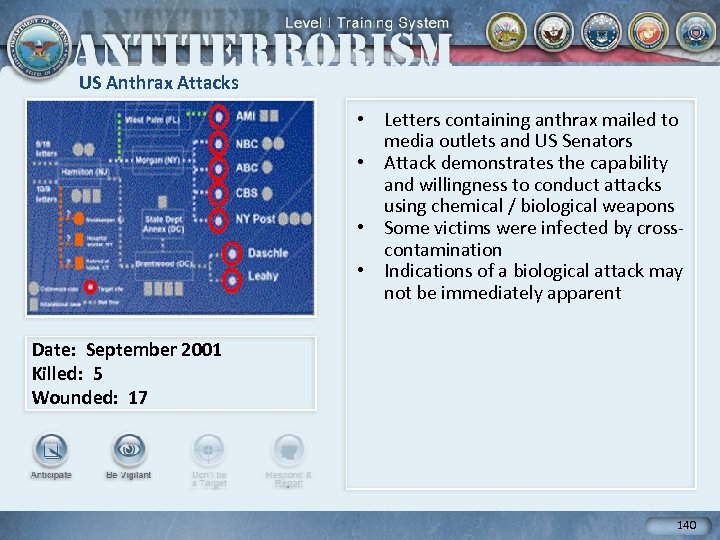 US Anthrax Attacks • Letters containing anthrax mailed to media outlets and US Senators • Attack demonstrates the capability and willingness to conduct attacks using chemical / biological weapons • Some victims were infected by crosscontamination • Indications of a biological attack may not be immediately apparent Date: September 2001 Killed: 5 Wounded: 17 140
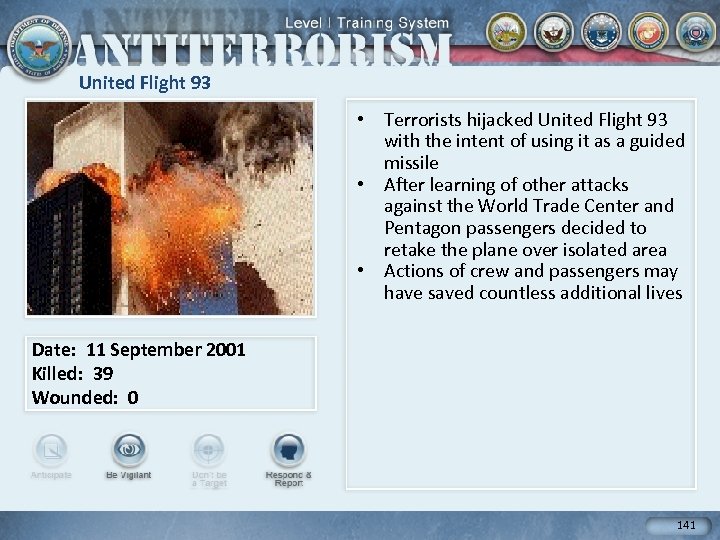 United Flight 93 • Terrorists hijacked United Flight 93 with the intent of using it as a guided missile • After learning of other attacks against the World Trade Center and Pentagon passengers decided to retake the plane over isolated area • Actions of crew and passengers may have saved countless additional lives Date: 11 September 2001 Killed: 39 Wounded: 0 141
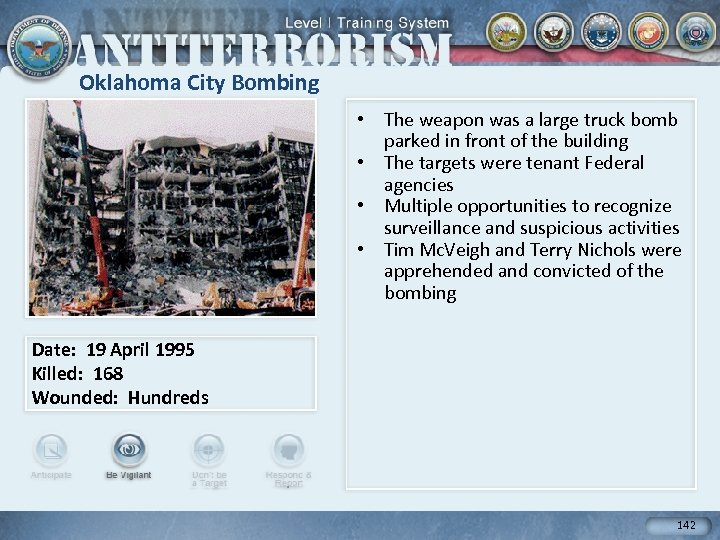 Oklahoma City Bombing • The weapon was a large truck bomb parked in front of the building • The targets were tenant Federal agencies • Multiple opportunities to recognize surveillance and suspicious activities • Tim Mc. Veigh and Terry Nichols were apprehended and convicted of the bombing Date: 19 April 1995 Killed: 168 Wounded: Hundreds 142
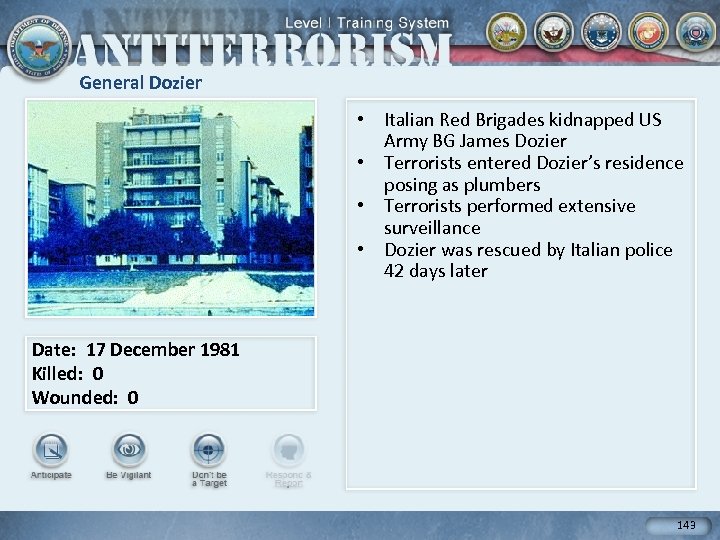 General Dozier • Italian Red Brigades kidnapped US Army BG James Dozier • Terrorists entered Dozier’s residence posing as plumbers • Terrorists performed extensive surveillance • Dozier was rescued by Italian police 42 days later Date: 17 December 1981 Killed: 0 Wounded: 0 143
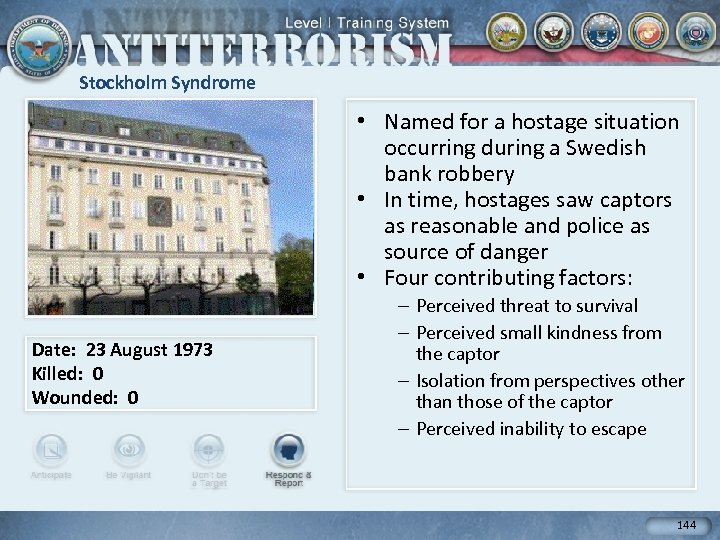 Stockholm Syndrome • Named for a hostage situation occurring during a Swedish bank robbery • In time, hostages saw captors as reasonable and police as source of danger • Four contributing factors: Date: 23 August 1973 Killed: 0 Wounded: 0 – Perceived threat to survival – Perceived small kindness from the captor – Isolation from perspectives other than those of the captor – Perceived inability to escape 144