 Скачать презентацию Department of Communication Systems Engineering Ben Gurion University
328307342965ecfe4a00287592cced93.ppt
- Количество слайдов: 15



Department of Communication Systems Engineering Ben Gurion University of the Negev Be’er-Sheva, Israel Multi-User Client Server Application over Bluetooth Piconet MCSBT Students : Himan Asaf &Roei Attias Supervisor: Dr. Chen Avin
Motivation • In the last few years the number of Bluetooth devices has grown up, almost in every portable device we can see a Bluetooth devices. • Still One of the main problems of this network is the opportunity to create a multi user network. • The multi user network can skip a lot of Physical imitations, which can open new commercials opportunity for it.
Bluetooth, Why ? • • Free! Portable and Common (cell phone …). Commercial Potential. Physical Properties: – Low Power consumption (0 – 20 dbm) – Minimum interferences (FH-SS – 79 Channels). – High rate data transfer (400 -700 Kbit/s).

Problem Definition • Develop a Client-Server application that extend Bluetooth protocol to support a large number of clients at a large range (by multi hop rooting) as well as client mobility. • Today status – only Piconet. • Future Develop – Scaternet.
Project’s Goal Develop an ad-hoc Client-Server application base on Bluetooth protocol which will support Multi hop communication. • • Large clients number Large physical range. Client mobility. Low energy consumption.
Solution Outline Step 1: Study the Bluetooth protocol. • Understanding the Bluetooth Physical limits. • Application Layer. Step 2: Develop program algorithm. • Defining network structure. • Defining protocol message structure. • Analyze all the “edge” cases. Step 3: Implement algorithm. • Implement multi user connection. • Develop publisher server. • Support mobility. Step 4: Experiment at network.
Design Outlines • 3 main network components : • D. S - Data Server – The Data. • P. S - Publisher server – The “Trigger”. • M. S – Client – Edge Unit.
Network Structure - Publisher Server- trigger MS according to it’s physical distance. • “wake up” according to the network area. • Publish Data server address. • MS Power save – MS “sleep” until receive a publisher message.
Network Structure – D. S Data Server (D. S) • • Simple file server. Unique MAC address. Transparency replay. Unreliable data transport. • Current implementation– FTP server.
Network Structure – M. S Client – MS. • • Most of the logic. Mobility support – “still alive message” Inactive – power save. Routing – • Routing table – shortest path. • Hold several path to D. S. • “Next hop” routing. • Current implementation– FTP client.
Network Structure – M. S Client – (continue). • Two operational mode, live together : – Message mode. • Reliable data transport – Time-out Mechanism. – ARQ. – Stop & wait. – Relay mode • Relay message to the next hop. • Unreliable data transport.
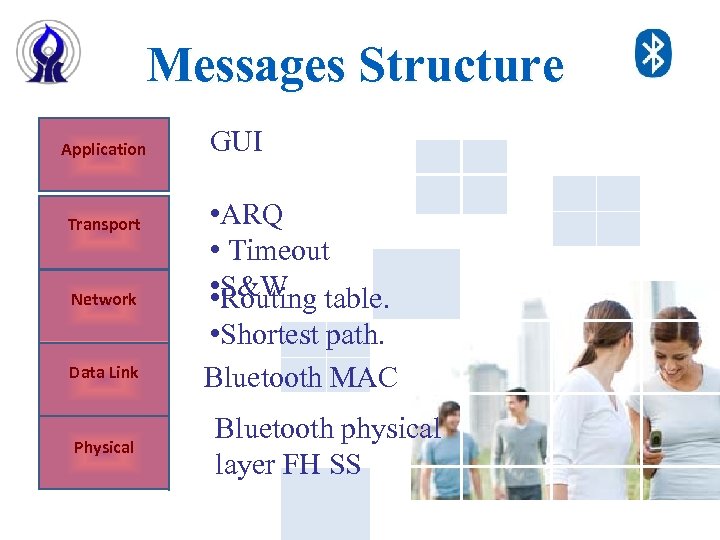
Messages Structure Application Transport Network Data Link Physical GUI • ARQ • Timeout • S&W table. • Routing • Shortest path. Bluetooth MAC Bluetooth physical layer FH SS
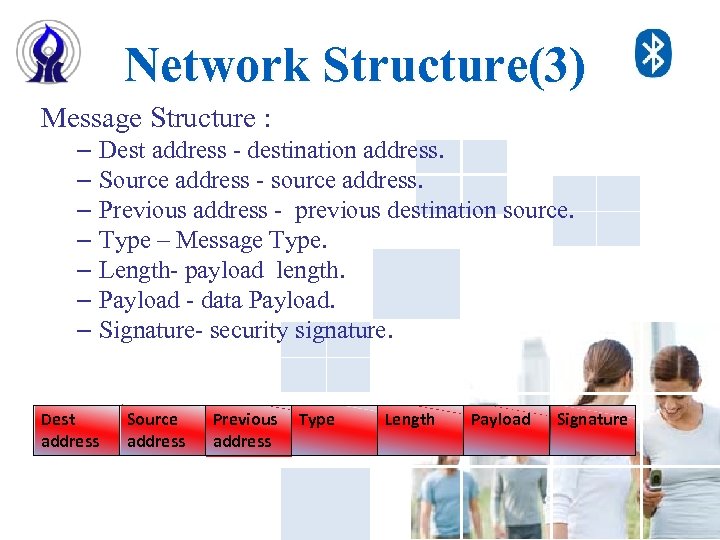
Network Structure(3) Message Structure : – – – – Dest address - destination address. Source address - source address. Previous address - previous destination source. Type – Message Type. Length- payload length. Payload - data Payload. Signature- security signature. Source address Previous address Type Length Payload Signature
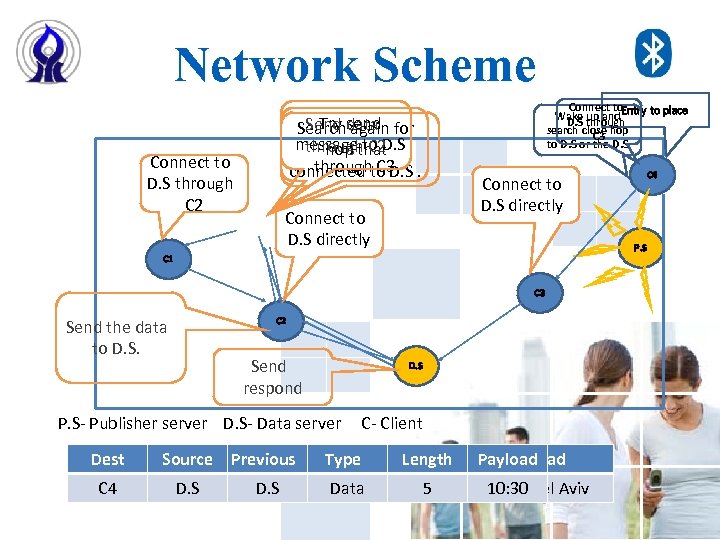
Network Scheme Try again Send send Searchdata for messagethat throughto D. S hop C 2 through C 3 connected to D. S. Connect to D. S through C 2 Connect to D. S directly Connect to. Entry to place Wake through D. S up and search close hop C 3 to D. S or the D. S Connect to D. S directly P. S C 1 C 3 Send the data to D. S. C 2 Send respond D. S P. S- Publisher server D. S- Data server Dest C 1/C 2 D. S C 3 C 4 Source Previous C 4 D. S P. S C 4 C 2 D. S P. S C 4 C- Client Type Data Search P. msg Data C 4 Length 15 15 --5 Payload Bus---to. Tel Aviv Busto Tel Aviv Bus to Tel Aviv 10: 30

The End -Q. A ?
Скачать презентацию Department of Communication Systems Engineering Ben Gurion University
328307342965ecfe4a00287592cced93.ppt