


 Скачать презентацию Department of Chemical Engineering University of Michigan Ann
8c6804376830dde957abf0b5bf6c4d43.ppt
- Количество слайдов: 32
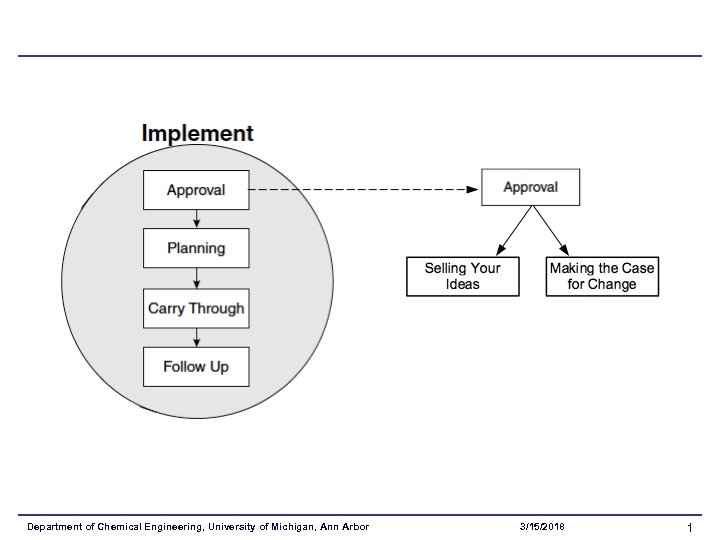 Department of Chemical Engineering, University of Michigan, Ann Arbor 3/15/2018 1
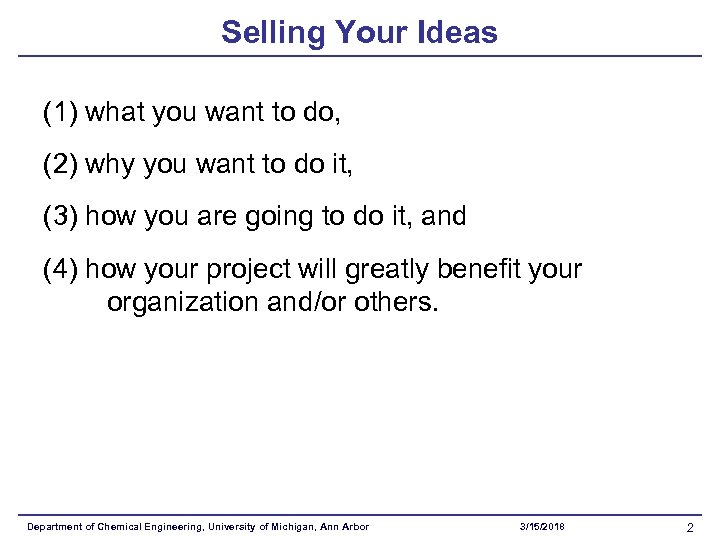 Selling Your Ideas (1) what you want to do, (2) why you want to do it, (3) how you are going to do it, and (4) how your project will greatly benefit your organization and/or others. Department of Chemical Engineering, University of Michigan, Ann Arbor 3/15/2018 2
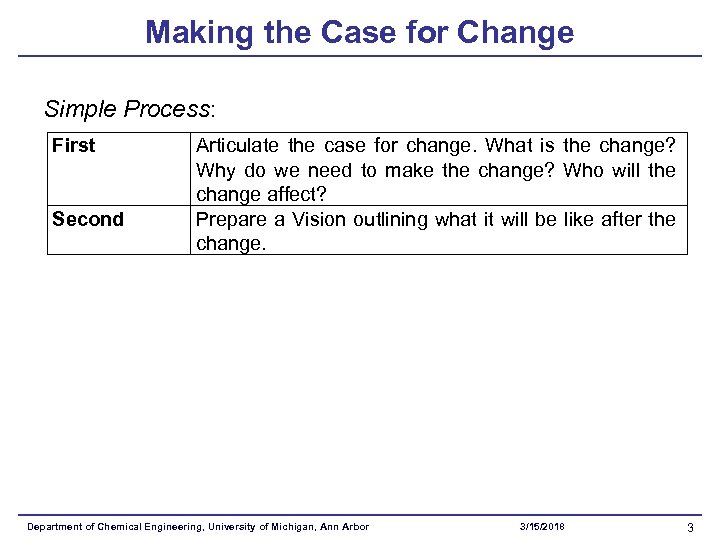 Making the Case for Change Simple Process: First Second Articulate the case for change. What is the change? Why do we need to make the change? Who will the change affect? Prepare a Vision outlining what it will be like after the change. Department of Chemical Engineering, University of Michigan, Ann Arbor 3/15/2018 3
 The Case for Change 4
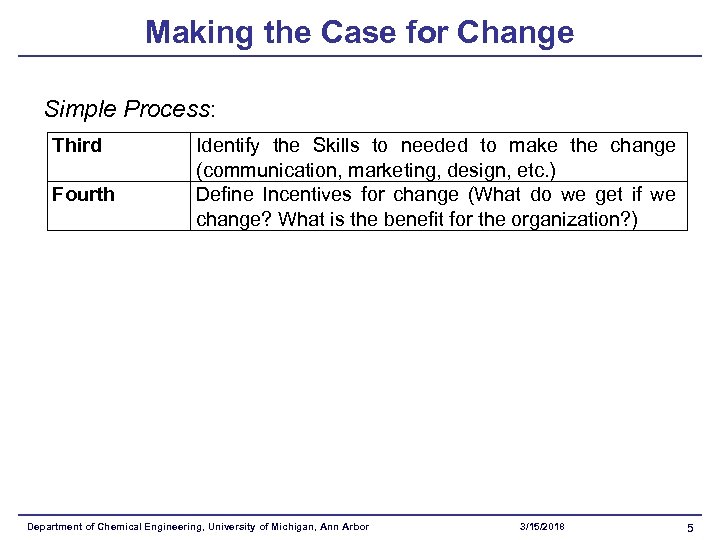 Making the Case for Change Simple Process: Third Fourth Identify the Skills to needed to make the change (communication, marketing, design, etc. ) Define Incentives for change (What do we get if we change? What is the benefit for the organization? ) Department of Chemical Engineering, University of Michigan, Ann Arbor 3/15/2018 5
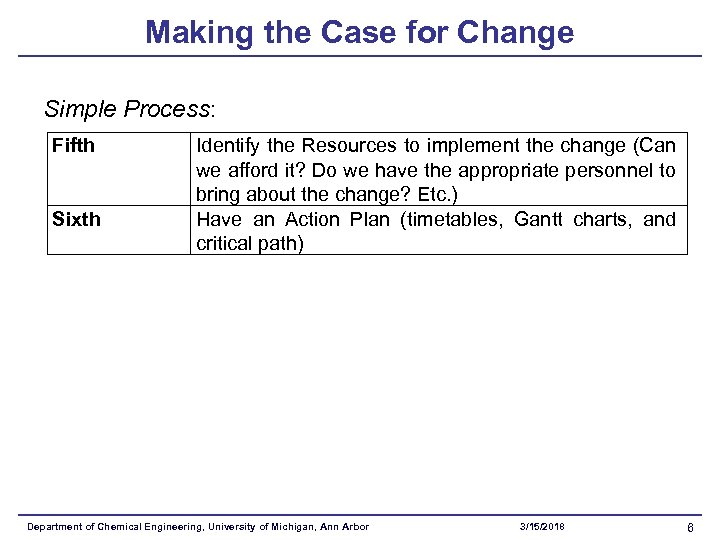 Making the Case for Change Simple Process: Fifth Sixth Identify the Resources to implement the change (Can we afford it? Do we have the appropriate personnel to bring about the change? Etc. ) Have an Action Plan (timetables, Gantt charts, and critical path) Department of Chemical Engineering, University of Michigan, Ann Arbor 3/15/2018 6
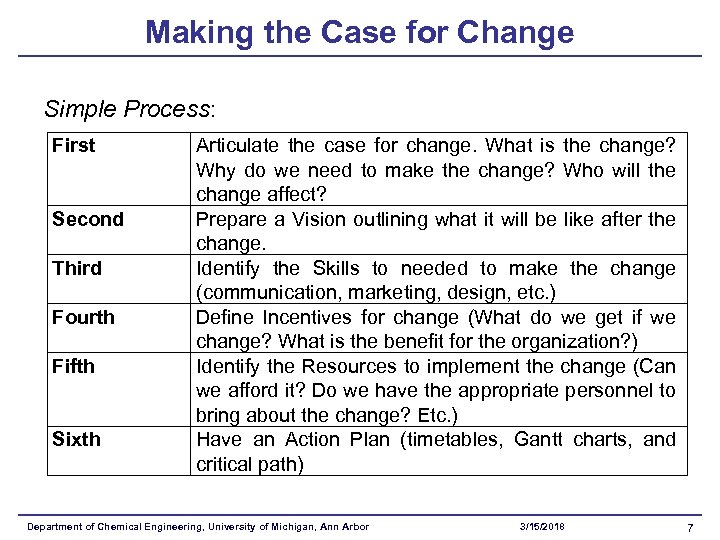 Making the Case for Change Simple Process: First Second Third Fourth Fifth Sixth Articulate the case for change. What is the change? Why do we need to make the change? Who will the change affect? Prepare a Vision outlining what it will be like after the change. Identify the Skills to needed to make the change (communication, marketing, design, etc. ) Define Incentives for change (What do we get if we change? What is the benefit for the organization? ) Identify the Resources to implement the change (Can we afford it? Do we have the appropriate personnel to bring about the change? Etc. ) Have an Action Plan (timetables, Gantt charts, and critical path) Department of Chemical Engineering, University of Michigan, Ann Arbor 3/15/2018 7
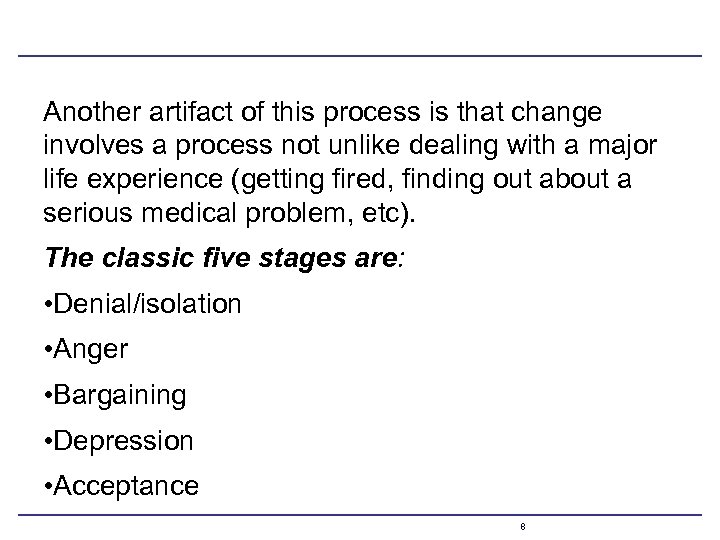 Another artifact of this process is that change involves a process not unlike dealing with a major life experience (getting fired, finding out about a serious medical problem, etc). The classic five stages are: • Denial/isolation • Anger • Bargaining • Depression • Acceptance 8
 What does this mean? • We need to think about addressing the missing elements in the change process - a better communication of the case for change and corresponding vision that is facilitated by the change. • I have found that when I have implemented major changes, communication is key (and if not done sufficiently, can result in the failure of the change I want to implement). We need to address the communication element • The 5 stages of mourning outlined above helps us to understand that many of the people impacted (Fellows) are at various stages. We can see that from the email traffic and we will need to accommodate this in our planning and communication. I have certainly seen evidence of the first 4 stages in the people I have talked to. 9
 Carry Through Checklist ü Make sure there is coordination of tasks and personnel. ü Constantly monitor your Gantt chart to make sure you stay on schedule. Department of Chemical Engineering, University of Michigan, Ann Arbor 3/15/2018 10
 Carry Through Checklist ü Continue to challenge and/or validate the assumptions of the chosen solution. ü Make sure no physical laws are violated. ü Make an educated guess about what your solution will look like when you are finished. Department of Chemical Engineering, University of Michigan, Ann Arbor 3/15/2018 11
 Carry Through Checklist ü Find the limits of your solution by creating simple models or making assumptions that would clearly both (1) overestimate the answer and (2) underestimate the answer. Department of Chemical Engineering, University of Michigan, Ann Arbor 3/15/2018 12
 Carry Through Checklist ü Construct a quick test or experiment to see whether the solution you have selected will work under the simplest conditions. ü Plan your computer experiments (i. e. , simulations) as carefully as you would plan your experiments in the laboratory. Department of Chemical Engineering, University of Michigan, Ann Arbor 3/15/2018 13
 Carry Through Checklist ü Evaluate each completed task along the way. ü Continue to learn as much as you can about the solution you have chosen. Read the literature and talk to your colleagues. Department of Chemical Engineering, University of Michigan, Ann Arbor 3/15/2018 14
 Follow Up In the follow-up phase, we monitor our progress not only with respect to ensuring that the time deadlines are met but also with respect to ensuring that our solution does, indeed, solve the problem at hand. Department of Chemical Engineering, University of Michigan, Ann Arbor 3/15/2018 15
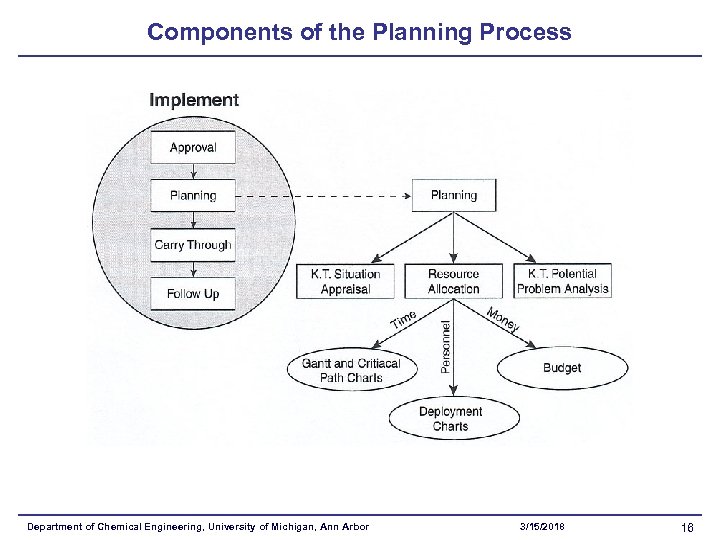 Components of the Planning Process Department of Chemical Engineering, University of Michigan, Ann Arbor 3/15/2018 16
 Follow Up In the follow-up phase, we monitor our progress not only with respect to ensuring that the time deadlines are met but also with respect to ensuring that our solution does, indeed, solve the problem at hand. Department of Chemical Engineering, University of Michigan, Ann Arbor 3/15/2018 17
 In the follow-up phase, make sure your progress • follows the solution plan (that is, it meets the solution goals and fulfills the solution criteria). • is proceeding on schedule. Department of Chemical Engineering, University of Michigan, Ann Arbor 3/15/2018 18
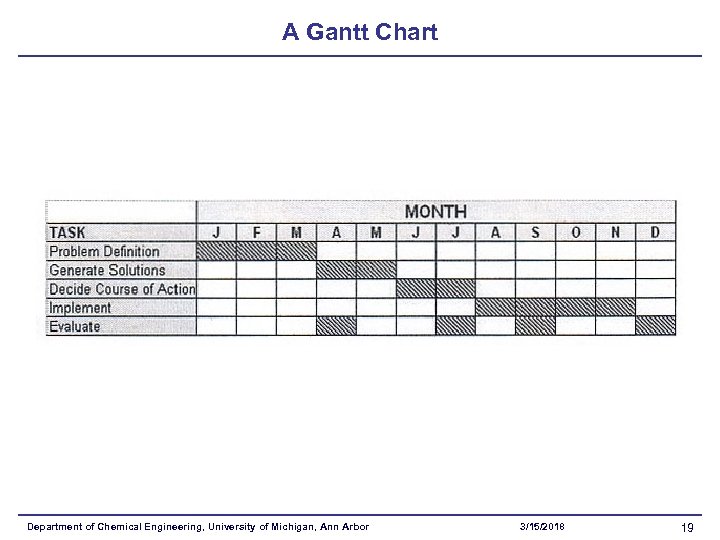 A Gantt Chart Department of Chemical Engineering, University of Michigan, Ann Arbor 3/15/2018 19
 In the follow-up phase, make sure your progress • is staying within the budget. • is maintaining an acceptable quality. • is still relevant to solving the original problem. Department of Chemical Engineering, University of Michigan, Ann Arbor 3/15/2018 20
 • • • Determine the site requirements and needs of the school Select the Web site name and register the Web address Develop a tentative layout Develop content and obtain suitable graphics Contract with an Internet service provider to host the Web site on its servers • Ensure that the site goes live • Follow up and arrange for periodic updates • Review the plans with the customer during the development • After the meeting, Melinda develops the following Gantt chart for the martial arts Web site project: Department of Chemical Engineering, University of Michigan, Ann Arbor 3/15/2018 21
 Developing a Web Site Jason and Melinda have a partnership to develop Web sites for small companies. A local martial arts school has asked them to develop a Web site to try to increase the school's business. Jason and Melinda meet with the owner to discuss the proposed Web site. During this meeting, they outline the following tasks, which will form the basis for the project: Department of Chemical Engineering, University of Michigan, Ann Arbor 3/15/2018 22
 • • Determine the site requirements and needs of the school Select the Web site name and register the Web address Develop a tentative layout Develop content and obtain suitable graphics Contract with an Internet service provider to host the Web site on its servers Ensure that the site goes live Follow up and arrange for periodic updates Review the plans with the customer during the development • After the meeting, Melinda develops the following Gantt chart for the martial arts Web site project: Department of Chemical Engineering, University of Michigan, Ann Arbor 3/15/2018 23
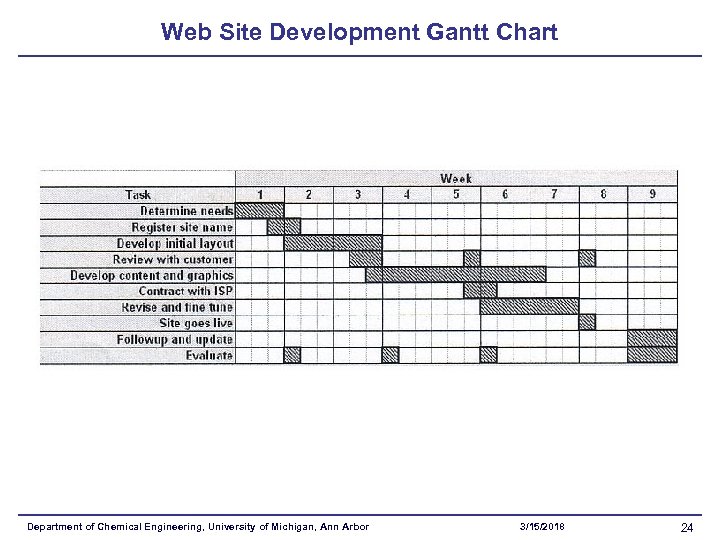 Web Site Development Gantt Chart Department of Chemical Engineering, University of Michigan, Ann Arbor 3/15/2018 24
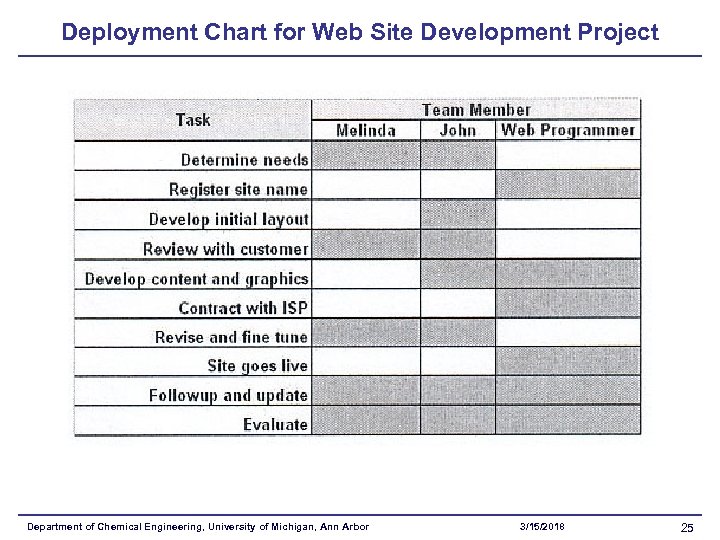 Deployment Chart for Web Site Development Project Department of Chemical Engineering, University of Michigan, Ann Arbor 3/15/2018 25
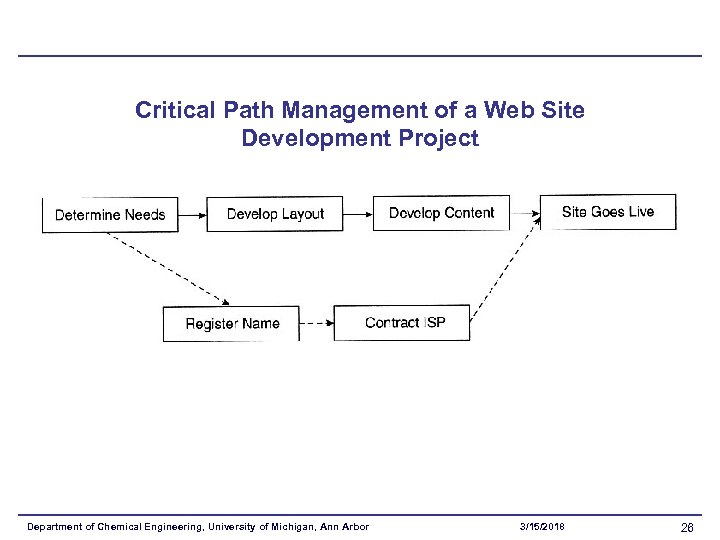 Critical Path Management of a Web Site Development Project Department of Chemical Engineering, University of Michigan, Ann Arbor 3/15/2018 26
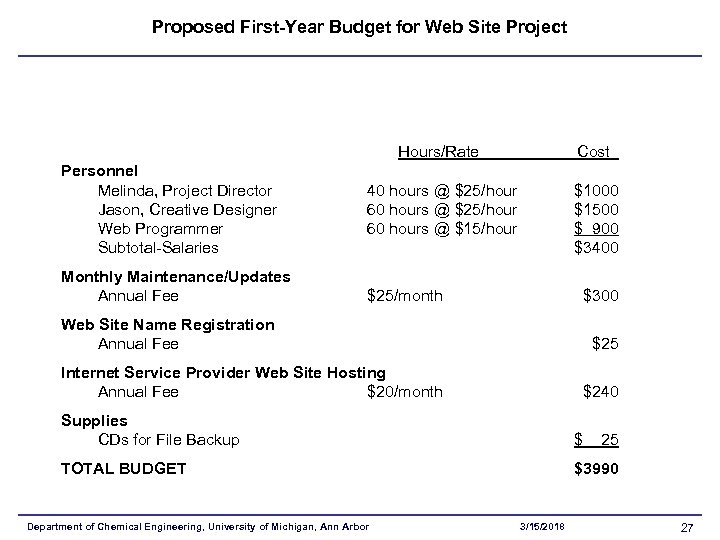 Proposed First-Year Budget for Web Site Project Hours/Rate Personnel Melinda, Project Director Jason, Creative Designer Web Programmer Subtotal-Salaries Monthly Maintenance/Updates Annual Fee Cost 40 hours @ $25/hour 60 hours @ $15/hour $1000 $1500 $ 900 $3400 $25/month $300 Web Site Name Registration Annual Fee $25 Internet Service Provider Web Site Hosting Annual Fee $20/month Supplies CDs for File Backup $240 $ 25 TOTAL BUDGET Department of Chemical Engineering, University of Michigan, Ann Arbor $3990 3/15/2018 27
 Department of Chemical Engineering, University of Michigan, Ann Arbor 3/15/2018 28
 In the follow-up phase, make sure your progress • is staying within the budget. • is maintaining an acceptable quality. • is still relevant to solving the original problem. Department of Chemical Engineering, University of Michigan, Ann Arbor 3/15/2018 29
 Developing a Web Site Jason and Melinda have a partnership to develop Web sites for small companies. A local martial arts school has asked them to develop a Web site to try to increase the school's business. Department of Chemical Engineering, University of Michigan, Ann Arbor 3/15/2018 30
 Developing a Web Site Jason and Melinda meet with the owner to discuss the proposed Web site. During this meeting, they outline the following tasks, which will form the basis for the project: Department of Chemical Engineering, University of Michigan, Ann Arbor 3/15/2018 31
 • Contract with an Internet service provider to host the Web site on its servers • Ensure that the site goes live • Follow up and arrange for periodic updates • Review the plans with the customer during the development After the meeting, Melinda develops the following Gantt chart for the martial arts Web site project: Department of Chemical Engineering, University of Michigan, Ann Arbor 3/15/2018 32