


 Скачать презентацию Department of Anesthesia Intensive Care and Pain Management
e0bc725153e3835c7369c36bfe2821e4.ppt
- Количество слайдов: 127
 Department of Anesthesia, Intensive Care and Pain Management Safety Features of the Anesthesia Workstation Raafat Abdelazim http: //telemed. shams. edu. eg/moodle
 Intended Learning Outcomes By the end of this lecture, the student will be able to understand : 1. The hazards of the anesthesia workstation (AWS) 2. The safety features developed to avoid these hazards 3. The anesthesia machine obsolescence 4. Preuse checkout 2
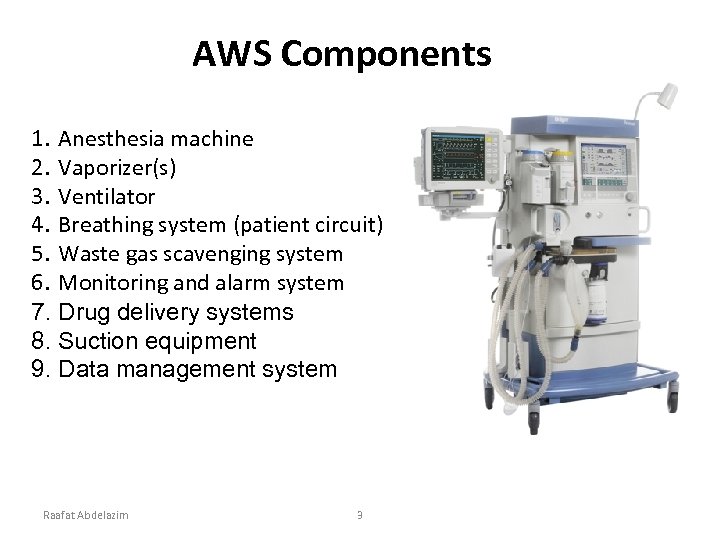 AWS Components 1. Anesthesia machine 2. Vaporizer(s) 3. Ventilator 4. Breathing system (patient circuit) 5. Waste gas scavenging system 6. Monitoring and alarm system 7. Drug delivery systems 8. Suction equipment 9. Data management system Raafat Abdelazim 3
 Raafat Abdelazim 4
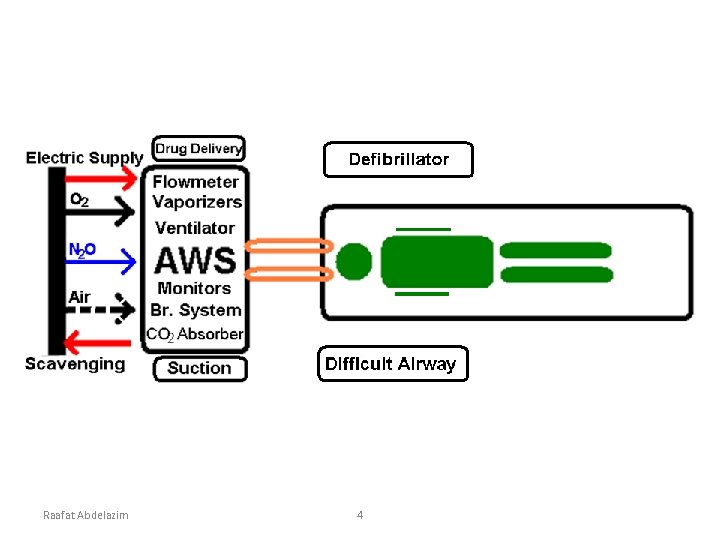
 AWS ØThe traditional pneumatic anesthesia machine has evolved into a complex electrical, mechanical, and pneumatic multicomponent workstation. ØAWS integrates most of the components necessary for administration of anesthesia into one unit. ØMonitoring and control functions as well as alarms can be integrated and data displayed on a single or multiple screens. ØReduced external connections should reduce the likelihood of misconnections, disconnections, or kinked connections. ØA certain amount of the preuse checking procedure can be performed automatically. ØThese workstations have built-in safeguards in case of machine failure. Raafat Abdelazim 5
 System Components I. Electrical Components II. Data Communication Ports III. Pneumatic System Raafat Abdelazim 6
 Hazards of the Anesthesia Workstation 7
 Critical Incidents and Adverse Outcomes Human error > equipment failure Misuse > pure failure 1 ry anesthesia provider > ancillary staff (AT, nurses) BS> vaporizers > ventilators > gas tanks or gas lines > AM itself The use or better use of monitoring could have prevented an adverse outcome Problems are decreasing: 2000 -2010 < 1990 -2000 The outcomes are less severe than earlier 8
 Major Causes for Patient Injury from Anesthesia Equipment • • • Insufficient O 2 supply to the brain Insufficient CO 2 removal Barotrauma ( Paw) Excessive anesthetic concentration Foreign matter injuring the airway 9
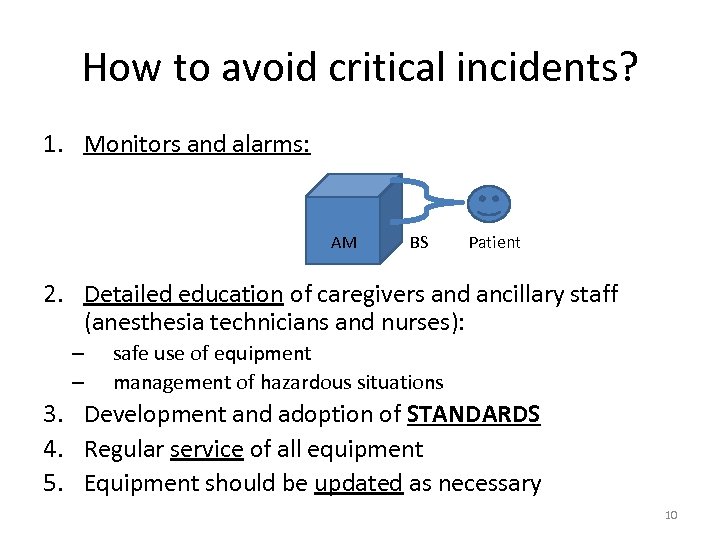 How to avoid critical incidents? 1. Monitors and alarms: AM BS Patient 2. Detailed education of caregivers and ancillary staff (anesthesia technicians and nurses): – – safe use of equipment management of hazardous situations 3. Development and adoption of STANDARDS 4. Regular service of all equipment 5. Equipment should be updated as necessary 10
 A safety feature is designed • to prevent the occurrence of a mistake • to correct a mistake • or to alert the anesthesia provider to a condition with a high risk. 11
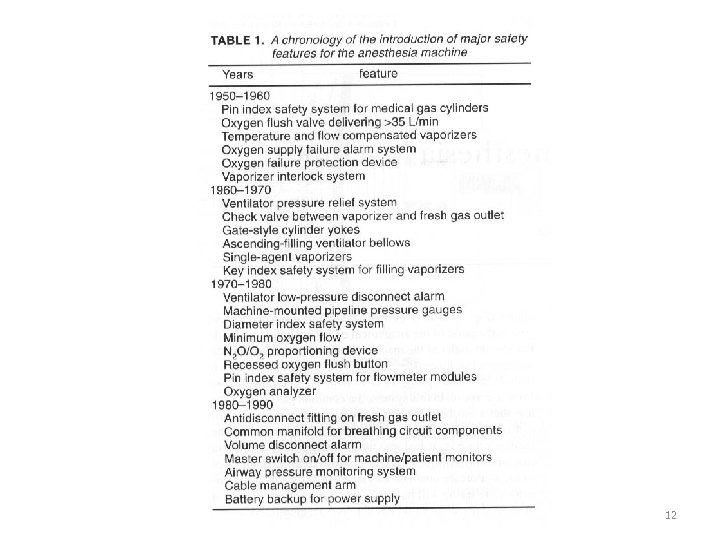 12
12
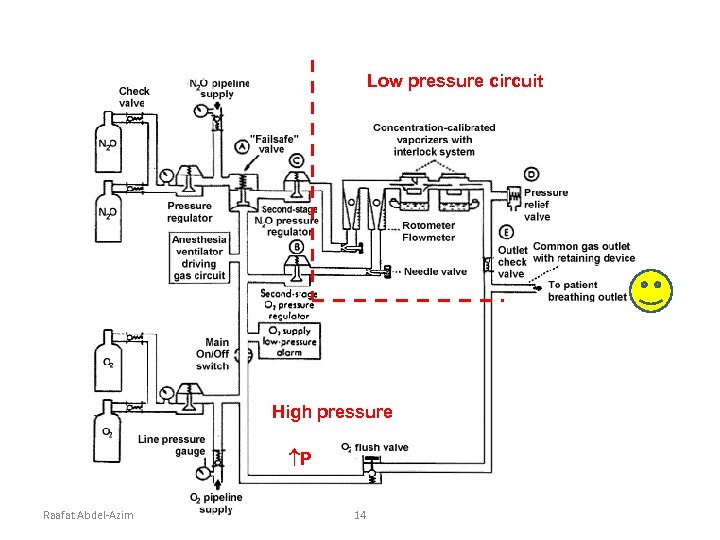
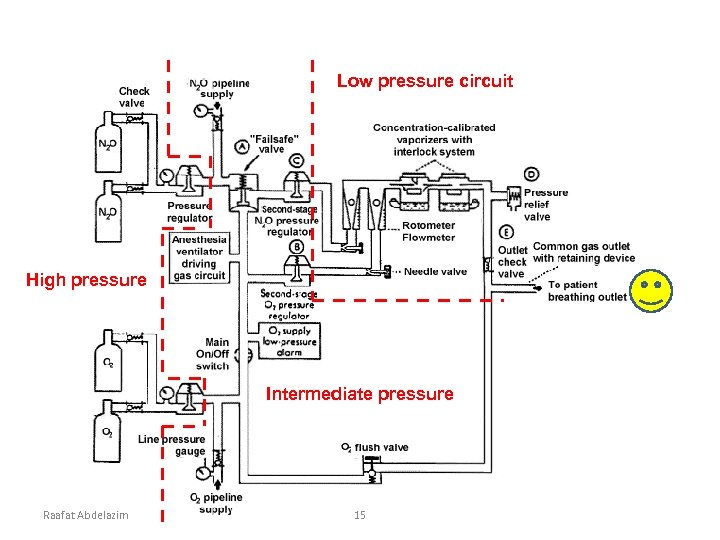
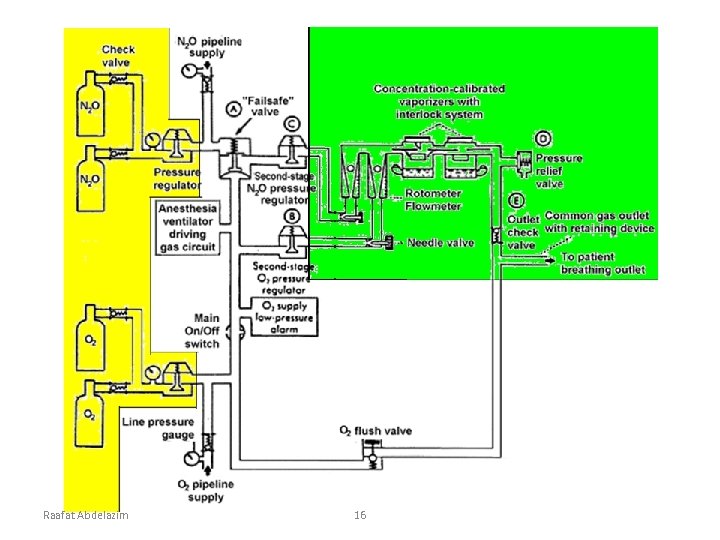
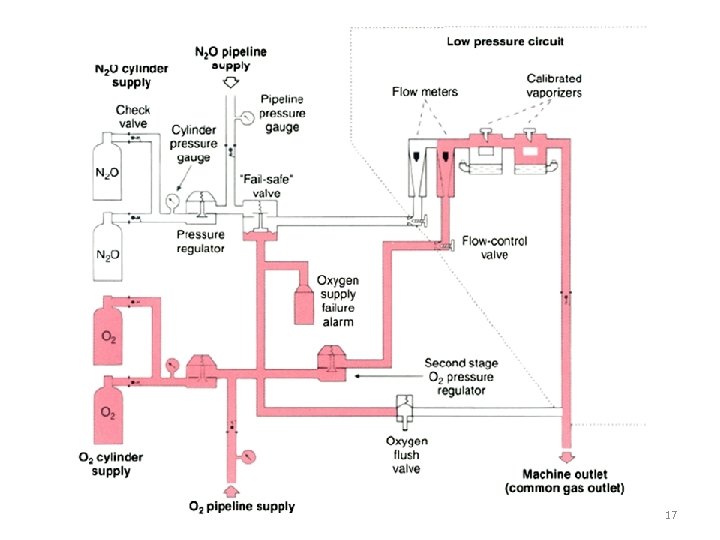
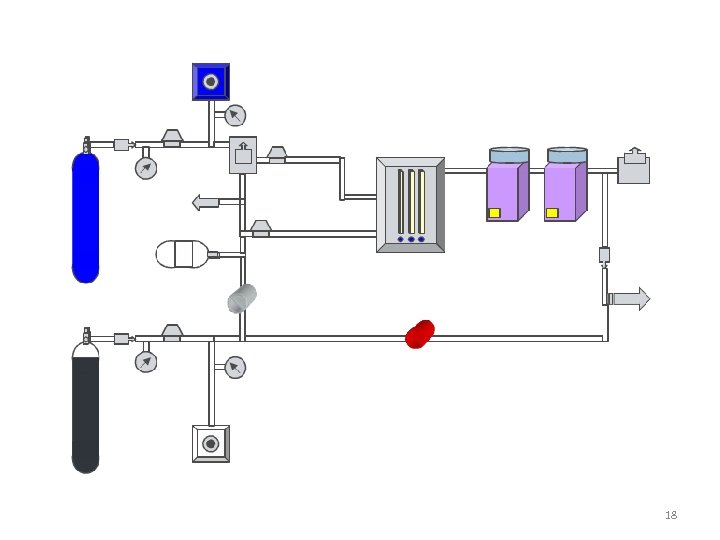
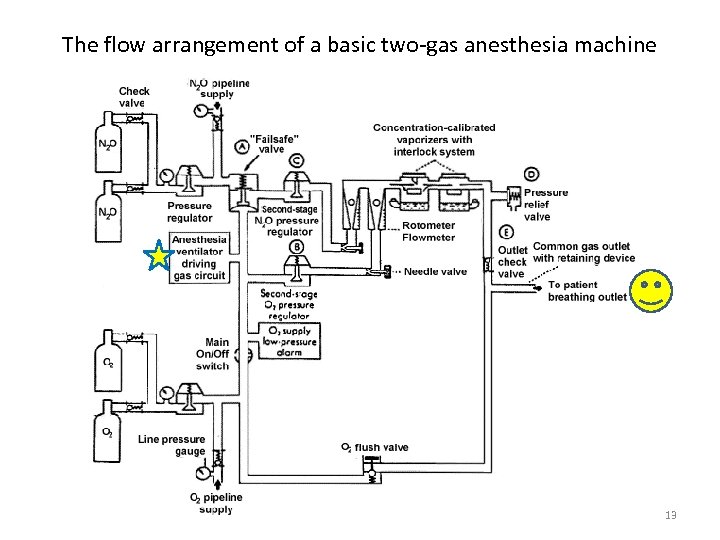 The flow arrangement of a basic two-gas anesthesia machine 13
 Low pressure circuit High pressure P Raafat Abdel-Azim 14
 Low pressure circuit High pressure Intermediate pressure Raafat Abdelazim 15
 Raafat Abdelazim 16
 17
17
 18
18
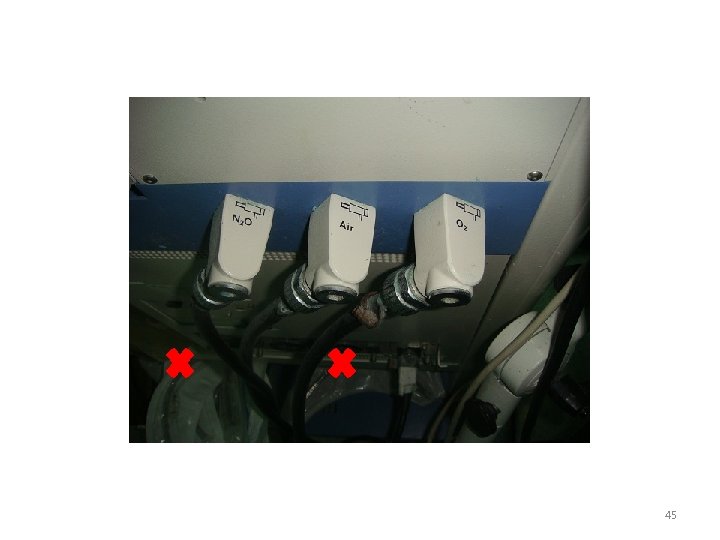
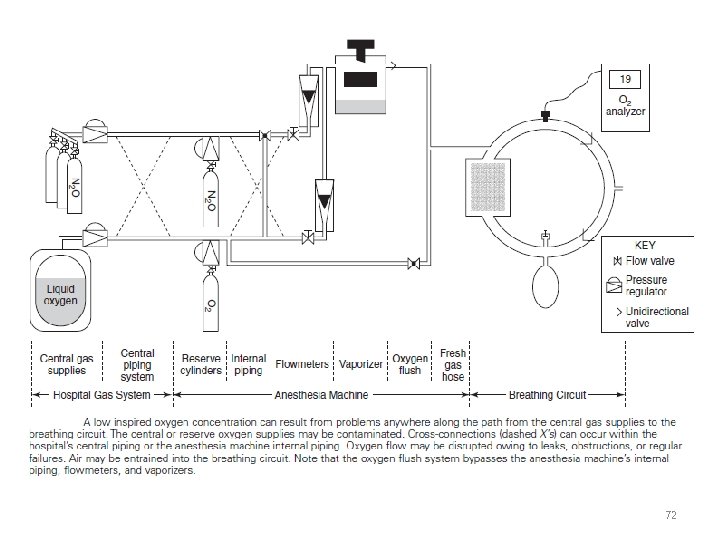
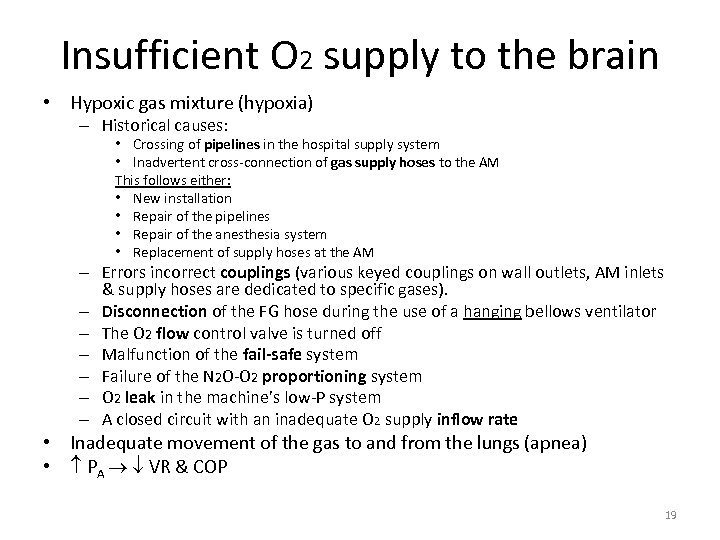 Insufficient O 2 supply to the brain • Hypoxic gas mixture (hypoxia) – Historical causes: • Crossing of pipelines in the hospital supply system • Inadvertent cross-connection of gas supply hoses to the AM This follows either: • New installation • Repair of the pipelines • Repair of the anesthesia system • Replacement of supply hoses at the AM – Errors incorrect couplings (various keyed couplings on wall outlets, AM inlets & supply hoses are dedicated to specific gases). – Disconnection of the FG hose during the use of a hanging bellows ventilator – The O 2 flow control valve is turned off – Malfunction of the fail-safe system – Failure of the N 2 O-O 2 proportioning system – O 2 leak in the machine’s low-P system – A closed circuit with an inadequate O 2 supply inflow rate • Inadequate movement of the gas to and from the lungs (apnea) • PA VR & COP 19
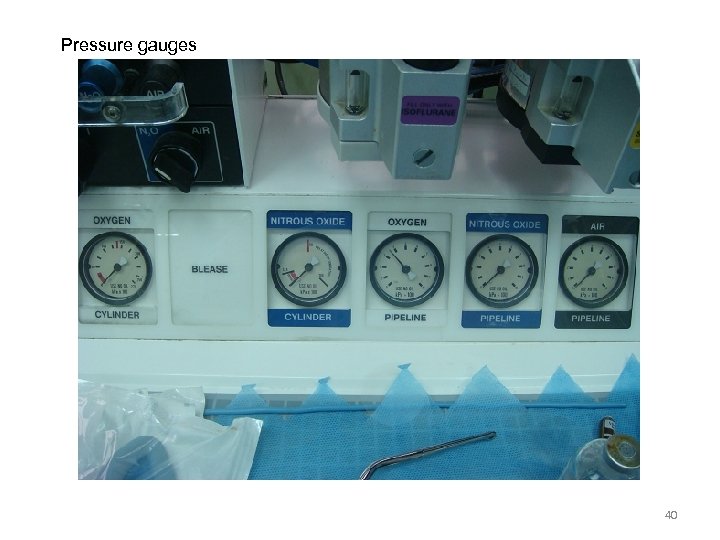
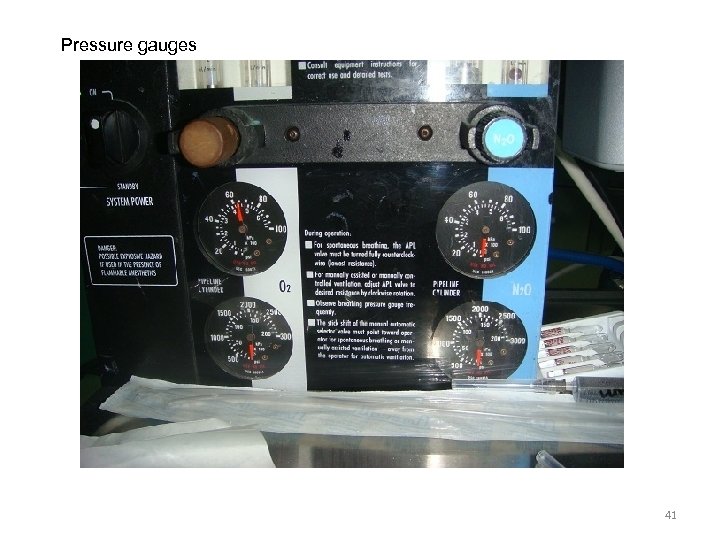
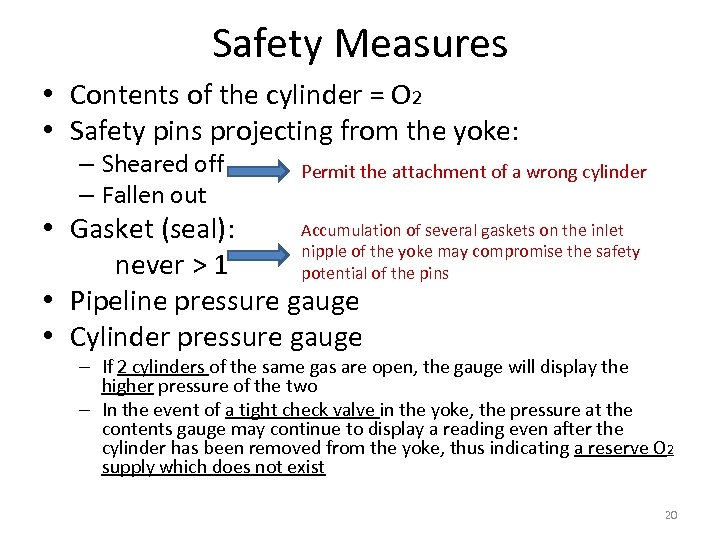 Safety Measures • Contents of the cylinder = O 2 • Safety pins projecting from the yoke: – Sheared off – Fallen out Permit the attachment of a wrong cylinder Accumulation of several gaskets on the inlet • Gasket (seal): nipple of the yoke may compromise the safety never > 1 potential of the pins • Pipeline pressure gauge • Cylinder pressure gauge – If 2 cylinders of the same gas are open, the gauge will display the higher pressure of the two – In the event of a tight check valve in the yoke, the pressure at the contents gauge may continue to display a reading even after the cylinder has been removed from the yoke, thus indicating a reserve O 2 supply which does not exist 20
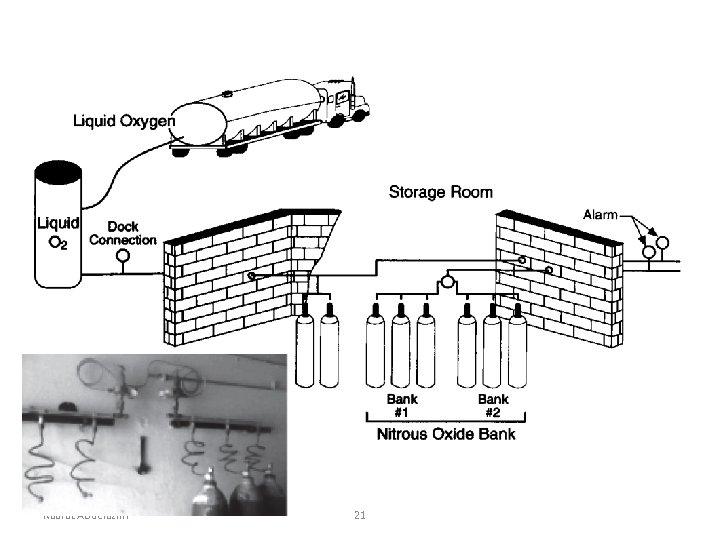 O 2 Bank Raafat Abdelazim 21
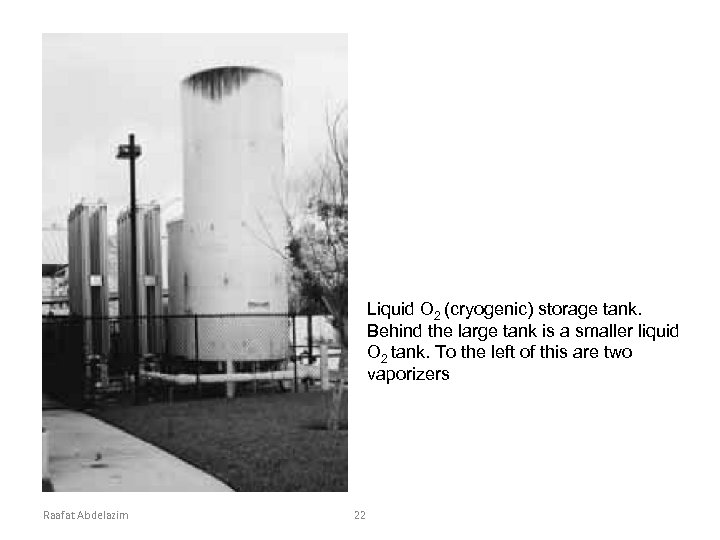 Liquid O 2 (cryogenic) storage tank. Behind the large tank is a smaller liquid O 2 tank. To the left of this are two vaporizers Raafat Abdelazim 22
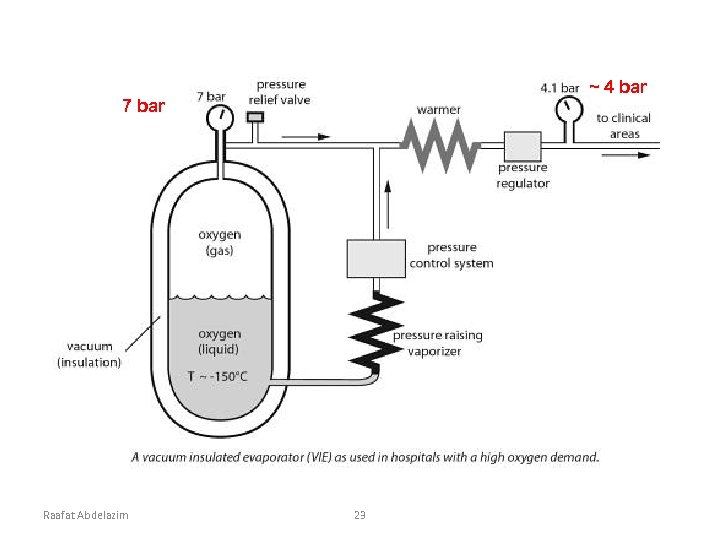 ~ 4 bar 7 bar Raafat Abdelazim 23
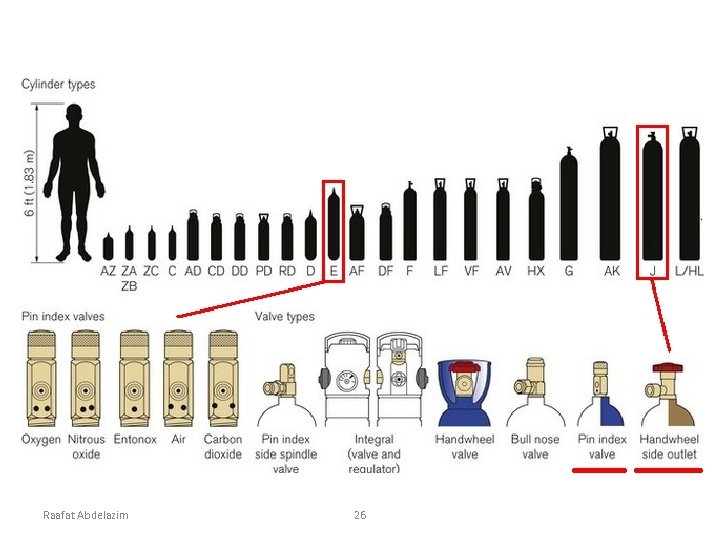
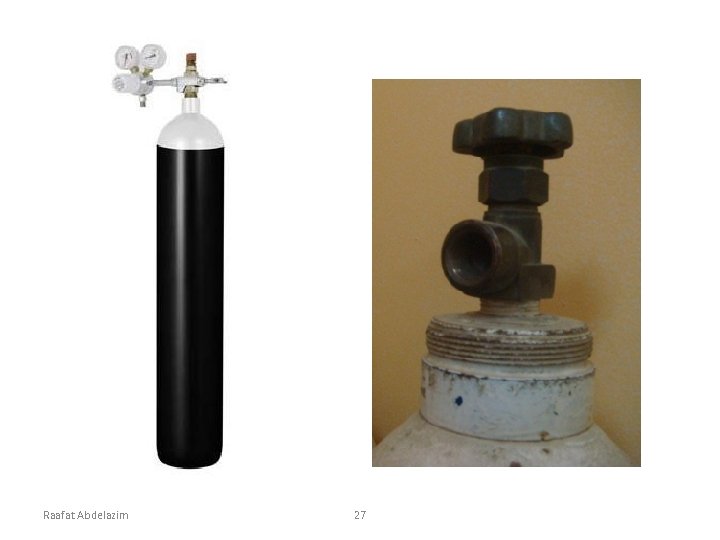
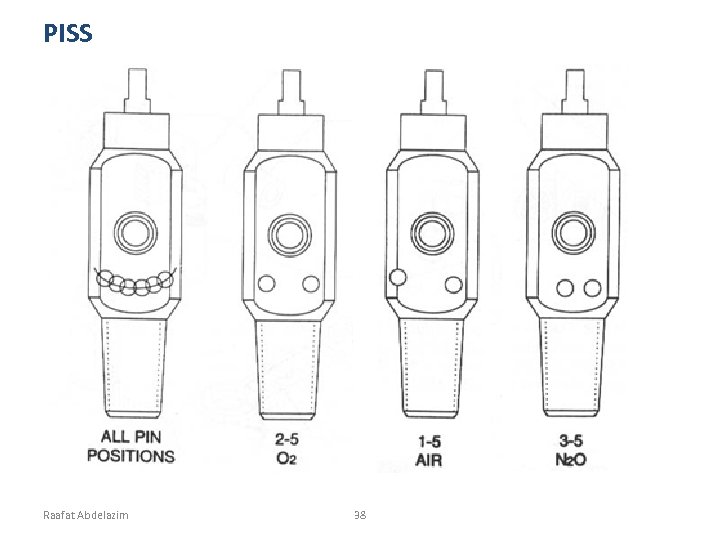
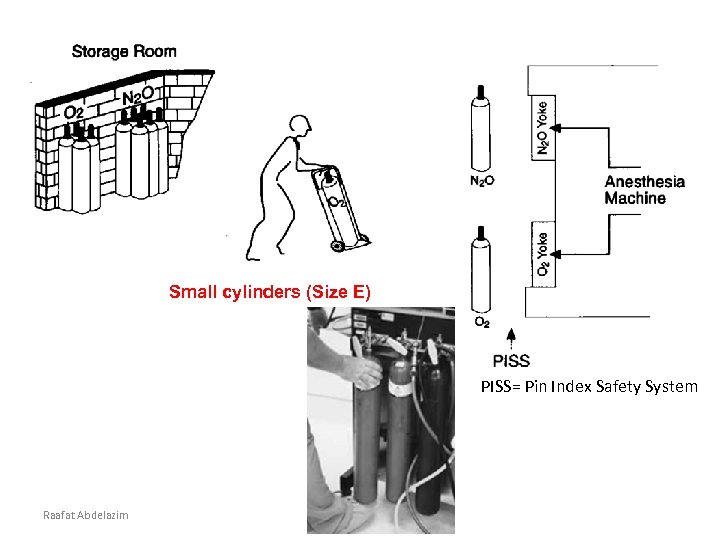 Small cylinders (Size E) PISS= Pin Index Safety System Raafat Abdelazim 24
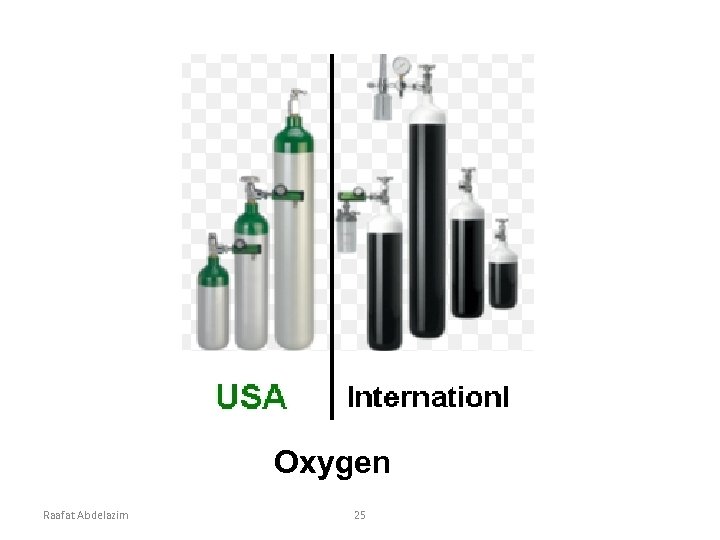 Oxygen Raafat Abdelazim 25
 Raafat Abdelazim 26
 Raafat Abdelazim 27
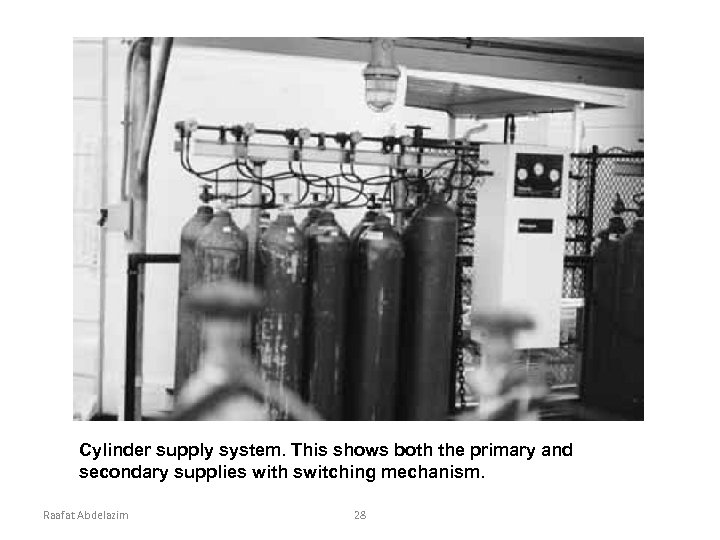 Cylinder supply system. This shows both the primary and secondary supplies with switching mechanism. Raafat Abdelazim 28
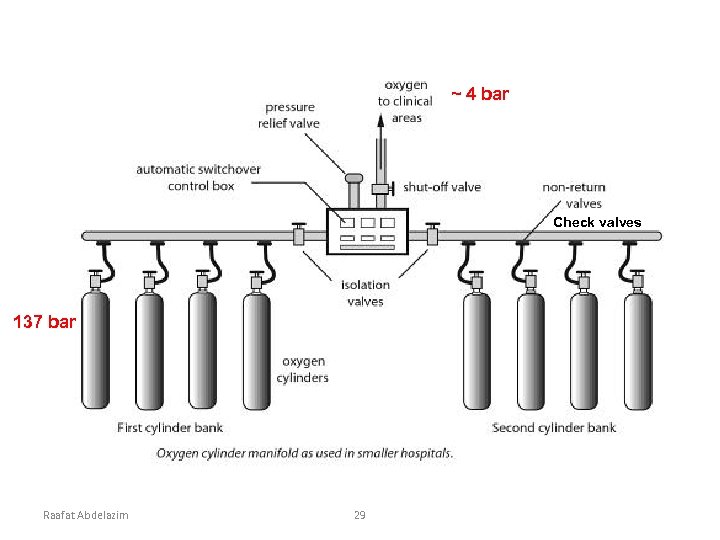 ~ 4 bar Check valves 137 bar Raafat Abdelazim 29
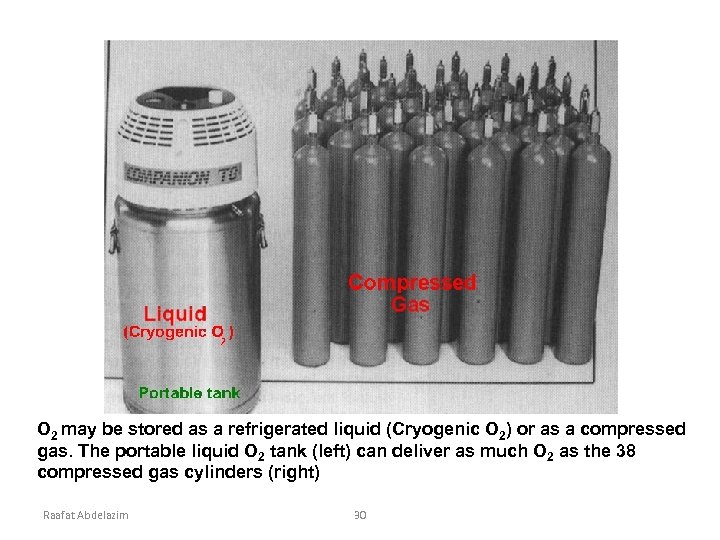 O 2 may be stored as a refrigerated liquid (Cryogenic O 2) or as a compressed gas. The portable liquid O 2 tank (left) can deliver as much O 2 as the 38 compressed gas cylinders (right) Raafat Abdelazim 30
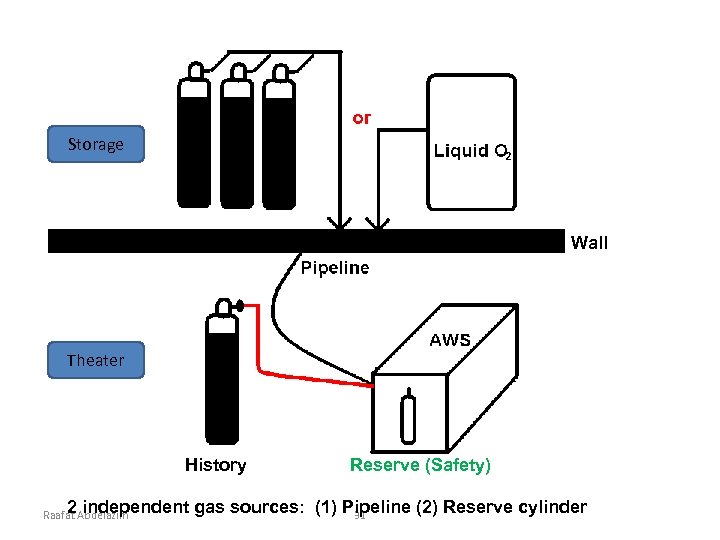 Storage Wall Theater History 2 independent Raafat Abdelazim Reserve (Safety) gas sources: (1) Pipeline (2) Reserve cylinder 31
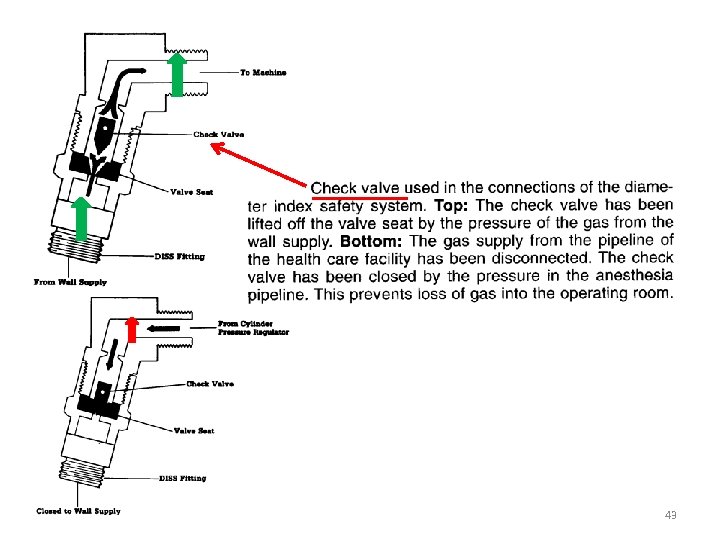
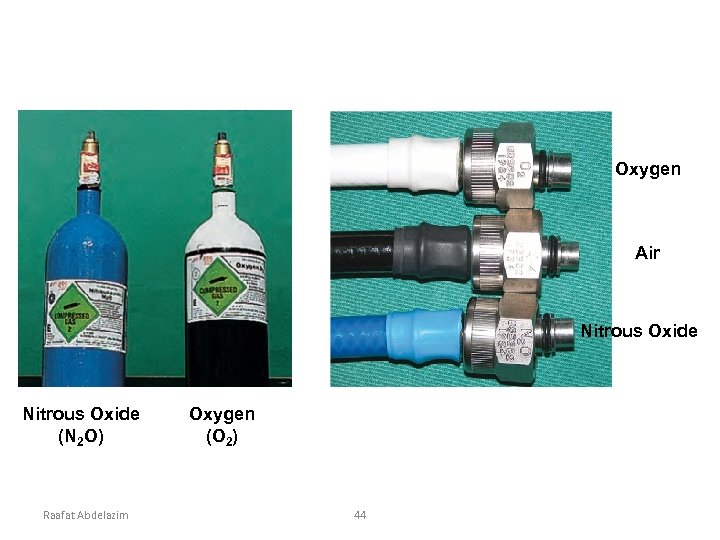
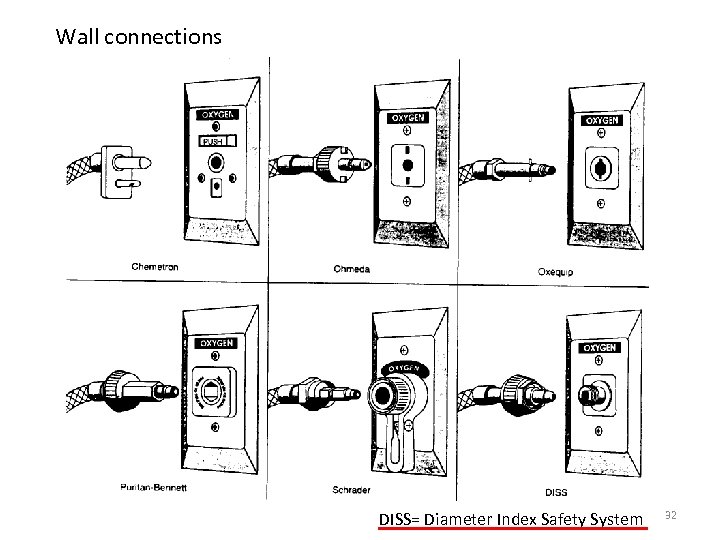 Wall connections DISS= Diameter Index Safety System 32
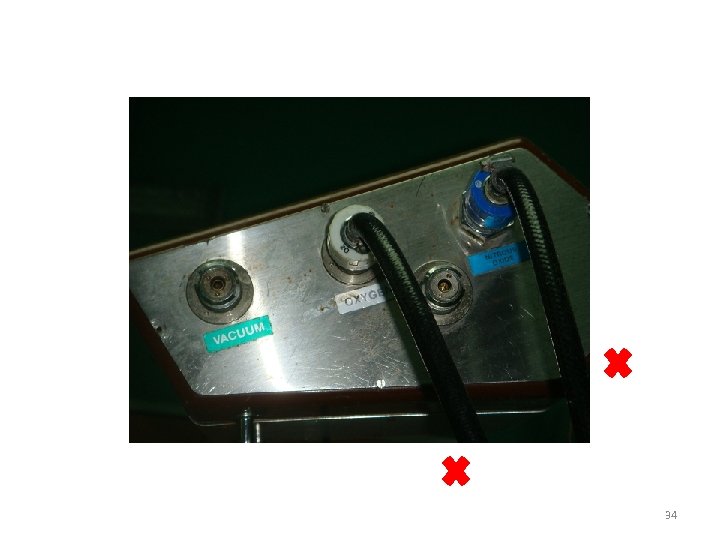
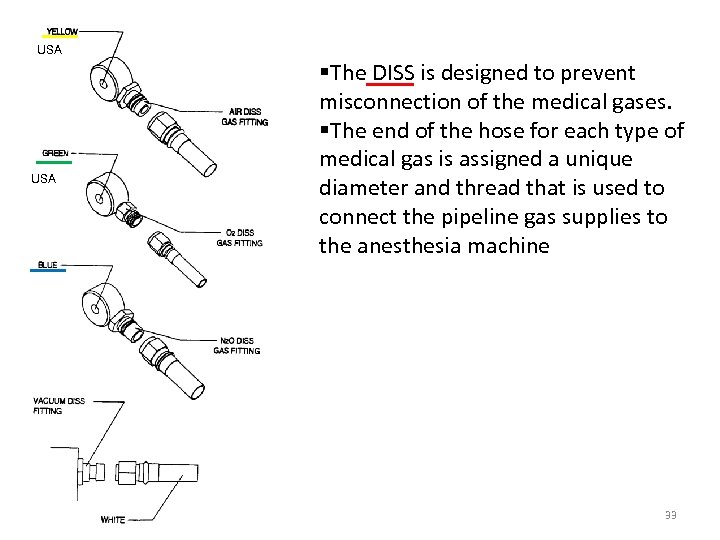 USA §The DISS is designed to prevent misconnection of the medical gases. §The end of the hose for each type of medical gas is assigned a unique diameter and thread that is used to connect the pipeline gas supplies to the anesthesia machine 33
 34
34
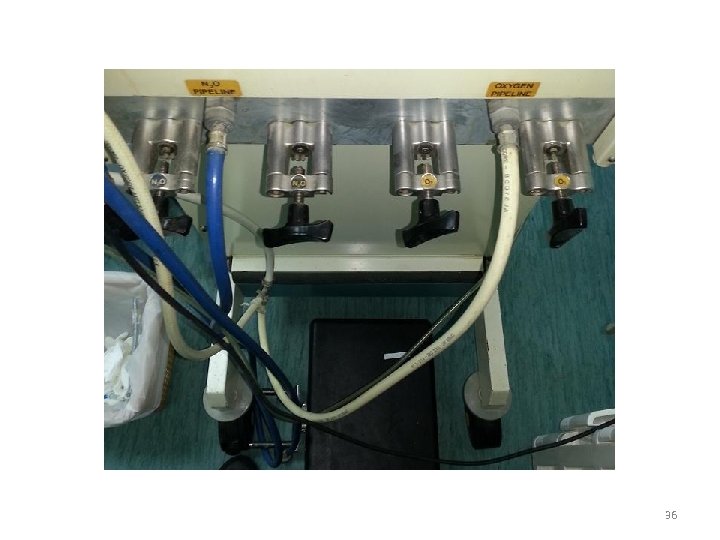
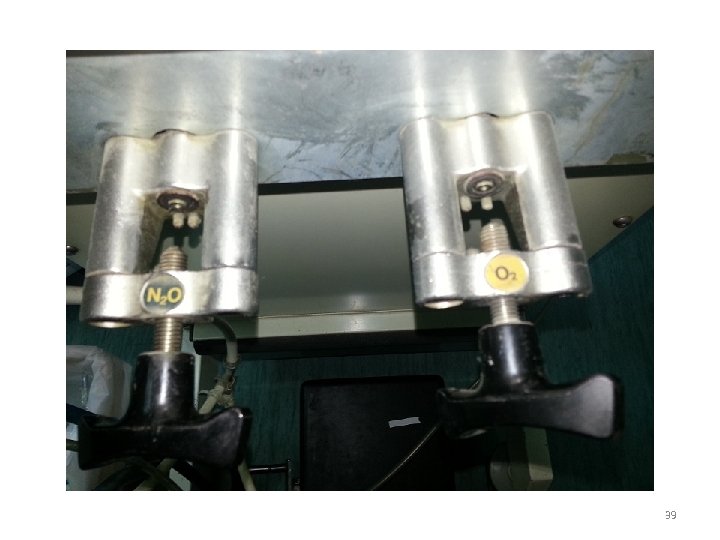
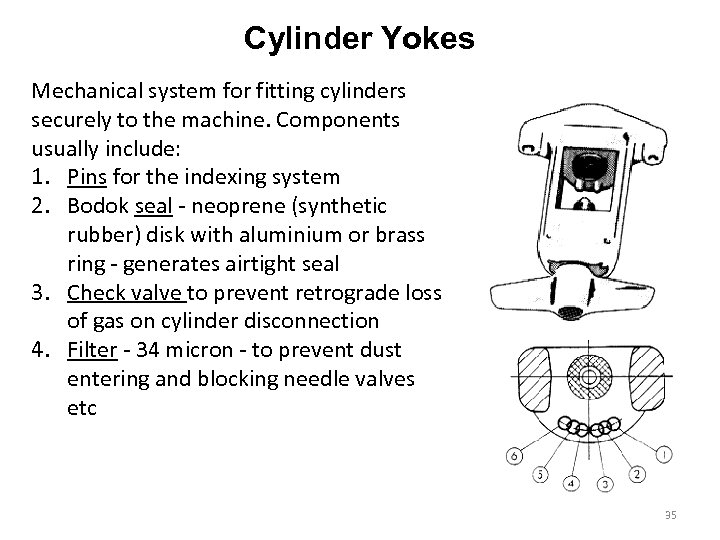 Cylinder Yokes Mechanical system for fitting cylinders securely to the machine. Components usually include: 1. Pins for the indexing system 2. Bodok seal - neoprene (synthetic rubber) disk with aluminium or brass ring - generates airtight seal 3. Check valve to prevent retrograde loss of gas on cylinder disconnection 4. Filter - 34 micron - to prevent dust entering and blocking needle valves etc 35
 36
36
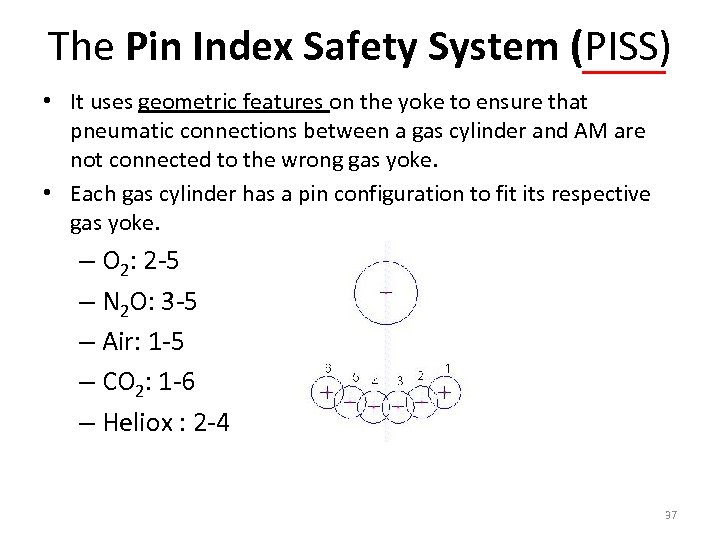 The Pin Index Safety System (PISS) • It uses geometric features on the yoke to ensure that pneumatic connections between a gas cylinder and AM are not connected to the wrong gas yoke. • Each gas cylinder has a pin configuration to fit its respective gas yoke. – O 2: 2 -5 – N 2 O: 3 -5 – Air: 1 -5 – CO 2: 1 -6 – Heliox : 2 -4 37
 PISS Raafat Abdelazim 38
 39
39
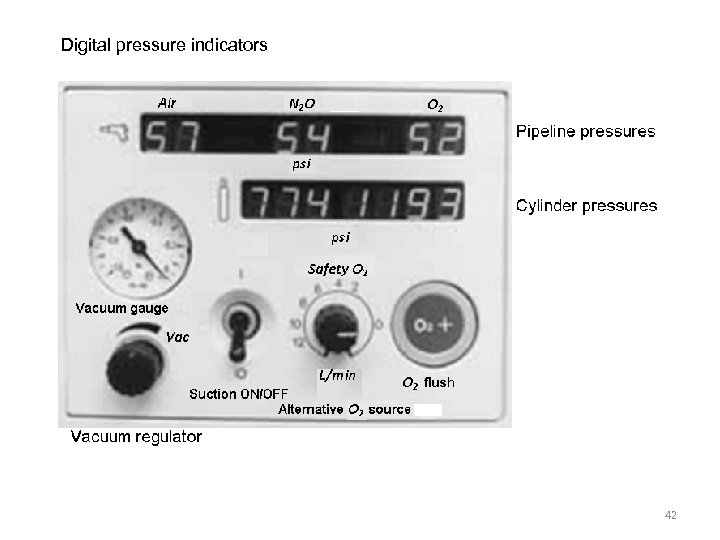
 Pressure gauges 40
 Pressure gauges 41
 Digital pressure indicators 42
 43
43
 Oxygen Air Nitrous Oxide (N 2 O) Raafat Abdelazim Oxygen (O 2) 44
 45
45
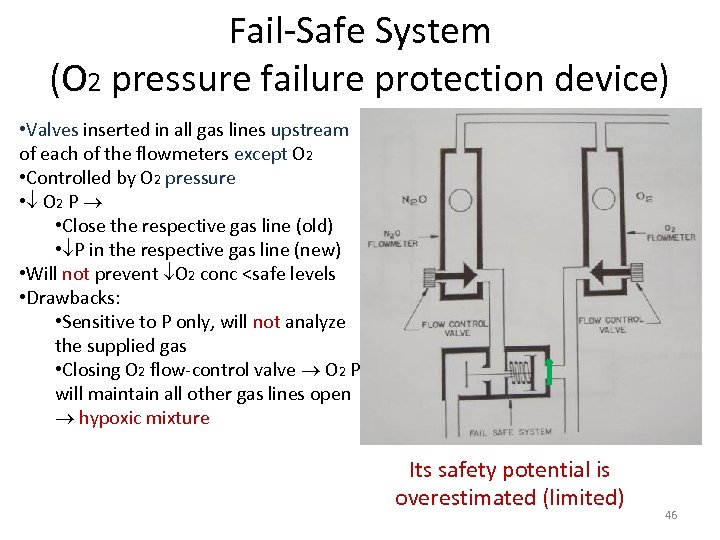 Fail-Safe System (O 2 pressure failure protection device) • Valves inserted in all gas lines upstream of each of the flowmeters except O 2 • Controlled by O 2 pressure • O 2 P • Close the respective gas line (old) • P in the respective gas line (new) • Will not prevent O 2 conc
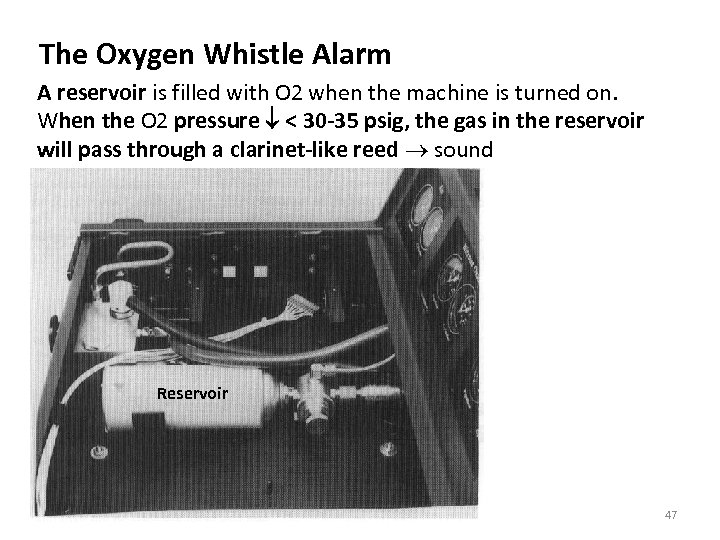 The Oxygen Whistle Alarm A reservoir is filled with O 2 when the machine is turned on. When the O 2 pressure < 30 -35 psig, the gas in the reservoir will pass through a clarinet-like reed sound Reservoir 47
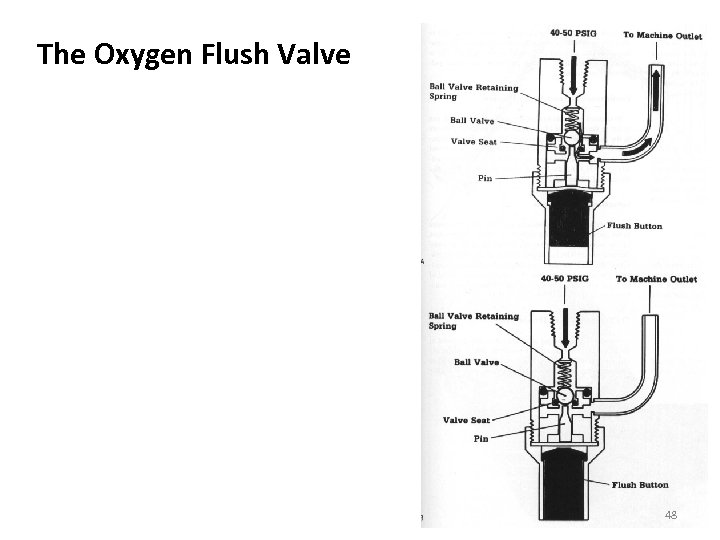 The Oxygen Flush Valve 48
 Oxygen Flush The O 2 flush (O 2 bypass, emergency O 2 bypass) receives O 2 from the pipeline inlet or cylinder P regulator and directs a high unmetered flow directly to the common gas outlet. It is commonly labeled “O 2+” On most AMs, the O 2 flush can be activated regardless of whether the master switch is turned ON or OFF. The AWS requires that the O 2 flush be a single-purpose, selfclosing device operable with one hand designed to minimize unintentional activation. A flow between 35 and 75 L/minute must be delivered. Raafat Abdelazim 49
 No safety measure other than an OXYGEN ANALYZER will reveal the hazard of the supply of N 2 O into the O 2 inlet of the AM 50
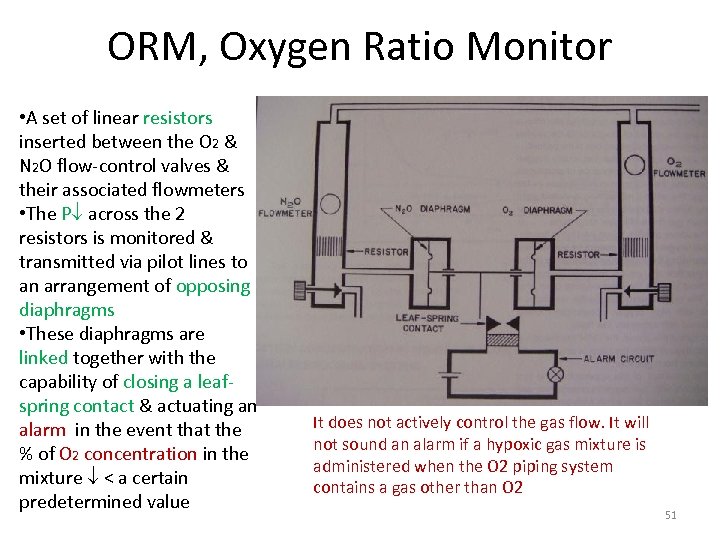 ORM, Oxygen Ratio Monitor • A set of linear resistors inserted between the O 2 & N 2 O flow-control valves & their associated flowmeters • The P across the 2 resistors is monitored & transmitted via pilot lines to an arrangement of opposing diaphragms • These diaphragms are linked together with the capability of closing a leafspring contact & actuating an alarm in the event that the % of O 2 concentration in the mixture < a certain predetermined value It does not actively control the gas flow. It will not sound an alarm if a hypoxic gas mixture is administered when the O 2 piping system contains a gas other than O 2 51
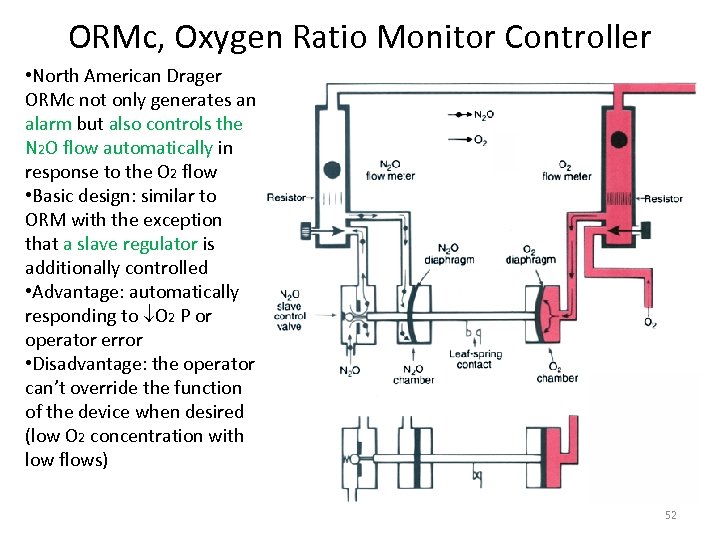 ORMc, Oxygen Ratio Monitor Controller • North American Drager ORMc not only generates an alarm but also controls the N 2 O flow automatically in response to the O 2 flow • Basic design: similar to ORM with the exception that a slave regulator is additionally controlled • Advantage: automatically responding to O 2 P or operator error • Disadvantage: the operator can’t override the function of the device when desired (low O 2 concentration with low flows) 52
 Mandatory Minimum Oxygen Flow • Some AMs require a minimum (50 to 250 m. L/minute) flow of O 2 before other gases will flow. This is preset by the manufacturer. • On some machines, the minimum flow may be deleted at the user's request. • Some machines activate an alarm if the O 2 flow goes below a certain minimum, even if no other gases are being used. • The minimum flow is activated when the master switch is turned ON. • On some machines, it is disabled when air is used. Raafat Abdelazim 53
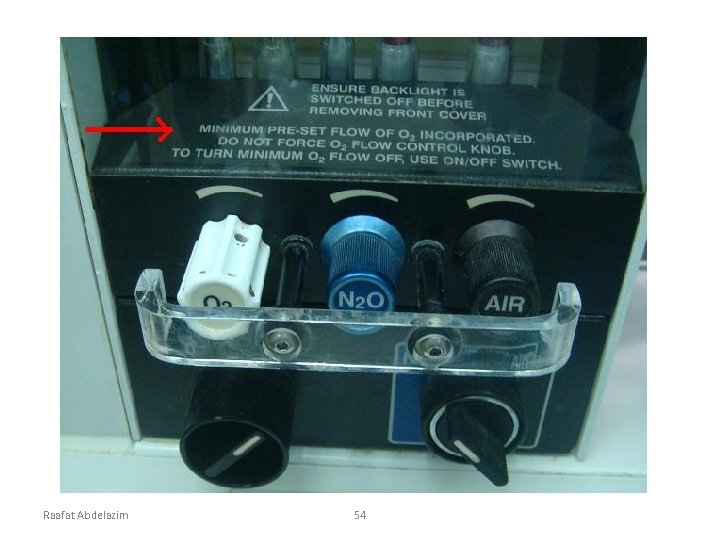 Raafat Abdelazim 54
 Minimum Oxygen Ratio AM is provided with a device to protect against an operatorselected delivery of a mixture of O 2 and N 2 O having an O 2 concentration < 25% O 2 (V/V) By: o Mechanical Linkage o Electronic Linkage o Mechanical and pneumatic Alarms: Alarms are available on some AMs to alert the operator that the O 2: N 2 O flow ratio has < a preset value. Raafat Abdelazim 55
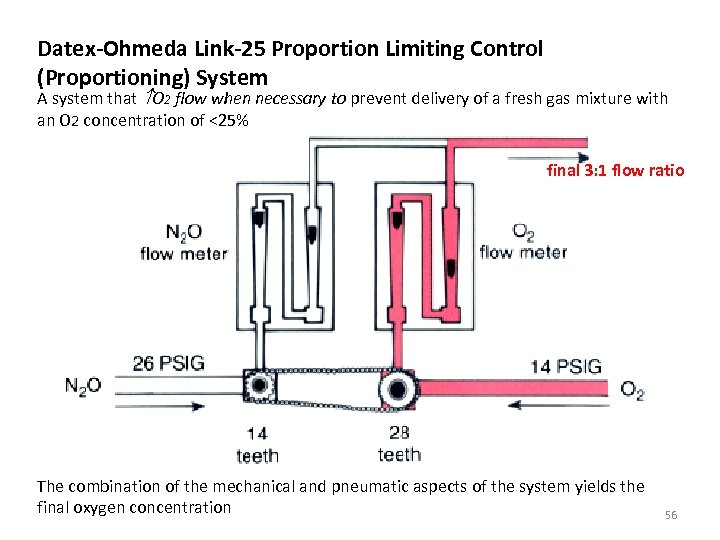 Datex-Ohmeda Link-25 Proportion Limiting Control (Proportioning) System A system that O 2 flow when necessary to prevent delivery of a fresh gas mixture with an O 2 concentration of <25% final 3: 1 flow ratio The combination of the mechanical and pneumatic aspects of the system yields the final oxygen concentration 56
 Proportioning Systems Manufacturers have equipped newer machines with proportioning systems in an attempt to prevent delivery of a hypoxic mixture. Nitrous oxide and oxygen are interfaced mechanically or pneumatically so that the minimum oxygen concentration at the common gas outlet is between 23% and 25%, depending on manufacturer 1. Datex-Ohmeda Link-25 Proportion Limiting Control System 2. North American Dräger Oxygen Ratio Monitor Controller 57
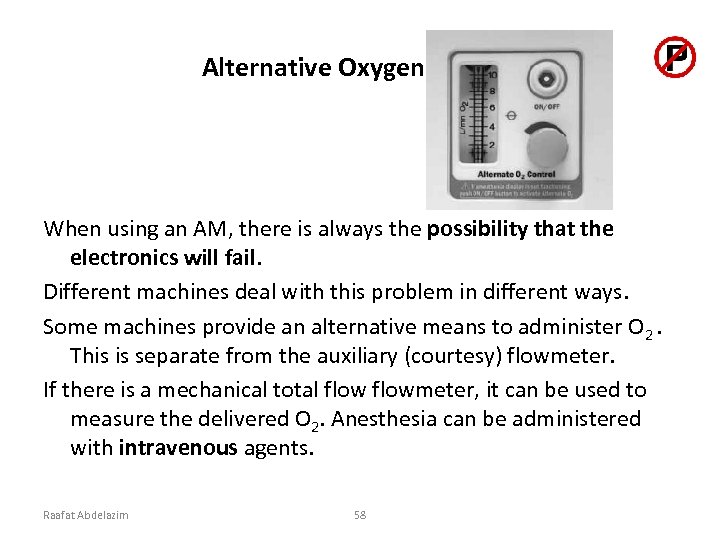 Alternative Oxygen Control When using an AM, there is always the possibility that the electronics will fail. Different machines deal with this problem in different ways. Some machines provide an alternative means to administer O 2. This is separate from the auxiliary (courtesy) flowmeter. If there is a mechanical total flowmeter, it can be used to measure the delivered O 2. Anesthesia can be administered with intravenous agents. Raafat Abdelazim 58
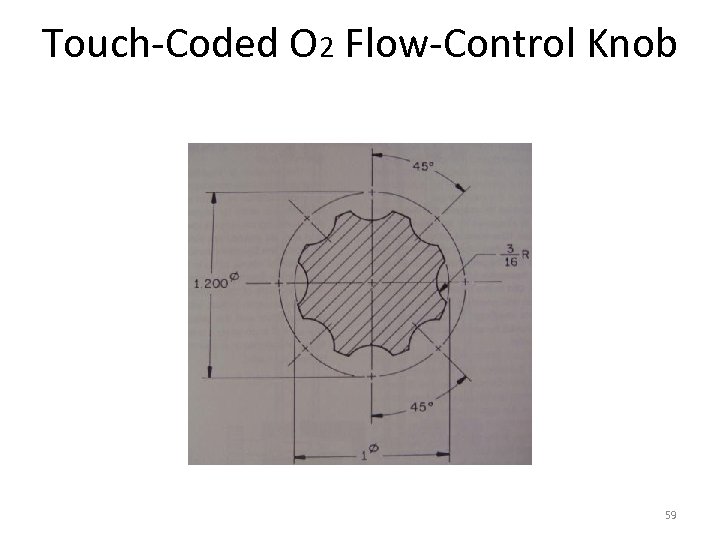 Touch-Coded O 2 Flow-Control Knob 59
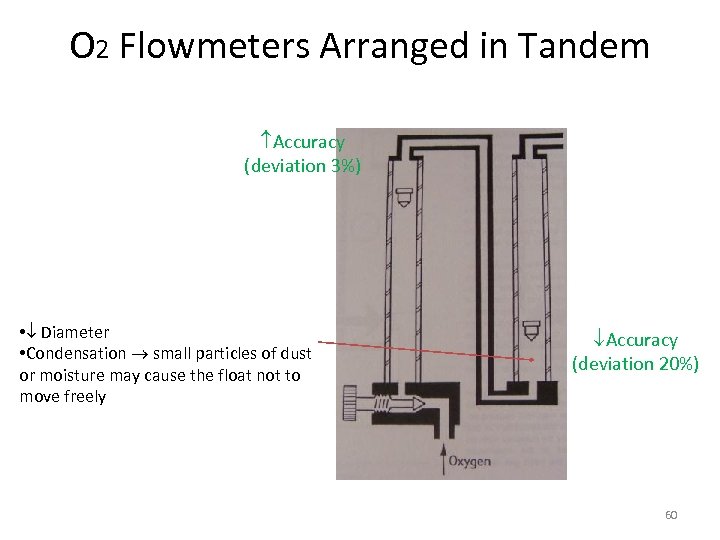 O 2 Flowmeters Arranged in Tandem Accuracy (deviation 3%) • Diameter • Condensation small particles of dust or moisture may cause the float not to move freely Accuracy (deviation 20%) 60
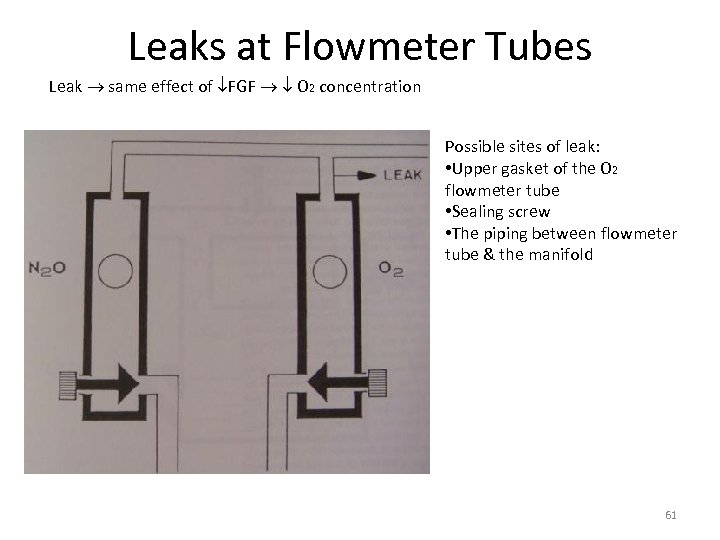 Leaks at Flowmeter Tubes Leak same effect of FGF O 2 concentration Possible sites of leak: • Upper gasket of the O 2 flowmeter tube • Sealing screw • The piping between flowmeter tube & the manifold 61
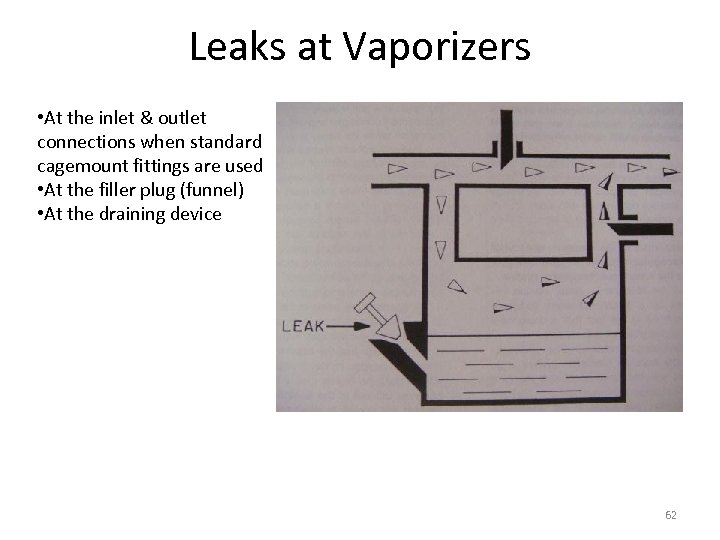 Leaks at Vaporizers • At the inlet & outlet connections when standard cagemount fittings are used • At the filler plug (funnel) • At the draining device 62
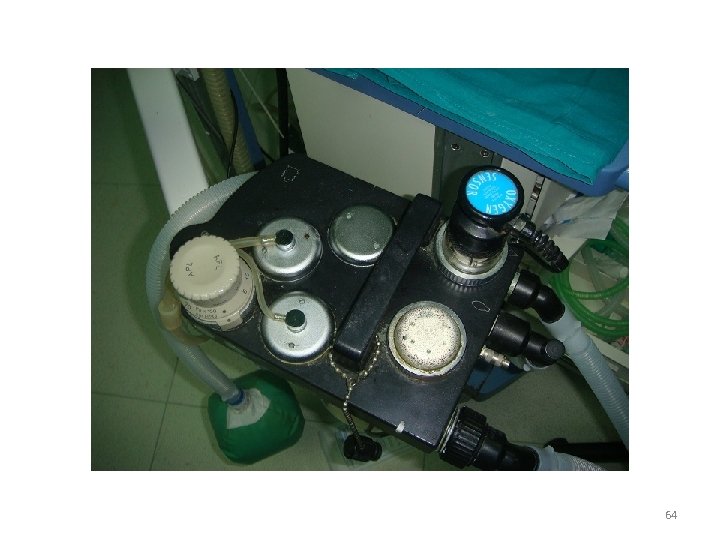
 Any of O 2 % due to leaks at any of the above-referenced points will be recognized if an OXYGEN ANALYZER is used in the breathing system 63
 64
64
 65
65
 66
66
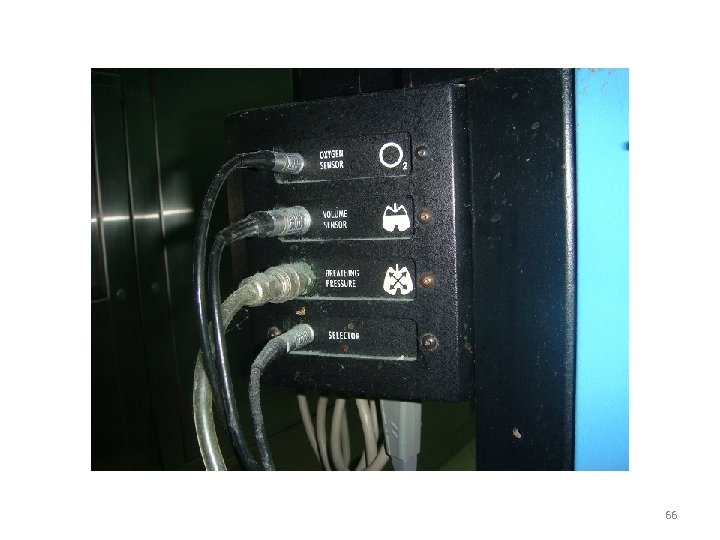
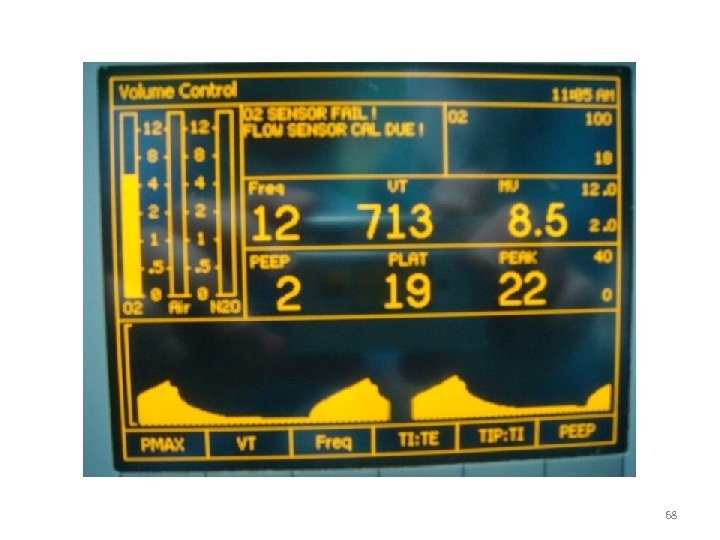
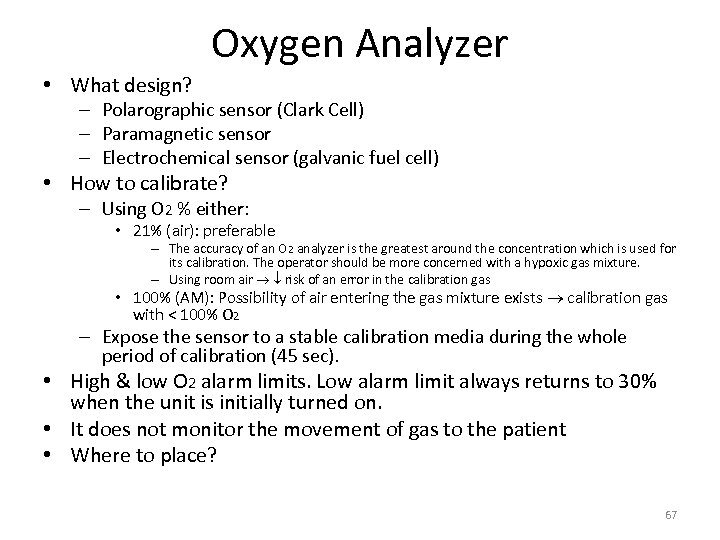 Oxygen Analyzer • What design? – Polarographic sensor (Clark Cell) – Paramagnetic sensor – Electrochemical sensor (galvanic fuel cell) • How to calibrate? – Using O 2 % either: • 21% (air): preferable – The accuracy of an O 2 analyzer is the greatest around the concentration which is used for its calibration. The operator should be more concerned with a hypoxic gas mixture. – Using room air risk of an error in the calibration gas • 100% (AM): Possibility of air entering the gas mixture exists calibration gas with < 100% O 2 – Expose the sensor to a stable calibration media during the whole period of calibration (45 sec). • High & low O 2 alarm limits. Low alarm limit always returns to 30% when the unit is initially turned on. • It does not monitor the movement of gas to the patient • Where to place? 67
 68
68
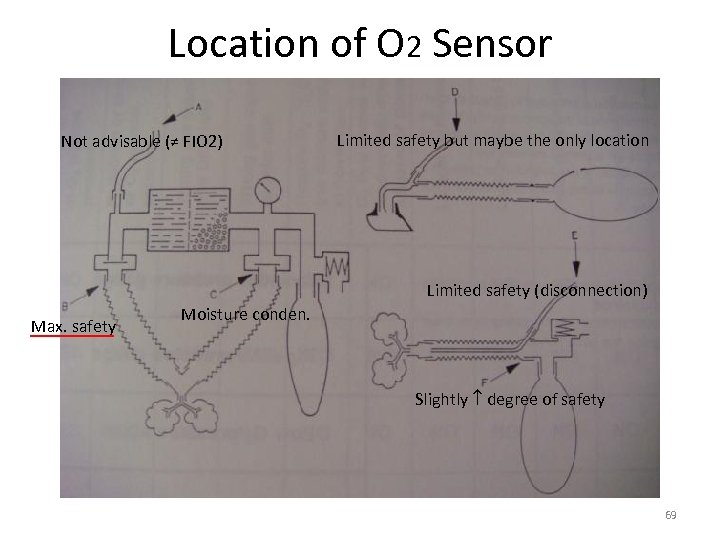 Location of O 2 Sensor Not advisable (≠ FIO 2) Limited safety but maybe the only location Limited safety (disconnection) Max. safety Moisture conden. Slightly degree of safety 69
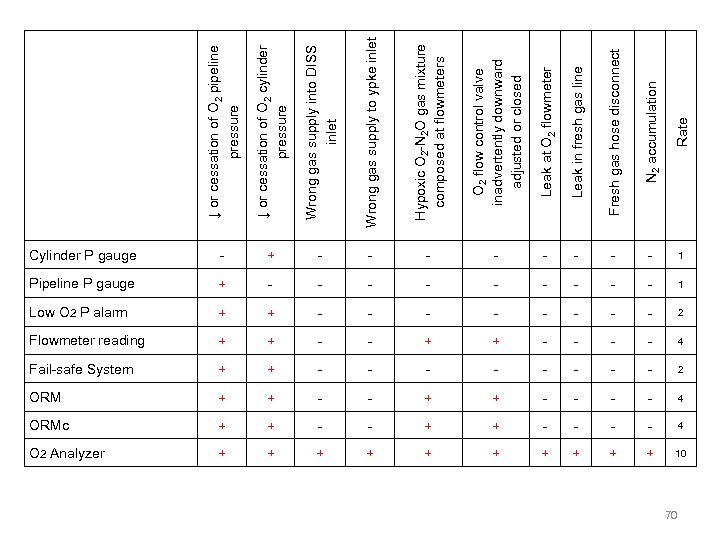 ↓ or cessation of O 2 pipeline pressure ↓ or cessation of O 2 cylinder pressure Wrong gas supply into DISS inlet Wrong gas supply to ypke inlet Hypoxic O 2 -N 2 O gas mixture composed at flowmeters O 2 flow control valve inadvertently downward adjusted or closed Leak at O 2 flowmeter Leak in fresh gas line Fresh gas hose disconnect N 2 accumulation Rate Cylinder P gauge + 1 Pipeline P gauge + 1 Low O 2 P alarm + + 2 Flowmeter reading + + 4 Fail-safe System + + 2 ORM + + 4 ORMc + + 4 O 2 Analyzer + + + + + 10 70
 71
71
 72
72
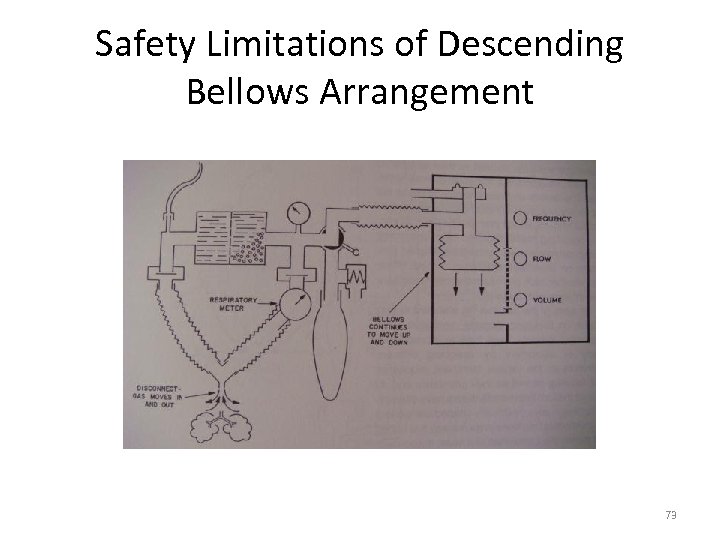 Safety Limitations of Descending Bellows Arrangement 73
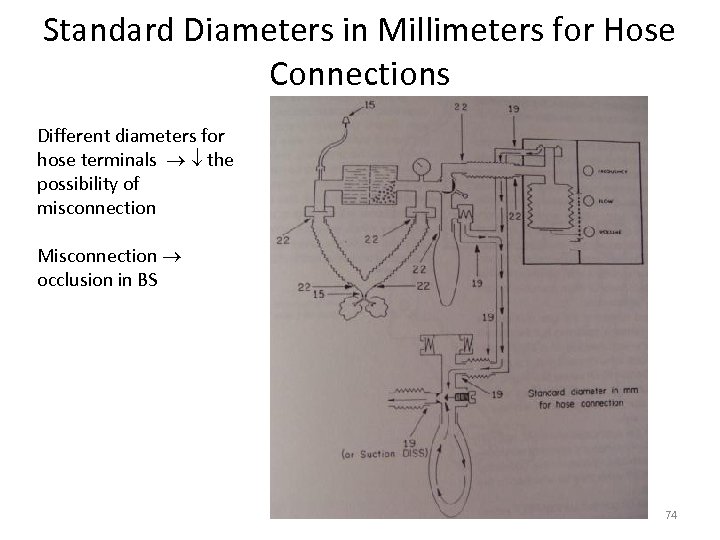 Standard Diameters in Millimeters for Hose Connections Different diameters for hose terminals the possibility of misconnection Misconnection occlusion in BS 74
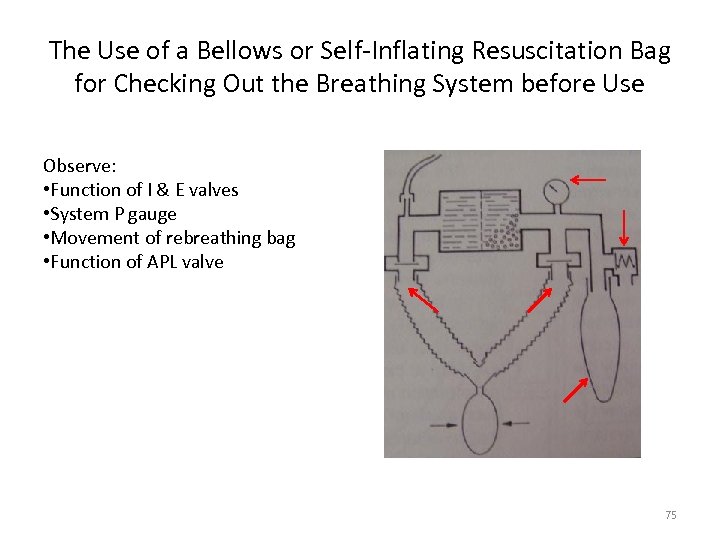 The Use of a Bellows or Self-Inflating Resuscitation Bag for Checking Out the Breathing System before Use Observe: • Function of I & E valves • System P gauge • Movement of rebreathing bag • Function of APL valve 75
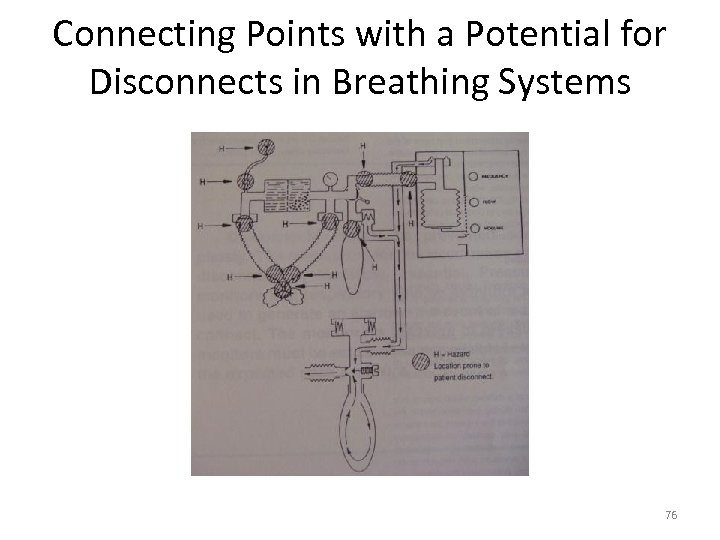 Connecting Points with a Potential for Disconnects in Breathing Systems 76
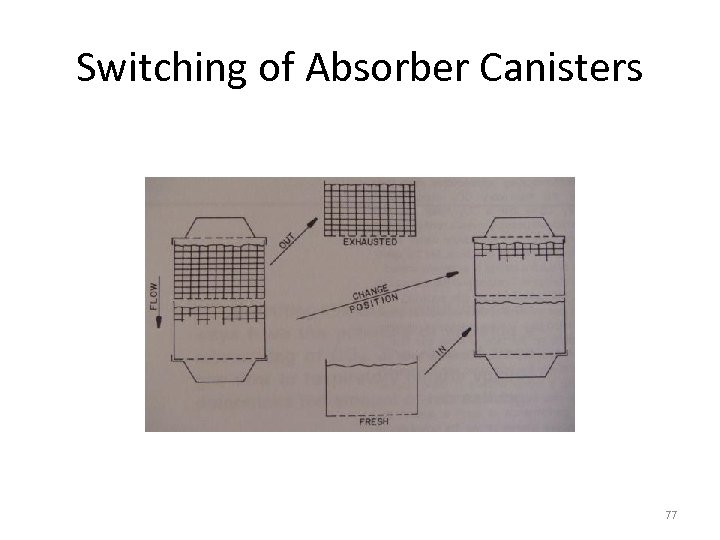 Switching of Absorber Canisters 77
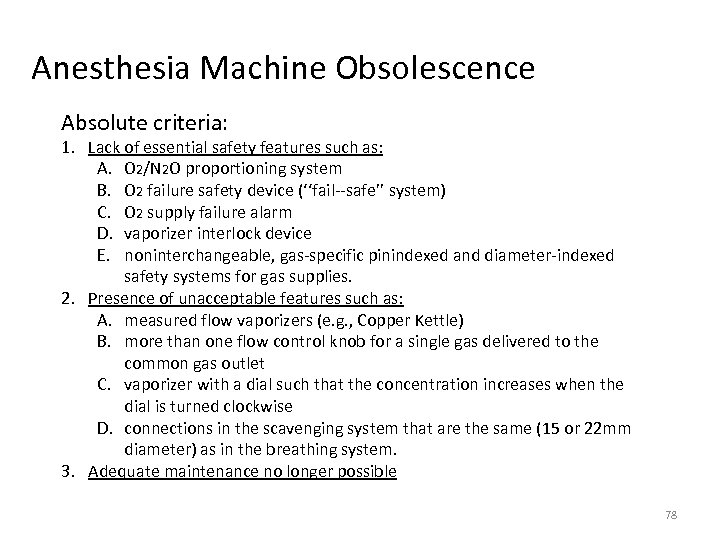 Anesthesia Machine Obsolescence Absolute criteria: 1. Lack of essential safety features such as: A. O 2/N 2 O proportioning system B. O 2 failure safety device (‘‘fail--safe’’ system) C. O 2 supply failure alarm D. vaporizer interlock device E. noninterchangeable, gas-specific pinindexed and diameter-indexed safety systems for gas supplies. 2. Presence of unacceptable features such as: A. measured flow vaporizers (e. g. , Copper Kettle) B. more than one flow control knob for a single gas delivered to the common gas outlet C. vaporizer with a dial such that the concentration increases when the dial is turned clockwise D. connections in the scavenging system that are the same (15 or 22 mm diameter) as in the breathing system. 3. Adequate maintenance no longer possible 78
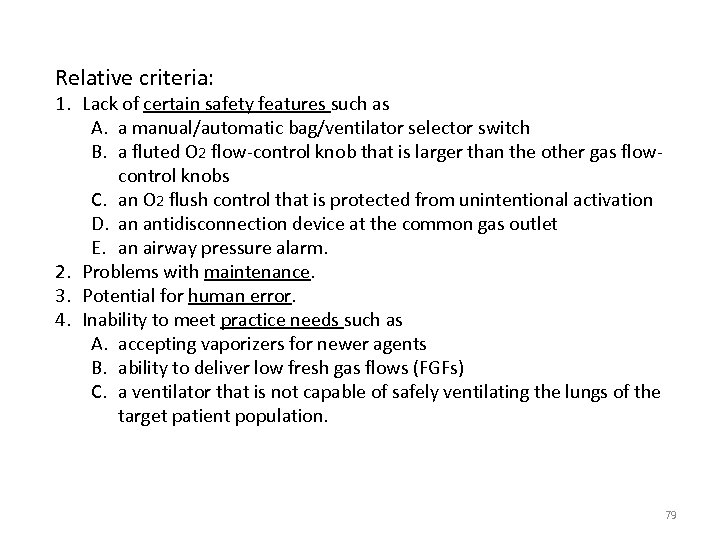 Relative criteria: 1. Lack of certain safety features such as A. a manual/automatic bag/ventilator selector switch B. a fluted O 2 flow-control knob that is larger than the other gas flowcontrol knobs C. an O 2 flush control that is protected from unintentional activation D. an antidisconnection device at the common gas outlet E. an airway pressure alarm. 2. Problems with maintenance. 3. Potential for human error. 4. Inability to meet practice needs such as A. accepting vaporizers for newer agents B. ability to deliver low fresh gas flows (FGFs) C. a ventilator that is not capable of safely ventilating the lungs of the target patient population. 79
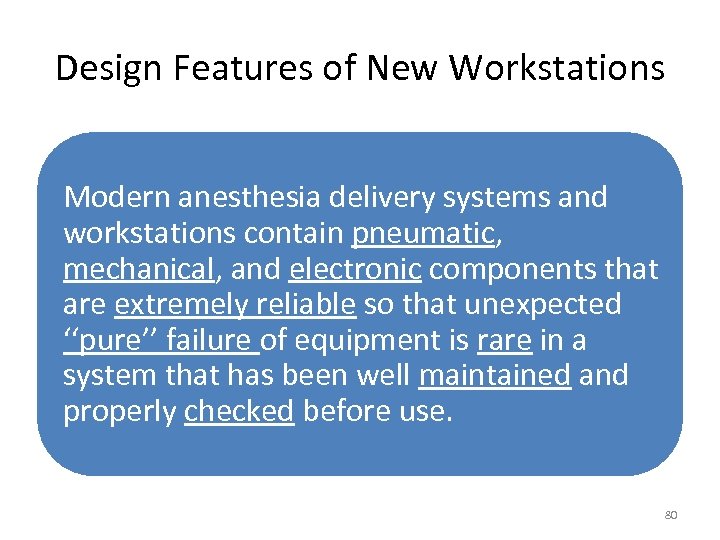 Design Features of New Workstations Modern anesthesia delivery systems and workstations contain pneumatic, mechanical, and electronic components that are extremely reliable so that unexpected ‘‘pure’’ failure of equipment is rare in a system that has been well maintained and properly checked before use. 80
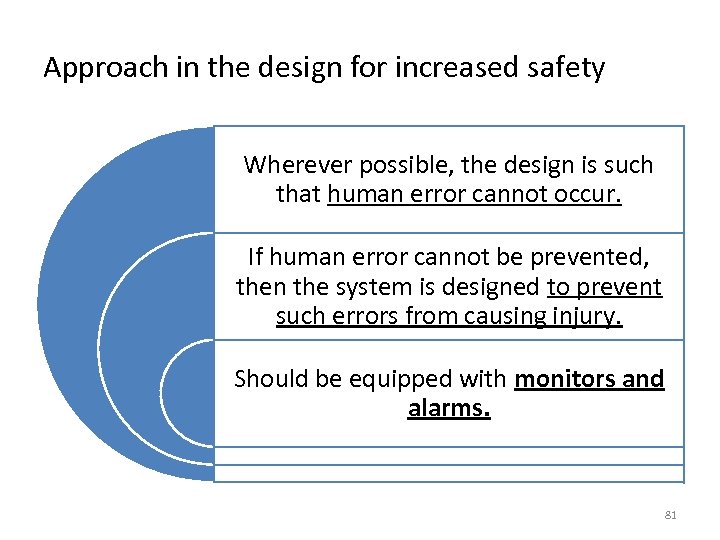 Approach in the design for increased safety Wherever possible, the design is such that human error cannot occur. If human error cannot be prevented, then the system is designed to prevent such errors from causing injury. Should be equipped with monitors and alarms. 81
 The Anesthesia Breathing System – Retaining devices – Connection is not accessible Design changes made • The bag-ventilator selector switch (older design: 5 steps, each step error) • PEEP valve: integrated component of the BS or built into the ventilator (older design: freestanding mistakenly placed into the inspiratory limb complete obstruction) • Hoses and connections (new design their number) • Fresh gas hose disconnection: prevented by: • Filters and humidifiers can become blocked • Failure to remove the plastic wrapping from facemasks or breathing circuits 82
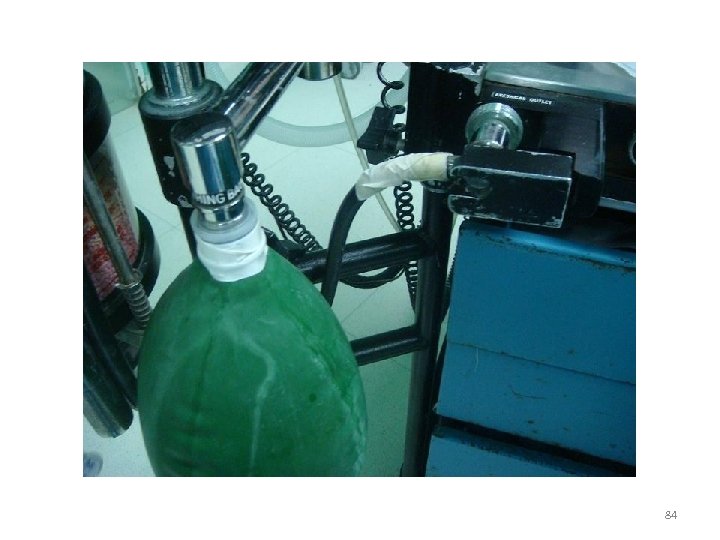
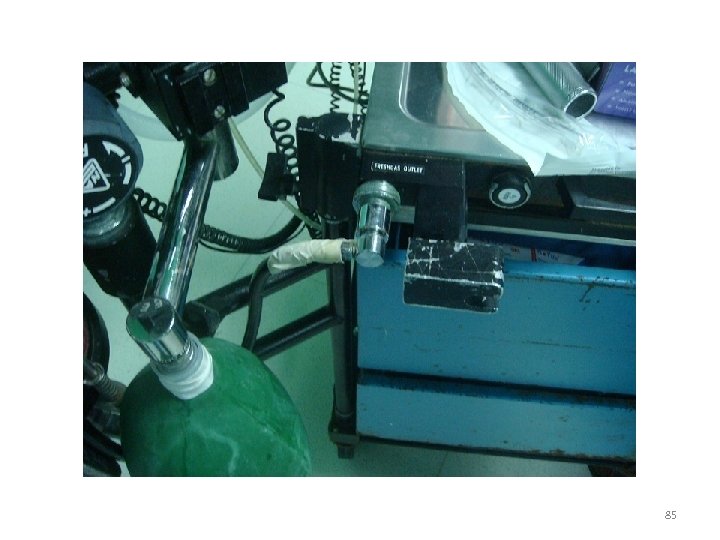
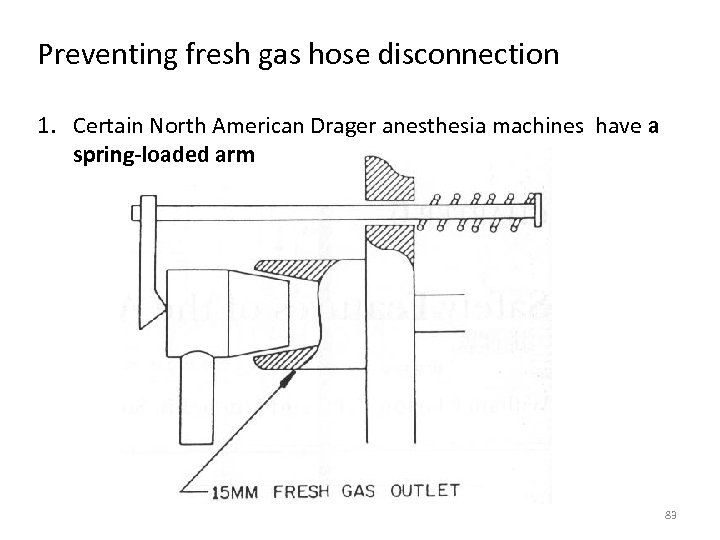 Preventing fresh gas hose disconnection 1. Certain North American Drager anesthesia machines have a spring-loaded arm 83
 84
84
 85
85
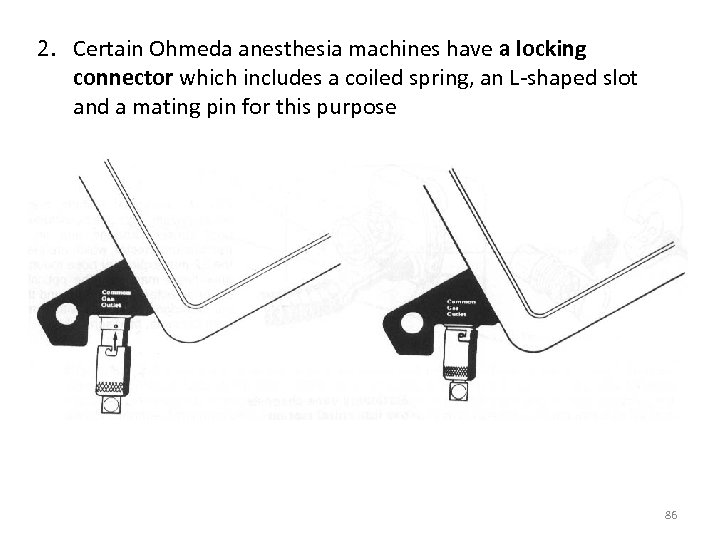 2. Certain Ohmeda anesthesia machines have a locking connector which includes a coiled spring, an L-shaped slot and a mating pin for this purpose 86
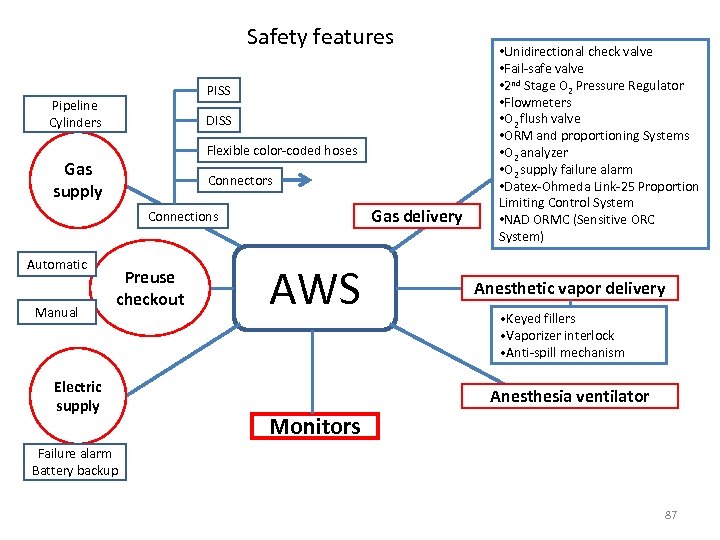 Safety features PISS Pipeline Cylinders DISS Flexible color-coded hoses Gas supply Connectors Gas delivery Connections Automatic Manual Preuse checkout Electric supply AWS • Unidirectional check valve • Fail-safe valve • 2 nd Stage O 2 Pressure Regulator • Flowmeters • O 2 flush valve • ORM and proportioning Systems • O 2 analyzer • O 2 supply failure alarm • Datex-Ohmeda Link-25 Proportion Limiting Control System • NAD ORMC (Sensitive ORC System) Anesthetic vapor delivery • Keyed fillers • Vaporizer interlock • Anti-spill mechanism Anesthesia ventilator Monitors Failure alarm Battery backup 87
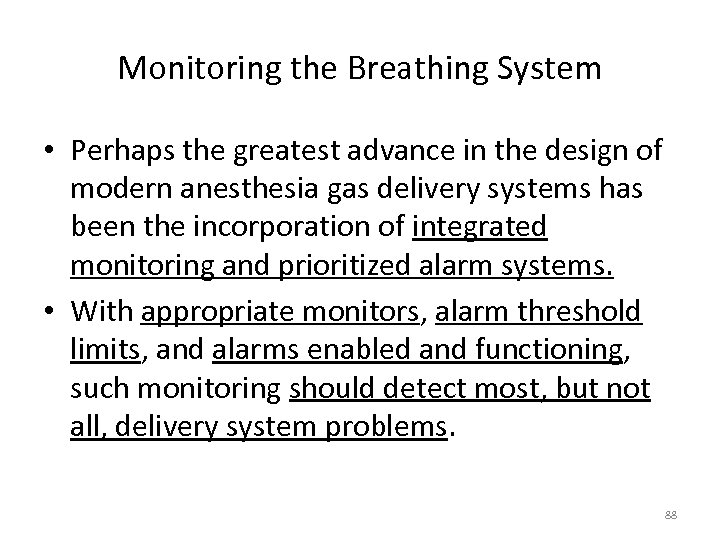 Monitoring the Breathing System • Perhaps the greatest advance in the design of modern anesthesia gas delivery systems has been the incorporation of integrated monitoring and prioritized alarm systems. • With appropriate monitors, alarm threshold limits, and alarms enabled and functioning, such monitoring should detect most, but not all, delivery system problems. 88
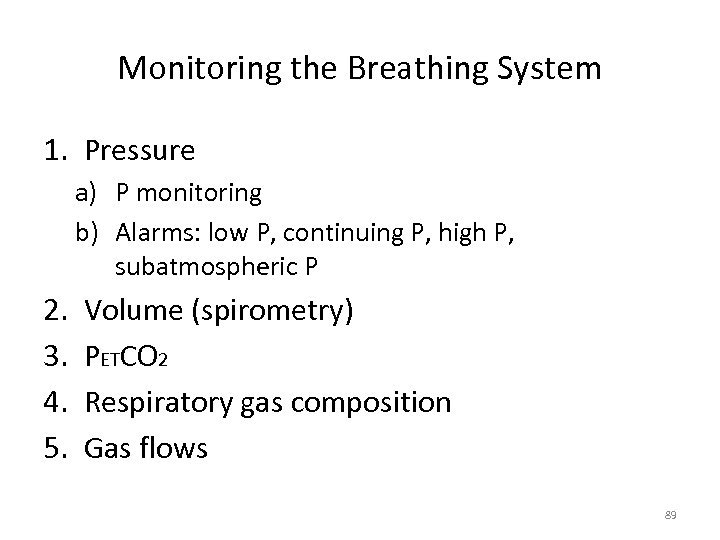 Monitoring the Breathing System 1. Pressure a) P monitoring b) Alarms: low P, continuing P, high P, subatmospheric P 2. 3. 4. 5. Volume (spirometry) PETCO 2 Respiratory gas composition Gas flows 89
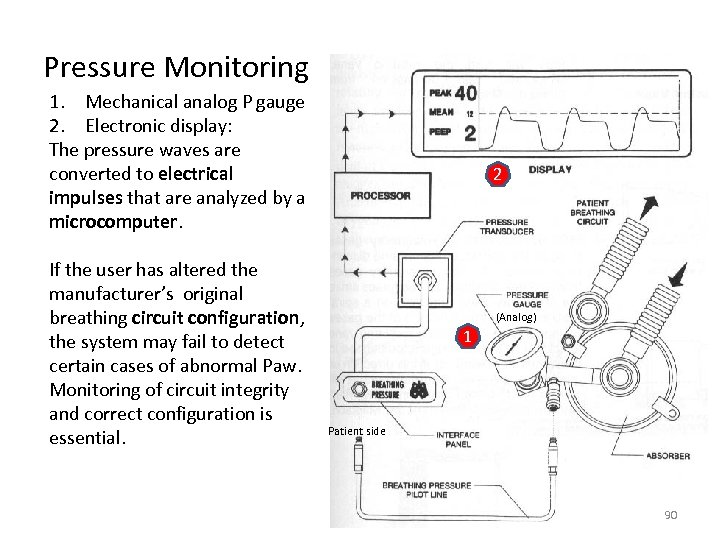 Pressure Monitoring 1. Mechanical analog P gauge 2. Electronic display: The pressure waves are converted to electrical impulses that are analyzed by a microcomputer. If the user has altered the manufacturer’s original breathing circuit configuration, the system may fail to detect certain cases of abnormal Paw. Monitoring of circuit integrity and correct configuration is essential. 2 (Analog) 1 Patient side 90
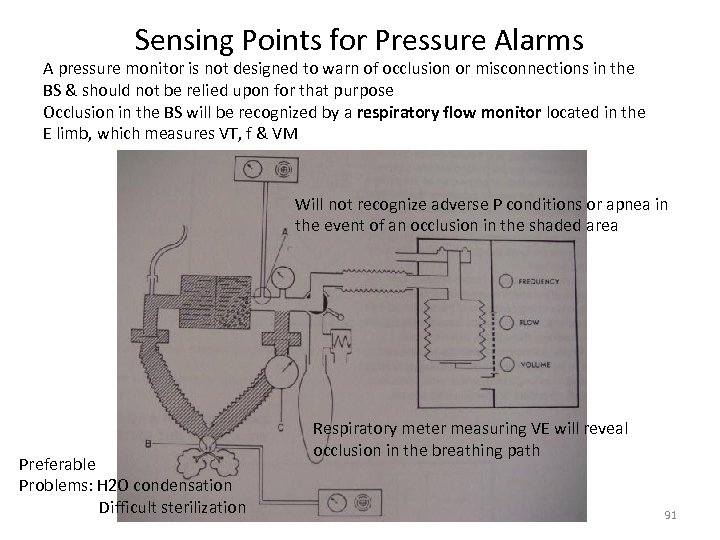 Sensing Points for Pressure Alarms A pressure monitor is not designed to warn of occlusion or misconnections in the BS & should not be relied upon for that purpose Occlusion in the BS will be recognized by a respiratory flow monitor located in the E limb, which measures VT, f & VM Will not recognize adverse P conditions or apnea in the event of an occlusion in the shaded area Preferable Problems: H 2 O condensation Difficult sterilization Respiratory meter measuring VE will reveal occlusion in the breathing path 91
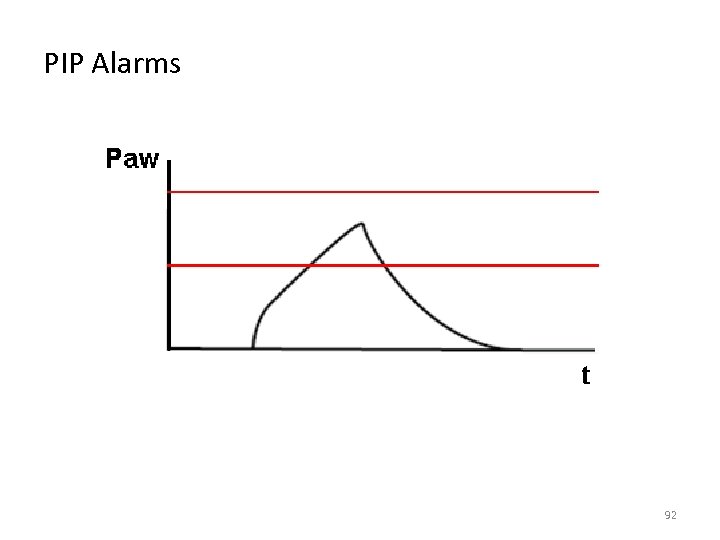 PIP Alarms 92
 High-Pressure Alarm • In new AWS, threshold can be adjusted by the user, with a default setting of 40 cm H 2 O – The ability to set the high-P limit to values of 6065 cm H 2 O may be necessary to permit adequate ventilation of patients whose lungs have C (stiff) • In some older models, it is not user-adjustable & have a threshold of 65 cm H 2 O too high to detect an otherwise harmful high-P 93
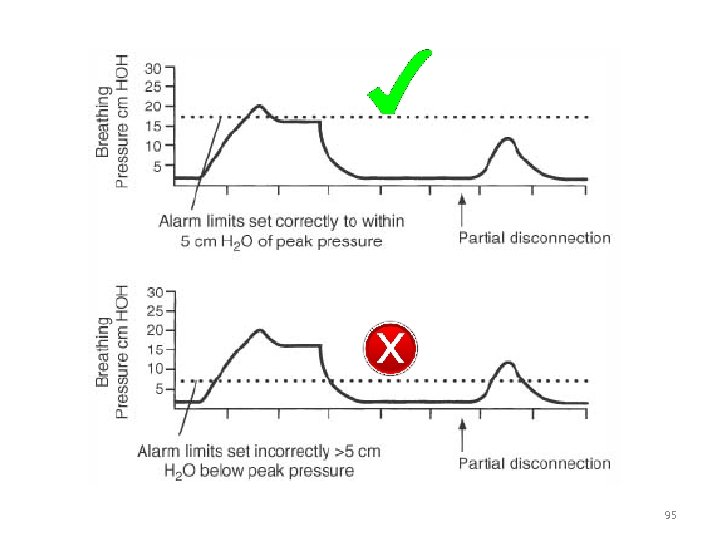
 Low-pressure Alarm (Low-pressure Monitor) • Sometimes have been called Disconnect Alarm (monitor). This is a misnomer because it monitors P. • An audible and visual alarm will be activated within 15 seconds when a minimum P threshold is not exceeded within the circuit. • This minimum P threshold should be adjusted to be just < PIP so that any slight will trigger the alarm (if not close to PIP a circuit leak or disconnect may go undetected). • A small-diameter ETT (e. g. , 3 -mm) might be pulled out. Because the tube has a high R (& P= Rx. F), the P in the circuit with each PPV may satisfy the low-P alarm threshold & the disconnect may go undetected by P monitoring. • Thus, NOT all disconnections can be detected with pressure actuated disconnect alarms. 94
 95
95
 • Display: – The circuit P waveform – High- and low-pressure alarm thresholds – The high-P alarm threshold can be adjusted by the user – The low-P alarm threshold can be: 1. Automatically enabled whenever the ventilator is turned on (new AWS) 2. Bracketed automatically to the existing PIP by pressing one button (auto limits) (new AWS) 3. Adjusted by the user (user-variable) (old models) 4. Provided by a limited choice of settings (manual set) (e. g. , 8, 12, or 26 cm H 2 O) (older models) may limit the monitor’s sensitivity to detect small decreases in PIP readjust the ventilator settings such that the PIP just exceeds one of the available low-P alarm limits 96
 Continuing Pressure Alarm • When > 10 cm H 2 O > 15 sec • Causes (gradual in circuit P): – Malfunction of the ventilator P-relief valve (stuck closed) – Waste gas scavenging system occlusion: the rate of P will depend on FGF rate 97
 Subatmospheric Pressure Alarm • Activated when P < -10 cm H 2 O • – -ve P barotrauma – -ve P pulmonary edema • May be the result of: – Spontaneous respiratory efforts (under MV) – Malfunctioning scavenging system – A side-stream sampling respiratory gas analyzer or capnography when FGF is inadequate – A suction catheter is passed into the airway – Suction is applied through the working channel of a fiberscope 98
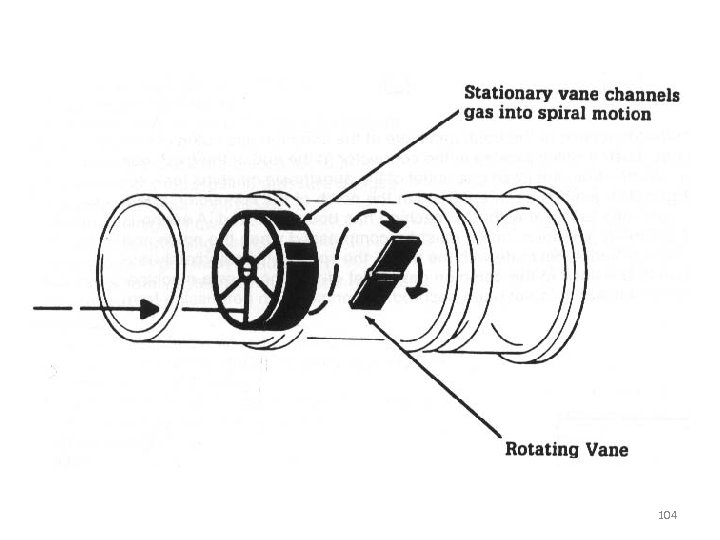
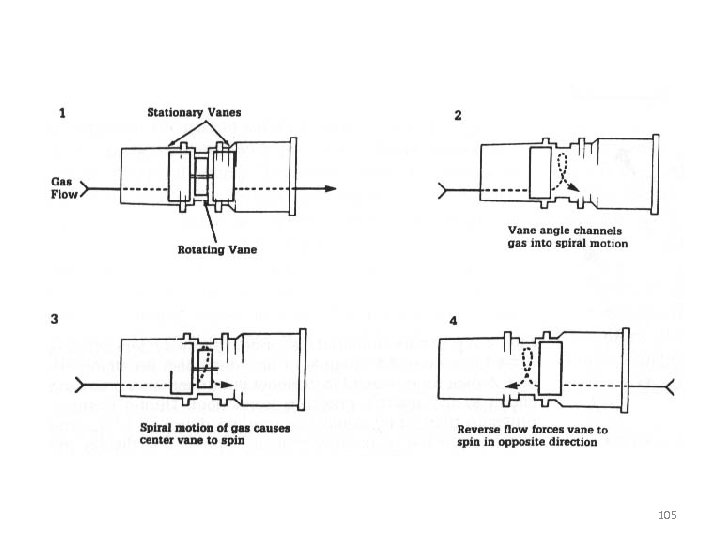
 Spirometry/Volume Monitoring • Exhaled VT & VM • Location: near the E unidirectional valve • Used to monitor: – Ventilation – Circuit integrity • Circuit disconnect → low VT alarm if appropriate limits have been set • In some older units the low-V alarm limit threshold may not be user-adjustable (e. g. , fixed at 80 ml). • Hanging bellows → disconnection may fail to trigger a low VT alarm 99
 • Because the spirometry sensor is usually placed by the E valve at the CO 2 absorber → it does not measure the actual I or E VT. It measures VE + V that has been compressed in the circle system tubing during I • High VT alarm is also useful. In older AWS: ↑GF entering the BS during I (when the BS is closed by closing the ventilator P-relief valve) → ↑VT. • This ↑may be due to: – FGF – ↑I: E – Through a hole in the bellows This is particularly hazardous for the pediatric patient 100
 • Modern electronic AWS incorporate features designed to ensure that the patient will always receive the intended VT • Automated checkout is performed to ensure that there are no leaks and to measure the C of the BS • FGD ensures that FGF does not VT • A spirometer that senses GF direction can alert to a situation of reversed GF (incompetent E valve, leak in the BS between the E valve and the spirometer) 101
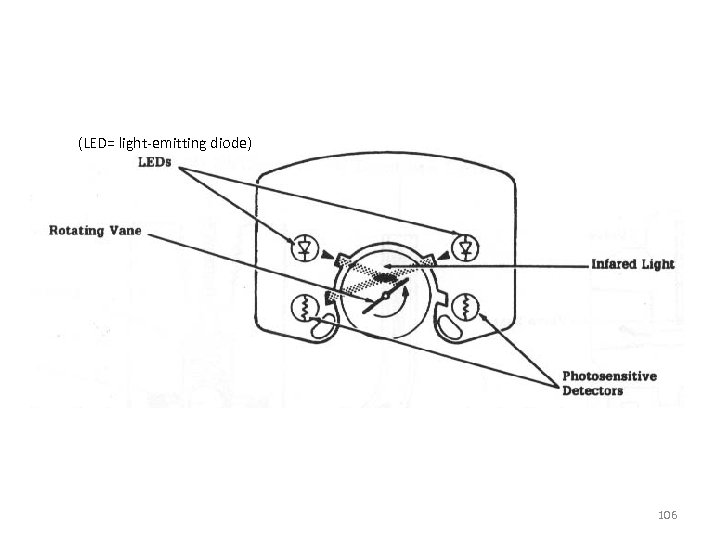
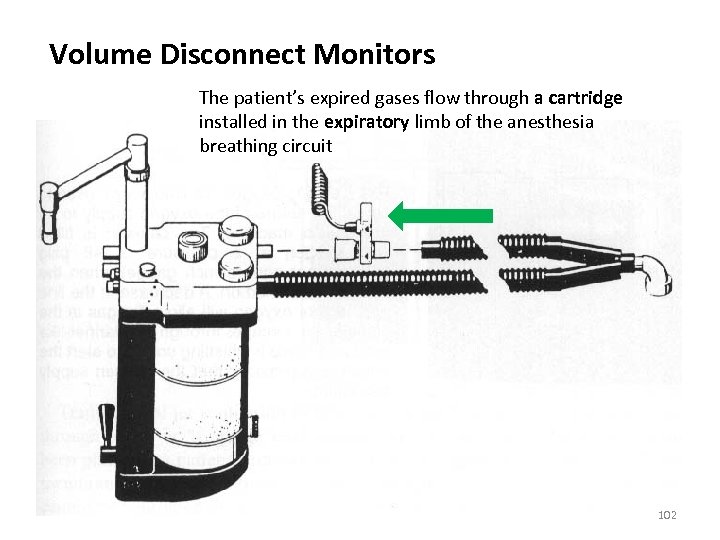 Volume Disconnect Monitors The patient’s expired gases flow through a cartridge installed in the expiratory limb of the anesthesia breathing circuit 102
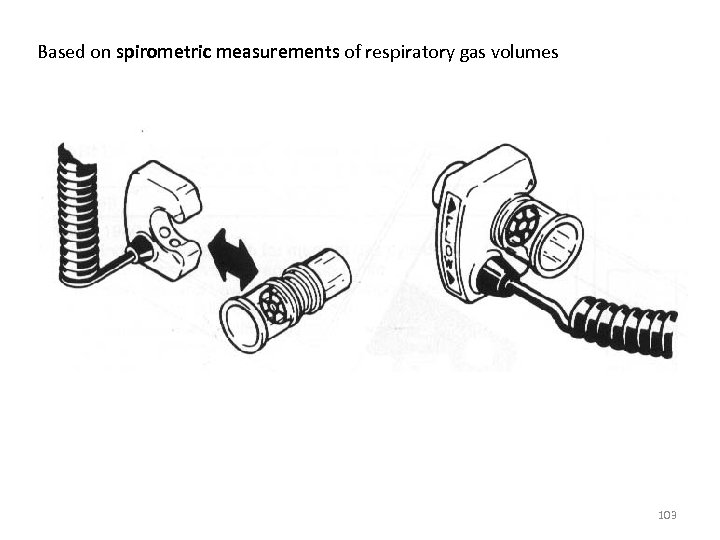 Based on spirometric measurements of respiratory gas volumes 103
 104
104
 105
105
 (LED= light-emitting diode) 106
 Gas Composition in the Breathing System • • • O 2 analyzer Capnography N 2 O Anesthetic agents Nitrogen 107
 Monitoring Gas Flows and Side Stream Spirometry • Side stream sampling (or diverting) gas analyzers are used to monitor I & ET % of CO 2, N 2 O & the anesthetic agent. • Gas is sampled from an adaptor close to the patient’s airway sampling tube analyzer BS or scavenging system • The addition of Pitot tube flow sensors monitoring of P, F, V & respired gas composition at the patient’s airway = side stream spirometry 108
 • VT and VM: I vs E detection of a leak distal to the airway adapter I-E difference may be due to: – Deflated TT cuff – Poorly fitting LMA • Loops: – F/V – P/V • With appropriate alarm limits greater patient safety because it is less likely to be deceived than are monitors whose sensors are remote from the patient’s airway 109
 • Rather than using the disposable Pitot tube F sensor placed by the airway, many AWSs use F sensors placed in the vicinity of the I & E unidirectional valves in the circle system. • These sensors measure the F into the I limb of the circle system during I and the F from the E limb during E. • The output of these sensors is compared and a difference may indicate a leak in the circuit. • In some AWSs, the sensors’ output is used to correct VT for changes in FGF and other aspects of ventilator control. 110
 Alarms • Problems with monitors or alarms: – Absent – Broken – Disabled – Ignored – Led to an inadequate response by the caregiver 111
 • Monitors should be: – User friendly – Automatically enabled when needed – Have alarm thresholds easily bracketed to prevailing “normal” conditions – Intelligent (smart) – Alarm signal should be appropriate in terms of: • Urgency • Specificity • Audibility (volume): should be tested & adjusted. The silencing of audible alarms (because “false alarms are annoying”) should be discouraged 112
 Other Potential Problems: Fires from interactions of anesthetics with desiccated absorbent • Sevoflurane CO & flammable gases • Baralyme +: – Sevoflurane >200 C fire – Desflurane & Isoflurane 100 C So, baralyme has been withdrawn from the market • Soda lime: strong base than baralyme hazard • Less basic CO 2 absorbents are now available; e. g. , Amsorb: – No strong base (Na, K, or Ba hydroxides) – It changes color from white to pink when desiccated 113
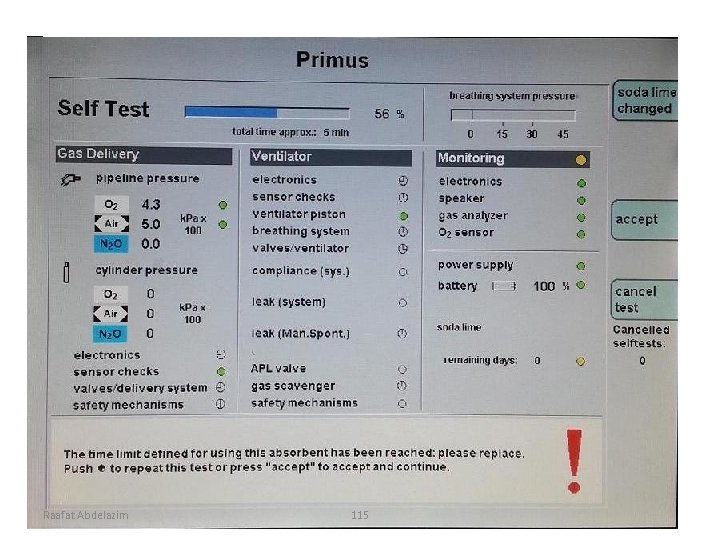
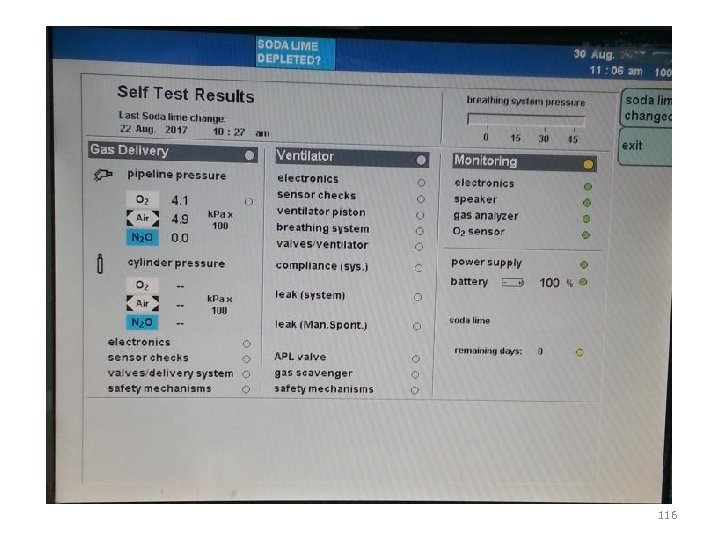
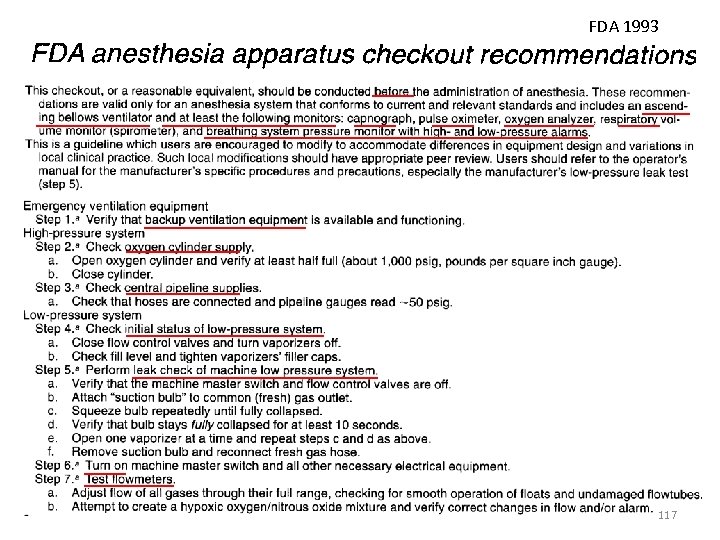
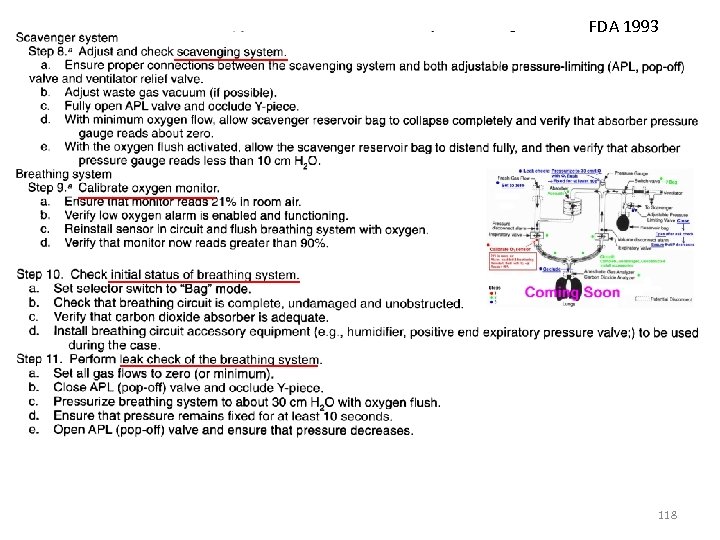
 Preuse Checkout 114
 Raafat Abdelazim 115
 116
116
 FDA 1993 117
 FDA 1993 118
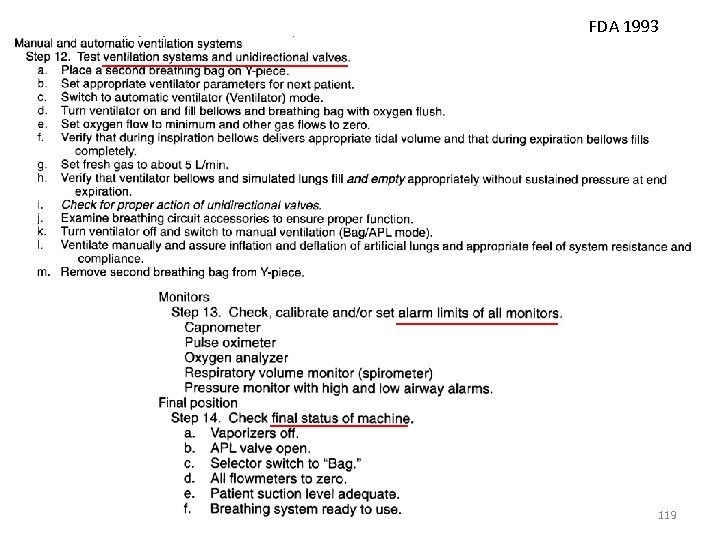 FDA 1993 119
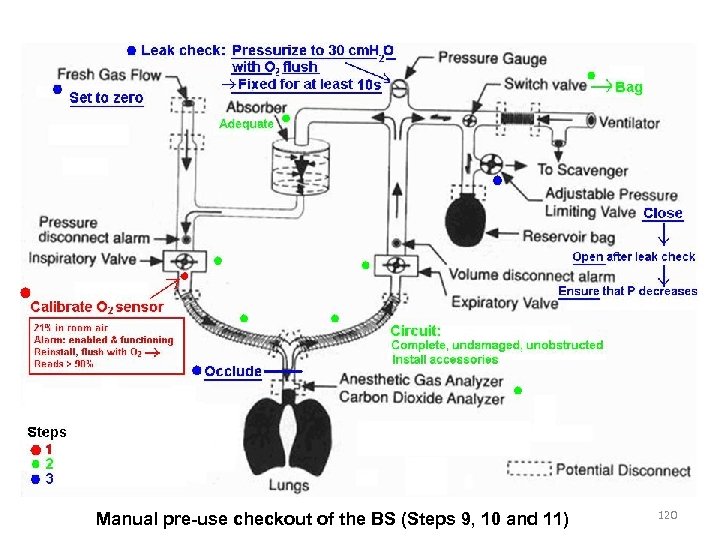 Manual pre-use checkout of the BS (Steps 9, 10 and 11) 120
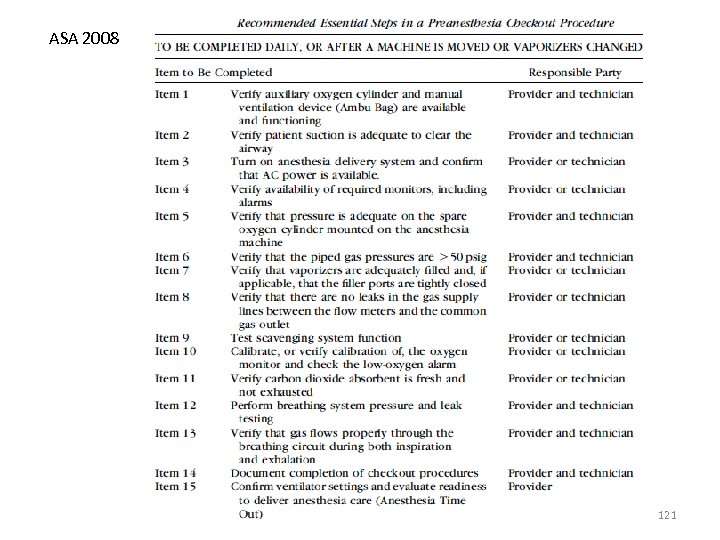 ASA 2008 121
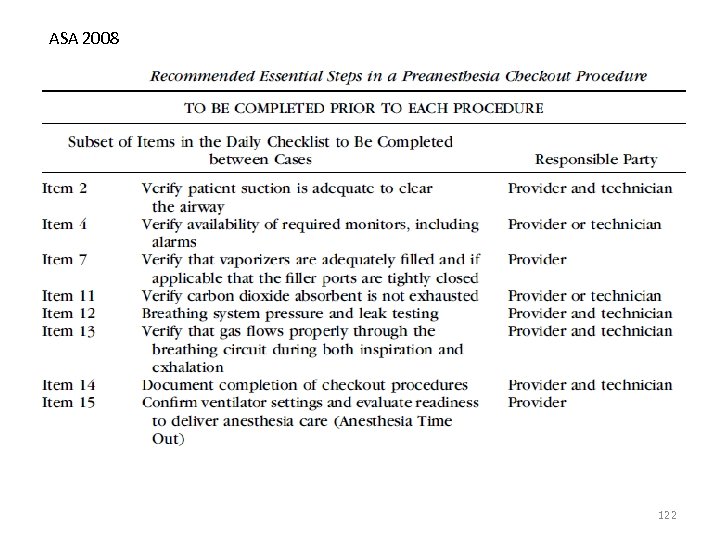 ASA 2008 122
 Although the new electronic AWSs provide an automated checkout, some steps in the preuse checkout must be performed by the user because they cannot be automated. It is essential that the user understand what these procedures are and perform them correctly. For example, the oxygen tank must be opened and then closed for the tank pressure to be measured. 123
 • • Although an automated preuse checkout can pressurize the BS, check for leaks, and measure C, it cannot check for correct assembly of the BS and possible misconnections of the hoses. Thus, in the 2008 preuse checkout guidelines, item 13 (‘‘Verify that gas flows properly through the breathing circuit during both I & E’’) is an essential step. A 3 -L bag should be connected at the Y-piece of the breathing circuit to simulate a model lung. Squeezing and releasing the reservoir bag in manual (bag) mode and operation of the ventilator (in automatic mode) should result in inflation and deflation of the model lung and verify presence and correct operation of the I & E unidirectional valves. 124
 New Workstation Designs: New Problems • Some AWSs use FGD to ensure that changes in FGF do not affect the desired (set) VT delivered to the patient’s airway. • With FGD, during the I phase of IPPV, only gas from the piston chamber (Drager) or hanging bellows (Anestar) is delivered to the I limb of the circle system because the decoupling valve closes to divert FG into the reservoir bag. • The FGD circuits differ from the traditional circle system in function and therefore may be associated with different problems, including detection of an air entraining leak in the BS and failure of the FGD valve resulting in failure to ventilate. 125
 • The new AWSs incorporate many more electronic systems than their predecessors. These systems sometimes fail and render the AWS nonfunctional. The user must understand how to proceed in the event of a power loss. • In addition, the electrical systems are sometimes the cause of a fire or smoke condition 126
 Thank you http: //telemed. shams. edu. eg/moodle 127