


 Скачать презентацию Dental Informatics Dental Research Making the Connection
a0659d7a1ee37c8b5ed44125a2e5dbc8.ppt
- Количество слайдов: 53
 Dental Informatics & Dental Research: Making the Connection NIH June 12 -13, 2003 Bethesda, MD
 Standards in Dental Informatics American Dental Association Standards Committee on Dental Informatics
 The Wit and Wisdom of Forest Gump If you don’t know where you are goin’, you will probably not wind up there.
 Do We Really Need Standards YES!
 Why are U. S. railroad tracks 4 feet eight and 1/2 inches apart? n n n They were designed by Scottish engineers To match the width of wagon wheels That fit in the wheel ruts on British roads Made by Roman war chariots That were as wide as two horses’ rear ends
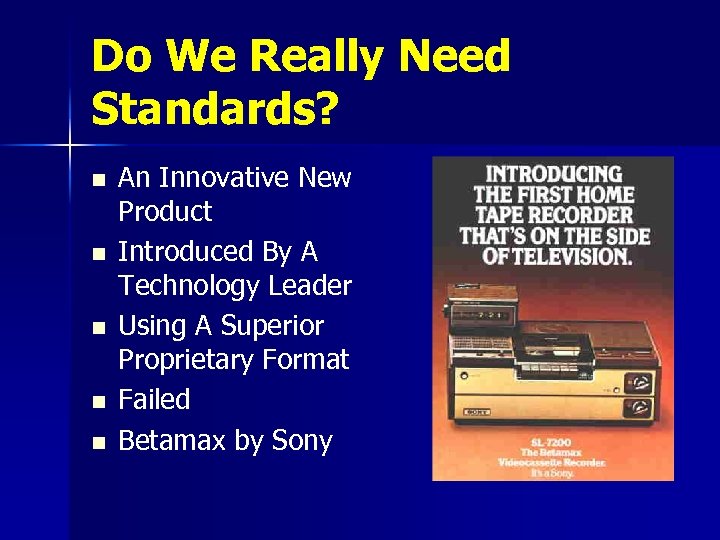 Do We Really Need Standards? n n n An Innovative New Product Introduced By A Technology Leader Using A Superior Proprietary Format Failed Betamax by Sony
 Why Does the ADA Support Standards? Evaluation criteria for products provide: – Enhanced safety and health – Greater selection of products – Easier choices n Better and consistent quality n Lower costs for members n
 Organization
 Organization ADA sponsors the only standards programs whose scope exclusively addresses dentistry n Administered by Department of Standards Administration n Administration of all standards activities is centralized n ADA Councils approve standards for the ADA and recommend experts n
 HIPAA recognition. . . Recognized for contribution to electronic standards in legislation n Designated as dental procedure code source n Asked to serve as dental content committee n Continuing role as the only professional association consulting to the Secretary n
 Other Government Impact. . . n n n FDA recognition of voluntary consensus standards in lieu of a 510(k) OMB Circular A-119 recommends government agencies adoption of voluntary consensus standards National Technology Transfer Act recommends government agencies adoption of voluntary consensus standards
 SCDI Membership Balance of interests between consumer, producer, and general interest n SCDI members are organizations n Organizations appoint a representative to “represent” the organization n Representative brings the organization’s views and objectives to the SCDI and visa versa n
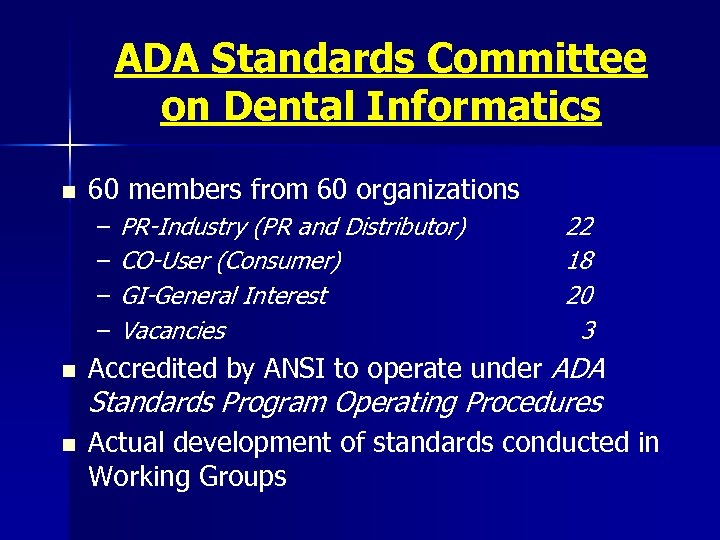 ADA Standards Committee on Dental Informatics n 60 members from 60 organizations – – n n PR-Industry (PR and Distributor) CO-User (Consumer) GI-General Interest Vacancies 22 18 20 3 Accredited by ANSI to operate under ADA Standards Program Operating Procedures Actual development of standards conducted in Working Groups
 Standards Committee Procedures n Standards Committee Operating Procedures – Approved by ADA Board of Trustees in February 1999 n Accredited by ANSI as a Std Development Organization (SDO) in 2001
 What is a Standard? n A document that: – Defines or provides specific technical requirements for a material, product, process, procedure, service, policy, etc. – Provides definitions dimensions, terminology, symbols, test methods, performance or safety requirements, etc. – Is clear, concise, unambiguous and easily understood by those not involved in its development
 What is a Technical Report? n A document that: – Is informational in nature – May describe a new technology – May provide information on “state of the art” – May be used in conjunction with an American National Standard – May provide implementation advice about a standard
 What a Standards Committee is not…. A Data Content Committee n A developer of dental codes and related terminologies n A developer of diagnostic codes n
 ANSI Accreditation Requires. . . n Balance of interests – Consumer, General Interest, Vendor Open to all interested parties n Consensus documents n Due Process n Written Procedures n
 As a Result…. . n All documents developed by the ADA Standards Committees are eligible to become approved American National Standards or registered as ANSI Technical Reports
 Informatics Committee Scope “To promote patient care and oral health through the application of information technology to dentistry’s clinical and administrative operations; to develop standards, specifications, technical reports, and guidelines for components of a computerized dental clinical workstation;
 Informatics Committee Scope n electronic technologies used in dental practice; and interoperability standards for different software and hardware products which provide a seamless information exchange throughout all facets of healthcare. ”
 SCDI Organization n n 4 Subcommittees with 18 Working groups Subcommittee 10, Dental Informatics Architecture and Devices – 8 Working Groups, 17 work items n Subcommittee 11, Electronic Health Records – 4 Working Groups, 5 work items n Subcommittee 12, Informatics Component Interoperability in Dentistry – 4 Working Groups, 4 work items n Subcommittee 13, Electronic Dissemination of Dental Information – 2 Working Groups, 2 work items
 SCDI Subcommittees n Subcomm 10 - Dental Informatics Architecture and Devices – Dr. Scott Trapp, Chairman n Subcomm 11 - Electronic Dental Records – Dr. Mark Diehl, Chairman
 SCDI Subcommittees n Subcomm 12 - Informatic Component Interoperability in Dentistry – Dr. Brent Dove, Chairman n Subcomm 13 - Electronic Dissemination of Dental Information – Dr. Gary Guest, Chairman
 SCDI Subcomm 10 Dental Informatics Architecture n Scope: To develop and promote standards for the device physical architecture, device-system physical interface, device-system informatics interface (API), system architecture, and information architecture.
 SCDI Subcomm 10 Projects WG 10. 1 - Infection Control for Dental Information Systems- Spec 1006 n WG 10. 2 - Hardware Recommendations for Dental Information Systems- TR 1012 n WG 10. 3 - Dental Information Systems Security and Safeguards n
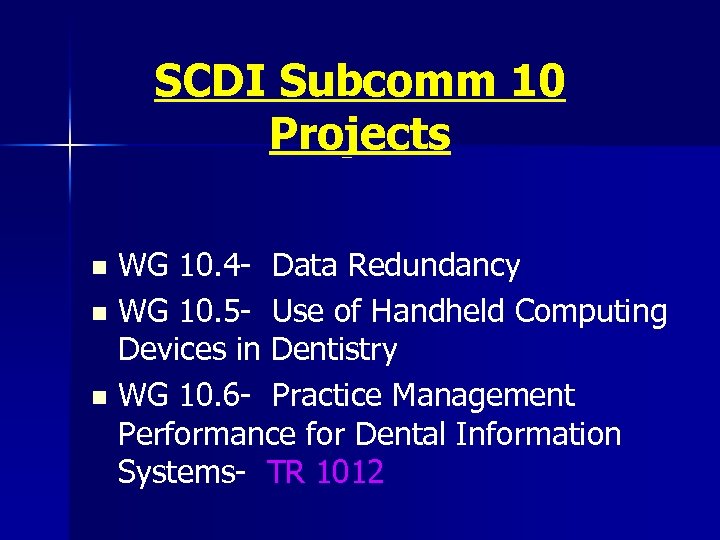 SCDI Subcomm 10 Projects WG 10. 4 - Data Redundancy n WG 10. 5 - Use of Handheld Computing Devices in Dentistry n WG 10. 6 - Practice Management Performance for Dental Information Systems- TR 1012 n
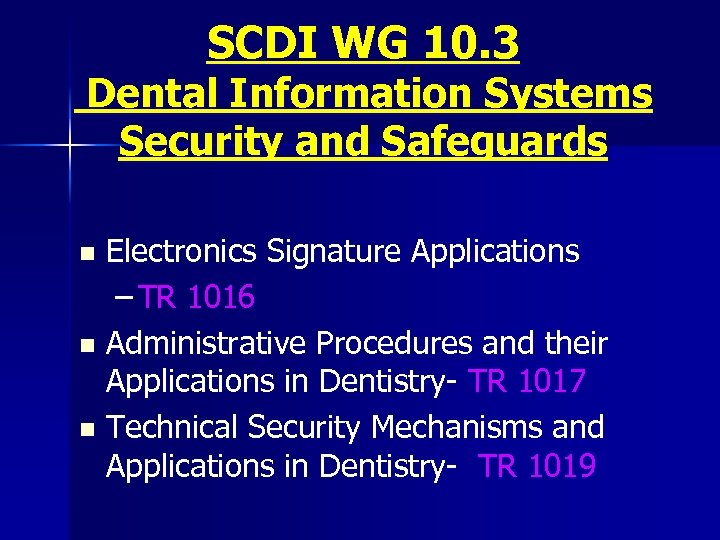 SCDI WG 10. 3 Dental Information Systems Security and Safeguards Electronics Signature Applications – TR 1016 n Administrative Procedures and their Applications in Dentistry- TR 1017 n Technical Security Mechanisms and Applications in Dentistry- TR 1019 n
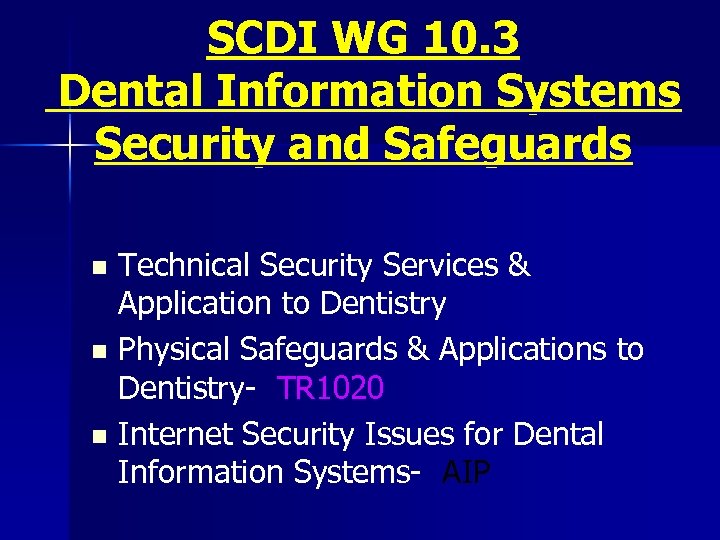 SCDI WG 10. 3 Dental Information Systems Security and Safeguards Technical Security Services & Application to Dentistry n Physical Safeguards & Applications to Dentistry- TR 1020 n Internet Security Issues for Dental Information Systems- AIP n
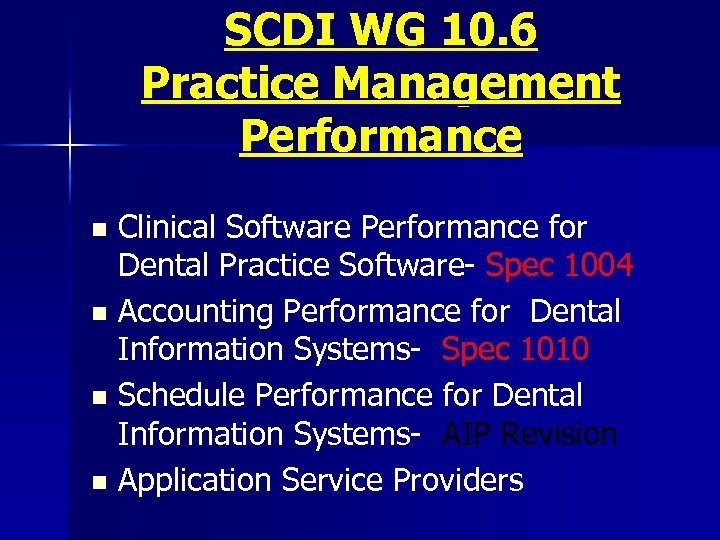 SCDI WG 10. 6 Practice Management Performance Clinical Software Performance for Dental Practice Software- Spec 1004 n Accounting Performance for Dental Information Systems- Spec 1010 n Schedule Performance for Dental Information Systems- AIP Revision n Application Service Providers n
 SCDI Subcomm 11 Electronic Health Record n Scope: To develop and promote standards for the electronic health record.
 ANSI/ADA Specification 1000 Standards Clinical Architecture for the Structure and Content of an Electronic Record n Specification approved by ANSI in February 2001 - Spec 1000 n
 ANSI/ADA SPEC 1000 Standard Clinical Data Architecture for the Structure & Content of an Electronic Health Record 19 separate parts n Not specifically made for dentistry n Can encompass all healthcare n Does not include coding n
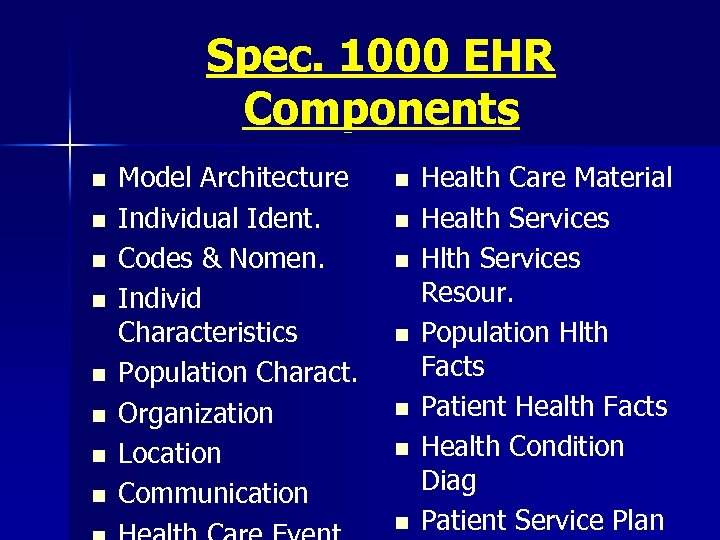 Spec. 1000 EHR Components n n n n Model Architecture Individual Ident. Codes & Nomen. Individ Characteristics Population Charact. Organization Location Communication n n n Health Care Material Health Services Hlth Services Resour. Population Hlth Facts Patient Health Facts Health Condition Diag Patient Service Plan
 Building a database is a lot like building a house Dr. Mark Diehl Computer Sciences Corporation 4/24/2003
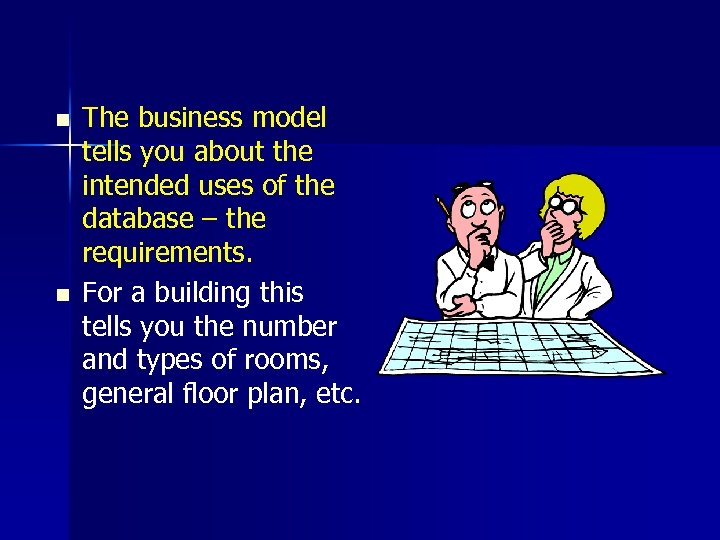 n n The business model tells you about the intended uses of the database – the requirements. For a building this tells you the number and types of rooms, general floor plan, etc.
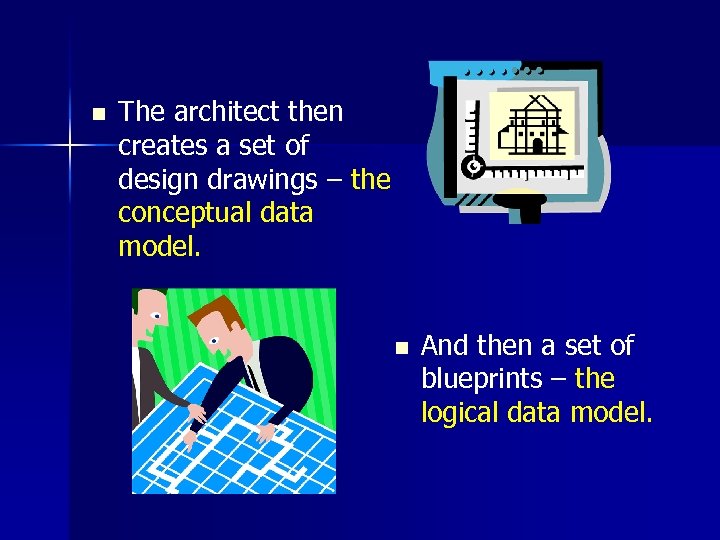 n The architect then creates a set of design drawings – the conceptual data model. n And then a set of blueprints – the logical data model.
 n The local construction code tells the architect and builder about what can be built – these are the internal data standards.
 n The data dictionary is the bill of materials, obtained from a warehouse, the metadata repository.
 n The builder uses the blueprints to construct the house, with the details, like types of doors and windows, wall colors, floors, etc. customized to the buyer’s needs, just like the database developer transform the logical data model, into a database tailored to the system’s functional requirements.
 • The implementation guide shows the database developer how to use the logical data model to create a database, just like a “how to” book tells a workman how to perform his trade.
 n And finally, when you move in, and place your furniture and belongings, you populate the database.
 Subcomm 11 Working Groups WG 11. 1 - Standard Clinical Architecture – TR 1027 - Implementation Guide for the Electronic Health Record n WG 11. 2 - Consumer Guide to the Electronic Dental Record n WG 11. 3 - Universal Data Archive File n
 SCDI Subcomm 12 Informatic Component Interoperability n Scope: To develop and promote standards for informatic component interoperability in dentistry.
 Subcomm 12 Projects Informatic Component Interoperability n WG 12. 1 - Application of the DICOM Standard to Dentistry n WG 12. 2 - Task-Related Testing of Digital Radiographic Systems
 Subcomm 12 Projects Informatic Component Interoperability n WG 12. 4 - Guide to Digital Dental Photography & Imaging- AIP n WG 12. 5 - Dental Inter-Application Communication
 SCDI Subcomm 13 Electronic Dissemination of Information n Scope: Develop and promote standards for quality, consistency, accuracy, security and functionality of health related information, knowledge representation and dissemination of information.
 SCDI Subcomm 13 Electronic Dissemination of Dental Information n WG 13. 1 - Educational Software Used in Electronic Media n WG 13. 3 - Research Applications in Dental Informatics
 ANSI/ADA Specification 1001 Guidelines for Design of Education Software Approved by ANSI in August 2002 n Purpose to promote quality in educational software n Not domain-specific n
 Specification 1001 Titus Schleyer & Lynn Johnsonauthors n Developers can use to ensure products are of high instructional quality during development & evaluation n End users can compare education software programs n Authors have derived validated rating instruments for use n
 Consequences for not participating. . . n Dentists could be burdened with programs and systems adapted to dentistry rather than developed for dentistry n Better to be proactive than reactive
 For Additional Information n American Dental Association. Department of Standards Administration n Anyone can become a member of a working group n www. ada. org/scdi
 Thank you!