


 Скачать презентацию Density Discussion of the pressures and impacts
2f1142bfc2e8533cfdaccc583e6d0113.ppt
- Количество слайдов: 20
 Density • Discussion of the pressures and impacts from high (and low) population densities • Impacts from the requirements generated by dense populations in small areas – recreation tends to be under pressure and therefore different responses evolve
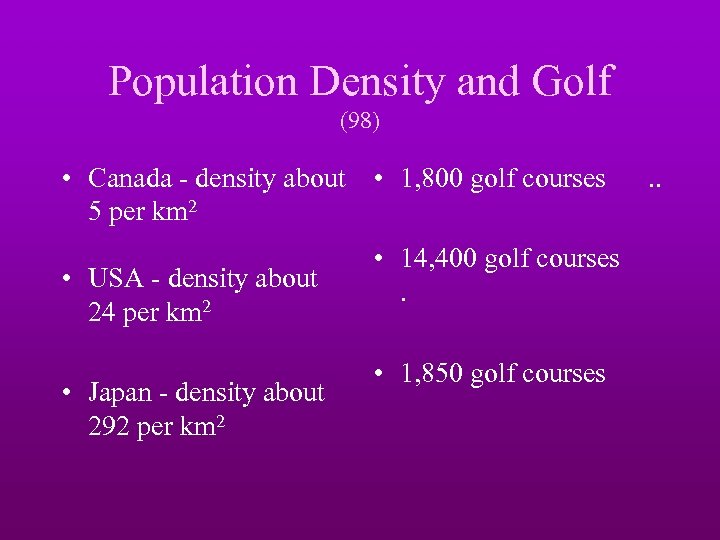 Population Density and Golf (98) • Canada - density about • 1, 800 golf courses 5 per km 2 • USA - density about 24 per km 2 • Japan - density about 292 per km 2 • 14, 400 golf courses. • 1, 850 golf courses . .
 Golf in Japan • In 1957 Japanese golfers won the world cup - the popularity of the sport exploded • In 1998 Japan was the second largest market in the world for golf equipment • In a population of 120 million only 2% can play with any regularity
 Pressure • Public greens fees start at $250 (US) – golfers can purchase rain insurance • Private clubs start an initiation fee at $200, 000 • Tokyo’s Koganei Club has an initiation fee of $2. 5 million (US)
 Response • Multi-storied driving ranges and driving ranges on the roofs of high rise office towers • Computerized indoor golf courses • Travel - to the USA (esp. Hawaii) and BC • Buy courses
 • From 1994 to 1997 Japanese companies spent over $2 Billion (US) acquiring US golf courses • Japanese firms control all of Hawaii’s golf courses • Japanese money is a key player in the PGA, LPGA, and USPGA tours
 Vital Rates • Birth and Death rates in a society – rates at which people are added (through natality) or subtracted (through mortality) – usually expressed per 1, 000 pop. • No accounting of age or sex – important - link with pressure on facility development within and outside recreation
 Sex Ratios • Number of males to 100 females in a society – expectation of balance • imbalance - more males in earlier years, leveling out in the 40’s and female dominance after – link to higher death rates for males and link to activity choice and expectations
 Age Splits • Distribution amongst age groups • Expectation of variance • Link - age to patterns and characteristics (of recreational choices and participation)
 Dependency Ratios • Two major ratios are OADR (old age dependency ratio) and YDR (youth dependency ratio) – Comparison to the ‘working population’ aged 15 - 64 • Combination in the TDR (total dependency ratio • All have links to facility development
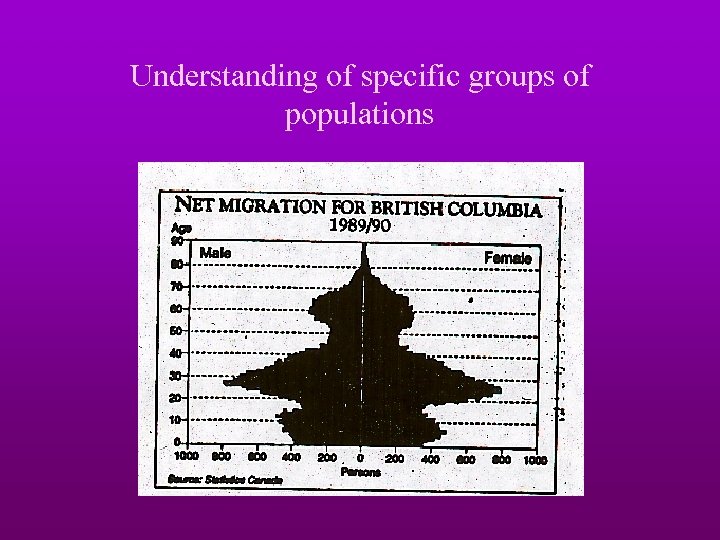
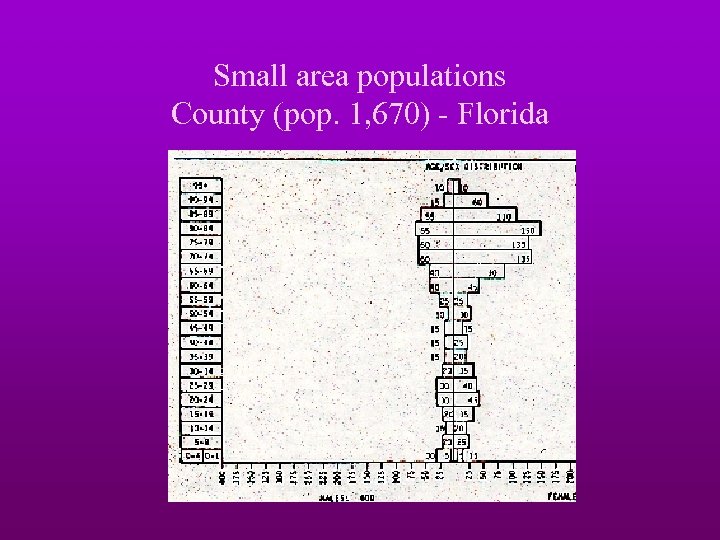
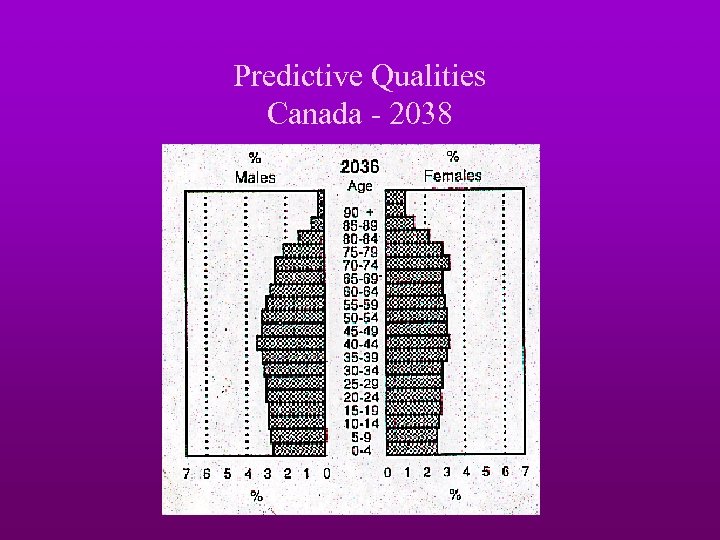
 Population Pyramids • Double bar graph that looks at age and sex – advantage in simplicity • graph split into a left half (males) and a right half (females) • the vertical axis represents age groupings (link to census) • the horizontal axis deals with population numbers or % of population
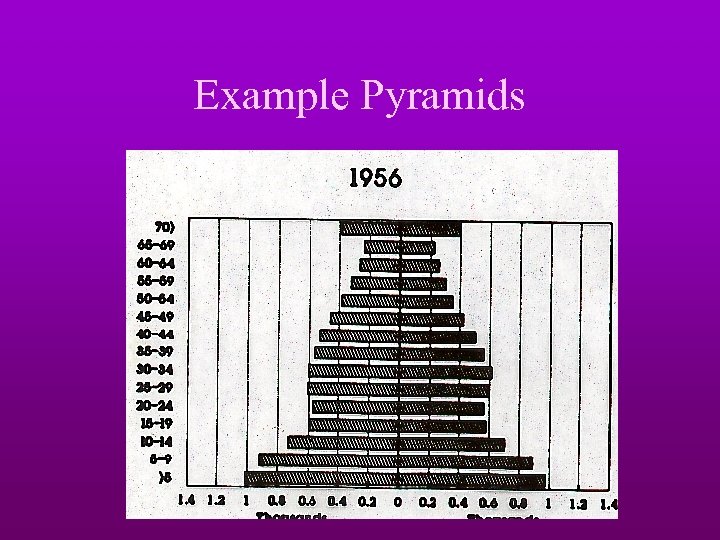 Example Pyramids
 Advantages 1 Easy to read 2 Quick impressions 3 Large ‘scars’ or differences show up well 4 Has ‘sense’ of prediction built in
 Disadvantages 1 Small differences do not ‘jump out’ 2 Utility declines for small, volatile (migration) areas
 Understanding of specific groups of populations
 Small area populations County (pop. 1, 670) - Florida
 Predictive Qualities Canada - 2038
 Canadian Population to the 90’s • The history of population growth in Canada has been one of ebbs and flows – migrants enter in waves through ‘attractive’ times – migrants dribble away in less ‘attractive’ times • 1851 - 1951 7. 1 million immigrants but 6. 6 million emigrants
 Traditional Comprehension • The Vital Rates are key to understanding the system – major factor is the CBR – migration has impact but is more an influence on CBR, sex ratios, and age structure
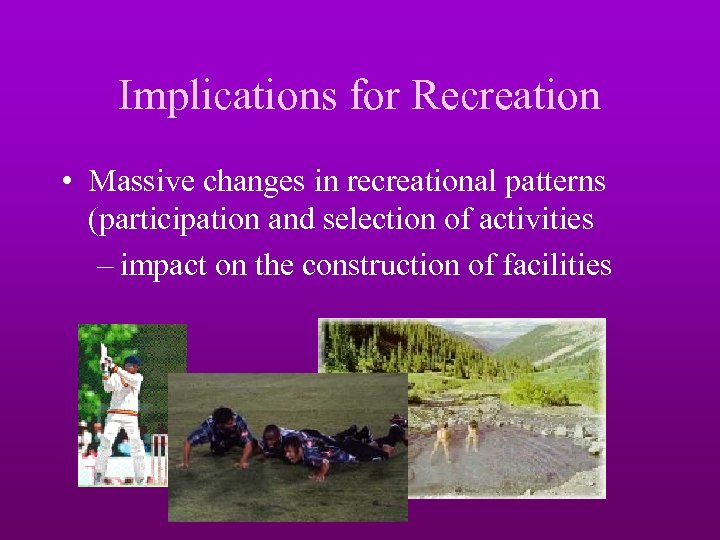 Implications for Recreation • Massive changes in recreational patterns (participation and selection of activities – impact on the construction of facilities