


 Скачать презентацию Denial of Services Dos What is Do
76b73f1ef398d0c1ffe65479fc4c46d0.ppt
- Количество слайдов: 24
 (Denial of Services) Dos
 What is Do. S Attack • A Do. S attack can disrupts or completely denies service to legitimate users, networks, systems, or other resources. ” • Can last from a few minutes to several days
 Types of Do. S l Bandwidth Consumption ¡ Network Flooding l. T 3 vs. 56 K ¡ Amplifying Attack l. Using multiple sites for attack
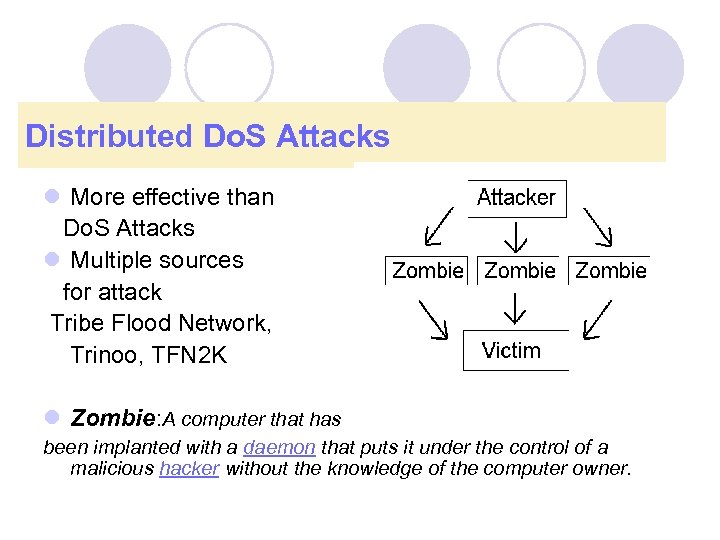 Distributed Do. S Attacks l More effective than Do. S Attacks l Multiple sources for attack Tribe Flood Network, Trinoo, TFN 2 K l Zombie: A computer that has been implanted with a daemon that puts it under the control of a malicious hacker without the knowledge of the computer owner.
 Some History BP (Before Pain) – Pre - 1990 ¡Do. S Tools: l. Single-source, single target tools l. IP source address spoofing l. Packet amplification (e. g. , smurf) ¡Deployment: l. Widespread scanning and exploitation via scripted tools l. Hand-installed tools and toolkits on compromised hosts (unix) ¡Use: l. Hand executed on source host
 The danger grows - 1999 ¡Do. S Tools: l. Multiple-source, single target tools l. Distributed attack networks (handler/agent) l. DDo. S attacks ¡Deployment: l. Hand-selected, hard-coded handlers l. Scripted agent installation (unix)
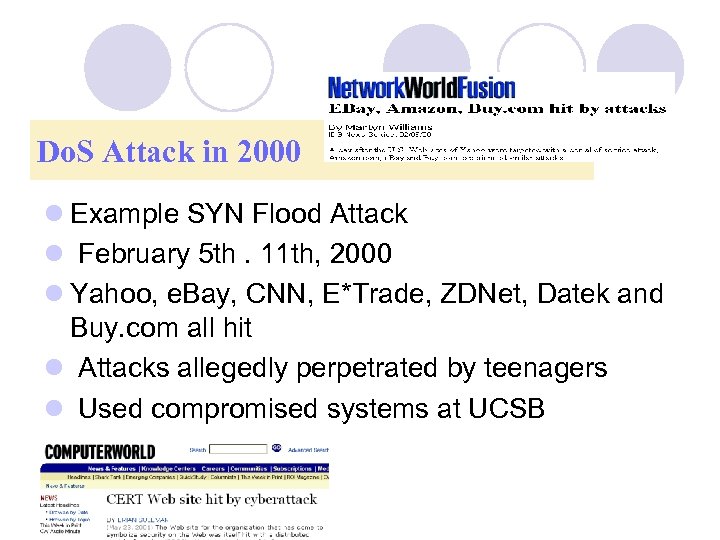 Do. S Attack in 2000 l Example SYN Flood Attack l February 5 th. 11 th, 2000 l Yahoo, e. Bay, CNN, E*Trade, ZDNet, Datek and Buy. com all hit l Attacks allegedly perpetrated by teenagers l Used compromised systems at UCSB
 Detailed Account of DDo. S • May 4 th-20 th, 2001 • Gibson Research Corporation www. grc. com/dos/intro. htm DDo. S attack from 474 machines • Completely saturated two T 1 s • 13 -year-old claimed responsibility
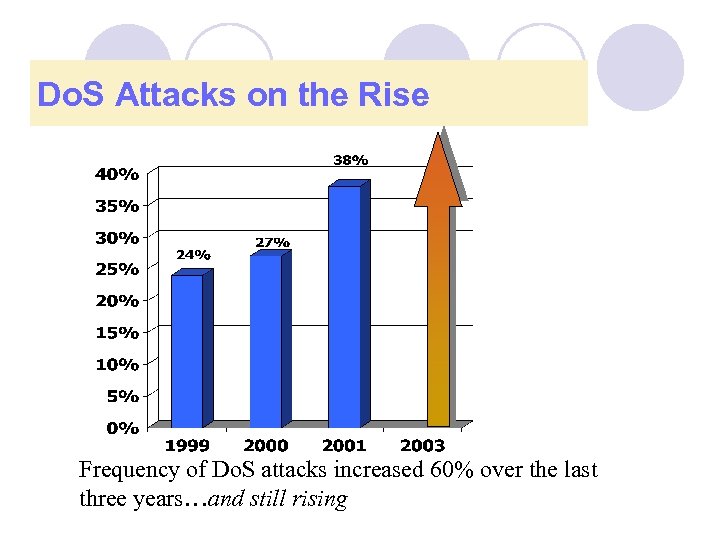 Do. S Attacks on the Rise Frequency of Do. S attacks increased 60% over the last three years…and still rising
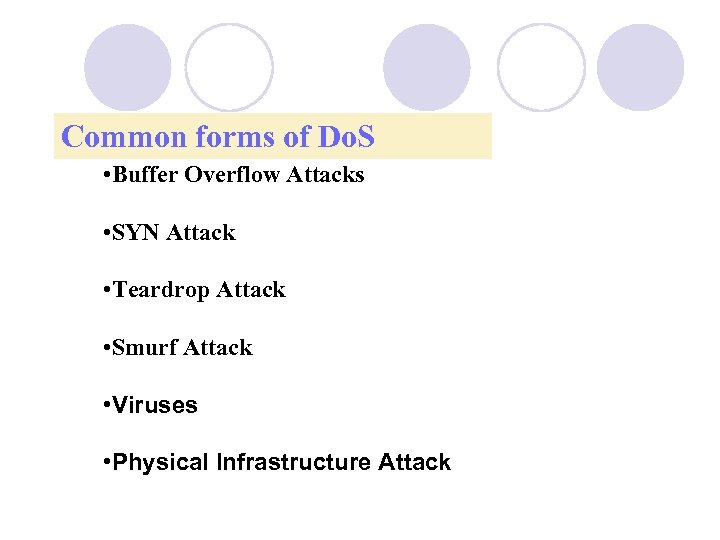 Common forms of Do. S • Buffer Overflow Attacks • SYN Attack • Teardrop Attack • Smurf Attack • Viruses • Physical Infrastructure Attack
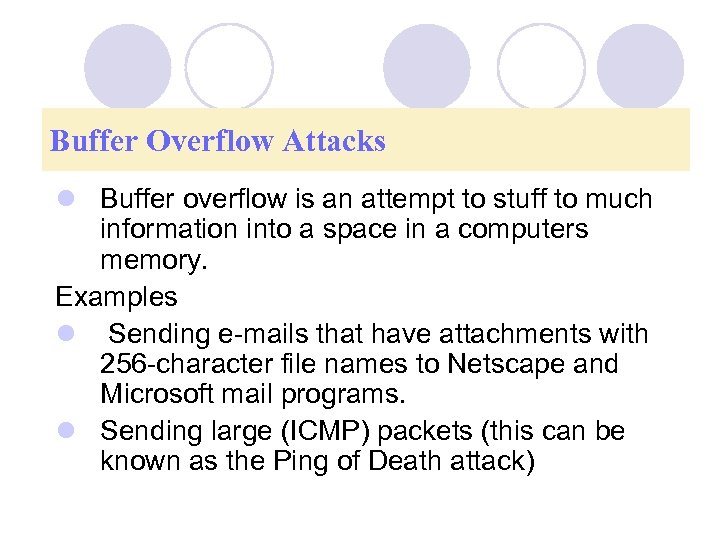 Buffer Overflow Attacks l Buffer overflow is an attempt to stuff to much information into a space in a computers memory. Examples l Sending e-mails that have attachments with 256 -character file names to Netscape and Microsoft mail programs. l Sending large (ICMP) packets (this can be known as the Ping of Death attack)
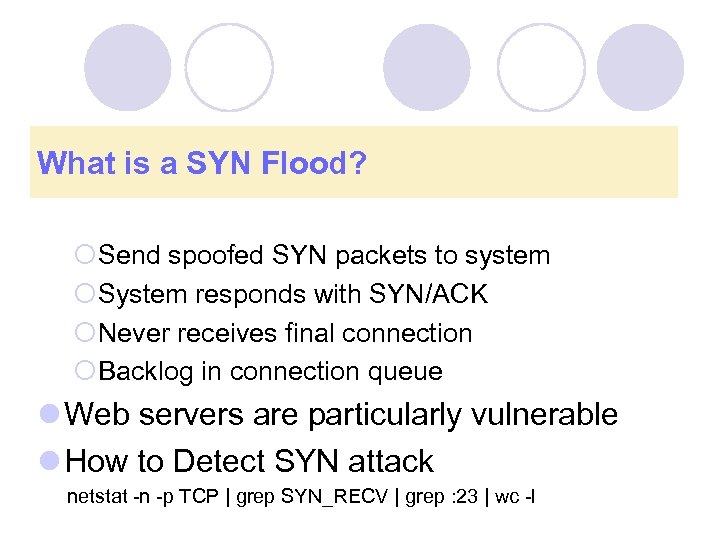 What is a SYN Flood? ¡Send spoofed SYN packets to system ¡System responds with SYN/ACK ¡Never receives final connection ¡Backlog in connection queue l Web servers are particularly vulnerable l How to Detect SYN attack netstat -n -p TCP | grep SYN_RECV | grep : 23 | wc -l
 l Smurf Attack ¡Amplification attack ¡Sends ICMP ECHO to network ¡Network sends response to victim system ¡The "smurf" attack's cousin is called "fraggle", which uses UDP echo packets in the same fashion
 Viruses Computer viruses, which replicate across a network in various ways, can be viewed as denial-of-service attacks where the victim is not usually specifically targetted but simply a host unlucky enough to get the virus. Depending on the particular virus, the denial of service can be hardly noticeable ranging all the way through disastrous. Physical Infrastructure Attacks fiber optic cable. This kind of attack is usually mitigated by the fact that traffic can sometimes quickly be rerouted.
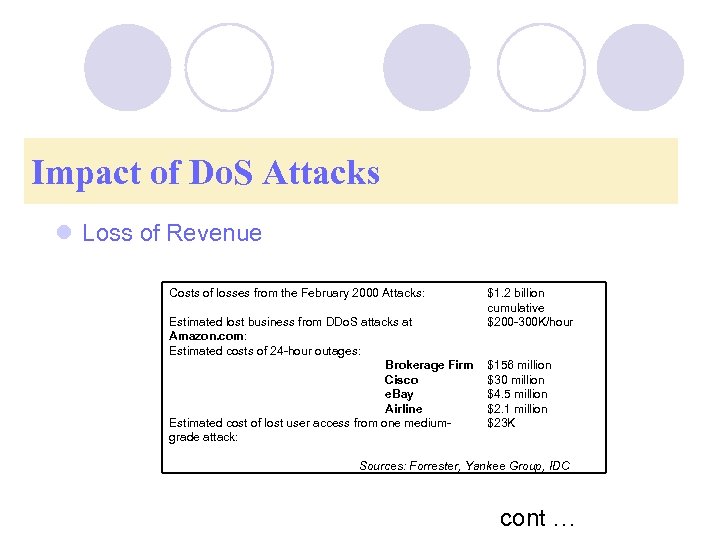 Impact of Do. S Attacks l Loss of Revenue Costs of losses from the February 2000 Attacks: Estimated lost business from DDo. S attacks at Amazon. com: Estimated costs of 24 -hour outages: Brokerage Firm Cisco e. Bay Airline Estimated cost of lost user access from one mediumgrade attack: $1. 2 billion cumulative $200 -300 K/hour $156 million $30 million $4. 5 million $2. 1 million $23 K Sources: Forrester, Yankee Group, IDC cont …
 Impact of Do. S Attacks • Damage to Corporate Image and Brand • Cost of Over-engineering Network Resources • Cost to diagnose and rebuild systems • Forensic cost estimated by University of Washington to be $22, 000 per event • Violation of service level agreements (SLAs) • Risk of litigation • Increase in insurance protection
 Why Defense is Difficult • SYN packets are part of normal traffic • Source IP addresses can be faked • SYN packets are small • Lengthy timeout period
 Possible Defenses l Increase size of connections table l Add more servers l Trace attack back to source l Deploy firewalls employing SYN l flood defense
 Who Offers a Defense? l PIX by Cisco l Firewall-1 by Checkpoint l Netscreen 100 by Netscreen l App. Safe/App. Switch by Top Layer
 How Bad Can It Get? l Theoretical maximums for attackers using: l Analog modem: 87 SYNs/sec l ISDN, Cable, DSL: 200 SYNs/sec l T 1: 2, 343 SYNs/sec l 474 hacked systems 94, 800 SYNs/sec
 How Much Do You Need? l Single firewall for attacker with single ISDN, DSL, or T 1 l Multiple parallel units for higher bandwidth l Transparent. mode permits rapid deployment
 Conclusion l SYN floods are nasty l Firewalls with SYN flood defense can successfully counter attacks l Multiple or distributed attacks may require multiple parallel firewalls
 In Summary
 Thank You