


 Скачать презентацию Demystifying Nuclear Energy Do the Economics Stack Up
a805cab540d54842a9444084aef3ff96.ppt
- Количество слайдов: 30
 Demystifying Nuclear Energy: Do the Economics Stack Up? Presentation to the Energia Klub: Budapest, April 23, 2008 Prof Steve Thomas (stephen. thomas@gre. ac. uk) PSIRU (www. psiru. org) University of Greenwich
 Outline • • • The World Market for Nuclear Plants Hang-over plants in Eastern Europe US developments: Nuclear Power 2010 UK: Nuclear power back with a vengeance? Olkiluoto: Demonstration of new nuclear technology or that nothing has changed? • Key determinants of nuclear economics • Need for and extent of public subsidies • Conclusions
 Why disagreement on nuclear costs? • There has always been an assumption that new plants would be much cheaper and more reliable than existing plants • Forecasts of nuclear costs and performance are generally made by those with a vested interest in nuclear and have invariably been optimistic • Few orders have been placed in the past two decades on which to base forecasts • Very little real data on construction and operating cost is published • All the designs being considered in the West are unproven. Only one plant worldwide of modern design has significant construction experience
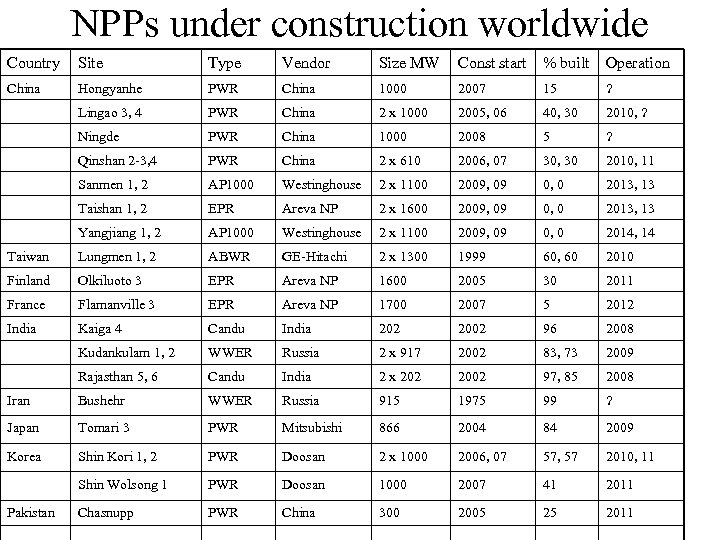 NPPs under construction worldwide Country Site Type Vendor Size MW Const start % built Operation China Hongyanhe PWR China 1000 2007 15 ? Lingao 3, 4 PWR China 2 x 1000 2005, 06 40, 30 2010, ? Ningde PWR China 1000 2008 5 ? Qinshan 2 -3, 4 PWR China 2 x 610 2006, 07 30, 30 2010, 11 Sanmen 1, 2 AP 1000 Westinghouse 2 x 1100 2009, 09 0, 0 2013, 13 Taishan 1, 2 EPR Areva NP 2 x 1600 2009, 09 0, 0 2013, 13 Yangjiang 1, 2 AP 1000 Westinghouse 2 x 1100 2009, 09 0, 0 2014, 14 Taiwan Lungmen 1, 2 ABWR GE-Hitachi 2 x 1300 1999 60, 60 2010 Finland Olkiluoto 3 EPR Areva NP 1600 2005 30 2011 France Flamanville 3 EPR Areva NP 1700 2007 5 2012 India Kaiga 4 Candu India 202 2002 96 2008 Kudankulam 1, 2 WWER Russia 2 x 917 2002 83, 73 2009 Rajasthan 5, 6 Candu India 2 x 202 2002 97, 85 2008 Iran Bushehr WWER Russia 915 1975 99 ? Japan Tomari 3 PWR Mitsubishi 866 2004 84 2009 Korea Shin Kori 1, 2 PWR Doosan 2 x 1000 2006, 07 57, 57 2010, 11 Shin Wolsong 1 PWR Doosan 1000 2007 41 2011 Chasnupp PWR China 300 2005 25 2011 Pakistan
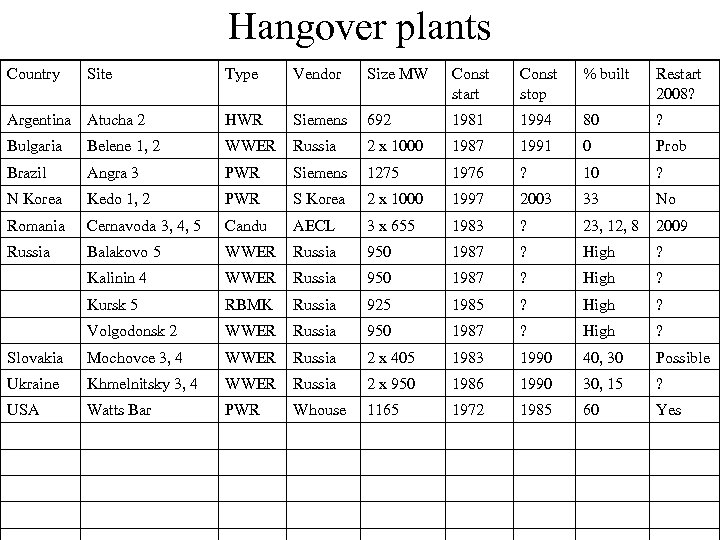 Hangover plants Country Site Type Vendor Size MW Const start Const stop % built Restart 2008? Argentina Atucha 2 HWR Siemens 692 1981 1994 80 ? Bulgaria Belene 1, 2 WWER Russia 2 x 1000 1987 1991 0 Prob Brazil Angra 3 PWR Siemens 1275 1976 ? 10 ? N Korea Kedo 1, 2 PWR S Korea 2 x 1000 1997 2003 33 No Romania Cernavoda 3, 4, 5 Candu AECL 3 x 655 1983 ? 23, 12, 8 2009 Russia Balakovo 5 WWER Russia 950 1987 ? High ? Kalinin 4 WWER Russia 950 1987 ? High ? Kursk 5 RBMK Russia 925 1985 ? High ? Volgodonsk 2 WWER Russia 950 1987 ? High ? Slovakia Mochovce 3, 4 WWER Russia 2 x 405 1983 1990 40, 30 Possible Ukraine Khmelnitsky 3, 4 WWER Russia 2 x 950 1986 1990 30, 15 ? USA Watts Bar PWR Whouse 1165 1972 1985 60 Yes
 The World Market for Nuclear Plants • Reports of a revival in nuclear ordering are premature • 439 units are already in service • Only 21 units are under active construction • A further 6 plants are on order, all in China, awaiting construction start • 18 plants are part complete but no work appears to be taking place
 The World Market for Nuclear Plants • Of the 27 plants under construction order, 17 are in China or India and 13 are supplied by China, Russia or India • The plants supplied by China are mainly based on a 1970 s French design • The plants supplied by Russia are also based on a 1970 s design • The plants supplied by India are based on a 1960 s Canadian design • Of the 18 ‘stalled’ plants, 13 are in Eastern Europe or the Former Soviet Union and 10 of these are of 1970 s or earlier Russian design
 Designs available 3 most credible generation III designs are: 1. Areva NP EPR, based on Areva N 4 and Siemens Konvoi. 4 orders. Regulatory approval in France and Finland but not USA before 2011 at earliest 2. Westinghouse AP-1000, based on AP-600 abandoned due to high costs. Regulatory approval in USA (Feb 2006) but not offered in Europe. 4 orders (all China) 3. GE ESBWR, based on SBWR. No orders for SBWR or ESBWR. US regulatory approval in 2009/10, but not offered in Europe Also Mitsubishi APWR and GE-Hitachi ABWR and Korean APWR
 Russia, India and China • Russia is offering a new version of the WWER-1000, AES-92 in China, Russia and Bulgaria. Units are in operation in China and under construction in India and Iran • It has two new designs under development, WWER-1200 and WWER-640 but these are a long way from completion • China is likely to continue to import one or two plants and then ‘copy’ these for further orders • India may abandon its old technology if the agreement with USA becomes operational
 World market for new nuclear orders • Western vendors active in Europe—Areva & Westinghouse—have 8 orders: Olkiluoto (Finland), Flamanville (France) China (6 units) • China, Korea and Japan have consistently over-estimated their ordering rate for 25 years but may order a few new plants • No other new orders likely to be placed in the next 2 -3 years except for USA (see later)
 E Europe and FSU: Hangover plants Attractions • Construction looks advanced (shell complete before internal work) • Completion likely to allow profitable power exports • Mochovce & Belene seem to replace Bohunice & Kozloduy But • Designs out of date. If building to below today’s standards was unacceptable, upgrading expensive • Much of the equipment has been stored for 15 yrs. It could need expensive work or replacement • Issues about quality of existing work. Showing it is up to standard would be expensive, and remedial work could be very expensive.
 Eastern Europe: Hangover plants Bulgaria • Belene construction started 1987, stopped 1991, 45% complete • Contract awarded to Atomstroyexport in 2006, but can it be financed? The contract was expected to be signed ‘soon’ in Jan 2008 Slovak Rep • ENEL promised to complete Mochovce 3 & 4 when it bought Slovenske Elektrarne in 2005 • Work might restart in 2008?
 Eastern Europe: Hangover plants Romania • Only civil work carried out at Cernavoda 3 -5, no equipment, so a new order. What design? • 7 companies inc Enel, Suez, RWE, Iberdrola, CEZ involved in the bid. . Many hurdles to overcome Russia • 4 plants have been ‘nearly complete’ for 10 years • Work on Kalinin 4 reported to restart in Jan 2008 for completion in 2011 • Internal pressure to complete Kursk 5 (Chernobyl type) but is that politically feasible? No funds before 2009 • Other 2 plants seem stalled Ukraine • Political pressure for Khmelnitsky 3 & 4 but not priority
 Eastern Europe: New orders Lithuania/Poland/Estonia/Latvia • A plant that would supply these countries could be built replacing the output of the Ignalina RBMK (closed 2009). No solid plans have been made and a start-up date of 2015 looks very optimistic Czech Rep • Little current government support Kalinin • New proposal by Russia to build 2 AES-92 units to supply European markets Hungary • ?
 US Initiative: Nuclear Power 2010 Last nuclear order in USA not cancelled was 1974 (68 cancellations). Extensive guarantees & subsidies back the Bush Nuclear 2010 programme of 2002. The Energy Policy Act 2005 offered 3 main types of support • A limited number of new nuclear power plants to receive a $18/MWh production tax credit up to $125 m per 1000 MW (about 80 per cent of what the plant could earn if it ran continuously) • Federal loan guarantees covering up to 80 per cent of the debt involved in the project (not the total cost) • Up to $500 m in risk insurance for units 1 -2 and $250 m for units 3 -6. This insurance is to be paid if delays not due to the licensee slow licensing of the plant • Support for R&D funding worth $850 m and help with historic decommissioning costs worth $1. 3 bn. • Total cost of this programme was around € 15 bn
 US Initiative: Nuclear Power 2010 • Several groups declared an interest, eg, ‘Nustart’ consortium and Dominion but no orders placed yet • [Dominion CEO Capps] ‘We aren’t going to build a nuclear plant anytime soon. Standard & Poor’s and Moody’s would have a heart attack. And my chief financial officer would too. ’ • [TXU CEO John Wilder] said there were now projects totalling about 26 GW lining up for limited federal incentives, which could provide ‘anywhere from a $2/MWh advantage to a $20/MWh advantage. ’ He said he didn’t believe it would be known which companies would receive those benefits until about 2012. ‘Quite frankly, that’s all the difference between these projects working or not working, ’ he said. • Exelon Nuclear’s President Crane said that the incentives were a key factor in his company’s decision to prepare a COL. But other factors would influence whether Exelon commits to building a new reactor.
 US Initiative: Nuclear Power 2010 • Sticking point is loan guarantees: • Nuclear industry lobbying for 100% debt coverage for up to 80% of the project cost • Energy Bill passed by Senate allowed for up to $18. 5 bn in loan guarantees for new nuclear power plants in 2008/09 • Any orders would demonstrate government can get nuclear plants built by compelling taxpayers and customers to pay for them
 UK: Nuclear back with a vengeance? 2006 • 8 years needed for designs to be given safety consent and sites to be approved • First plant not ordered till 2015 and 6 years construction so first power 2021 • 6000 MW total (effectively replaces existing capacity) new nuclear capacity by 2026 • Decisions to be taken by private companies • Wicks (Energy Minister): [Is that the Government’s position? No direct subsidies and no indirect subsidies? ’] ‘No cheques will be written, there will be no sweetheart deals. we are going to look very carefully at that [waste and decommissioning] to make sure that the full costs of new nuclear waste are paid by the market. ’
 UK: Nuclear back with a vengeance? 2008 • Companies claim new plant could be online by 2017 • Nuclear White Paper: ‘Nuclear is currently one of the cheapest low-carbon electricity generation technologies. Our conclusion remains that not having nuclear as an option would increase the costs of delivering these goals. ’ • Hutton (Business Minister): ‘Britain will become increasingly reliant on nuclear power for its energy needs over the next two decades. We need the maximum contribution from nuclear sources. I'd be very disappointed if it's not significantly above the current level. ’ • Nuclear consultation of Feb 2008 promised that a fixed price for waste disposal and decommissioning would be set the day a company starts building a nuclear plant • What other guarantees and subsidies will government give, eg, loan guarantees?
 How are low costs produced? Olkiluoto • Construction price reported to be € 3 bn, € 2000/k. W, higher than all recent forecasts • Will this cost be met? Is it really fixed? Is it a ‘loss-leader’? • Export credit guarantees from France & Sweden • Syndicate led by Bayerische Landesbank (BLB) gave € 1. 95 bn loan (60% of cost) at 2. 6% nominal • PVO, main customer, is not-for-profit organisation owned by energy intensive companies • Output is contracted for the life of the plant to PVO owners at prices set to cover all costs
 Olkiluoto: What is the experience? • Problems: poor quality concrete and welds, delays in design completion, problems with subcontractors, inadequate protection against aircraft crashes • Costs appear to be € 1 -1. 5 bn over budget • Plant is 2 years late and penalty clauses reached the maximum at 12 months • Turnkey contract under strain: Areva ‘Areva-Siemens cannot accept 100 per cent compensation responsibility, because the project is one of vast co-operation. ’ TVO ‘I don’t believe that Areva says this, the realisation of the project is Areva’s responsibility’ • Now speculation Areva will sue TVO because they have taken too long to carry out checks • Concrete pouring problems also at Flamanville
 What has gone wrong at Olkiluoto? • Sept 2005: Problems with strength & porosity of concrete for the reactor building base slab and manufacturing of the pressure vessel and steam generators "some weeks" behind schedule. • Feb 2006: Problems with qualifying pressure vessel welds & delays in detailed engineering design • Oct 2006: TVO discovers that 3 of 4 of the ‘hot legs’ were not made to specification • Mar 2007: damaged steel liner for the containment must be repaired • Aug 2007: Delays due to design changes needed to make the plant able to withstand aircraft crash • Sept 2007: Steel containment liner being repaired in 12 places to fix deformations and weld problems discovered in June
 What determines nuclear power cost? • Construction cost & time, and cost of capital. Repaying construction cost and interest is expected to account for about 2/3 of the cost of power • Operating performance. The reliability of the plant (load factor) determines how thinly fixed costs can be spread • Operations & maintenance cost. British Energy went bust because it could not even cover its operating cost from revenue.
 Important factors not seen in discounted cash flow (DCF) analyses • Decommissioning & waste disposal provision. If cost is accurately forecast and provisions are collected and invested safely, this is not a major cost. But there is no experience of high-level waste (HLW) disposal and little experience of decommissioning • Fuel cost. Nuclear fuel purchase is a small part of the generation cost. But if nuclear was expected to make a major contribution on climate change, uranium resources would be important • Insurance and liability cover. International treaties mean governments bear the main risk but even limited cover is expensive.
 Construction costs • In late 1990 s, nuclear industry forecast new designs would cost $1000/k. W (€ 660/k. W) • Forecasts from 2002 -04 assumed € 1000 -1500/k. W • Olkiluoto contract price (2004) € 2000/k. W • After 3 years construction, it is 50% over-budget • From 2004, ‘China effect’ means commodities are increasing in price by 10% per year or (much) more • Recent cost estimates from US, much higher – Keystone - € 2400 -2700/k. W (June 2007) – S&P - $2700/k. W (May 2007) – Moody’s - $3350 -4000/k. W (Oct 2007) – FP&L - $3800 -5400/k. W (Fall 2007) – Puget Sound Energy - $6, 700/k. W (Jan 2008)
 Cost of capital • Previously, if problems with a nuclear plant, costs were paid by consumers. Was this fair? • Investment risk was low because consumers were bearing the risk and lenders were sure to be paid back. So interest rate low • But in an electricity market, if things go wrong, the plant owner goes bankrupt & lenders lose the money • So investment risk & interest rate is high • Government credit guarantees are vital if plants are to be built in a competitive market
 Need for subsidies and guarantees: A wish list • 15 year power purchase agreement indexed to costs • Turnkey construction contract • Performance/reliability guarantee • A guarantee on operating costs • A cap on decommissioning liabilities and waste (esp spent fuel) • Insurance guarantees against regulatory and judicial delays and the consequences of events elsewhere in the world
 Conclusions (1) • Cost-reducing factors - learning, technical change, scale & number economies - have had little impact on nuclear costs so far. Why? • Skills in the nuclear area are eroding fast & forgetting is more likely than learning • Major bottlenecks in manufacturing large components • Little experience with current designs • ‘China effect’ is raising costs rapidly • Waste & decommissioning costs are guesses
 Conclusions (2) • Liberalisation of electricity industries raises cost of capital and shifts economic risk to share-holders – are they willing to bear it? • US government subsidies and guarantees worth about $15 bn not sufficient for new orders there • Loan guarantees worth $20 bn now on offer in US. Will it be enough? Will orders be possible when subsidies are not offered?
 Conclusions (3) • UK programme still some time from first order. Guarantees & subsidies will be needed • Olkiluoto is unique - Underpriced turnkey contract, uneconomic loan, loan guarantees, cost-plus power contract for life of plant, not-for-profit utility • Experience with construction at Olkiluoto awful. After 2 years, construction about 2 years late and costs nearly 50% above contract. Is it a one-off or a symptom of likely problems?