


 Скачать презентацию Demonstration of Autonomous Rendezvous Technology DART Inter-Agency AR C
1578b1375c182cb63c32fd40617ab1e9.ppt
- Количество слайдов: 40
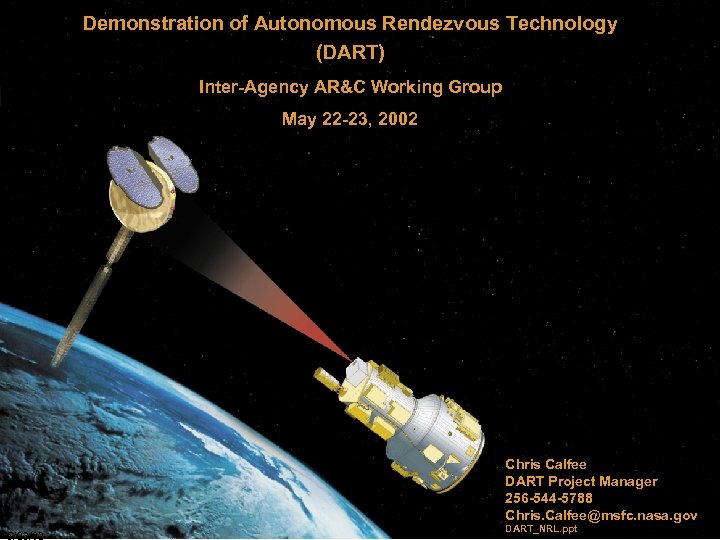 Demonstration of Autonomous Rendezvous Technology (DART) Inter-Agency AR&C Working Group May 22 -23, 2002 Chris Calfee DART Project Manager 256 -544 -5788 Chris. Calfee@msfc. nasa. gov DART_NRL. ppt
 Agenda – Introduction to DART • Overview & Objectives • Organization & Schedule – DART Mission Description • “Chaser” Vehicle - DART • “Target” Vehicle - MUBLCOM • Launch Vehicle - Pegasus • Mission Operations - Flight & Ground • System Test Summary • Technology Readiness Levels – Advanced Video Guidance Sensor (AVGS) DART_NRL. ppt
 Introduction to DART_NRL. ppt
 Project Overview • DART Stands for: Demonstration of Autonomous Rendezvous Technology. • DART Is a Flight Demonstration of the Hardware and Software Required to Autonomously Rendezvous with a Satellite (MUBLCOM) Currently in Orbit. – Hardware: Advanced Video Guidance Sensor (AVGS) • Heritage: VGS Developed by MSFC for Automated Rendezvous & Capture (AR&C) Project. Flown Twice on Board the Shuttle in an Open. Loop Mode • AVGS is next generation system with advanced optics and electronics. Design goals: Longer Range, Lower Power and Weight – Software: Based on Autonomous Rendezvous and Proximity Operations (ARPO) Algorithms Also Developed by NASA/MSFC. • Both the AVGS and the ARPO Algorithms Will Become Embedded Technology on Board a Pegasus ELV, Making the DART Vehicle an Extension of the ELV Rather Than an Independent and Isolated Payload DART_NRL. ppt
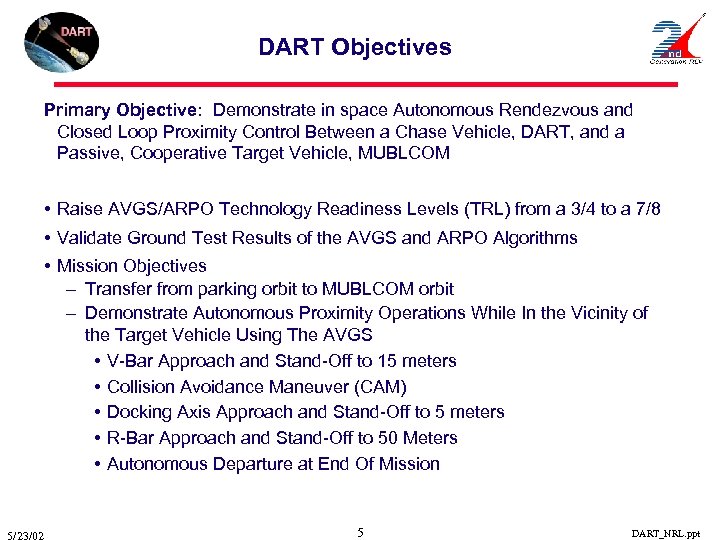 DART Objectives Primary Objective: Demonstrate in space Autonomous Rendezvous and Closed Loop Proximity Control Between a Chase Vehicle, DART, and a Passive, Cooperative Target Vehicle, MUBLCOM • Raise AVGS/ARPO Technology Readiness Levels (TRL) from a 3/4 to a 7/8 • Validate Ground Test Results of the AVGS and ARPO Algorithms • Mission Objectives – Transfer from parking orbit to MUBLCOM orbit – Demonstrate Autonomous Proximity Operations While In the Vicinity of the Target Vehicle Using The AVGS • V-Bar Approach and Stand-Off to 15 meters • Collision Avoidance Maneuver (CAM) • Docking Axis Approach and Stand-Off to 5 meters • R-Bar Approach and Stand-Off to 50 Meters • Autonomous Departure at End Of Mission 5 DART_NRL. ppt
 Second Generation RLV Relevance – The United States Has Successfully Performed Numerous Rendezvous and Docking Missions in the Past. – The Common Element of All US Rendezvous and Docking is That the Spacecraft Have Always Been Piloted by Astronauts. – Only the Russian Space Program Has Developed and Demonstrated a Routine Autonomous Capability. – The European Space Agency and Japanese Are Developing Similar Technology. – The DART Mission Provides a Key Step in Establishing an Autonomous Rendezvous Capability for the United States. – All 2 nd Generation Architectures and AAS Can Benefit From ARPO Technology. – Even Manned/Piloted Vehicles Can Benefit Through Robust System Performance and Reduction of Potential Piloting Errors. 6 DART_NRL. ppt
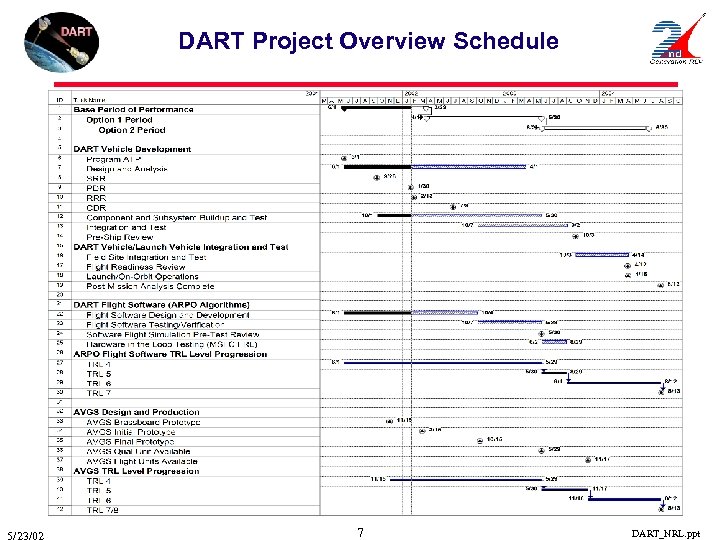 DART Project Overview Schedule 7 DART_NRL. ppt
 Project Team – OSC - Overall Project Integration, Launch Vehicle Buildup & Test, AVGS Development, Test, Manufacture, & Integration, DART Buildup & Test, LV/DART Integration & Test, Launch & Mission Operations – MSFC - Overall Project Management, AR&C Algorithms, AVGS S/W Development, Test Facilities & Support, Mission ops Support – Draper – GNC System, Flight Vehicle S/W – Advanced Optical Systems (AOS) - AVGS Design & Engineering Support – KSC - Launch Services Support – GSFC - IV&V DART_NRL. ppt
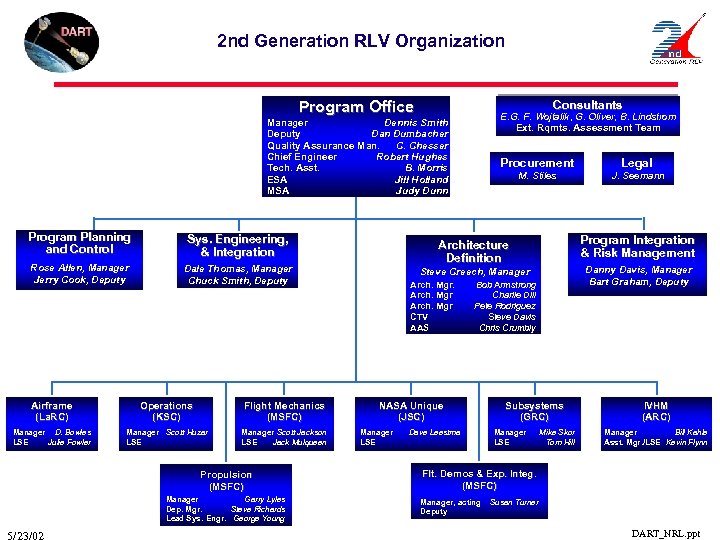 2 nd Generation RLV Organization Program Office Consultants E. G. F. Wojtalik, G. Oliver, B. Lindstrom Ext. Rqmts. Assessment Team Manager Dennis Smith Deputy Dan Dumbacher Quality Assurance Man. C. Chesser Chief Engineer Robert Hughes Tech. Asst. B. Morris ESA Jill Holland MSA Judy Dunn Program Planning and Control Sys. Engineering, & Integration Rose Allen, Manager Jerry Cook, Deputy Dale Thomas, Manager Chuck Smith, Deputy Airframe (La. RC) Operations (KSC) Flight Mechanics (MSFC) Manager D. Bowles LSE Julie Fowler Manager Scott Huzar LSE Manager Scott Jackson LSE Jack Mulqueen Propulsion (MSFC) Manager Garry Lyles Dep. Mgr. Steve Richards Lead Sys. Engr. George Young Procurement Legal M. Stiles J. Seemann Program Integration & Risk Management Architecture Definition Danny Davis, Manager Bart Graham, Deputy Steve Creech, Manager Arch. Mgr CTV AAS Bob Armstrong Charlie Dill Pete Rodriguez Steve Davis Chris Crumbly NASA Unique (JSC) Manager LSE Dave Leestma Subsystems (GRC) Manager LSE Mike Skor Tom Hill IVHM (ARC) Manager Bill Kahle Asst. Mgr. /LSE Kevin Flynn Flt. Demos & Exp. Integ. (MSFC) Manager, acting Deputy Susan Turner DART_NRL. ppt
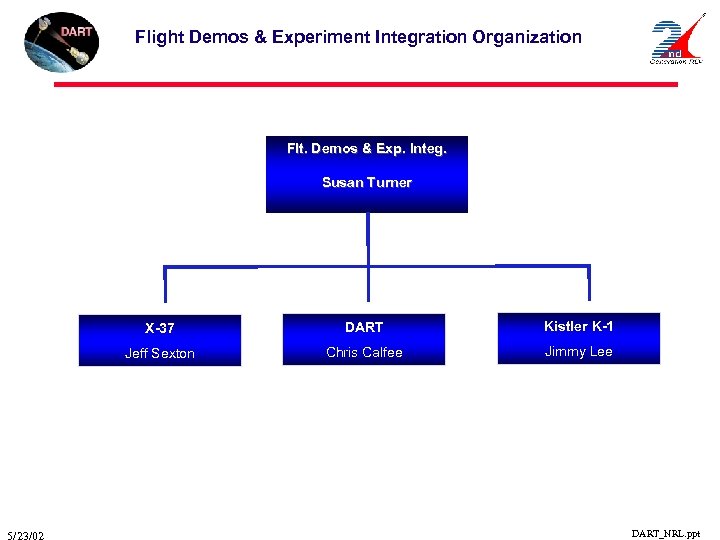 Flight Demos & Experiment Integration Organization Flt. Demos & Exp. Integ. Susan Turner X-37 DART Kistler K-1 Jeff Sexton Chris Calfee Jimmy Lee DART_NRL. ppt
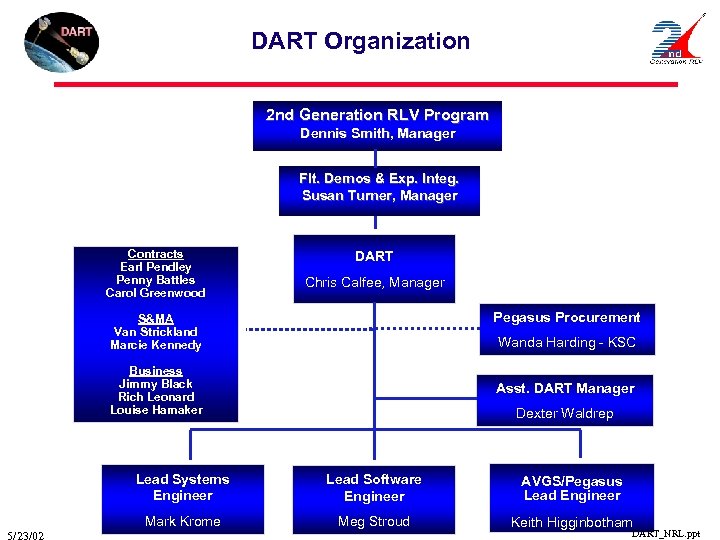 DART Organization 2 nd Generation RLV Program Dennis Smith, Manager Flt. Demos & Exp. Integ. Susan Turner, Manager Contracts Earl Pendley Penny Battles Carol Greenwood DART Chris Calfee, Manager Pegasus Procurement S&MA Van Strickland Marcie Kennedy Wanda Harding - KSC Business Jimmy Black Rich Leonard Louise Hamaker Asst. DART Manager Dexter Waldrep Lead Systems Engineer Lead Software Engineer AVGS/Pegasus Lead Engineer Mark Krome Meg Stroud Keith Higginbotham DART_NRL. ppt
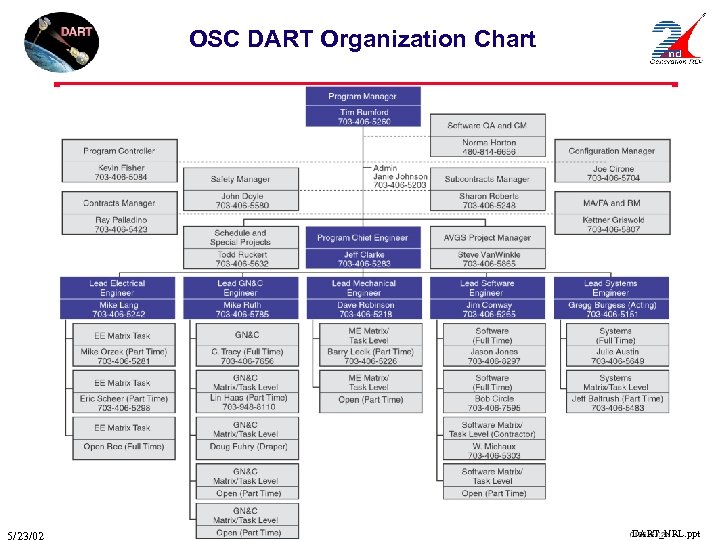 OSC DART Organization Chart DART_NRL. ppt
 DART Mission Description DART_NRL. ppt
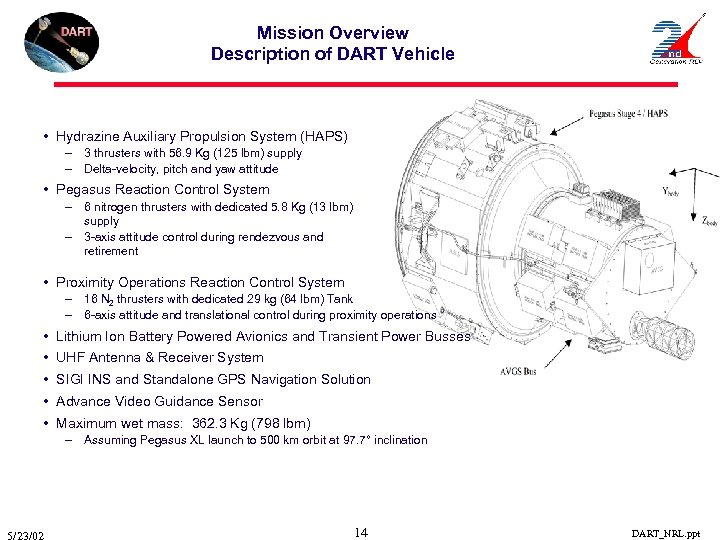 Mission Overview Description of DART Vehicle • Hydrazine Auxiliary Propulsion System (HAPS) – 3 thrusters with 56. 9 Kg (125 lbm) supply – Delta-velocity, pitch and yaw attitude • Pegasus Reaction Control System – 6 nitrogen thrusters with dedicated 5. 8 Kg (13 lbm) supply – 3 -axis attitude control during rendezvous and retirement • Proximity Operations Reaction Control System – 16 N 2 thrusters with dedicated 29 kg (64 lbm) Tank – 6 -axis attitude and translational control during proximity operations • Lithium Ion Battery Powered Avionics and Transient Power Busses • UHF Antenna & Receiver System • SIGI INS and Standalone GPS Navigation Solution • Advance Video Guidance Sensor • Maximum wet mass: 362. 3 Kg (798 lbm) – Assuming Pegasus XL launch to 500 km orbit at 97. 7° inclination 14 DART_NRL. ppt
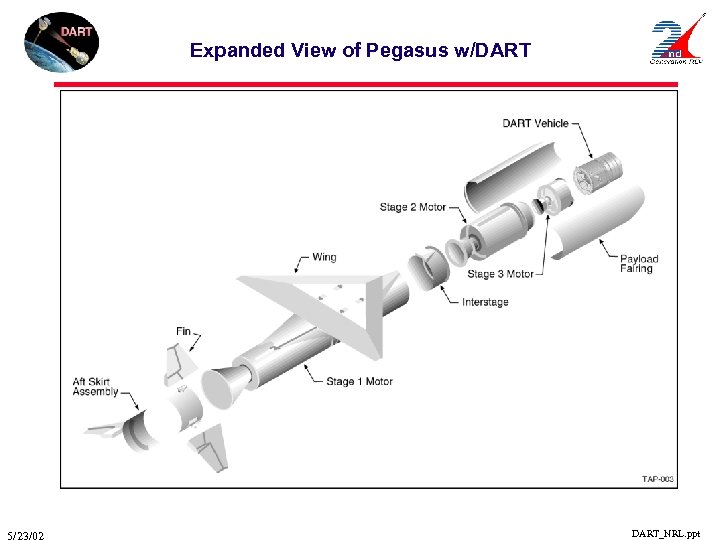
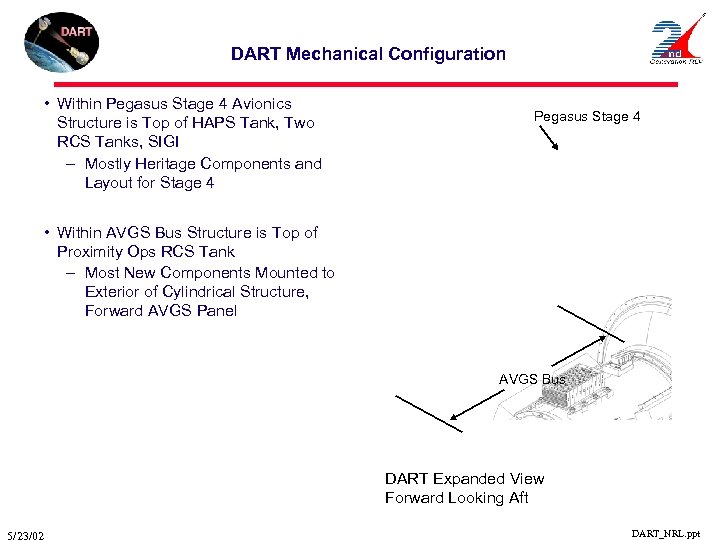 DART Mechanical Configuration • Within Pegasus Stage 4 Avionics Structure is Top of HAPS Tank, Two RCS Tanks, SIGI – Mostly Heritage Components and Layout for Stage 4 Pegasus Stage 4 • Within AVGS Bus Structure is Top of Proximity Ops RCS Tank – Most New Components Mounted to Exterior of Cylindrical Structure, Forward AVGS Panel AVGS Bus DART Expanded View Forward Looking Aft DART_NRL. ppt
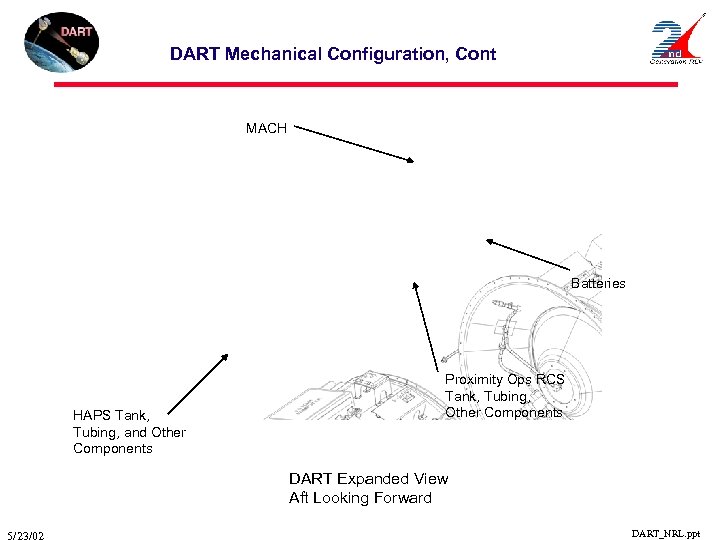 DART Mechanical Configuration, Cont MACH Batteries HAPS Tank, Tubing, and Other Components Proximity Ops RCS Tank, Tubing, Other Components DART Expanded View Aft Looking Forward DART_NRL. ppt
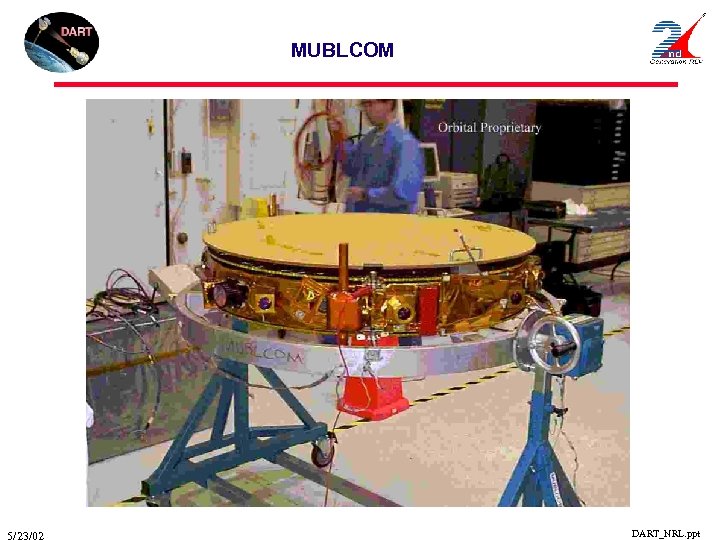
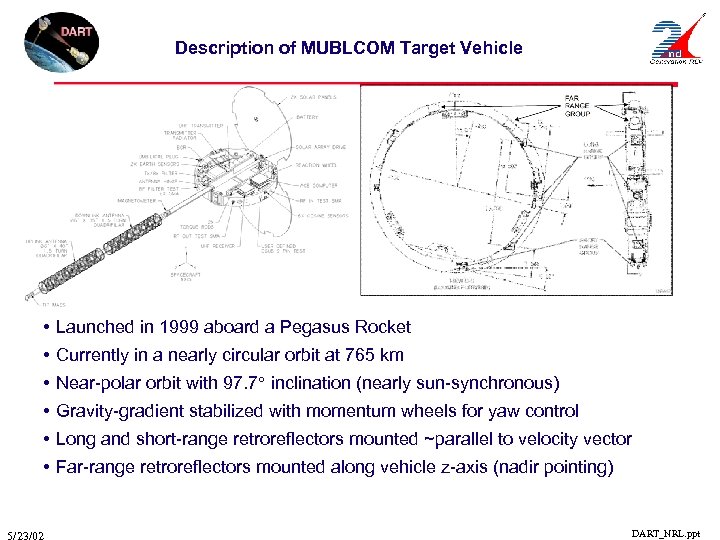 Description of MUBLCOM Target Vehicle • Launched in 1999 aboard a Pegasus Rocket • Currently in a nearly circular orbit at 765 km • Near-polar orbit with 97. 7 inclination (nearly sun-synchronous) • Gravity-gradient stabilized with momentum wheels for yaw control • Long and short-range retroreflectors mounted ~parallel to velocity vector • Far-range retroreflectors mounted along vehicle z-axis (nadir pointing) DART_NRL. ppt
 MUBLCOM DART_NRL. ppt
 Expanded View of Pegasus w/DART_NRL. ppt
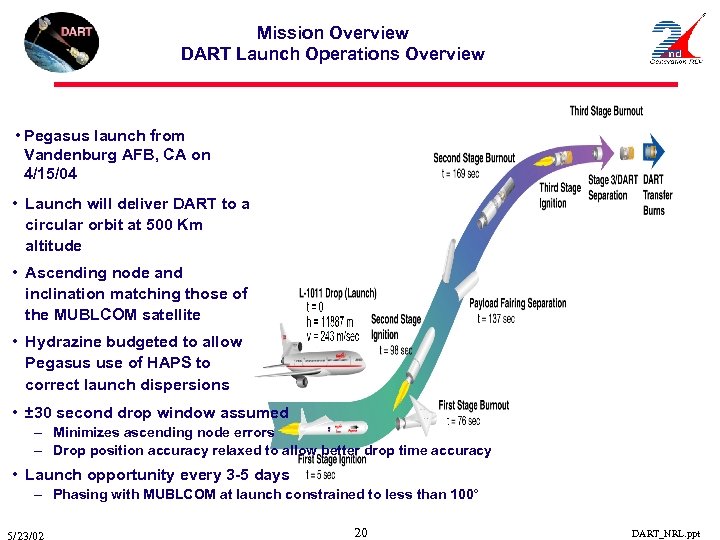 Mission Overview DART Launch Operations Overview • Pegasus launch from Vandenburg AFB, CA on 4/15/04 • Launch will deliver DART to a circular orbit at 500 Km altitude • Ascending node and inclination matching those of the MUBLCOM satellite • Hydrazine budgeted to allow Pegasus use of HAPS to correct launch dispersions • ± 30 second drop window assumed – Minimizes ascending node errors – Drop position accuracy relaxed to allow better drop time accuracy • Launch opportunity every 3 -5 days – Phasing with MUBLCOM at launch constrained to less than 100° 20 DART_NRL. ppt
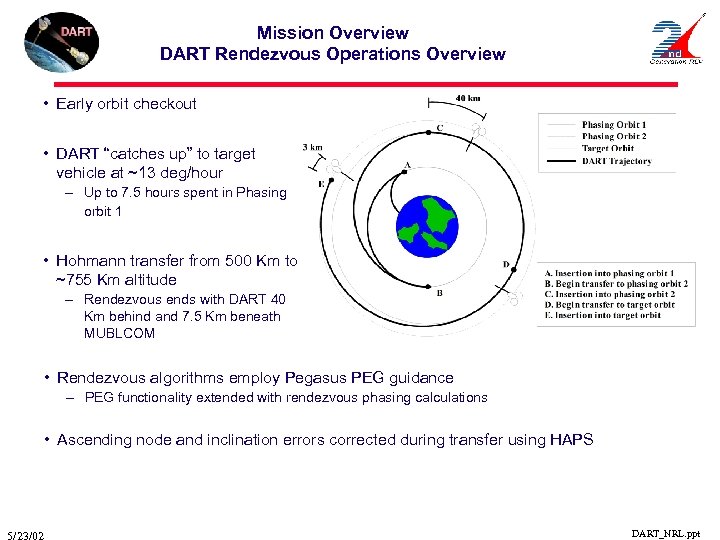 Mission Overview DART Rendezvous Operations Overview • Early orbit checkout • DART “catches up” to target vehicle at ~13 deg/hour – Up to 7. 5 hours spent in Phasing orbit 1 • Hohmann transfer from 500 Km to ~755 Km altitude – Rendezvous ends with DART 40 Km behind and 7. 5 Km beneath MUBLCOM • Rendezvous algorithms employ Pegasus PEG guidance – PEG functionality extended with rendezvous phasing calculations • Ascending node and inclination errors corrected during transfer using HAPS DART_NRL. ppt
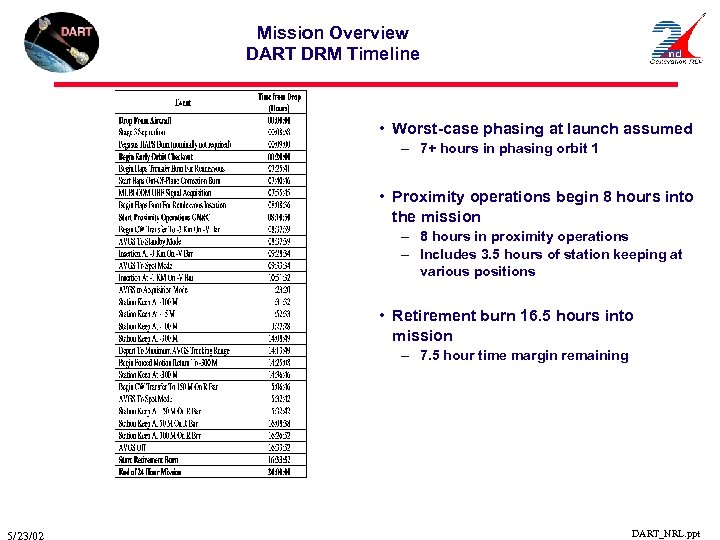 Mission Overview DART DRM Timeline • Worst-case phasing at launch assumed – 7+ hours in phasing orbit 1 • Proximity operations begin 8 hours into the mission – 8 hours in proximity operations – Includes 3. 5 hours of station keeping at various positions • Retirement burn 16. 5 hours into mission – 7. 5 hour time margin remaining DART_NRL. ppt
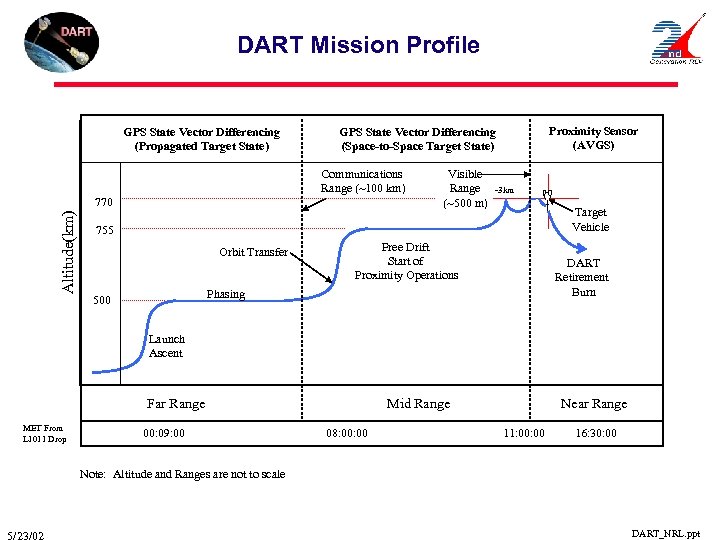 DART Mission Profile GPS State Vector Differencing (Propagated Target State) Communications Range (~100 km) 770 Altitude(km) Proximity Sensor (AVGS) GPS State Vector Differencing (Space-to-Space Target State) Visible Range (~500 m) -3 km Target Vehicle 755 Orbit Transfer Free Drift Start of Proximity Operations DART Retirement Burn Phasing 500 Launch Ascent Far Range MET From L 1011 Drop 00: 09: 00 Mid Range 08: 00 Near Range 11: 00 16: 30: 00 Note: Altitude and Ranges are not to scale DART_NRL. ppt
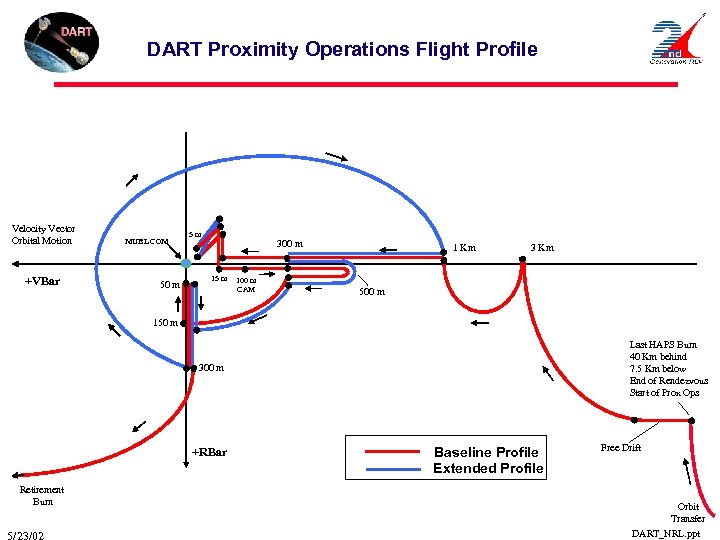 DART Proximity Operations Flight Profile Velocity Vector Orbital Motion +VBar MUBLCOM 50 m 5 m 300 m 15 m 100 m CAM 1 Km 3 Km 500 m 150 m Last HAPS Burn 40 Km behind 7. 5 Km below End of Rendezvous Start of Prox Ops 300 m +RBar Retirement Burn Baseline Profile Extended Profile Free Drift Orbit Transfer DART_NRL. ppt
 DART-MUBLCOM Rendezvous Visual DART_NRL. ppt
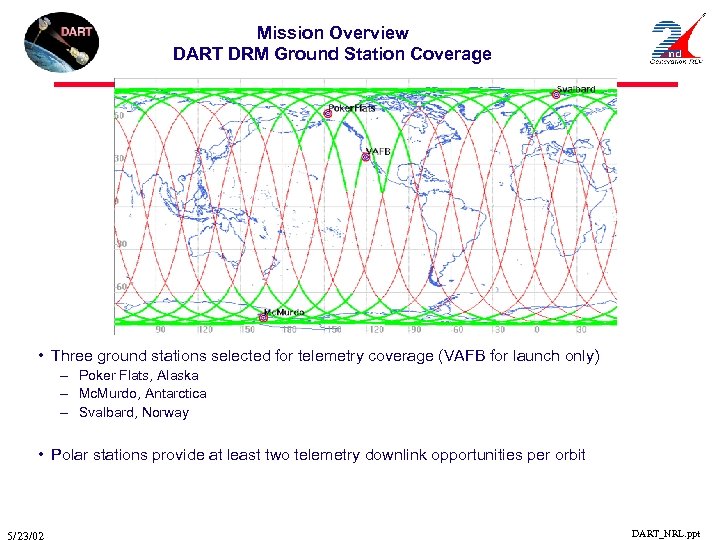 Mission Overview DART DRM Ground Station Coverage • Three ground stations selected for telemetry coverage (VAFB for launch only) – Poker Flats, Alaska – Mc. Murdo, Antarctica – Svalbard, Norway • Polar stations provide at least two telemetry downlink opportunities per orbit DART_NRL. ppt
 DART Testing • Desktop Simulation – Performed at OSC – Psuedo Flight Code (CMDH, GN&C, Telemetry) • Hardware in the Loop – Static – Performed at OSC – Flight Computer, GPS, INS, UHF, AVGS • Hardware in the Loop – Dynamic – Performed at MSFC Flight Robotics Lab – Flight Computer, GPS, INS, AVGS DART_NRL. ppt
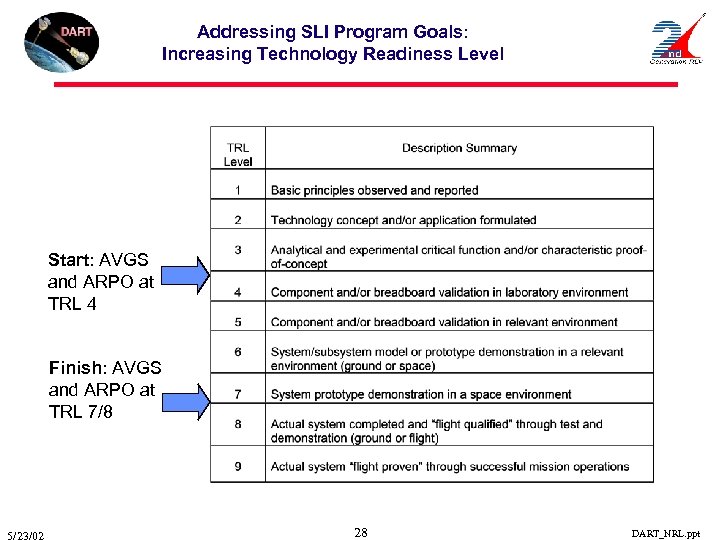 Addressing SLI Program Goals: Increasing Technology Readiness Level Start: AVGS and ARPO at TRL 4 Finish: AVGS and ARPO at TRL 7/8 28 DART_NRL. ppt
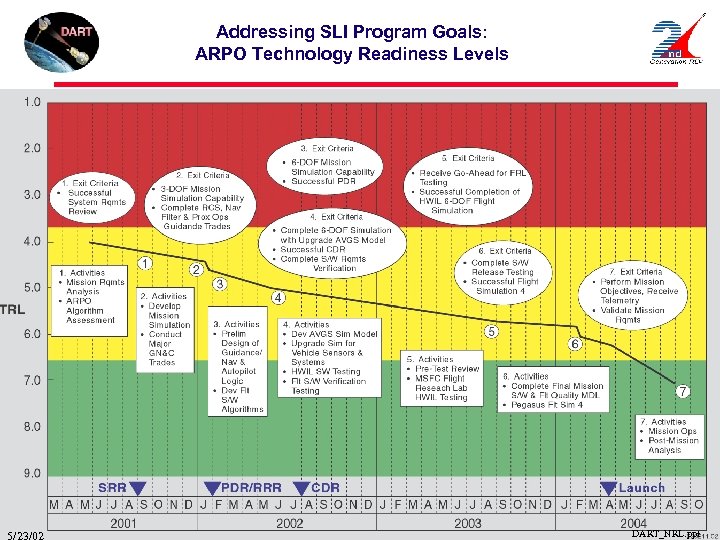 Addressing SLI Program Goals: ARPO Technology Readiness Levels DART_NRL. ppt
 Advanced Video Guidance Sensor (AVGS) DART_NRL. ppt
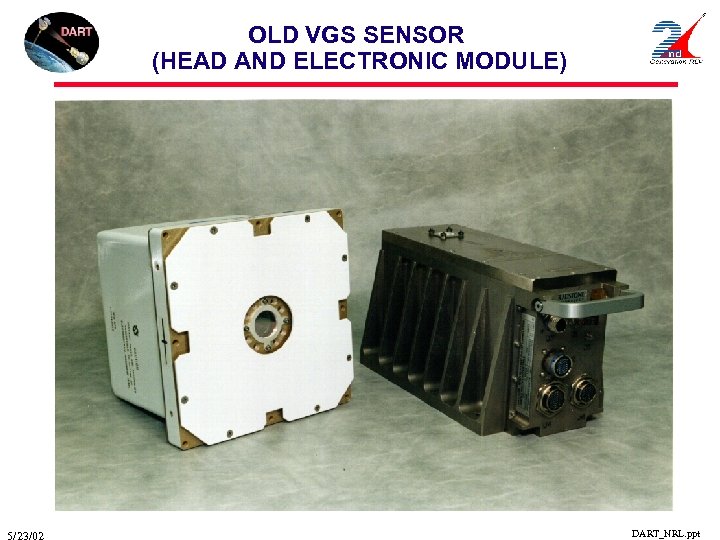 OLD VGS SENSOR (HEAD AND ELECTRONIC MODULE) DART_NRL. ppt
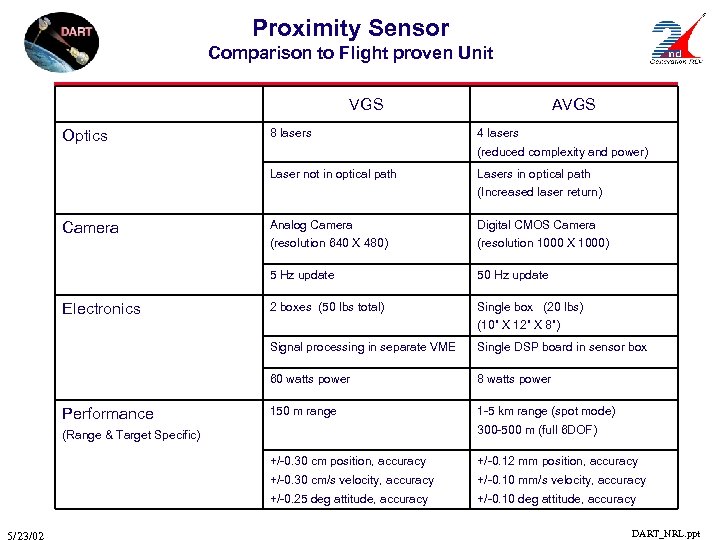 Proximity Sensor Comparison to Flight proven Unit VGS Optics 8 lasers AVGS 4 lasers (reduced complexity and power) Laser not in optical path Lasers in optical path (Increased laser return) Digital CMOS Camera (resolution 1000 X 1000) 5 Hz update Electronics Analog Camera (resolution 640 X 480) Camera 50 Hz update 2 boxes (50 lbs total) Single box (20 lbs) (10” X 12” X 8”) Signal processing in separate VME 60 watts power Performance Single DSP board in sensor box 8 watts power 150 m range 1 -5 km range (spot mode) 300 -500 m (full 6 DOF) (Range & Target Specific) +/-0. 30 cm position, accuracy +/-0. 12 mm position, accuracy +/-0. 30 cm/s velocity, accuracy +/-0. 10 mm/s velocity, accuracy +/-0. 25 deg attitude, accuracy +/-0. 10 deg attitude, accuracy DART_NRL. ppt
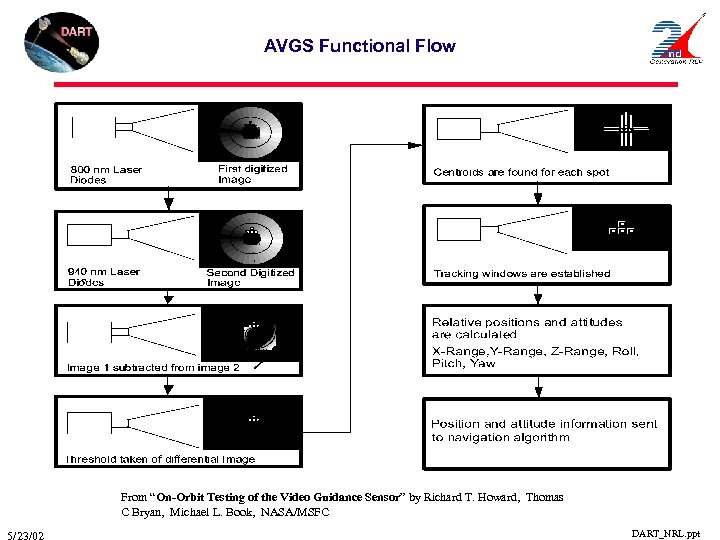 AVGS Functional Flow From “On-Orbit Testing of the Video Guidance Sensor” by Richard T. Howard, Thomas C Bryan, Michael L. Book, NASA/MSFC DART_NRL. ppt
 AVGS Design, Analysis and Test – Brassboard Development Phase (6/1/01 - 1/28/02) • Parts and Material Review – EEE Parts Availability – Outgasssing – Radiation Environment Analysis • Begin AVGS Software Development • Evaluate Optics Performance – Initial Prototype (IP) Development Phase (6/1/01 - 3/29/02) • Power Supply Design • Electronics Packaging Concepts • Initial Structural Analysis • Initial Electrical Analysis • Initial Thermal Analysis • Radiation Hardening • Continue AVGS Software Development DART_NRL. ppt
 AVGS Design, Analysis and Test (Cont) – Final Prototype (FP) Development Phase (4/1/02 - 10/18/02) • 2 Prototype Units (Form, Fit & Function) • FMEA • Update Thermal Analysis • Finalize Electronic Packaging Concepts • Final Design for Radiation Environment • Finalize Structural Analysis • Finalize Electrical Analysis • Begin AVGS Software functional Verification and Validation – Qualification Unit Development Phase (9/23/02 - 5/29/03) • Acceptance Testing (random vibe and thermal vac) • Qualification Testing (EMI/EMC, Vibe, Shock, Thermal) • AVGS Flight Load Software Delivery – Flight Unit Development Phase (5/1/03 - 11/17/03) • 3 Units • Acceptance Testing (random vibe and thermal vac) • Final AVGS Software Load Delivery (Jan 04) DART_NRL. ppt
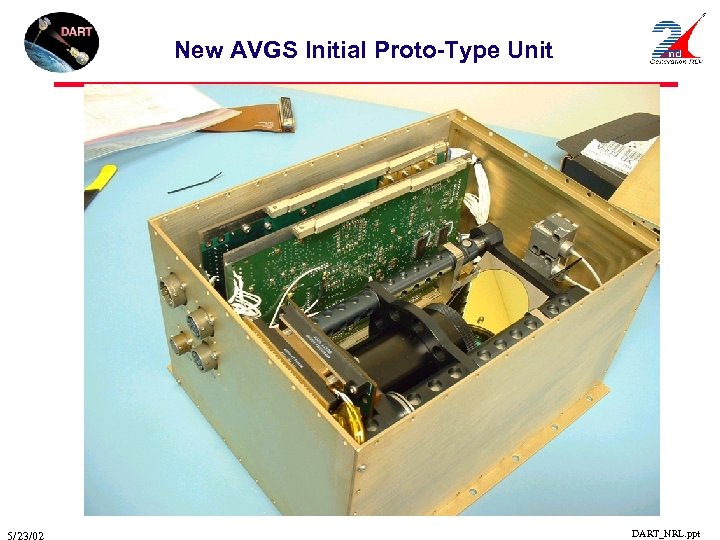 New AVGS Initial Proto-Type Unit DART_NRL. ppt
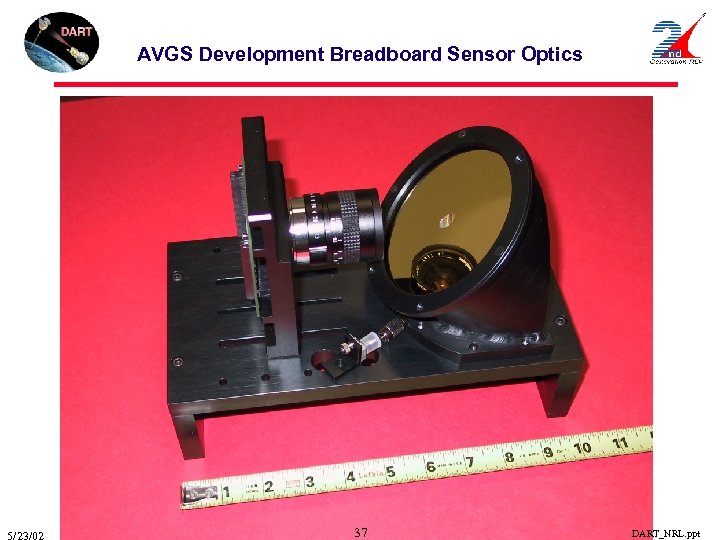 AVGS Development Breadboard Sensor Optics 37 DART_NRL. ppt
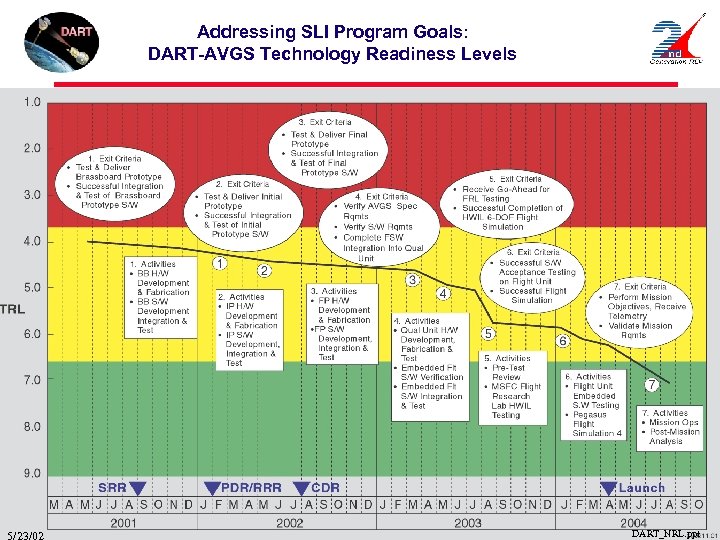 Addressing SLI Program Goals: DART-AVGS Technology Readiness Levels DART_NRL. ppt
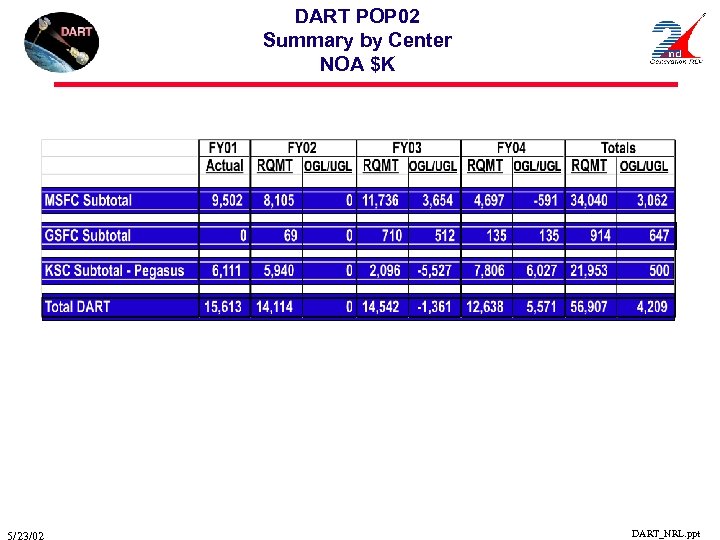 DART POP 02 Summary by Center NOA $K DART_NRL. ppt
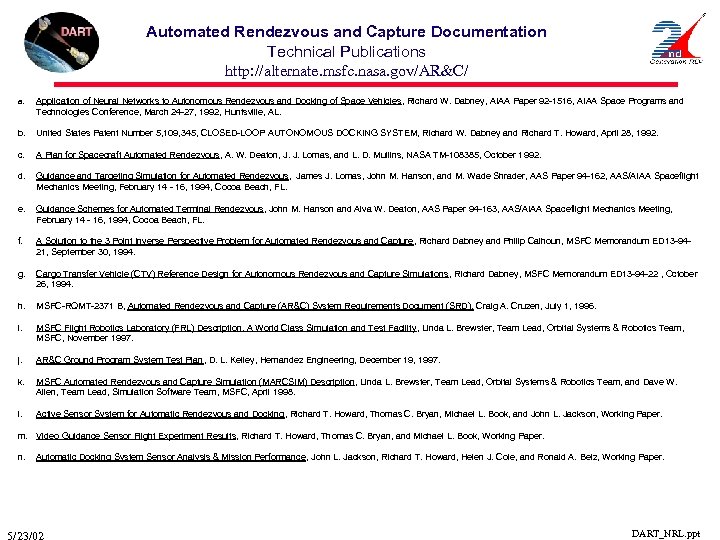 Automated Rendezvous and Capture Documentation Technical Publications http: //alternate. msfc. nasa. gov/AR&C/ a. Application of Neural Networks to Autonomous Rendezvous and Docking of Space Vehicles, Richard W. Dabney, AIAA Paper 92 -1516, AIAA Space Programs and Technologies Conference, March 24 -27, 1992, Huntsville, AL. b. United States Patent Number 5, 109, 345, CLOSED-LOOP AUTONOMOUS DOCKING SYSTEM, Richard W. Dabney and Richard T. Howard, April 28, 1992. c. A Plan for Spacecraft Automated Rendezvous, A. W. Deaton, J. J. Lomas, and L. D. Mullins, NASA TM-108385, October 1992. d. Guidance and Targeting Simulation for Automated Rendezvous, James J. Lomas, John M. Hanson, and M. Wade Shrader, AAS Paper 94 -162, AAS/AIAA Spaceflight Mechanics Meeting, February 14 - 16, 1994, Cocoa Beach, FL. e. Guidance Schemes for Automated Terminal Rendezvous, John M. Hanson and Alva W. Deaton, AAS Paper 94 -163, AAS/AIAA Spaceflight Mechanics Meeting, February 14 - 16, 1994, Cocoa Beach, FL. f. A Solution to the 3 Point Inverse Perspective Problem for Automated Rendezvous and Capture, Richard Dabney and Philip Calhoun, MSFC Memorandum ED 13 -9421, September 30, 1994. g. Cargo Transfer Vehicle (CTV) Reference Design for Autonomous Rendezvous and Capture Simulations, Richard Dabney, MSFC Memorandum ED 13 -94 -22 , October 26, 1994. h. MSFC-RQMT-2371 B, Automated Rendezvous and Capture (AR&C) System Requirements Document (SRD), Craig A. Cruzen, July 1, 1996. i. MSFC Flight Robotics Laboratory (FRL) Description, A World Class Simulation and Test Facility, Linda L. Brewster, Team Lead, Orbital Systems & Robotics Team, MSFC, November 1997. j. AR&C Ground Program System Test Plan, D. L. Kelley, Hernandez Engineering, December 19, 1997. k. MSFC Automated Rendezvous and Capture Simulation (MARCSIM) Description, Linda L. Brewster, Team Lead, Orbital Systems & Robotics Team, and Dave W. Allen, Team Lead, Simulation Software Team, MSFC, April 1998. l. Active Sensor System for Automatic Rendezvous and Docking, Richard T. Howard, Thomas C. Bryan, Michael L. Book, and John L. Jackson, Working Paper. m. Video Guidance Sensor Flight Experiment Results, Richard T. Howard, Thomas C. Bryan, and Michael L. Book, Working Paper. n. Automatic Docking System Sensor Analysis & Mission Performance, John L. Jackson, Richard T. Howard, Helen J. Cole, and Ronald A. Belz, Working Paper. DART_NRL. ppt