


 Скачать презентацию Demographic Multipliers Recent National and State Findings Prepared
8ce9a56c6c23cdbcde391f6817beb8b5.ppt
- Количество слайдов: 19
 Demographic Multipliers: Recent National and State Findings Prepared By DAVID LISTOKIN, Ph. D. ROBERT W. BURCHELL, Ph. D. Prepared For NATIONAL IMPACT FEE ROUND TABLE (NIFR) NATIONAL CONFERENCE ARLINGTON, VIRGINIA OCTOBER 2006
 PRESENTATION OVERVIEW n Perspective on Demographic Multipliers: definition, application, and literature n Changes in Multipliers Over Time n Results of New National Data n Results of New State Data (New Jersey example) n Conclusions
 DEFINITIONS OF DEMOGRAPHIC MULTIPLIERS n Demographic multipliers – the number and profile of the populations associated with new residential and nonresidential development n Residential multipliers – Resident population associated with housing n Nonresidential multipliers – Worker population associated with commercial and other business uses
 USE OF DEMOGRAPHIC MULTIPLIERS n Interlinked Applications n Impact fees n Fiscal impact analysis n School enrollment projections n Public staffing analysis n Market studies n Calculating development standards n “Cost of sprawl” studies n Other applications
 DEMOGRAPHIC MULTIPLIERS LITERATURE OVERVIEW (EXAMPLES) n The Fiscal Impact Handbook (1978) n The Practitioner’s Guide to Fiscal Impact Analysis n n n (1985) Development Impact Assessment Handbook and Model (1994) Planner’s Estimating Guide (2004) Residential Demographic Multipliers (2006) Fiscal and Impact Fee Studies (1970 s-2000 s) Other Conclusion: Extensive literature—but of varying quality and dating is often an issue
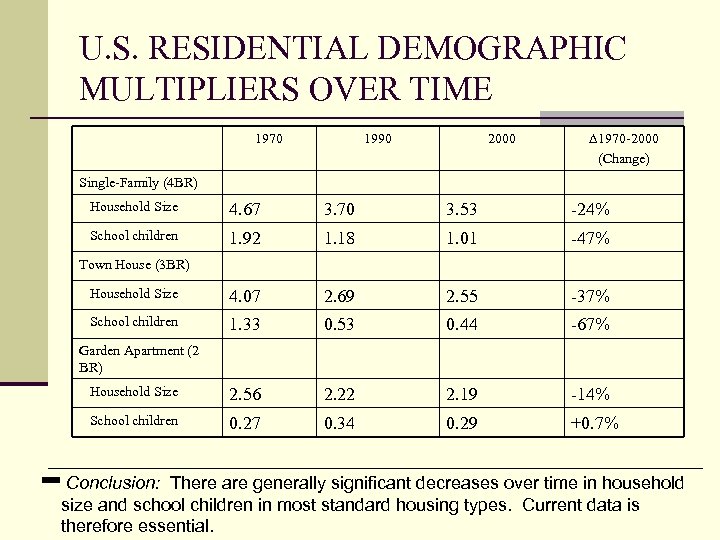 U. S. RESIDENTIAL DEMOGRAPHIC MULTIPLIERS OVER TIME 1970 1990 2000 1970 -2000 (Change) Single-Family (4 BR) Household Size 4. 67 3. 70 3. 53 -24% School children 1. 92 1. 18 1. 01 -47% Household Size 4. 07 2. 69 2. 55 -37% School children 1. 33 0. 53 0. 44 -67% Household Size 2. 56 2. 22 2. 19 -14% School children 0. 27 0. 34 0. 29 +0. 7% Town House (3 BR) Garden Apartment (2 BR) Conclusion: There are generally significant decreases over time in household size and school children in most standard housing types. Current data is therefore essential.
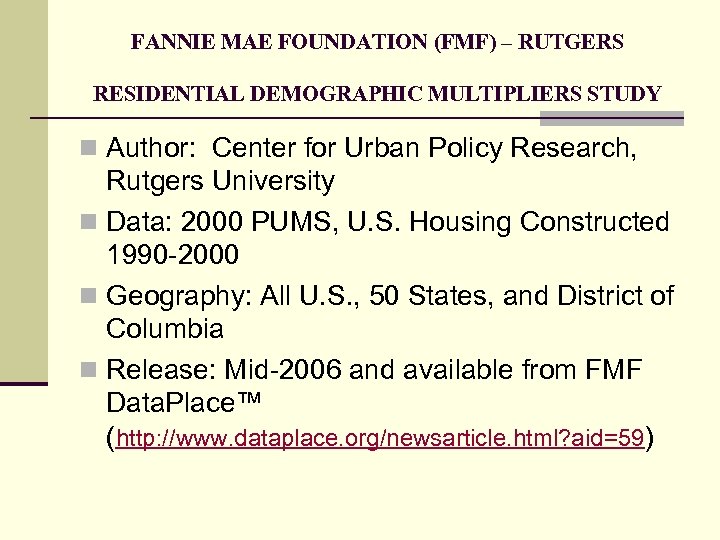 FANNIE MAE FOUNDATION (FMF) – RUTGERS RESIDENTIAL DEMOGRAPHIC MULTIPLIERS STUDY n Author: Center for Urban Policy Research, Rutgers University n Data: 2000 PUMS, U. S. Housing Constructed 1990 -2000 n Geography: All U. S. , 50 States, and District of Columbia n Release: Mid-2006 and available from FMF Data. Place™ (http: //www. dataplace. org/newsarticle. html? aid=59)
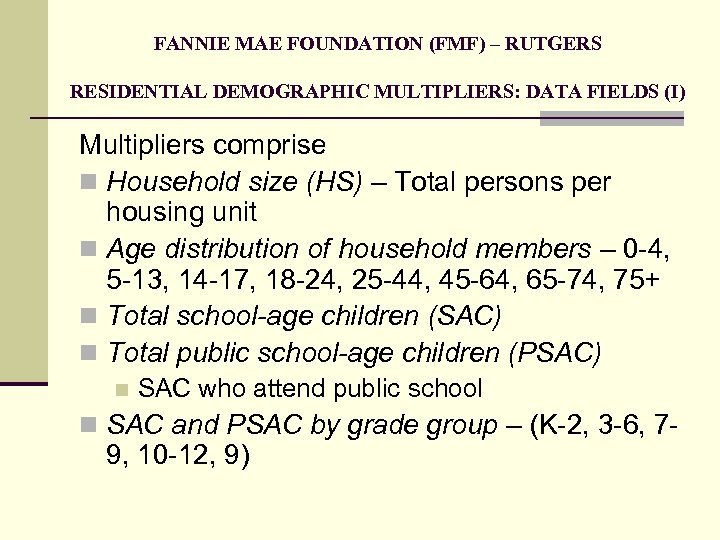 FANNIE MAE FOUNDATION (FMF) – RUTGERS RESIDENTIAL DEMOGRAPHIC MULTIPLIERS: DATA FIELDS (I) Multipliers comprise n Household size (HS) – Total persons per housing unit n Age distribution of household members – 0 -4, 5 -13, 14 -17, 18 -24, 25 -44, 45 -64, 65 -74, 75+ n Total school-age children (SAC) n Total public school-age children (PSAC) n SAC who attend public school n SAC and PSAC by grade group – (K-2, 3 -6, 7 - 9, 10 -12, 9)
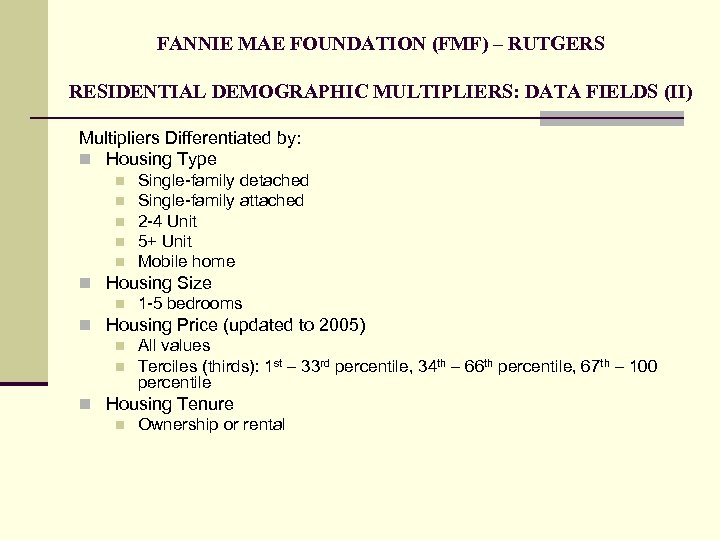 FANNIE MAE FOUNDATION (FMF) – RUTGERS RESIDENTIAL DEMOGRAPHIC MULTIPLIERS: DATA FIELDS (II) Multipliers Differentiated by: n Housing Type n n n Single-family detached Single-family attached 2 -4 Unit 5+ Unit Mobile home n Housing Size n 1 -5 bedrooms n Housing Price (updated to 2005) n All values n Terciles (thirds): 1 st – 33 rd percentile, 34 th – 66 th percentile, 67 th – 100 percentile n Housing Tenure n Ownership or rental
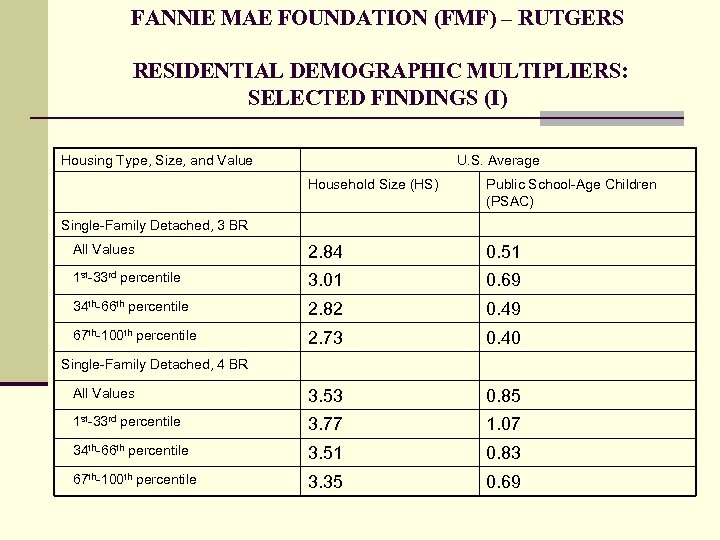 FANNIE MAE FOUNDATION (FMF) – RUTGERS RESIDENTIAL DEMOGRAPHIC MULTIPLIERS: SELECTED FINDINGS (I) Housing Type, Size, and Value U. S. Average Household Size (HS) Public School-Age Children (PSAC) All Values 2. 84 0. 51 1 st-33 rd percentile 3. 01 0. 69 34 th-66 th percentile 2. 82 0. 49 67 th-100 th percentile 2. 73 0. 40 All Values 3. 53 0. 85 1 st-33 rd percentile 3. 77 1. 07 34 th-66 th percentile 3. 51 0. 83 67 th-100 th percentile 3. 35 0. 69 Single-Family Detached, 3 BR Single-Family Detached, 4 BR
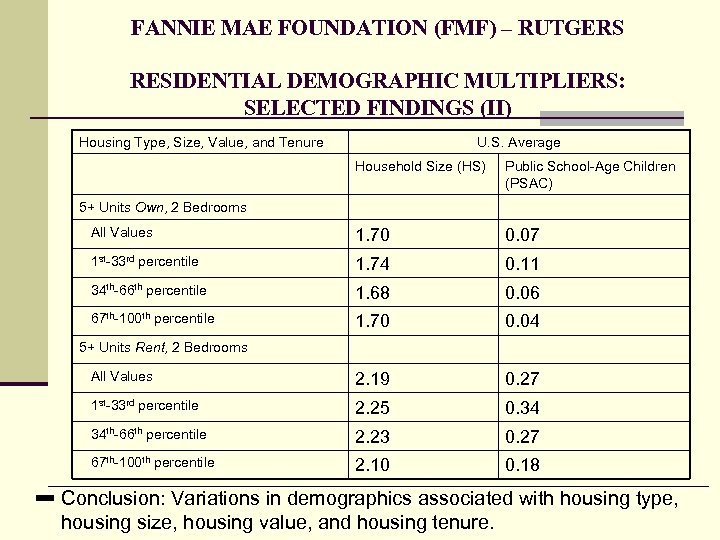 FANNIE MAE FOUNDATION (FMF) – RUTGERS RESIDENTIAL DEMOGRAPHIC MULTIPLIERS: SELECTED FINDINGS (II) Housing Type, Size, Value, and Tenure U. S. Average Household Size (HS) Public School-Age Children (PSAC) All Values 1. 70 0. 07 1 st-33 rd percentile 1. 74 0. 11 34 th-66 th percentile 1. 68 0. 06 67 th-100 th percentile 1. 70 0. 04 All Values 2. 19 0. 27 1 st-33 rd percentile 2. 25 0. 34 34 th-66 th percentile 2. 23 0. 27 67 th-100 th percentile 2. 10 0. 18 5+ Units Own, 2 Bedrooms 5+ Units Rent, 2 Bedrooms Conclusion: Variations in demographics associated with housing type, housing size, housing value, and housing tenure.
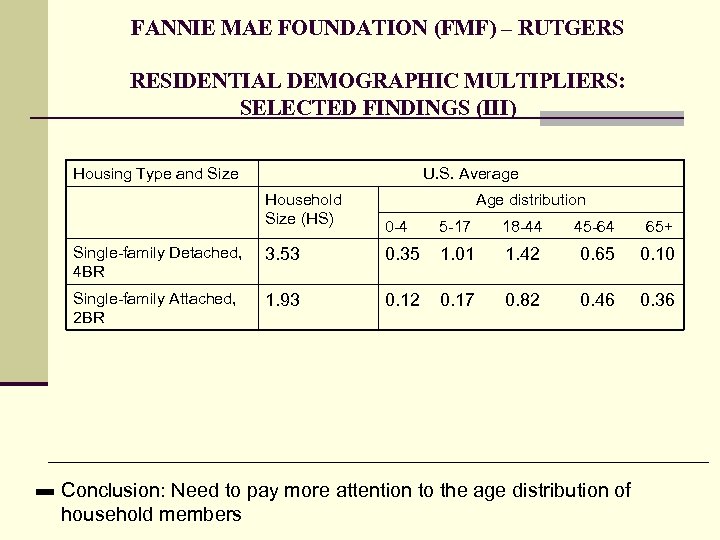 FANNIE MAE FOUNDATION (FMF) – RUTGERS RESIDENTIAL DEMOGRAPHIC MULTIPLIERS: SELECTED FINDINGS (III) Housing Type and Size U. S. Average Household Size (HS) Age distribution 0 -4 5 -17 18 -44 45 -64 65+ Single-family Detached, 4 BR 3. 53 0. 35 1. 01 1. 42 0. 65 0. 10 Single-family Attached, 2 BR 1. 93 0. 12 0. 17 0. 82 0. 46 0. 36 Conclusion: Need to pay more attention to the age distribution of household members
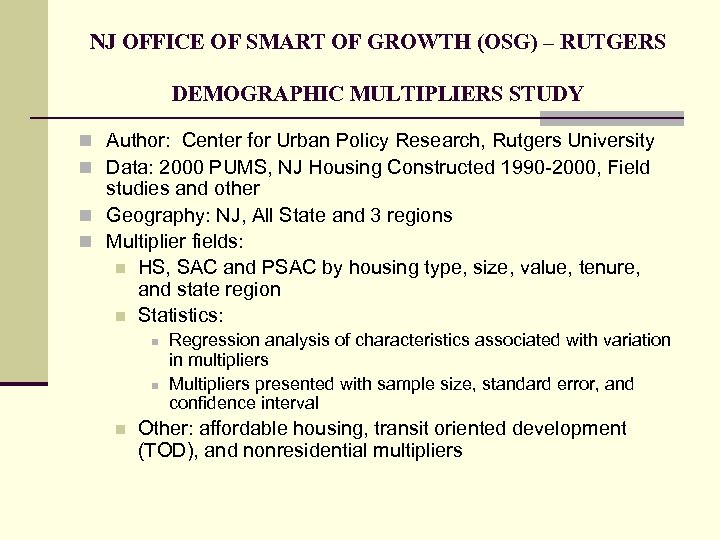 NJ OFFICE OF SMART OF GROWTH (OSG) – RUTGERS DEMOGRAPHIC MULTIPLIERS STUDY n Author: Center for Urban Policy Research, Rutgers University n Data: 2000 PUMS, NJ Housing Constructed 1990 -2000, Field studies and other n Geography: NJ, All State and 3 regions n Multiplier fields: n HS, SAC and PSAC by housing type, size, value, tenure, and state region n Statistics: n n n Regression analysis of characteristics associated with variation in multipliers Multipliers presented with sample size, standard error, and confidence interval Other: affordable housing, transit oriented development (TOD), and nonresidential multipliers
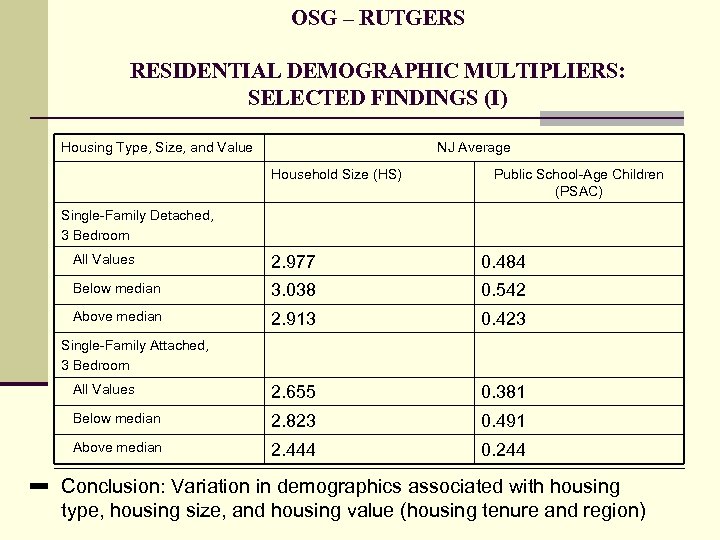 OSG – RUTGERS RESIDENTIAL DEMOGRAPHIC MULTIPLIERS: SELECTED FINDINGS (I) Housing Type, Size, and Value NJ Average Household Size (HS) Public School-Age Children (PSAC) Single-Family Detached, 3 Bedroom All Values 2. 977 0. 484 Below median 3. 038 0. 542 Above median 2. 913 0. 423 All Values 2. 655 0. 381 Below median 2. 823 0. 491 Above median 2. 444 0. 244 Single-Family Attached, 3 Bedroom Conclusion: Variation in demographics associated with housing type, housing size, and housing value (housing tenure and region)
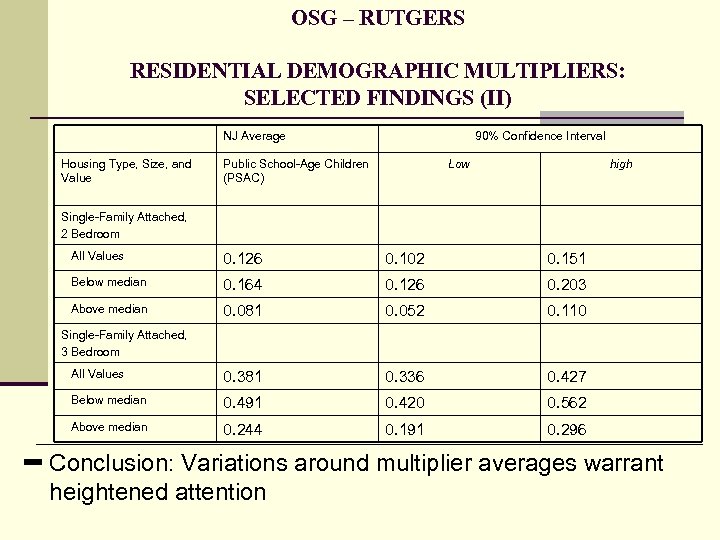 OSG – RUTGERS RESIDENTIAL DEMOGRAPHIC MULTIPLIERS: SELECTED FINDINGS (II) NJ Average Housing Type, Size, and Value 90% Confidence Interval Public School-Age Children (PSAC) Low high Single-Family Attached, 2 Bedroom All Values 0. 126 0. 102 0. 151 Below median 0. 164 0. 126 0. 203 Above median 0. 081 0. 052 0. 110 All Values 0. 381 0. 336 0. 427 Below median 0. 491 0. 420 0. 562 Above median 0. 244 0. 191 0. 296 Single-Family Attached, 3 Bedroom Conclusion: Variations around multiplier averages warrant heightened attention
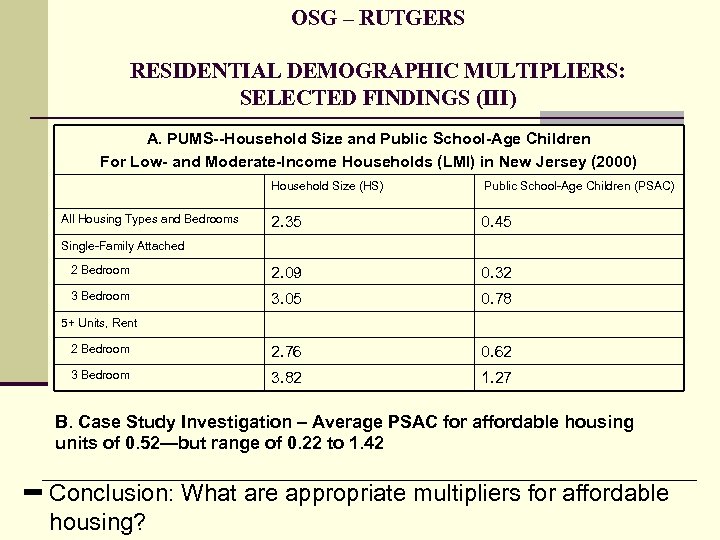 OSG – RUTGERS RESIDENTIAL DEMOGRAPHIC MULTIPLIERS: SELECTED FINDINGS (III) A. PUMS--Household Size and Public School-Age Children For Low- and Moderate-Income Households (LMI) in New Jersey (2000) Household Size (HS) Public School-Age Children (PSAC) 2. 35 0. 45 2 Bedroom 2. 09 0. 32 3 Bedroom 3. 05 0. 78 2 Bedroom 2. 76 0. 62 3 Bedroom 3. 82 1. 27 All Housing Types and Bedrooms Single-Family Attached 5+ Units, Rent B. Case Study Investigation – Average PSAC for affordable housing units of 0. 52—but range of 0. 22 to 1. 42 Conclusion: What are appropriate multipliers for affordable housing?
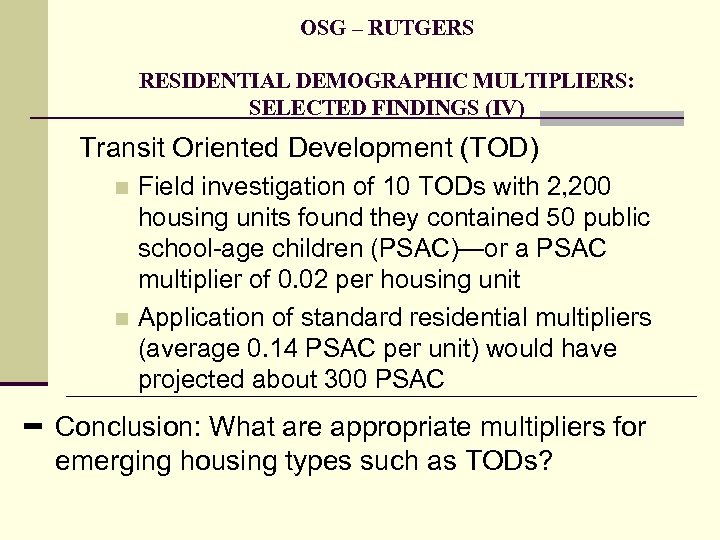 OSG – RUTGERS RESIDENTIAL DEMOGRAPHIC MULTIPLIERS: SELECTED FINDINGS (IV) Transit Oriented Development (TOD) Field investigation of 10 TODs with 2, 200 housing units found they contained 50 public school-age children (PSAC)—or a PSAC multiplier of 0. 02 per housing unit n Application of standard residential multipliers (average 0. 14 PSAC per unit) would have projected about 300 PSAC n Conclusion: What are appropriate multipliers for emerging housing types such as TODs?
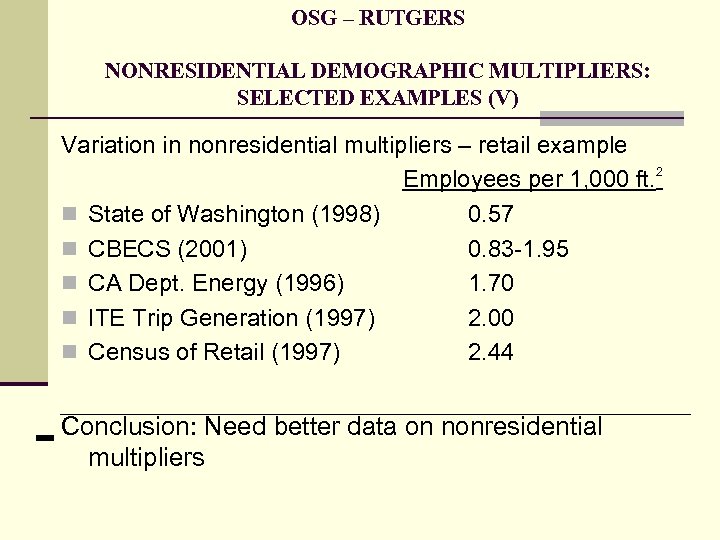 OSG – RUTGERS NONRESIDENTIAL DEMOGRAPHIC MULTIPLIERS: SELECTED EXAMPLES (V) Variation in nonresidential multipliers – retail example Employees per 1, 000 ft. 2 n State of Washington (1998) 0. 57 n CBECS (2001) 0. 83 -1. 95 n CA Dept. Energy (1996) 1. 70 n ITE Trip Generation (1997) 2. 00 n Census of Retail (1997) 2. 44 Conclusion: Need better data on nonresidential multipliers
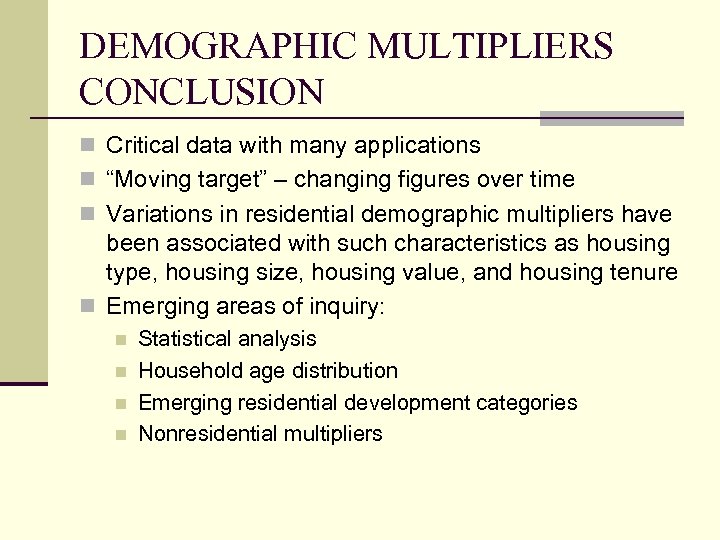 DEMOGRAPHIC MULTIPLIERS CONCLUSION n Critical data with many applications n “Moving target” – changing figures over time n Variations in residential demographic multipliers have been associated with such characteristics as housing type, housing size, housing value, and housing tenure n Emerging areas of inquiry: n n Statistical analysis Household age distribution Emerging residential development categories Nonresidential multipliers