


 Скачать презентацию Dementia Training support Skills development Competency
ce82199474cca7b415ff483d1a004869.ppt
- Количество слайдов: 19
 Dementia Training support • Skills development • Competency • Assessment • Scholarships • Education Training to care for people with dementia
 Development of a brief delirium screen for older patients in the Emergency Department Malcolm Hare, Fremantle Hospital Ph. D Candidate Training to care for people with dementia
 Background • • • Delirium is an episode of acute confusion, and signals a serious physiological problem. It occurs frequently in older hospitalised patients and is often present on arrival in ED Older patients with delirium are at high risk of a range of serious adverse outcomes Early recognition leads to early treatment and management with better outcomes (↑ survival, ↓ LOS, ↓ falls, ↓ ‘specialling’, ↓ discharge to nursing home etc), BUT Recognition of delirium by nurses and other health staff is poor Training to care for people with dementia
 Background • • • 2006: Investigated nurses’ knowledge of delirium and its risk factors – Demonstrated that nurses knowledge is generally poor, especially in relation to risk factors – Questionnaire (or parts of it) now in use in Victoria, NSW, Queensland, Ireland the USA Delirium prevalence by audit of in-patient notes – Approx 10% prevalence – Poor documentation, suggestive of poor understanding – Many cases of probable delirium undiagnosed Training to care for people with dementia
 Background • 2006: • Delirium screening using CAM and AMT with patients aged 65 years and over in the ED • Found to be time-consuming and problematic even with AMT (which is briefer than the required / recommended MMSE) • Published in International Emergency Nursing Journal 2008 – – In top 10 most downloaded articles second half of 2008 and first half of 2009 Training to care for people with dementia
 Background • • • Tools to screen for cognitive deficit / delirium exist BUT They need training to use They take time to administer They are often difficult or inappropriate to use in ED Staff lack knowledge Training to care for people with dementia
 Project • HREC approval (SMAHS and Curtin) • Funding for new project from Office of the Chief nurse • Permission and buy-in from ED research coordination group and nursing management Training to care for people with dementia
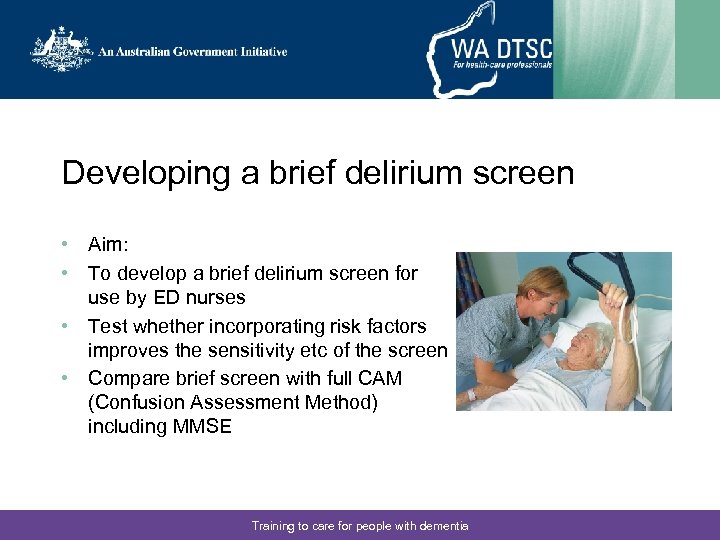 Developing a brief delirium screen • Aim: • To develop a brief delirium screen for use by ED nurses • Test whether incorporating risk factors improves the sensitivity etc of the screen • Compare brief screen with full CAM (Confusion Assessment Method) including MMSE Training to care for people with dementia
 Stage 1: Collect data • Research nurse conducted CAM assessment including MMSE on convenience sample of patients aged 65+ • Gathered data on risk factors (from the literature), demographics etc • Consent from patient/relative • Conducted in-service education for ED nurses Training to care for people with dementia
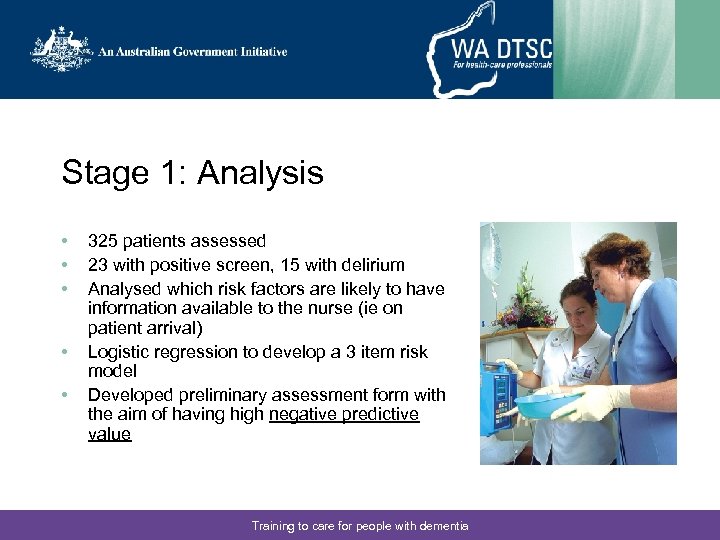 Stage 1: Analysis • • • 325 patients assessed 23 with positive screen, 15 with delirium Analysed which risk factors are likely to have information available to the nurse (ie on patient arrival) Logistic regression to develop a 3 item risk model Developed preliminary assessment form with the aim of having high negative predictive value Training to care for people with dementia
 Stage 2: Process • In-service sessions on delirium • Nurses used assessment form to screen all patients aged 65+ over all shifts in the context of their initial assessment • Research nurse collated data and conducted a full delirium assessment and data collection for patients who had an ED nurse screen (only if they could assess the patient within 2 hours of the ED nurse screen) • Preliminary assessment form developed into final form during the stage Training to care for people with dementia
 Assessment form design • Front page: – AMT 4 (4 questions abbreviated from AMT) – Risk screen: • Any evidence of acute onset of confusion • and/or combination of risk factors: – Dementia plus either or both depression and abnormal cardiac rhythm – If negative screen, no further assessment required, total assessment time < 1 min Training to care for people with dementia
 Assessment form design • Second page (only if positive risk screen): – Elements from CAM, ignoring fluctuation: • * Fluctuation is required for a diagnosis of delirium, but is not required for a positive screen according to the developers of the CAM. It is assumed that at the first assessment the ED nurse will not have had enough time with the patient to assess for this. – “Delirium screen” score, linked to actions. Highest score = probable delirium Training to care for people with dementia
 Assessment form design • Second page (cont): – “Delirium screen” score: • 2 points for Inattention, 1 point each for disorganised thinking and altered conscious state – Score 3 or 4 = probable delirium – Score 2 = high risk of delirium – Score 0 or 1 = moderate risk (the patient was already at risk from the front page screen or we would not be on the back page) Training to care for people with dementia
 Final form development • • Preliminary form designed (intended) to be simple to follow, quick to use and require no reference to other information Format of initial form redeveloped through iterative process, with changes driven by: – Inconsistent / contradictory results – Feedback from research nurses – Feedback from staff – Readability (layout, wording to improve reliability, repeatability) not core content Final version released in August, data more consistent. Stage 2 finalised in November Training to care for people with dementia
 Assess impact of in-service education and use of form • Questionnaire to nurses: impact on workload, patient assessment, confidence and care of older patients – Preliminary data from Stage 2: • Time taken to complete each assessment times number of patients = workload over 8 weeks: 1 minute per nurse per day if all patients aged 65 + assessed • Positive responses regarding improvement in knowledge and assessment skills • Mixed responses regarding workload impact Training to care for people with dementia
 Stage 3: Testing assessment form • Funding from Nurses Memorial Trust Fund • Break over Christmas (4 hour rule implementation, staffing issues) • Started last week with 1 week run-in • To run for at least 16 weeks • Further education & information to staff (turnover) • Re-focus protocol: day shift only Training to care for people with dementia
 Questions? Training to care for people with dementia
 Acknowledgements and disclaimer • • • Fremantle Hospital Curtin University OCNO WA DTSC WA Nurses’ Memorial Trust • The Western Australian Dementia Training Study Centre (WA DTSC) has been established as part of the Australian Government’s Dementia Initiative. The WA DTSC is one of four Centres nationally that promote dementia studies in Australian graduate and undergraduate curriculum as well as providing tertiary dementia career pathways. The views expressed in this work are the views of its author(s) and not necessarily those of the Commonwealth of Australia. Despite any permitted use of Graphic Design Guidelines for Training Partner and Projects copyright material, the reader needs to be aware that the information contained in this work is not necessarily endorsed, and its contents may not have been approved or reviewed, by the Australian Government Department of Health and Ageing. • • Training to care for people with dementia