


 Скачать презентацию Demand Trudie Murray Demand Supply Game
fc793711f1071c0813fd9d36d43fad48.ppt
- Количество слайдов: 34
 Demand Trudie Murray ©
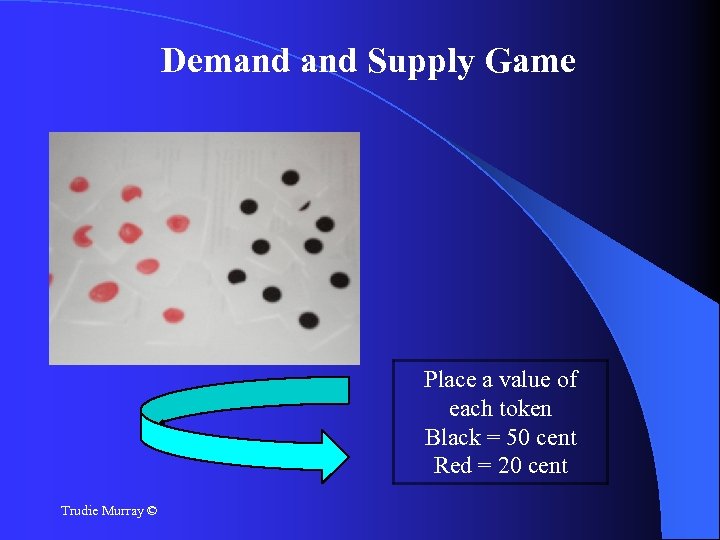 Demand Supply Game Place a value of each token Black = 50 cent Red = 20 cent Trudie Murray ©
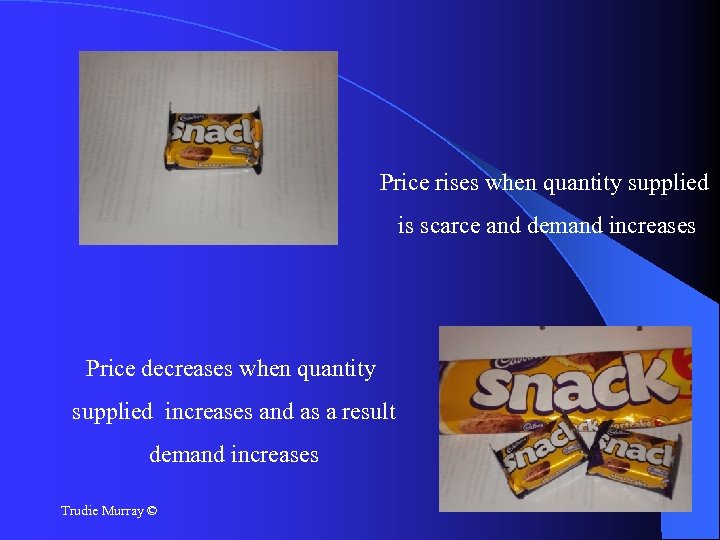 Price rises when quantity supplied is scarce and demand increases Price decreases when quantity supplied increases and as a result demand increases Trudie Murray ©
 Demand The amount consumers desire to purchase at various prices at any given time Demand does not necessarily mean a consumer WILL buy, but refers to a good or service they WOULD LIKE to buy Trudie Murray ©
 Effective Demand • Consumers must be willing to buy AND be capable of paying the price set by the supplier Trudie Murray ©
 Law of Demand If Price rises – Quantity demanded falls P Q If Price falls – Quantity demanded rises P Trudie Murray © Q
 Individual Demand Schedule Lists the different quantities of a good that an individual consumer is prepared to buy at each price Trudie Murray ©
 Market Demand Schedule Lists the different quantities of a good that all consumers in the market are prepared to buy at each price. It is derived by adding together all the individual demand schedules for the good Trudie Murray ©
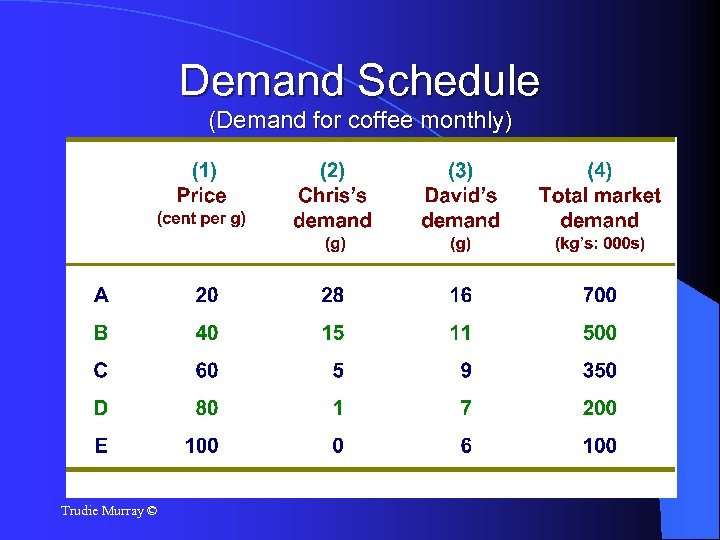 Demand Schedule (Demand for coffee monthly) Trudie Murray ©
 Demand Curve At higher prices, consumers are generally willing to purchase less than at lower prices Demand curve is said to have a negative slope - downward sloping from left to right Trudie Murray ©
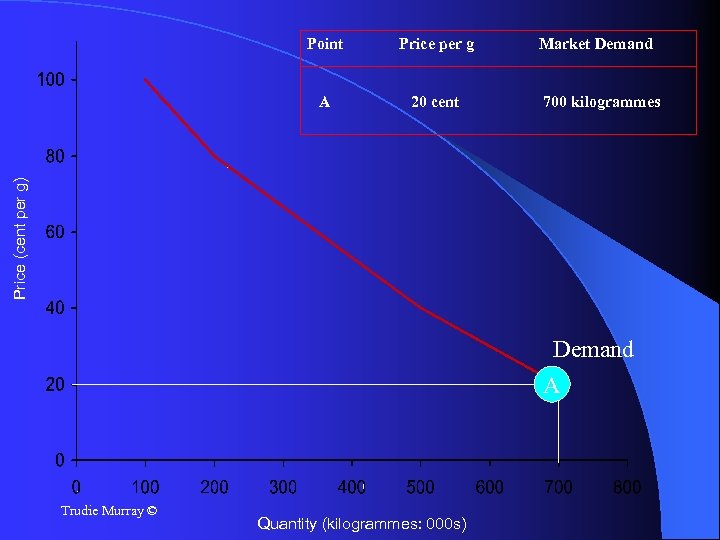 Price per g A 20 cent Market Demand 700 kilogrammes Price (cent per g) Point Demand A Trudie Murray © Quantity (kilogrammes: 000 s)
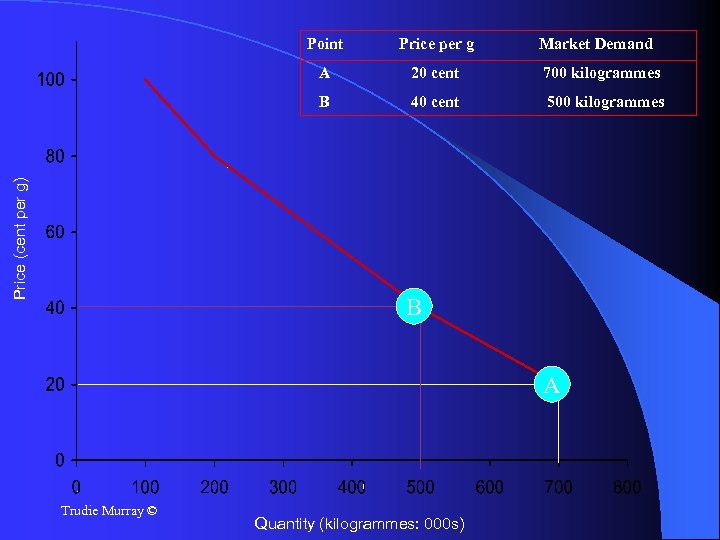 Price per g A 20 cent 700 kilogrammes B Price (cent per g) Point Market Demand 40 cent 500 kilogrammes B A Trudie Murray © Quantity (kilogrammes: 000 s)
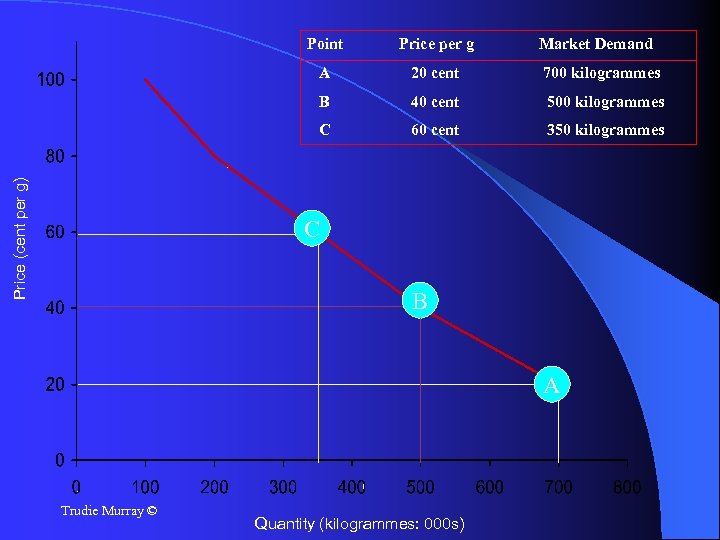 Price per g A 20 cent 700 kilogrammes B 40 cent 500 kilogrammes C Price (cent per g) Point Market Demand 60 cent 350 kilogrammes C B A Trudie Murray © Quantity (kilogrammes: 000 s)
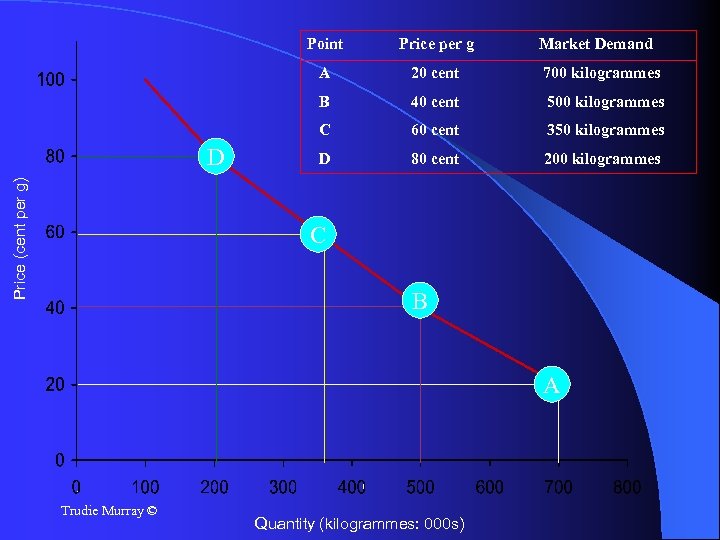 Point A 700 kilogrammes 40 cent 500 kilogrammes C Price (cent per g) 20 cent B D Price per g Market Demand 60 cent 350 kilogrammes D 80 cent 200 kilogrammes C B A Trudie Murray © Quantity (kilogrammes: 000 s)
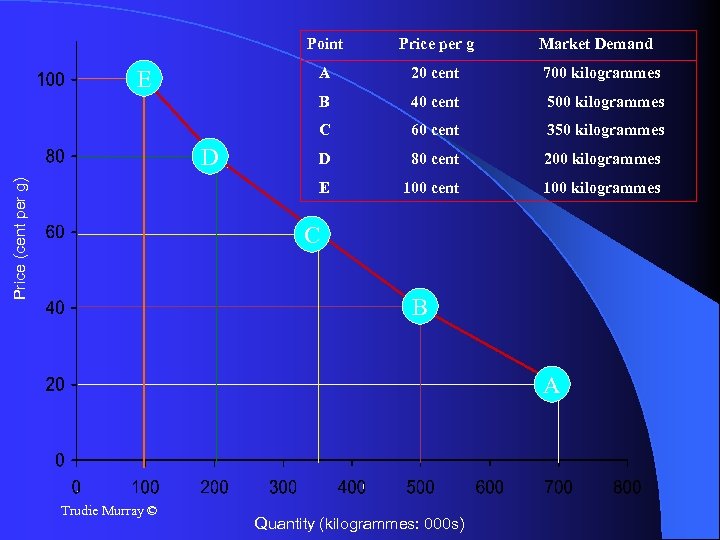 Point A 40 cent 500 kilogrammes 60 cent 350 kilogrammes D 80 cent 200 kilogrammes E Price (cent per g) 700 kilogrammes C D 20 cent B E Price per g Market Demand 100 cent 100 kilogrammes C B A Trudie Murray © Quantity (kilogrammes: 000 s)
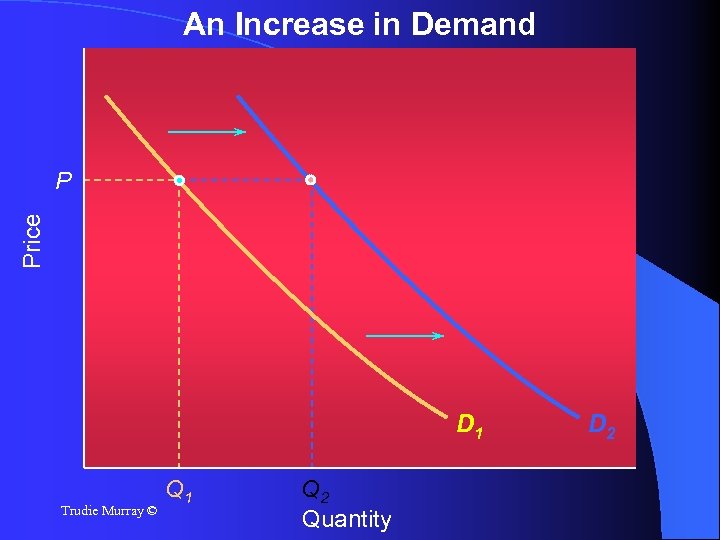 An Increase in Demand Price P D 1 Trudie Murray © Q 1 Q 2 Quantity D 2
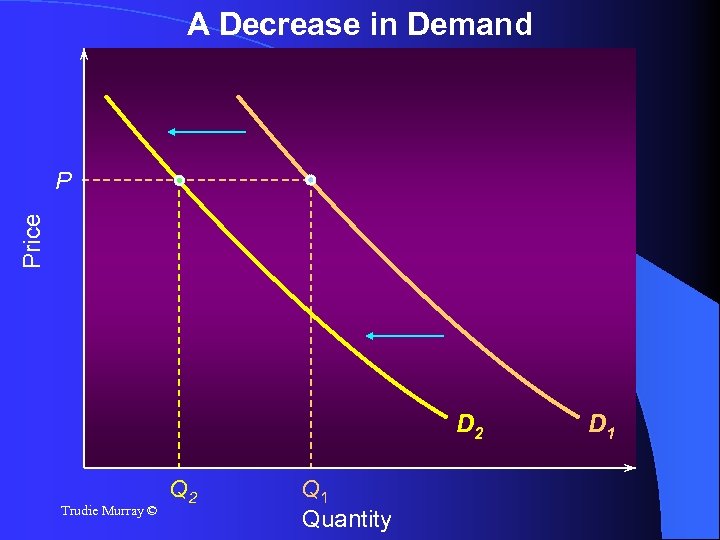 A Decrease in Demand Price P D 2 Trudie Murray © Q 2 Q 1 Quantity D 1
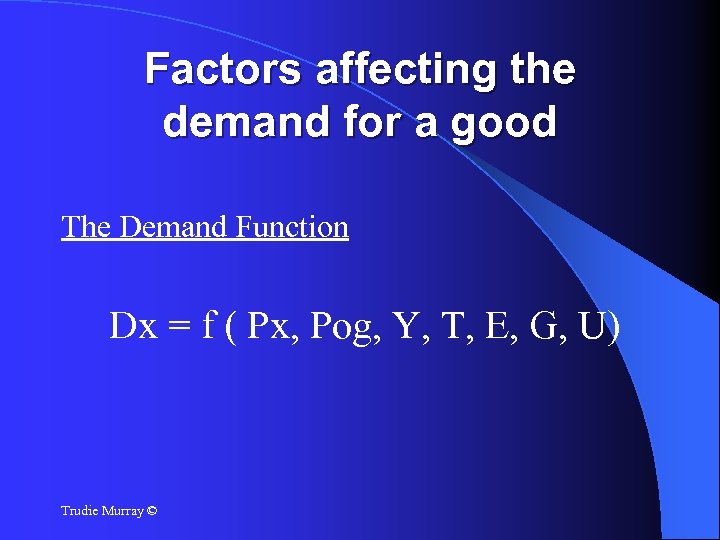 Factors affecting the demand for a good The Demand Function Dx = f ( Px, Pog, Y, T, E, G, U) Trudie Murray ©
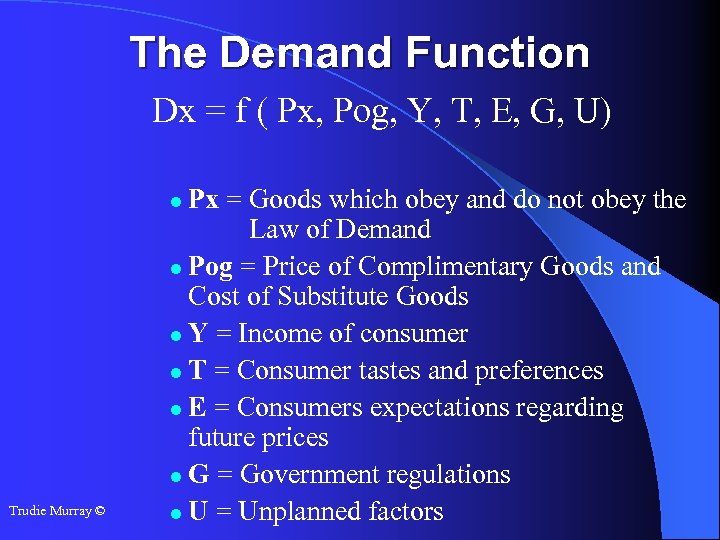 The Demand Function Dx = f ( Px, Pog, Y, T, E, G, U) Px = Goods which obey and do not obey the Law of Demand Pog = Price of Complimentary Goods and Cost of Substitute Goods Y = Income of consumer T = Consumer tastes and preferences E = Consumers expectations regarding future prices G = Government regulations U = Unplanned factors Trudie Murray ©
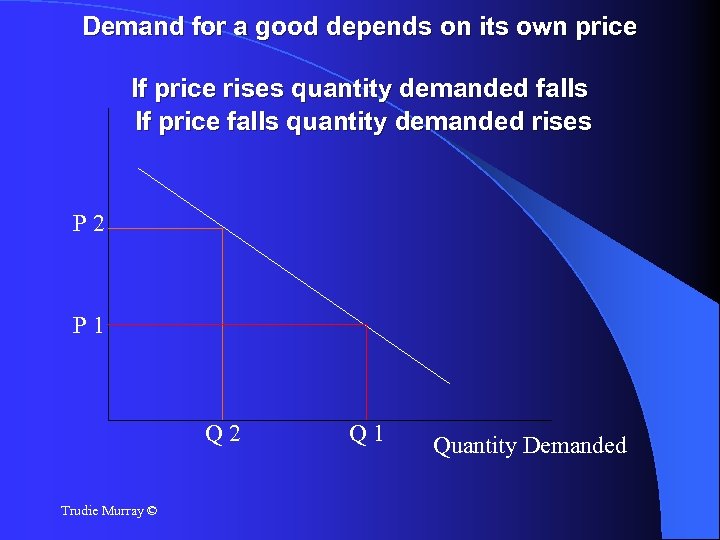 Demand for a good depends on its own price If price rises quantity demanded falls If price falls quantity demanded rises P 2 P 1 Q 2 Trudie Murray © Q 1 Quantity Demanded
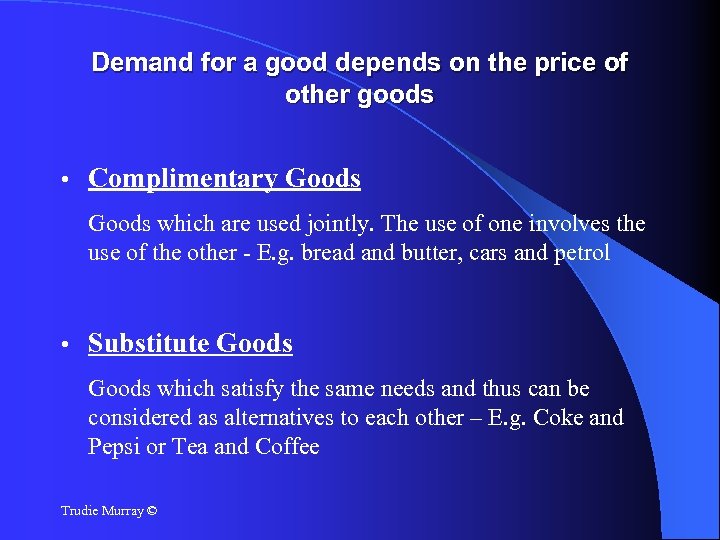 Demand for a good depends on the price of other goods • Complimentary Goods which are used jointly. The use of one involves the use of the other - E. g. bread and butter, cars and petrol • Substitute Goods which satisfy the same needs and thus can be considered as alternatives to each other – E. g. Coke and Pepsi or Tea and Coffee Trudie Murray ©
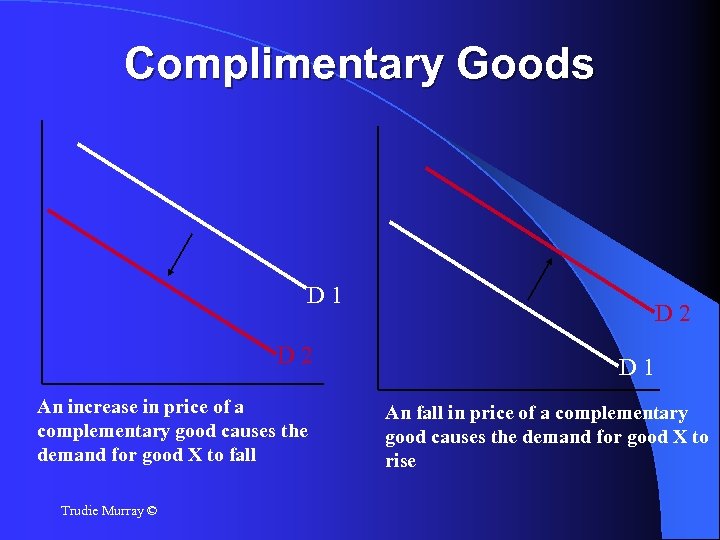 Complimentary Goods D 1 D 2 An increase in price of a complementary good causes the demand for good X to fall Trudie Murray © D 2 D 1 An fall in price of a complementary good causes the demand for good X to rise
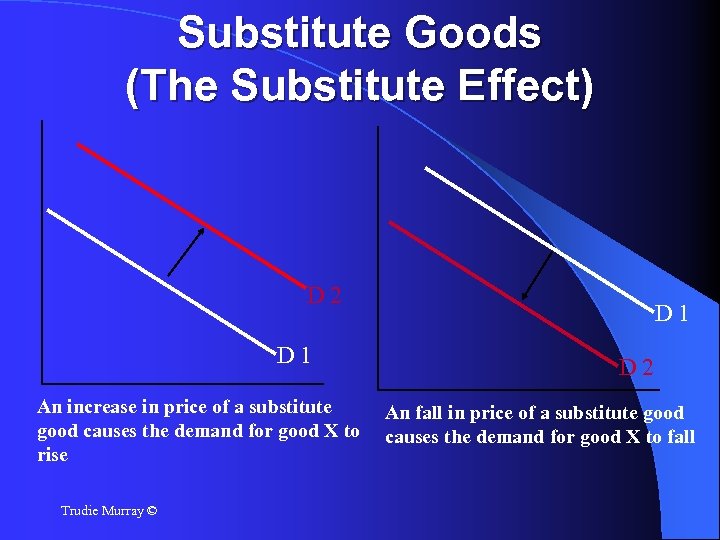 Substitute Goods (The Substitute Effect) D 2 D 1 An increase in price of a substitute good causes the demand for good X to rise Trudie Murray © D 1 D 2 An fall in price of a substitute good causes the demand for good X to fall
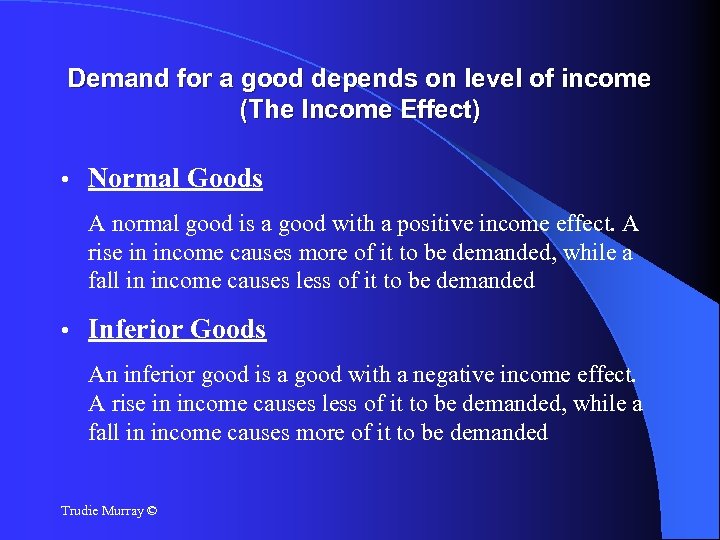 Demand for a good depends on level of income (The Income Effect) • Normal Goods A normal good is a good with a positive income effect. A rise in income causes more of it to be demanded, while a fall in income causes less of it to be demanded • Inferior Goods An inferior good is a good with a negative income effect. A rise in income causes less of it to be demanded, while a fall in income causes more of it to be demanded Trudie Murray ©
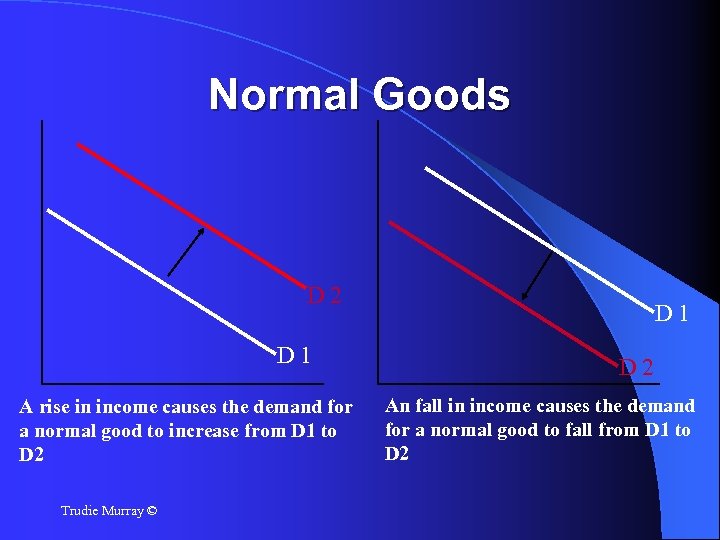 Normal Goods D 2 D 1 A rise in income causes the demand for a normal good to increase from D 1 to D 2 Trudie Murray © D 1 D 2 An fall in income causes the demand for a normal good to fall from D 1 to D 2
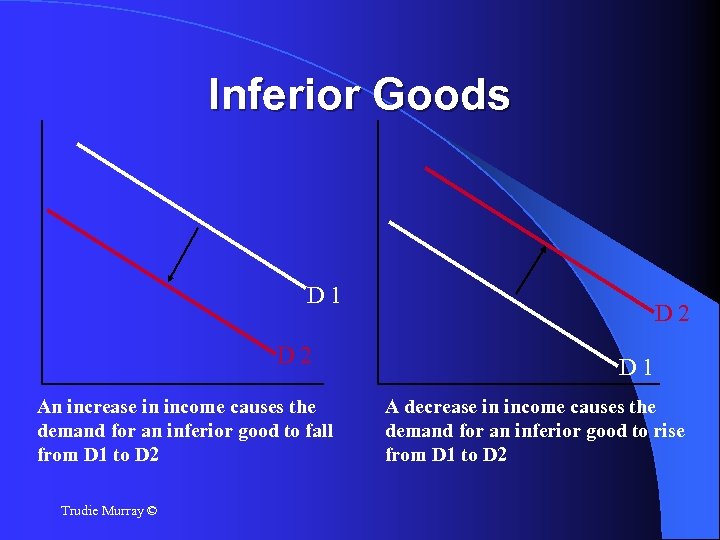 Inferior Goods D 1 D 2 An increase in income causes the demand for an inferior good to fall from D 1 to D 2 Trudie Murray © D 2 D 1 A decrease in income causes the demand for an inferior good to rise from D 1 to D 2
 Demand depends on Consumer Tastes If the movement in taste or preferences is in favour of the good it causes an increase in demand which shifts the demand curve to the right If the movement in taste or preferences is against the good it causes a fall in demand which shifts the demand curve to the left Trudie Murray ©
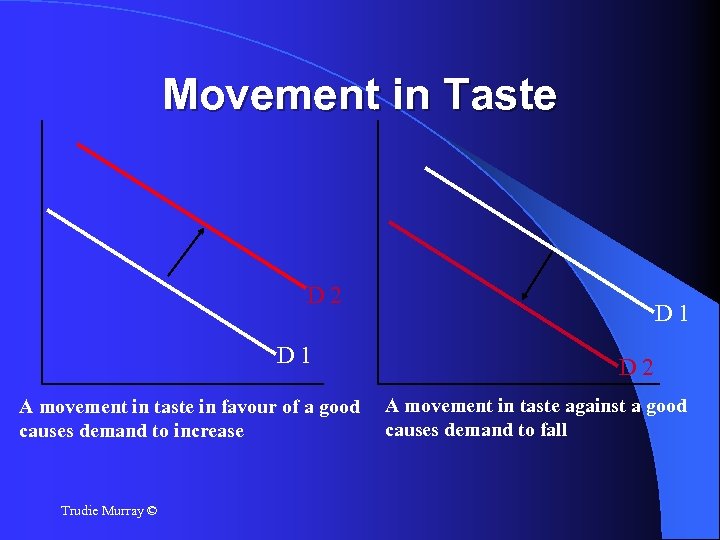 Movement in Taste D 2 D 1 A movement in taste in favour of a good causes demand to increase Trudie Murray © D 1 D 2 A movement in taste against a good causes demand to fall
 Demand for a good depends on the expectations of consumers Demand for a good will shift to the right if consumers expect: 1. 2. 3. The price of good X to be higher in the future e. g. property A scarcity of good X in the future e. g. oil Their incomes to be higher in the future e. g. promotion Demand for a good will shift to the left if consumers expect: 1. 2. 3. Trudie Murray © The price of good X to be lower in the future A plentiful supply of good X in the future Their incomes will be lower in the future
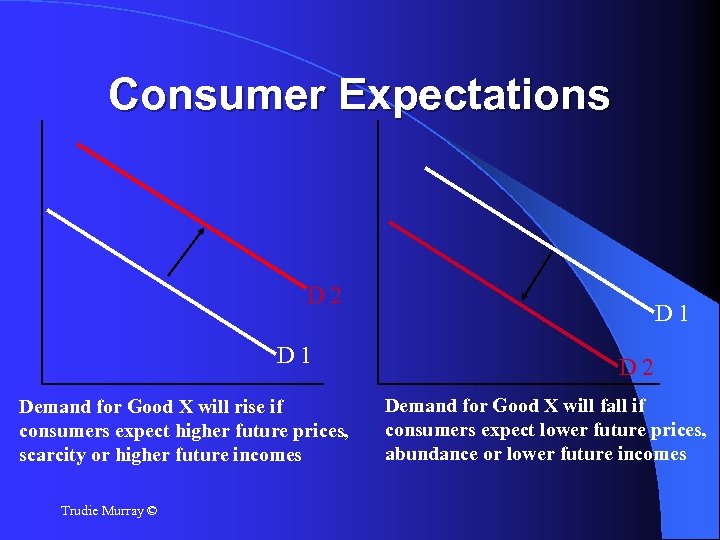 Consumer Expectations D 2 D 1 Demand for Good X will rise if consumers expect higher future prices, scarcity or higher future incomes Trudie Murray © D 1 D 2 Demand for Good X will fall if consumers expect lower future prices, abundance or lower future incomes
 Demand for a good depends on government regulations If the government implement a programme which reduces consumption of a particular product than demand for this good will be affected Ø E. g. The smoking ban / educational campaign to reduce alcohol consumption. Trudie Murray ©
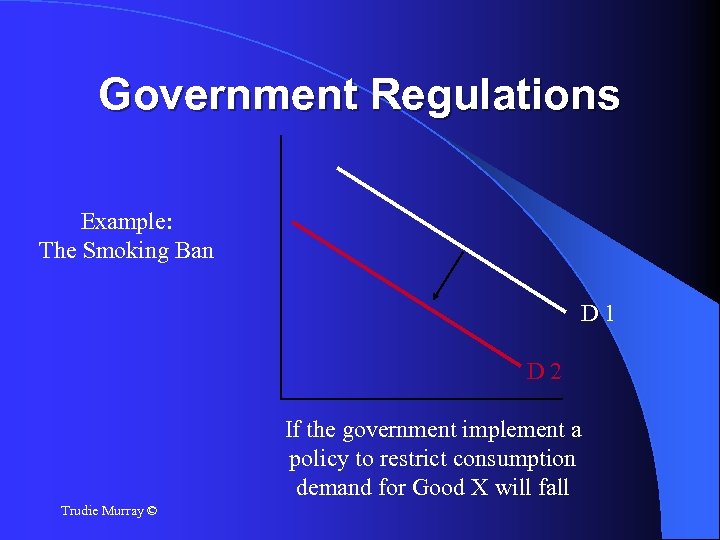 Government Regulations Example: The Smoking Ban D 1 D 2 If the government implement a policy to restrict consumption demand for Good X will fall Trudie Murray ©
 Demand for a good depends on unplanned factors If there is a sudden heat wave – an unplanned factor – this may result in an increase in demand for sunscreen and a decrease in the demand of home oil If flash floods occur across the country – an unplanned factor – this may result in an increase in the demand for Wellingtons. Trudie Murray ©
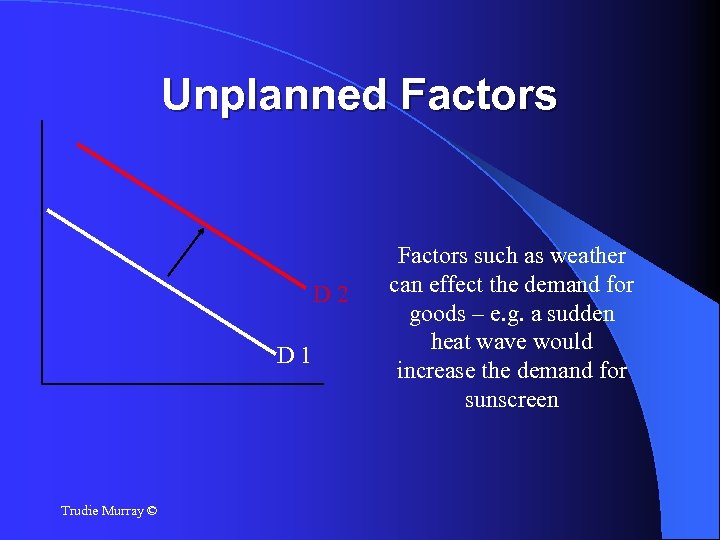 Unplanned Factors D 2 D 1 Trudie Murray © Factors such as weather can effect the demand for goods – e. g. a sudden heat wave would increase the demand for sunscreen