



 Demand supply Topic 2 1
 Agenda n Basics of demand n Closer look at demand n Basics of supply n Closer look at supply 2
 n Part 1: Basics of demand 3
 The law of demand n THE LAW OF DEMAND states that, in general, other things being constant, the lower the price of a good, the greater the quantity of that good buyers will purchase over a given period (and conversely). n More precisely: other things remaining the same, the higher the price of a good, the smaller is the quantity demanded; and the lower the price of a good, the greater is the quantity demanded. Source: Hyman; Parkin 4
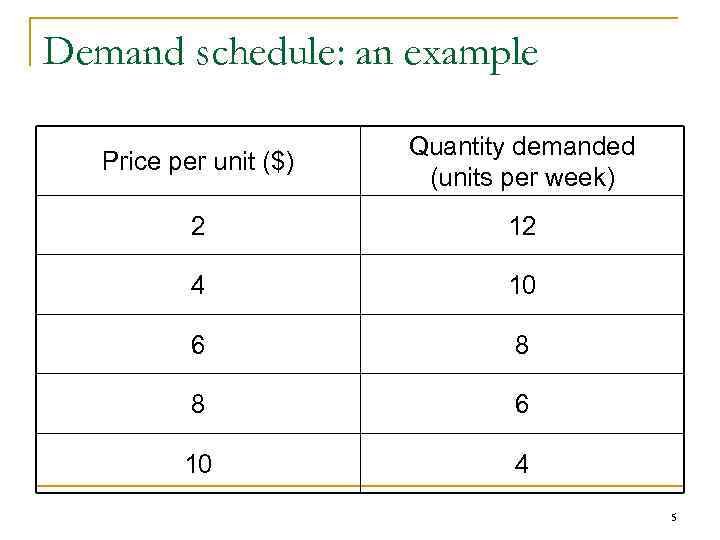 Demand schedule: an example Price per unit ($) Quantity demanded (units per week) 2 12 4 10 6 8 8 6 10 4 5
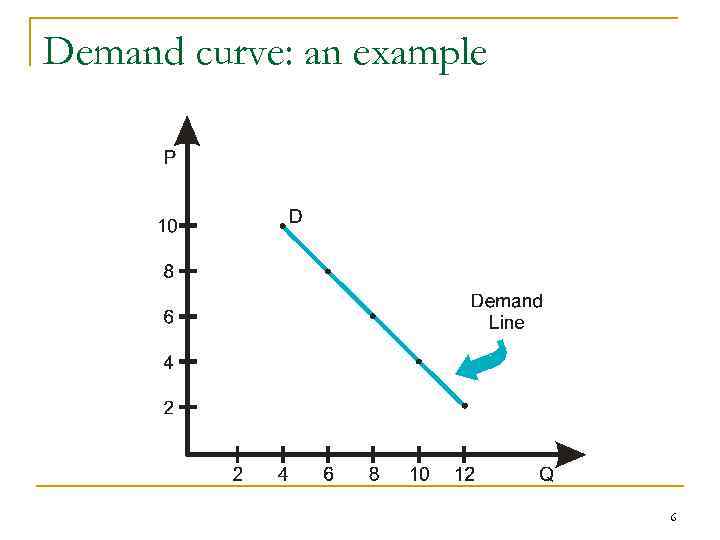 Demand curve: an example 6
 The law of demand – things to remember n n n Ceteris paribus qualification Shift factors of demand Shift along demand curve and shift of demand curve Quantity demanded vs. demand Effective demand vs. potential demand Time dimension 7
 Ceteris paribus qualification n Recall Alfred Marshall’s concept of „pound”. 8
 Shift factors of demand n n SHIFT FACTORS OF DEMAND = the things held constant when plotting demand curve; factors influencing demand (other than price). Basic shift factors of demand: q q q income, prices of other goods (substitutes and complements), preferences. 9
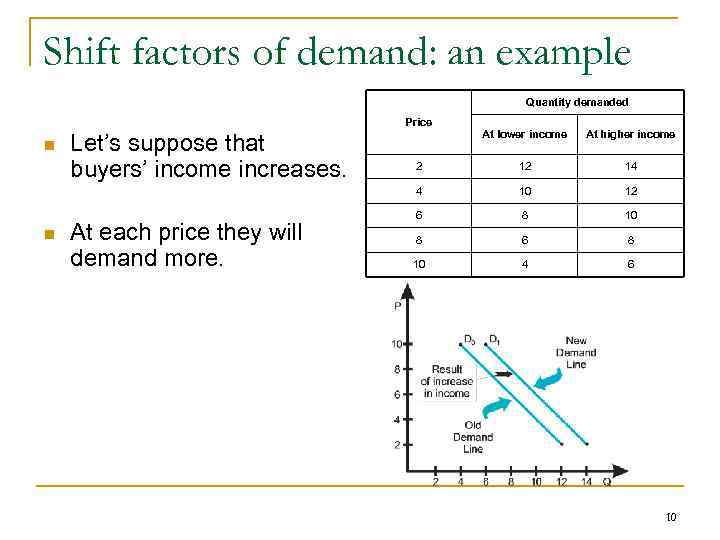 Shift factors of demand: an example Quantity demanded Price n Let’s suppose that buyers’ income increases. At each price they will demand more. At lower income At higher income 2 12 14 4 n 10 12 6 8 10 8 6 8 10 4 6 10
 Quantity demanded vs. demand n QUANTITY DEMANDED = amount of a good that buyers are willing and able to purchase over a period at a certain price. n DEMAND = quantity of a good which buyers are willing and able to purchase over a period at various prices. 11
 Effective demand vs. potential demand n n WANTED ≠ DEMANDED in the sense we’re using the term If you demand something, then you: q q q n n want it, can afford it, plan to buy it. EFFECTIVE DEMAND = consumers are willing and able to purchase POTENTIAL DEMAND = consumers are only willing to purchase 12
 n Part 2: Closer look at demand 13
 The forces behind the law of demand n SUBSTITUTION EFFECT of a good’s rising price: when the price of a good rises, we will substitute other similar goods for it; the good is now more expensive in relation to other goods; we switch to alternatives. 14
 Money price vs. relative price n MONEY PRICE = the number of dollars that must be given up in exchange for a good. n RELATIVE PRICE = the ratio of price of one good to price of another good. 15
 The forces behind the law of demand (cont. ) n INCOME EFFECT of a good’s rising price: when the price of a good rises, we find ourselves somewhat poorer than before; we are not able to afford to buy so much of the good with our money as earlier; purchasing power of our income falls. 16
 Nominal income vs. real income n NOMINAL INCOME = income measured in terms of an amount of money (the number of dollars) n REAL INCOME = income measured in terms of the quantity of goods the money can buy; in other words, it reflects PURCHASING POWER of the money 17
 Relationship between income and demand n From the point of view of the effect changing income has on demand, goods can be categorized into: q q normal (superior) goods, inferior goods. n INFERIOR GOODS: low-quality, often second-hand goods that have more expensive substitutes. n The higher buyer’s income, the lower is demand for inferior goods (because we substitute better goods for them). 18
 Relationship between prices of other goods and demand n From the point of view of the effect prices of other goods have on demand, the goods can be divided into: q substitutes, q complements. n SUBSTITUTES = alternatives, similar goods that can satisfy (better or worse) the same need. n COMPLEMENTS = goods used together in order to satisfy a need. 19
 Shift factors of demand: recapitulation n Outward shift of demand curve can be caused by: q increase in income (normal goods), q decrease in income (inferior goods), q increase in prices of substitutes, q decrease in prices of complements, q change in buyers’ tastes, preferences and habits to the advantage of a good. n Inward shift of demand curve can be caused by: q decrease in income (normal goods), q increase in income (inferior goods), q decrease in prices of substitutes, q increase in prices of complements, q change in buyers’ tastes, preferences and habits to the detriment of a good. 20
 n Part 3: Basics of supply 21
 The law of supply n THE LAW OF SUPPLY states that, in general, other things being constant, the lower the price of a good, the smaller the quantity of that good sellers will make available in the market over a given period (and conversely). Source: Hyman 22
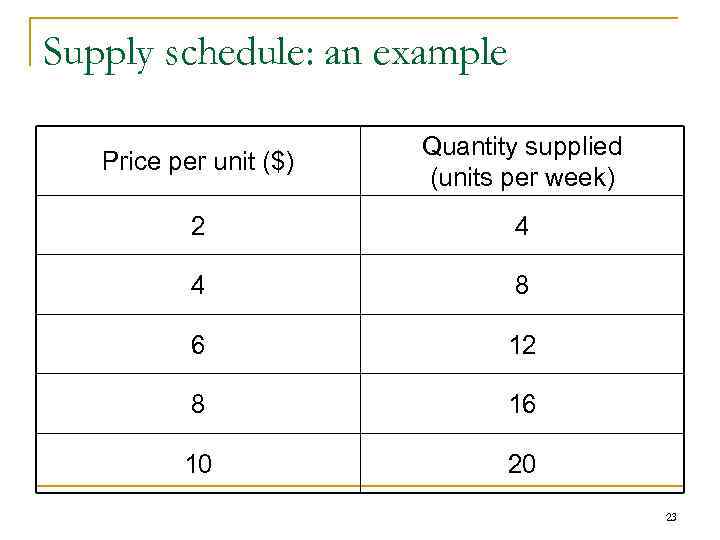 Supply schedule: an example Price per unit ($) Quantity supplied (units per week) 2 4 4 8 6 12 8 16 10 20 23
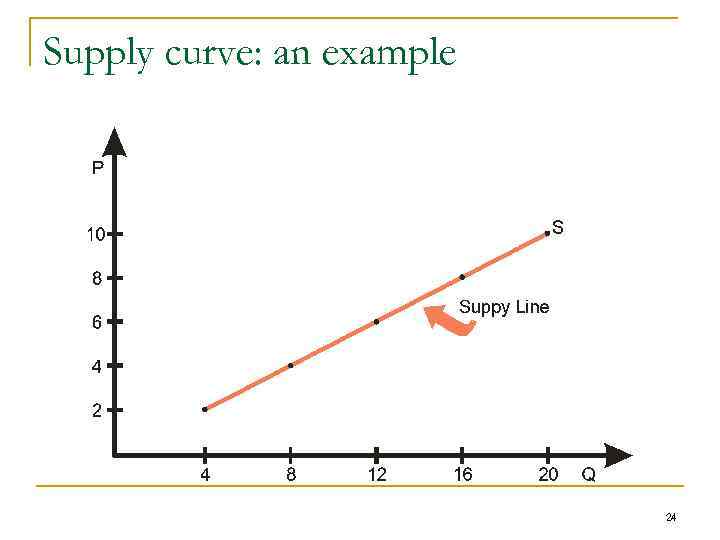 Supply curve: an example 24
 The law of supply – things to remember n n n Ceteris paribus qualification Shift factors of supply Shift along supply curve and shift of supply curve Quantity supplied vs. supply Effective supply vs. potential supply Time dimension 25
 Shift factors of supply n n SHIFT FACTORS OF SUPPLY = the things held constant when plotting supply curve; factors influencing supply (other than price). Basic shift factors of supply: q q q production costs (prices of inputs), changes in technology, the state of nature. 26
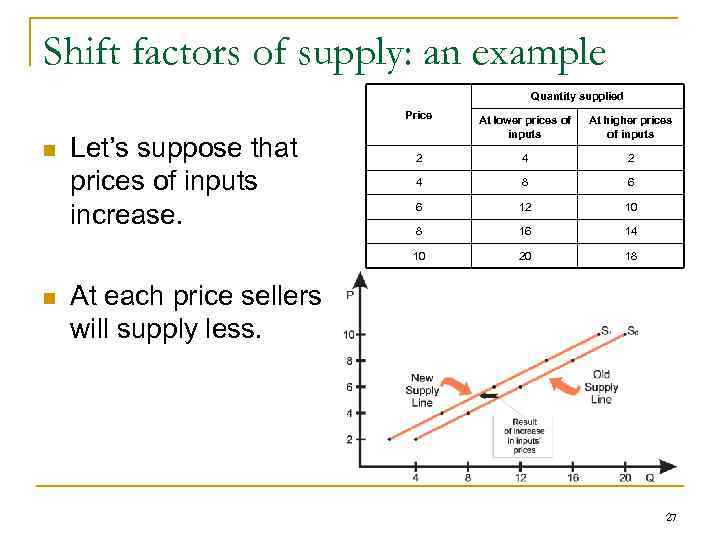 Shift factors of supply: an example Quantity supplied Price n Let’s suppose that prices of inputs increase. At higher prices of inputs 2 4 8 6 6 12 10 8 16 14 10 n At lower prices of inputs 20 18 At each price sellers will supply less. 27
 Quantity supplied vs. supply n QUANTITY SUPPLIED = amount of a good that sellers are willing and able to deliver in the market over a period at a certain price. n SUPPLY = quantity of a good which sellers are willing and able to deliver in the market over a period at various prices. 28
 Effective supply vs. potential supply n Having the resources and technology is not enough to supply a good. n If a firm supplies a good or service, the firm: q q q has the resources and technology to produce it, can profit from producing it, plans to produce it and sell it. 29
 n Part 4: closer look at supply 30
 Forces behind the law of supply n n The law of diminishing returns implies that producing every additional unit of a good becomes more and more expensive. To offer more goods, firms must be motivated by rising price. In other words, it is never worth producing a good if the price received for the good does not at least cover the marginal cost of producing it. 31
 Shift factors of supply: recapitulation n Outward shift of supply curve can be caused by: q q q decrease in prices of inputs, improvements in technology, advantageous state of nature. n Inward shift of supply curve can be caused by: q q q increase in prices of inputs, deteriorations in technology, disadvantageous state of nature. 32