


 Скачать презентацию Demand Supply Chapter 4 Section 1 Understanding
35fceae2ff8457c99f75668e07e002d9.ppt
- Количество слайдов: 49
 Demand Supply
 Chapter 4 Section 1: Understanding Demand
 As You Read 1. 2. 3. 4. 5. Law of demand Substitution effect Income effect Demand Schedule Market Demand Schedule
 Reviewing Key Terms 6. Demand Schedule 7. Market Demand Schedule 8. Demand Curve 9. Income effect 10. Law of Demand
 Chapter 4 Section 2: Shifts of the Demand Curve 1. As long as all other things held constant 2. The Curve can shift to left or right 3. When I^ > D^ (normal goods)
 4. Anticipation for P^ will cause immediate demand for a good or service ^ 5. As greater number of people enter a particular age group demand for G & S ^ for products related to their age
 6. Advertising can sometimes influence customers to buy certain goods. Companies hope D^. 7. Complementary G & S rely on each other for sales thus, an D^ for skis > D^ for ski boots. Also a P^ in snowboards > Dv in snowboards > D^ skis 8. Car v. Motorcycle
 Chapter 4 Section 3: Elasticity of Demand
 Elasticity of Demand > how we respond to changes in Price If demand is elastic > very sensitive to price change (E > 1) If demand is inelastic > NOT sensitive to price change > must buy even if P changes (E < 1)
 Factors affecting Elasticity 5. Substitutes: If substitutes D > elastic No substitutes D > Inelastic 6. Necessities vs. Luxuries: Necessities D > Inelastic Luxuries D > elastic 7. Changes over time: If price changes, D for G&S tends to be Inelastic in short term
 Elasticity and Revenue 8. Total Revenue: All sales of G&S for a company over one day, one month or one year. Example: If Walmart adds up all the G&S they sold in one year that equals their total revenue. Example: If D&D add up all the G&S they sell in one year that equals their total revenue.
 9. How elasticity affects a company’s pricing: If D is Inelastic (product is needed) > company’s might P^ > Total revenue ^ If D is elastic (product is not needed) > if company P^ > Dv > Total revenue v.
 Chapter 5 Understanding Supply
 Understanding Supply 1. If the price of pizza increases Pizzerias > increase output > open new restaurants 2. The cost of tomato sauce increases along with the price of pizza > new supply schedule is needed (company needs to pass on cost to customer)
 3. Prices remain stable (within a range) > Prices will remain the same as on a single pizzeria’s supply curve. 4. Higher prices lead to higher output of goods > the curve always rises from left to right. 5. The supply of a good is not very responsive to price changes > supply is inelastic 6. A supplier, such as an orange grower, has a long time to respond to a price change > supply becomes more elastic
 7. True 8. False (in a graph) 9. False 10. True
 Costs of Production 1. How many workers do I hire? 2. Increased output per worker and rising marginal products of labor 3. Total output increases at a decreasing rate, creating diminishing marginal returns of labor 4. Increasing marginal returns followed by diminishing returns
 5. rent, machinery repairs, property taxes, salaries of workers needed to keep the business running even when production STOPS or is interrupted 6. The cost of labor changes with the number of workers, which changes the quantity produced 7. Marginal cost increase as the law of diminishing returns sets in and benefits of specialization are gone (people get in each others way)
 8. Find the greatest difference between Total Revenue and Total cost 9. The point at which they are equal is the highest profit level 10. A profit can still be realized as long as marginal cost does not overtake marginal revenue
 11. Marginal product of labor: Change in output resulting from hiring 1 more worker 12. Diminishing marginal returns: Level of production in which the marginal production decreases with new investment 13. Total costs: The Sum of fixed and variable costs 14. Marginal cost: Additional cost of producing 1 more unit
 Changes is Supply 1. Cut production and lower marginal cost until it equals the lower price 2. Lowering costs and increasing supply at all price levels 3. To make sure its farms can feed its citizens in case imports are cut off. 4. Promising to pay off these industries’ debts 5. Mining, cattle ranching, and tobacco growing
 6. Adding an extra cost for each unit sold. 7. Such prices are built into the price of the good. 8. They increase costs. 9. Such goods retain their value while cash loses its value
 10. Government can increase supply by granting producers (suppliers) a subsidy. 11. To reduce supply, a government might levy an excise tax. 12. Requiring pollution control on automobiles exemplifies government regulation.
 Chapter 6: Prices
 Chapter 6 Combining Supply and Demand
 In the case of the Pizzerias 1. $1. 50 2. 200 slices 3. 200 slices
 In any Market Environment 4. The points at which the S and D intersect 5. Excess supply or excess demand 6. Suppliers will P^ => D = S 7. Whenever the market is in disequilibrium and prices are flexible
 In the case of Government Intervention 8. To prevent inflation during a housing crisis, help renters with the greatest need 9. Lower income people will not be able to afford “new” rent; landlords will improve buildings and P^ => current residents cannot afford => move out
 10. Excess supply of labor 11. To guarantee a minimum price for milk produced on farms in the northeaster states
 Reviewing Key Terms 12. Price ceiling 13. Excess supply 14. Equilibrium 15. Price floor 16. Disequilibrium
 Changes in Market Equilibrium 1. Equilibrium price and Q demanded change 2. Prices fell 3. Excess Supply causes suppliers to Pv in order to increase demand
 4. Equilibrium point moves gradually downward and to the right 5. Supply curve continues to move to the right 6. In the Market: P^ => Dv On the equilibrium point: above and to the left of original
 7. D > S at original Price; shortages of the good; long lines 8. On suppliers: suppliers will raise prices 9. On the demand curve: demand curve shifts to the left
 10. Shortage occurs when the quantity demanded exceeds the quantity supplied. 11. Excess supply for a good indicates a market surplus of that good. 12. Consumers pay search costs in the form of financial and opportunity costs as they search for a good.
 The Role of Prices 1. Prices help move land, labor and capital into the hands of producers and finished goods into the hands of buyers 2. They set a standard measure of value for goods 3. Producers: S^ Consumers: Dv
 4. Easier to manage in terms of change. Changing production can be costly and time consuming. 5. The millions of decisions made by consumers and producers. 6. It gives consumers a way to choose among similar products and allows producers to target the audience they want with goods that will sell best to that audience
 7. To create a society in which everyone was equal 8. There was little variety of goods and although inexpensive, goods were hard to get. 9. It goes to uses consumers value most and that resources use will adjust to consumers’ changing demands/taste
 10. Profit incentive 11. Imperfect competition, spillover costs, and imperfect information
 law of supply: Tendency of suppliers to offer more of a good at a higher price LAW OF DEMAND: CONSUMERS BUY MORE OF A GOOD WHEN ITS PRICE DECREASES AND LESS WHEN ITS PRICE INCREASES
 equilibrium: the point at which quantity demanded and quantity supplied are equal
 disequilibrium: describes any price or quantity not at equilibrium; when quantity supplied is not equal to quantity demanded in a market
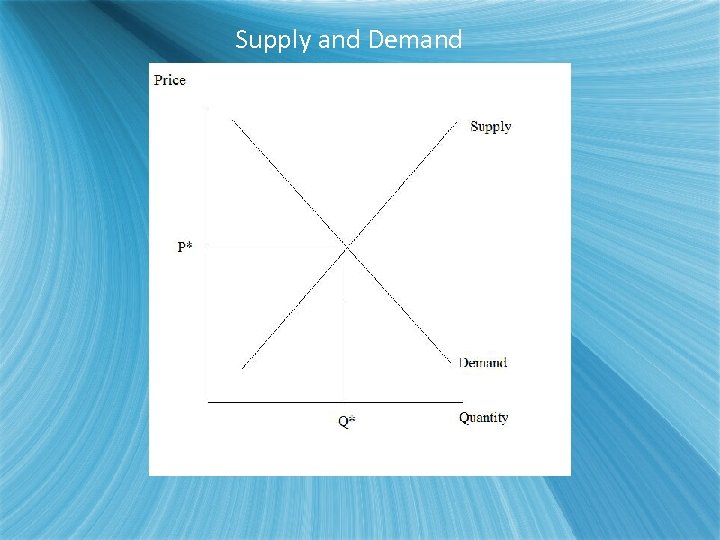 Supply and Demand
 excess supply: when quantity supplied is more than quantity demanded
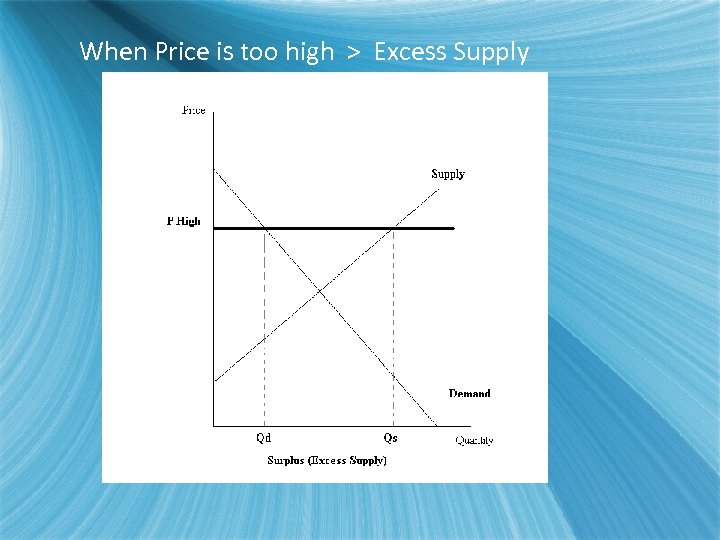 When Price is too high > Excess Supply
 price ceiling: a maximum price that can be legally charged for a good or service
 excess demand: when quantity demanded is more than quantity supplied
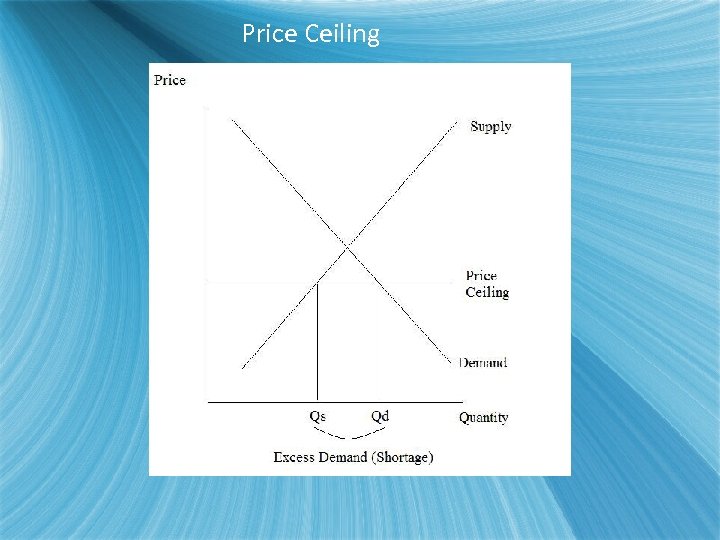 Price Ceiling
 The following graph shows consumer and producer surplus…. CONSUMER SURPLUS = EXTRA MONEY YOU GET TO KEEP (RED) PRODUCER SURPLUS = EXTRA MONEY YOU GET FOR FISH (BLUE)
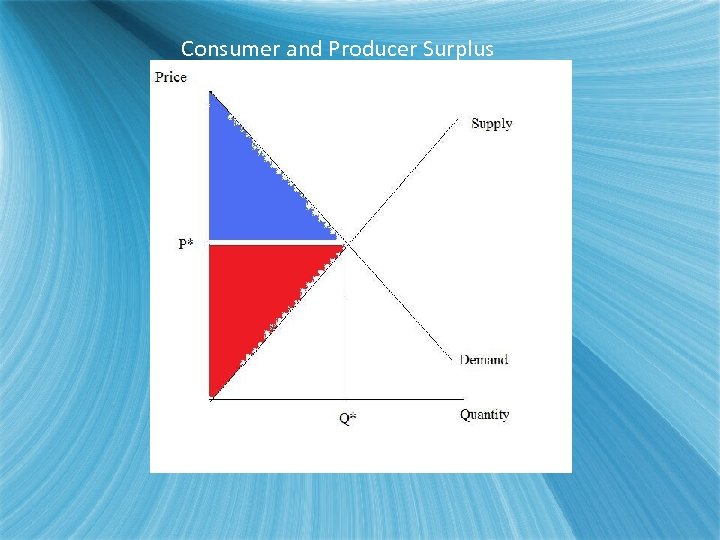 Consumer and Producer Surplus