


 Скачать презентацию Demand Supply CHAPTER 4 CHAPTER CHECKLIST When
46fbfd9fc9e05f4dd6718e6e2b78d639.ppt
- Количество слайдов: 64

 Demand Supply CHAPTER 4
 CHAPTER CHECKLIST When you have completed your study of this chapter, you will be able to 1 2 3 4 Distinguish between quantity demanded and demand explain what determines demand. Distinguish between quantity supplied and supply and explain what determines supply. Explain how demand supply determine price and quantity in a market and explain the effects of changes in demand supply. Explain how price floors, price ceilings, and sticky prices cause surpluses, unemployment, and shortages.
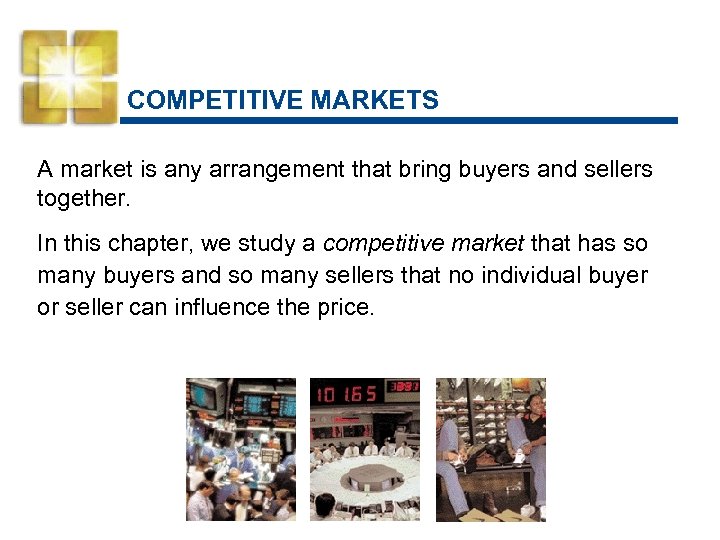 COMPETITIVE MARKETS A market is any arrangement that bring buyers and sellers together. In this chapter, we study a competitive market that has so many buyers and so many sellers that no individual buyer or seller can influence the price.
 4. 1 DEMAND Quantity demanded The amount of a good, service, or resource that people are willing and able to buy during a specified period at a specified price. The quantity demanded is an amount per unit of time. For example, the amount per day or per month.
 4. 1 DEMAND
 4. 1 DEMAND
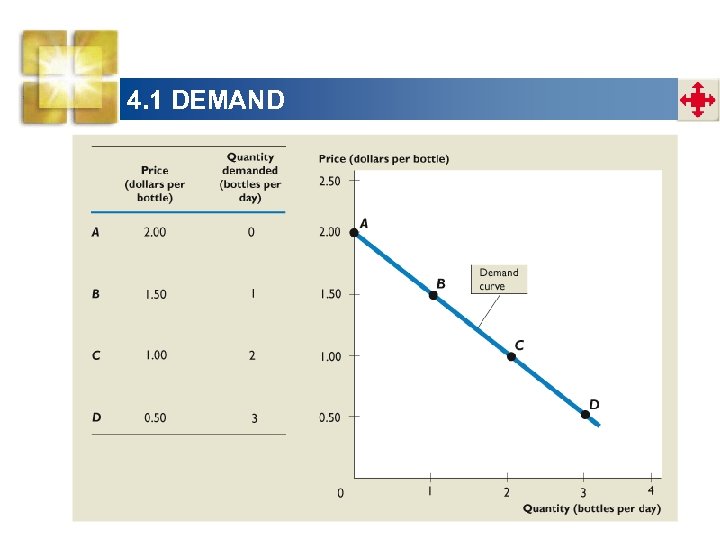
 4. 1 DEMAND Demand schedule A list of the quantities demanded at each different price when all the other influences on buying plans remain the same. Demand curve A graph of the relationship between the quantity demanded of a good and its price when all other influences on buying plans remain the same.
 4. 1 DEMAND
 4. 1 DEMAND
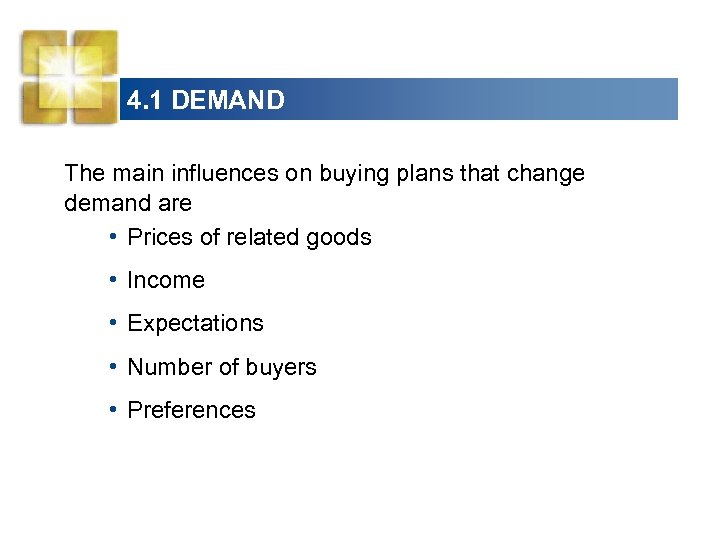 4. 1 DEMAND The main influences on buying plans that change demand are • Prices of related goods • Income • Expectations • Number of buyers • Preferences
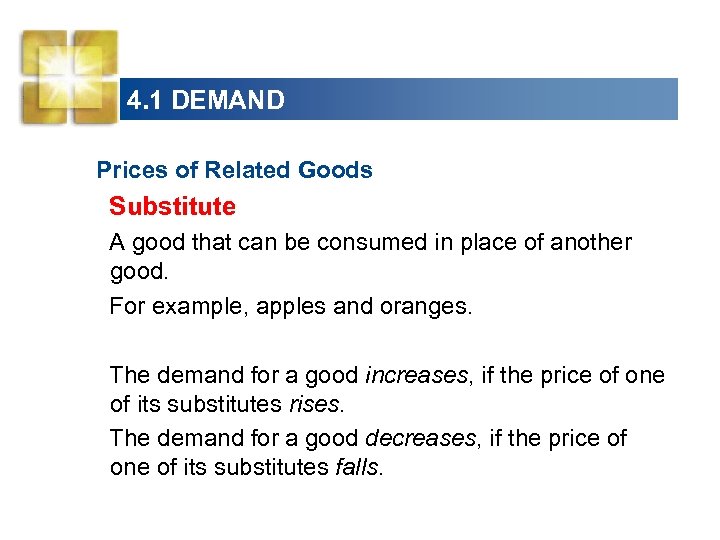 4. 1 DEMAND Prices of Related Goods Substitute A good that can be consumed in place of another good. For example, apples and oranges. The demand for a good increases, if the price of one of its substitutes rises. The demand for a good decreases, if the price of one of its substitutes falls.
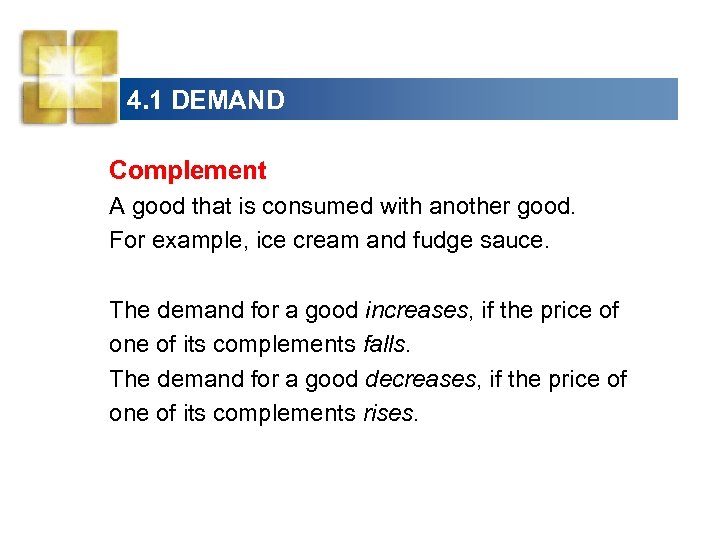 4. 1 DEMAND Complement A good that is consumed with another good. For example, ice cream and fudge sauce. The demand for a good increases, if the price of one of its complements falls. The demand for a good decreases, if the price of one of its complements rises.
 4. 1 DEMAND Income Normal good A good for which the demand increases if income increases and demand decreases if income decreases. Inferior good A good for which the demand decreases if income increases and demand increases if income decreases.
 4. 1 DEMAND Expectations Expected future income and expected future prices influence demand today. For example, if the price of a computer is expected to fall next month, the demand for computers today decreases. Number of Buyers The greater the number of buyers in a market, the larger is the demand for any good.
 4. 1 DEMAND Preferences When preferences change, the demand for one item increases and the demand for another item (or items) decreases. Preferences change when: • People become better informed. • New goods become available.
 4. 1 DEMAND
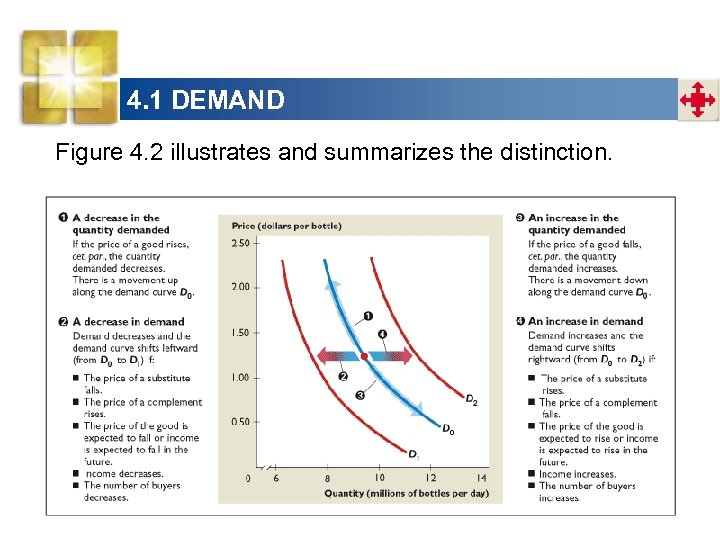 4. 1 DEMAND Figure 4. 2 illustrates and summarizes the distinction.
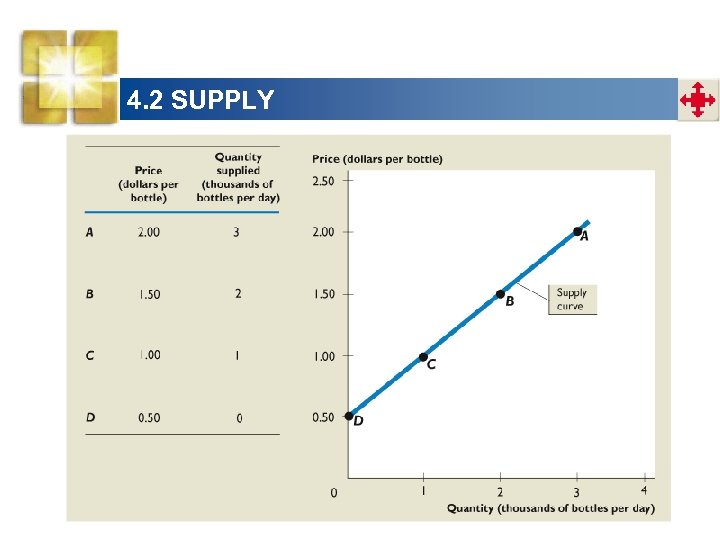
 4. 2 SUPPLY Quantity supplied The amount of a good, service, or resource that people are willing and able to sell during a specified period at a specified price. < The Law of Supply Other things remaining the same, • If the price of a good rises, the quantity supplied of that good increases. • If the price of a good falls, the quantity supplied of that good decreases.
 4. 2 SUPPLY
 4. 2 SUPPLY Supply schedule A list of the quantities supplied at each different price when all other influences on selling plans remain the same. Supply curve A graph of the relationship between the quantity supplied and the price of the good when all other influences on selling plans remain the same.
 4. 2 SUPPLY
 4. 2 SUPPLY
 4. 2 SUPPLY The main influences on selling plans that change supply are • Prices of related goods • Prices of resources and other Inputs • Expectations • Number of sellers • Productivity
 4. 2 SUPPLY Prices of Related Goods A change in the price of one good can bring a change in the supply of another good. Substitute in production A good that can be produced in place of another good. For example, a truck and an SUV in an auto factory. • The supply of a good increases if the price of one of its substitutes in production falls. • The supply a good decreases if the price of one of its substitutes in production rises.
 4. 2 SUPPLY Complement in production A good that is produced along with another good. For example, cream is a complement in production of skim milk in a dairy. • The supply of a good increases if the price of one of its complements in production rises. • The supply a good decreases if the price of one of its complements in production falls.
 4. 2 SUPPLY Prices of Resources and Other Inputs Resource and input prices influence the cost of production. And the more it costs to produce a good, the smaller is the quantity supplied of that good. Expectations • Expectations about future prices influence supply. • Expectations of future input prices also influence supply.
 4. 2 SUPPLY Number of Sellers The greater the number of sellers in a market, the larger is supply. Productivity is output per unit of input. An increase in productivity lowers costs and increases supply. For example, an advance in technology. A decrease in productivity raises costs and decreases supply. For example, a severe hurricane.
 4. 2 SUPPLY
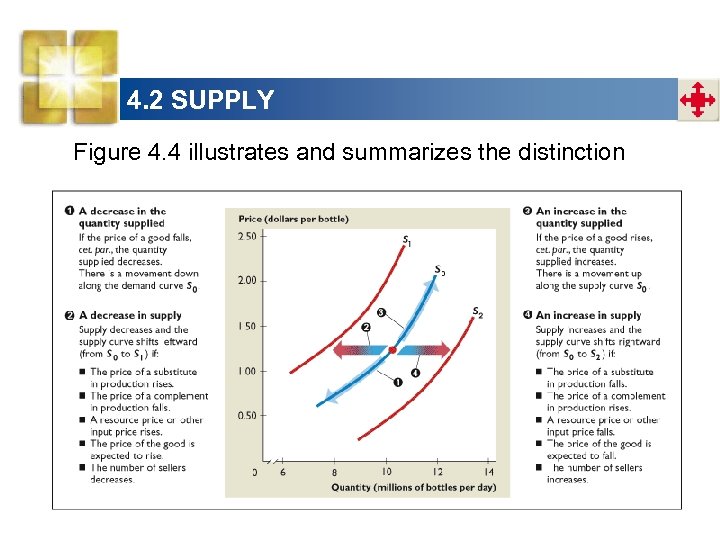 4. 2 SUPPLY Figure 4. 4 illustrates and summarizes the distinction
 4. 3 MARKET EQUILIBRIUM Market equilibrium When the quantity demanded equals the quantity supplied—when buyers’ and sellers’ plans are consistent. Equilibrium price The price at which the quantity demanded equals the quantity supplied. Equilibrium quantity The quantity bought and sold at the equilibrium price.
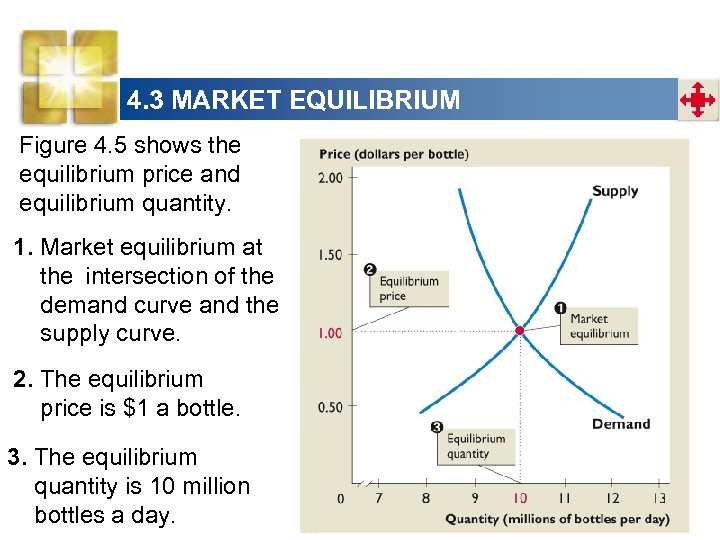 4. 3 MARKET EQUILIBRIUM Figure 4. 5 shows the equilibrium price and equilibrium quantity. 1. Market equilibrium at the intersection of the demand curve and the supply curve. 2. The equilibrium price is $1 a bottle. 3. The equilibrium quantity is 10 million bottles a day.
 4. 3 MARKET EQUILIBRIUM
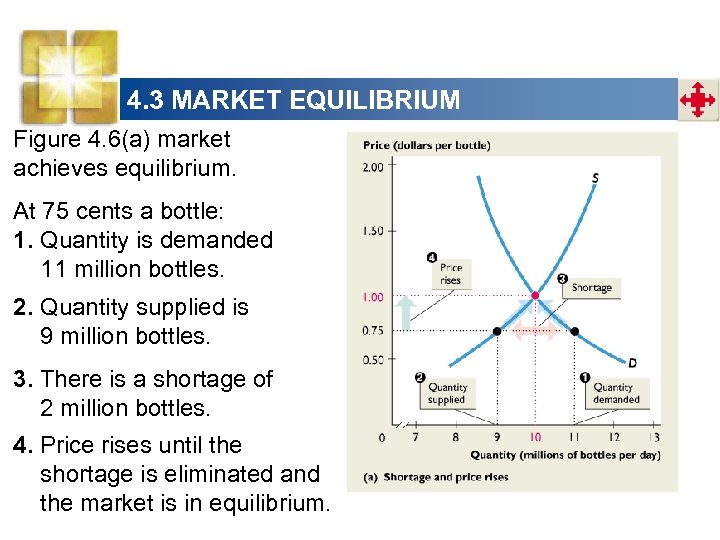 4. 3 MARKET EQUILIBRIUM Figure 4. 6(a) market achieves equilibrium. At 75 cents a bottle: 1. Quantity is demanded 11 million bottles. 2. Quantity supplied is 9 million bottles. 3. There is a shortage of 2 million bottles. 4. Price rises until the shortage is eliminated and the market is in equilibrium.
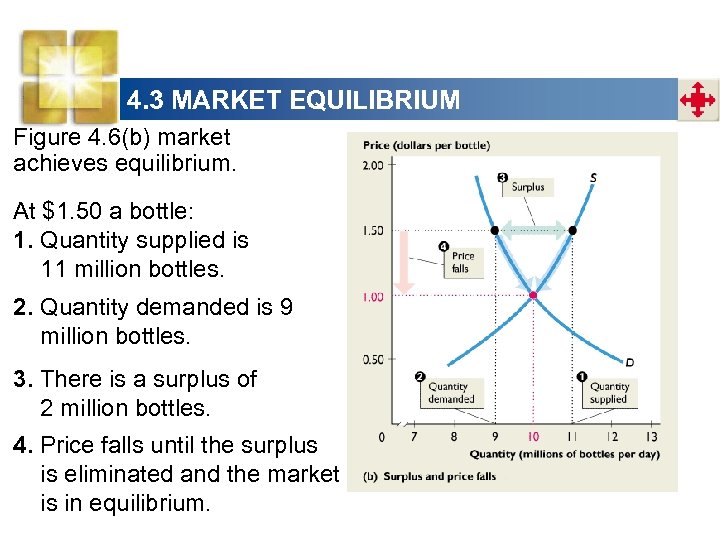 4. 3 MARKET EQUILIBRIUM Figure 4. 6(b) market achieves equilibrium. At $1. 50 a bottle: 1. Quantity supplied is 11 million bottles. 2. Quantity demanded is 9 million bottles. 3. There is a surplus of 2 million bottles. 4. Price falls until the surplus is eliminated and the market is in equilibrium.
 4. 3 MARKET EQUILIBRIUM < Predicting Price Changes: Three Questions We can work out the effects of an event by answering: 1. Does the event change demand or supply? 2. Does the event increase or decrease demand or supply—shift the demand curve or the supply curve rightward or leftward? 3. What are the new equilibrium price and equilibrium quantity and how have they changed?
 4. 3 MARKET EQUILIBRIUM < Effects of Changes in Demand Event: A new study says that tap water is unsafe. To work out the effects on the market for bottled water: 1. With tap water unsafe, demand for bottled water changes. 2. The demand for bottled water increases, the demand curve shifts rightward. 3. What are the new equilibrium price and equilibrium quantity and how have they changed?
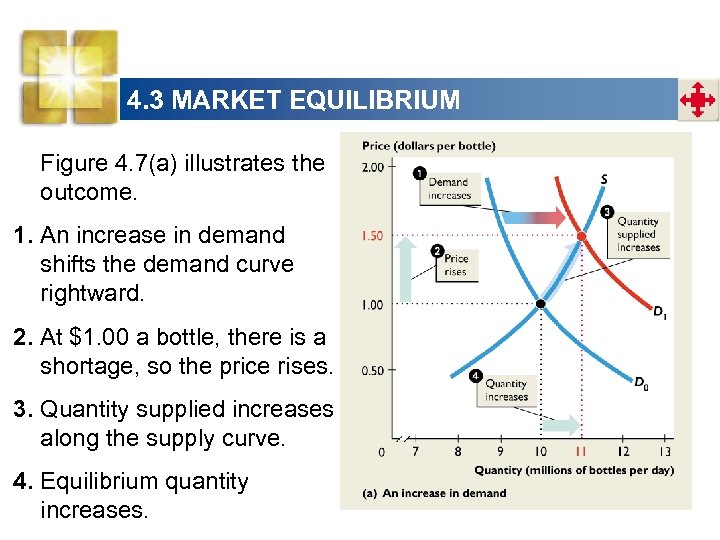 4. 3 MARKET EQUILIBRIUM Figure 4. 7(a) illustrates the outcome. 1. An increase in demand shifts the demand curve rightward. 2. At $1. 00 a bottle, there is a shortage, so the price rises. 3. Quantity supplied increases along the supply curve. 4. Equilibrium quantity increases.
 4. 3 MARKET EQUILIBRIUM Event: A new zero-calorie sports drink is invented. To work out the effects on the market for bottled water: 1. The new drink is a substitute for bottled water, so the demand for bottled water changes 2. The demand for bottled water decreases, the demand curve shifts leftward. 3. What are the new equilibrium price and equilibrium quantity and how have they changed?
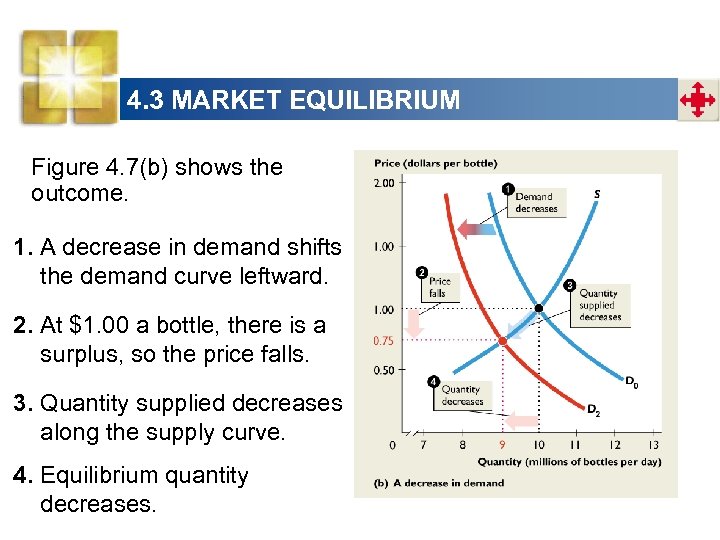 4. 3 MARKET EQUILIBRIUM Figure 4. 7(b) shows the outcome. 1. A decrease in demand shifts the demand curve leftward. 2. At $1. 00 a bottle, there is a surplus, so the price falls. 3. Quantity supplied decreases along the supply curve. 4. Equilibrium quantity decreases.
 4. 3 MARKET EQUILIBRIUM When demand changes: • The supply curve does not shift. • But there is a change in the quantity supplied. • Equilibrium price and equilibrium quantity change in the same direction as the change in demand.
 4. 3 MARKET EQUILIBRIUM < Effects of Changes in Supply Event: Europeans produce bottled water in the United States. To work out the effects on the market for bottled water: 1. With more suppliers of bottled water, supply changes. 2. The supply of bottled water increases, the supply curve shifts rightward. 3. What are the new equilibrium price and equilibrium quantity and how have they changed?
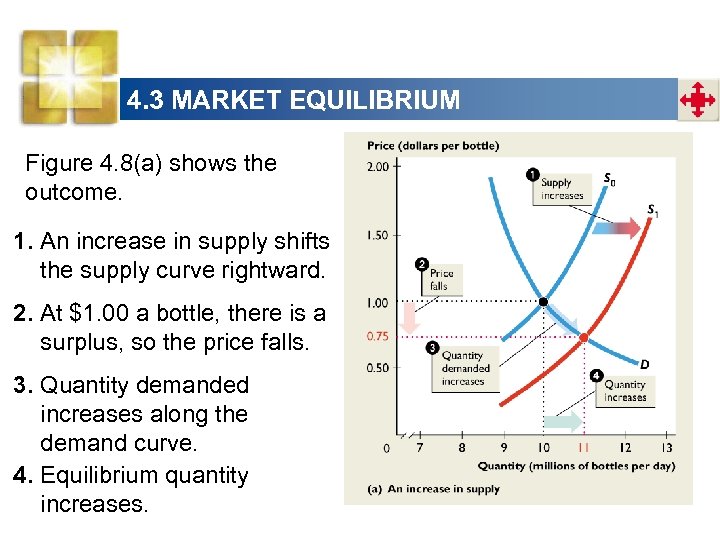 4. 3 MARKET EQUILIBRIUM Figure 4. 8(a) shows the outcome. 1. An increase in supply shifts the supply curve rightward. 2. At $1. 00 a bottle, there is a surplus, so the price falls. 3. Quantity demanded increases along the demand curve. 4. Equilibrium quantity increases.
 4. 3 MARKET EQUILIBRIUM Event: Drought dries up some springs in the United States. To work out the effects on the market for bottled water: 1. Drought changes the supply of bottled water. 2. The supply of bottled water decreases, the supply curve shifts leftward. 3. What are the new equilibrium price and equilibrium quantity and how have they changed?
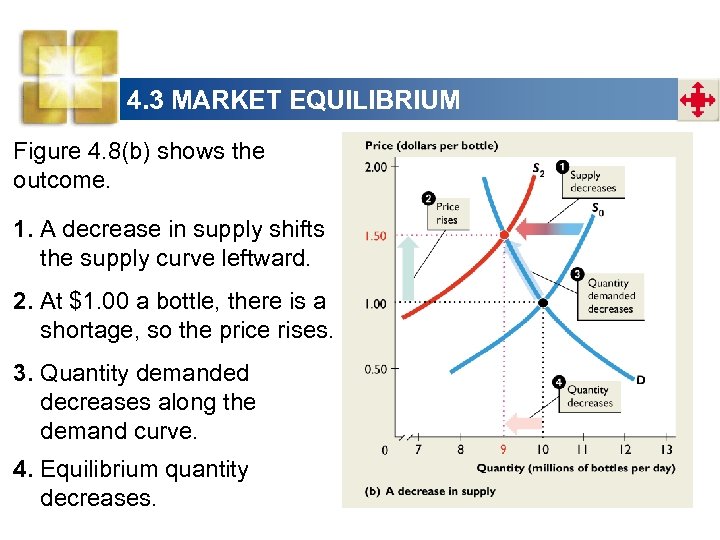 4. 3 MARKET EQUILIBRIUM Figure 4. 8(b) shows the outcome. 1. A decrease in supply shifts the supply curve leftward. 2. At $1. 00 a bottle, there is a shortage, so the price rises. 3. Quantity demanded decreases along the demand curve. 4. Equilibrium quantity decreases.
 4. 3 MARKET EQUILIBRIUM When supply changes: • The demand curve does not shift. • But there is a change in the quantity demanded. • Equilibrium price changes in the same direction as the change in supply. • Equilibrium quantity changes in the opposite direction to the change in supply.
 4. 3 MARKET EQUILIBRIUM < Changes in Both Demand Supply When two events occur at the same time, work out how each event influences the market: 1. Does each event change demand or supply? 2. Does either event increase or decrease demand or increase or decrease supply? 3. What are the new equilibrium price and equilibrium quantity and how have they changed?
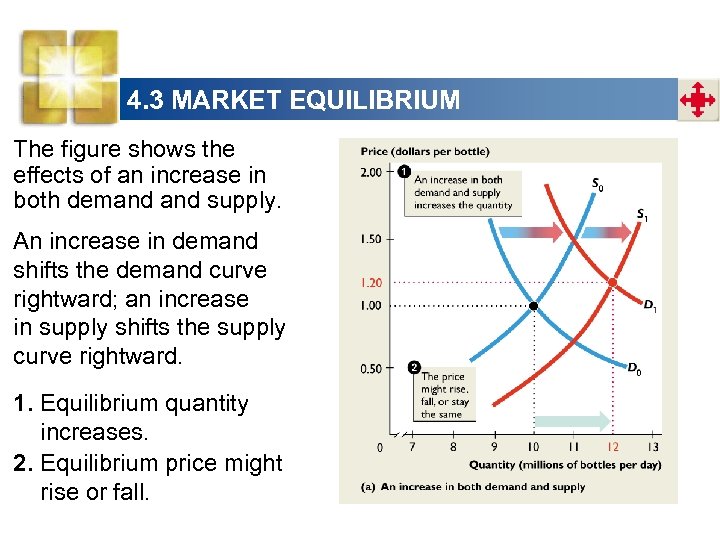 4. 3 MARKET EQUILIBRIUM The figure shows the effects of an increase in both demand supply. An increase in demand shifts the demand curve rightward; an increase in supply shifts the supply curve rightward. 1. Equilibrium quantity increases. 2. Equilibrium price might rise or fall.
 4. 3 MARKET EQUILIBRIUM Increase in Both Demand Supply • Increases the equilibrium quantity. • The change in the equilibrium price is ambiguous because the: Increase in demand raises the price. Increase in supply lowers the price.
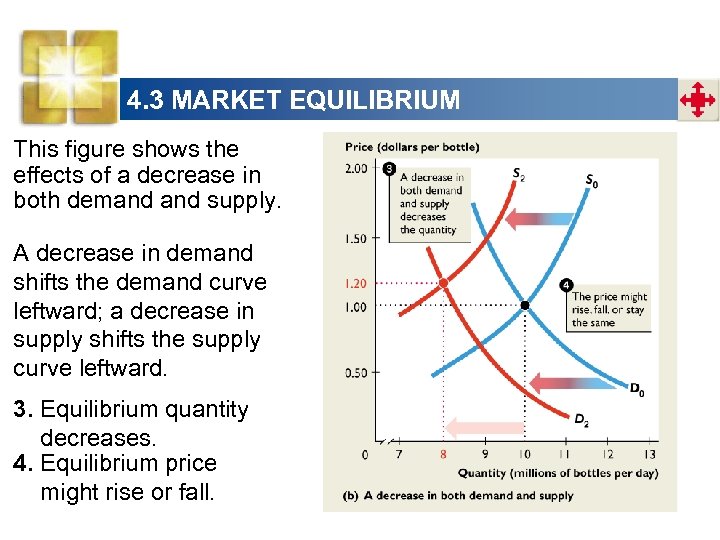 4. 3 MARKET EQUILIBRIUM This figure shows the effects of a decrease in both demand supply. A decrease in demand shifts the demand curve leftward; a decrease in supply shifts the supply curve leftward. 3. Equilibrium quantity decreases. 4. Equilibrium price might rise or fall.
 4. 3 MARKET EQUILIBRIUM Decrease in Both Demand Supply • Decreases the equilibrium quantity. • The change in the equilibrium price is ambiguous because the: Decrease in demand lowers the price Decrease in supply raises the price.
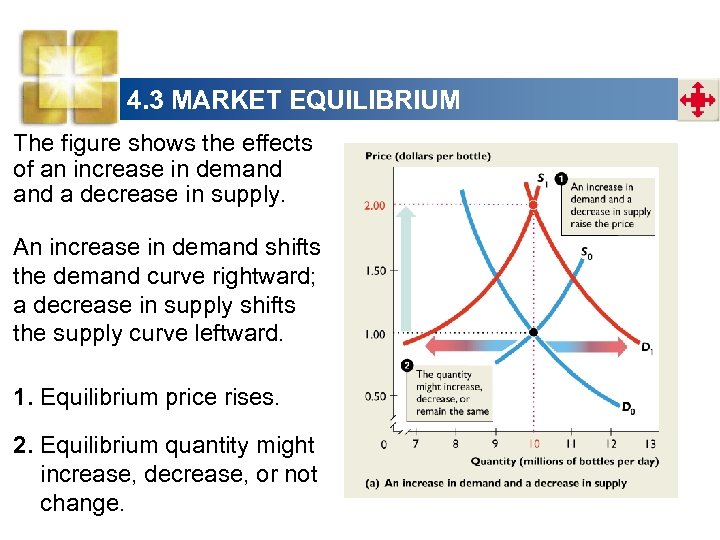 4. 3 MARKET EQUILIBRIUM The figure shows the effects of an increase in demand a decrease in supply. An increase in demand shifts the demand curve rightward; a decrease in supply shifts the supply curve leftward. 1. Equilibrium price rises. 2. Equilibrium quantity might increase, decrease, or not change.
 4. 3 MARKET EQUILIBRIUM Increase in Demand Decrease in Supply • Raises the equilibrium price. • The change in the equilibrium quantity is ambiguous because the: Increase in demand increases the quantity. Decrease in supply decreases the quantity.
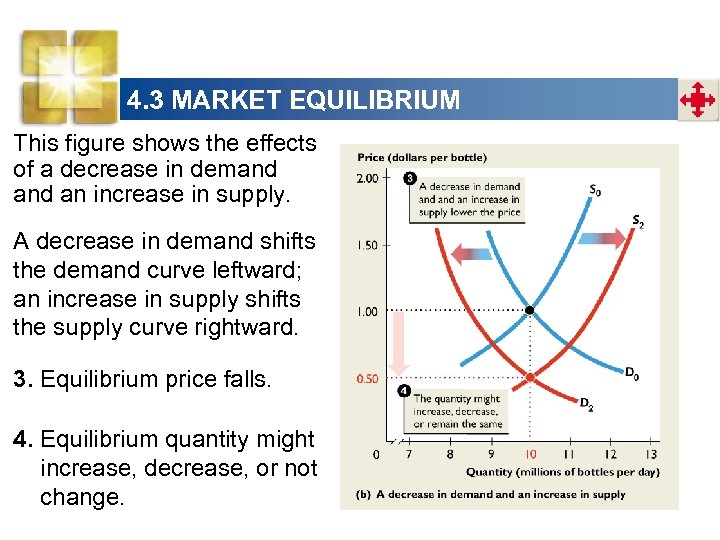 4. 3 MARKET EQUILIBRIUM This figure shows the effects of a decrease in demand an increase in supply. A decrease in demand shifts the demand curve leftward; an increase in supply shifts the supply curve rightward. 3. Equilibrium price falls. 4. Equilibrium quantity might increase, decrease, or not change.
 4. 3 MARKET EQUILIBRIUM Decrease in Demand Increase in Supply • Lowers the equilibrium price. • The change in the equilibrium quantity is ambiguous because the: Decrease in demand decreases the quantity. Increase in supply increases the quantity.
 4. 4 PRICE RIGIDITIES Price adjustments bring market equilibrium. But sometimes prices do not adjust. What happens then? Three reasons why price adjustment might not occur are: • Price floor • Price ceiling • Sticky price
 4. 4 PRICE RIGIDITIES
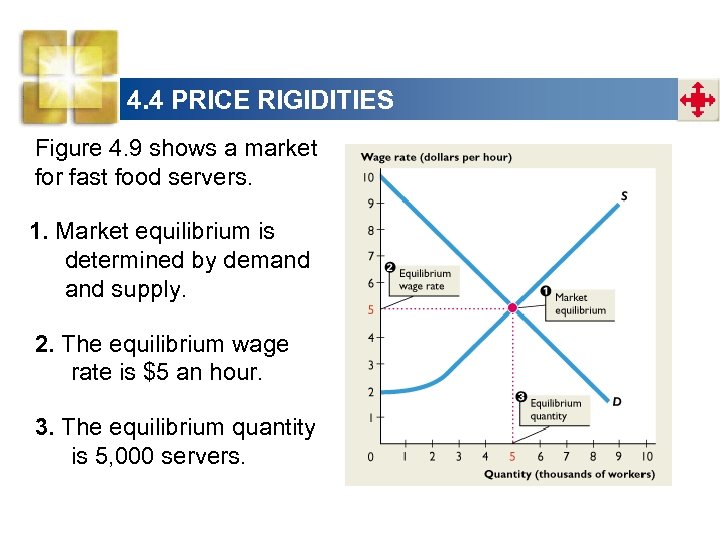 4. 4 PRICE RIGIDITIES Figure 4. 9 shows a market for fast food servers. 1. Market equilibrium is determined by demand supply. 2. The equilibrium wage rate is $5 an hour. 3. The equilibrium quantity is 5, 000 servers.
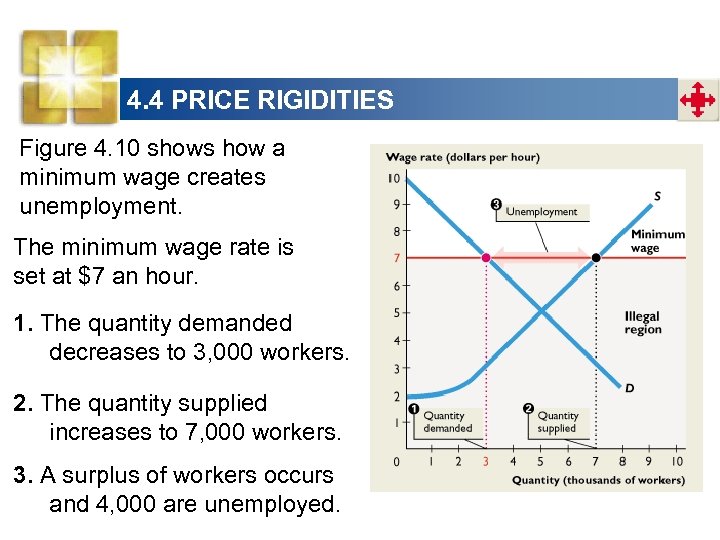 4. 4 PRICE RIGIDITIES Figure 4. 10 shows how a minimum wage creates unemployment. The minimum wage rate is set at $7 an hour. 1. The quantity demanded decreases to 3, 000 workers. 2. The quantity supplied increases to 7, 000 workers. 3. A surplus of workers occurs and 4, 000 are unemployed.
 4. 4 PRICE RIGIDITIES
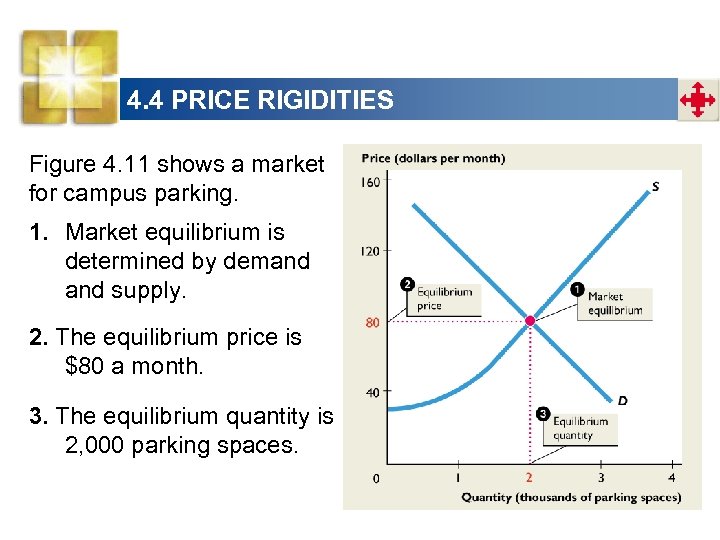 4. 4 PRICE RIGIDITIES Figure 4. 11 shows a market for campus parking. 1. Market equilibrium is determined by demand supply. 2. The equilibrium price is $80 a month. 3. The equilibrium quantity is 2, 000 parking spaces.
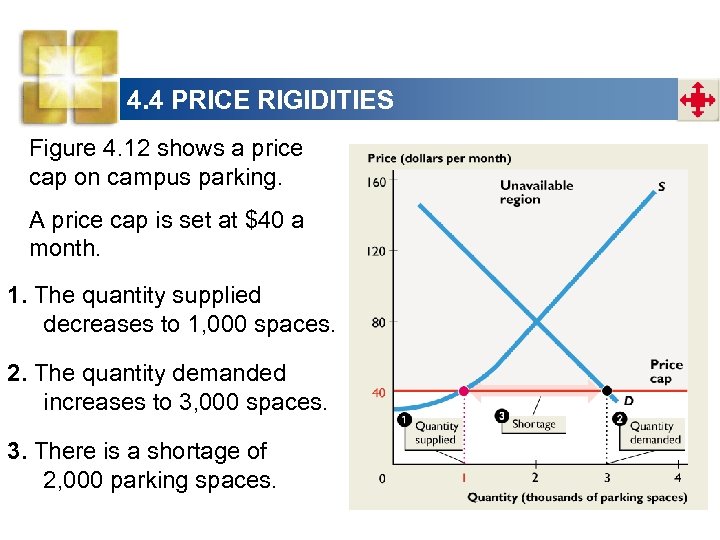 4. 4 PRICE RIGIDITIES Figure 4. 12 shows a price cap on campus parking. A price cap is set at $40 a month. 1. The quantity supplied decreases to 1, 000 spaces. 2. The quantity demanded increases to 3, 000 spaces. 3. There is a shortage of 2, 000 parking spaces.
 4. 4 PRICE RIGIDITIES
 Demand Supply in YOUR Life The demand supply model is going to be a big part of the rest of your life! 1. You’ll use it again and again in your economics course— it is your major tool. 2. By understanding how prices adjust, you’ll have a much better appreciation of how your economic world works. 3. When people complain about a price hike, think about the law of market forces and how the intersection of demand supply determined that price. 4. As you shop for your favourite goods, try to describe the supply and demand influences on the price of each of them.