 Скачать презентацию Demand Supply and The Market Equilibrium The
2748240d472fcbeee6c7809bf86416ce.ppt
- Количество слайдов: 35



Demand Supply and The Market Equilibrium
The product market is where the two sides interact: The Consumers’ Side The Producers’ side • Consumers create DEMAND for the product. • Producers SUPPLY the product

The Consumers’ Choice • Who are the consumers? - Those who demand the product. For final products (processed food, ready-made clothing etc. ) the end user demand the product. For Intermediate goods (Chemicals used in textile industry, transport / logistic services used for exports) the downstream firm creates the demand.

Demand for Final Products
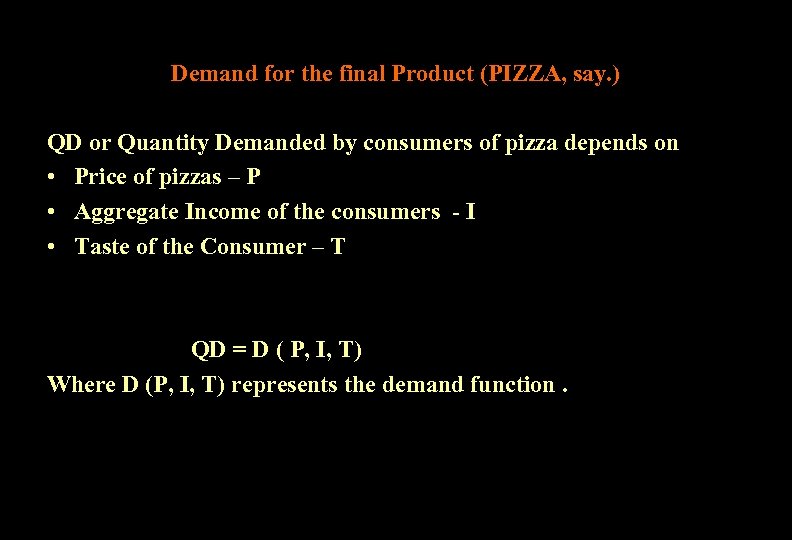
Demand for the final Product (PIZZA, say. ) QD or Quantity Demanded by consumers of pizza depends on • Price of pizzas – P • Aggregate Income of the consumers - I • Taste of the Consumer – T QD = D ( P, I, T) Where D (P, I, T) represents the demand function.
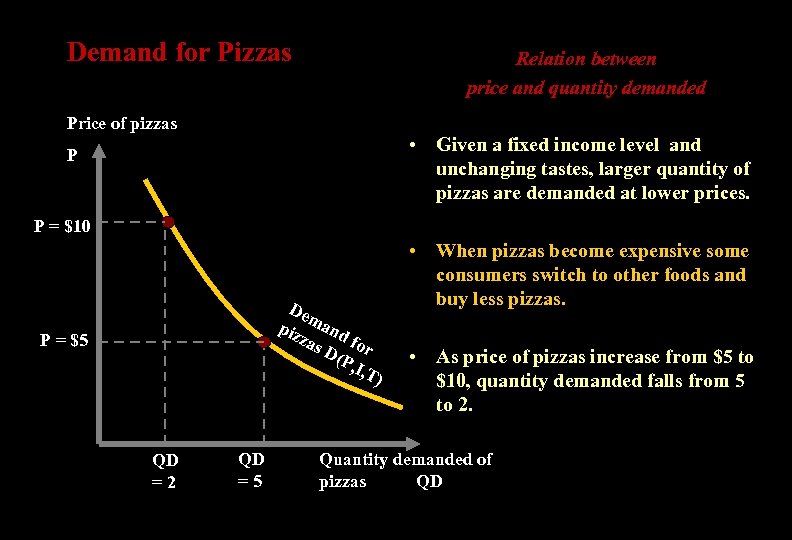
Demand for Pizzas Relation between price and quantity demanded Price of pizzas • Given a fixed income level and unchanging tastes, larger quantity of pizzas are demanded at lower prices. P P = $10 De m piz and zas f D(P or , I, T ) P = $5 QD =2 QD =5 • When pizzas become expensive some consumers switch to other foods and buy less pizzas. • As price of pizzas increase from $5 to $10, quantity demanded falls from 5 to 2. Quantity demanded of pizzas QD
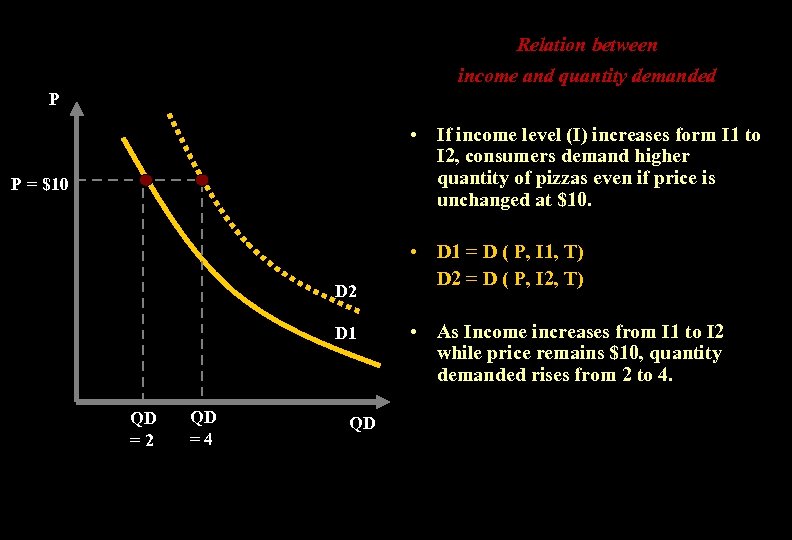
Relation between income and quantity demanded P • If income level (I) increases form I 1 to I 2, consumers demand higher quantity of pizzas even if price is unchanged at $10. P = $10 D 2 D 1 QD =2 QD =4 QD • D 1 = D ( P, I 1, T) D 2 = D ( P, I 2, T) • As Income increases from I 1 to I 2 while price remains $10, quantity demanded rises from 2 to 4.
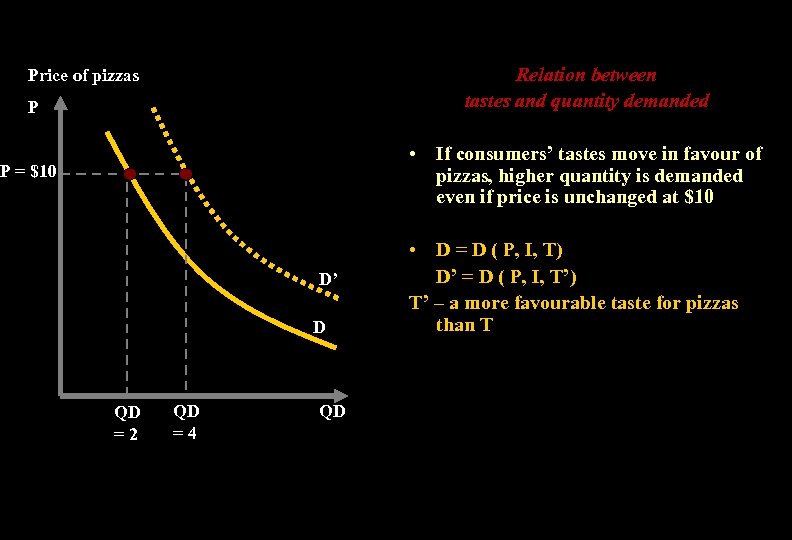
Relation between tastes and quantity demanded Price of pizzas P • If consumers’ tastes move in favour of pizzas, higher quantity is demanded even if price is unchanged at $10 P = $10 D’ D QD =2 QD =4 QD • D = D ( P, I, T) D’ = D ( P, I, T’) T’ – a more favourable taste for pizzas than T
Endogenous and exogenous variables Note that • when price changed, quantity demanded changed following the demand curve. • When income and taste changed, the demand curve shifted. In a price – quantity plane, • Price and quantity are Endogenous Variables • All other variables (income / tastes etc. ) are Exogenous Variables
Endogenous and exogenous variables…Cont. Endogenous Variables – Variables which are explained within the model. • Here changes in price and quantity demanded of pizzas can be explained within the model. Exogenous Variables – Variables that are not explained within the model. • Here changes in income or taste is not explained within the model. • Nevertheless exogenous variables (income / tastes) case changes in the endogenous variables (Price , quantity).
A Distinction: ‘quantity demanded’ & ‘demand’ Quantity demanded: • At any given price level the quantity of the product that the consumers demand is called ‘quantity demanded’. • To specify quantity demanded one must specify the price. Demand: • By ‘Demand’ we imply the demand curve. • By ‘change in demand’ we mean change in quantity demanded at each price level. • A change in demand is depicted by a shift in the demand curve either to the left or to the right.
Exercise 1 Bread and butter are consumed together. an increase in the price of watches (b) Suppose for some reason price of bread has increased. How should it affect the demand for butter? a decrease in the price of watches
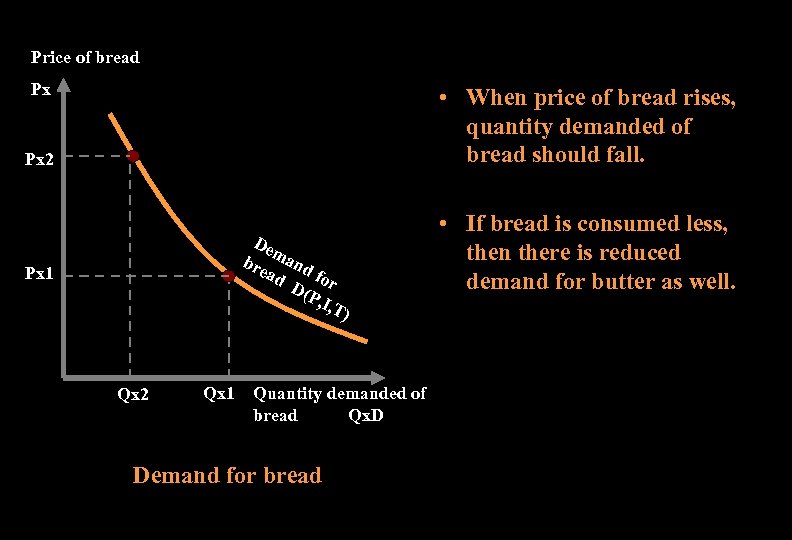
Price of bread Px • When price of bread rises, quantity demanded of bread should fall. Px 2 De m bre and ad f D(P or , I, T ) Px 1 Qx 2 Qx 1 Quantity demanded of bread Qx. D Demand for bread • If bread is consumed less, then there is reduced demand for butter as well.
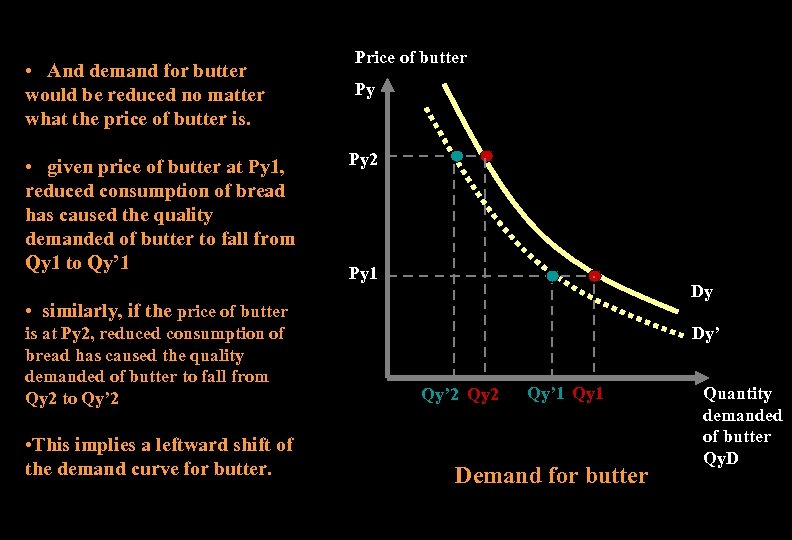
• And demand for butter would be reduced no matter what the price of butter is. • given price of butter at Py 1, reduced consumption of bread has caused the quality demanded of butter to fall from Qy 1 to Qy’ 1 Price of butter Py Py 2 Py 1 Dy • similarly, if the price of butter is at Py 2, reduced consumption of bread has caused the quality demanded of butter to fall from Qy 2 to Qy’ 2 • This implies a leftward shift of the demand curve for butter. Dy’ Qy’ 2 Qy’ 1 Qy 1 Demand for butter Quantity demanded of butter Qy. D
Conclusion • If price of bread increases demand for butter falls. • If price of a good increases, demand for the ‘complementary’ good falls. • Price of a good and the demand for its complements are inversely related
Exercise 2 Jam and butter are substitutes. How would a rise in price of butter affect the demand for Jam?
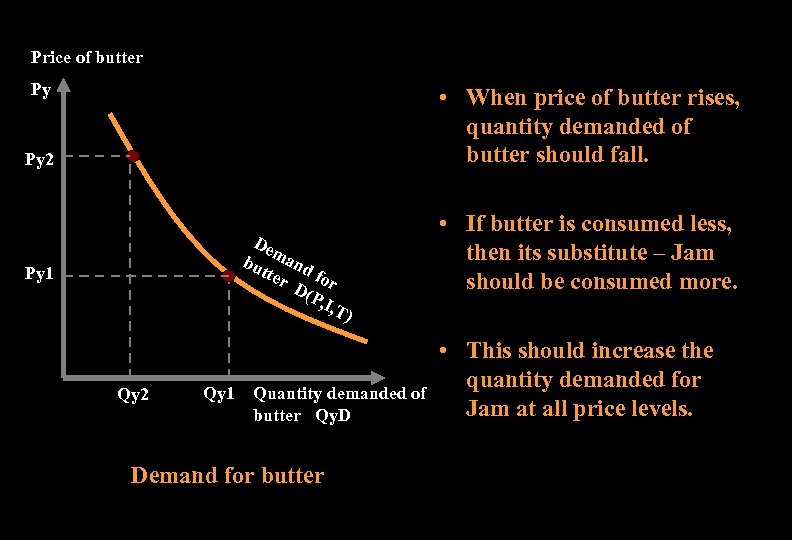
Price of butter Py • When price of butter rises, quantity demanded of butter should fall. Py 2 De m bu and tte r D for (P, I, T ) Py 1 Qy 2 Qy 1 Quantity demanded of butter Qy. D Demand for butter • If butter is consumed less, then its substitute – Jam should be consumed more. • This should increase the quantity demanded for Jam at all price levels.
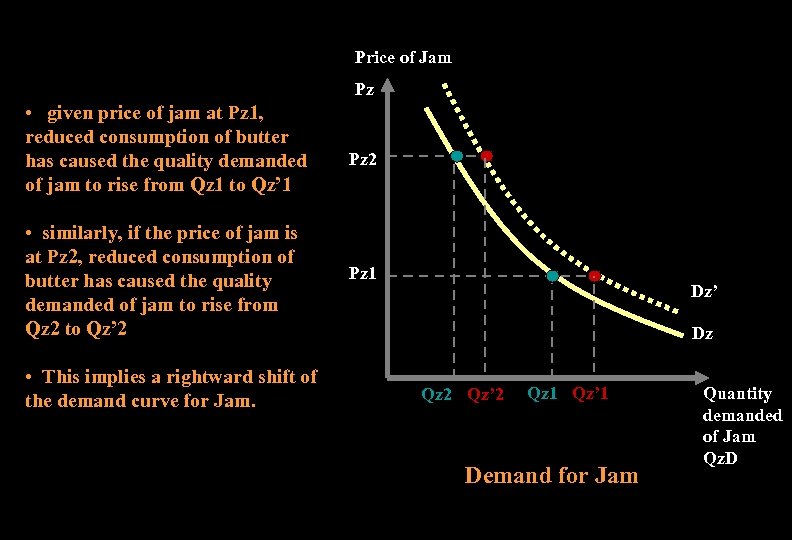
Price of Jam Pz • given price of jam at Pz 1, reduced consumption of butter has caused the quality demanded of jam to rise from Qz 1 to Qz’ 1 • similarly, if the price of jam is at Pz 2, reduced consumption of butter has caused the quality demanded of jam to rise from Qz 2 to Qz’ 2 • This implies a rightward shift of the demand curve for Jam. Pz 2 Pz 1 Dz’ Dz Qz 2 Qz’ 2 Qz 1 Qz’ 1 Demand for Jam Quantity demanded of Jam Qz. D
Conclusion • If price of butter increases demand for jam rises. • If price of a good increases, demand for the ‘substitute’ good increases. • Price of a good and demand for its substitutes are directly related
Exercise 3 Which of the following shifts the demand for watches to the right? (a) (b) (c) (d) an increase in the price of watches a decrease in the price of watch batteries if watch batteries and watches are complements a decrease in income levels of consumers a decrease in the price of watches
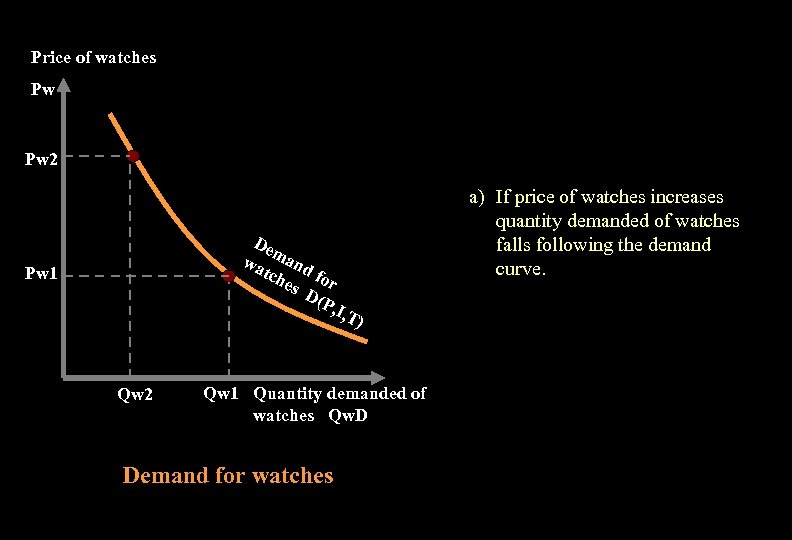
Price of watches Pw Pw 2 a) If price of watches increases quantity demanded of watches falls following the demand curve. De m wa and tch es for D(P , I, T Pw 1 ) Qw 2 Qw 1 Quantity demanded of watches Qw. D Demand for watches
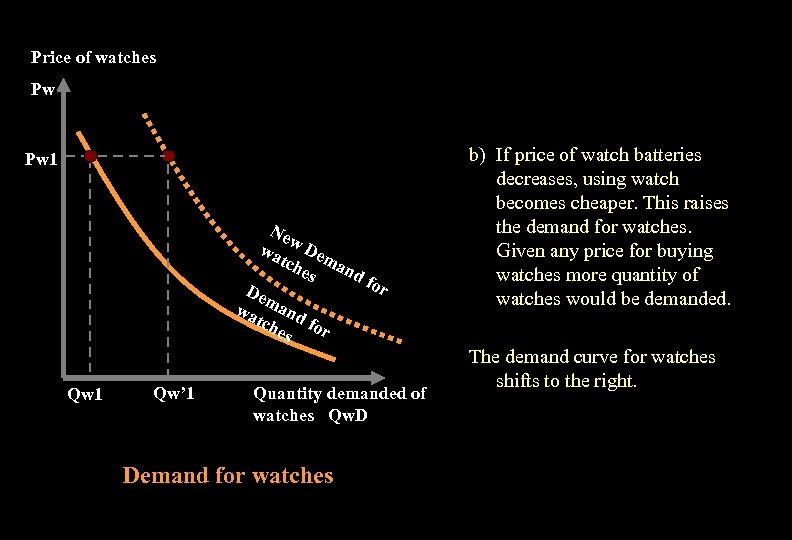
Price of watches Pw Pw 1 Ne w wa Dem tch es and for De m wa and tch es for Qw 1 Qw’ 1 Quantity demanded of watches Qw. D Demand for watches b) If price of watch batteries decreases, using watch becomes cheaper. This raises the demand for watches. Given any price for buying watches more quantity of watches would be demanded. The demand curve for watches shifts to the right.
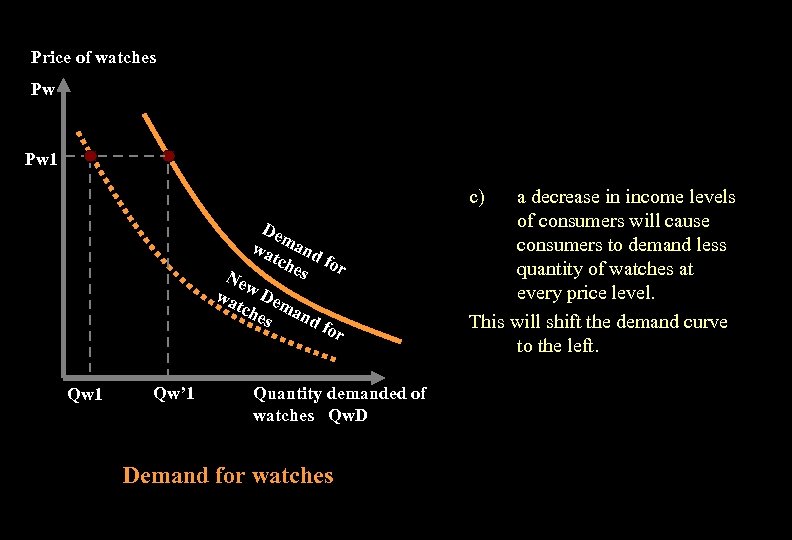
Price of watches Pw Pw 1 c) De m wa and tch es for Ne w wa Dem tch es and for Qw 1 Qw’ 1 Quantity demanded of watches Qw. D Demand for watches a decrease in income levels of consumers will cause consumers to demand less quantity of watches at every price level. This will shift the demand curve to the left.
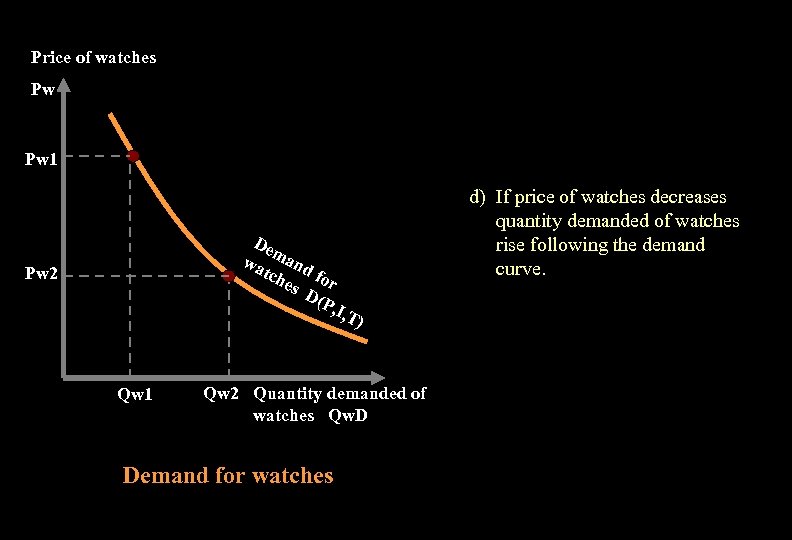
Price of watches Pw Pw 1 d) If price of watches decreases quantity demanded of watches rise following the demand curve. De m wa and tch es for D(P , I, T Pw 2 ) Qw 1 Qw 2 Quantity demanded of watches Qw. D Demand for watches

Demand for Intermediate Products
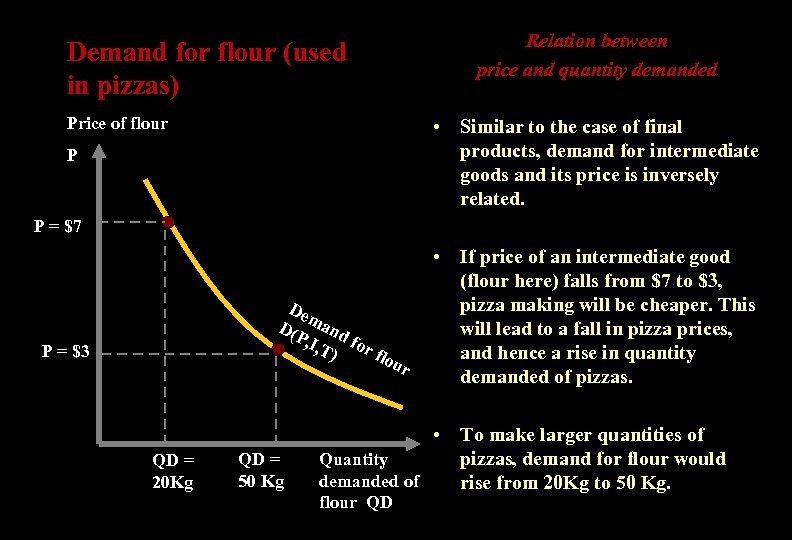
Relation between price and quantity demanded Demand for flour (used in pizzas) Price of flour • Similar to the case of final products, demand for intermediate goods and its price is inversely related. P P = $7 De m D(P and , I, T for flo ) u P = $3 r QD = 20 Kg QD = 50 Kg • If price of an intermediate good (flour here) falls from $7 to $3, pizza making will be cheaper. This will lead to a fall in pizza prices, and hence a rise in quantity demanded of pizzas. • To make larger quantities of pizzas, demand for flour would Quantity demanded of rise from 20 Kg to 50 Kg. flour QD
Exercise 4 Suppose India gains a new export market in Korea for textiles produced with India cotton. How will this affect the demand for domestic cotton producers?
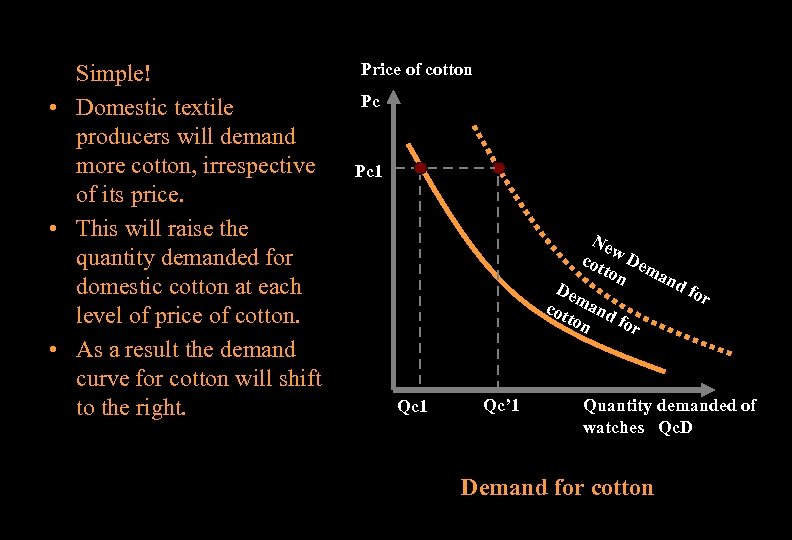
Simple! • Domestic textile producers will demand more cotton, irrespective of its price. • This will raise the quantity demanded for domestic cotton at each level of price of cotton. • As a result the demand curve for cotton will shift to the right. Price of cotton Pc Pc 1 Ne w cot Dem ton and De for ma cot ton nd fo r Qc 1 Qc’ 1 Quantity demanded of watches Qc. D Demand for cotton
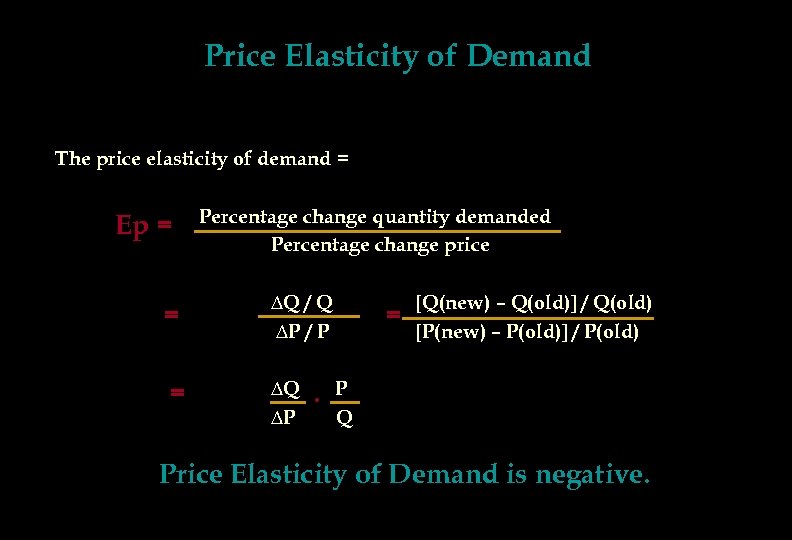
Price Elasticity of Demand The price elasticity of demand = Ep = Percentage change quantity demanded Percentage change price = ∆Q / Q ∆P / P = ∆Q ∆P . = [Q(new) – Q(old)] / Q(old) [P(new) – P(old)] / P(old) P Q Price Elasticity of Demand is negative.
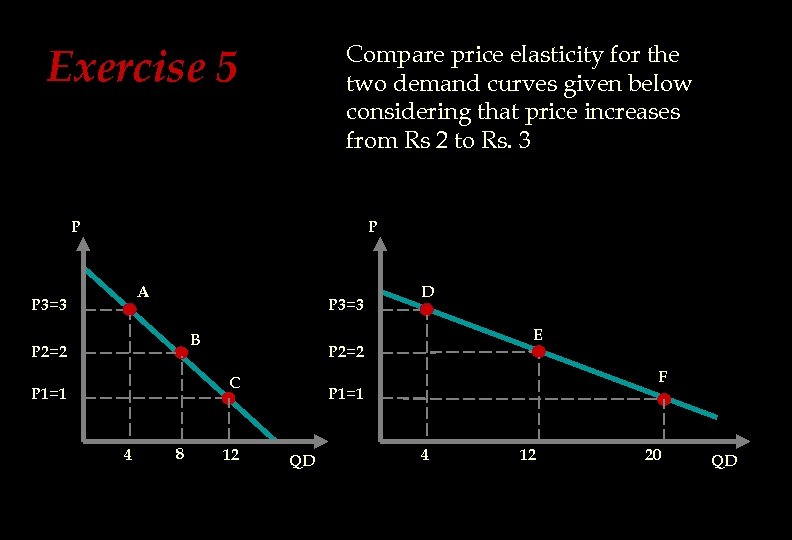
Compare price elasticity for the two demand curves given below considering that price increases from Rs 2 to Rs. 3 Exercise 5 P P A P 3=3 B P 2=2 4 8 E P 2=2 C P 1=1 D 12 F P 1=1 QD 4 12 20 QD
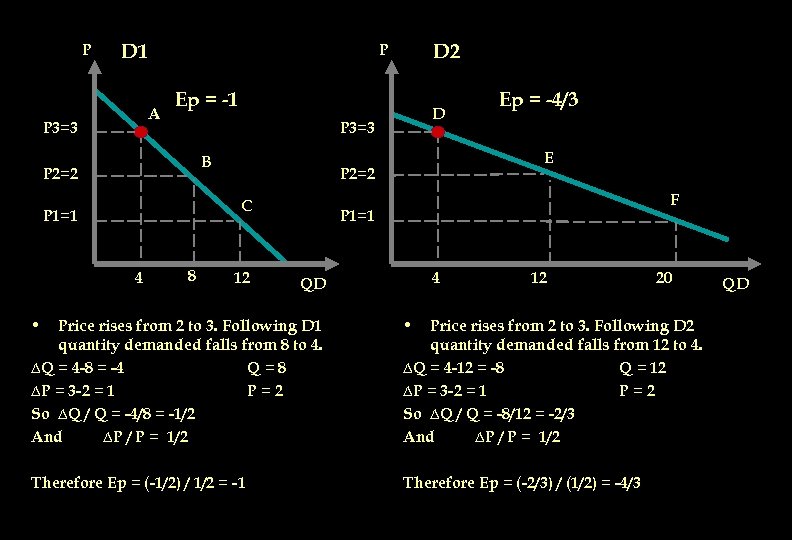
P P D 1 A P 3=3 Ep = -1 D P 3=3 B P 2=2 P 1=1 8 12 Ep = -4/3 E P 2=2 C 4 D 2 F P 1=1 4 QD 12 • Price rises from 2 to 3. Following D 1 quantity demanded falls from 8 to 4. ∆Q = 4 -8 = -4 Q=8 ∆P = 3 -2 = 1 P=2 So ∆Q / Q = -4/8 = -1/2 And ∆P / P = 1/2 • Therefore Ep = (-1/2) / 1/2 = -1 Therefore Ep = (-2/3) / (1/2) = -4/3 20 Price rises from 2 to 3. Following D 2 quantity demanded falls from 12 to 4. ∆Q = 4 -12 = -8 Q = 12 ∆P = 3 -2 = 1 P=2 So ∆Q / Q = -8/12 = -2/3 And ∆P / P = 1/2 QD
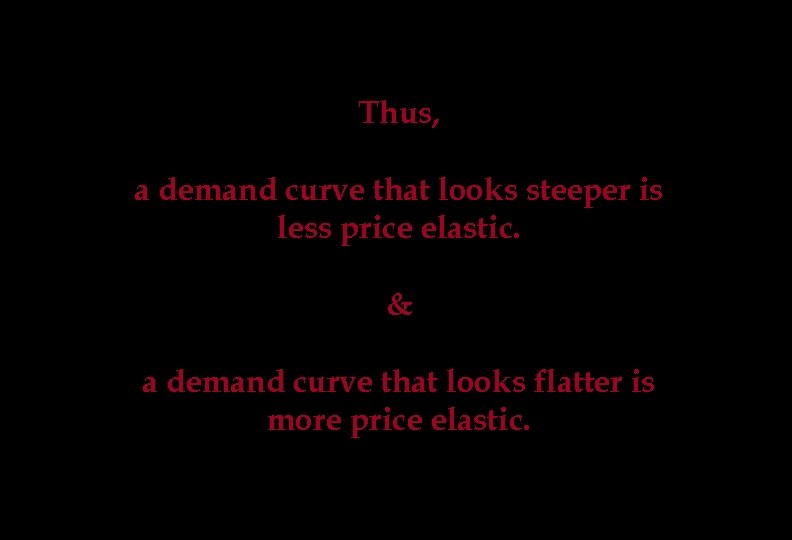
Thus, a demand curve that looks steeper is less price elastic. & a demand curve that looks flatter is more price elastic.
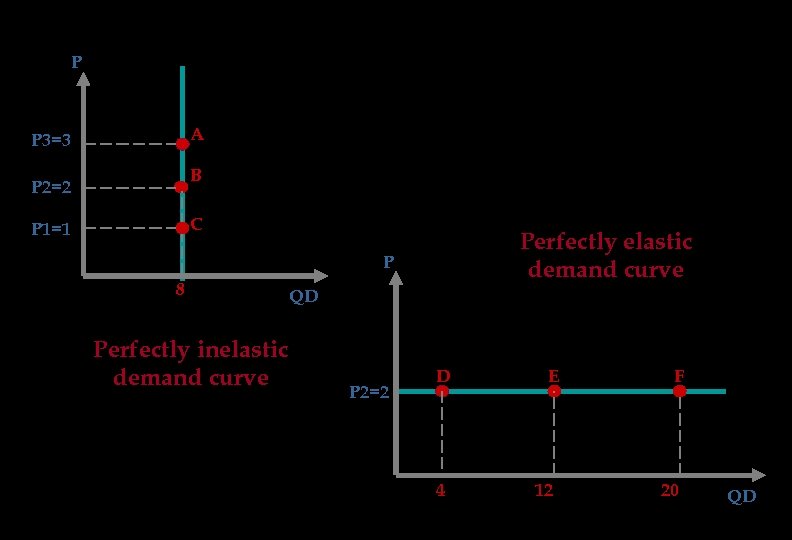
P A P 3=3 B P 2=2 C P 1=1 Perfectly elastic demand curve P 8 QD Perfectly inelastic demand curve P 2=2 D 4 E 12 F 20 QD
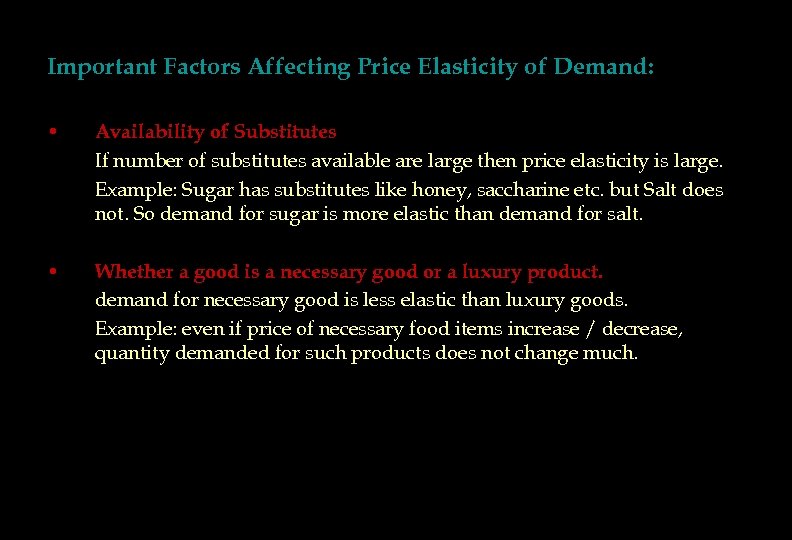
Important Factors Affecting Price Elasticity of Demand: • Availability of Substitutes If number of substitutes available are large then price elasticity is large. Example: Sugar has substitutes like honey, saccharine etc. but Salt does not. So demand for sugar is more elastic than demand for salt. • Whether a good is a necessary good or a luxury product. demand for necessary good is less elastic than luxury goods. Example: even if price of necessary food items increase / decrease, quantity demanded for such products does not change much.
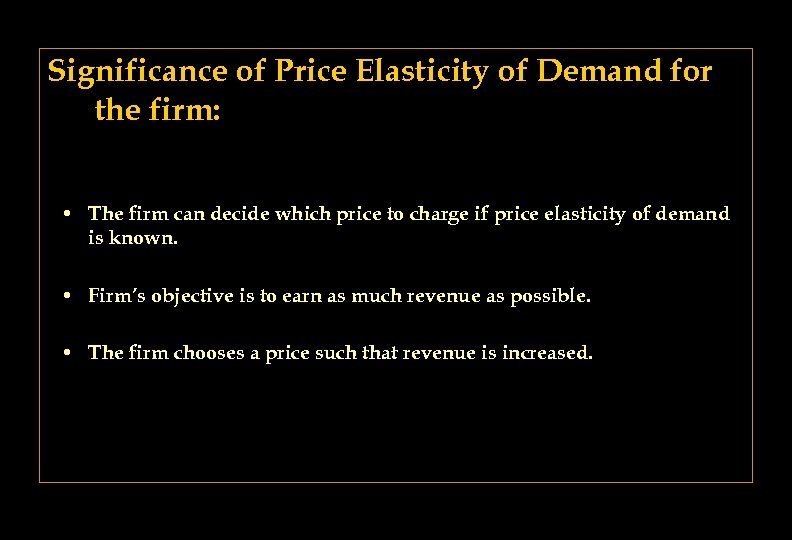
Significance of Price Elasticity of Demand for the firm: • The firm can decide which price to charge if price elasticity of demand is known. • Firm’s objective is to earn as much revenue as possible. • The firm chooses a price such that revenue is increased.
Скачать презентацию Demand Supply and The Market Equilibrium The
2748240d472fcbeee6c7809bf86416ce.ppt