 Скачать презентацию Demand Forecasting and Managing Variability in a Supply
acf9608d586a4d6e420d97a209ce232c.ppt
- Количество слайдов: 47



Demand Forecasting and Managing Variability in a Supply Chain
Learning Objectives n Role of forecasting in a supply chain Components of a demand forecast Demand forecasting using historical data Analysing forecast errors Managing demand/supply in a supply chain n Forecasting with Excel n n 2
Role of forecasting n Demand forecasts form the basis of all planning decisions in a supply chain n Push: produce to anticipated demand levels Pull: set capacity and component availability levels Forecast time horizons n n n Short term (days, weeks): shift scheduling Medium Term (weeks, months): workforce planning, materials purchasing, promotions Long term (months, years): capacity expansion, capital/financial budget 3
Characteristics of Forecasts n Forecasts are always wrong! n n n Expected value Error/variability from the expected value Long-term forecasts are usually less accurate than short-term forecasts Aggregate forecasts are usually more accurate than disaggregate forecasts Mature products with stable demand are easier to forecast than seasonal goods or “fashion” items with short product-life 4
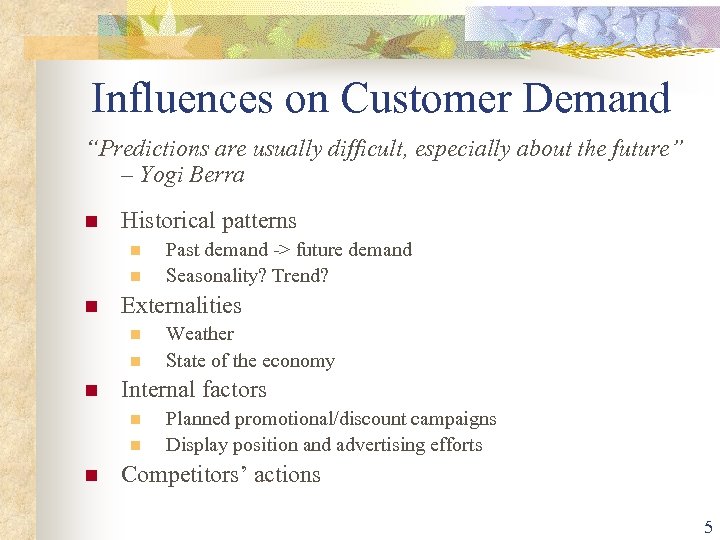
Influences on Customer Demand “Predictions are usually difficult, especially about the future” – Yogi Berra n Historical patterns n n n Externalities n n n Weather State of the economy Internal factors n n n Past demand -> future demand Seasonality? Trend? Planned promotional/discount campaigns Display position and advertising efforts Competitors’ actions 5
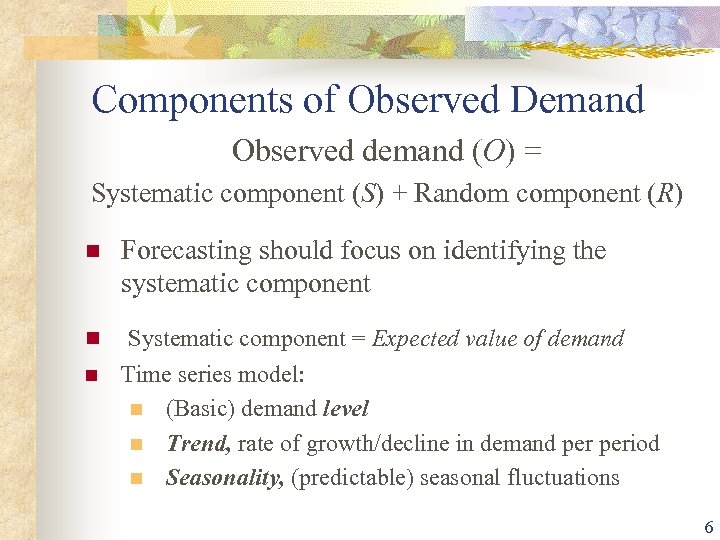
Components of Observed Demand Observed demand (O) = Systematic component (S) + Random component (R) n Forecasting should focus on identifying the systematic component n Systematic component = Expected value of demand Time series model: n (Basic) demand level n Trend, rate of growth/decline in demand period n Seasonality, (predictable) seasonal fluctuations n 6
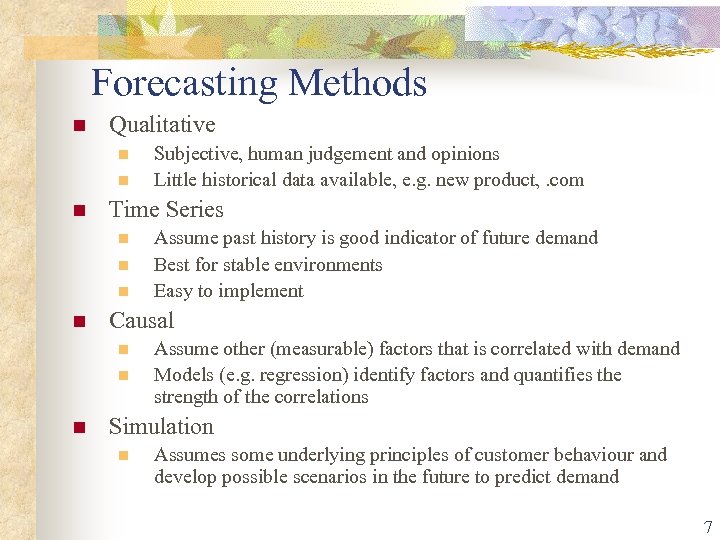
Forecasting Methods n Qualitative n n n Time Series n n Assume past history is good indicator of future demand Best for stable environments Easy to implement Causal n n n Subjective, human judgement and opinions Little historical data available, e. g. new product, . com Assume other (measurable) factors that is correlated with demand Models (e. g. regression) identify factors and quantifies the strength of the correlations Simulation n Assumes some underlying principles of customer behaviour and develop possible scenarios in the future to predict demand 7
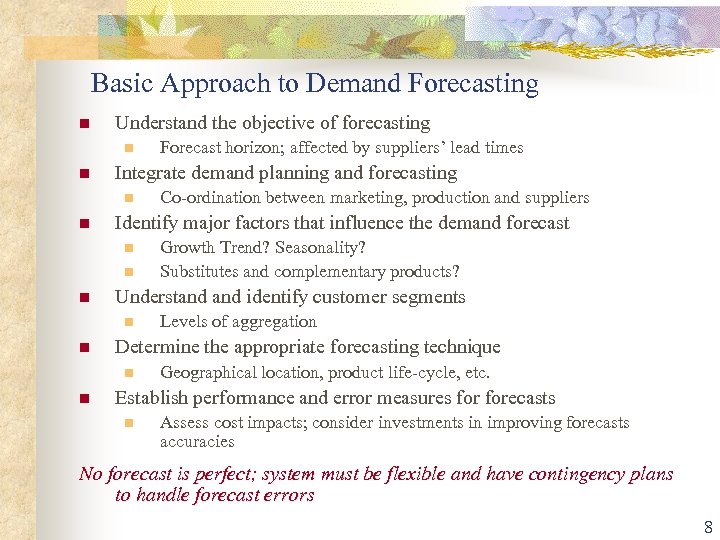
Basic Approach to Demand Forecasting n Understand the objective of forecasting n n Integrate demand planning and forecasting n n n Levels of aggregation Determine the appropriate forecasting technique n n Growth Trend? Seasonality? Substitutes and complementary products? Understand identify customer segments n n Co-ordination between marketing, production and suppliers Identify major factors that influence the demand forecast n n Forecast horizon; affected by suppliers’ lead times Geographical location, product life-cycle, etc. Establish performance and error measures forecasts n Assess cost impacts; consider investments in improving forecasts accuracies No forecast is perfect; system must be flexible and have contingency plans to handle forecast errors 8
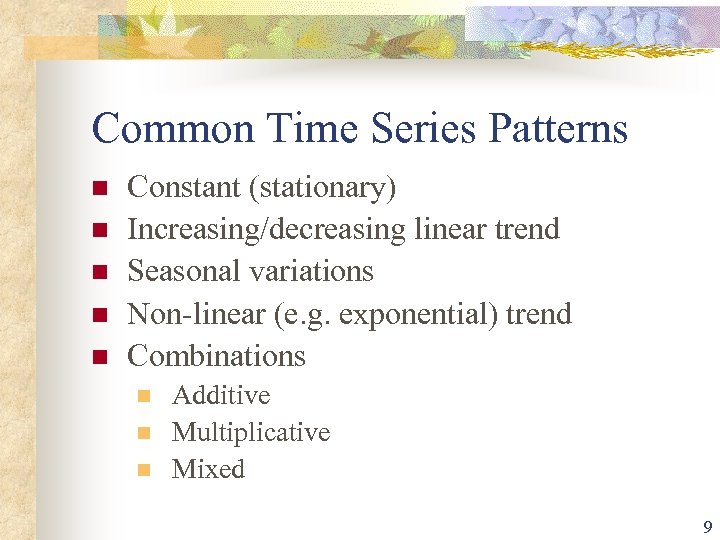
Common Time Series Patterns n n n Constant (stationary) Increasing/decreasing linear trend Seasonal variations Non-linear (e. g. exponential) trend Combinations n n n Additive Multiplicative Mixed 9
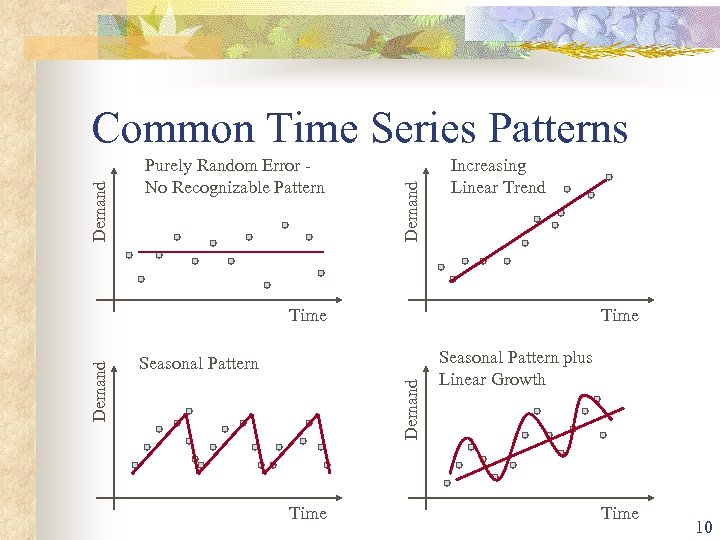
Purely Random Error No Recognizable Pattern Demand Common Time Series Patterns Increasing Linear Trend Time Seasonal Pattern Demand Time Seasonal Pattern plus Linear Growth Time 10
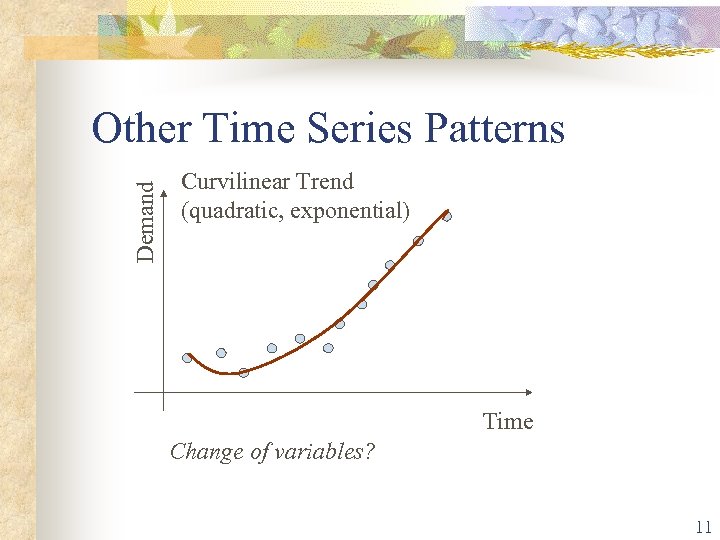
Demand Other Time Series Patterns Curvilinear Trend (quadratic, exponential) Time Change of variables? 11
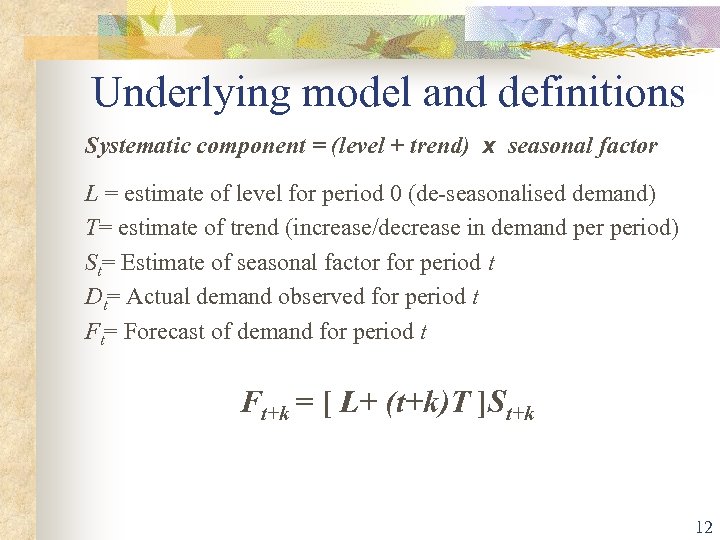
Underlying model and definitions Systematic component = (level + trend) x seasonal factor L = estimate of level for period 0 (de-seasonalised demand) T= estimate of trend (increase/decrease in demand period) St= Estimate of seasonal factor for period t Dt= Actual demand observed for period t Ft= Forecast of demand for period t Ft+k = [ L+ (t+k)T ]St+k 12
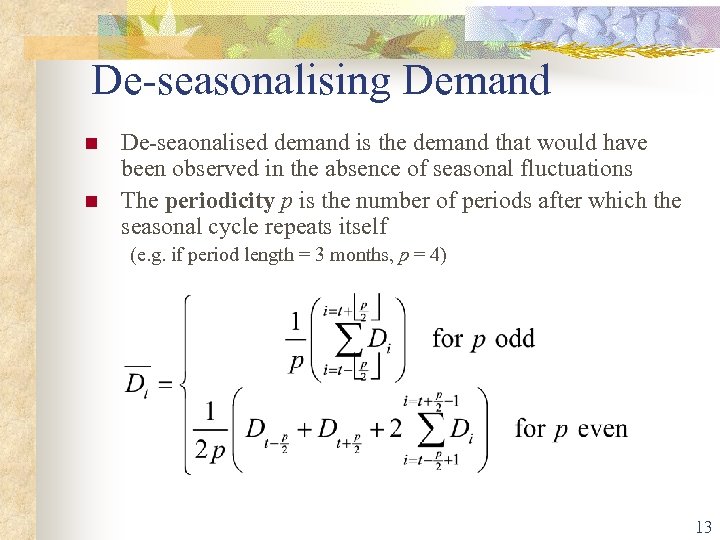
De-seasonalising Demand n n De-seaonalised demand is the demand that would have been observed in the absence of seasonal fluctuations The periodicity p is the number of periods after which the seasonal cycle repeats itself (e. g. if period length = 3 months, p = 4) 13
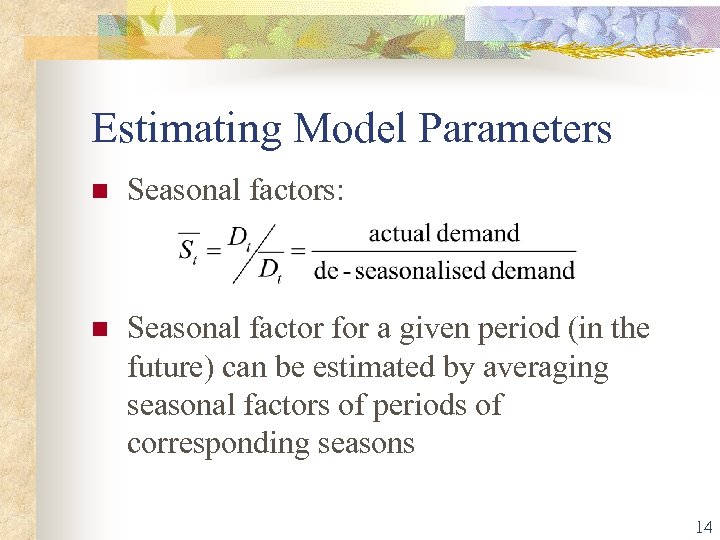
Estimating Model Parameters n Seasonal factors: n Seasonal factor for a given period (in the future) can be estimated by averaging seasonal factors of periods of corresponding seasons 14
Static Forecasting n n Values of L and T estimated based on a set of data Methods: n n n Simple averaging Linear regression These (static) values of L and T are used for future forecasts 15
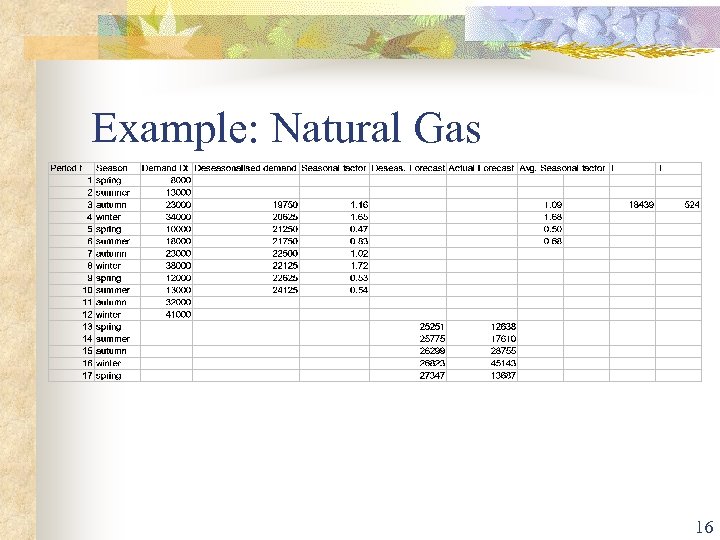
Example: Natural Gas 16
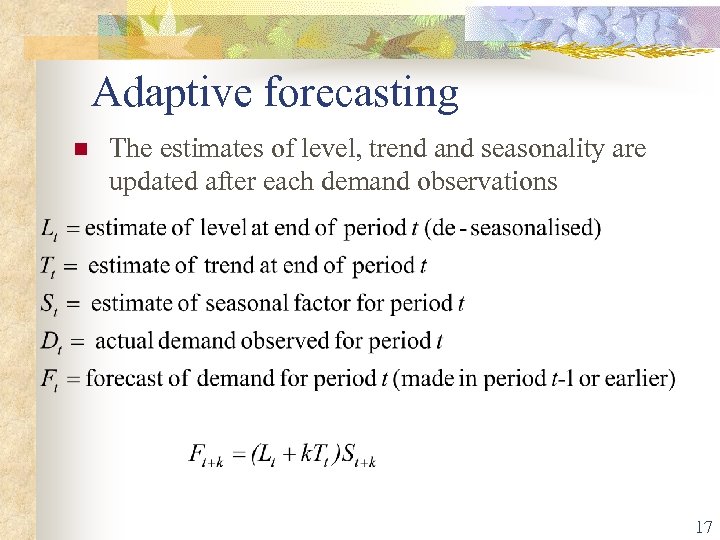
Adaptive forecasting n The estimates of level, trend and seasonality are updated after each demand observations 17
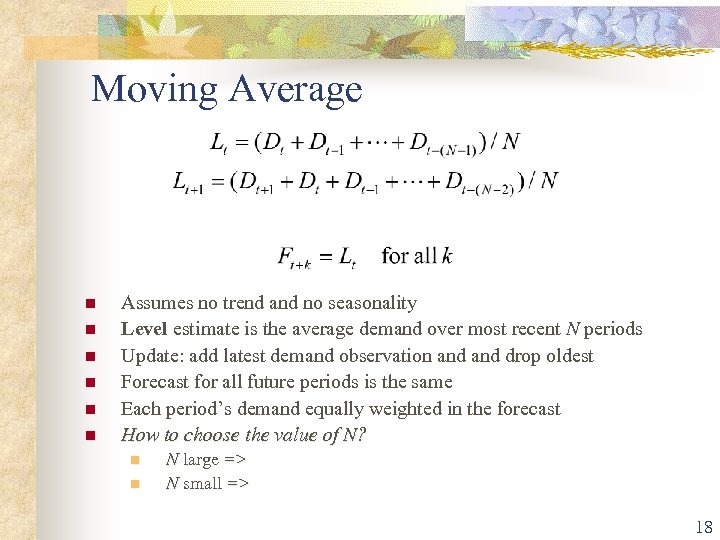
Moving Average n n n Assumes no trend and no seasonality Level estimate is the average demand over most recent N periods Update: add latest demand observation and drop oldest Forecast for all future periods is the same Each period’s demand equally weighted in the forecast How to choose the value of N? n n N large => N small => 18
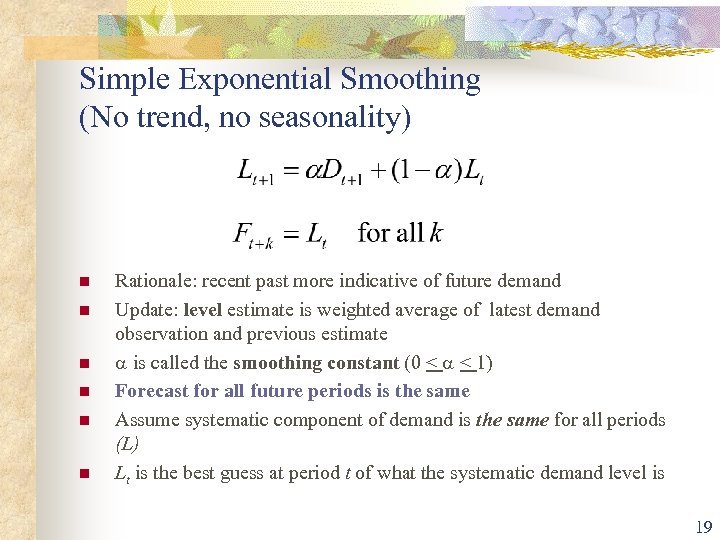
Simple Exponential Smoothing (No trend, no seasonality) n n n Rationale: recent past more indicative of future demand Update: level estimate is weighted average of latest demand observation and previous estimate a is called the smoothing constant (0 < a < 1) Forecast for all future periods is the same Assume systematic component of demand is the same for all periods (L) Lt is the best guess at period t of what the systematic demand level is 19
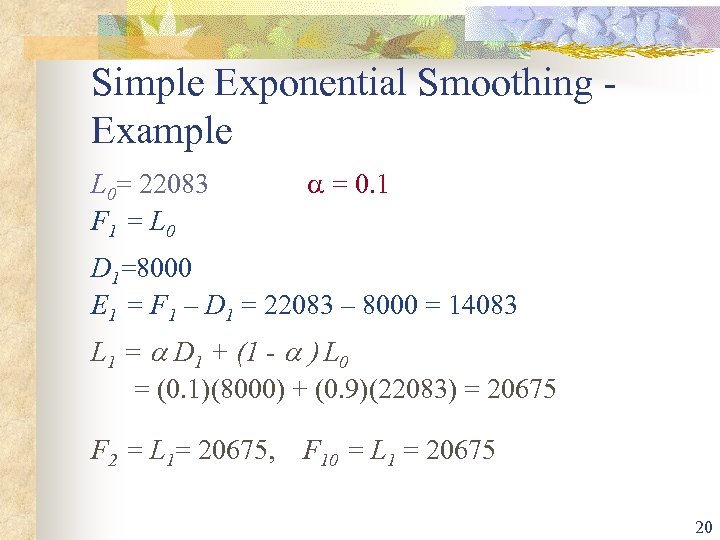
Simple Exponential Smoothing Example L 0= 22083 F 1 = L 0 a = 0. 1 D 1=8000 E 1 = F 1 – D 1 = 22083 – 8000 = 14083 L 1 = a D 1 + (1 - a ) L 0 = (0. 1)(8000) + (0. 9)(22083) = 20675 F 2 = L 1= 20675, F 10 = L 1 = 20675 20
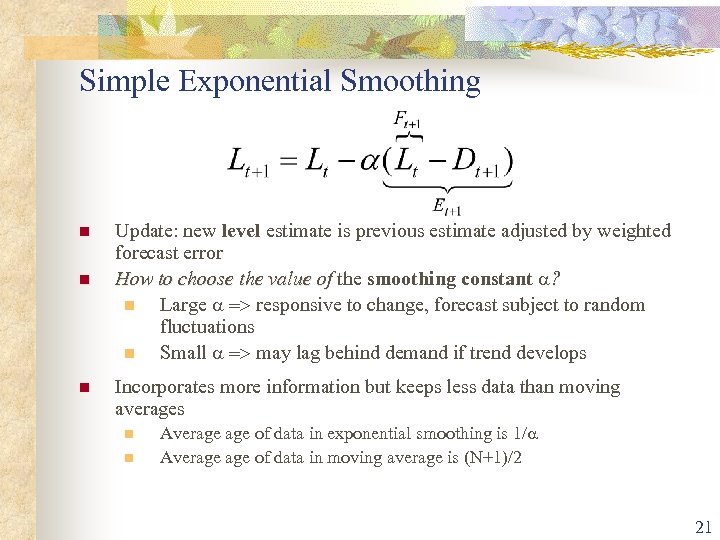
Simple Exponential Smoothing n n n Update: new level estimate is previous estimate adjusted by weighted forecast error How to choose the value of the smoothing constant a? n Large a => responsive to change, forecast subject to random fluctuations n Small a => may lag behind demand if trend develops Incorporates more information but keeps less data than moving averages n n Average of data in exponential smoothing is 1/a Average of data in moving average is (N+1)/2 21
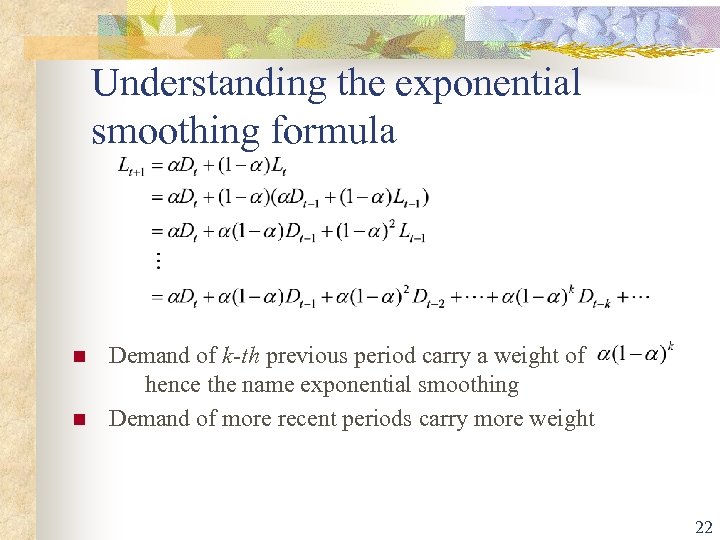
Understanding the exponential smoothing formula n n Demand of k-th previous period carry a weight of hence the name exponential smoothing Demand of more recent periods carry more weight 22
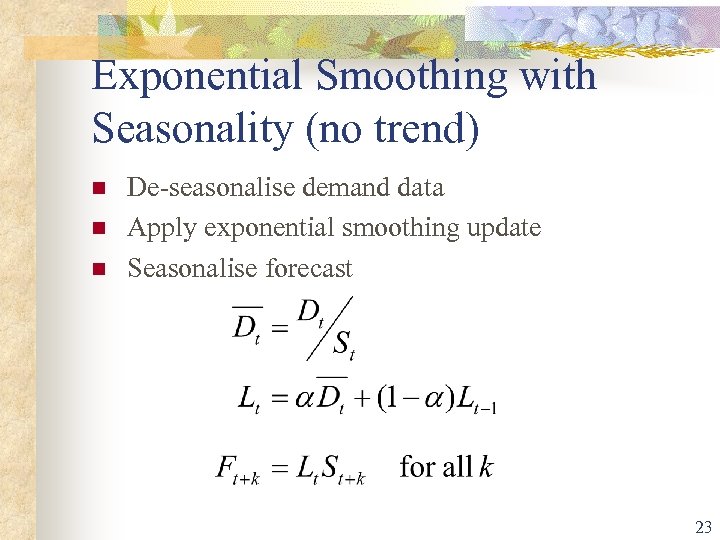
Exponential Smoothing with Seasonality (no trend) n n n De-seasonalise demand data Apply exponential smoothing update Seasonalise forecast 23
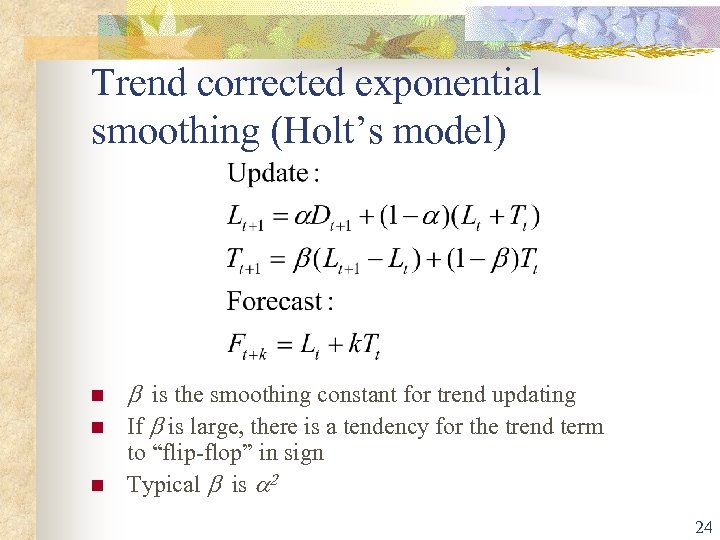
Trend corrected exponential smoothing (Holt’s model) n n n b is the smoothing constant for trend updating If b is large, there is a tendency for the trend term to “flip-flop” in sign Typical b is a 2 24
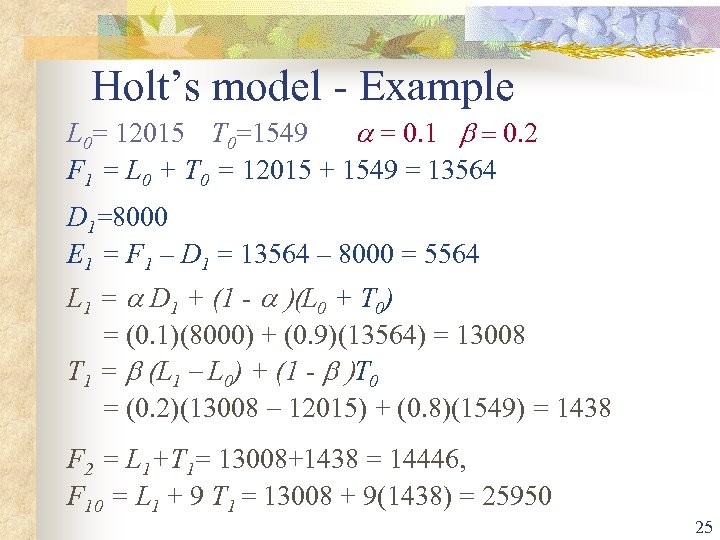
Holt’s model - Example L 0= 12015 T 0=1549 a = 0. 1 b = 0. 2 F 1 = L 0 + T 0 = 12015 + 1549 = 13564 D 1=8000 E 1 = F 1 – D 1 = 13564 – 8000 = 5564 L 1 = a D 1 + (1 - a )(L 0 + T 0) = (0. 1)(8000) + (0. 9)(13564) = 13008 T 1 = b (L 1 - L 0) + (1 - b )T 0 = (0. 2)(13008 - 12015) + (0. 8)(1549) = 1438 F 2 = L 1+T 1= 13008+1438 = 14446, F 10 = L 1 + 9 T 1 = 13008 + 9(1438) = 25950 25
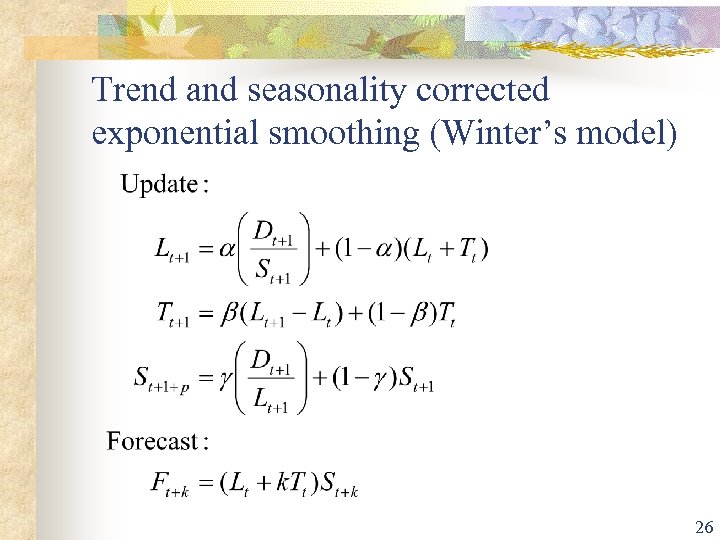
Trend and seasonality corrected exponential smoothing (Winter’s model) 26
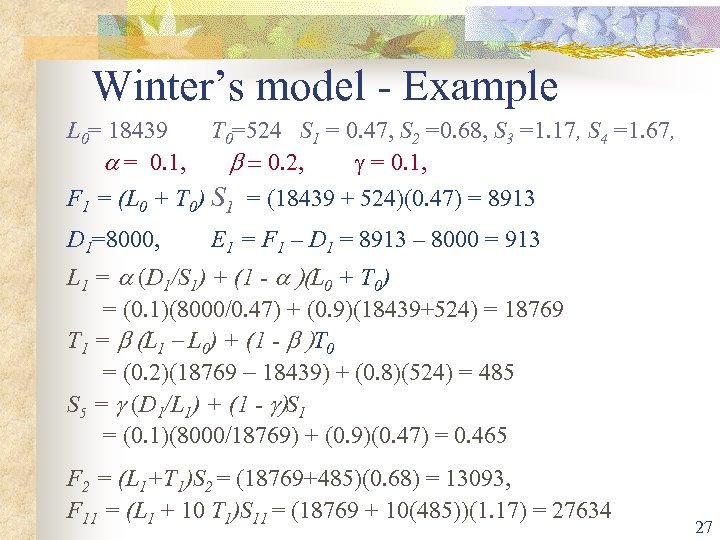
Winter’s model - Example L 0= 18439 a = 0. 1, T 0=524 S 1 = 0. 47, S 2 =0. 68, S 3 =1. 17, S 4 =1. 67, b = 0. 2, g = 0. 1, F 1 = (L 0 + T 0) S 1 = (18439 + 524)(0. 47) = 8913 D 1=8000, E 1 = F 1 – D 1 = 8913 – 8000 = 913 L 1 = a (D 1/S 1) + (1 - a )(L 0 + T 0) = (0. 1)(8000/0. 47) + (0. 9)(18439+524) = 18769 T 1 = b (L 1 - L 0) + (1 - b )T 0 = (0. 2)(18769 - 18439) + (0. 8)(524) = 485 S 5 = g (D 1/L 1) + (1 - g)S 1 = (0. 1)(8000/18769) + (0. 9)(0. 47) = 0. 465 F 2 = (L 1+T 1)S 2 = (18769+485)(0. 68) = 13093, F 11 = (L 1 + 10 T 1)S 11 = (18769 + 10(485))(1. 17) = 27634 27
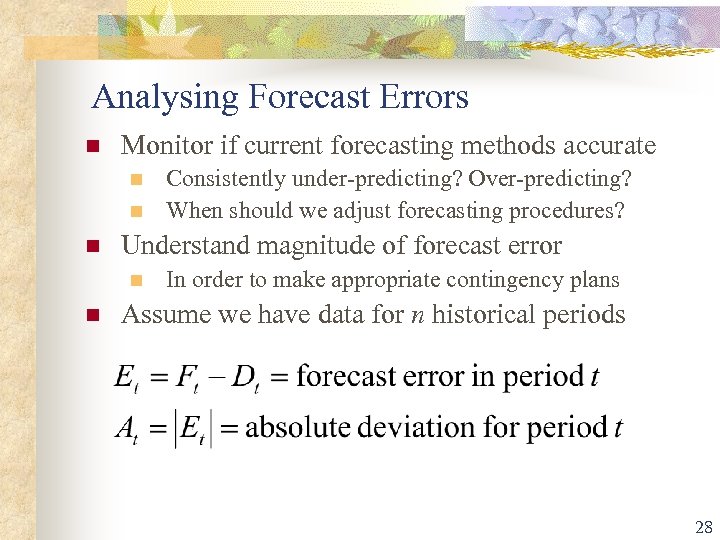
Analysing Forecast Errors n Monitor if current forecasting methods accurate n n n Understand magnitude of forecast error n n Consistently under-predicting? Over-predicting? When should we adjust forecasting procedures? In order to make appropriate contingency plans Assume we have data for n historical periods 28
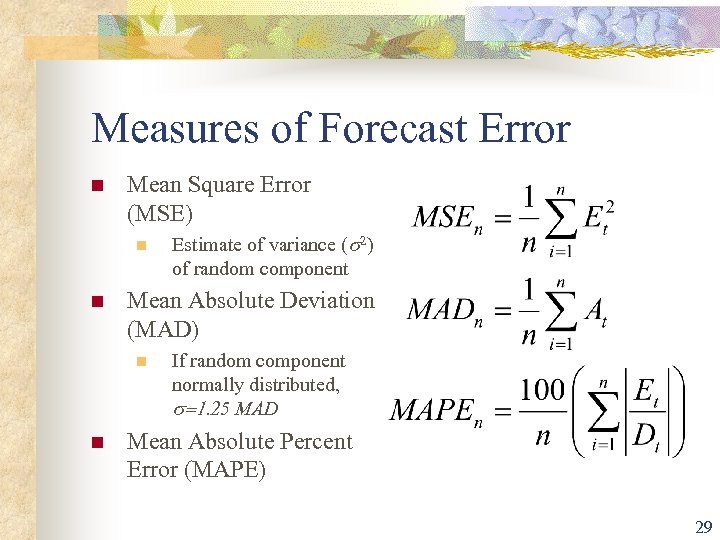
Measures of Forecast Error n Mean Square Error (MSE) n n Mean Absolute Deviation (MAD) n n Estimate of variance (s 2) of random component If random component normally distributed, s=1. 25 MAD Mean Absolute Percent Error (MAPE) 29
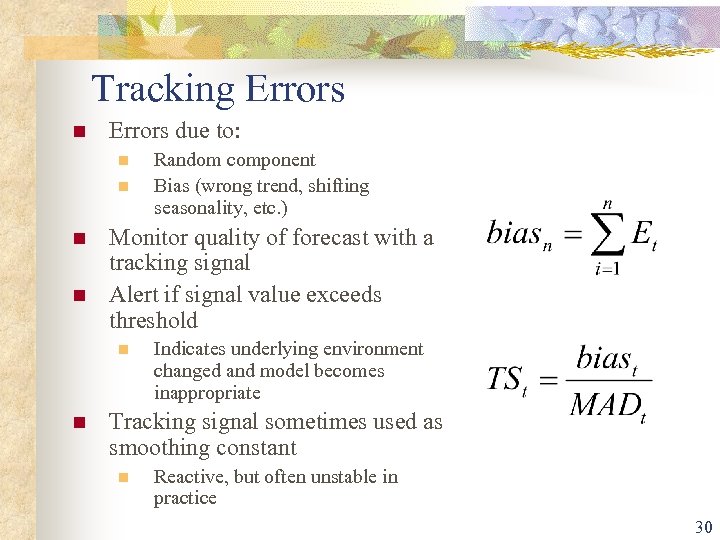
Tracking Errors n Errors due to: n n Monitor quality of forecast with a tracking signal Alert if signal value exceeds threshold n n Random component Bias (wrong trend, shifting seasonality, etc. ) Indicates underlying environment changed and model becomes inappropriate Tracking signal sometimes used as smoothing constant n Reactive, but often unstable in practice 30
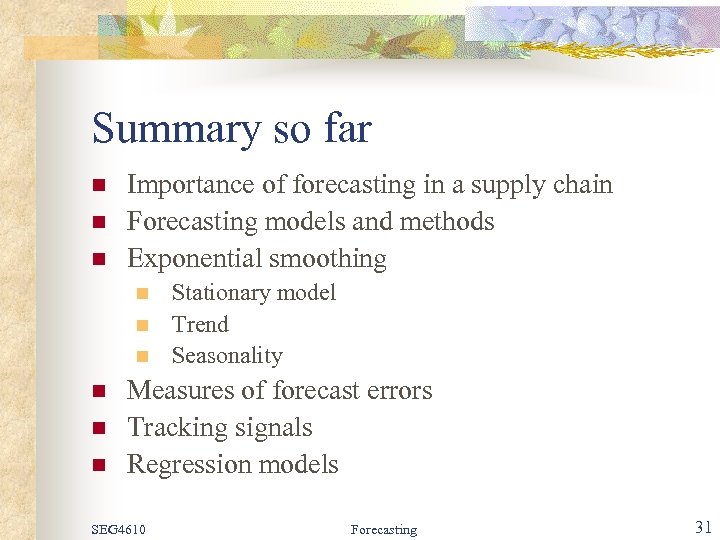
Summary so far n n n Importance of forecasting in a supply chain Forecasting models and methods Exponential smoothing n n n Stationary model Trend Seasonality Measures of forecast errors Tracking signals Regression models SEG 4610 Forecasting 31
Regression Analysis n n Statistical technique to determine the degree of association between set of variables and demand. Given values of the predictor (independent) variables, the regression equation provides a forecast of demand. SEG 4610 Forecasting 32
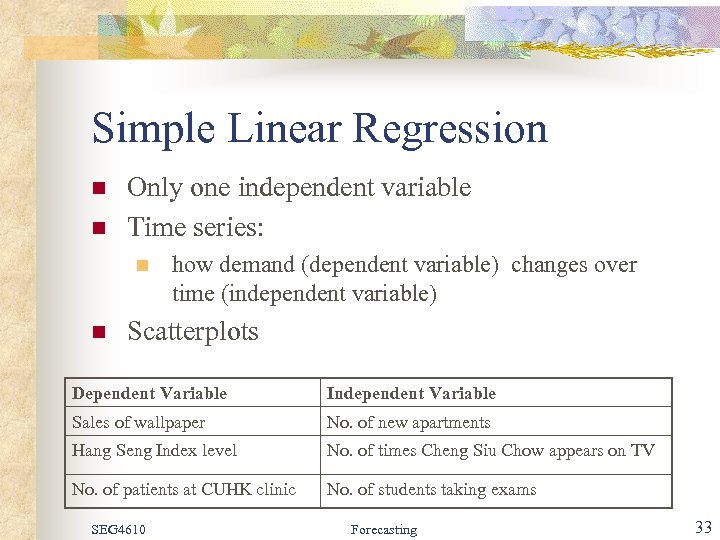
Simple Linear Regression n n Only one independent variable Time series: n n how demand (dependent variable) changes over time (independent variable) Scatterplots Dependent Variable Independent Variable Sales of wallpaper No. of new apartments Hang Seng Index level No. of times Cheng Siu Chow appears on TV No. of patients at CUHK clinic No. of students taking exams SEG 4610 Forecasting 33
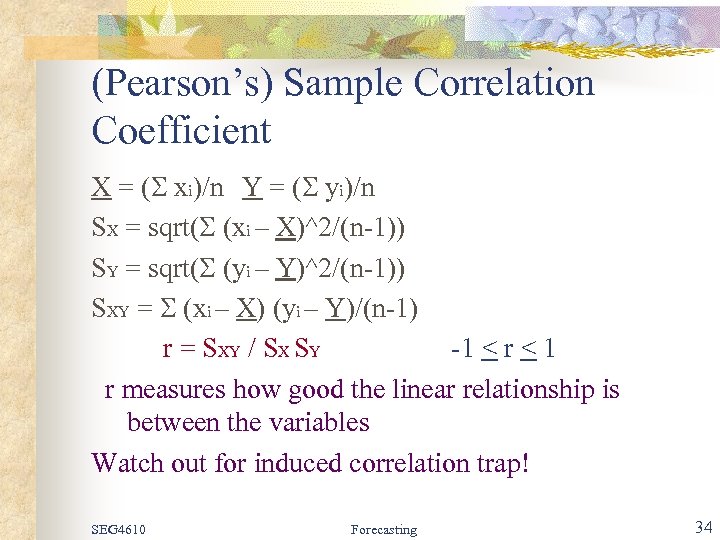
(Pearson’s) Sample Correlation Coefficient X = (S xi)/n Y = (S yi)/n SX = sqrt(S (xi – X)^2/(n-1)) SY = sqrt(S (yi – Y)^2/(n-1)) SXY = S (xi – X) (yi – Y)/(n-1) r = SXY / SX SY -1 < r < 1 r measures how good the linear relationship is between the variables Watch out for induced correlation trap! SEG 4610 Forecasting 34
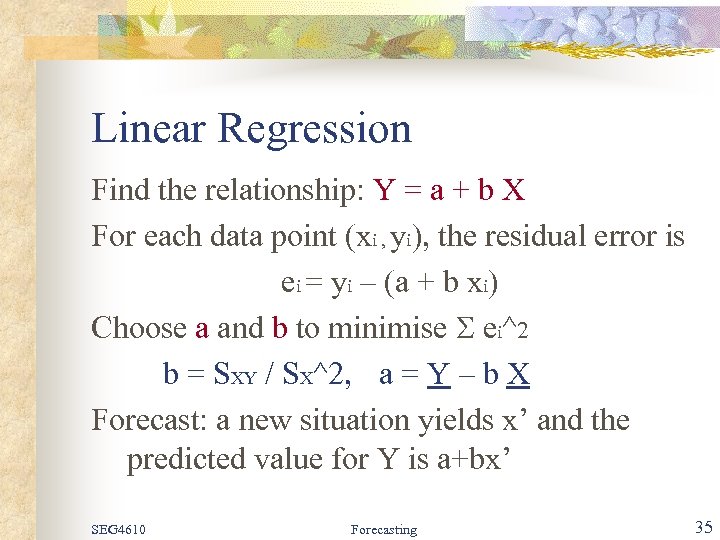
Linear Regression Find the relationship: Y = a + b X For each data point (xi , yi), the residual error is ei = yi – (a + b xi) Choose a and b to minimise S ei^2 b = SXY / SX^2, a = Y – b X Forecast: a new situation yields x’ and the predicted value for Y is a+bx’ SEG 4610 Forecasting 35
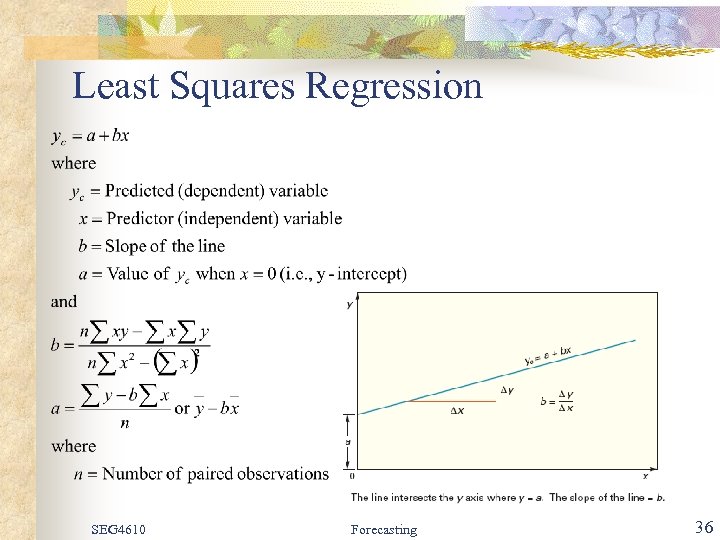
Least Squares Regression SEG 4610 Forecasting 36
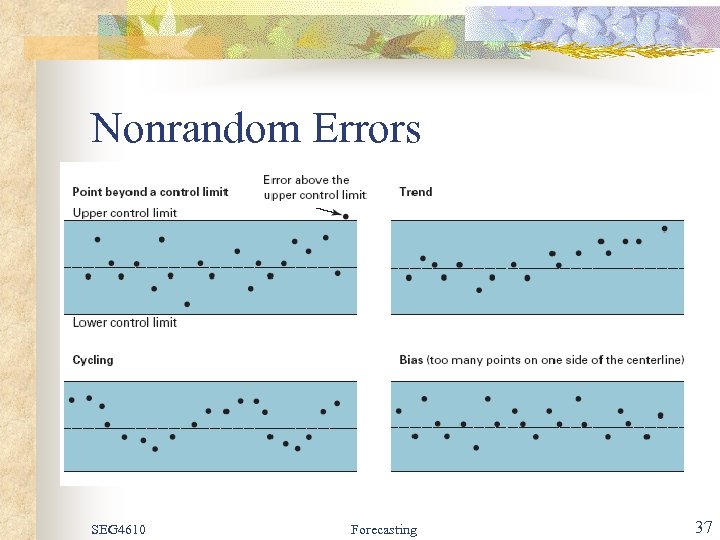
Nonrandom Errors SEG 4610 Forecasting 37
Special Forecasting Difficulties for Supply Chains n New products and service introductions n n n Lumpy derived demand n n No past history Use qualitative methods until sufficient data collected Examine correlation with similar products Use a large exponential smoothing constant Large but infrequent orders Random variations “swamps” trend and seasonality Identify reason for lumpiness and modify forecasts Spatial variations in demand n Separate forecast vs. allocation of total forecasts 38
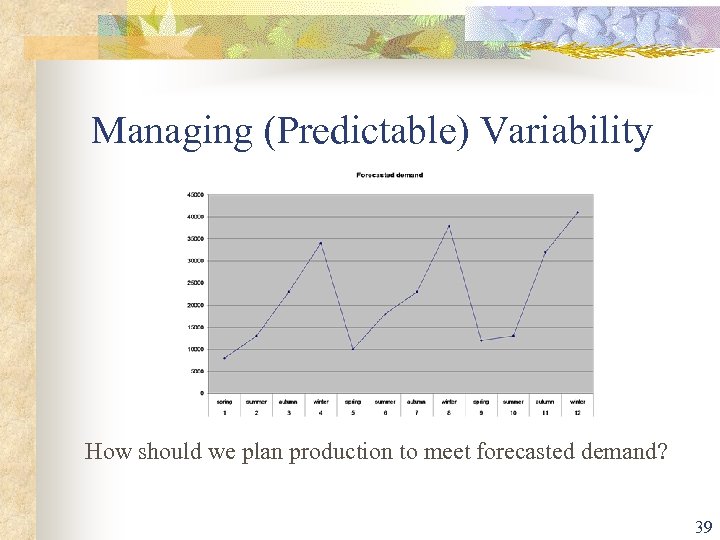
Managing (Predictable) Variability How should we plan production to meet forecasted demand? 39
Managing Supply n Chase strategy: production matches demand n n n Level (stable) production n n No inventory Capacity under-utilised during low demand periods High capacity utilisation Personnel management/training simpler Inventory build up in anticipation of seasonal demand variations; obsolescence risk Order backlog; loss of goodwill Capacity vs. Inventory trade-off 40
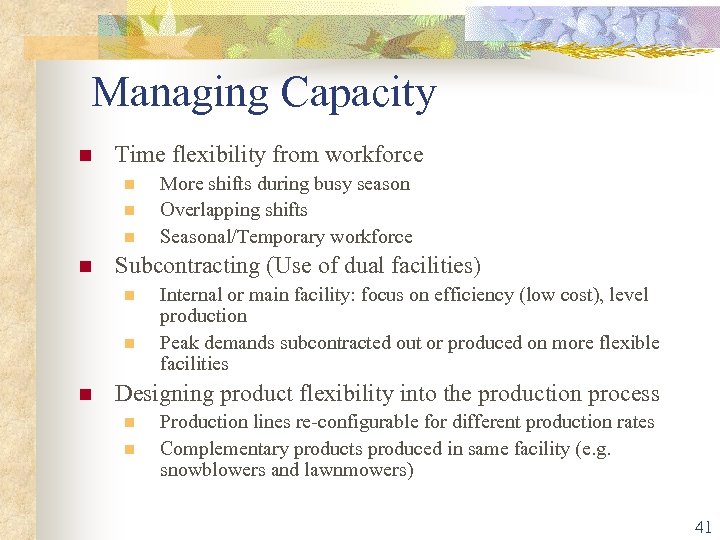
Managing Capacity n Time flexibility from workforce n n Subcontracting (Use of dual facilities) n n n More shifts during busy season Overlapping shifts Seasonal/Temporary workforce Internal or main facility: focus on efficiency (low cost), level production Peak demands subcontracted out or produced on more flexible facilities Designing product flexibility into the production process n n Production lines re-configurable for different production rates Complementary products produced in same facility (e. g. snowblowers and lawnmowers) 41
Managing Inventory n Use common components across multiple products n n n Aggregate demand more stable (forecast more accurate) Less obsolescence risk Build inventory of high demand or predictable demand items n Delay production of “fashion” items until closer to selling season 42
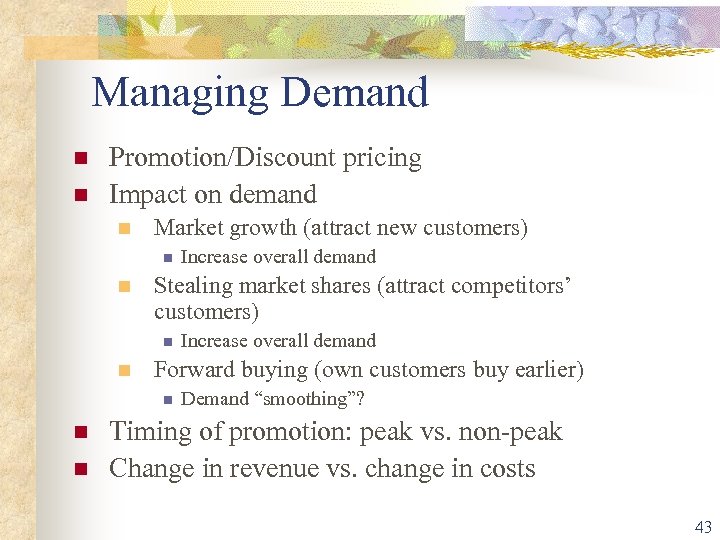
Managing Demand n n Promotion/Discount pricing Impact on demand n Market growth (attract new customers) n n Stealing market shares (attract competitors’ customers) n n n Increase overall demand Forward buying (own customers buy earlier) n n Increase overall demand Demand “smoothing”? Timing of promotion: peak vs. non-peak Change in revenue vs. change in costs 43
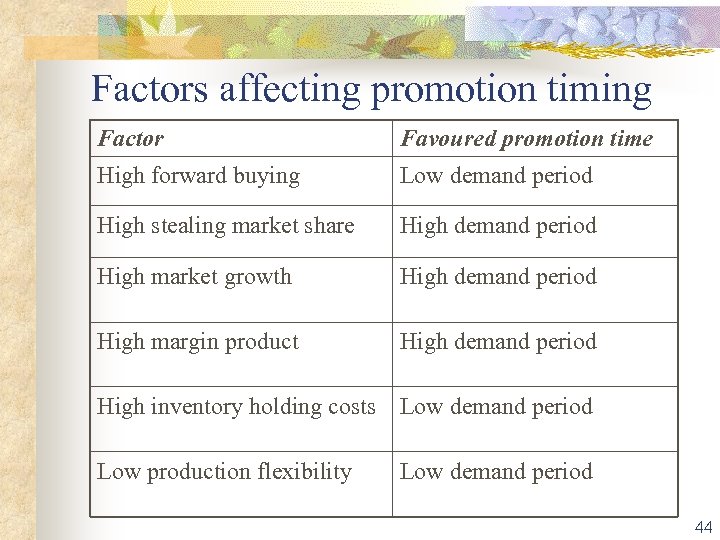
Factors affecting promotion timing Factor Favoured promotion time High forward buying Low demand period High stealing market share High demand period High market growth High demand period High margin product High demand period High inventory holding costs Low demand period Low production flexibility Low demand period 44
Demand management n Changes in demand impact production scheduling and inventory levels n n n Promotion at peak demand periods increases demand variability Promotion at non-peak “smoothes” demand Pricing and production planning must be done jointly Preempt, don’t just react, to predictable variability Actively managing predictable variability can be a strategic competitive advantage 45
Flexibility and Quick Response No forecast is perfect … There is no better forecast than the actual order! n If supply chain is responsive, then effect of forecast errors is minimised n Especially important when demand is unpredictable n Example: National bicycle n n Difficult to predict styles in sports bikes Re-engineer supply chain Customers design their own bike on Internet Bike produced in Kashiwara and delivered in 2 weeks! 46
Summary n n Importance of forecasting Exponential smoothing models n n n Measuring forecast error; tracking Predictable variability n n n Level, Trend, Seasonality Managing supply Managing demand Unpredictable variability? Co-ordinated management of supply and demand optimises profit Forecasting with Excel 47
Скачать презентацию Demand Forecasting and Managing Variability in a Supply
acf9608d586a4d6e420d97a209ce232c.ppt