

Demand assessment elementary methods 1 2 directions in












 Скачать презентацию Demand assessment elementary methods 1 2 directions in
30902-15_simple_linear_regression_in_demand_evaluation.ppt
- Количество слайдов: 27
Demand assessment elementary methods 1
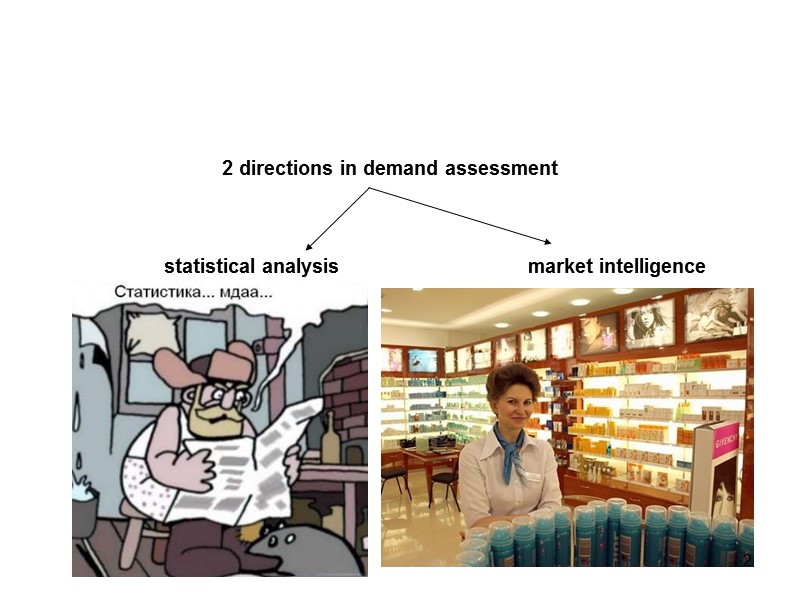
2 directions in demand assessment statistical analysis market intelligence 2
Statistical analysis Steps: 1) Collection, validation and assessment of data 2) The choice of the information curve 3) Verification and evaluation of the selected curve 3
1) Collection, validation and assessment of data time series cross-sectional data Statistical analysis 4
time series 1) Collection, validation and assessment of data Statistical analysis Examine time changes in the demand for certain types of goods or services and the corresponding time changes in pricing, sales volume and other independent variables that affect the demand 5
Adjustment of necessary information in order to avoid effects such as inflation Deflationary correction: divide all nominal figures by the consumer price index and multiplied by 100. Get "regular money" base period And also it is necessary to take into account changes in population, accounting for seasonal and cyclical fluctuations Long time period time series 6
Statistical analysis 1) Collection, validation and assessment of data cross-sectional data Considered changing the variables from some set in a particular time A snapshot of the many variables in one certain time 7
Ex: In order to determine the effect of prices on demand, as a variable can be selected volume of sales for a particular month, while the set may include a list of firms producing the product 8
Statistical analysis 2) The choice of the information curve The results of the observations are used to estimate the parameters of demand function This function can then be used to predict values for the dependent variable for known values of the independent variables 9
When choosing a curve there are two main questions: What type of equation it is necessary to use? How the selected function fits and predicts the demand? The choice of the equation depends on two conditions: а) the number of independent variables and б) the distribution of the data, i.e. linear or nonlinear distribution 10
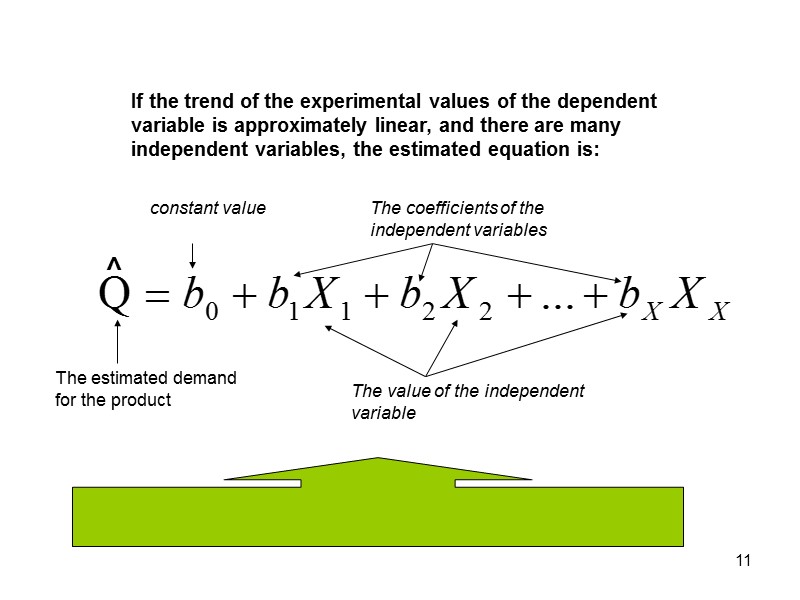
If the trend of the experimental values of the dependent variable is approximately linear, and there are many independent variables, the estimated equation is: The estimated demand for the product The value of the independent variable constant value The coefficients of the independent variables ˄ 11
If the data can be reduced to a single independent variable (e.g. price) and the trend is almost linear than to find the formula for this straight line we can use simple (pair) regression analysis The equation thus is: The quantity X, (dependent variable) The unit price of X (independent variable) A constant value (which determines the point of intersection of the graph of the function with the Y axis) The regression coefficient for Px (defining the slope of a line on the graph of a function) 12
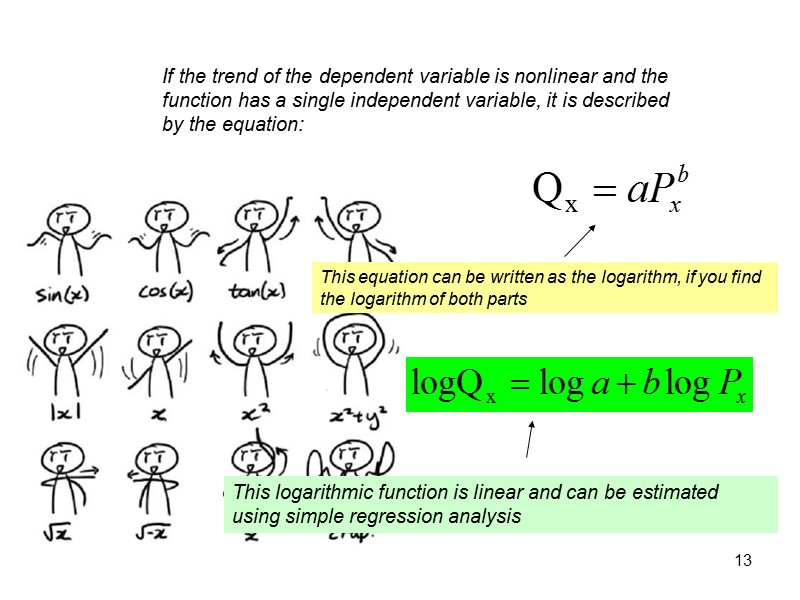
If the trend of the dependent variable is nonlinear and the function has a single independent variable, it is described by the equation: This equation can be written as the logarithm, if you find the logarithm of both parts This logarithmic function is linear and can be estimated using simple regression analysis 13
Simple linear regression STEP 1. Data collection TASK: TO FIND THE REGRESSION FUNCTION for THESE DATA! Collect time series data 14 Period Observation X Observation Y
STEP 2. Organization variables in time simple linear regression Причины: визуализация; определение линейности или нелинейности для выбора соответствующей формы кривой 15 Period X and Y There is a direct relationship between X and Y, with an increase of X, Y also increases and if X falls, Y falls too There are no obvious links of the lag-lead between them (no need to move forward or back in time) the trend, allocated to each series, is linear
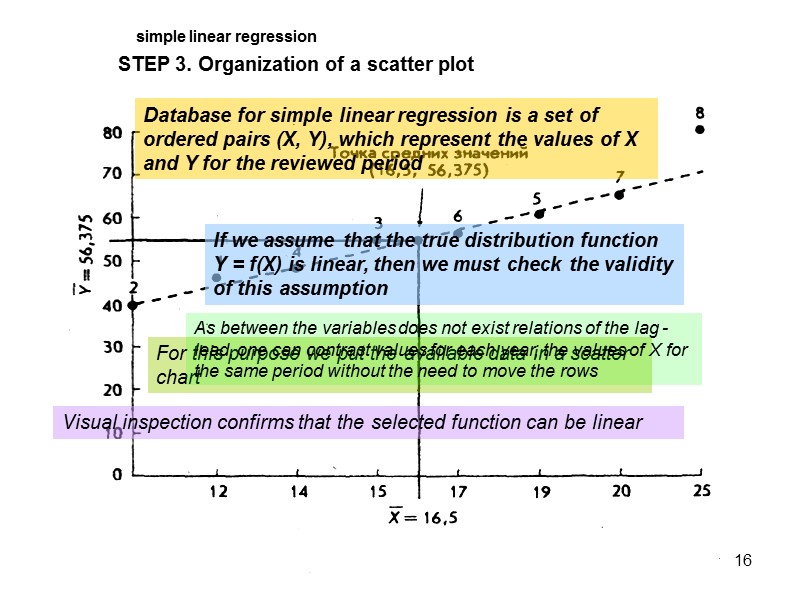
simple linear regression STEP 3. Organization of a scatter plot Database for simple linear regression is a set of ordered pairs (X, Y), which represent the values of X and Y for the reviewed period If we assume that the true distribution function Y = f(X) is linear, then we must check the validity of this assumption For this purpose we put the available data in a scatter chart As between the variables does not exist relations of the lag - lead, one can contrast values for each year, the values of X for the same period without the need to move the rows Visual inspection confirms that the selected function can be linear 16
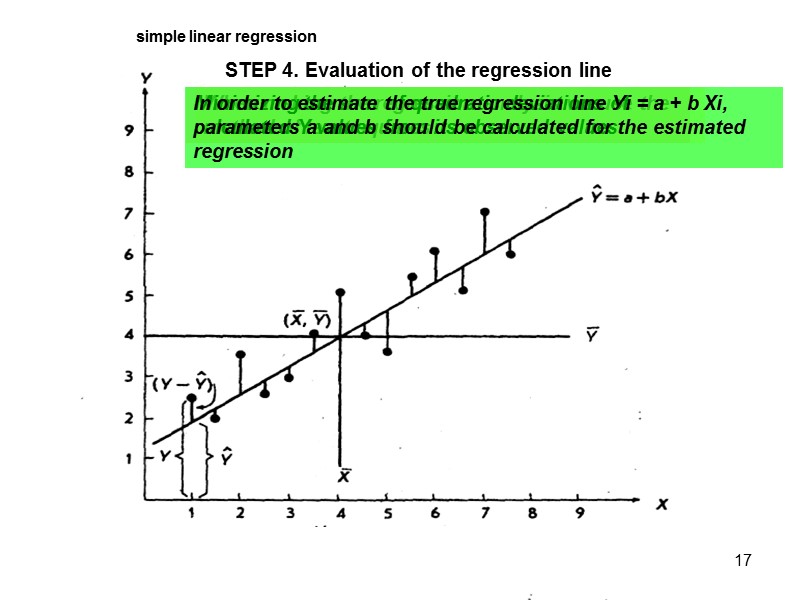
simple linear regression STEP 4. Evaluation of the regression line When making the regression analysis we use the method of least squares Minimizing the sum of quadratic deviations of calculated Y values from its observed values In order to estimate the true regression line Уi = а + b Хi, parameters a and b should be calculated for the estimated regression 17
simple linear regression STEP 4. Evaluation of the regression line 18 Period Observa-tion X Observa-tion X Observa-tion Y Sum Average
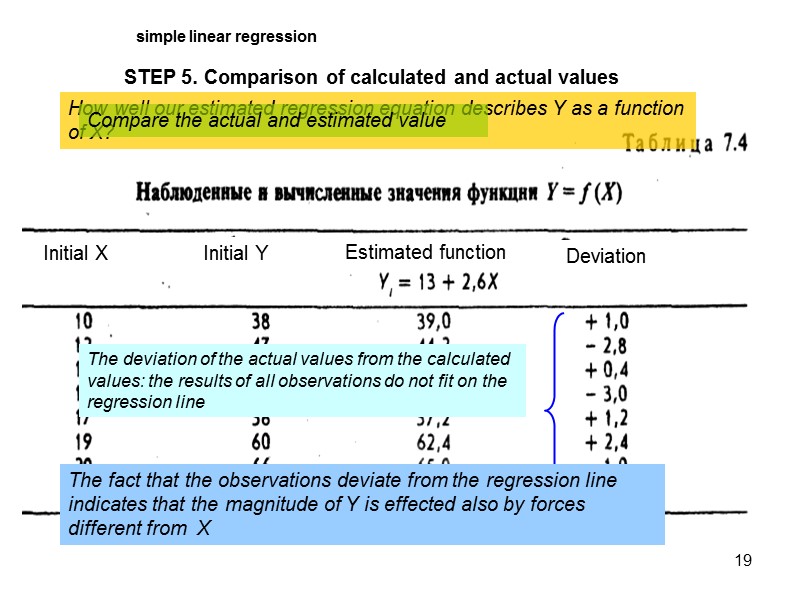
simple linear regression STEP 5. Comparison of calculated and actual values How well our estimated regression equation describes Y as a function of X? Compare the actual and estimated value The deviation of the actual values from the calculated values: the results of all observations do not fit on the regression line The fact that the observations deviate from the regression line indicates that the magnitude of Y is effected also by forces different from X 19 Initial X Initial Y Estimated function Deviation
simple linear regression Interpretation of parameters The "a" parameter determines the point of intersection of the regression line with the Y axis "a" has no economic sense in the demand equation Option "b" determines the slope of the regression line "b" represents the individual contribution of each independent variable to the value of the dependent variable The positive sign of the parameter "b" indicates that the variables change in the same direction 20
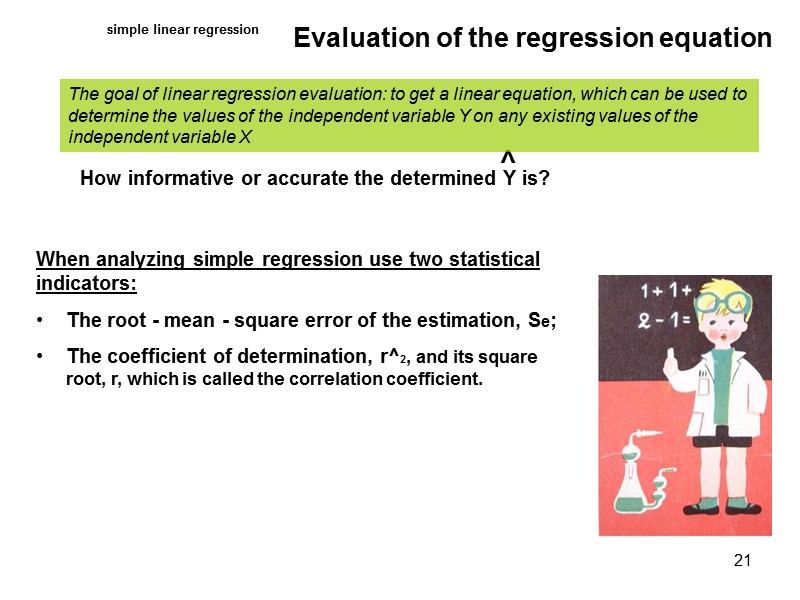
simple linear regression Evaluation of the regression equation How informative or accurate the determined Y is? ˄ When analyzing simple regression use two statistical indicators: The root - mean - square error of the estimation, Se; The coefficient of determination, r^2, and its square root, r, which is called the correlation coefficient. The goal of linear regression evaluation: to get a linear equation, which can be used to determine the values of the independent variable Y on any existing values of the independent variable X 21
The root – mean - square error of the estimation, Se; Represents the deviation of experimental points from the estimated regression line (determines the variance of random Y values) 22
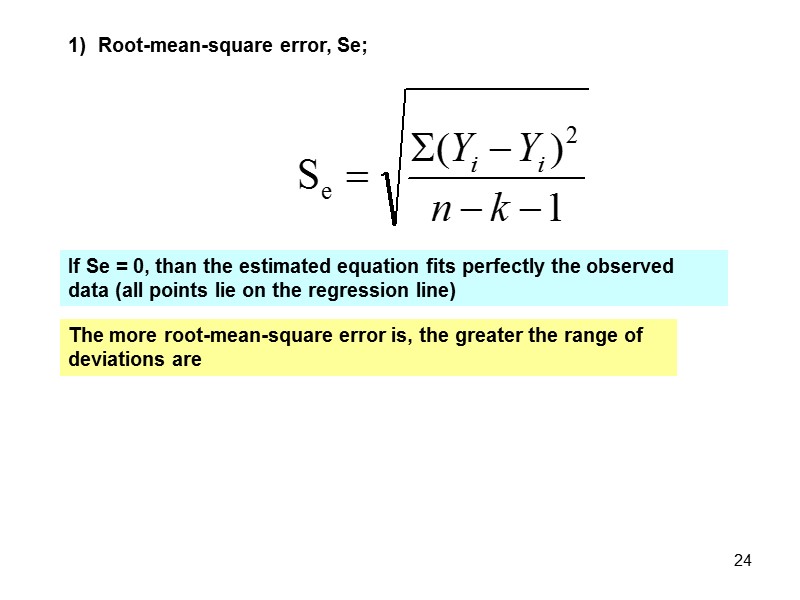
The root - mean - square error of the estimation, Se; ˄ Root-mean-square error Observed Y for Xi Evaluated Y for Xi Number of observations Number of independent variables 23
The more root-mean-square error is, the greater the range of deviations are Root-mean-square error, Se; If Se = 0, than the estimated equation fits perfectly the observed data (all points lie on the regression line) 24
coefficient of determination, r^2 Shows how well the regression model describes the variation of the dependent variable ЕХ: if r^2 = 0,975, than approximately 97.5% of the changes in the dependent variable explained by the variation of the independent variable X Values can range from 0 to 1 or from 0 to 100% 0 - there is no relationship between the variables, 1 - the regression line is perfect (all changes are explained by changes in X) 25
the correlation coefficient, r, Determines the degree of connection between variables -1 < r > 1 26
27