


 Скачать презентацию Delivery of Cancer Screening How Important is the
03b54f1a4b25818c429db471ab8304e3.ppt
- Количество слайдов: 24
 Delivery of Cancer Screening: How Important is the Preventive Health Exam? Joshua J. Fenton, MD, MPH Department of Family & Community Medicine University of California, Davis
 Preventive Health Exams (PHE) • Part of medical practice since 1860 s • Includes physical examination, screening, counseling, immunizations • Regarded skeptically since 1970 s • Increased emphasis on “opportunistic” delivery of preventive services • PHEs remain popular with patients and physicians
 PHE and Cancer Screening • PHE may be an auspicious time to promote cancer screening. • Correlated with screening but studies limited by: – Selected samples – Old data – Self-report – Potential confounding (e. g. , by total number of visits) • “Welcome to Medicare” Examination makes new study timely
 Research Questions Among a population-based sample of primary care patients: • Is PHE receipt associated with higher incidence of screening for colorectal, breast, and prostate cancer? • Is the PHE more strongly associated with screening in patients with fewer outpatient visits (i. e. , fewer chances for “opportunistic” prevention)?
 Setting and Samples • Large HMO in western Washington • Adults (age 52 -78) who received at least one primary care visit • Eligible for colorectal, breast, or prostate cancer screening in 2002 -2003 – No target organ cancer – No indications for diagnostic or surveillance testing (e. g. prior abnormal mammography) – No recent lower endoscopy for colorectal cohort • Novel breast cancer screening program
 Cancer Testing, 2002 -2003 • Any colorectal cancer test – Fecal occult blood test – Sigmoidoscopy, colonoscopy, or barium enema • One or more screening mammograms • One or more PSA tests
 Preventive Health Exams, 2002 -2003 • ICD-9 -CM Codes – “General medical exam” (V 700, V 708 -9, V 723) – “Gynecologic exam” (V 723) • E&M Codes – “Initial evaluation” (99386 -7) or “Re-evaluation of a healthy individual” (99396 -7)
 Covariates • Comorbidity (automated Charlson index) • Number of outpatient visits • Historical preventive service use, 20012002 – Target organ cancer tests – Preventive exams • BPH diagnoses, 2000 -2003 • Census-linked median household income
 Analyses • Multivariate logistic regression • Adjusted incidence differences and relative incidences associated with PHE • Subgroup analyses by number of outpatient visits, age, sex (colorectal testing), and comorbidity
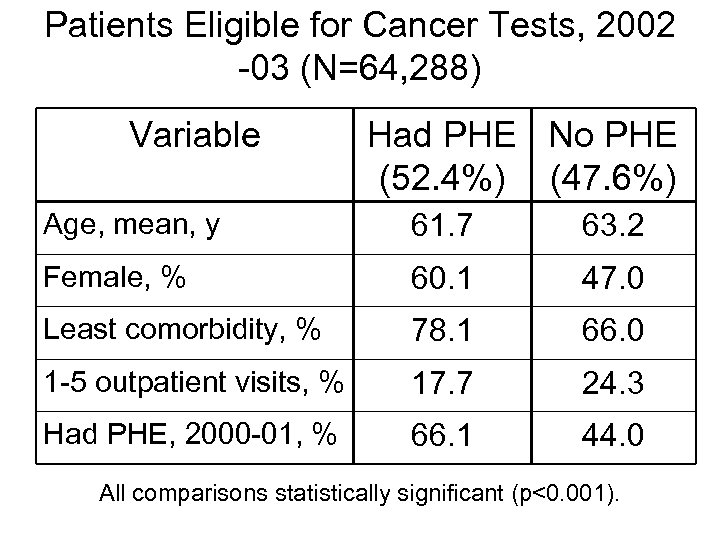 Patients Eligible for Cancer Tests, 2002 -03 (N=64, 288) Variable Had PHE No PHE (52. 4%) (47. 6%) Age, mean, y 61. 7 63. 2 Female, % 60. 1 47. 0 Least comorbidity, % 78. 1 66. 0 1 -5 outpatient visits, % 17. 7 24. 3 Had PHE, 2000 -01, % 66. 1 44. 0 All comparisons statistically significant (p<0. 001).
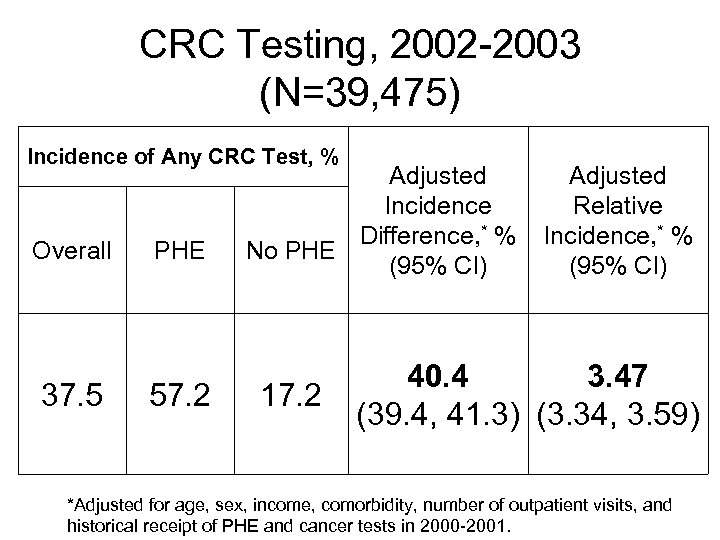 CRC Testing, 2002 -2003 (N=39, 475) Incidence of Any CRC Test, % Overall 37. 5 PHE 57. 2 Adjusted Incidence Difference, * % No PHE (95% CI) 17. 2 Adjusted Relative Incidence, * % (95% CI) 40. 4 3. 47 (39. 4, 41. 3) (3. 34, 3. 59) *Adjusted for age, sex, income, comorbidity, number of outpatient visits, and historical receipt of PHE and cancer tests in 2000 -2001.
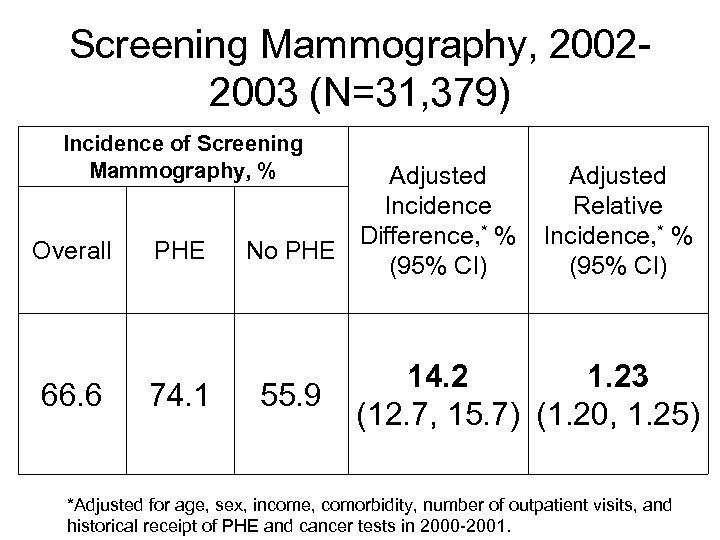 Screening Mammography, 20022003 (N=31, 379) Incidence of Screening Mammography, % Overall 66. 6 PHE 74. 1 Adjusted Incidence Difference, * % No PHE (95% CI) 55. 9 Adjusted Relative Incidence, * % (95% CI) 14. 2 1. 23 (12. 7, 15. 7) (1. 20, 1. 25) *Adjusted for age, sex, income, comorbidity, number of outpatient visits, and historical receipt of PHE and cancer tests in 2000 -2001.
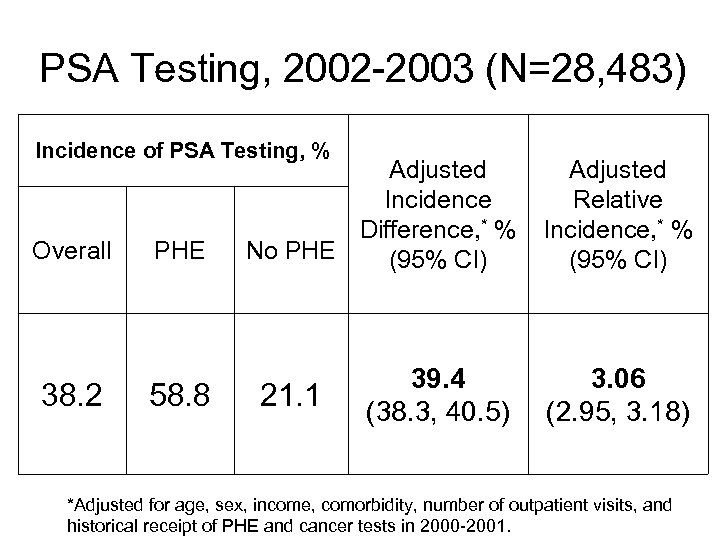 PSA Testing, 2002 -2003 (N=28, 483) Incidence of PSA Testing, % Overall 38. 2 PHE 58. 8 Adjusted Incidence Difference, * % No PHE (95% CI) Adjusted Relative Incidence, * % (95% CI) 39. 4 (38. 3, 40. 5) 3. 06 (2. 95, 3. 18) 21. 1 *Adjusted for age, sex, income, comorbidity, number of outpatient visits, and historical receipt of PHE and cancer tests in 2000 -2001.
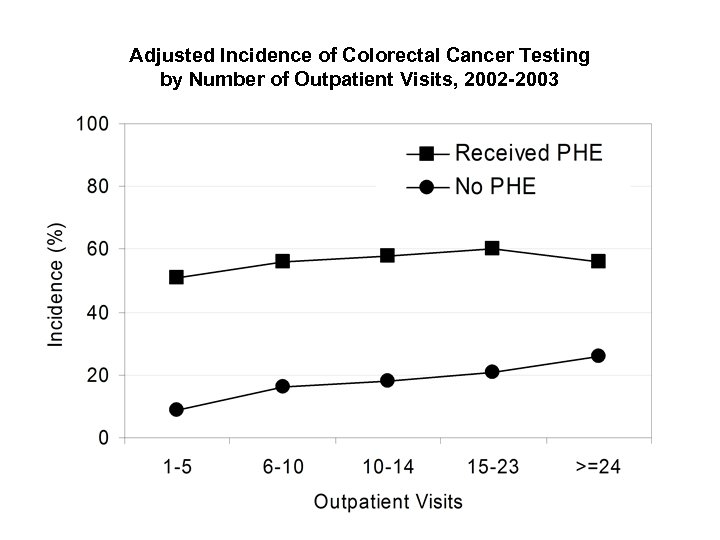 Adjusted Incidence of Colorectal Cancer Testing by Number of Outpatient Visits, 2002 -2003
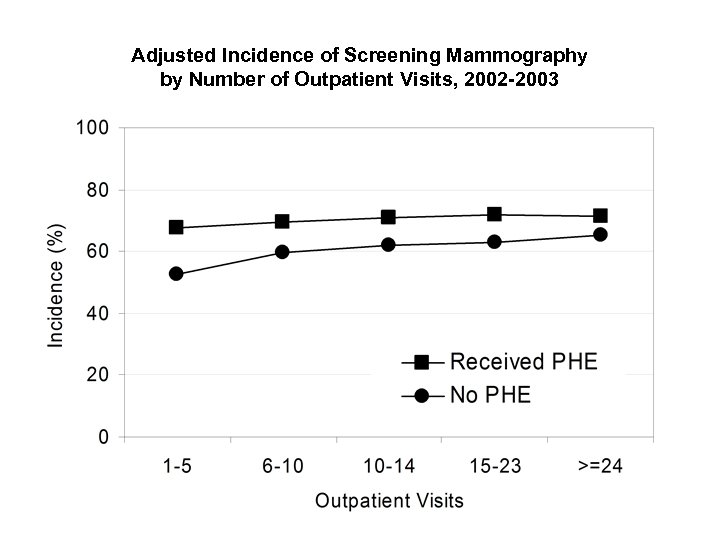 Adjusted Incidence of Screening Mammography by Number of Outpatient Visits, 2002 -2003
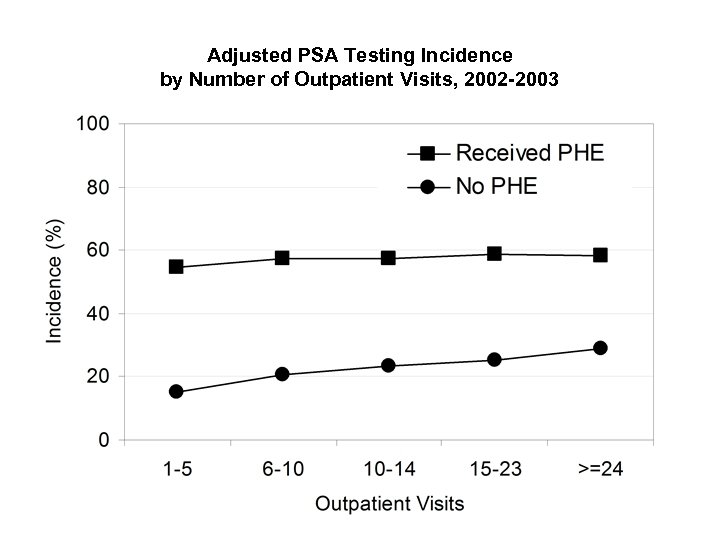 Adjusted PSA Testing Incidence by Number of Outpatient Visits, 2002 -2003
 Other Subgroups • PHE similarly associated with cancer testing among: – Men and women eligible for CRC testing – All age groups – All comorbidity categories
 Summary of Findings • Preventive exam (PHE) strongly associated with cancer testing in a population-based sample with confirmed eligibility • Substantial association even among patients with many other opportunities for screening promotion
 Source of the Association • “Prevention orientation” of patients who receive PHEs • PHE may be an opportunity to discuss and recommend cancer screening • Physicians’ recommendation strongly associated with cancer screening
 Comparing Different Cancer Tests • CRC and PSA testing – Overall incidence similar – PHE strongly associated with both • Mammography – Population-based screening program – PHE less strongly associated with mammography
 Limitations • Uncertain validity of PHE measure • Potential confounding (e. g. , patient attitudes or beliefs) • Uncertain generalizability
 Implications • PHE may contribute to populationbased cancer screening • PHE strongly associated with cancer screening even among patients with many other screening opportunities • Raises questions about the total content of PHEs
 Conclusions • PHE may serve as a clinically important forum for promotion of cancer screening in similar populations • Research needed to: – Elucidate ideal content of PHEs – Develop interventions to improve the PHE in actual clinical practice
 Acknowledgments • Supported by the American Cancer Society and the National Cancer Institute • Laura-Mae Baldwin, Yong Cai, Noel Weiss, Joann Elmore, Michael Von Korff, Robert Reid, and Peter Franks