


 Скачать презентацию Delivering Climate Information to Farmers Agronomic and Economic
beb7b076a7c15321a866d9fc16629ed2.ppt
- Количество слайдов: 37
 Delivering Climate Information to Farmers: Agronomic and Economic Impacts on Corn Production Systems in Isabela, Philippines Felino P. Lansigan University of the Philippines Los Baños (UPLB) e-mail: fpl@instat. uplb. edu. ph William L. Delos Santos University of the Philippines Los Baños (UPLB) James W. Hansen International Institute for Climate Prediction (IRI)
 Outline of Presentation Analysis of the linkages between climate information, and farm-level decision-making in corn production systems in Isabela, Philippines Demonstration of the agronomic and economic impacts of advanced climate information on corn production systems in Isabela, Philippines Challenges and issues in delivering climate information for corn production and crop forecasting systems Concluding remarks
 Climate and Corn Production Weather and climate affect crop growth and yield. Climate information influenced corn production activities and decisions e. g. planting period, date of fertilization, irrigation, etc. Corn farmers have developed through time management practices and adaptation measures to cope up with climate variability. Perceptions of corn farmers and agricultural extension workers on climate information and seasonal climate forecast have influenced their farm activities in corn production.
 Objectives of Case Study • Determine the perceptions of corn farmers in Isabela, Philippines on climate information, seasonal climate forecasts, and farm activities. • Analyze the linkages of climate information on farm-level decisions in corn production systems. • Evaluate the agronomic and economic impacts of advanced climate information on corn production.
 Description of Case Study Site Isabela Province - Located northeast of the Philippines - No pronounced dry or wet season but relatively dry during first half of year, and wet during the second half. - Annual rainfall: 1844 mm. ; Mean Temperature - 29 o Celsius; RH - 66%; Along the typhoon path - Top corn-producing province (about 17% of total production) - Corn grown in lowland, upland, and riverine or floodplains - Wet season cropping: May - August/September (corn crop) Dry season cropping: Oct/Nov - February (corn)
![Isabela* Rainfall Normals [in mm]](https://present5.com/presentation/beb7b076a7c15321a866d9fc16629ed2/image-6.jpg "Isabela* Rainfall Normals [in mm]") Isabela* Rainfall Normals [in mm]
Isabela* Rainfall Normals [in mm]
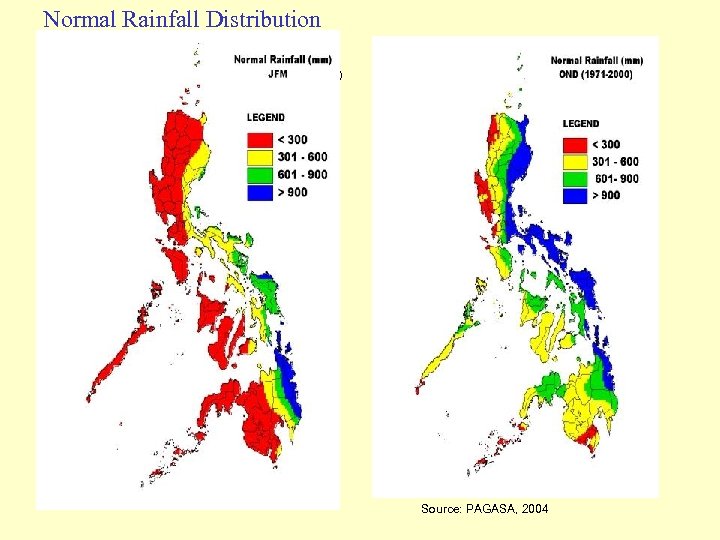 Normal Rainfall Distribution (1971 -2000) Source: PAGASA, 2004
 Case study sites Municipality of Naguilian, Isabela Low-lying , flood-prone areas near the Cagayan River. Land area: 170 km 2 ; Elevation: 40 masl Population: 26, 131 Municipality of Benito Soliven, Isabela Upland corn areas in mountainous regions Land area: 187 km 2 ; Elevation: 98 masl Population: 22, 146
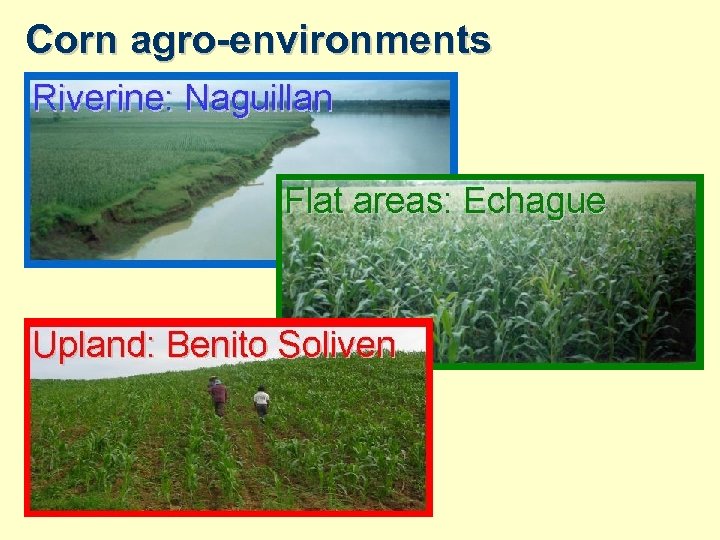 Corn agro-environments
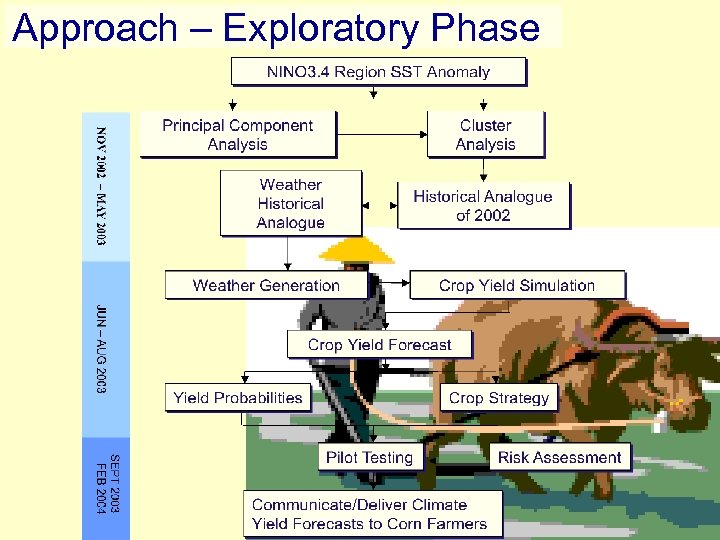 Approach – Exploratory Phase
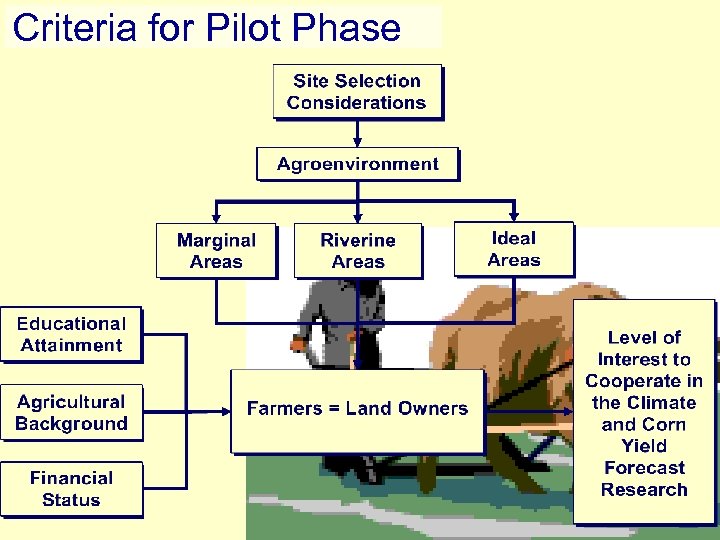
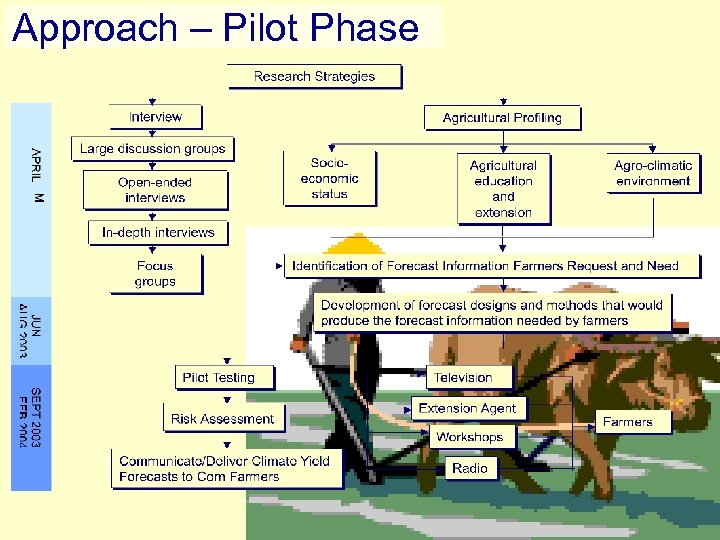 Approach – Pilot Phase
 Analysis of Links among Corn Production, Climate Information and Farm-level Decision-making Farmers’ perceptions on the effects of climatic events (El Niño and La Niña) on corn production Sources of climate information Impacts of seasonal climate information on decision-making Climate information important in corn production Effective medium for communicating climate forecast information
 Analysis of Links among Corn Production, Climate Information and Decision-making …. Continued Data Collection: Personal interviews Structured survey questionnaire Respondents: 60 corn farmers + 40 agricultural extension workers from Naguilian and Benito Soliven
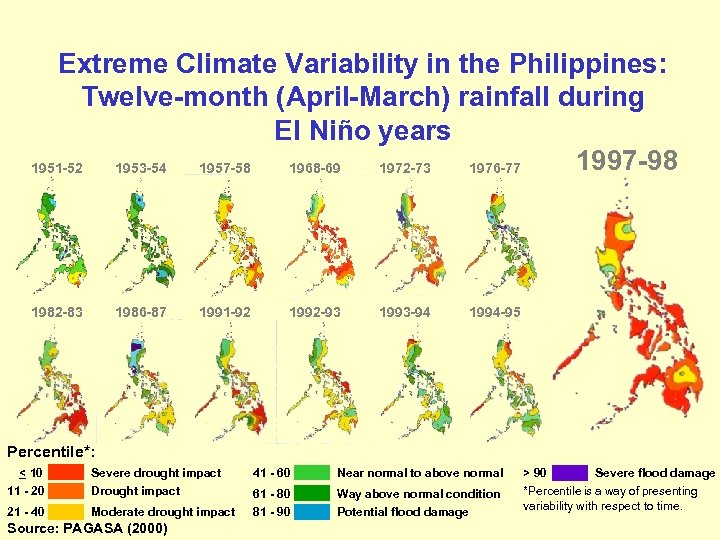 Extreme Climate Variability in the Philippines: Twelve-month (April-March) rainfall during El Niño years 1997 -98 1951 -52 1953 -54 1957 -58 1968 -69 1972 -73 1976 -77 1982 -83 1986 -87 1991 -92 1992 -93 1993 -94 1994 -95 Percentile*: < 10 11 - 20 Severe drought impact Drought impact 21 - 40 Moderate drought impact Source: PAGASA (2000) 41 - 60 Near normal to above normal > 90 Severe flood damage 61 - 80 81 - 90 Way above normal condition Potential flood damage *Percentile is a way of presenting variability with respect to time.
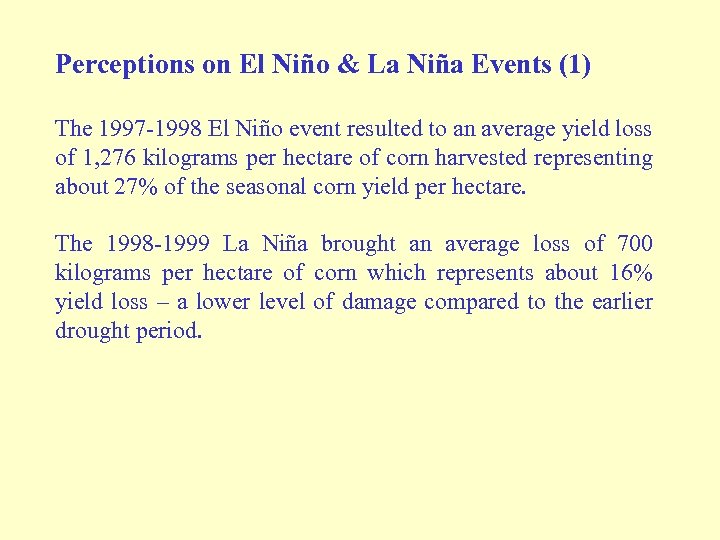 Perceptions on El Niño & La Niña Events (1) The 1997 -1998 El Niño event resulted to an average yield loss of 1, 276 kilograms per hectare of corn harvested representing about 27% of the seasonal corn yield per hectare. The 1998 -1999 La Niña brought an average loss of 700 kilograms per hectare of corn which represents about 16% yield loss – a lower level of damage compared to the earlier drought period.
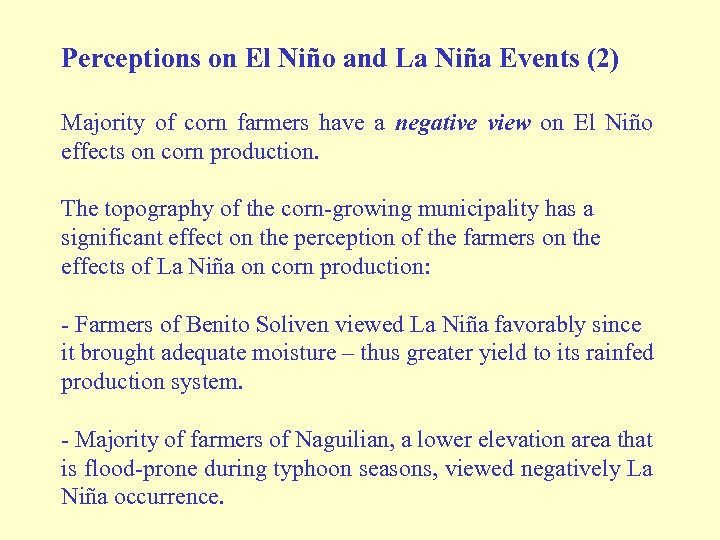 Perceptions on El Niño and La Niña Events (2) Majority of corn farmers have a negative view on El Niño effects on corn production. The topography of the corn-growing municipality has a significant effect on the perception of the farmers on the effects of La Niña on corn production: - Farmers of Benito Soliven viewed La Niña favorably since it brought adequate moisture – thus greater yield to its rainfed production system. - Majority of farmers of Naguilian, a lower elevation area that is flood-prone during typhoon seasons, viewed negatively La Niña occurrence.
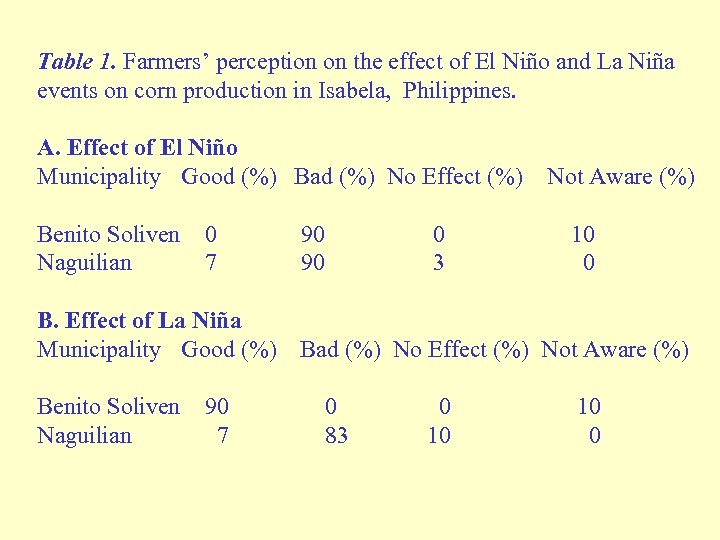 Table 1. Farmers’ perception on the effect of El Niño and La Niña events on corn production in Isabela, Philippines. A. Effect of El Niño Municipality Good (%) Bad (%) No Effect (%) Benito Soliven Naguilian 0 7 B. Effect of La Niña Municipality Good (%) Benito Soliven Naguilian 90 7 90 90 0 3 Not Aware (%) 10 0 Bad (%) No Effect (%) Not Aware (%) 0 83 0 10 10 0
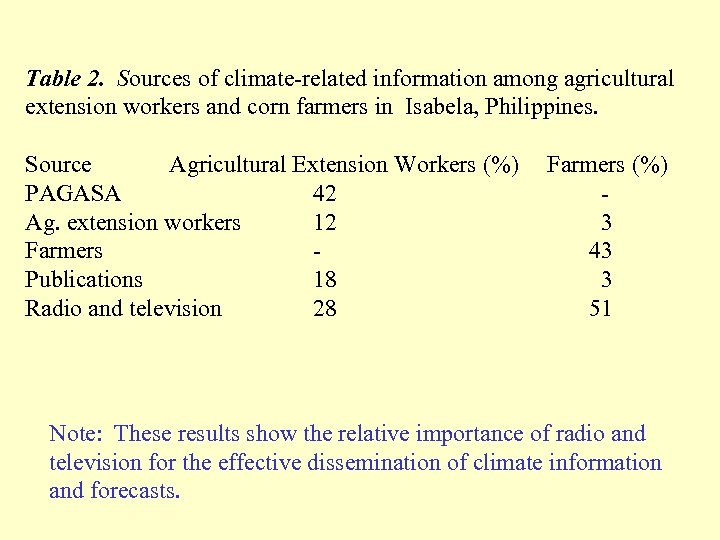 Table 2. Sources of climate-related information among agricultural extension workers and corn farmers in Isabela, Philippines. Source Agricultural Extension Workers (%) PAGASA 42 Ag. extension workers 12 Farmers Publications 18 Radio and television 28 Farmers (%) 3 43 3 51 Note: These results show the relative importance of radio and television for the effective dissemination of climate information and forecasts.
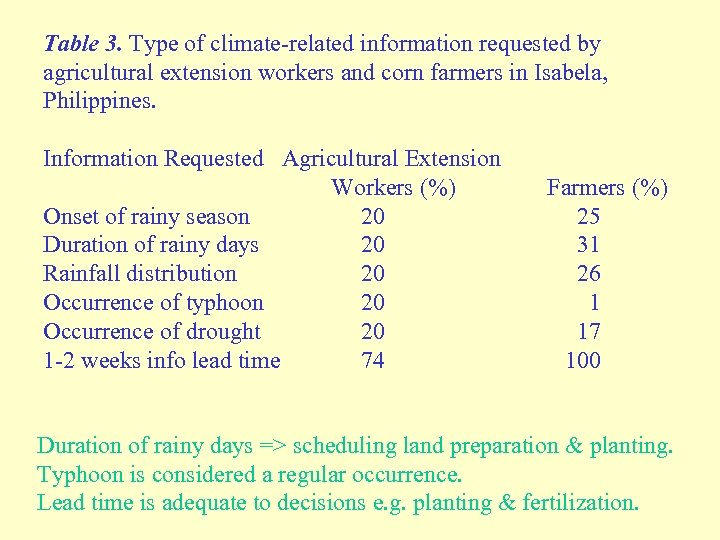 Table 3. Type of climate-related information requested by agricultural extension workers and corn farmers in Isabela, Philippines. Information Requested Agricultural Extension Workers (%) Onset of rainy season 20 Duration of rainy days 20 Rainfall distribution 20 Occurrence of typhoon 20 Occurrence of drought 20 1 -2 weeks info lead time 74 Farmers (%) 25 31 26 1 17 100 Duration of rainy days => scheduling land preparation & planting. Typhoon is considered a regular occurrence. Lead time is adequate to decisions e. g. planting & fertilization.
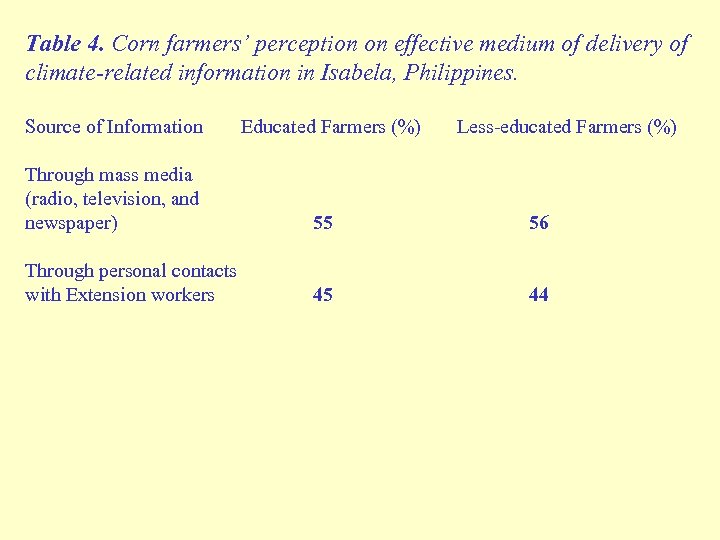 Table 4. Corn farmers’ perception on effective medium of delivery of climate-related information in Isabela, Philippines. Source of Information Educated Farmers (%) Less-educated Farmers (%) Through mass media (radio, television, and newspaper) 55 56 Through personal contacts with Extension workers 45 44
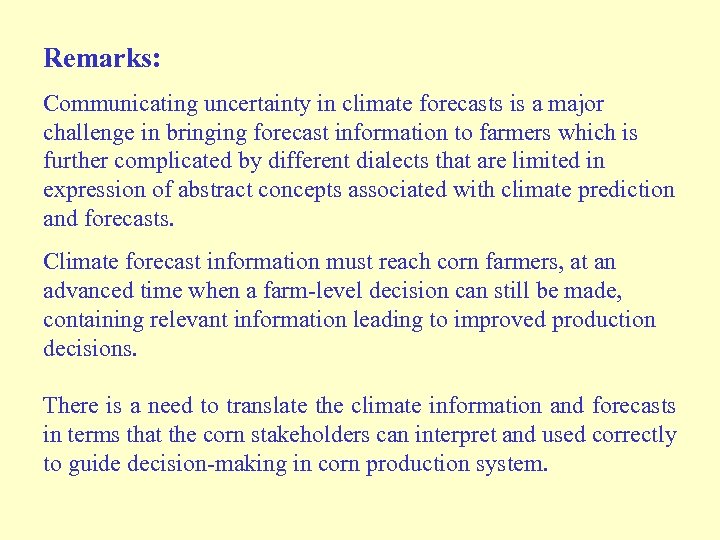 Remarks: Communicating uncertainty in climate forecasts is a major challenge in bringing forecast information to farmers which is further complicated by different dialects that are limited in expression of abstract concepts associated with climate prediction and forecasts. Climate forecast information must reach corn farmers, at an advanced time when a farm-level decision can still be made, containing relevant information leading to improved production decisions. There is a need to translate the climate information and forecasts in terms that the corn stakeholders can interpret and used correctly to guide decision-making in corn production system.
 Criteria for Pilot Phase
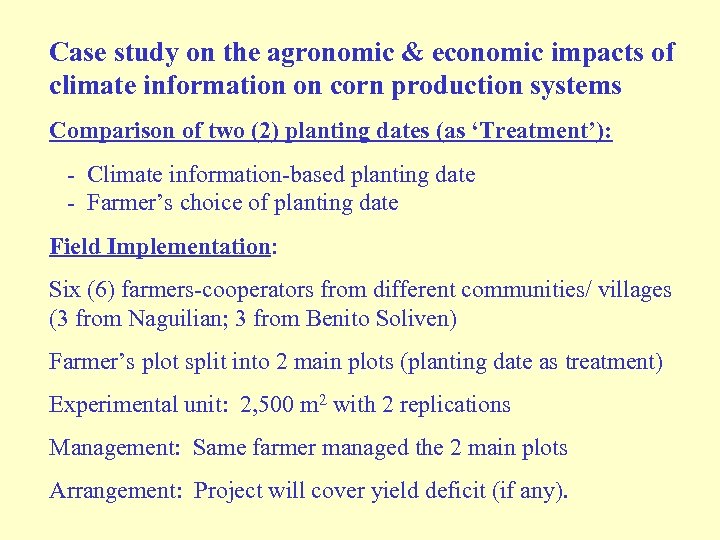 Case study on the agronomic & economic impacts of climate information on corn production systems Comparison of two (2) planting dates (as ‘Treatment’): - Climate information-based planting date - Farmer’s choice of planting date Field Implementation: Six (6) farmers-cooperators from different communities/ villages (3 from Naguilian; 3 from Benito Soliven) Farmer’s plot split into 2 main plots (planting date as treatment) Experimental unit: 2, 500 m 2 with 2 replications Management: Same farmer managed the 2 main plots Arrangement: Project will cover yield deficit (if any).
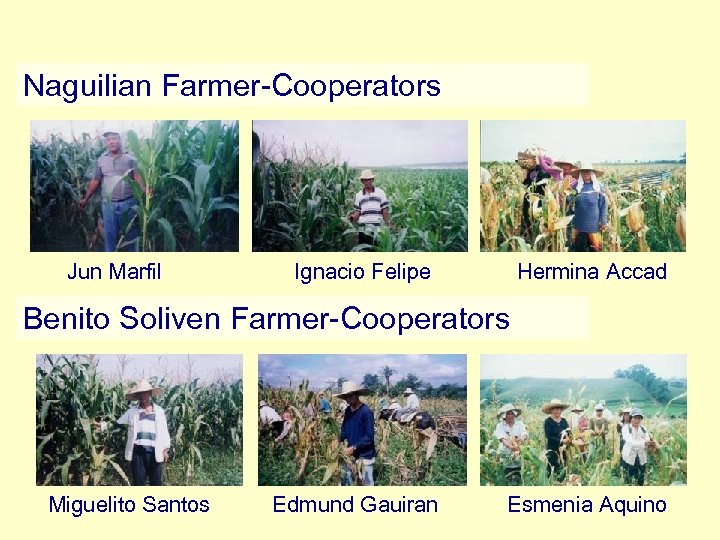 Naguilian Farmer-Cooperators Jun Marfil Ignacio Felipe Hermina Accad Benito Soliven Farmer-Cooperators Miguelito Santos Edmund Gauiran Esmenia Aquino
 Determining planting date recommendation for corn farmers in Isabela, Philippines Use the available historical rainfall data combined with statistical analysis to determine the distribution of the end of rainfall occurrence, and validate the planting date using crop simulation. The 42 -year monthly rainfall data of Isabela was classified as an El Nino, La Nina or Neutral year leading to the classification of the October 2003 -January 2004 corn cropping season as El Nino, La Nina or as Neutral season. The historical end of the rainfall occurrence for the October – January cropping season for the grouped years was then determined.
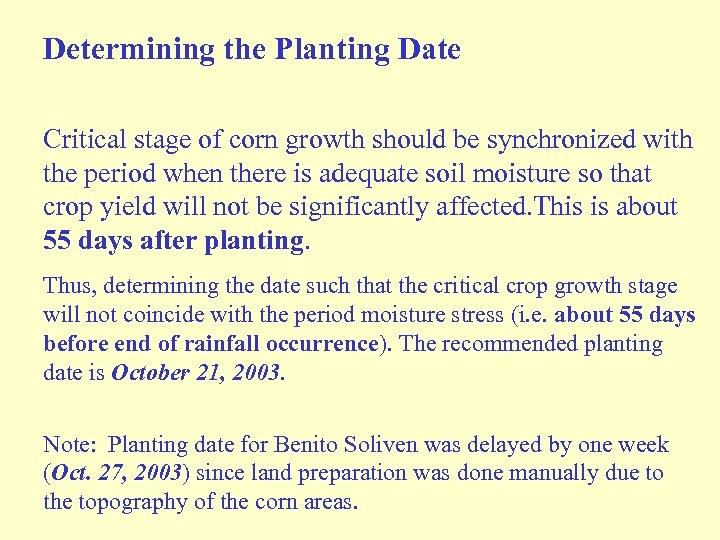 Determining the Planting Date Critical stage of corn growth should be synchronized with the period when there is adequate soil moisture so that crop yield will not be significantly affected. This is about 55 days after planting. Thus, determining the date such that the critical crop growth stage will not coincide with the period moisture stress (i. e. about 55 days before end of rainfall occurrence). The recommended planting date is October 21, 2003. Note: Planting date for Benito Soliven was delayed by one week (Oct. 27, 2003) since land preparation was done manually due to the topography of the corn areas.
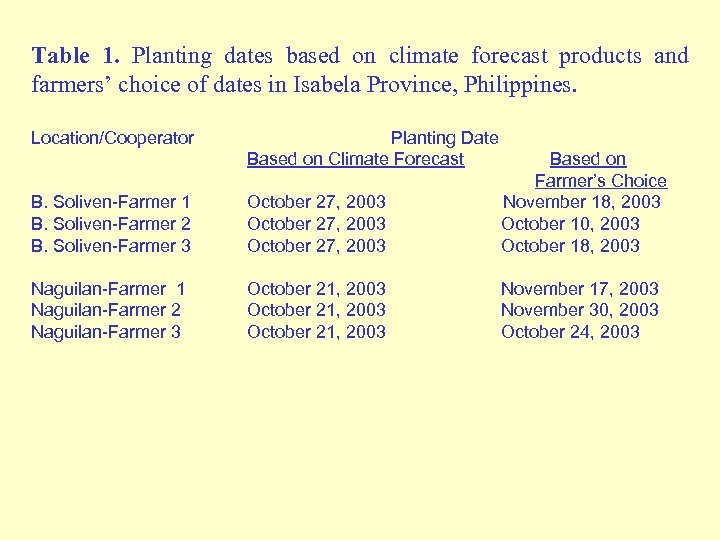 Table 1. Planting dates based on climate forecast products and farmers’ choice of dates in Isabela Province, Philippines. Location/Cooperator Planting Date Based on Climate Forecast B. Soliven-Farmer 1 B. Soliven-Farmer 2 B. Soliven-Farmer 3 October 27, 2003 Based on Farmer’s Choice November 18, 2003 October 10, 2003 October 18, 2003 Naguilan-Farmer 1 Naguilan-Farmer 2 Naguilan-Farmer 3 October 21, 2003 November 17, 2003 November 30, 2003 October 24, 2003
 Corn yield vs Planting dates
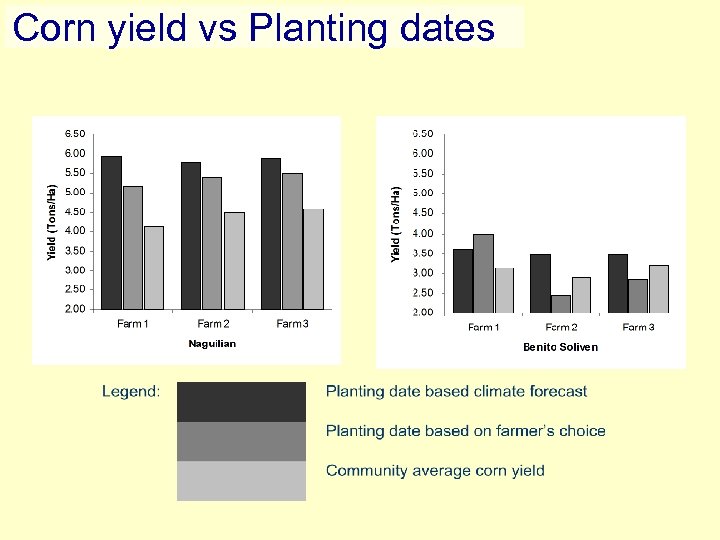
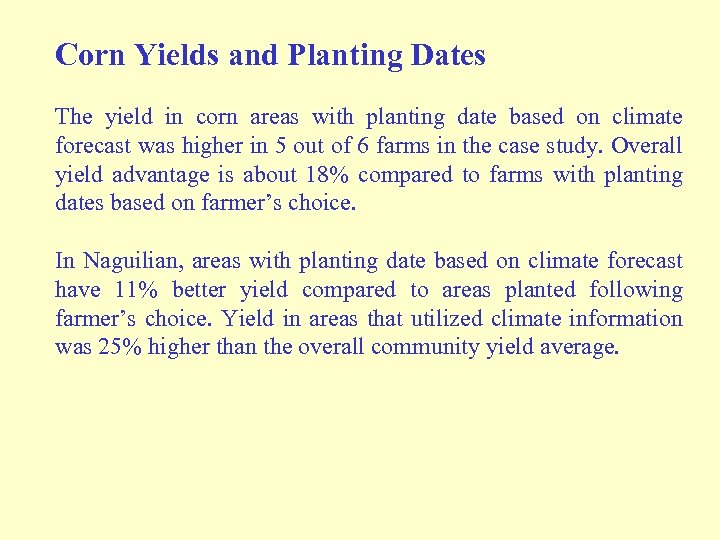 Corn Yields and Planting Dates The yield in corn areas with planting date based on climate forecast was higher in 5 out of 6 farms in the case study. Overall yield advantage is about 18% compared to farms with planting dates based on farmer’s choice. In Naguilian, areas with planting date based on climate forecast have 11% better yield compared to areas planted following farmer’s choice. Yield in areas that utilized climate information was 25% higher than the overall community yield average.
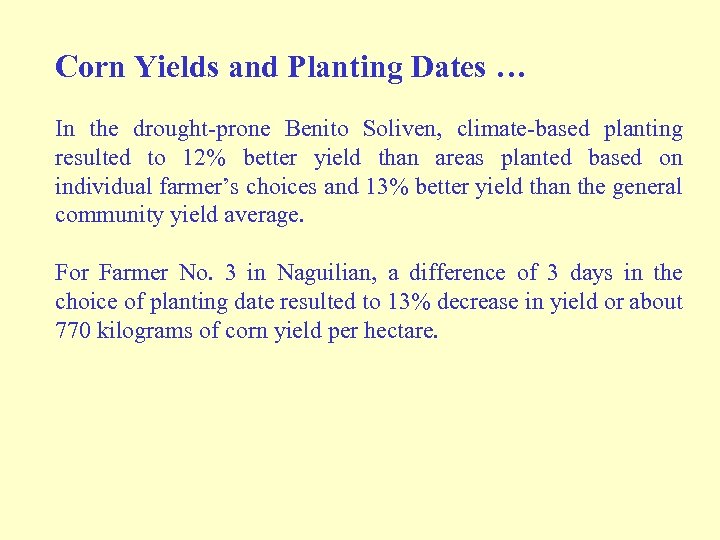 Corn Yields and Planting Dates … In the drought-prone Benito Soliven, climate-based planting resulted to 12% better yield than areas planted based on individual farmer’s choices and 13% better yield than the general community yield average. For Farmer No. 3 in Naguilian, a difference of 3 days in the choice of planting date resulted to 13% decrease in yield or about 770 kilograms of corn yield per hectare.
 Selling price and Harvest dates
 Net income vs Planting dates
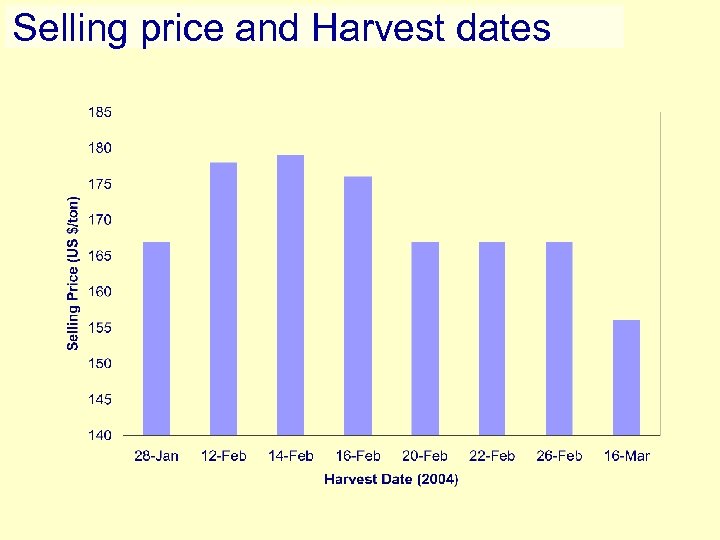
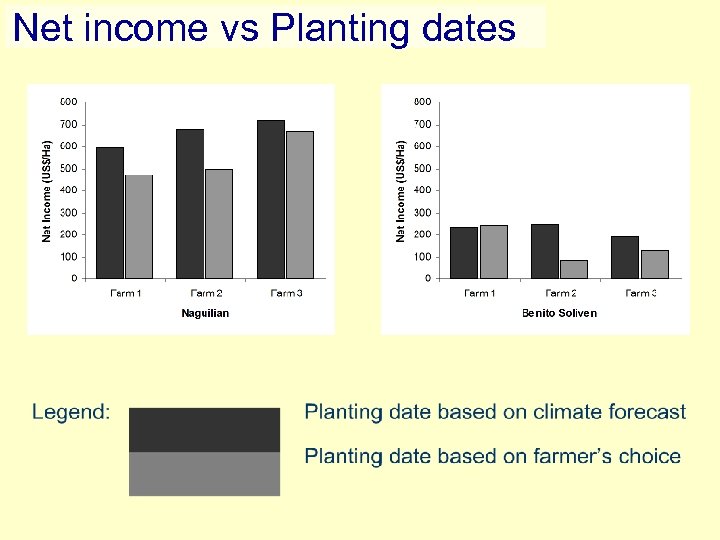
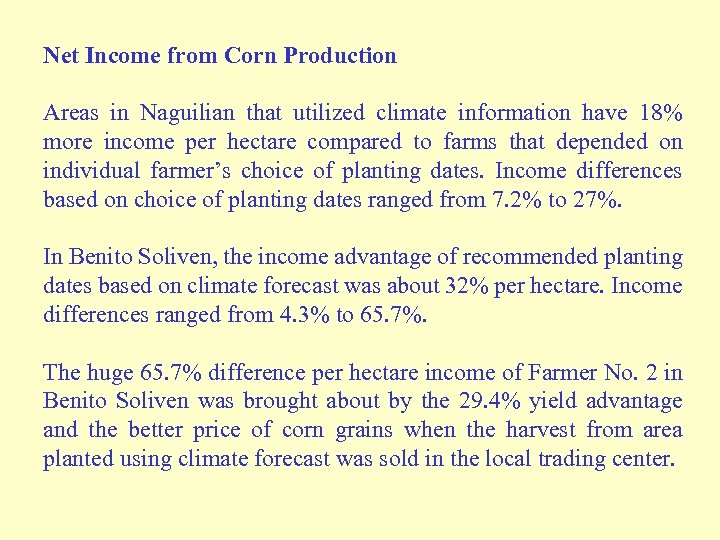 Net Income from Corn Production Areas in Naguilian that utilized climate information have 18% more income per hectare compared to farms that depended on individual farmer’s choice of planting dates. Income differences based on choice of planting dates ranged from 7. 2% to 27%. In Benito Soliven, the income advantage of recommended planting dates based on climate forecast was about 32% per hectare. Income differences ranged from 4. 3% to 65. 7%. The huge 65. 7% difference per hectare income of Farmer No. 2 in Benito Soliven was brought about by the 29. 4% yield advantage and the better price of corn grains when the harvest from area planted using climate forecast was sold in the local trading center.
 Conclusions For rainfed corn production systems in Isabela, the recommended planting date can be estimated by determining the historical end of the rainfall occurrence based on available climate data, and deducting from this period about 55 days to avoid water stress during the critical period of the reproductive stage from flowering until the end of grain formation. During wet season cropping, however, the use of climate information to determine the planting date may not be useful and practical as the crop will not experience significant water stress throughout its growing period since there is adequate soil moisture available. Moreover, wet season is also characterized by atmospheric disturbances due to typhoons with strong winds and heavy rainfall which may destroy the crops.
 Concluding Remarks Case study had demonstrated that corn farms that used climate information to determine the planting date obtained higher crop yields and higher net income compared to areas are planted based on farmers’ decision of planting date. These results showed that using advanced climate information in farm-level climate-related decisions in corn production system can lead to increased yield and farm income as well as minimize risks due to climate variability. Thus, it is worth the investment or consideration of climate forecast products in corn production and forecasting systems.
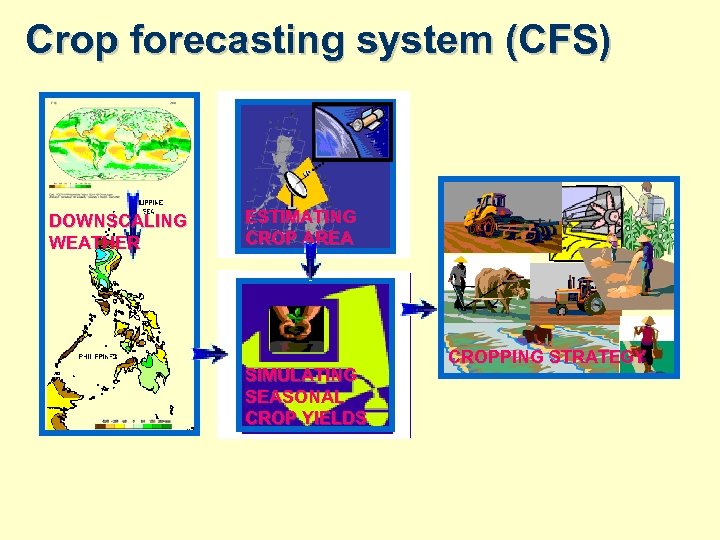 Crop forecasting system (CFS) DOWNSCALING WEATHER ESTIMATING CROP AREA SIMULATING SEASONAL CROP YIELDS CROPPING STRATEGY
 Thank you