


 Скачать презентацию DELAWARE S GROWTH MODEL FOR AYP DETERMINATIONS August 1
0868c824d5c81efa4c9b1e7bb6de05a3.ppt
- Количество слайдов: 28
 DELAWARE’S GROWTH MODEL FOR AYP DETERMINATIONS August 1, 2007
 AYP Performance for 2007 • AYP determination was based first on the Growth Model • If it met the target, then the school received an “Above” rating for AYP • If it did not meet AYP using the Growth Model, then the Original Model was used to see if the school made AYP
 AYP Performance – cont’d • If school made AYP using the Original Model, the school was assigned “Above” or “Meets” depending on whether or not confidence intervals, special education adjustment, or safe harbor were used • If the school did not make AYP in Growth or in Original, the “Below” designation from Growth is assigned and is used for school improvement status
 Background Information • Invitation for states to submit proposals to use a growth model • Pilot project – up to ten states • Model must demonstrate that it can raise student achievement and enhance school accountability • “Bright Line” principles of NCLB upheld • DE first submitted proposal in March 2006 – was denied • DE revised/resubmitted proposal September 2006 • USED approved for use in 2006 -07 with one condition – Cannot use Confidence Interval • Calculate AYP by growth and original models • Report both growth and original models
 Why did we submit? • To ensure more valid and reliable accountability determinations • To monitor various subgroups’ progress • To support our value of continuous improvement and longitudinal student growth
 What Growth Model did we propose? • Value Table Model – Maintains emphasis on performance levels (standards based achievement) – Values longitudinal individual student growth – Gives schools credit for moving students towards proficiency – Values growth especially below the standard
 Who chose Delaware’s model? • Committee of Stakeholders – – – Community members Parents Teachers District Administrators School Administrators
 How do value tables work? • Values are placed in a table to indicate points earned from growth one year to the next • Calculate the average growth value for the school and each subgroup in reading and math • Compare average growth to the target
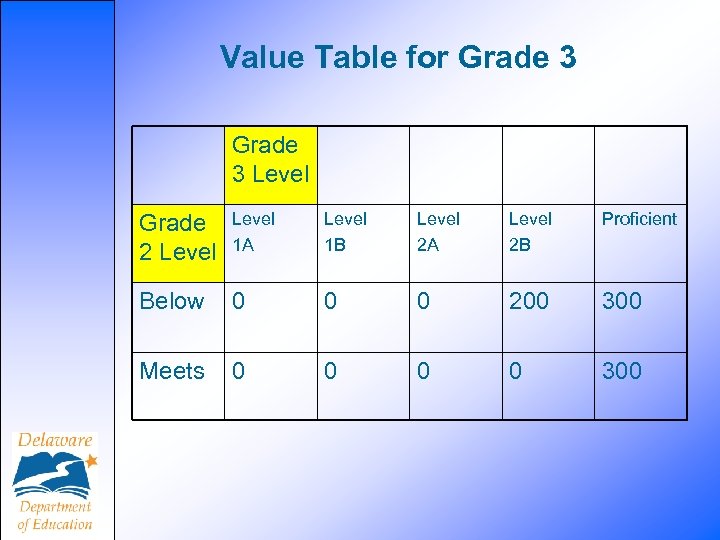 Value Table for Grade 3 Level Grade 2 Level 1 A Level 1 B Level 2 A Level 2 B Proficient Below 0 0 0 200 300 Meets 0 0 300
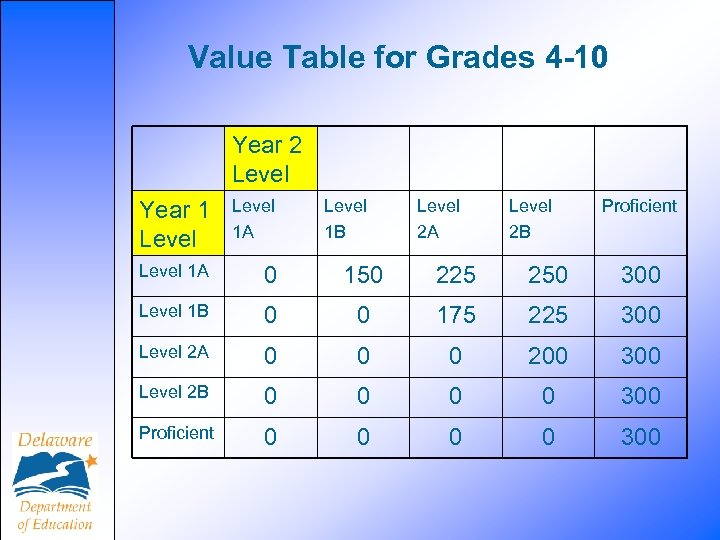 Value Table for Grades 4 -10 Year 2 Level Year 1 Level 1 A Level 1 B Level 2 A Level 2 B Proficient Level 1 A 0 150 225 250 300 Level 1 B 0 0 175 225 300 Level 2 A 0 0 0 200 300 Level 2 B 0 0 300 Proficient 0 0 300
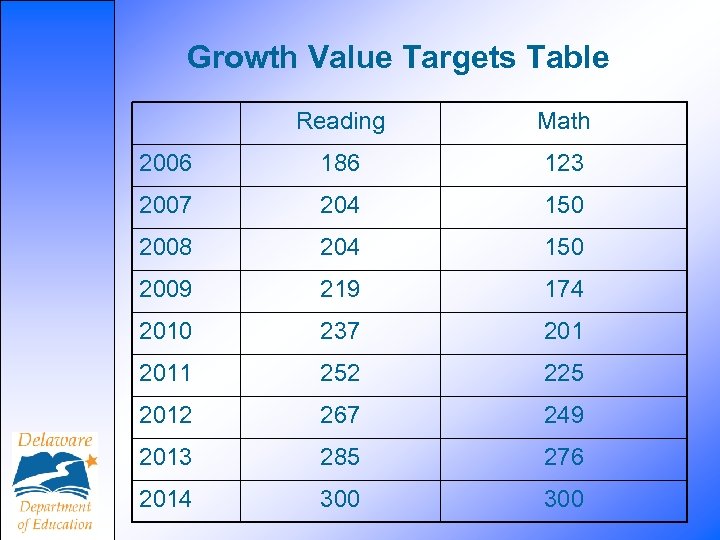 Growth Value Targets Table Reading Math 2006 186 123 2007 204 150 2008 204 150 2009 219 174 2010 237 2011 252 225 2012 267 249 2013 285 276 2014 300
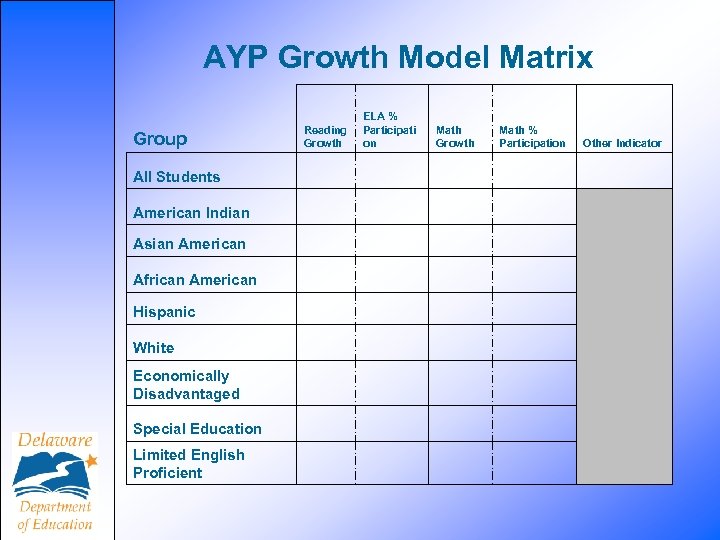 AYP Growth Model Matrix ELA % Participati on Math Growth Math % Participation Other Indicator All Students American Indian Asian American African American Hispanic White Economically Disadvantaged Special Education Limited English Proficient Group Reading Growth
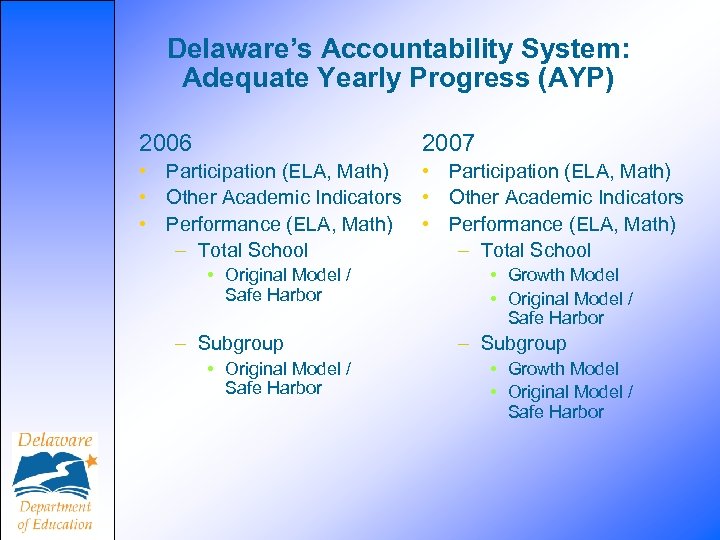 Delaware’s Accountability System: Adequate Yearly Progress (AYP) 2006 2007 • Participation (ELA, Math) • Other Academic Indicators • Performance (ELA, Math) – Total School • Original Model / Safe Harbor – Subgroup • Original Model / Safe Harbor • Growth Model • Original Model / Safe Harbor – Subgroup • Growth Model • Original Model / Safe Harbor
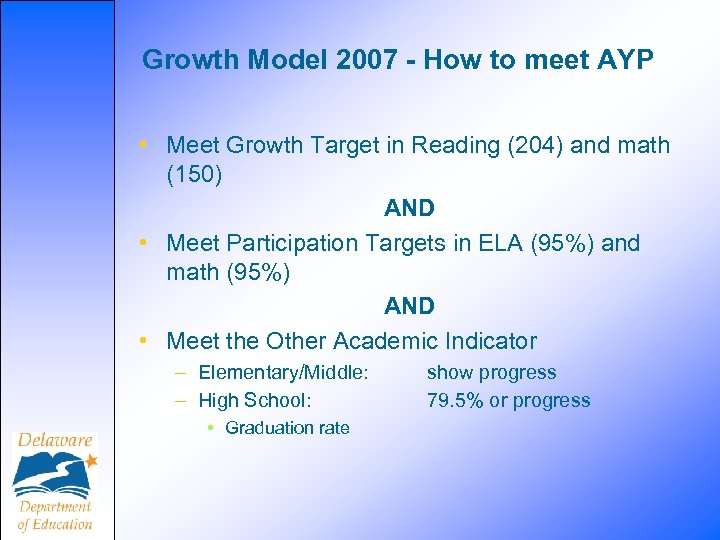 Growth Model 2007 - How to meet AYP • Meet Growth Target in Reading (204) and math (150) AND • Meet Participation Targets in ELA (95%) and math (95%) AND • Meet the Other Academic Indicator – Elementary/Middle: – High School: • Graduation rate show progress 79. 5% or progress
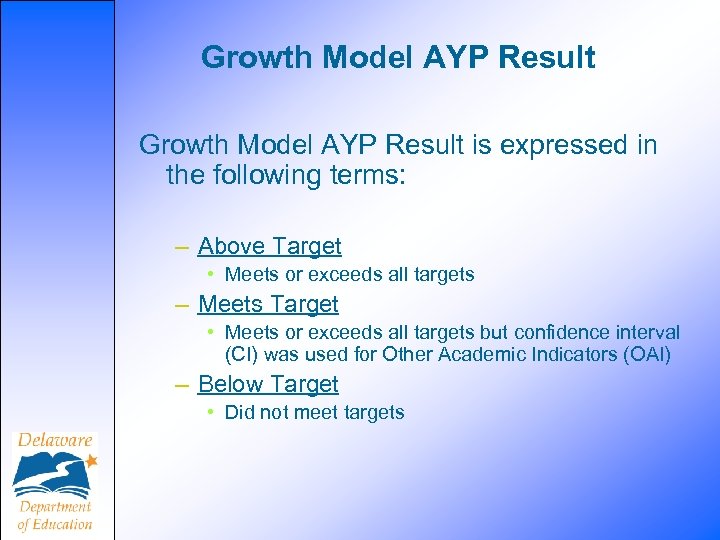 Growth Model AYP Result is expressed in the following terms: – Above Target • Meets or exceeds all targets – Meets Target • Meets or exceeds all targets but confidence interval (CI) was used for Other Academic Indicators (OAI) – Below Target • Did not meet targets
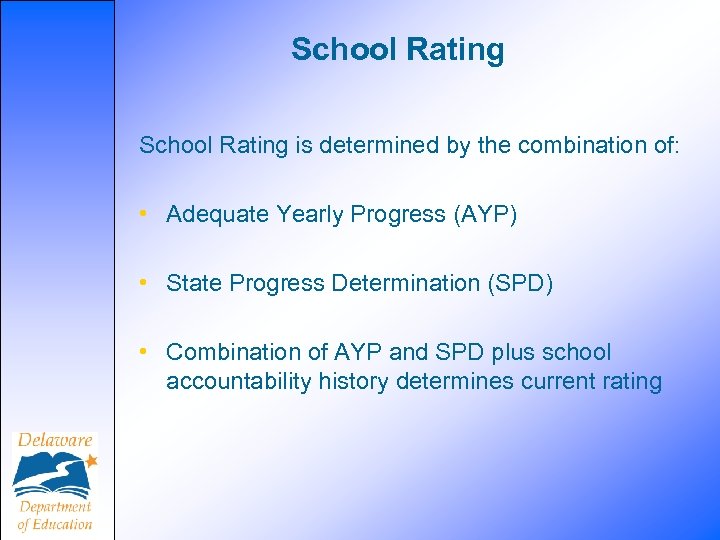 School Rating is determined by the combination of: • Adequate Yearly Progress (AYP) • State Progress Determination (SPD) • Combination of AYP and SPD plus school accountability history determines current rating
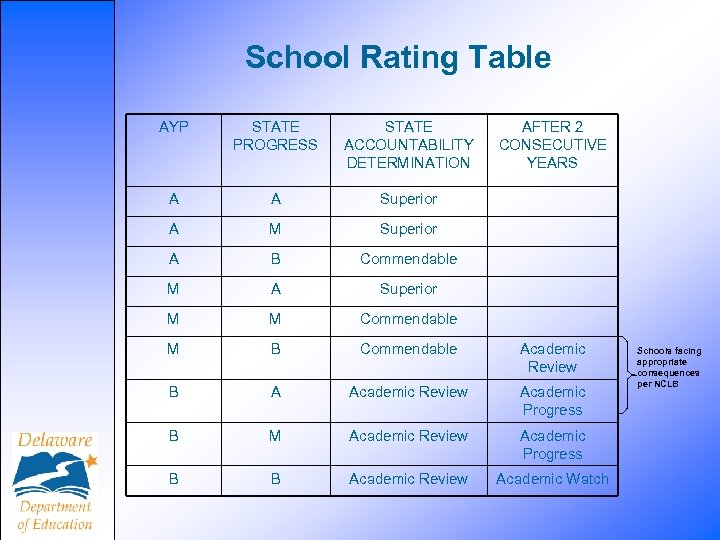 School Rating Table AYP STATE PROGRESS STATE ACCOUNTABILITY DETERMINATION AFTER 2 CONSECUTIVE YEARS A A Superior A M Superior A B Commendable M A Superior M M Commendable M B Commendable Academic Review B A Academic Review Academic Progress B M Academic Review Academic Progress B B Academic Review Academic Watch Schools facing appropriate consequences per NCLB
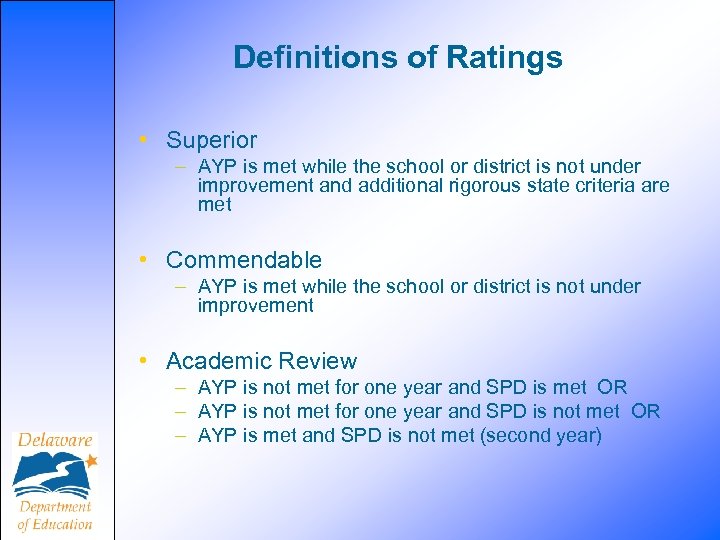 Definitions of Ratings • Superior – AYP is met while the school or district is not under improvement and additional rigorous state criteria are met • Commendable – AYP is met while the school or district is not under improvement • Academic Review – AYP is not met for one year and SPD is met OR – AYP is not met for one year and SPD is not met OR – AYP is met and SPD is not met (second year)
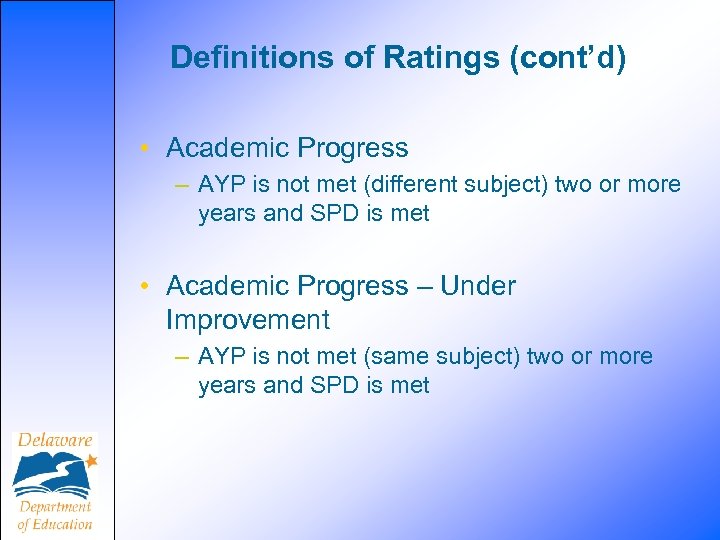 Definitions of Ratings (cont’d) • Academic Progress – AYP is not met (different subject) two or more years and SPD is met • Academic Progress – Under Improvement – AYP is not met (same subject) two or more years and SPD is met
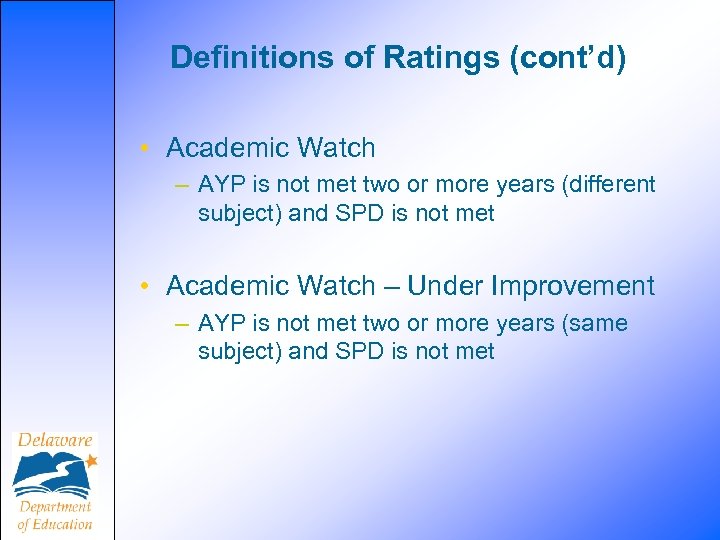 Definitions of Ratings (cont’d) • Academic Watch – AYP is not met two or more years (different subject) and SPD is not met • Academic Watch – Under Improvement – AYP is not met two or more years (same subject) and SPD is not met
 How to be Classified as “Under School Improvement” • Two consecutive years not meeting AYP targets in same area • • Participation Other Academic Indicator ELA/Reading Math
 How to Move Out of “Under School Improvement” • Two consecutive years of meeting AYP targets in all areas • • Participation Other Academic Indicator ELA/Reading Math
 Rewards and Sanctions • Sanctions & rewards for Title I and non-Title I schools closely aligned • Sanctions only apply when classified as Under Improvement
 Consequences of being Under Improvement for Title I Schools • 1 year = school implements choice • 2 years = school offers choice and provides supplemental services • 3 years = same as year 2 plus school is subject to corrective action • 4 years = same as year 3 plus school develops a plan for restructuring • 5 years = same as year 2 plus school implements the restructuring plan
 Consequences of being Under Improvement for Non-Title I Schools • 1 year = review and modify School Improvement Plan (SIP) • 2 years = same as year 1; provide additional priority to subgroups that did not meet target • 3 years = same as year 2; school subject to corrective action • 4 years = same as year 3 plus school develops plan for restructuring • 5 years = same as year 2 plus school implements restructuring plan
 School Accountability Ratings • Released on DOE website 8/1/07 (www. doe. k 12. de. us) • Specific data by school
 District Accountability Ratings Will be released Fall 2007 Will include specific data by district
 Contact Information • Robin Taylor – rtaylor@doe. k 12. de. us – 735 -4080 • Joanne Reihm – jreihm@doe. k 12. de. us – 735 -4090 • Terry Anderson – tanderson@doe. k 12. de. us – 735 -4140 • DOE web site www. doe. k 12. de. us/aab