


 Скачать презентацию Definitions and Content of Field z Electronic Commerce
fd6ff0d36751c26dcb1e195b401989e8.ppt
- Количество слайдов: 32
 Definitions and Content of Field z. Electronic Commerce (EC) is where business transactions take place via telecommunications networks, especially the Internet. y. Electronic commerce describes the buying and selling of products, services, and information via computer networks including the Internet. y. The infrastructure for EC is a networked computing environment in business, home, and government. y. E-Business describes the broadest definition of EC. It includes customer service and intrabusiness tasks. It is frequently used interchangeably with EC. CKFarn 1
 Definitions and Content of Field (cont. ) y. A global networked environment is known as the Internet y. A counterpart within organizations, is called an intranet y. An extranet extends intranets so that they can be accessed by business partners. CKFarn 2
 Pure Vs. Partial Electronic Commerce y. Three dimensions xthe product (service) sold [physical / digital]; xthe process [physical / digital] xthe delivery agent (or intermediary) [physical / digital] y. Traditional commerce xall dimensions are physical y. Pure EC xall dimensions are digital y. Partial EC xall other possibilities include a mix of digital and physical dimensions CKFarn 3
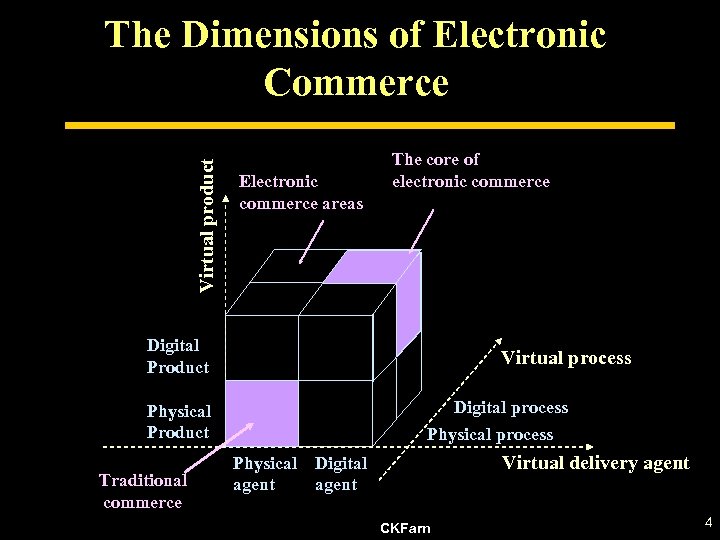 Virtual product The Dimensions of Electronic Commerce Electronic commerce areas The core of electronic commerce Digital Product Virtual process Digital process Physical Product Traditional commerce Physical agent Virtual delivery agent Digital agent CKFarn 4
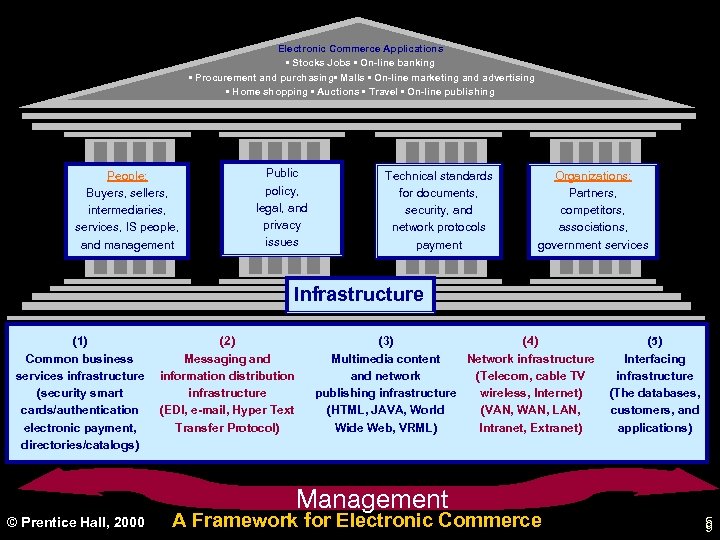 Electronic Commerce Applications • Stocks Jobs • On-line banking • Procurement and purchasing • Malls • On-line marketing and advertising • Home shopping • Auctions • Travel • On-line publishing People: Buyers, sellers, intermediaries, services, IS people, and management Public policy, legal, and privacy issues Technical standards for documents, security, and network protocols payment Organizations: Partners, competitors, associations, government services Infrastructure (1) Common business services infrastructure (security smart cards/authentication electronic payment, directories/catalogs) (2) Messaging and information distribution infrastructure (EDI, e-mail, Hyper Text Transfer Protocol) (3) (4) Multimedia content Network infrastructure and network (Telecom, cable TV publishing infrastructure wireless, Internet) (HTML, JAVA, World (VAN, WAN, LAN, Wide Web, VRML) Intranet, Extranet) (5) Interfacing infrastructure (The databases, customers, and applications) Management © Prentice Hall, 2000 A Framework for Electronic Commerce 5 9
 Electronic Markets y. A market is a network of interactions and relationships where information, products, services, and payments are exchanged. y. The market handles all the necessary transactions. y. An electronic market is a place where shoppers and sellers meet electronically. y. In electronic markets, sellers and buyers negotiate, submit bids, agree on an order, and finish the execution on- or off-line. CKFarn 6
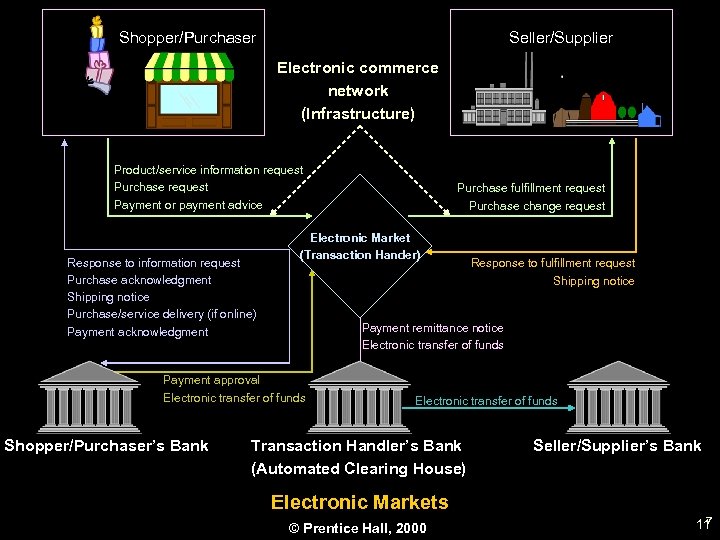 Shopper/Purchaser Seller/Supplier Electronic commerce network (Infrastructure) Product/service information request Purchase request Payment or payment advice Response to information request Purchase acknowledgment Shipping notice Purchase/service delivery (if online) Payment acknowledgment Electronic Market (Transaction Hander) Response to fulfillment request Shipping notice Payment remittance notice Electronic transfer of funds Payment approval Electronic transfer of funds Shopper/Purchaser’s Bank Purchase fulfillment request Purchase change request Electronic transfer of funds Transaction Handler’s Bank (Automated Clearing House) Seller/Supplier’s Bank Electronic Markets © Prentice Hall, 2000 7 11
 Interorganization Information Systems y. An interorganizational information system (IOS) involves information flow among two or more organizations. y. Its major objective is efficient routine transaction processing, such as transmitting orders, bills, and payments using EDI or extranets. y. Scope: An IOS is a unified system encompassing two or several business partners. y. A typical IOS includes a company and its suppliers and/or customers. CKFarn 8
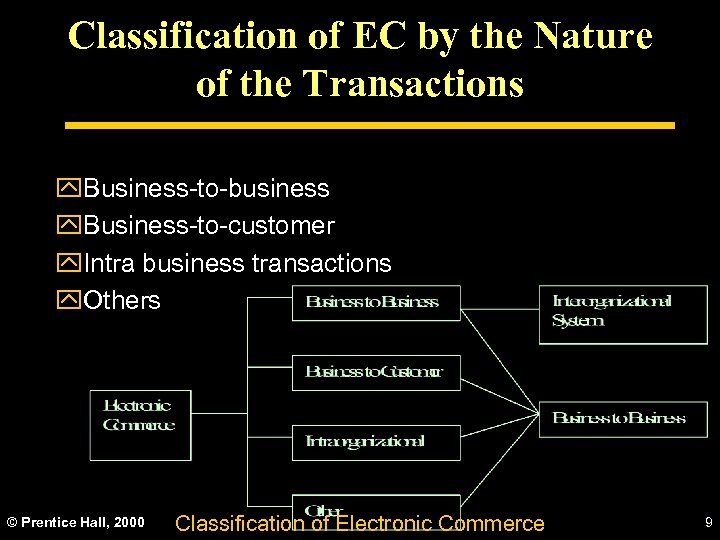 Classification of EC by the Nature of the Transactions y. Business-to-business y. Business-to-customer y. Intra business transactions y. Others © Prentice Hall, 2000 Classification of Electronic Commerce CKFarn 9
 Benefits to Customers y. Enables customers to shop or do other transactions 24 hours a day, all year round from almost any location y. Provides customers with more choices y. Provides customers with less expensive products and services by allowing them to shop in many places and conduct quick comparisons y. Allows quick delivery of products and services in some cases, especially with digitized products CKFarn 10
 Benefits to Customers (cont. ) y. Customers can receive relevant and detailed information in seconds, rather than in days or weeks y. Makes it possible to participate in virtual auctions y. Allows customers to interact with other customers in electronic communities and exchange ideas as well as compare experiences y. Electronic commerce facilitates competition, which results in substantial discounts. CKFarn 11
 Benefits to Society y. Enables more individuals to work at home, and to do less traveling for shopping, resulting in less traffic on the roads, and lower air pollution y. Allows some merchandise to be sold at lower prices benefiting the poor ones y. Enables people in Third World countries and rural areas to enjoy products and services which otherwise are not available to them y. Facilitates delivery of public services at a reduced cost, increases effectiveness, and/or improves quality CKFarn 12
 The Limitations of Electronic Commerce z. Technical Limitations of Electronic Commerce y. Lack of sufficient system’s security, reliability, standards, and communication protocols y. Insufficient telecommunication bandwidth y. The software development tools are still evolving and changing rapidly y. Difficulties in integrating the Internet and electronic commerce software with some existing applications and databases CKFarn 13
 Technical Limitations of Electronic Commerce (cont. ) y. The need for special Web servers and other infrastructures, in addition to the network servers (additional cost) y. Possible problems of interoperability, meaning that some EC software does not fit with some hardware, or is incompatible with some operating systems or other components CKFarn 14
 Non-Technical Limitations y. Cost and justification (35% of the respondents) x. The cost of developing an EC in house can be very high, and mistakes due to lack of experience, may result in delays. There are many opportunities for outsourcing, but where and how to do it is not a simple issue. Furthermore, to justify the system one needs to deal with some intangible benefits which are difficult to quantify. CKFarn 15
 Non-Technical Limitations (cont. ) y. Security and Privacy (17% of the respondents) x. These issues are especially important in the B 2 C area, and security concerns are not truly so serious from a technical standpoint. Privacy measures are constantly improving too. Yet, the customers perceive these issues as very important and therefore the EC industry has a very long and difficult task of convincing customers that online transactions and privacy are, in fact, fairly secure. y. Lack of trust and user resistance (4%) x. Customers do not trust an unknown faceless seller, paperless transactions, and electronic money. So switching from a physical to a virtual store may be difficult. CKFarn 16
 Non-Technical Limitations (cont. ) y. Other limiting factors are: x. Lack of touch and feel online x. Many unresolved legal issues x. Rapidly evolving and changing EC x. Lack of support services x. Insufficiently large enough number of sellers and buyers x. Breakdown of human relationships x. Expensive and/or inconvenient accessibility to the Internet CKFarn 17
 The Driving Forces of Electronic Commerce z. The New World of Business y. Business pressures y. Organizational responses y. The role of Information Technology (including electronic commerce) CKFarn 18
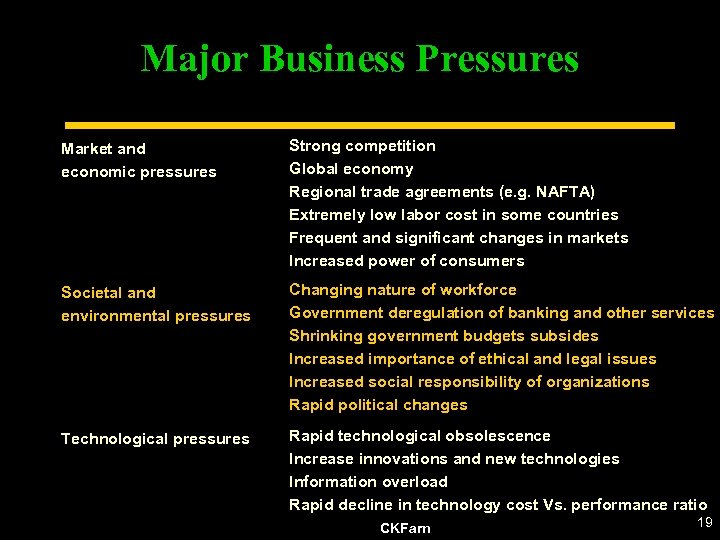 Major Business Pressures Market and economic pressures Strong competition Global economy Regional trade agreements (e. g. NAFTA) Extremely low labor cost in some countries Frequent and significant changes in markets Increased power of consumers Societal and environmental pressures Changing nature of workforce Government deregulation of banking and other services Shrinking government budgets subsides Increased importance of ethical and legal issues Increased social responsibility of organizations Rapid political changes Technological pressures Rapid technological obsolescence Increase innovations and new technologies Information overload Rapid decline in technology cost Vs. performance ratio CKFarn 19
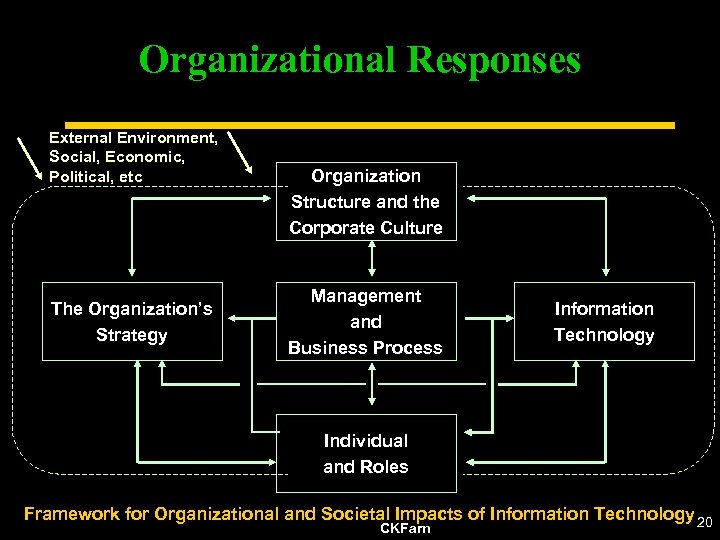 Organizational Responses External Environment, Social, Economic, Political, etc The Organization’s Strategy Organization Structure and the Corporate Culture Management and Business Process Information Technology Individual and Roles Framework for Organizational and Societal Impacts of Information Technology 20 CKFarn
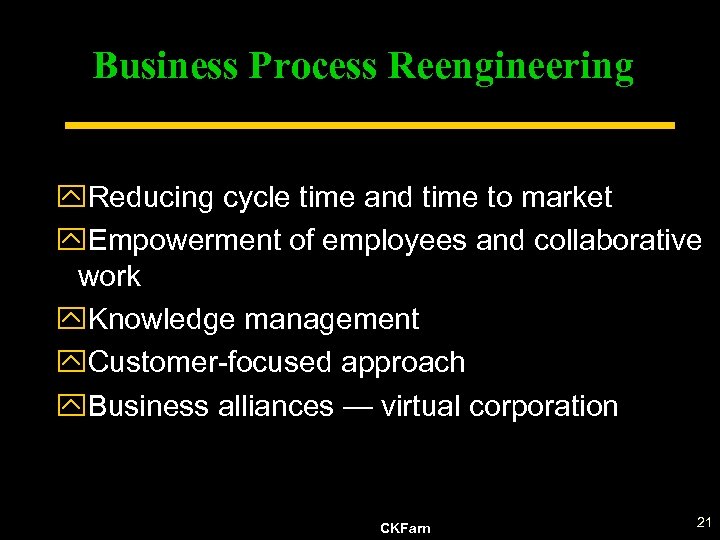 Business Process Reengineering y. Reducing cycle time and time to market y. Empowerment of employees and collaborative work y. Knowledge management y. Customer-focused approach y. Business alliances — virtual corporation CKFarn 21
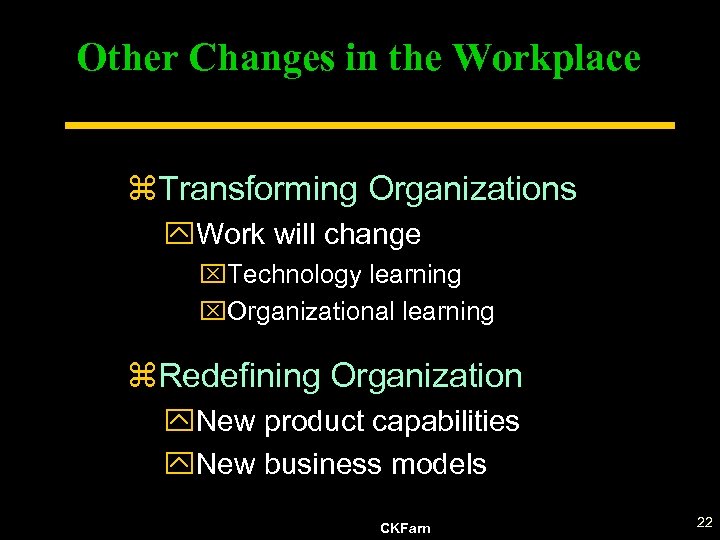 Other Changes in the Workplace z. Transforming Organizations y. Work will change x. Technology learning x. Organizational learning z. Redefining Organization y. New product capabilities y. New business models CKFarn 22
 Other Changes in the Workplace (cont. ) z Impacts on Manufacturing y. Pull processing, mass customization, shorter cycle time, integration (ERP), electronic bidding and procurement z Impacts on Finance and Accounting y. Electronic payment systems, electronic cash, automating back office, home banking, electronic stock trading z Human Resource Management y. Electronic recruiting, training, distance learning CKFarn 23
 Overview of Electronic Marketing Structure z. Consumer-oriented Electronic Marketing (B 2 C) y. Mostly online; on the Internet y. Growing offline too, mainly by using smart cards, although it is still experimental z. Business-oriented Electronic Marketing (B 2 B) y. Needs more precise record keeping, trackability, accountability, and formal contracts, usually with high volume of transactions and large amount payments CKFarn 24
 Advantages of Electronic Marketing z. Customers can order from cyberstores 24 hours a day, 7 days a week from any place in the world y. Direct marketing y. Customization y. Online customer service y. Electronic shopping malls: x. Intermediaries (e. g. Internet Mall) x. Stores (e. g. Amazon, J. C. Penney Online) y. Electronic intermediaries y. Global marketing CKFarn 25
 Forecast of the B 2 C Electronic Markets (cont. ) z What sells on the Internet? y. Items with high brand recognition y. Goods that can be transformed to digitized goods like books, music, and video y. Items with security guarantee given by highly reliable or known vendors y. Relatively cheap items y. Repetitively purchased items such as groceries y. Commodities with standard specification y. Items whose operating procedures can be more effectively demonstrated by a video y. Packaged items which are well known to customers and which cannot be opened even when customers physically visit the store CKFarn 26
 Active Electronic Intermediaries z Pure electronic mall y. Company’s retailing business exists only on the Internet y. Electronic distributors xtake full responsibility of fulfilling orders and collecting payments y. Electronic brokers xassist the search process of finding the appropriate products and their vendors z Partial electronic mall y. Electronic mall as one of existing distribution channels CKFarn 27
 Active Electronic Intermediaries (cont. ) z. Generalized Electronic Intermediaries y. Examples : Choice Mall, and i. Mall y. Provide a directory, keyword search engine, message encryption, optional Web site hosting service and a common platform of electronic payments y. Necessary factors to make shopping successful x. Screening quality and reliability for assurance • customers need a reliable screening capability of quality and reliability of brands and companies • e-brokers should create a trusted third party x. Competing electronic channels • several electronic channels help in finding the items needed • e-brokers should provide some differentiated attraction CKFarn 28
 Active Electronic Intermediaries (cont. ) z Specialized Electronic Distributors y. Cyber Bookstores x. Amazon, Barnes and Noble y. Cyber CD Stores x. Columbia House, Music Boulevard, CD Universe, and CDNow y. Digitized Products and Services Stores x. Software, games, CDs, and videos y. Cyber Flower Stores x 1 -800 -FLOWERS CKFarn 29
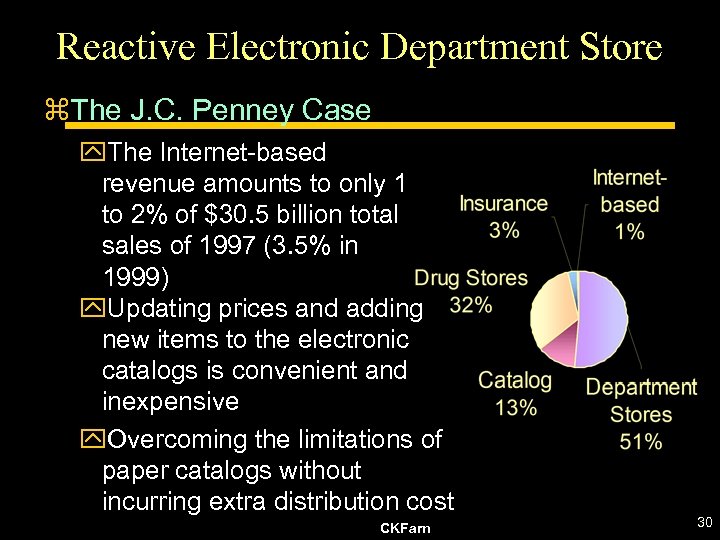 Reactive Electronic Department Store z. The J. C. Penney Case y. The Internet-based revenue amounts to only 1 to 2% of $30. 5 billion total sales of 1997 (3. 5% in 1999) y. Updating prices and adding new items to the electronic catalogs is convenient and inexpensive y. Overcoming the limitations of paper catalogs without incurring extra distribution cost CKFarn 30
 Aiding Comparison Shopping z. Search hypertext files by agents z. Search in a web-based database both by human and software agents within an e-mall z. Comparable item retrieval and tabular comparison z. Comparisons over multiple malls z. Comparisons as a multiple criteria decision making CKFarn 31
 The Impact of EC on Traditional Retailing System z Disintermediation and Re-intermediation (Fig 2. 5) y. Disintermediation — the removal of organizations or business process layers responsible for certain intermediary steps in a given value chain xeliminating the traditional intermediaries, such as wholesalers, distributors, and retailers, to reduce the cost y. Re-intermediation — the shifting or transfer of the intermediary functions, rather than the complete elimination xintermediation such as electronic shopping malls, directory and search engine service, and comparison aids using agents creates the role of re-intermediation CKFarn 32