


 Скачать презентацию Definition of Terms Ø Volunteer any
685f9906987deb8a7e886db562f77fc6.ppt
- Количество слайдов: 26

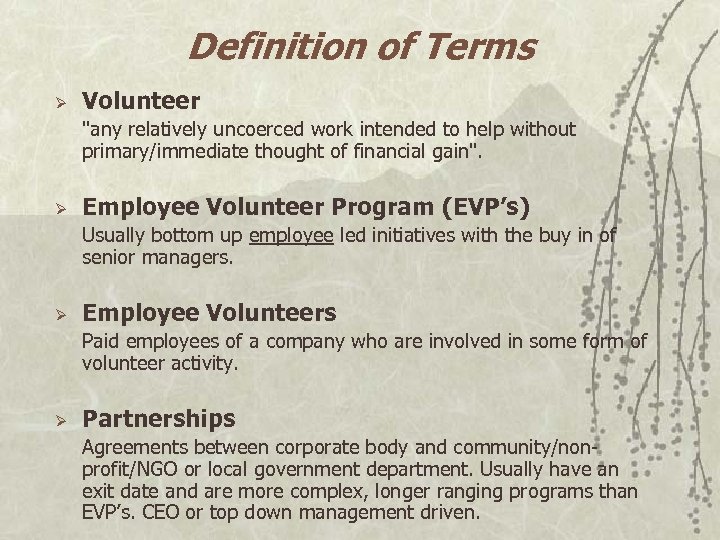 Definition of Terms Ø Volunteer "any relatively uncoerced work intended to help without primary/immediate thought of financial gain". Ø Employee Volunteer Program (EVP’s) Usually bottom up employee led initiatives with the buy in of senior managers. Ø Employee Volunteers Paid employees of a company who are involved in some form of volunteer activity. Ø Partnerships Agreements between corporate body and community/nonprofit/NGO or local government department. Usually have an exit date and are more complex, longer ranging programs than EVP’s. CEO or top down management driven.
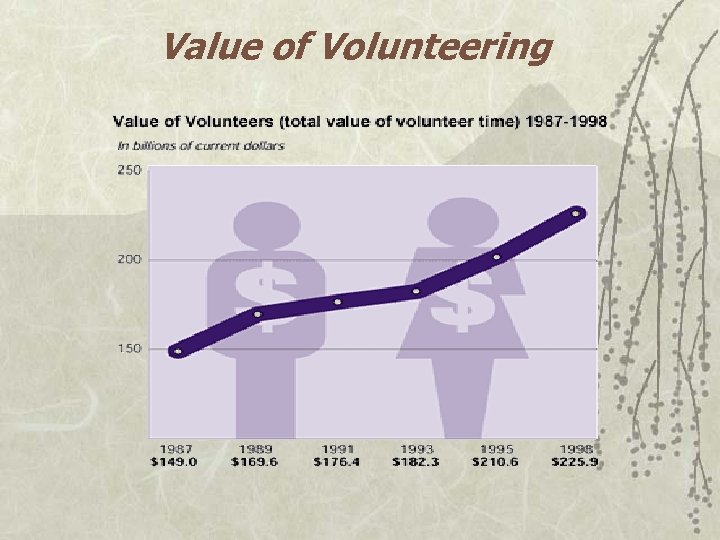 Value of Volunteering
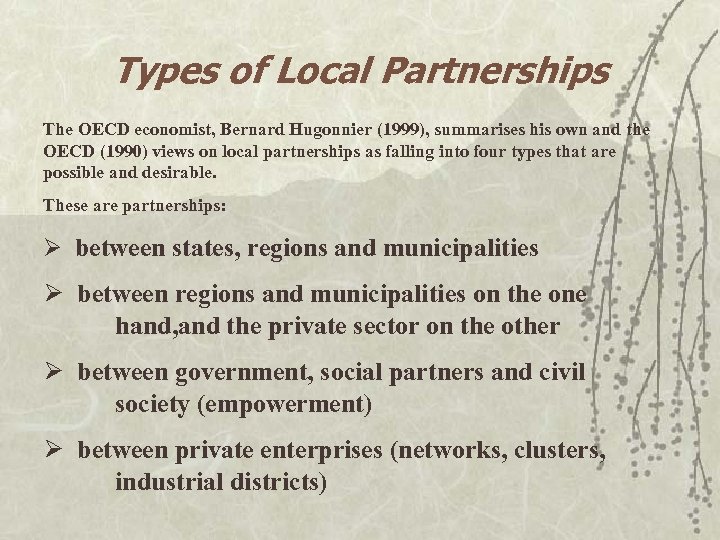 Types of Local Partnerships The OECD economist, Bernard Hugonnier (1999), summarises his own and the OECD (1990) views on local partnerships as falling into four types that are possible and desirable. These are partnerships: Ø between states, regions and municipalities Ø between regions and municipalities on the one hand, and the private sector on the other Ø between government, social partners and civil society (empowerment) Ø between private enterprises (networks, clusters, industrial districts)
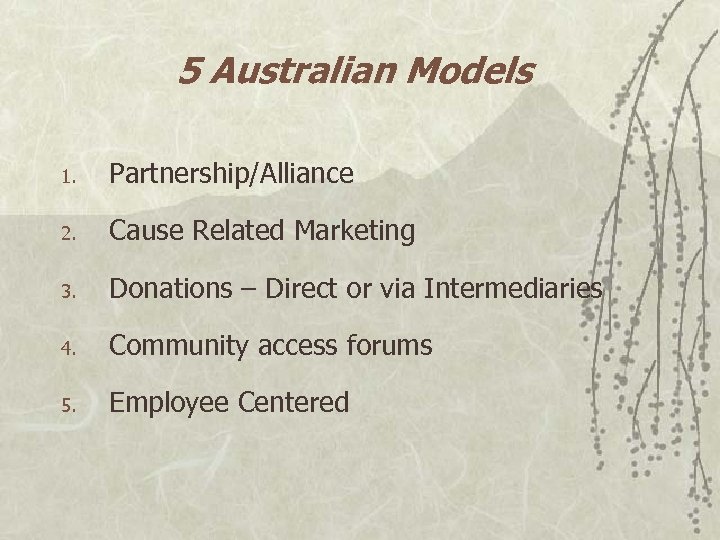 5 Australian Models 1. Partnership/Alliance 2. Cause Related Marketing 3. Donations – Direct or via Intermediaries 4. Community access forums 5. Employee Centered
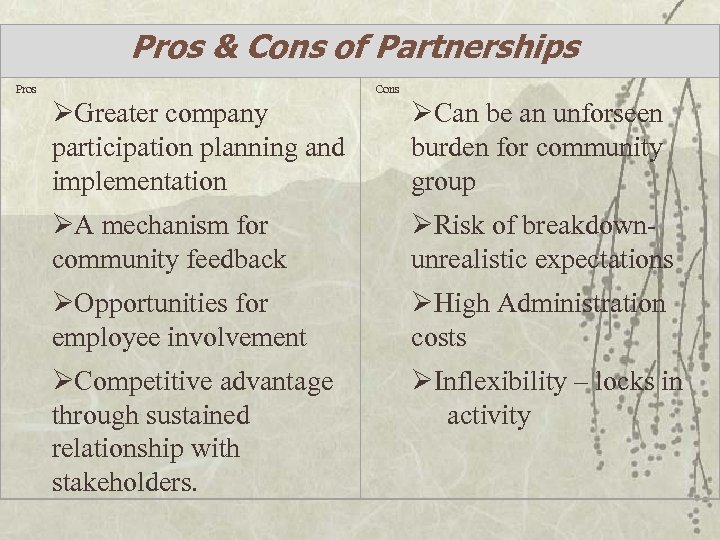 Pros & Cons of Partnerships Pros Cons ØGreater company participation planning and implementation ØCan be an unforseen burden for community group ØA mechanism for community feedback ØRisk of breakdownunrealistic expectations ØOpportunities for employee involvement ØHigh Administration costs ØCompetitive advantage through sustained relationship with stakeholders. ØInflexibility – locks in activity
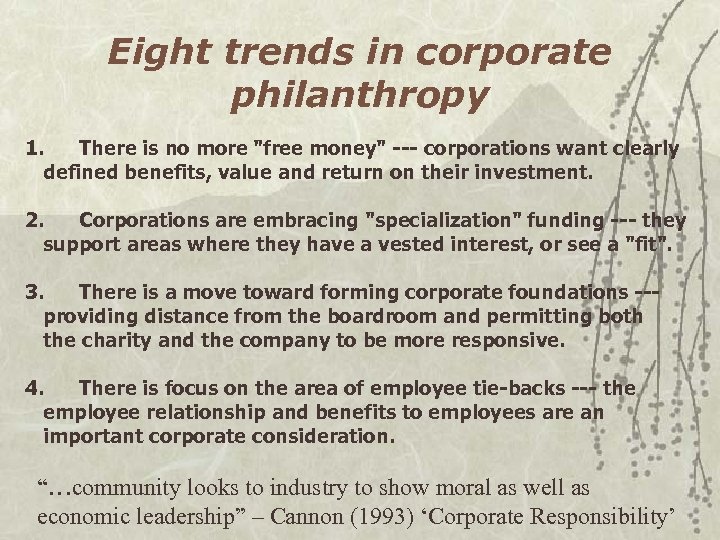 Eight trends in corporate philanthropy 1. There is no more "free money" --- corporations want clearly defined benefits, value and return on their investment. 2. Corporations are embracing "specialization" funding --- they support areas where they have a vested interest, or see a "fit". 3. There is a move toward forming corporate foundations --- providing distance from the boardroom and permitting both the charity and the company to be more responsive. 4. There is focus on the area of employee tie-backs --- the employee relationship and benefits to employees are an important corporate consideration. “…community looks to industry to show moral as well as economic leadership” – Cannon (1993) ‘Corporate Responsibility’
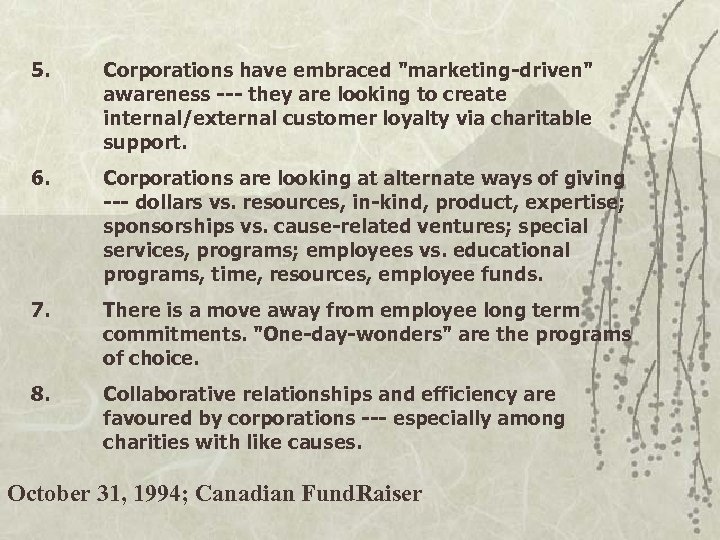 5. Corporations have embraced "marketing-driven" awareness --- they are looking to create internal/external customer loyalty via charitable support. 6. Corporations are looking at alternate ways of giving --- dollars vs. resources, in-kind, product, expertise; sponsorships vs. cause-related ventures; special services, programs; employees vs. educational programs, time, resources, employee funds. 7. There is a move away from employee long term commitments. "One-day-wonders" are the programs of choice. 8. Collaborative relationships and efficiency are favoured by corporations --- especially among charities with like causes. October 31, 1994; Canadian Fund. Raiser
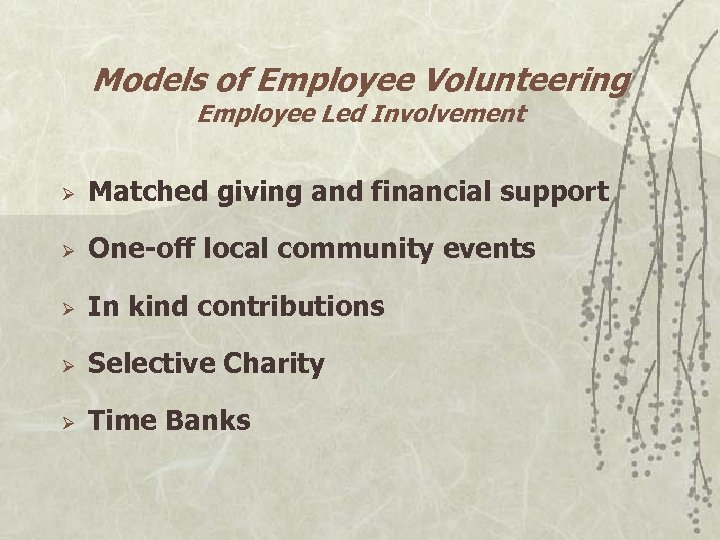 Models of Employee Volunteering Employee Led Involvement Ø Matched giving and financial support Ø One-off local community events Ø In kind contributions Ø Selective Charity Ø Time Banks
 Models of Employee Volunteering Provide information and resources Take on a special project Allow time off for volunteers Provide financial support to encourage volunteering. Recognise employees for volunteering Loan managers or executives. Enlist suppliers or customers. Join hands with other companies.
 Models of Employee Volunteering Employer-Initiated Programs Ø Secondment for Transition Ø Development Assignment Ø Team Development Assignments Ø Mentoring Ø Trustees and School Governors
 Putting it in to Action: Level 1 -Companies just beginning to review community involvement Ø Ensure top level commitment of senior management to manage and measure impact on society within the community through corporate community investment Ø Review the company's current activity in community investment activity, identifying: Ø existing activity Ø business objectives Ø community needs Ø Decide what resources (budget and personnel) will be appropriate for the programme Ø Nominate a project champion and project manager for the community activity.
 Putting it in to Action: Level 2 -Companies wishing to move beyond a basic commitment ØDevelop a community policy and strategy statement including : Øan action plan, with objectives and targets Øallocation of resources Øinvolvement with community partners ØMonitor achievements and measure the value ØProvide relevant training and support for staff involved with community activity.
 Putting it in to Action: Level 3 -Companies aiming at further improvement of their performance ØCommit to continuous improvement and learning through systematic evaluation and benchmarking ØSeek external validation for company community investment through standards and awards ØAssess, evaluate and report achievements and long term impact of the programme. Include in this perception measures of involved parties ØSystematically and regularly involve stakeholders in programme development and improvement ØMeasure and report on the outcomes of community investment ØShare best practice with others and act as a leader and an advocate for business engagement in this area.
 Some Benefits Ø Ø Ø Skills Gain Changed Attitudes Community Wide Benefits
 Skills Gain EVP’s can be a practice forum which is a low risk environment for business, where mistakes will not have a commercial effect Ø Communication skills Ø Organisational and time management skills Ø People skills (caring, negotiating and listening) Ø Accountability and assessment reporting Ø Planning skills Ø Budgeting skills Ø Survival skills –stress management, prioritisation.
 Changed Perspectives and Attitudes Ø Increased understanding of co-workers and respect for diversity Ø More innovative approach to responding to difficulties Ø Enhancement of calculated risk-taking Ø Enlarged sense of community and social obligation Ø Heightened appreciation of benefits provided by the team Ø Affirmation of personal capability and worth Ø Positive resistance to feelings of isolation and alienation.
 Community Wide Benefits ØImproved morale and motivation –Employee Community Involvement (ECI) helps to bridge the gap between the company and the community ØThe creation of a culture of caring and community service ECI promotes a clear and positive message that the company cares ØImproved communications - ECI facilitates people from different sites, departments and levels of seniority to work together on community/social initiatives Ø“The creation of a licence to operate”- ECI can build trust for the company with the community and is demonstrable of good social policy practice [1] Business in the Community (1998) The role of employers in Active Communities, Bi. TC
 How do you measure it? Level 1 - Companies just beginning to measure progress ØCash value of community support as a percentage of pretax profit ØEstimated combined value of paid staff time, gifts in kind and management costs Level 2 - Companies wishing to move beyond a basic commitment ØIndividual value of staff time, gifts in kind and management costs ØPositive and negative media comment on community activities ØProject progress and achievement against milestone targets ØLeverage of other resources as a result of programme
 How do you measure it? Level 3 - Companies aiming at further improvement of their performance ØImpact evaluations carried out on community programmes such as : Øimproved educational attainment Ønumber of jobs created Øprofessional support for community organisations Øenvironment enhancement or conservation ØPerception measures Øcompany as a good neighbour www. charityvillage. com
 What Potential Corporate Partners Are Looking For Ø Access to networks, contacts and members Ø Expertise in special events, management and communications Ø Exclusivity, to be unique among their competitors Ø Integration with the company's total marketing mix Ø Safety --- no lawsuits or injury to participants Ø Image --- a high profile, stature and credibility Ø Longevity --- the opportunity to repeat and/or expand
 Appealing to a Corporate Partner Ø Delivery of target audiences Ø Cost-efficient operations Ø Demonstrated value-add Ø Measurable results and impact Ø The ability to serve current corporate partner objectives Kirby at: http: //www. charityvillage. com/charityvillage/research/rcp 11. html
 The Principles of Excellence in Community Service: A Plan to A. C. T. Acknowledge that the corporation's community service involvement and its employee volunteer efforts contribute to the achievement of its business goals. Commit to establish, support, and promote an employee volunteer program that encourages the involvement of every employee and treat it like any other core business function. Target community service efforts at serious social problems in the community.
 10 Steps to EVP’s 1. Identify corporate priorities 2. Determine employee interests 3. Determine community needs 4. Develop a program structure 5. Develop written corporate policies 6. Select volunteer projects relative to company interests and community needs. 7. Evaluate your volunteer program 8. Publicize your company's volunteer efforts 9. Reward and Recognise participants 10. Work with local volunteer centers
 Some Obstacles in the Path of EVP’s Ø Strength of a company's donation program Ø Effectiveness of volunteer centres and nonprofits in soliciting corporate support Ø Ignorance of employee volunteering, economic health of the company Ø Lack of employee time to participate Ø Influence of a company's union or employee association Ø Management reticence about involvement in an employee's personal affairs Ø Absence of key champions Ø Lack of data demonstrating the benefits of corporate volunteering. http: //www. charityvillage. com/charityvillage/research/rcp 12. html
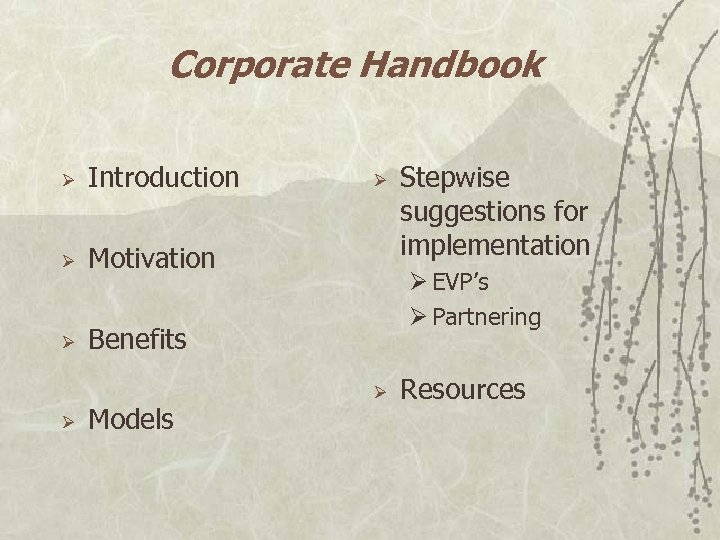 Corporate Handbook Ø Introduction Ø Motivation Ø Benefits Ø Models Ø Stepwise suggestions for implementation Ø EVP’s Ø Partnering Ø Resources