


 Скачать презентацию Definition of effective practice Effective practice in relation
575d3b64a6cf3938882d87bb587ff220.ppt
- Количество слайдов: 50
 Definition of effective practice Effective practice in relation to TAs involves contributions that: • foster the participation of pupils in the academic and social processes of the school • seek to enable pupils to become more independent learners • help to raise standards of learning for pupils Presentation slide 1. 1
 Aims of the programme The programme aims to provide induction training for newly recruited TAs to enable them to assist teachers in raising the standards of pupil performance. The training is designed to promote: • support by the TA for teachers, pupils and the school • and support for the TA in carrying out the responsibilities functions of the role ascribed by the school Presentation slide 1. 2
 The role of mentors • To support the TAs in this session and in the follow-up to this and other sessions back in their schools • To help the TAs relate course principles to school practice • To help TAs consider follow-up and further training and professional development, including that which can lead to qualifications or career progression Presentation slide 1. 3
 The four types of support provided by the TA • Helping with classroom resources and records • Helping with the care and support of pupils • Providing support for learning activities • Providing support for colleagues Presentation slide 1. 4
 Support from the school might include: • an appraisal of performance to inform decisions about priorities for further support or professional development • involving TAs in planning the programme of support • including TAs in relevant school-based meetings and training Presentation slide 1. 5
 Defining responsibilities clearly Indicator 1: Schools have clear policies outlining the roles and responsibilities of TAs • Does the school provide appropriate job descriptions for TAs? • Does the school involve TAs in drawing up the job descriptions? • Do the job descriptions reflect a balance of responsibilities, reflecting TAs’ help with classroom resources and records, care and support of pupils, support for learning activities and support for colleagues? Presentation slide 1. 6
 Every child matters: change for children Outcomes • Be healthy • Stay safe • Enjoy and achieve • Make a positive contribution • Achieve economic well-being Presentation slide 2. 1
 The national healthy schools standard Schools are asked to demonstrate evidence in the core themes using a whole-school approach involving the whole school community: • personal, social and health education including sex and relationship education and drug education (including alcohol, tobacco and volatile substance abuse) • healthy eating • physical activity • emotional health and well-being (including bullying) Presentation slide 2. 2
 Aims of PSHE in secondary school PSHE should help pupils to lead confident, healthy and responsible lives as individuals and members of society. It should: • help them live healthily and safely and deal with the spiritual, moral, social and cultural issues they face as they approach adulthood • reflect on their experiences and how they are developing • understand manage responsibly a wider range of relationships as they mature • show respect for the diversity of, and differences between, people • develop pupils’ well-being and self-esteem, encouraging belief in their ability to succeed • enable pupils to take responsibility for their learning and future choice of courses and career Presentation slide 2. 3
 Healthy eating To achieve the required standard, schools must ensure that, through a whole-school approach, they: • present consistent, informed messages about healthy eating – for example, food on offer in vending machines, tuck shops and school meals should complement what is taught about healthy eating in the taught curriculum • provide, promote and monitor healthier food at lunch and break times and in any breakfast clubs where they are provided • include education on healthier eating and basic food safety practices in the taught curriculum The Df. ES also published compulsory nutritional standards for school lunches which came into effect on 1 April 2001 Presentation slide 2. 4
 Physical activity To achieve the required standard, schools must ensure that, through a whole-school approach, they: • offer all pupils, whatever their age or ability, two hours of physical activity a week within and outside the national curriculum • take advantage of appropriate opportunities to promote and develop physical activity • encourage staff, pupils, parents/carers and other adults, eg. sports development officers, to become involved in promoting physical activity and develop their skills, abilities and understanding through appropriate training Presentation slide 2. 5
 Health and safety TAs need to be familiar with: • health and safety policies and procedures • areas of risk and how risks can be minimised • emergency procedures • accident and security procedures Presentation slide 2. 6
 Safety on school visits TAs should: • be clear about their responsibilities • not be left in sole charge of pupils, except where it has been agreed as part of the risk assessment • follow the instructions of the group leader and teacher supervisors and help with control and discipline • speak to the group leader or teacher supervisors if they have concerns about the health and safety of pupils at any time during the visit Presentation slide 2. 7
 Aims of this section • To build a basic understanding of safeguarding matters likely to be encountered by TAs • To inform TAs what to do if they have concerns about pupils that relate to their safety Presentation slide 2. 8
 Children Act 2004 • Local authorities and governing bodies must make arrangements to ensure that their functions are discharged with a view to safeguarding and promoting the welfare of children • They must have regard to any guidance given to them by the secretary of state Presentation slide 2. 9
 ‘Safeguarding’ • All agencies working with children, young people and their families take all reasonable measures to ensure that the risks of harm to children’s welfare minimised • Where there are concerns about children and young people’s welfare, all agencies take all appropriate actions to address those concerns, working to agreed local policies and procedures Presentation slide 2. 10
 What do we mean by child abuse? Abuse is when a child is hurt or harmed by another person in a way that causes significant harm to that child and which may well have an effect on the child’s development or well-being. Presentation slide 2. 11
 Duty to refer Through their day-to-day contact with pupils and direct work with families, education staff have a crucial role to play in noticing indicators of possible abuse or neglect, and in referring concerns to the designated senior person (DSP) in their school. Presentation slide 2. 12
 Designated senior person The designated senior person: • need not be a teacher, but must have sufficient authority within the school management structure to carry out the duties of the post, including committing resources to child protection matters and, where appropriate, directing other staff • will have undertaken training to standards set by the local safeguarding children board and is responsible for coordinating action to safeguard pupils • liaises with other agencies about safeguarding concerns and referrals • offers support and advice to staff who may have concerns about pupils Presentation slide 2. 13
 Barriers to diagnosis “The biggest barrier to diagnosis is the existence of emotional blocks in the minds of professionals. These can be so powerful that they prevent diagnosis even being considered in quite obvious cases. All those working with children should be warned that their overwhelming impulse on confronting their first case is to cover it up. ” British Medical Journal (1989) Presentation slide 2. 14
 Physical abuse may involve hitting, shaking, throwing, poisoning, burning or scalding, drowning, suffocating or otherwise causing physical harm to a child. Physical harm may also be caused when a parent or carer fakes the symptoms of, or deliberately causes ill health to, a child whom they are looking after. Presentation slide 2. 15
 Emotional abuse Actual or likely adverse effect on the emotional and behavioural development of a child under the age of 18 years, caused by persistent or severe emotional ill-treatment or rejection. Presentation slide 2. 16
 Neglect Persistent or severe neglect of children under the age of 18 years, or the failure to protect a child from physical harm or danger. Presentation slide 2. 17
 Sexual abuse is the actual or likely sexual exploitation of a child or adolescent under the age of 18 years by any person. This would include any form of sexual activity to which the child cannot give true consent either by law or because of ignorance, dependence, developmental immaturity or fear. Presentation slide 2. 18
 Golden rules • It is not the responsibility of education staff to interview pupils. If a pupil makes a disclosure of abuse they should listen carefully to what the pupil has to say, but should not question them in a way that puts words in their mouth • It is important to make accurate notes about what has been heard, seen or told • Interviewing pupils should be left to the police and social care staff, who have the necessary training to carry out this role effectively. Inappropriate interviewing may jeopardise the chances of a successful prosecution at a later date Presentation slide 2. 19 a
 Golden rules • Concerns should always be made known quickly to the DSP, or in their absence to another senior member of staff • Concerns should not be discussed with parents/carers until advice on how to proceed has been obtained from the DSP • A pupil must not be promised confidentiality about any information on abuse they may choose to disclose. The TA must explain that they may need to pass on information to other professionals to help keep the pupil or other children safe Presentation slide 2. 19 b
 Useful websites www. publications. doh. gov. uk/safeguardingchildren www. teachernet. gov. uk/childprotection Presentation slide 2. 20
 The nature of bullying There are many definitions of bullying, but most consider it to be: • deliberately hurtful (including aggression) • repeated over a period of time • difficult for victims to defend themselves against Bullying can take many forms, but three main types are: • physical – hitting, kicking, taking belongings • verbal – name calling, insulting, making offensive remarks • indirect – spreading nasty stories, exclusion from social groups, being the subject of malicious rumours, sending malicious emails or text messages Presentation slide 2. 21
 The school curriculum “The school curriculum comprises all learning and other experiences that each school plans for its pupils. The national curriculum is an important element of the school curriculum. ” The national curriculum handbook for secondary teachers in England, p. 10 Presentation slide 2. 22
 Answers 1. 5 to 16 2. KS 3: 11– 14; KS 4: 14– 16 3. English, mathematics, science, design and technology, information and communication technology, history, geography, modern foreign languages, music, art and design, citizenship and physical education 4. English, mathematics and science 5. (Answers will vary) 6. Religious education 7. Qualifications and Curriculum Authority and Office for Standards in Education 8. Department for Children, Schools and Families 9. General Certificate in Secondary Education Presentation slide 2. 23
 The national curriculum • The whole curriculum (includes what’s taught in lessons, break times, assemblies, extra-curricular activities) • The legally required basic curriculum, including RE • The national curriculum Presentation slide 2. 24
 Core and non-core foundation subjects The national curriculum (2000) in England contains the teaching requirements for secondary schools: • core subjects – English, mathematics and science • non-core subjects – art and design, citizenship, design and technology, information and communication technology, geography, history, modern foreign languages, music and physical education Presentation slide 2. 25
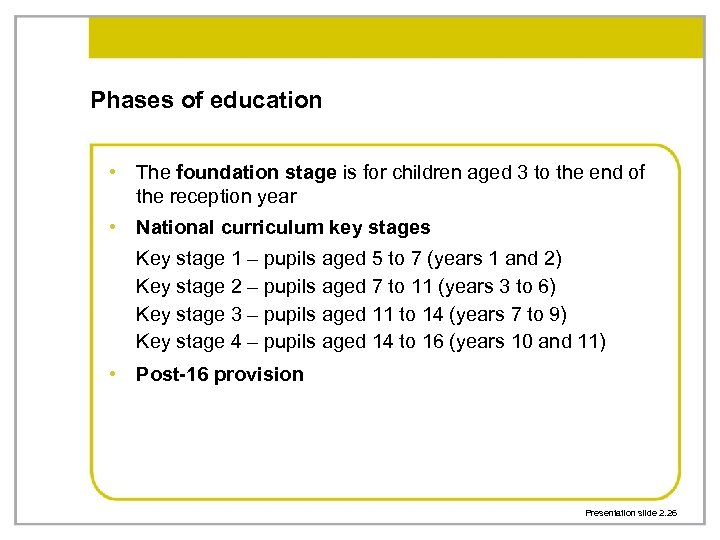 Phases of education • The foundation stage is for children aged 3 to the end of the reception year • National curriculum key stages Key stage 1 – pupils aged 5 to 7 (years 1 and 2) Key stage 2 – pupils aged 7 to 11 (years 3 to 6) Key stage 3 – pupils aged 11 to 14 (years 7 to 9) Key stage 4 – pupils aged 14 to 16 (years 10 and 11) • Post-16 provision Presentation slide 2. 26
 Terminology used in the national curriculum • Attainment targets • Level descriptions Presentation slide 2. 27
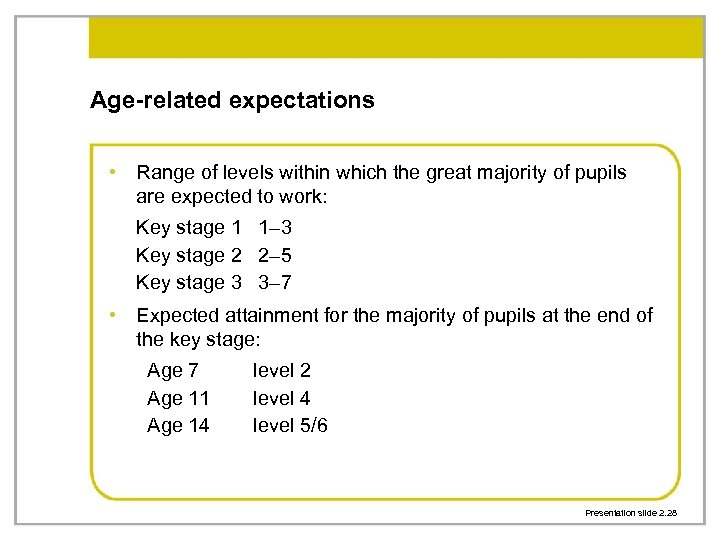 Age-related expectations • Range of levels within which the great majority of pupils are expected to work: Key stage 1 1– 3 Key stage 2 2– 5 Key stage 3 3– 7 • Expected attainment for the majority of pupils at the end of the key stage: Age 7 Age 11 Age 14 level 2 level 4 level 5/6 Presentation slide 2. 28
 Learning across the curriculum • Creativity • ICT • Education for sustainable development • Literacy • Numeracy Presentation slide 2. 29
 Supporting transitions • Look out for signs of changes in attitudes and behaviour • Build open and honest relationships with pupils • Employ good listening skills • Empathise and reassure • Understand the limits of your role • Know about school procedures and referral routes • Provide practical help if it has been agreed by senior colleagues Presentation slide 2. 30
 Careers education “Young people who have received an effective careers education programme delivered through the curriculum, alongside impartial advice and guidance from external guidance specialists, make the best transitions at age 16 and are less likely to switch or drop out of courses in year 12. ” 14– 19: extending opportunities, raising standards (Df. ES 2002) Presentation slide 2. 31
 The purpose of observation Observation is intended to: • provide reliable information of pupils’ progress on the curriculum • identify pupils’ strengths and weaknesses • discover how well pupils are responding to the teaching resources • enable feedback to pupils of what they need to do to progress • enable feedback to teachers of the response of pupils to the work Presentation slide 3. 1
 Differentiation • By grouping • By task • By outcome • By support Presentation slide 3. 2
 Definition of effective practice Effective practice in relation to TAs involves contributions that: • seek to enable pupils to become more independent learners • foster the participation of pupils in the social and academic processes of the school • help to raise standards of learning for pupils Presentation slide 3. 3
 Working cooperatively with teachers Indicator 3. 1: TAs work cooperatively with teachers to support the learning and participation of pupils • Do TAs understand the purpose of lesson activities? • Do TAs share in long- and medium-term planning? • Are TAs involved in the planning of specific lessons where teachers and TAs share the classroom? • Do TAs and teachers have arrangements that encourage them to offer one another constructive feedback? • Do TAs and teachers plan in ways that demonstrate to pupils their commitment to teamwork? • Are there agreed plans for TAs to respond to individual pupils’ needs? Presentation slide 3. 4
 The use of TAs’ skills Indicator 2. 2: The expertise, skills and knowledge of TAs are used flexibly to foster the learning of pupils • Are TAs’ previous experiences and skills used to support curriculum access and flexible approaches? • Is care taken to make sure that TAs are actively encouraged to work in curriculum areas or faculties in which they feel confident and interested? • Is the particular curricular knowledge of TAs recognised and used? • Do TAs contribute to record keeping and collecting evidence of pupils’ progress formal assessments? Presentation slide 3. 5
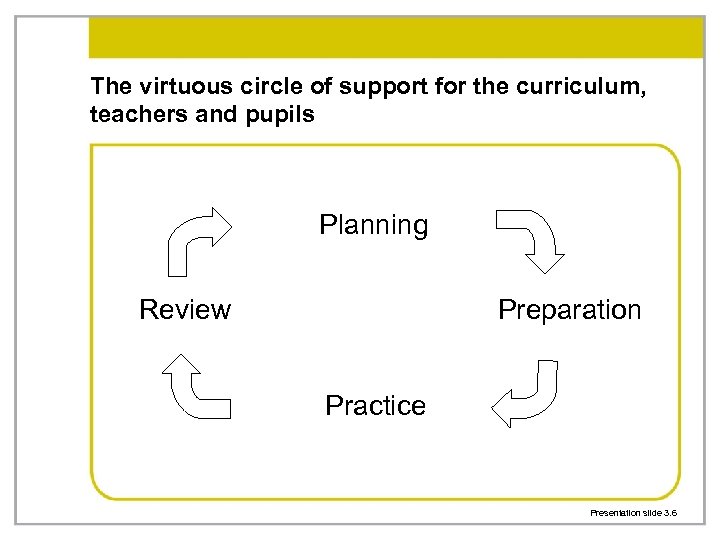 The virtuous circle of support for the curriculum, teachers and pupils Planning Review Preparation Practice Presentation slide 3. 6
 Support for the TA Indicator 6: TAs are supported in relation to their induction, mentoring and development needs. • Are TAs provided with a school induction programme? • Are TAs encouraged to complete a professional achievement and development portfolio? • Are TAs appraised as a means of developing their contributions and accountabilities in the school? • Does the school structure responsibilities for TAs to reflect their qualifications, experience and training? • Are there clear means of identifying appropriate and relevant continuing professional development to support TAs’ further development? Presentation slide 4. 1
 Appraisal The purpose of appraisal is to: • provide an opportunity for two-way dialogue and review • enhance professional development • recognise achievement • identify any areas of weakness • set targets • identify any professional development needed • provide information for management Presentation slide 4. 2
 Self-review A self-review should be an honest appraisal of: • your strengths and development needs in respect of working in support of the school, the curriculum, pupils and teachers • any extra contributions you have made to school life, in particular in relation to your key responsibilities • any appreciative or critical comments you have received from others • your future professional development needs Presentation slide 4. 3
 The process of an appraisal • Consideration of how well targets established in the last appraisal have been met • A self-assessment by the person being appraised • Observations on the performance of the person being appraised by the line manager • Dialogue, including any problems raised by the person being appraised Presentation slide 4. 4 a
 The process of an appraisal • Agreeing the actions required to meet those targets, including any training needed • Consideration of the job description and agreeing any changes, if necessary • Setting a date for the next review • Agreeing what is to go on the recorded note for the headteacher/ staff development manager/ governors Presentation slide 4. 4 b
 Study skills needed for further professional development • Organisation – time management • Recording • Reflective thought • Sharing professional ideas Presentation slide 4. 5