


 Скачать презентацию Defining High-Technology An Ontological Perspective Culture is
11742af32bad6dd6c018b663c5139caa.ppt
- Количество слайдов: 23
 Defining High-Technology: An Ontological Perspective
 Culture is a “whole way of life (ideas, attitudes, languages, practices, institutions, structures of power) and a whole range of cultural practices: artistic forms, texts, canons, architecture, mass-produced commodities, technology, and so on. […] Culture, in other words, means not only ‘high culture, ’ what we usually call art or literature, but also the everyday practices, representations, and cultural productions of people and of societies. ”
 Questions Concerning Technology u u What types of representations of technology can you identify in popular culture? How does our popular culture imagine our relationship with technology? What do these representations tell us about the meaning of “being human”? What do these representations tell us about the meaning of technology?
 The Utopians and the Dystopians In recent history there have always been two views of technology. u What they share in common is the definition of technology as instrumental, a means to an end. u
 Theories of Technology u The instrumental theory: Tools standing ready to serve the purpose of their users (Feenberg, 1991). u Technology in itself is deemed "neutral" u • The value of technology then is determined by the use of the adopter.
 Instrumental Technology: Freedom, Empowerment, and Control Box 2: Freedom at Fingertips The American, French, and Russian revolutions notwithstanding, in 2001, NCR (finally) unveiled the “Freedom concept” to the world. In a demonstration at the Marriott Marquis hotel in New York in July 2001, “Freedom” came in the shape of a special bank automatic teller machine (ATM) in the shape of a bright red egg. Using a mobile phone or PDA, people were now free to obtain cash from ATMs. With the Freedom concept, mobile devices would replace the magnetic-stripe cards in a consumer’s pocket. A pilot project in Denmark gave people the first taste of such “freedom at fingertips” – Danes could now use for the first time a mobile phone to withdraw cash in a live environment at regular ATMs on the street. NCR hopes its red eggs will turn into golden eggs. The company sees a lucrative future in dispensing more than cash from the Freedom eggs, or from regular ATMs with Freedom systems – in banks, restaurants, stores, airports, and hotels. Among the uses: point-and-click retrieval of travel or entertainment tickets, even MP 3 files. Such Freedom-infused ATMs could dispense physical or virtual items. For example, local area maps can be downloaded on a mobile device. The mobile communications link in the “Freedom concept” employs infrared technology. Other short distance mobile technologies such as Bluetooth could also be used in ATMs specially adapted to accept such technology. Source: “NCR hatches a Bluetooth Egg, ” 10 Meters News Service, July 13, 2001, http: //www. 10 meters. com/ncr_atm. html; Lorraine Russell, “World First - Mobile Phone Used to Withdraw Cash from NCR ATM in Denmark Pilot Project”, http: //www. ncr. com/media_information/2002/apr/pr 042602. ht m CONCOR
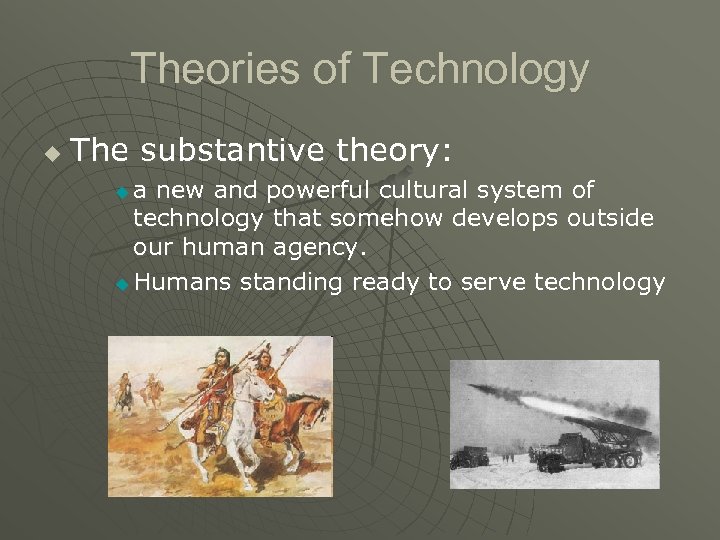 Theories of Technology u The substantive theory: a new and powerful cultural system of technology that somehow develops outside our human agency. u Humans standing ready to serve technology u
 Substantial Technology: Enslavement and Surveillance WAR IS PEACE u FREEDOM IS SLAVERY u IGNORANCE IS STRENGTH u Box 3: Dataveilled Danielle 11 -year old Danielle Duval will be implanted with a microchip to track her continuously. If kidnapped, Danielle’s location would be discovered via a computer. Professor Kevin Warwick of Reading University near London has worked with humanimplantable chips, including some implanted in his own body. He is developing the chip that will go in Danielle’s leg, and provide security and assurance to the Duval family. Skeptics are not convinced that such Star Wars technology is ready for prime time. When Danielle’s mother was quoted as saying, “If a car can be fitted with equipment to enable it to be tracked when it is stolen, why not apply the same principle to finding missing children? ”, a columnist wrote a rebuttal entitled “No, Mrs. Duval, you CANNOT track a mobile human by wireless like a car!” He argued that chip production economics, the need to have massive networks reaching every corner, and lack of portable power sources represented barriers that would take years to overcome. Source: Lorraine Fisher, “Microchipped”, http: //www. mirror. co. uk/news/allnews/page. cfm? objectid=12164609&method=full&siteid=50143 ; Guy Keweny, “No, Mrs. Duval, you CANNOT track a mobile human by wireless like a car!”, http: //www. newswireless. net/articles/020801 -tracker. html; Charles Gibson, “ 21 st Century Lives: Kevin Warwick”, ABCNews. com, Aug. 25, 2000, http: //more. abcnews. go. com/onair/worldnewstonight/wnt 000825_21 st_warwick_feature. html
 Technology as Control u Þ Þ Renaissance: the view of technology as an instrumental and rational tool that allows humans to control the world and master nature is born. Technological societies = Modern Societies Non-technological Societies = Primitive Societies.
 Technology as Control u u u Technology “breaks down” the mythic or enchanted view of the world. It makes the world and its objects available for human use, control and mastery. It “secures” the world for humans in instrumental terms. ÞThe paradox: efforts to secure the world and its objects has become all the more ‘frantic’ and ‘furious’ because these efforts are constantly under attack by the “unsecuring” tendencies of technology itself.
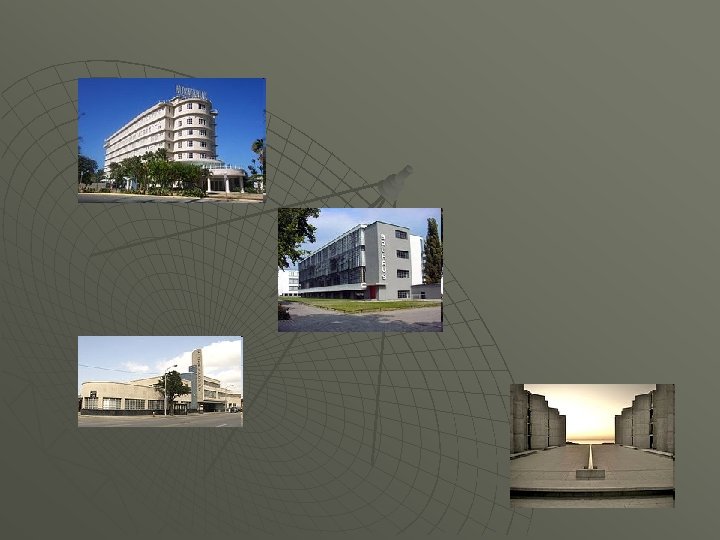
 19 th Century: The Rise of the Engineer u u With this conception of Technology, the goal is to make “everything” practical. Engineers and mass production come to be seen as models even for artistic production!! • The house as a mass-produced “machine for living in. ” • An object of design has to be “of no discernible ‘style’ but simply a product of the industrial order of mass production. E. g. , a car, an airplane, a building. u Technologies of War
 The 20 th Century: The Modern View Everything is to be subjected to standardization and rationalization – the T-Model replaces the customized coach car. u The practical, the functional came to be seen as the holy grail of production. u The famous: “form follows function” – the birth of a machine aesthetic u
 Summary: 1750 -1960 u With the coming of the modern era, the conception of technology was redefined from the classical Greek notion of “art”: • Strives to “kill” the “spirits that “animate” the world. • Render objects of the world as “dead. ” • Open a world of rational enlightenment. • Bring scientific-technological progress.
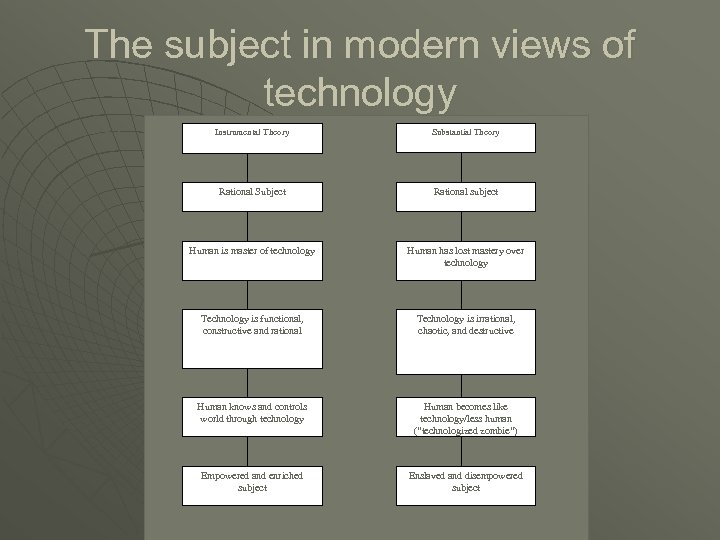 The subject in modern views of technology Instrumental Theory Substantial Theory Rational Subject Rational subject Human is master of technology Human has lost mastery over technology Technology is functional, constructive and rational Technology is irrational, chaotic, and destructive Human knows and controls world through technology Human becomes like technology/less human (“technologized zombie”) Empowered and enriched subject Enslaved and disempowered subject
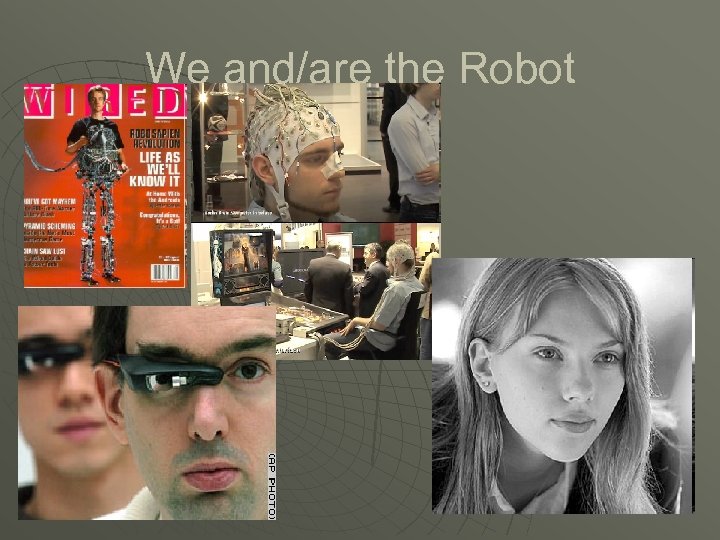
 High-Technology: Technological Humans and Cyborg Consumers? u u Aesthetization of technology Technology is generative, “alive” u From monstrous robots and mutants to artificial intelligence, cyborgs, and biotechnological life-forms.
 APPLIED DIGITAL SOLUTIONS Veri. Chip Corporation Miniaturized, Implantable Identification Technology Veri. Chip is a miniaturized, implantable radio frequency identification device (RFID) that is about the size of the point of a typical ballpoint pen. It contains a unique verification number. Utilizing an external scanner, radio frequency energy passes through the skin energizing the dormant Veri. Chip, which then emits a radio frequency signal containing the verification number. The number is displayed by the scanner and transmitted to a secure data storage site by authorized personnel via telephone or Internet.
 Levis and Philips: Co-producing the Kid-Cyborg “A multifunctional children’s anorak with integrated camera, game displays, and – a special highlight – connected to the Global Positioning System (GPS) targets the somewhat larger toddlers. The navigation system enables worried parents to keep close tabs on their children. A further advantage: the up-and-coming generation effortlessly learns how interactive technology functions. ”
 But what about us Humans? The machine aesthetic of modernity conceives technology as dead and humans as alive. u Humans are “outside” technology. u If machines are “alive” they are perceived as monsters, irrational, destructive (Frankenstein, Golems, “False Maria” in Film “Metropolis”, Terminator I, etc. ) u Technology can be “out of control. ” u
 But what about us Humans? u u The high-tech age “merges” technology and the human element (e. g. , Neuromancer, cyber punk, Matrix) Machines, the “electronic realm”, the “cyberspatial matrix”, in short high-technological systems are seen as so complex that there appears to be a generative, mutational force in technology that is beyond our control. Technology is no longer just an instrument but has its own logic and “mystery. ” But instead of conceiving of this as destructive and out of control, we embrace this uncertainty and engage in acts of cooperation, of “making deals” (Gibson).
 We and/are the Robot
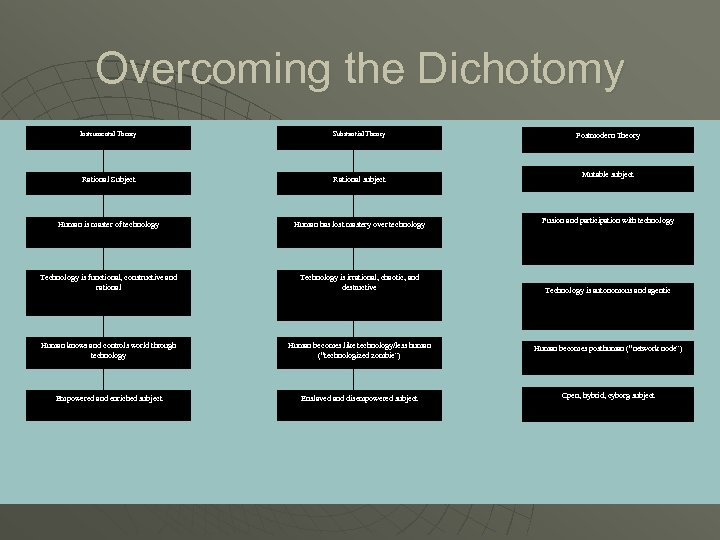 Overcoming the Dichotomy Instrumental Theory Substantial Theory Rational Subject Rational subject Human is master of technology Human has lost mastery over technology Fusion and participation with technology Technology is functional, constructive and rational Technology is irrational, chaotic, and destructive Technology is autonomous and agentic Human knows and controls world through technology Human becomes like technology/less human (“technologized zombie”) Human becomes posthuman (“network node”) Empowered and enriched subject Enslaved and disempowered subject Open, hybrid, cyborg subject Postmodern Theory Mutable subject
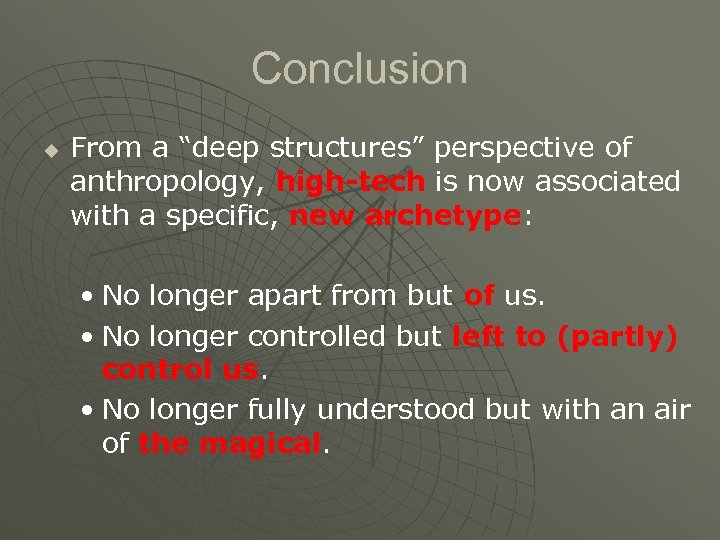 Conclusion u From a “deep structures” perspective of anthropology, high-tech is now associated with a specific, new archetype: • No longer apart from but of us. • No longer controlled but left to (partly) control us. • No longer fully understood but with an air of the magical.