


 Скачать презентацию Deficit Reduction Act of 2005 and Federal Update
dcf4c6d068dede6654c3a7c461810839.ppt
- Количество слайдов: 58
 Deficit Reduction Act of 2005 (and Federal Update) What do we do NOW? !! Kim Musheno, Director, Legislative Affairs, AUCD Anne Rohall, Director, Government Affairs, NACDD August 24, 2006 Center for Disabilities Studies Newark, Delaware 1
 What is the Deficit Reduction Act? n n Deficit Reduction Act (DRA) of 2005 (P. L. 109171) signed into law on Feb. 8, 2006 by President Bush Purpose was to reduce the deficit by reducing a wide range of Federal programs (e. g. , housing) DRA makes changes to the Medicaid statute that could negatively or positively impact beneficiaries/people with disabilities. It limits Medicaid, but also provides opportunities to increase health & community-based services Advocates must be at the table to help states make the right decisions about Medicaid! 2
 Background on the DRA Congressional Budget Office (CBO) estimates: n n n DRA will reduce Federal Medicaid spending by $7 billion from 2006 -2010 and $28 billion from 2006 -2015 DRA will result in a net savings of $4. 7 billion over 5 years 75% of DRA savings will make it more difficult for individuals to qualify for long-term care and will impact Medicaid beneficiaries 3
 Background on the DRA (cont. ) n n n Issue for advocates: is the DRA valid legislation? Lawsuits over constitutionality of the DRA Why? It’s “High School Civics 101”: The version of the DRA passed by the U. S. House on February 1, 2006 differs from the version of the DRA passed by the U. S. Senate on December 21, 2005 This technically violates the “bicameral” requirement (same version of law must be passed by House & Senate) 4
 Background on the DRA (cont. ) n Federal Medicaid law may not allow states to revise their cost-sharing requirements for certain Medicaid populations, but. . . n Some states may be forced to make changes because of their own state law requirements 5
 Interesting State Law Statistics n n n States requiring legislative approval of state plan amendments: CT, D. C. , MO, NH States with a provision requiring legislative approval of waivers: CO, FL, LA, MO, MT, NV, NH, ND, OH, OR, D. C. , WY States with statutory requirements related to Medicaid cost-sharing: AL, AK, CA, CT, FL, IN, IA, KY, ME, MA, MN, MO, NE, NJ, NM, NY, OH, OR, TX, VT, WI 6
 Interesting State Law Statistics (cont. ) States with some form of statutory Medicaid benefits requirement: AK, AZ, CA, CO, CT, ID, IL, IN, IA, ME, MD, MA, MI, MN, MS, MO, NE, ND, OH, PA n States that do not have state regulations that lay out substantive requirements for state Medicaid program: AR, CT, MI, MS, NV, ND, VT, WY n Courtesy of the National Health Law Program and National Association of Community Health Centers, Role of State Law in Limiting Medicaid Changes 7
 What about Delaware? 8
 Role of Delaware State Law on DRA Advocacy n Delaware has a State code that contains substantive provisions for the State Medicaid Program (DEL. CODE. ANN. 501 -523 (2006) n n Delaware has State regulations containing substantive provisions for the Medicaid program (See DE Register of Regulations) Delaware has a State code with an administrative procedures provision that requires public notice and comment before regulations can be changed! (DEL. CODE. ANN. 10115) 9
 The Delaware Code and Regulations are online for your searching pleasure! n http: //www. delcode. state. de. us/ n http: //regulations. delaware. gov/ default. shtml 10
 Important note for advocates: Often, state law covering Medicaid is “murky” at best! n This is a “fluid” area of the law, so advocates should always check on the status of Delaware law before mapping out an advocacy plan to prevent harmful changes to Medicaid. n 11
 Why is Medicaid the Target? What are some policymakers saying? 12
 Some say Medicaid is: n Broken n Out of control spending n Crowding out other state priorities, e. g. , education n Unsustainable in its current form 13
 Advocates need to say that Medicaid: n Works for persons with disabilities n Supports national health policy goals n Allows other parts of the health system to function n Is a good deal for states n Is a good investment, even in tough fiscal times 14
 Medicaid Works for Persons with Disabilities Yes, improvements to Medicaid are needed, but no other major public program has been more responsive to the needs of persons with disabilities… 15
 Medicaid Works for Persons with Disabilities (cont. ) n n n Largest source of funding for long-term services Largest source of funding for developmental disability services Largest source of funding for mental health services Early & Periodic Screening, Diagnosis & Treatment (EPSDT) services provide for screening, early detection and treatment of disabilities and health conditions in children (healthy children is a national priority) The so-called “optional” services tend to be disability services – that’s not good public policy! 16
 Our Nation’s Issues are BIGGER than Medicaid… Controlling health costs across all payers n Controlling escalating prescription drug costs n Financing access to new medical technology n Establishing a national system for financing long-term services for people of moderate income (takes pressure off Medicaid) n Adapting to demographic changes n 17
 What do we do now? n Advocacy is at the STATE level n “Bad things” stemming from the DRA are preventable (or can be minimized) in many cases! n There is light at the end of the tunnel! 18
 Long Term Care Options in the DRA Geared toward ending the institutional bias in Medicaid 19
 Home & Community Based Services Section 6086 Establishes HCBS as optional Medicaid benefit for certain individuals at or below 150% of poverty (about $14, 700 for individual) n A State Plan Service – no waiver required n No need to prove need for institutional level of care n Includes any services allowed under current HCBS waiver program (not room and board) n 20
 HCBS-consumer protections n Permits states to establish enrollment caps n First time waiting lists specifically put into law n New precedent for Medicaid state plan n State does not have to make services Statewide BUT services must be comparable for all populations 21
 HCBS-State requirements n States required to establish needs-based criteria for eligibility for HCBS and for institutions n Criteria for eligibility for institutions must be more stringent than for HCBS n Idea is to change the institutional bias in Medicaid 22
 HCBS Needs-based criteria n n n Assessment of support needs and capabilities May consider person’s inability to perform 2 or more activities of daily living (ADL) e. g. , bathing, dressing, transferring, toileting, eating), or need for significant assistance to perform these activities/other risk factors Permits states to modify the criteria if more people become eligible than projected! n Public gets 60 -day notice of change n Services to existing recipients guaranteed for only 12 months Eligibility determined by independent evaluation and assessment 23 Individualized plan developed
 HCBS Option Advocacy n n n - - Prepare comments to CMS when draft regulations are published – regulations govern how broad/restrictive law will be at state level Advocate for legislative/other oversight, if DE takes this option (e. g. , by P&A/consumers) Focus on: Initial & future changes to eligibility criteria Individuals who may lose HCBS eligibility under new criteria – “grandfather” them completely (not just for 12 months) Implement option statewide 24
 HCBS Option Advocacy (cont. ) Focus on (cont. ): n Ensure states do not terminate optional Medicaid services, e. g. , rehab services, and offer them to persons who qualify for the HCBS option (where number of individuals receiving the option may be CAPPED!) 25
 Self-directed Option n States may allow individuals (or representative) to self-direct purchase and control of state plan HCBS n Service plan developed based on assessment of needs n Must include person-centered process and risk management techniques 26
 Quality Assurance/effective date of Self-directed Option n HHS Secretary must consult with consumers, among others, to develop performance indicators and measure client satisfaction n Effective date is this January 1, 2007 n Federal cost is $766 million over 5 yrs. 27
 Cash and Counseling Option Section 6087 n Allows state to provide for self-direction of services (using the Cash and Counseling individual budget model) without needing to request a waiver n n Service provider may be a relative HHS Secretary must assure that state proposals include basic consumer protections Self-directed services may NOT be provided to individuals who reside in a home or property owned, operated, or controlled by a provider, not related by blood or marriage State-wideness and comparability not required 28
 Cash & Counseling, cont. n State may employ a financial management entity to make payments to providers and track costs n Reimbursed at Medicaid administrative rate (generally 50%) n Effective this January 1, 2007 n Federal costs $100 million over 5 years 29
 Cash & Counseling Advocacy n Cash & Counseling demonstrations have been studied and monitored by several groups – there are “lessons learned” that advocates should know about… n E. g. , Alliance for Health Reform has described 5 steps for getting started: www. allhealth. org 30
 Money Follows the Person Section 6071 HHS Secretary may provide competitive grants to states to increase use of Medicaid HCBS services over institutional services n Increases the Federal Medicaid match rate (FMAP) for cost of transitioning an individual from institution to community n Federal share increased to 75% to 90% depending on state n After 12 months, state continues services at regular FMAP n 31
 MFP Eligibility n Eligible if residing in institution for no less than six months or a longer time determined by state (up to maximum of 2 years) 32
 MFP State requirements – many! Must show proposed methods to increase investment in home and community-based services n Methods used to eliminate barriers to paying for LTC services in settings of individuals’ choice n Preference given to states that balance target groups and geographic distribution n Preference given to states that offer selfdirection n 33
 MFP (cont. ) $250 million for FY 2007 that begins this January 1, 2007 ($1. 8 billion over 2007 -2011 period) n $2. 4 million for technical assistance n $1. 1 million for national evaluation and report required n A copy of the “ 2006 Money Follows the Person Rebalancing Initiative Demonstration Program, ” including the application forms, can be obtained at www. grants. gov. n 34
 MFP Advocacy n n n Individuals potentially eligible for services, their family members, providers, and other interested parties MUST BE INCLUDED in developing the MFP project State will determine service area, targeted groups of eligible individuals, and number of individuals to be served, but… Advocates must be at the table to help with the rest! 35
 Family Opportunity Act Section 6061 -6062 n n n Took over six years to get enacted – championed by Sens. Grassley (R-IA) and Kennedy (D-MA) and Reps. Waxman (D-CA) and Sessions (R-TX) Creates Medicaid “buy-in” for children with disabilities with family income below 300% of poverty (monthly income of $4, 150 for a family of 3 in 2006) Premiums paid in sliding scale n under 200% of poverty, premiums and cost-sharing limited to 5% of family income n 200 -300% poverty, premiums and cost-sharing limited to 7. 5% of family income 36
 FOA cont. n Phased in coverage – in 2007, available to families with incomes up to $60, 000 for a family of four if their child is under the age of 6. n n In 2008 to children under 12; and in 2009, children under 19 Parents must participate in family group coverage if offered and employer pays at least 50% of the premium 37
 FOA cont. n n n States can establish a demonstration program for children with “potentially severe” disabilities Children who receive inpatient psychiatric services are eligible for HCB waiver services Newborns with significant disabilities are presumed eligible for Medicaid and no longer have to wait for the first day of the next month for coverage $22 million over 5 years to develop family-to-family health information centers in every state States must develop legislation to implement the FOA 38
 FOA Advocacy Advocates should note that some children may already be eligible for Medicaid under other Medicaid categories, e. g. , some kids of families with higher income brackets. n Advocates should compares cost sharing/benefits for kids who fall within 2 or more categories and decide which option is more comprehensive n 39
 FOA Advocacy (cont. ) n Advocates should monitor coordination of benefits: - Children enrolled in FOA option will have same benefit package as other needy children, including EPSDT - Medicaid would be secondary payer to any employersponsored family coverage (purchased as a condition of FOA coverage) - Some states enroll children under age 19 in “benchmark” plans with Medicaid EPSDT wraparound coverage (i. e. , 3 potential plans to coordinate!) 40
 Cost Sharing, Section 6041 n n n DRA modifies current cost-sharing provisions effective since March 31, 2006 Services can be denied for failure to pay cost-sharing For individuals below poverty, supposed to be limited to nominal standards (i. e. $3 per service) but indexed to medical inflation For individuals with incomes between 100 and 150% of poverty, premiums not permitted and cost-sharing capped at 5% total family income and 10% for item or service For individuals with incomes above 150% of poverty, cost-sharing and premiums would be allowed but capped at 5% incomes and 20% for item or service 41
 Cost sharing exemptions n 1. 2. 3. 4. 5. 6. 7. No cost-sharing on: children under 18 and foster children Preventive services to children Services to pregnant women, if services are pregnancy related Services for hospice Any inpatient in hospital, NF, ICF/MR Emergency service; and Family planning services and supplies 42
 Premiums exemptions n 1. 2. 3. 4. No premiums can be imposed on: Children and foster children Pregnant women Individuals receiving hospice care Inpatient in hospital, NF, ICF/MR 43
 Benefit package flexibility Section 6044 n n States can provide medical assistance through enrollment that provides benchmark coverage or benchmark equivalent coverage Benchmark plans may be modeled after FEHB, state employees, largest non-Medicaid HMO, actuarially equivalent coverage, or any Secretary-approved coverage EPSDT must be maintained but state can enroll kids in private plans & provide a state wrap for EPSDT coverage People with disabilities are exempted from flexible benefit packages however, CMS guidance allows states to shift protected groups into benchmark plans as long as it is “voluntary” 44
 Benefit Packages Advocacy Advocates should monitor how their state implements Section 6044 n Individuals in certain categories are excluded from mandatory participation, BUT, many folks are eligible for Medicaid under more than one category – Medicaid applicants will need to select their eligibility category carefully to avoid mandatory enrollment in a benchmark plan n 45
 Benefit Packages Advocacy (cont. ) Advocates should know that the DRA does not prohibit states from offering voluntary enrollment in the option to excluded groups n This can be confusing, especially to some individuals with developmental disabilities, and can disrupt care n Advocates should ensure that a state exercising this DRA option does so with great care – with the interest of people with disabilities in mind! n 46
 Benefit Packages Advocacy (cont. ) n n n Advocates should monitor any limits placed on benefits – scope of benefits AND delivery systems (e. g. , managed care, fee for service, vouchers) It is not clear under the DRA whether the Federal Medicaid Act’s managed care consumer protections will apply to section 6044 – new rules for accountability and consumer protection may be required… The DEVIL is in the DETAILS! 47
 Benefit Packages Advocacy (cont. ) n n n Advocates should be aware of the impact of Section 6044 benefit packages on kids and EPSDT services This section in the DRA has not been drafted clearly and there is confusion – even among advocates There is a risk that benchmark packages and wraparound EPSTD benefits could be uncoordinated Advocates should work to ensure CLEAR guidelines and education for families For DE’s track record , advocates should review how the state has coordinated the provision of services of managed care plans that do not provide the full scope of Medicaid benefits, e. g. , dental or mental health 48
 HOMEWORK for Delaware Disability Advocates… 49
 Homework (cont. ) HCBS Option: Push DE to keep people in personal care and rehab options. Push for commitment not to cap community services n Cost-sharing: Educate DE policymakers that it is counter-productive n FOA/MFP: Push DE to take advantage of these opportunities n Benefits: Pressure DE to continue providing comprehensive medically necessary Medicaid services n 50
 Homework (cont. ) n Explain to DE Policymakers that the Medicaid Institutional Bias is a Civil Rights Issue: - Medicaid has mandatory services that states must provide and optional services for which states can receive federal matching payments - Under the Medicaid Act, nursing facility services are mandatory and many community-based services are optional 51
 Homework (cont. ) n - Explain Institutional Bias in Medicaid (cont. ) Community services are scarce More than 206, 000 people with disabilities are on waiting lists for waiver services Average waiting period for some waivers is more than 2 years (Source: Disability Policy Institute) People can die while waiting for services Talk about what the DE waiting lists are like 52
 DRA Resources Online 1. 2. 3. 4. 5. 6. Centers for Medicare and Medicaid Services (CMS): www. cms. hhs. gov/Deficit. Reduction. Act/ AUCD Medicaid Resource page: http: //www. aucd. org/aucd_medicaid. htm National Disability Rights Network (NDRN): www. napas. org/policy/DRA/ Kaiser Family Foundation: http: //www. kff. org/medicaid/index. cfm National Health Law Program (NHe. LP): www. healthlaw. org Center on Budget and Policy Priorities (CBPP): www. cbpp. org 53
 Don’t forget DD Act Reauthorization! Developmental Disabilities Assistance and Bill of Rights (DD) Act is scheduled to be reauthorized in 2007 n Advocates, including the DE Council and DE UCEDD, should begin to market the Act to their Federal delegation, highlighting disability issues and projects in the state and what the Act is doing for people with disabilities in Delaware n REMEMBER: If we don’t tell Congress about the DD Act, no one else will!! n 54
 Current Political Atmosphere n n n 2006 is an election year for Congress Very few bills will pass this fall Mostly reauthorizations, not new programs Bills that contain issues that Republican party can highlight in campaigns, e. g. tax cuts, pension reform, antgay marriage amendment, etc. Even annual appropriations bills may wait until post election “lame duck” session 55
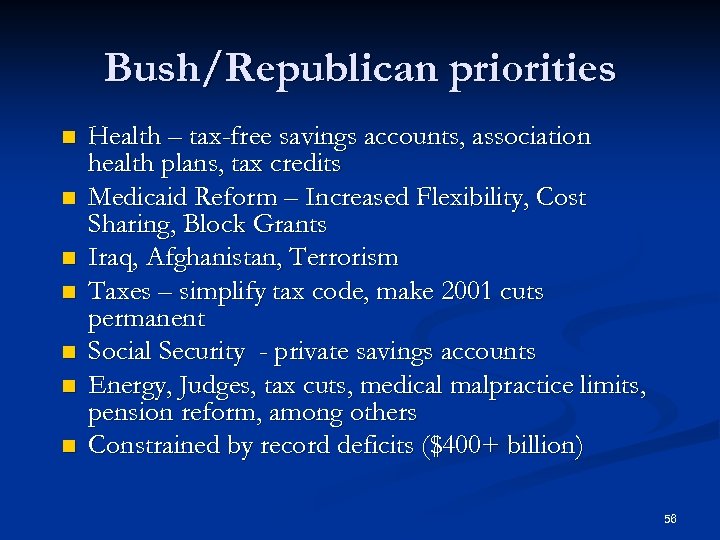 Bush/Republican priorities n n n n Health – tax-free savings accounts, association health plans, tax credits Medicaid Reform – Increased Flexibility, Cost Sharing, Block Grants Iraq, Afghanistan, Terrorism Taxes – simplify tax code, make 2001 cuts permanent Social Security - private savings accounts Energy, Judges, tax cuts, medical malpractice limits, pension reform, among others Constrained by record deficits ($400+ billion) 56
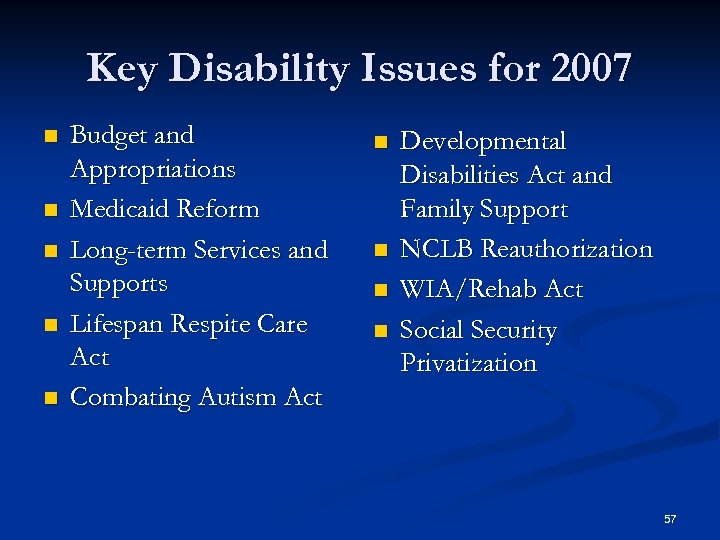 Key Disability Issues for 2007 n n n Budget and Appropriations Medicaid Reform Long-term Services and Supports Lifespan Respite Care Act Combating Autism Act n n Developmental Disabilities Act and Family Support NCLB Reauthorization WIA/Rehab Act Social Security Privatization 57
 Contact AUCD and NACDD n n Kim Musheno, Director of Legislative Affairs Association of University Centers on Disabilities n (301) 588 -8252 n kmusheno@aucd. org n http: //www. aucd. org Anne Rohall, Director, Government Relations National Association of Councils on Developmental Disabilities n (703) 739 -4400, ext. 4 n arohall@nacdd. org n http: //www. nacdd. org 58