


 Скачать презентацию Defense Trade Advisory Group DTAG Government Program License
e6213ea63cfc98cb1329b0e098f54edf.ppt
- Количество слайдов: 27
 Defense Trade Advisory Group (DTAG) Government Program License (GPL) Review Plenary Session May 3, 2011 Draft 4 -29 -11
 GPL Working Group Members Angvall, Bryon – Boeing Beiter, Jerald - Booz Allen Hamilton Bencivenga, Lisa – Lisa Bencivenga LLC Bourn, Gregory – Finmeccanica North America Carney, Ginger - Network Centric Operations Industry Consortium Cormaney, Michael - Luks Cormaney LLP Fink, Lawrence - Science Applications International Corp Hartwig, Jahna - Johns Hopkins U. Applied Physics Laboratory Hein, Tim - Alliant Tech Systems Huffman, Jeremy - Huffman Riley Kao Jordan, Peter – UTC Ketts, Robert - Cubic Defense Applications Inc. Mc. Ginn, Christine - Cobham Corporate North America Mersch, Beth - Northrop Grumman Otis, Terry - ITT Defense Rishel, Janet – Bell Helicopter Shaffer, Debbie - Southwest Research Institute Weinrod, Bruce - Woodrow Wilson International Center for Scholars White, Thomas - Lockheed Martin 2
 Agenda • • • Task DDTC Concept Construct Foreign Parties Process Amendments/Changes Advantages Issues to be addressed Recommendations Examples 3
 Task • Review the GPL concept and provide a report for discussion and answers the following questions: – Will the GPL as depicted in the concept be used/useful by the exporting community? – What modifications would the DTAG recommend to make it more useful? – Are there additional technical requirements or issues that need to be addressed? 4
 DDTC GPL Concept • USG program office would submit request for a GPL to DDTC • Request includes list of: – Foreign parties – US parties – Scope of work • GPL application would be handled by DDTC as any other license – All parties listed are validated with respect to eligibility – Application staffed according to the current procedures – GPLs that exceed CN thresholds would be notified to Congress • The final adjudicated license would be posted to the PM/DDTC website behind the DTRADE 2 external log in – Ensures that only those companies registered with DDTC and have DTRADE 2 access would be able to review the final GPL 5
 DDTC GPL Concept (continued) • Applicants listed on the GPL request to participate in exports under the program by applying for licenses in furtherance of the GPL – Submit a license application to DDTC referencing the GPL license – Blocks of the license that normally require individual entries (foreign and intermediate consignees for example), would merely list the GPL license identifier – Other blocks that are company specific (freight forwarders used only by the applicant for example) would be filled in as a normal license. • Information contained in the application will be validated as all license applications are and the license application will be staffed to the appropriate USG sponsor and Do. D 6
 DDTC GPL Concept (continued) • Once approved, the license will be provided to the applicant via DTRADE 2 and the applicant would then be authorized to participate in the program, claiming their individual export actions under their individual license • As the scope of the GPL changes, the GPL would be amended and the latest version of the GPL posted – Applicant would not be required to submit a new license to export in furtherance of the amended GPL • Industry licenses will not require notification to Congress since notification are made under the GPL • GPL could be terminated at any time as determined by either the USG sponsor or DDTC 7
 DDTC GPL Concept Technical Requirements/Issues Implementation of a Government Project License will require modifications to the current export licensing and shipping applications for – • • • Deploying USXports (necessary to capture the GPL to be available for reviewers in conjunction with applicant licenses in furtherance of the GPL) Developing a portal for USG sponsors to submit GPLs and to amend as necessary Developing a portal for listing approved GPLs and their various versions that is available only to registered parties Adding a flag to identify that an application submitted is a GPL from a USG sponsor Versioning of the GPL identifier in USXports Developing a portal or other transmission method to provide GPLs to Census Bureau and CBP Modifying the existing fields in D-Trade so the reference to the GPL in various fields would not be rejected on submission of the license and accept a larger submissions in certain blocks. Modifying the AES fields to correspond the to the D-Trade changes to fields to accept larger submissions Increased flexibility for querying and reporting against authorizations and actual exports against GPLs 8
 Construct • • Any USG program is a potential candidate for a GPL, for example: – NASA – Do. D – NSA – DHS – MDA The GPL is a cooperative effort between the USG and US industry (i. e. , not between US industry and foreign industry) Initiation – USG sponsor may propose GPL to contractors – US contractor(s) proposes GPL to US program office USG sponsor “Program Office” is responsible for preparing the scope of the GPL – Assisted by the prime and major sub-contractors – Includes – to the extent possible at beginning stages – identification and roles of domestic and foreign participants and their sub-contractors at various levels – GPL scope based on USG contract or cooperative agreement SOW – Identifies overall terms/conditions 9
 Construct (Continued) • The scope of the GPL and corresponding limitations/provisos may be divided into various sub-elements depending upon the complexity of the program and technology transfer concerns – Primary structural elements – Propulsion – Weapons – Sensors (e. g. , radar, EW, EO/IR etc. ) – Software development and software documentation – Communications including command & control systems – Technology (e. g. , design, manufacturing, test/ validation) – Hydraulic/ mechanical/ electrical systems – Parts/components/materials for all of the above (includes MDE and SME) • Retransfer of data/hardware among the approved US and 10 foreign entities identified in the GPL would be authorized
 Construct (Continued) • USG Program Office must be able to amend the GPL (e. g. , add scope or additional parties) in an efficient manner – Not all participants will be identifiable at the outset of the program (e. g. , 2 nd or 3 rd tier subcontractors, foreign third parties) – Process needed to ensure that potential participants at all levels are aware of and can benefit from GPL (e. g. , posting on DDTC website, single point of contact at Program Office, etc. ) • Program Office identifies responsible USG Point of Contact for GPL questions and modifications (e. g. may be Prime Contracting Officer or Foreign Disclosure Officer) 11
 Foreign Parties Foreign parties are bound by ITAR requirements when they receive defense articles or defense services; no need to add redundant restrictions 12
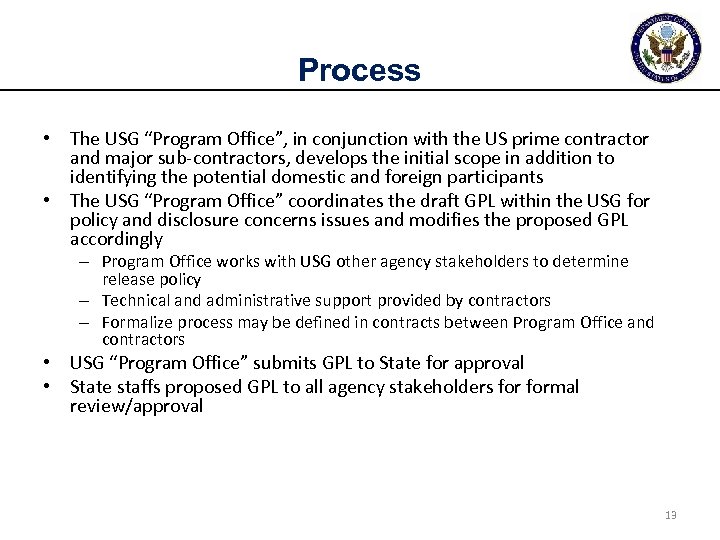 Process • The USG “Program Office”, in conjunction with the US prime contractor and major sub-contractors, develops the initial scope in addition to identifying the potential domestic and foreign participants • The USG “Program Office” coordinates the draft GPL within the USG for policy and disclosure concerns issues and modifies the proposed GPL accordingly – Program Office works with USG other agency stakeholders to determine release policy – Technical and administrative support provided by contractors – Formalize process may be defined in contracts between Program Office and contractors • USG “Program Office” submits GPL to State for approval • State staffs proposed GPL to all agency stakeholders formal review/approval 13
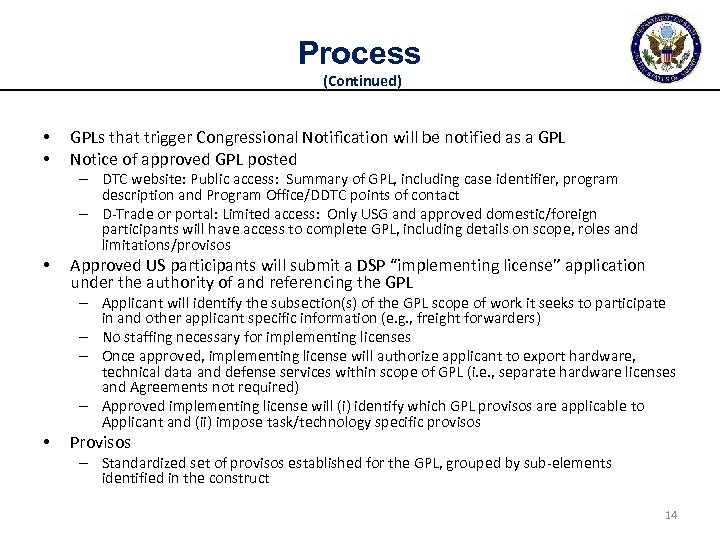 Process (Continued) • • GPLs that trigger Congressional Notification will be notified as a GPL Notice of approved GPL posted – DTC website: Public access: Summary of GPL, including case identifier, program description and Program Office/DDTC points of contact – D-Trade or portal: Limited access: Only USG and approved domestic/foreign participants will have access to complete GPL, including details on scope, roles and limitations/provisos • Approved US participants will submit a DSP “implementing license” application under the authority of and referencing the GPL – Applicant will identify the subsection(s) of the GPL scope of work it seeks to participate in and other applicant specific information (e. g. , freight forwarders) – No staffing necessary for implementing licenses – Once approved, implementing license will authorize applicant to export hardware, technical data and defense services within scope of GPL (i. e. , separate hardware licenses and Agreements not required) – Approved implementing license will (i) identify which GPL provisos are applicable to Applicant and (ii) impose task/technology specific provisos • Provisos – Standardized set of provisos established for the GPL, grouped by sub-elements identified in the construct 14
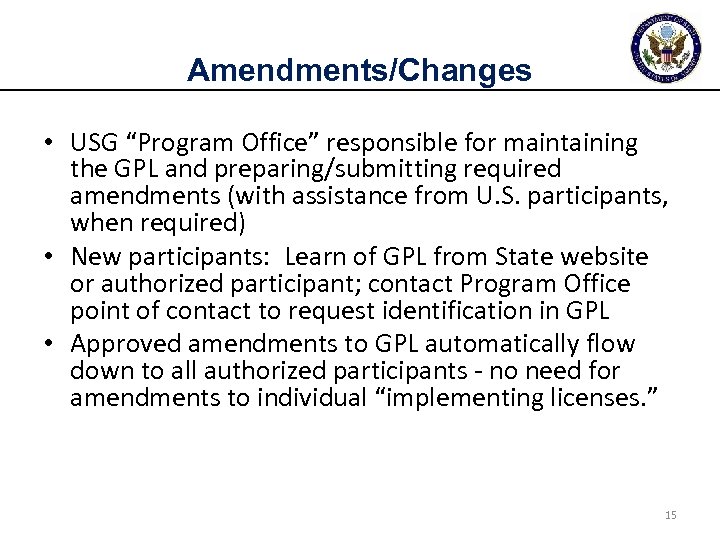 Amendments/Changes • USG “Program Office” responsible for maintaining the GPL and preparing/submitting required amendments (with assistance from U. S. participants, when required) • New participants: Learn of GPL from State website or authorized participant; contact Program Office point of contact to request identification in GPL • Approved amendments to GPL automatically flow down to all authorized participants - no need for amendments to individual “implementing licenses. ” 15
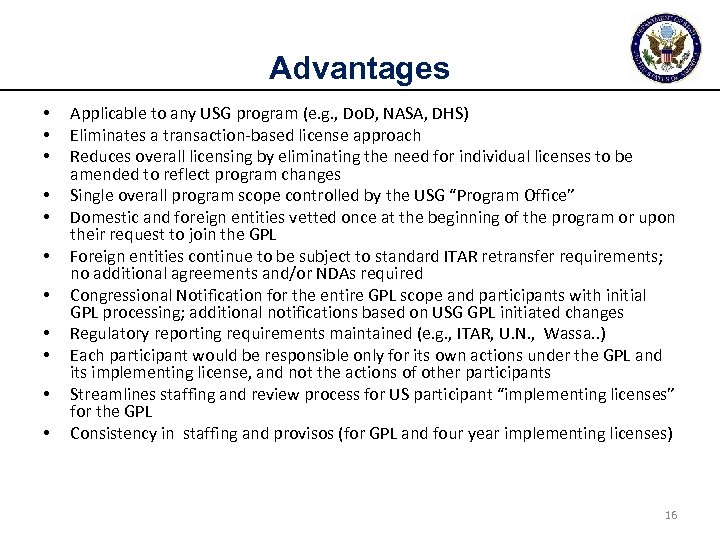 Advantages • • • Applicable to any USG program (e. g. , Do. D, NASA, DHS) Eliminates a transaction-based license approach Reduces overall licensing by eliminating the need for individual licenses to be amended to reflect program changes Single overall program scope controlled by the USG “Program Office” Domestic and foreign entities vetted once at the beginning of the program or upon their request to join the GPL Foreign entities continue to be subject to standard ITAR retransfer requirements; no additional agreements and/or NDAs required Congressional Notification for the entire GPL scope and participants with initial GPL processing; additional notifications based on USG GPL initiated changes Regulatory reporting requirements maintained (e. g. , ITAR, U. N. , Wassa. . ) Each participant would be responsible only for its own actions under the GPL and its implementing license, and not the actions of other participants Streamlines staffing and review process for US participant “implementing licenses” for the GPL Consistency in staffing and provisos (for GPL and four year implementing licenses) 16
 Issues To Be Addressed • Development and maintenance of the scope as well as timely tracking of additions/ deletions of approved participants including second and third tier suppliers • Automated mechanism (DTRADE or other) enabled to allow submission of GPLs by USG “Program Office, ” flagging of “implementing licenses” tied to the specific GPL, updating of approved GPL and access to approved GPL by authorized parties • Assess whether FAR or other regulations are impacted • Flow down/Involvement of GPL to lower tier suppliers, education of the supplier base 17
 Recommendations • To ensure that all potential participants (including lower-tier suppliers) are aware of the GPL, State should post a notice available to the public on its website when a GPL is approved that provides: – Point of contact at the USG “Program Office” to provide a path to entry for new participants – Primary/alternate DDTC licensing officers to provide consistency in implementing licensing process (similar to what is currently done on the F-35 program) • • • State should provide USG agencies with general guidelines with respect to the criteria required for establishment of a GPL (e. g. , similar to DDTC “Agreement Guidelines”) State should provide US industry “how to” guidance for preparation and submission of GPL “implementing licenses” Allow for expansion of GPL to additional scope to support FMS or DCS customers as applicable Extend period for implementing licenses to six years Provisos broken into party-specific subsets as applicable 18
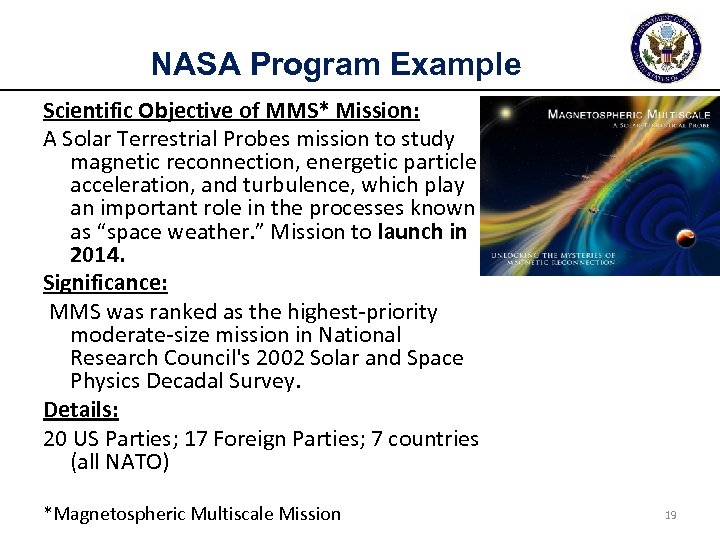 NASA Program Example Scientific Objective of MMS* Mission: A Solar Terrestrial Probes mission to study magnetic reconnection, energetic particle acceleration, and turbulence, which play an important role in the processes known as “space weather. ” Mission to launch in 2014. Significance: MMS was ranked as the highest-priority moderate-size mission in National Research Council's 2002 Solar and Space Physics Decadal Survey. Details: 20 US Parties; 17 Foreign Parties; 7 countries (all NATO) *Magnetospheric Multiscale Mission 19
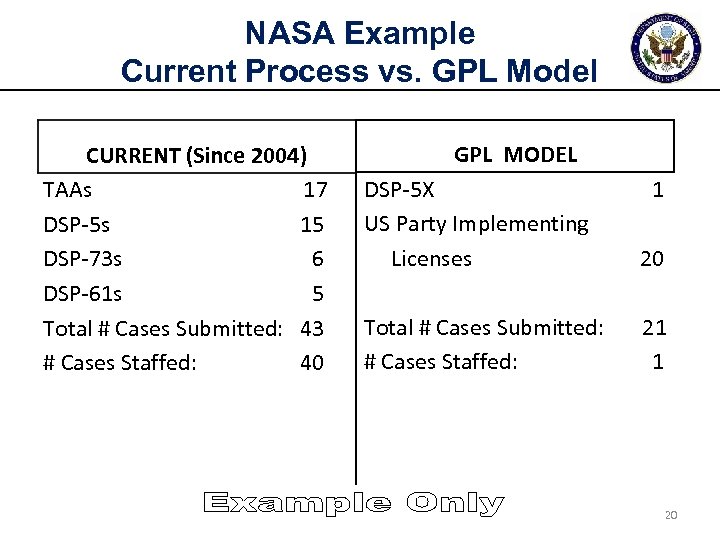 NASA Example Current Process vs. GPL Model CURRENT (Since 2004) TAAs 17 DSP-5 s 15 DSP-73 s 6 DSP-61 s 5 Total # Cases Submitted: 43 # Cases Staffed: 40 GPL MODEL DSP-5 X 1 US Party Implementing Licenses 20 Total # Cases Submitted: 21 # Cases Staffed: 1 20
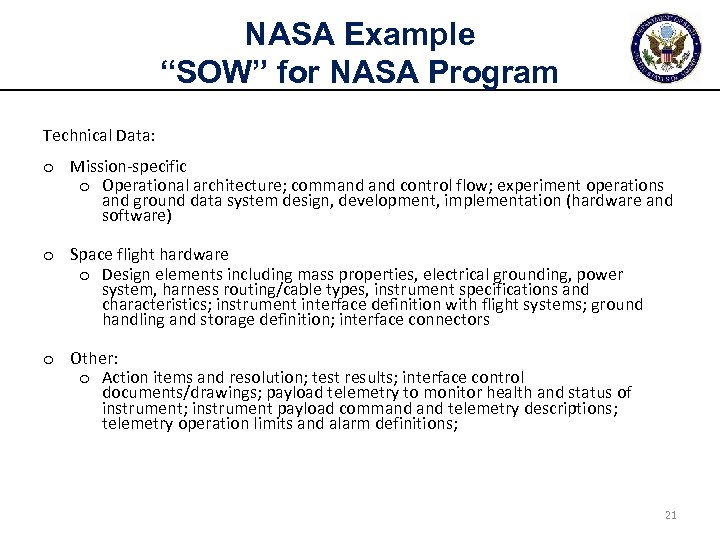 NASA Example “SOW” for NASA Program Technical Data: o Mission-specific o Operational architecture; command control flow; experiment operations and ground data system design, development, implementation (hardware and software) o Space flight hardware o Design elements including mass properties, electrical grounding, power system, harness routing/cable types, instrument specifications and characteristics; instrument interface definition with flight systems; ground handling and storage definition; interface connectors o Other: o Action items and resolution; test results; interface control documents/drawings; payload telemetry to monitor health and status of instrument; instrument payload command telemetry descriptions; telemetry operation limits and alarm definitions; 21
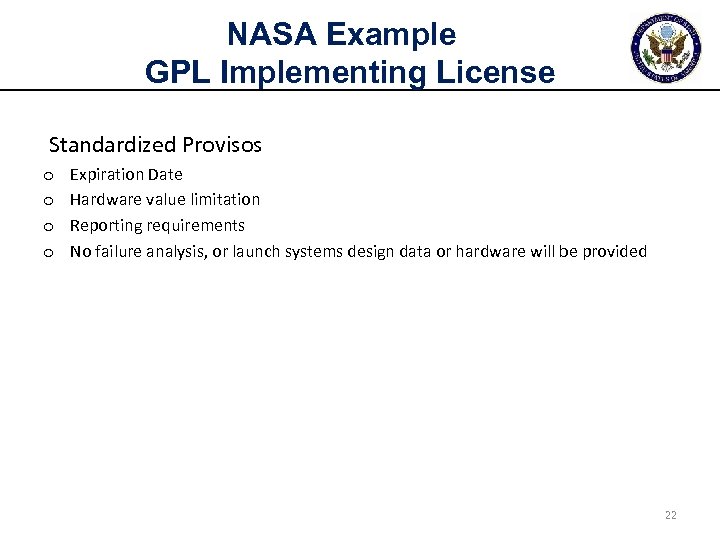 NASA Example GPL Implementing License Standardized Provisos o o Expiration Date Hardware value limitation Reporting requirements No failure analysis, or launch systems design data or hardware will be provided 22
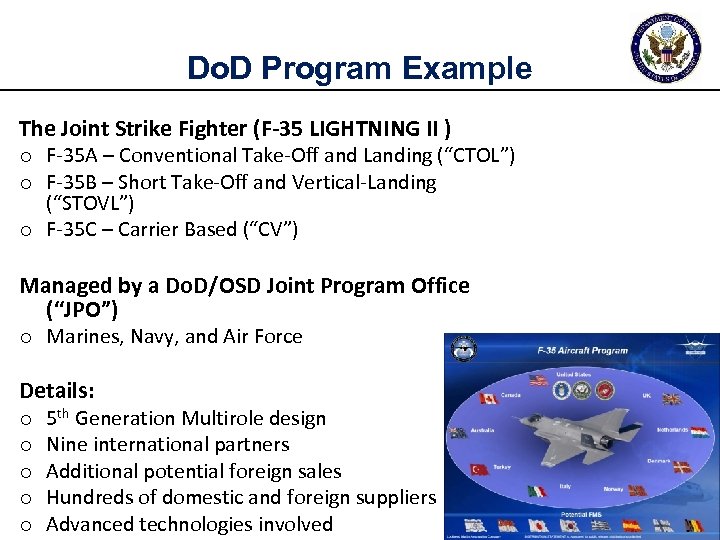 Do. D Program Example The Joint Strike Fighter (F-35 LIGHTNING II ) o F-35 A – Conventional Take-Off and Landing (“CTOL”) o F-35 B – Short Take-Off and Vertical-Landing (“STOVL”) o F-35 C – Carrier Based (“CV”) Managed by a Do. D/OSD Joint Program Office (“JPO”) o Marines, Navy, and Air Force Details: o o o 5 th Generation Multirole design Nine international partners Additional potential foreign sales Hundreds of domestic and foreign suppliers Advanced technologies involved 23
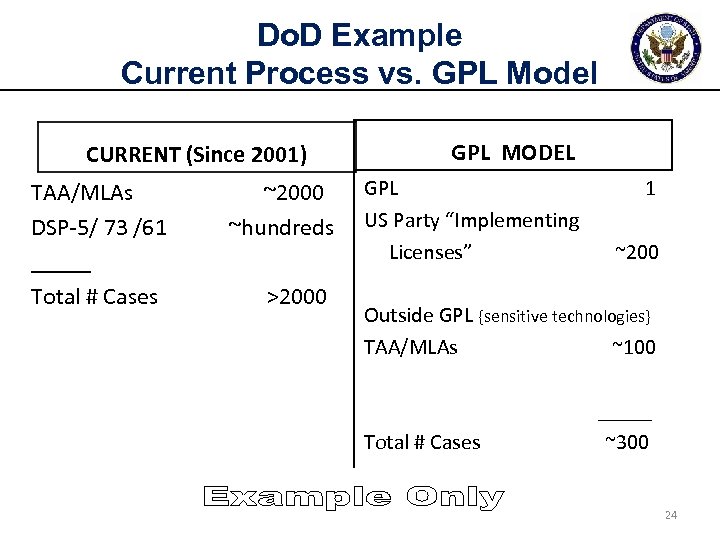 Do. D Example Current Process vs. GPL Model CURRENT (Since 2001) TAA/MLAs ~2000 DSP-5/ 73 /61 ~hundreds _____ Total # Cases >2000 GPL MODEL GPL 1 US Party “Implementing Licenses” ~200 Outside GPL {sensitive technologies} TAA/MLAs ~100 _____ Total # Cases ~300 24
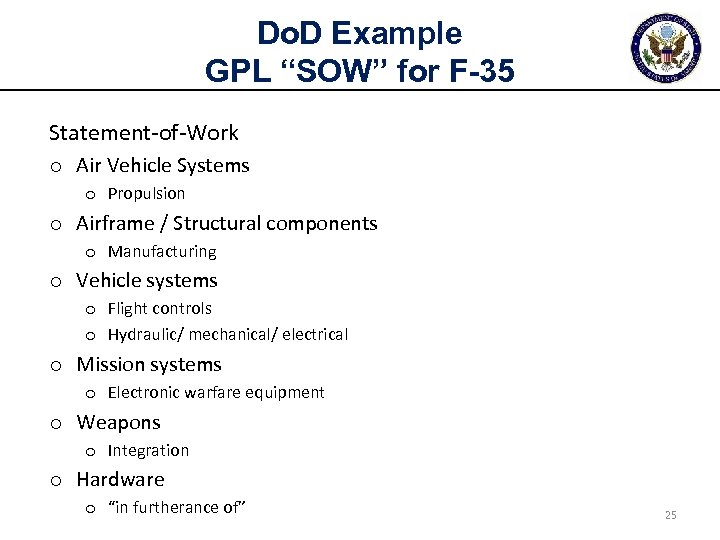 Do. D Example GPL “SOW” for F-35 Statement-of-Work o Air Vehicle Systems o Propulsion o Airframe / Structural components o Manufacturing o Vehicle systems o Flight controls o Hydraulic/ mechanical/ electrical o Mission systems o Electronic warfare equipment o Weapons o Integration o Hardware o “in furtherance of” 25
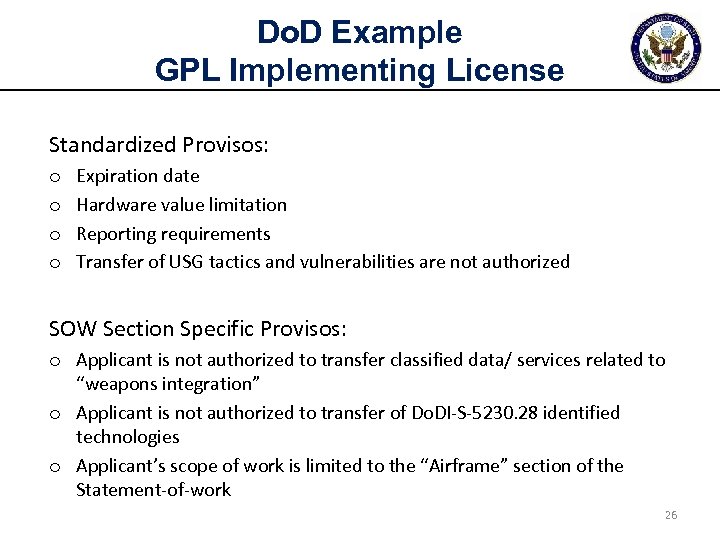 Do. D Example GPL Implementing License Standardized Provisos: o o Expiration date Hardware value limitation Reporting requirements Transfer of USG tactics and vulnerabilities are not authorized SOW Section Specific Provisos: o Applicant is not authorized to transfer classified data/ services related to “weapons integration” o Applicant is not authorized to transfer of Do. DI-S-5230. 28 identified technologies o Applicant’s scope of work is limited to the “Airframe” section of the Statement-of-work 26
 Defense Trade Advisory Group (DTAG) GPL Review Questions?