


 Скачать презентацию Defense Support of Civil Authorities Edwin A Hurston
8ddcee43cec24c40e18d25aff577dbf6.ppt
- Количество слайдов: 45
 Defense Support of Civil Authorities Edwin A. Hurston, CEM 21 September 2012 1
 Learning Objective Summarize the mechanisms and constraints of Homeland Defense Support of Civil Authorities (DSCA) while preparing for and responding to an emergency in accordance with Do. D instructions and policies. 2
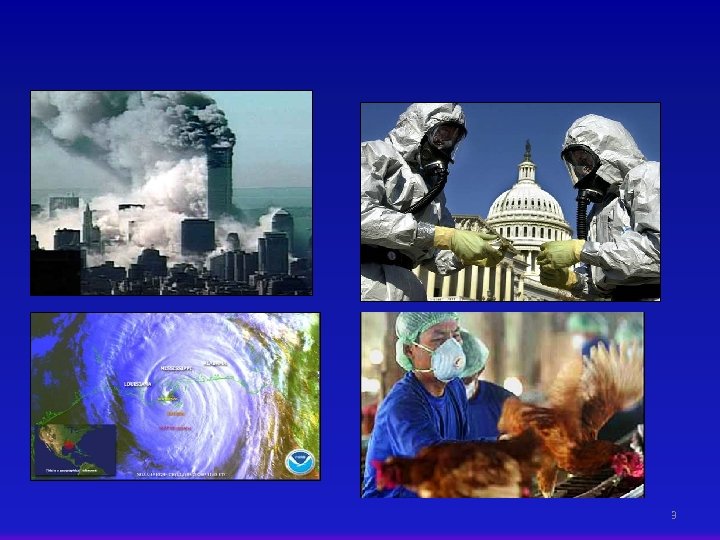 3
3
 Definitions • Homeland Defense (HD): The protection of United States sovereignty, territory, domestic population, and critical defense infrastructure against external threats and aggression or other threats as directed by the President. (JP 3 -27) • Homeland Security (HS): A concerted national effort to prevent terrorist attacks within the United States, reduce America’s vulnerability to terrorism, and minimize the damage and recover from attacks that do occur. (JP 3 -28) • Civil Support (CS): Do. D support to US civil authorities foreign or domestic emergencies, and for designated law enforcement and other activities. (JP 3 -28) 4
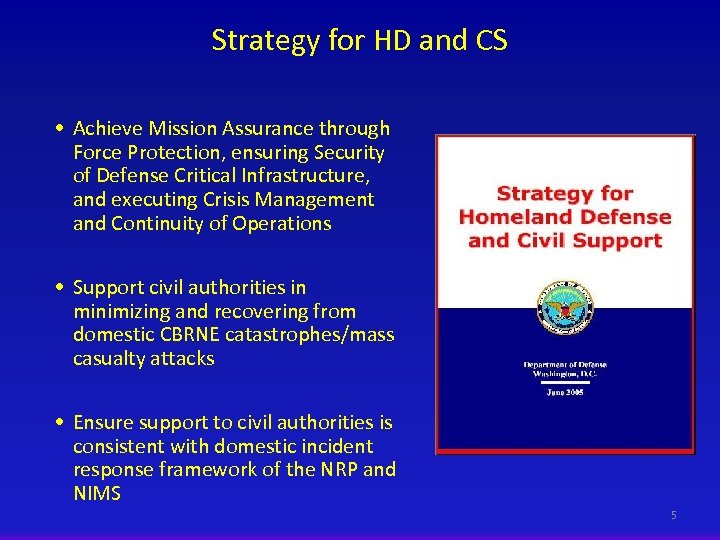 Strategy for HD and CS • Achieve Mission Assurance through Force Protection, ensuring Security of Defense Critical Infrastructure, and executing Crisis Management and Continuity of Operations • Support civil authorities in minimizing and recovering from domestic CBRNE catastrophes/mass casualty attacks • Ensure support to civil authorities is consistent with domestic incident response framework of the NRP and NIMS 5
 Strategy for HD and CS • Achieving Mission Assurance through: – Ensure Force Protection – Preparedness and protection of defense critical infrastructure – Preparedness of the Defense Industrial Base – Defense crisis management and Do. D continuity preparedness 6
 Strategy for HD and CS • Improving US and International Capabilities for Homeland Defense and Homeland Security through: – Improved interagency planning and interoperability – Improved State and local partnership capacity and effective domestic relationships – Improved international partnership capacity and effective defense-to-defense relationships 7
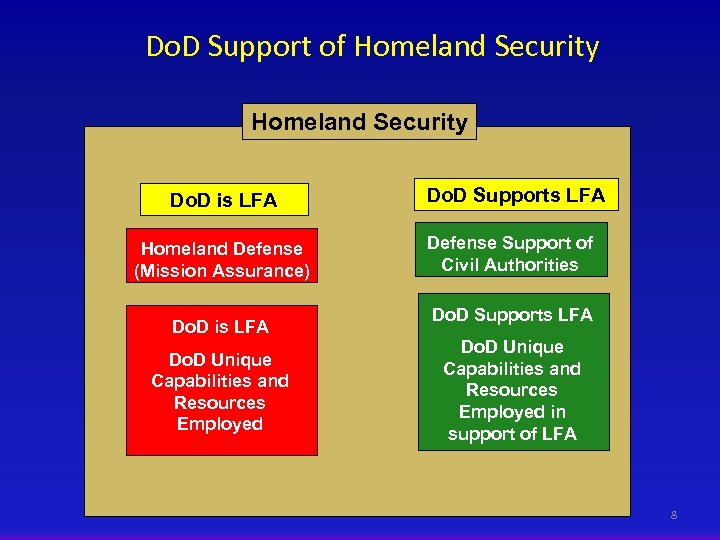 Do. D Support of Homeland Security Do. D is LFA Homeland Defense (Mission Assurance) Do. D is LFA Do. D Unique Capabilities and Resources Employed Do. D Supports LFA Defense Support of Civil Authorities Do. D Supports LFA Do. D Unique Capabilities and Resources Employed in support of LFA 8
 Defense Support of Civil Authorities (DSCA) Support provided by U. S. Federal military forces, Do. D civilians, Do. D contract personnel, Do. D Component assets, and National Guard forces (when the Secretary of Defense, in coordination with the Governors of the affected States, elects and requests to use those forces in Title 32, U. S. C. , status) in response to requests for assistance from civil authorities for domestic emergencies, law enforcement support, and other domestic activities, or from qualifying entities for special events. (Do. DD 3025. 18) 9
 Do. DD 3025. 18, “Defense Support of Civil Authorities (DSCA)” • Establishes DSCA policy – Combines MSCA, MACA, & MACDIS • Authorizes immediate response authority for providing DSCA (to save lives, prevent human suffering, or mitigate great property damage) • Requires DSCA requests be in writing and include an offer to reimburse Do. D • Requests shall be evaluated for: - Legality - Cost - Lethality - Appropriateness - Risk - Readiness 10
 Declarations and Authorizations • President can declare National Emergency through National Emergencies Act • President can declare major disaster through the Stafford Act • Secretary of Department of Health & Human Services can declare Public Health Emergency 11
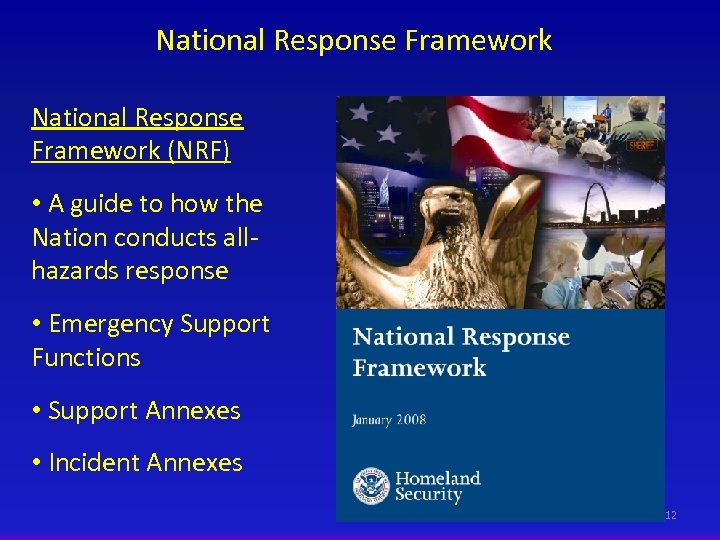 National Response Framework (NRF) • A guide to how the Nation conducts allhazards response • Emergency Support Functions • Support Annexes • Incident Annexes 12
 NRF Signatories Provide Resources & Support 13
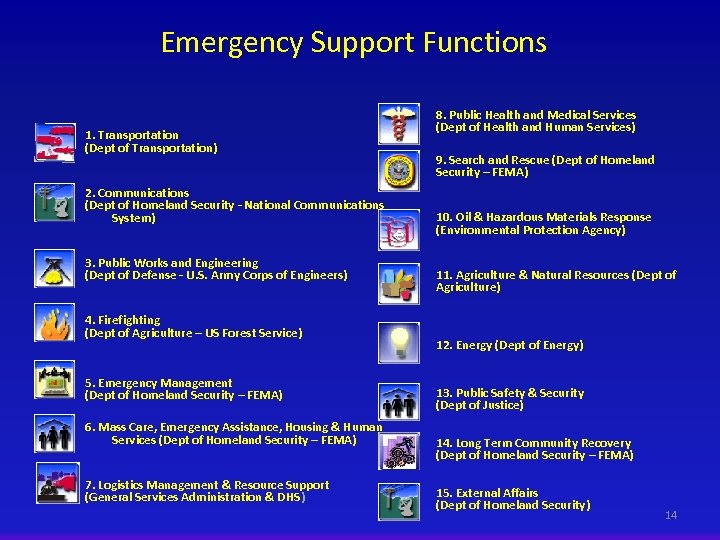 Emergency Support Functions 1. Transportation (Dept of Transportation) 2. Communications (Dept of Homeland Security - National Communications System) 3. Public Works and Engineering (Dept of Defense - U. S. Army Corps of Engineers) 4. Firefighting (Dept of Agriculture – US Forest Service) 5. Emergency Management (Dept of Homeland Security – FEMA) 6. Mass Care, Emergency Assistance, Housing & Human Services (Dept of Homeland Security – FEMA) 7. Logistics Management & Resource Support (General Services Administration & DHS) • • 8. Public Health and Medical Services (Dept of Health and Human Services) • 9. Search and Rescue (Dept of Homeland Security – FEMA) • • 10. Oil & Hazardous Materials Response (Environmental Protection Agency) • 11. Agriculture & Natural Resources (Dept of Agriculture) • 12. Energy (Dept of Energy) • • 13. Public Safety & Security (Dept of Justice) • • 14. Long Term Community Recovery (Dept of Homeland Security – FEMA) • • 15. External Affairs (Dept of Homeland Security) 14
 15
15
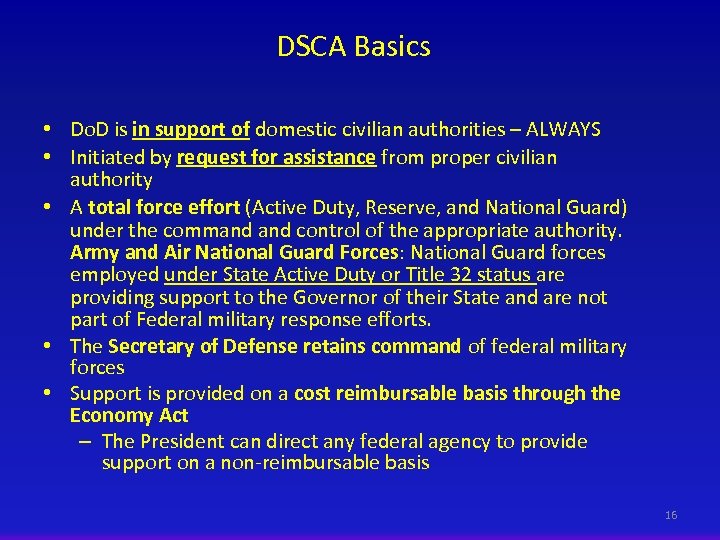 DSCA Basics • Do. D is in support of domestic civilian authorities – ALWAYS • Initiated by request for assistance from proper civilian authority • A total force effort (Active Duty, Reserve, and National Guard) under the command control of the appropriate authority. Army and Air National Guard Forces: National Guard forces employed under State Active Duty or Title 32 status are providing support to the Governor of their State and are not part of Federal military response efforts. • The Secretary of Defense retains command of federal military forces • Support is provided on a cost reimbursable basis through the Economy Act – The President can direct any federal agency to provide support on a non-reimbursable basis 16
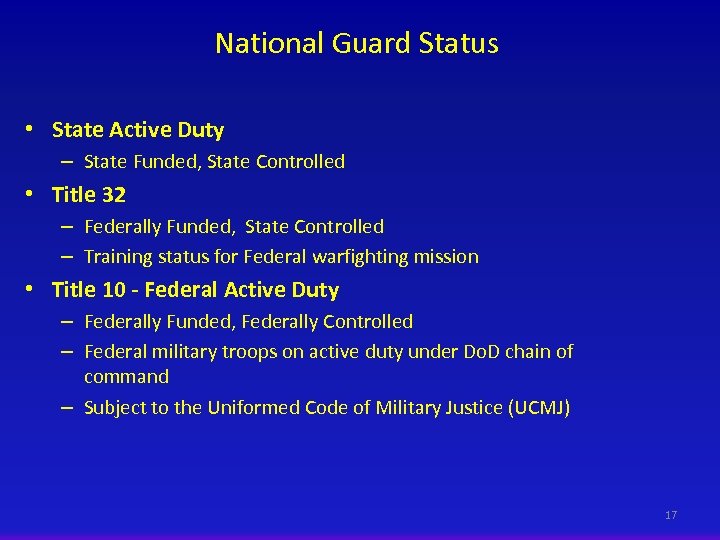 National Guard Status • State Active Duty – State Funded, State Controlled • Title 32 – Federally Funded, State Controlled – Training status for Federal warfighting mission • Title 10 - Federal Active Duty – Federally Funded, Federally Controlled – Federal military troops on active duty under Do. D chain of command – Subject to the Uniformed Code of Military Justice (UCMJ) 17
 Restrictions on the Employment of Do. D • • Local and state civilian resources applied first DOD resources used only when response is beyond capabilities of civil authorities on a cost reimbursable basis • • • Only minimum essential resources No violation of Posse Comitatus Act (no law enforcement) No competition with private enterprise Military chain of command Generally, military operations other than DSCA have priority unless directed by SECDEF **DOD is last in and first out-Very Expensive** 18
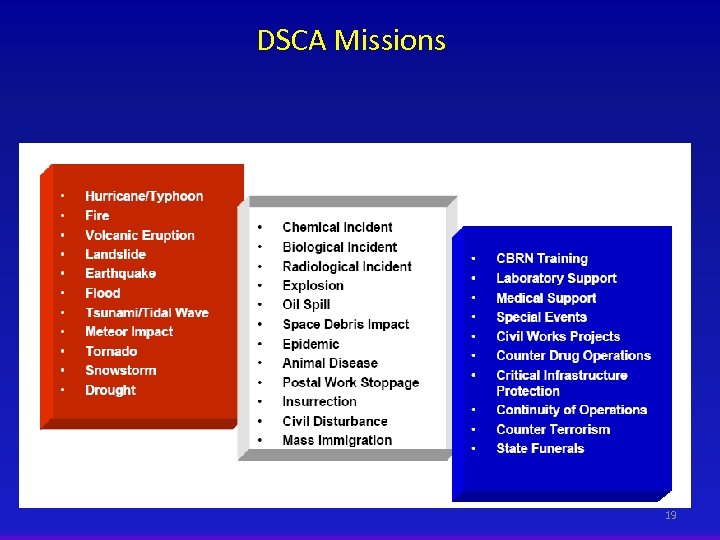 DSCA Missions 19
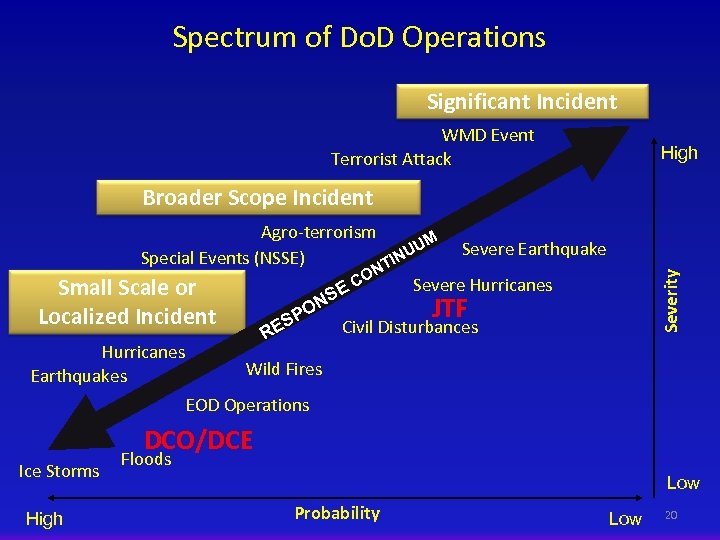 Spectrum of Do. D Operations Significant Incident WMD Event Terrorist Attack High Broader Scope Incident Localized Incident Hurricanes Earthquakes ES R S ON P Severity Agro-terrorism M Severe Earthquake UU Special Events (NSSE) IN T ON Severe Hurricanes Small Scale or EC JTF Civil Disturbances Wild Fires EOD Operations DCO/DCE Ice Storms High Floods Low Probability Low 20
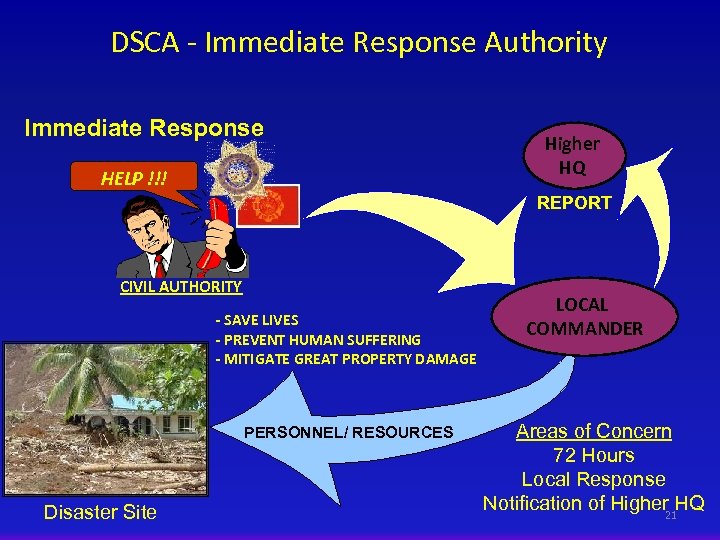 DSCA - Immediate Response Authority Immediate Response HELP !!! Higher HQ REPORT CIVIL AUTHORITY - SAVE LIVES - PREVENT HUMAN SUFFERING - MITIGATE GREAT PROPERTY DAMAGE PERSONNEL/ RESOURCES Disaster Site LOCAL COMMANDER Areas of Concern 72 Hours Local Response Notification of Higher HQ 21
 Immediate Response • A Federal military commander’s or responsible Do. D civilian official’s authority to temporarily employ resources to: – Save lives, prevent human suffering, or mitigate property damage – Imminently serious conditions must exist – Assistance is requested by appropriate civilian authorities – Support is provided on a reimbursable basis (not delayed/denied) • Urgency of request does not permit advanced approval from higher headquarters – National Military Command Center notification required • Requested support is reassessed for urgency and need within 72 hours 22
 Immediate Response Examples • Air compression chambers for trapped miners • Aerial Evacuation (fixed wing) to critical care patients (Hurricane Isadore) • Medical support to 40 nursing home patients at Keesler AFB, MS (Hurricane Ivan) • Helicopter water bucket operations (California Fires) • Fire fighting trucks and equipment responding off post to protect threatened structures • Transportation support to move disaster relief supplies • HAZMAT Teams responding to chemical spill resulting from a train derailment 23
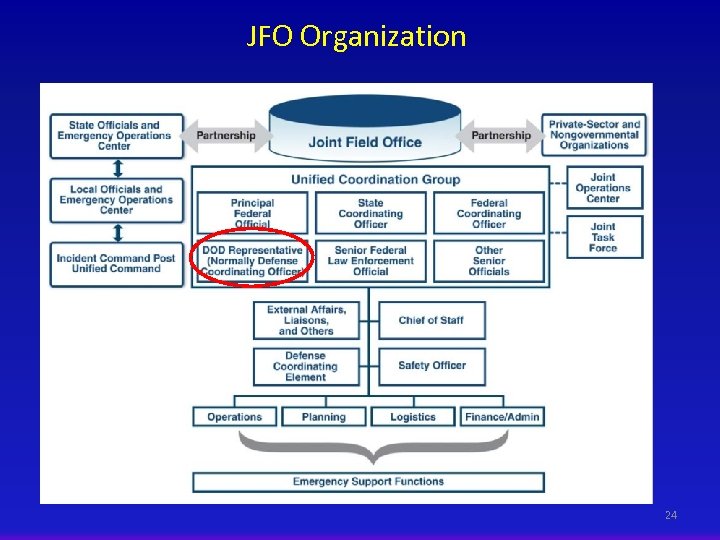 JFO Organization 24
 25
25
 Roles and Responsibilities • Defense Coordinating Officer (DCO) • Emergency Preparedness Liaison Officer (EPLO) • Joint Regional Medical Planning Officers (JRMP) 26
 “How Do. D Gets to the Fight” 27
 Key DOD Players • Assistant Secretary of Defense (Homeland Defense & Americas’ Security Affairs) • Supervises Homeland Defense Activities • Do. D Domestic Crisis Manager • The Joint Staff, Joint Director of Military Support • Action Agent for DSCA • Liaison between DOD and Lead Federal Agencies • Focal point for coordination with COCOMS, Service and National Guard 28
 Key DOD Players • Supported Combatant Commanders • Principal Planning Agents • Supporting Combatant Commanders • Provides resources and assets to COCOMS • Military Department Services – Establish the necessary policies and procedures to ensure the appropriate personnel are trained to execute DSCA plans – Direct that requests for reimbursement of actual DSCA expenditures (performance of work or services, payments to contractors, or delivery from inventory) begin within 30 calendar days after the month in which performance occurred 29
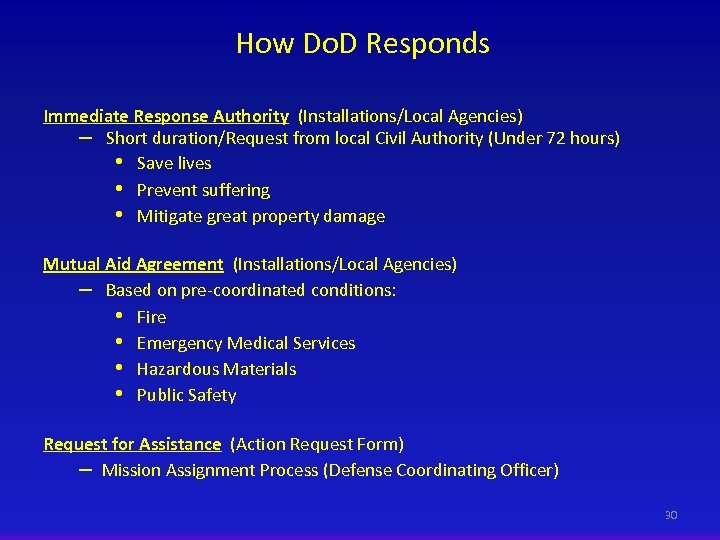 How Do. D Responds Immediate Response Authority (Installations/Local Agencies) – Short duration/Request from local Civil Authority (Under 72 hours) • Save lives • Prevent suffering • Mitigate great property damage Mutual Aid Agreement (Installations/Local Agencies) – Based on pre-coordinated conditions: • Fire • Emergency Medical Services • Hazardous Materials • Public Safety Request for Assistance (Action Request Form) – Mission Assignment Process (Defense Coordinating Officer) 30
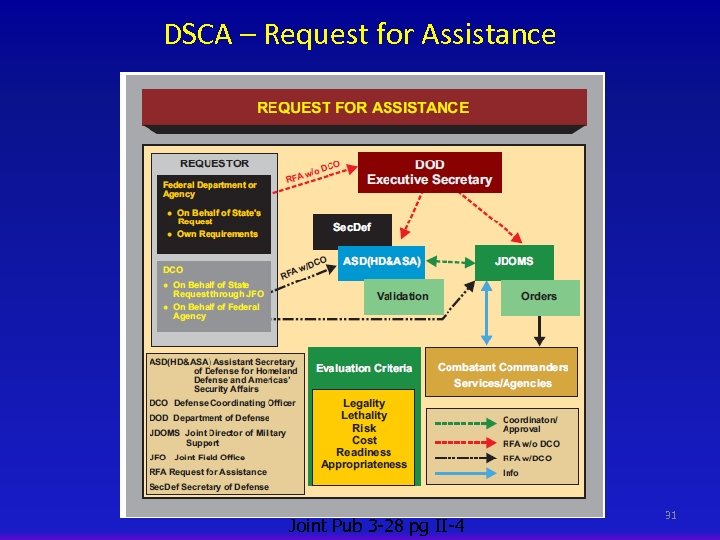 DSCA – Request for Assistance Joint Pub 3 -28 pg II-4 31
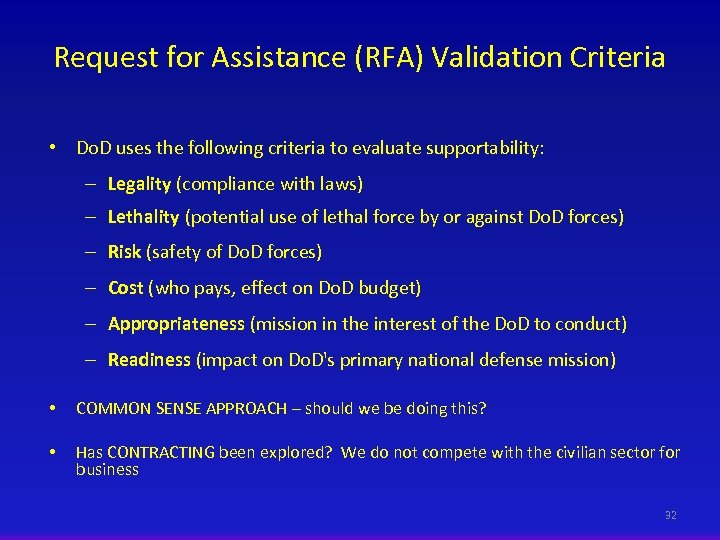 Request for Assistance (RFA) Validation Criteria • Do. D uses the following criteria to evaluate supportability: – Legality (compliance with laws) – Lethality (potential use of lethal force by or against Do. D forces) – Risk (safety of Do. D forces) – Cost (who pays, effect on Do. D budget) – Appropriateness (mission in the interest of the Do. D to conduct) – Readiness (impact on Do. D's primary national defense mission) • COMMON SENSE APPROACH – should we be doing this? • Has CONTRACTING been explored? We do not compete with the civilian sector for business 32
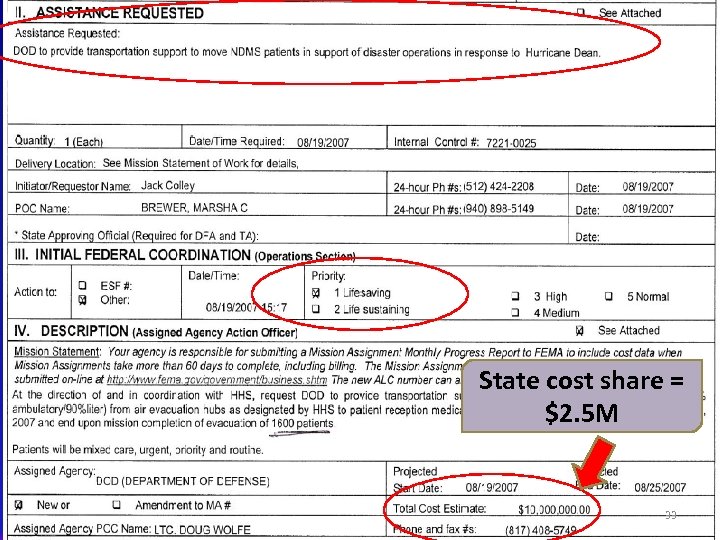 State cost share = $2. 5 M 33
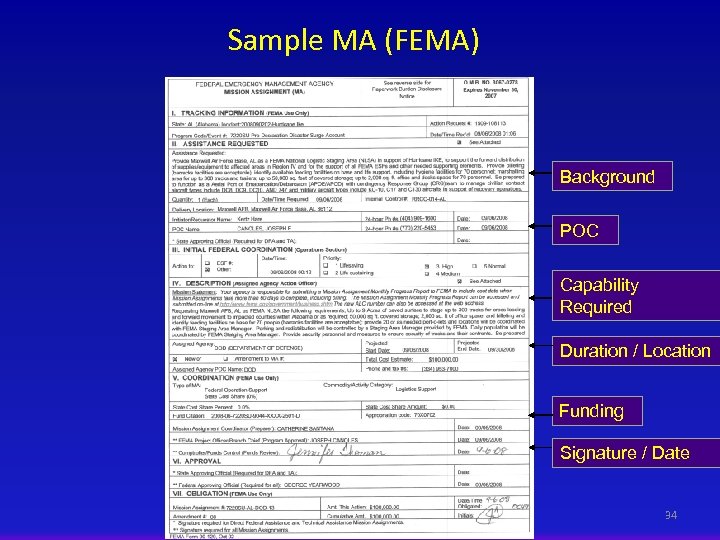 Sample MA (FEMA) Background POC Capability Required Duration / Location Funding Signature / Date 34
 Pre-Planned Employment of MHS Asset and Capabilities • Pre-scripted RFAs and Mission Assignments (PSMAs) (26) ESF#8 Do. D PSMAs – Rotary Wing Medical Evacuation – Temporary Medical Facilities – Staff Augmentation to local hospitals – Patient Movement • Standing Execute Orders (EXORD) – DSCA EXORD (unclassified) – Chemical, Biological, Radiological, Nuclear, High-Yield Explosive (CBRNE) EXORD (classified) 35
 Requests for Forces (RFF) ØRFF – Submitted to request units or capabilities to fill un-forecasted requirements within an AOR that cannot be sourced by redistribution of existing forces. ü Used to obtain DOD assets not assigned that may be necessary to support requested DOD capabilities 36
 DSCA Standing Execute Orders • Category 1 - Assigned and Allocated Forces • Category 2 – Pre-Identified Resources • Category 3 – Resources for Internal use – To support Do. D / Do. D Funded • Category 4 – Large-Scale Response Resources • Also covers Authorities / Command & Control (C 2) structure – Operational Control / Tactical Control 37
 Relevant Do. D Issuances for HD/DSCA • Do. DI 3025. 18, “Defense Support of Civil Authorities (DSCA)” 29 Dec 2010 • Do. DI 6055. 17, Do. D Installation Emergency Management (IEM) Program, 19 November 2010 • Do. DD 3020. 40, “Defense Critical Infrastructure Program (DCIP)” 19 Aug 2005 • Do. DI 3020. 45, “DCIP Management” 21 Apr 2008 • Do. DD 2000. 12, “Do. D Antiterrorism Program” 21 Nov 2003 in revision 38
 Relevant Do. D Issuances for HD/DSCA • Do. DI 6200. 03, “Public Health Emergency Management Within Do. D” 5 March 2010 • Do. DI 3020. 52, “Do. D Installation CBRNE Preparedness Standards“, 18 May 2012 • Do. DI 6010. 22, “National Disaster Medical System”, 24 November 2003 • Do. DI 6440. 03, “Defense Laboratory Network” 10 June 2011 39
 Do. DI 6055. 17, Do. D Installation Emergency Management (IEM) Program • Establishes IEM policy and procedures for response to allhazards incidents • Aligns Do. D Emergency Management (EM) activities with NIMS and the NRF • Established Do. D level EM Steering Group • Requires establishment of an Installation Emergency Management Working Group 40
 Do. DD 3020. 40 and Do. DI 3020. 45 Defense Critical Infrastructure Program (DCIP) • Assigns responsibilities governing risk management including the acceptance, remediation, and/or mitigation of Defense Critical Infrastructure risks • Implements Do. D’s critical infrastructure/key resource responsibilities as a federal agency under HSPD-7 • Assigns lead agents with Do. D for various sectors – ASD(HA) lead for the “Health Sector” 41
 Do. DI 3020. 52, Do. D Installation CBRNE Preparedness Standards • Guidance for the establishment of a CBRNE preparedness program for emergency responders at all Do. D installations • Multi-layered approaches of active and passive deterrence, including dedicating resources to Consequence Management • Replaces Do. DI 2000. 18, “Do. D Installation CBRNE Emergency Response Guidelines” 42
 Do. DI 6440. 03, “Defense Laboratory Network” Establishes a forum that allows Do. D laboratories, programs, and activities with analytic or response capabilities to coordinate and make recommendations governing the detection; identification, characterization, and diagnosis; and reporting of all-hazards agents of military or national significance in support of the Do. D's global and homeland defense missions. . . 43
 Homeland Security Presidential and Presidential Policy Directives (HSPDs & PPDs) • HSPD 5: Management of Domestic Incidents • HSPD 7: Critical Infrastructure Identification, Prioritization, and Protection • PPD 8: National Preparedness • HSPD 9: Defense of United States Agriculture and Food • HSPD 10: Biodefense for the 21 st Century • HSPD 18: Medical Countermeasures Against Weapons of Mass Destruction • HSPD 21: Public Health and Medical Preparedness • HSPD 22: Domestic Chemical Defense 44
 Questions? ? 45 45