


 Скачать презентацию DEFENSE REVIEW AND STATUS OF DEFENSE REFORM Maj
a6d05c3b7f1fccfa56cfb55979b2f819.ppt
- Количество слайдов: 20
 DEFENSE REVIEW AND STATUS OF DEFENSE REFORM Maj. Zoltan HORVATH Staff Officer, J-5, HUMOD, DS February 2005
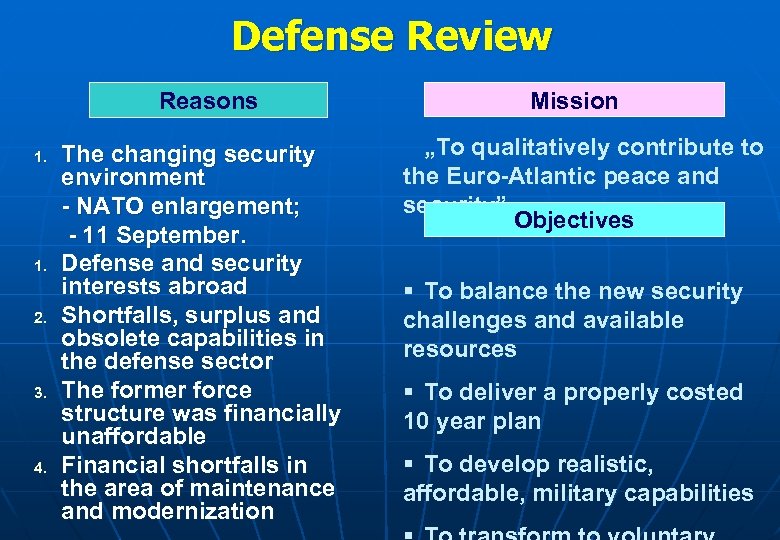 Defense Review Reasons 1. 2. 3. 4. The changing security environment - NATO enlargement; - 11 September. Defense and security interests abroad Shortfalls, surplus and obsolete capabilities in the defense sector The former force structure was financially unaffordable Financial shortfalls in the area of maintenance and modernization Mission „To qualitatively contribute to the Euro-Atlantic peace and security” Objectives § To balance the new security challenges and available resources § To deliver a properly costed 10 year plan § To develop realistic, affordable, military capabilities
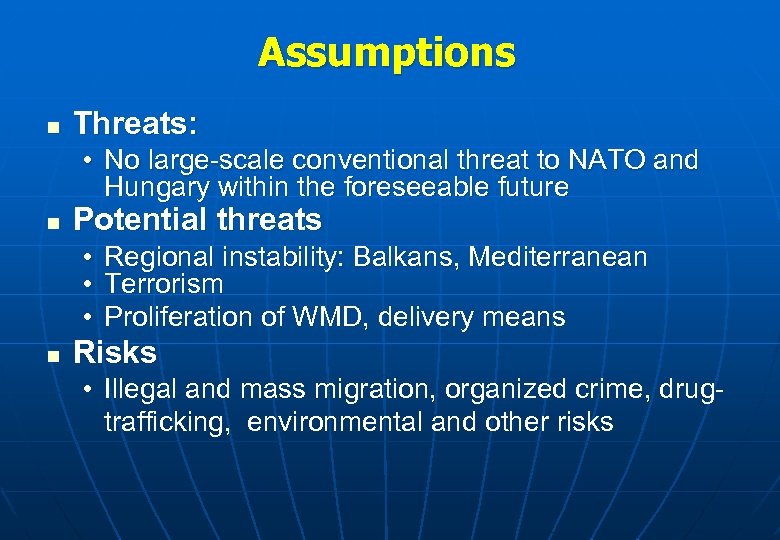 Assumptions n Threats: • No large-scale conventional threat to NATO and Hungary within the foreseeable future n Potential threats • Regional instability: Balkans, Mediterranean • Terrorism • Proliferation of WMD, delivery means n Risks • Illegal and mass migration, organized crime, drugtrafficking, environmental and other risks
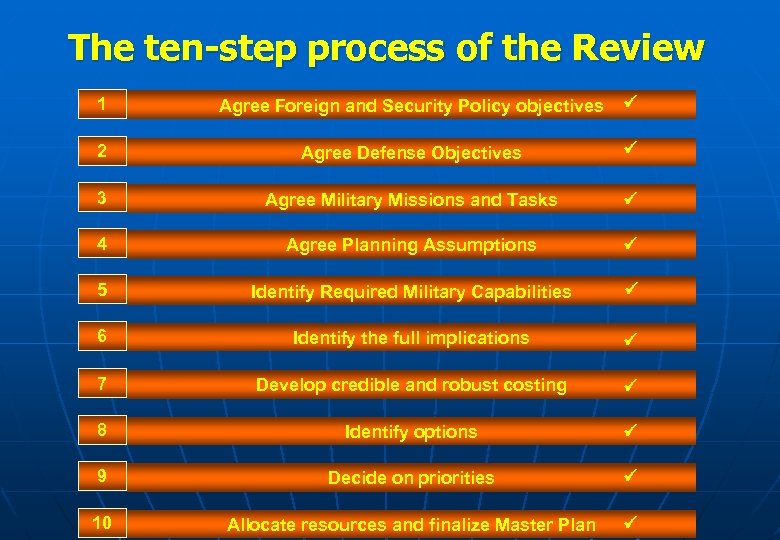 The ten-step process of the Review 1 Agree Foreign and Security Policy objectives 2 Agree Defense Objectives 3 Agree Military Missions and Tasks 4 Agree Planning Assumptions 5 Identify Required Military Capabilities 6 Identify the full implications 7 Develop credible and robust costing 8 Identify options 9 Decide on priorities 10 Allocate resources and finalize Master Plan
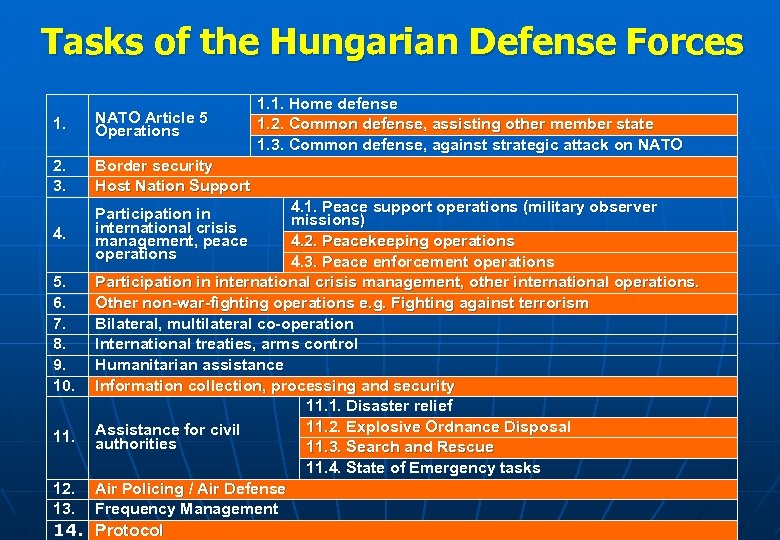 Tasks of the Hungarian Defense Forces 1. NATO Article 5 Operations 2. 3. Border security Host Nation Support 4. Participation in international crisis management, peace operations 1. 1. Home defense 1. 2. Common defense, assisting other member state 1. 3. Common defense, against strategic attack on NATO 5. 6. 7. 8. 9. 10. 11. 12. 13. 4. 1. Peace support operations (military observer missions) 4. 2. Peacekeeping operations 4. 3. Peace enforcement operations Participation in international crisis management, other international operations. Other non-war-fighting operations e. g. Fighting against terrorism Bilateral, multilateral co-operation International treaties, arms control Humanitarian assistance Information collection, processing and security 11. 1. Disaster relief 11. 2. Explosive Ordnance Disposal Assistance for civil authorities 11. 3. Search and Rescue 11. 4. State of Emergency tasks Air Policing / Air Defense Frequency Management 14. Protocol
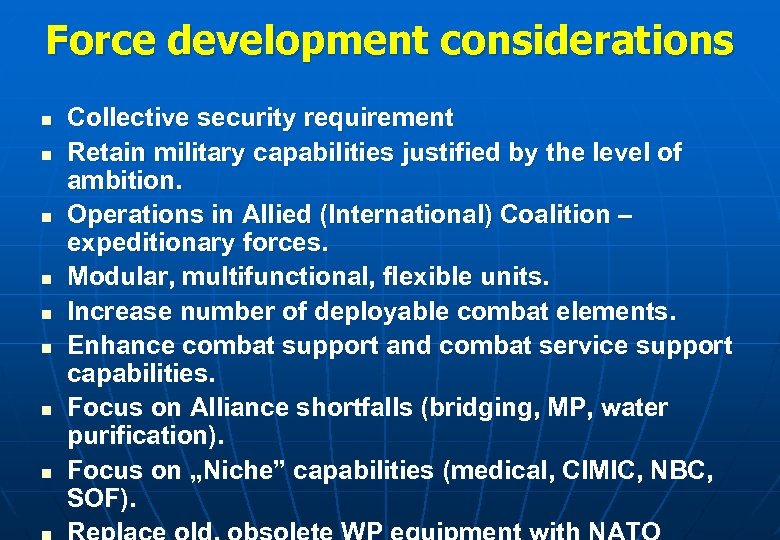 Force development considerations n n n n Collective security requirement Retain military capabilities justified by the level of ambition. Operations in Allied (International) Coalition – expeditionary forces. Modular, multifunctional, flexible units. Increase number of deployable combat elements. Enhance combat support and combat service support capabilities. Focus on Alliance shortfalls (bridging, MP, water purification). Focus on „Niche” capabilities (medical, CIMIC, NBC, SOF).
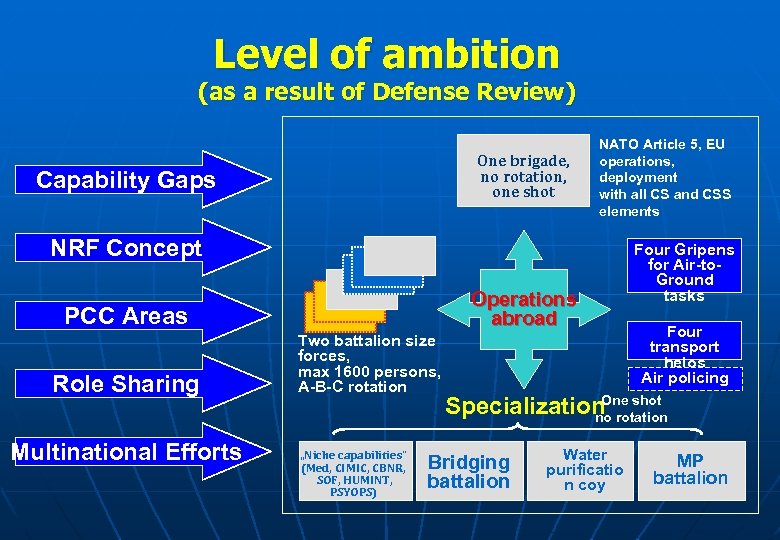 Level of ambition (as a result of Defense Review) One brigade, no rotation, one shot Capability Gaps NATO Article 5, EU operations, deployment with all CS and CSS elements NRF Concept Operations abroad PCC Areas Role Sharing Multinational Efforts Two battalion size forces, max 1600 persons, A-B-C rotation „Niche capabilities” (Med, CIMIC, CBNR, SOF, HUMINT, PSYOPS) Four Gripens for Air-to. Ground tasks Four transport helos Air policing Specialization. One shot no rotation Bridging battalion Water purificatio n coy MP battalion
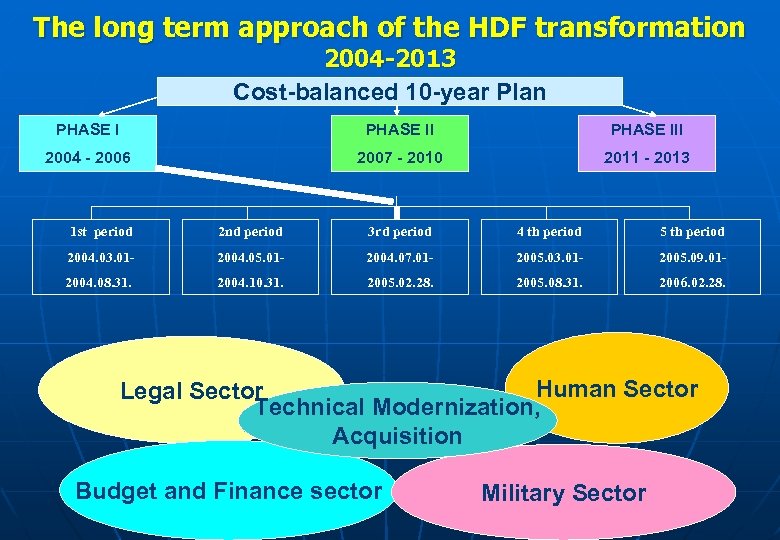 The long term approach of the HDF transformation 2004 -2013 Cost-balanced 10 -year Plan PHASE III 2004 - 2006 2007 - 2010 2011 - 2013 1 st period 2 nd period 3 rd period 4 th period 5 th period 2004. 03. 01 - 2004. 05. 01 - 2004. 07. 01 - 2005. 03. 01 - 2005. 09. 01 - 2004. 08. 31. 2004. 10. 31. 2005. 02. 28. 2005. 08. 31. 2006. 02. 28. Human Sector Legal Sector Technical Modernization, Acquisition Budget and Finance sector Military Sector
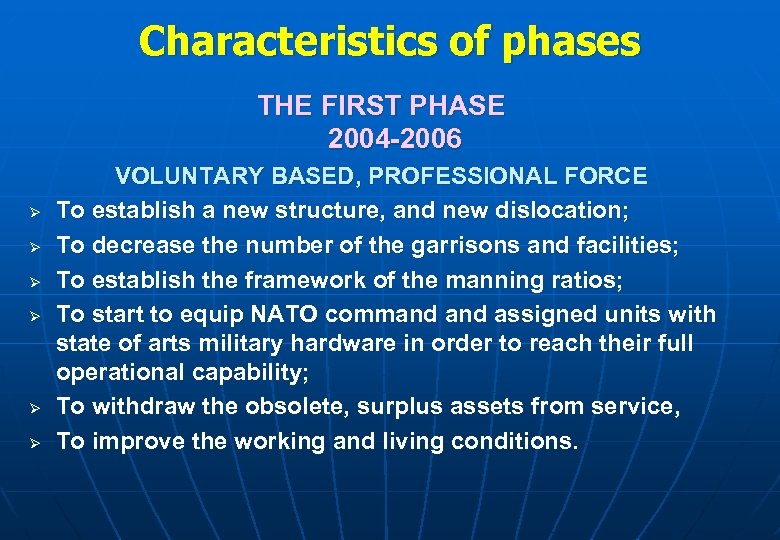 Characteristics of phases THE FIRST PHASE 2004 -2006 Ø Ø Ø VOLUNTARY BASED, PROFESSIONAL FORCE To establish a new structure, and new dislocation; To decrease the number of the garrisons and facilities; To establish the framework of the manning ratios; To start to equip NATO command assigned units with state of arts military hardware in order to reach their full operational capability; To withdraw the obsolete, surplus assets from service, To improve the working and living conditions.
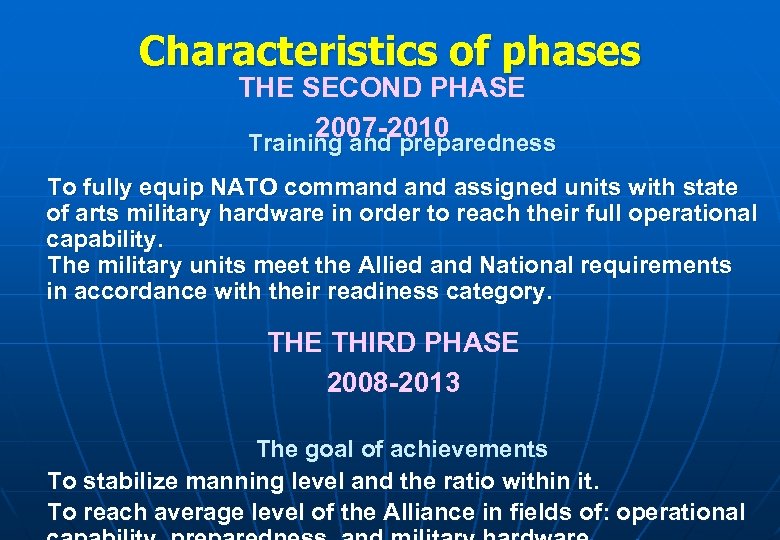 Characteristics of phases THE SECOND PHASE 2007 -2010 Training and preparedness To fully equip NATO command assigned units with state of arts military hardware in order to reach their full operational capability. The military units meet the Allied and National requirements in accordance with their readiness category. THE THIRD PHASE 2008 -2013 The goal of achievements To stabilize manning level and the ratio within it. To reach average level of the Alliance in fields of: operational
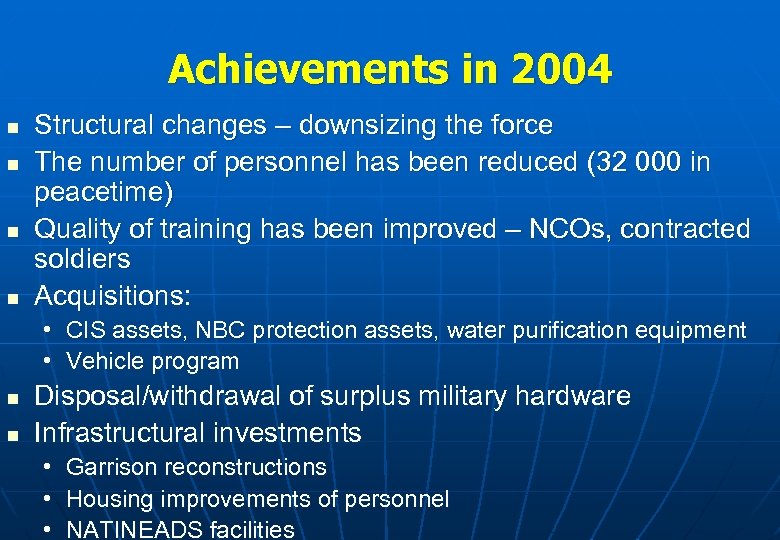 Achievements in 2004 n n Structural changes – downsizing the force The number of personnel has been reduced (32 000 in peacetime) Quality of training has been improved – NCOs, contracted soldiers Acquisitions: • CIS assets, NBC protection assets, water purification equipment • Vehicle program n n Disposal/withdrawal of surplus military hardware Infrastructural investments • Garrison reconstructions • Housing improvements of personnel • NATINEADS facilities
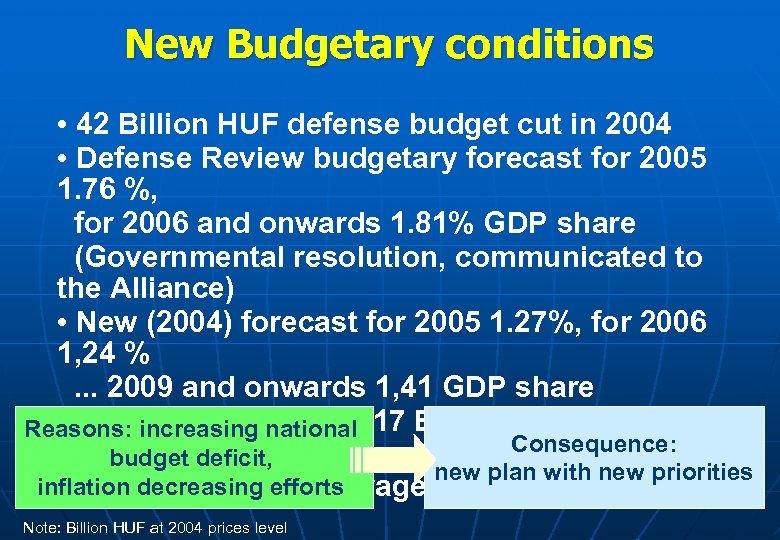 New Budgetary conditions • 42 Billion HUF defense budget cut in 2004 • Defense Review budgetary forecast for 2005 1. 76 %, for 2006 and onwards 1. 81% GDP share (Governmental resolution, communicated to the Alliance) • New (2004) forecast for 2005 1. 27%, for 2006 1, 24 %. . . 2009 and onwards 1, 41 GDP share • Shortfall is approx 1. 17 Billion HUF (4. 8 Million Reasons: increasing national Consequence: €) budget deficit, new plan with new priorities inflation decreasing efforts for ten years, an average 24. 7 % Note: Billion HUF at 2004 prices level
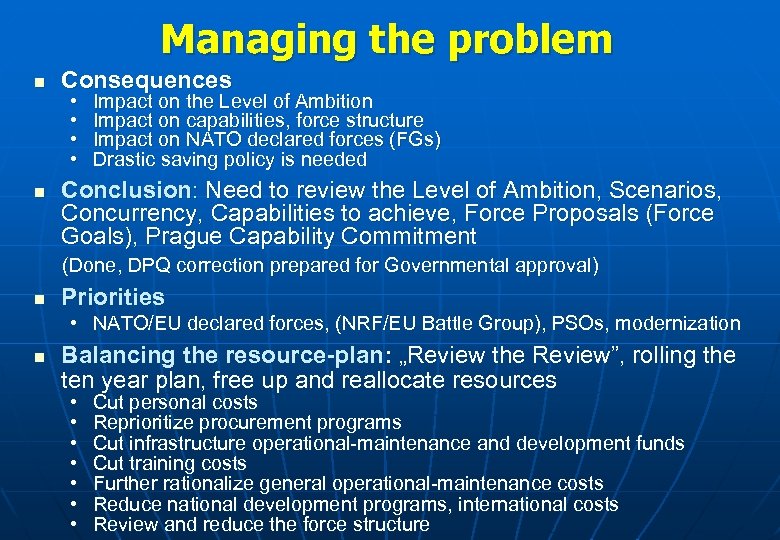 Managing the problem n n Consequences • • Impact on the Level of Ambition Impact on capabilities, force structure Impact on NATO declared forces (FGs) Drastic saving policy is needed Conclusion: Need to review the Level of Ambition, Scenarios, Concurrency, Capabilities to achieve, Force Proposals (Force Goals), Prague Capability Commitment (Done, DPQ correction prepared for Governmental approval) n Priorities • NATO/EU declared forces, (NRF/EU Battle Group), PSOs, modernization n Balancing the resource-plan: „Review the Review”, rolling the ten year plan, free up and reallocate resources • • Cut personal costs Reprioritize procurement programs Cut infrastructure operational-maintenance and development funds Cut training costs Further rationalize general operational-maintenance costs Reduce national development programs, international costs Review and reduce the force structure
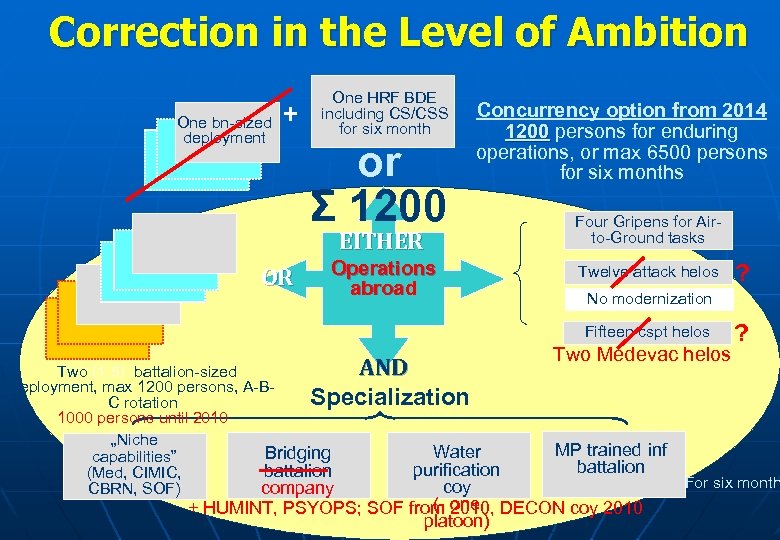 Correction in the Level of Ambition One bn-sized deployment + One HRF BDE including CS/CSS for six month or Σ 1200 EITHER OR Operations abroad Concurrency option from 2014 1200 persons for enduring operations, or max 6500 persons for six months Four Gripens for Airto-Ground tasks Twelve attack helos No modernization Fifteen cspt helos AND Specialization Two (1. 5) battalion-sized deployment, max 1200 persons, A-BC rotation 1000 persons until 2010 „Niche Bridging capabilities” battalion (Med, CIMIC, company CBRN, SOF) ? Two Medevac helos MP trained inf Water battalion purification coy (- one + HUMINT, PSYOPS; SOF from 2010, DECON coy 2010 platoon) ? For six month
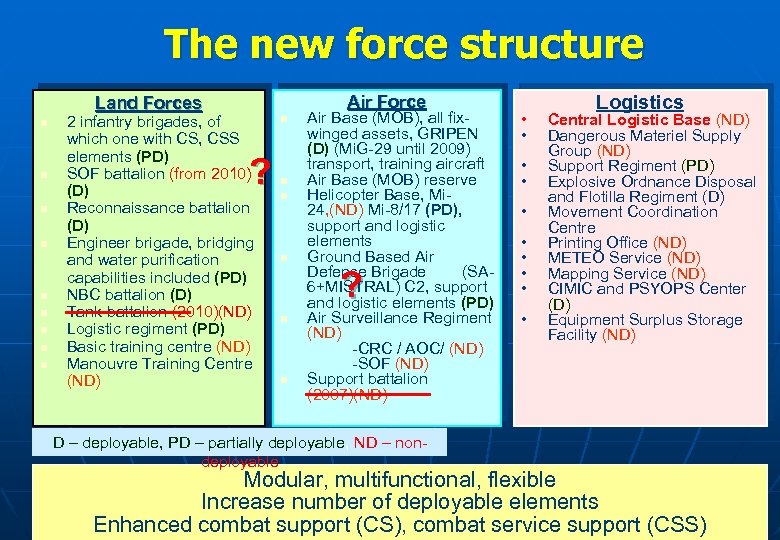 The new force structure Air Force Land Forces n n n n n 2 infantry brigades, of which one with CS, CSS elements (PD) SOF battalion (from 2010) (D) Reconnaissance battalion (D) Engineer brigade, bridging and water purification capabilities included (PD) NBC battalion (D) Tank battalion (2010)(ND) Logistic regiment (PD) Basic training centre (ND) Manouvre Training Centre (ND) ? n n Air Base (MOB), all fixwinged assets, GRIPEN (D) (Mi. G-29 until 2009) transport, training aircraft Air Base (MOB) reserve Helicopter Base, Mi 24, (ND) Mi-8/17 (PD), support and logistic elements Ground Based Air Defense Brigade (SA 6+MISTRAL) C 2, support and logistic elements (PD) Air Surveillance Regiment (ND) -CRC / AOC/ (ND) -SOF (ND) Support battalion (2007)(ND) ? n n D – deployable, PD – partially deployable, ND – nondeployable • • • Logistics Central Logistic Base (ND) Dangerous Materiel Supply Group (ND) Support Regiment (PD) Explosive Ordnance Disposal and Flotilla Regiment (D) Movement Coordination Centre Printing Office (ND) METEO Service (ND) Mapping Service (ND) CIMIC and PSYOPS Center (D) Equipment Surplus Storage Facility (ND) Modular, multifunctional, flexible Increase number of deployable elements Enhanced combat support (CS), combat service support (CSS)
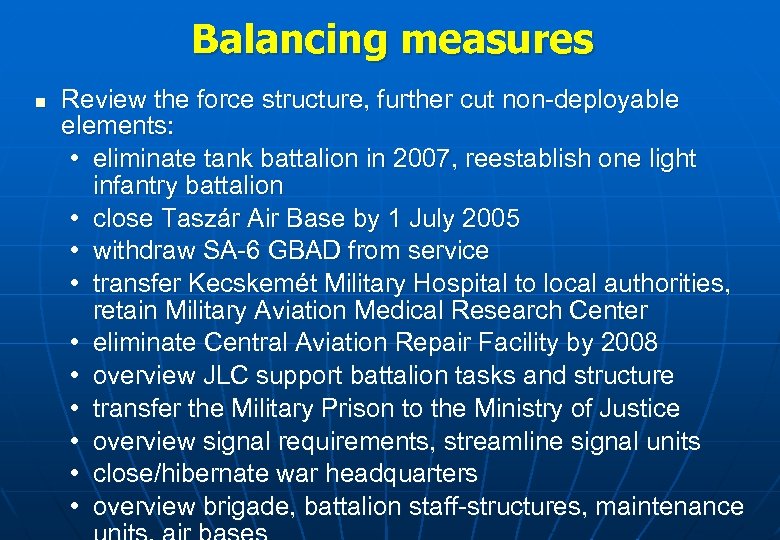 Balancing measures n Review the force structure, further cut non-deployable elements: • eliminate tank battalion in 2007, reestablish one light infantry battalion • close Taszár Air Base by 1 July 2005 • withdraw SA-6 GBAD from service • transfer Kecskemét Military Hospital to local authorities, retain Military Aviation Medical Research Center • eliminate Central Aviation Repair Facility by 2008 • overview JLC support battalion tasks and structure • transfer the Military Prison to the Ministry of Justice • overview signal requirements, streamline signal units • close/hibernate war headquarters • overview brigade, battalion staff-structures, maintenance
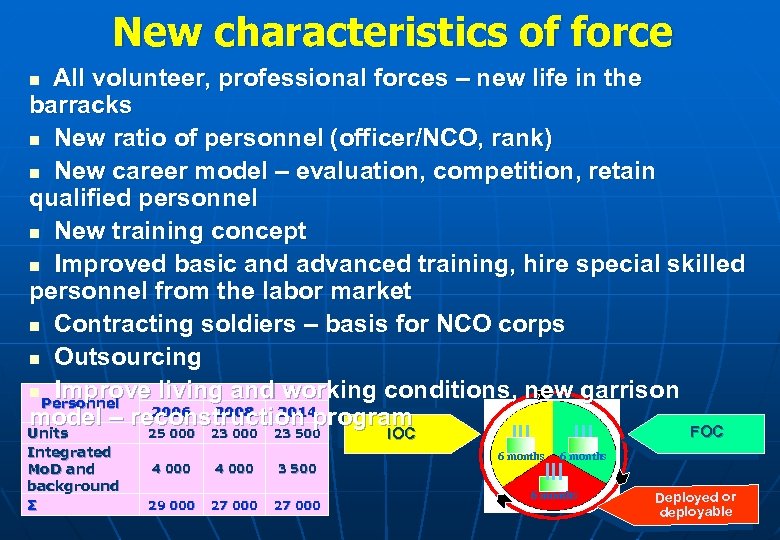 New characteristics of force All volunteer, professional forces – new life in the barracks n New ratio of personnel (officer/NCO, rank) n New career model – evaluation, competition, retain qualified personnel n New training concept n Improved basic and advanced training, hire special skilled personnel from the labor market n Contracting soldiers – basis for NCO corps n Outsourcing n Improve living and working conditions, new garrison Personnel 2006 2008 201 model – reconstruction 4 program FOC 25 000 23 500 Units IOC III n Integrated Mo. D and background Σ 4 000 3 500 29 000 27 000 6 months III 6 months Deployed or deployable
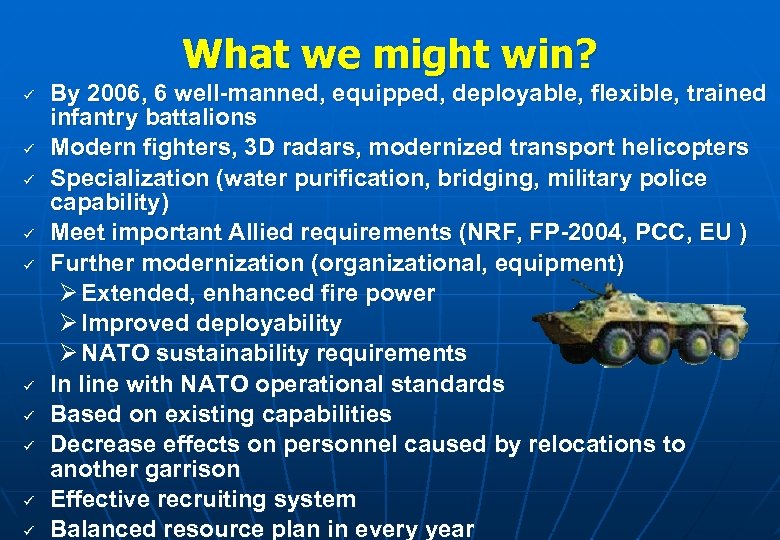 What we might win? ü ü ü ü ü By 2006, 6 well-manned, equipped, deployable, flexible, trained infantry battalions Modern fighters, 3 D radars, modernized transport helicopters Specialization (water purification, bridging, military police capability) Meet important Allied requirements (NRF, FP-2004, PCC, EU ) Further modernization (organizational, equipment) Ø Extended, enhanced fire power Ø Improved deployability Ø NATO sustainability requirements In line with NATO operational standards Based on existing capabilities Decrease effects on personnel caused by relocations to another garrison Effective recruiting system Balanced resource plan in every year
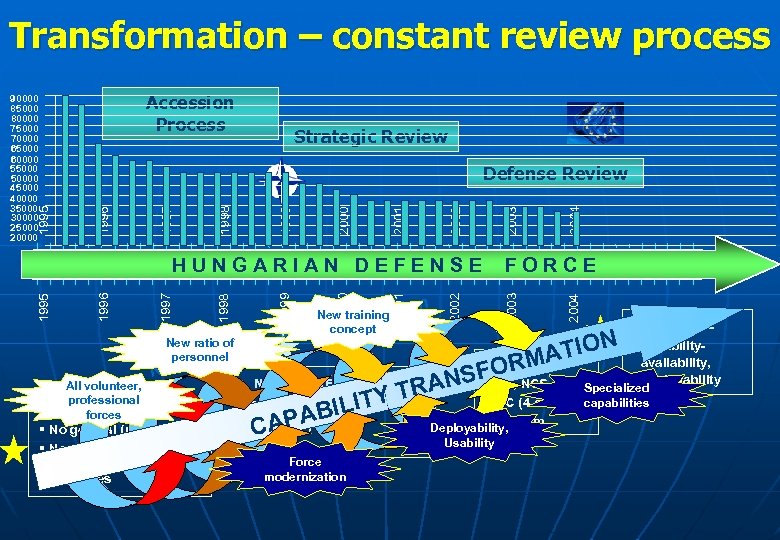 Transformation – constant review process Accession Process 90000 85000 80000 75000 70000 65000 60000 550000 45000 40000 35000 30000 25000 20000 Strategic Review New ratio of personnel Term Near All volunteer, professional STRATEGIC CONCEPT forces § No general (nucl. ) threat § New security challenges § Coop with former adversaries ti o pera O Y IT ABIL §DCI (5 AP C areas) §CRO Force modernization 2004 2003 N ATIO PRAGUE RM ISTAMBUL §Usabilityavailability, deployability O NSFNFS, NCS, NRF Specialized § TRA NEW STRATEGIC CONCEPT §Effective mil. capabilities FORCE 2004 n New trainingatio uc concept al Ed on 2002 2001 2000 1999 1998 1997 1996 1995 HUNGARIAN DEFENSE 2003 2002 2001 2000 1999 1998 1997 1996 1995 Defense Review §PCC (4 areas) capabilities §terrorism Deployability, Usability
 „To qualitatively contribute to the Euro-Atlantic peace and security” Thank you for your attention!