


 Скачать презентацию Defeating Malicious Terminals in an Electronic Voting System
0448c8f7b5ba60788dd4860c49442b80.ppt
- Количество слайдов: 29
 Defeating Malicious Terminals in an Electronic Voting System Daniel Hanley Andre dos Santos Jeff King Georgia Tech Information Security Center
 Overview Motivation Related Work Protocol Examples Analysis
 Motivation The Voting Problem Traditional Approach Electronic Voting
 Motivation: The Voting Problem Scenario: Alice, a human, wishes to transmit message c Є C to central tallier, Trent. Security requirements Anonymity Accuracy etc.
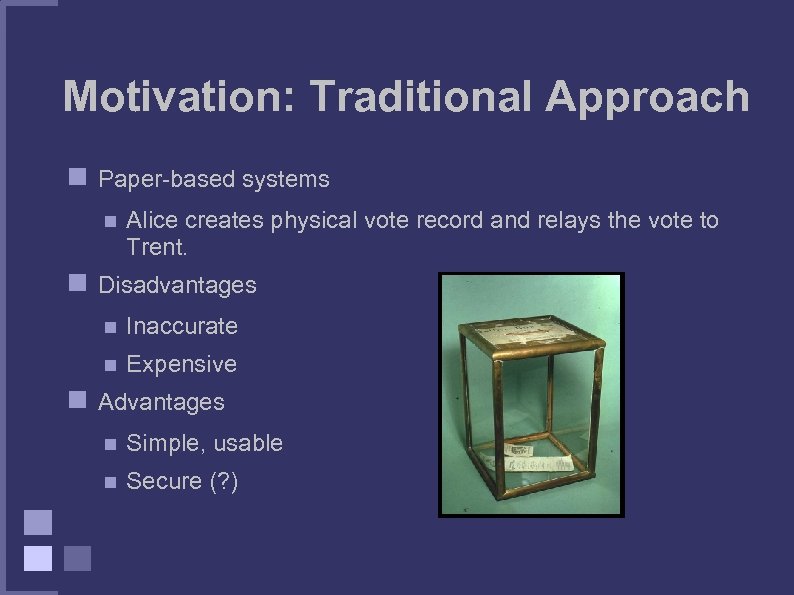 Motivation: Traditional Approach Paper-based systems Alice creates physical vote record and relays the vote to Trent. Disadvantages Inaccurate Expensive Advantages Simple, usable Secure (? )
 Motivation: Electronic Voting Current state of electronic voting systems Systems entrust untrustworthy voting terminals, volunteers Security policy dictates isolation and physical controls Advantages Relatively inexpensive Accurate Disadvantages Fails to use public infrastructure Vulnerable to automated attacks Vulnerable to undetectable attacks
 Motivation: Electronic Voting Current state of electronic voting systems Systems entrust untrustworthy voting terminals, volunteers Security policy dictates isolation and physical controls Advantages Relatively inexpensive Accurate Disadvantages Fails to use public infrastructure Vulnerable to automated attacks Vulnerable to undetectable attacks
 Motivation: Electronic Voting Solution: Blind signature protocol with trustworthy hardware Direct communication with Trent – infeasible! Trustworthy voting terminals – costly! Personal tamper resistant device – yes! Problem: How can we establish a trusted path between Alice and her voting device? Direct I/O? Form factor prohibits this. Via voting terminal? No! CAPTCHA-Voting Protocol? Other schemes (Chaum, Prêt-à-Voter, KHAP) Voter performs verification and auditing steps.
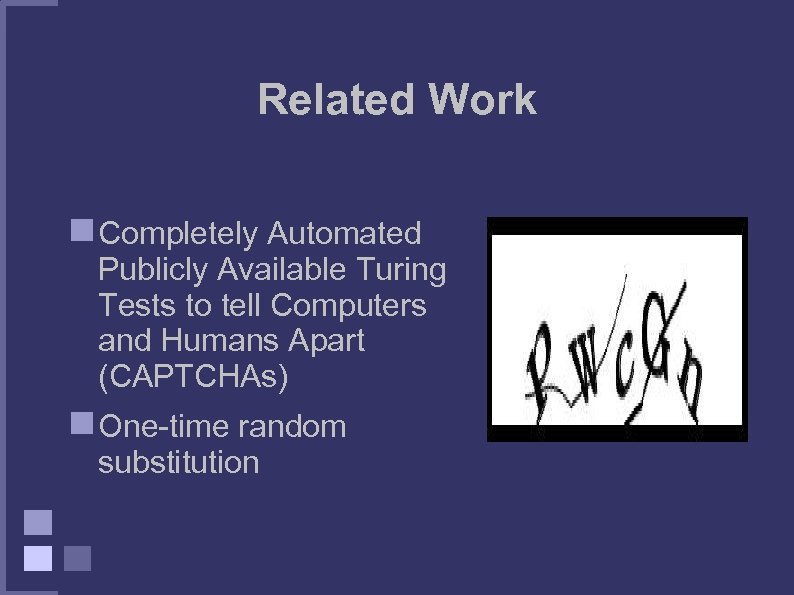 Related Work Completely Automated Publicly Available Turing Tests to tell Computers and Humans Apart (CAPTCHAs) One-time random substitution
 Protocol: Actors Alice a human voter Trent a central tallier, trusted to perform complex, anonymous operations on Alice's behalf Mallory an untrusted voting terminal
![Protocol Public list of candidates C = [ c , … , c ]](https://present5.com/presentation/0448c8f7b5ba60788dd4860c49442b80/image-11.jpg "Protocol Public list of candidates C = [ c , … , c ]") Protocol Public list of candidates C = [ c , … , c ] Public, random set R = [ r , … , r ] such that m ≥ n Random mapping of candidates to random elements 1 1 2 2 n m K : C → R such that P( K(c) = ri ) = P( K(c) = rj ) for all i, j K-1 : R → C CAPTCHA transformation function T(m) such that Mallory cannot derive m from T(m), while Alice may infer m from T(m) Trent may encode K using T. This is denoted by T(K).
Protocol Public list of candidates C = [ c , … , c ] Public, random set R = [ r , … , r ] such that m ≥ n Random mapping of candidates to random elements 1 1 2 2 n m K : C → R such that P( K(c) = ri ) = P( K(c) = rj ) for all i, j K-1 : R → C CAPTCHA transformation function T(m) such that Mallory cannot derive m from T(m), while Alice may infer m from T(m) Trent may encode K using T. This is denoted by T(K).
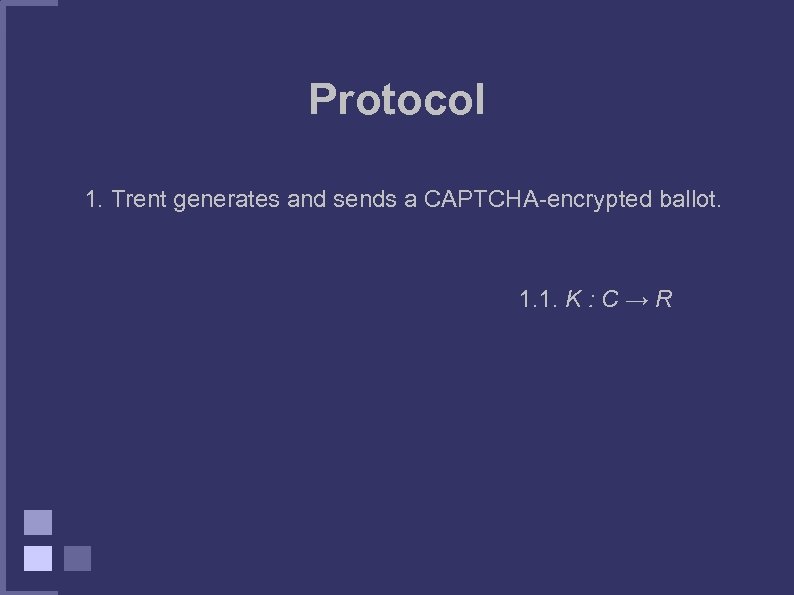 Protocol 1. Trent generates and sends a CAPTCHA-encrypted ballot. 1. 1. K : C → R
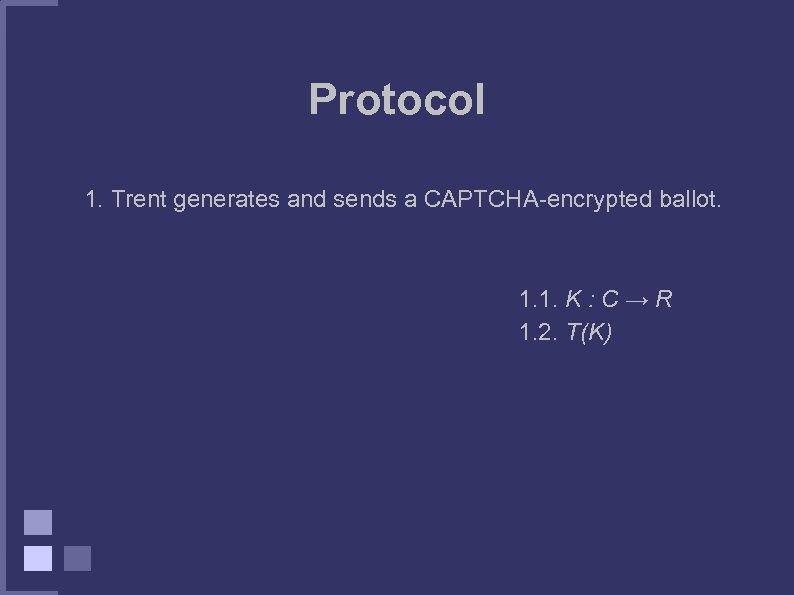 Protocol 1. Trent generates and sends a CAPTCHA-encrypted ballot. 1. 1. K : C → R 1. 2. T(K)
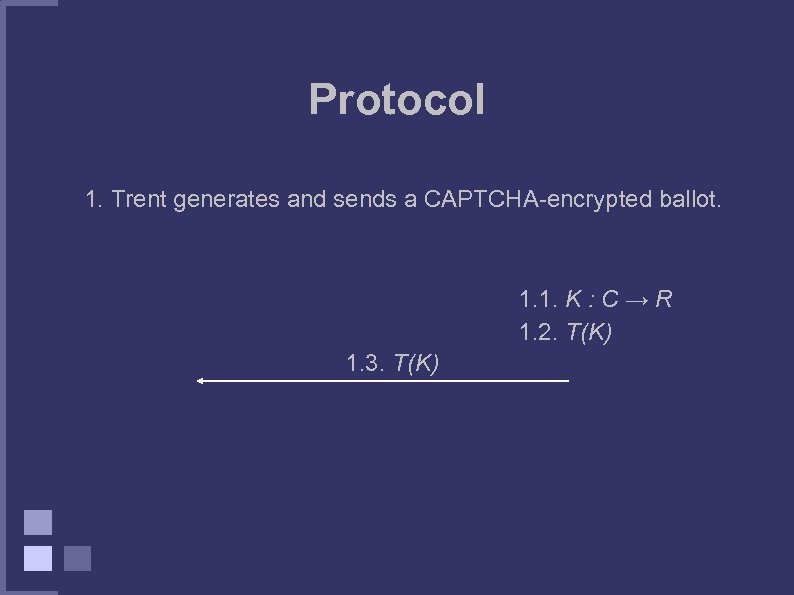 Protocol 1. Trent generates and sends a CAPTCHA-encrypted ballot. 1. 1. K : C → R 1. 2. T(K) 1. 3. T(K)
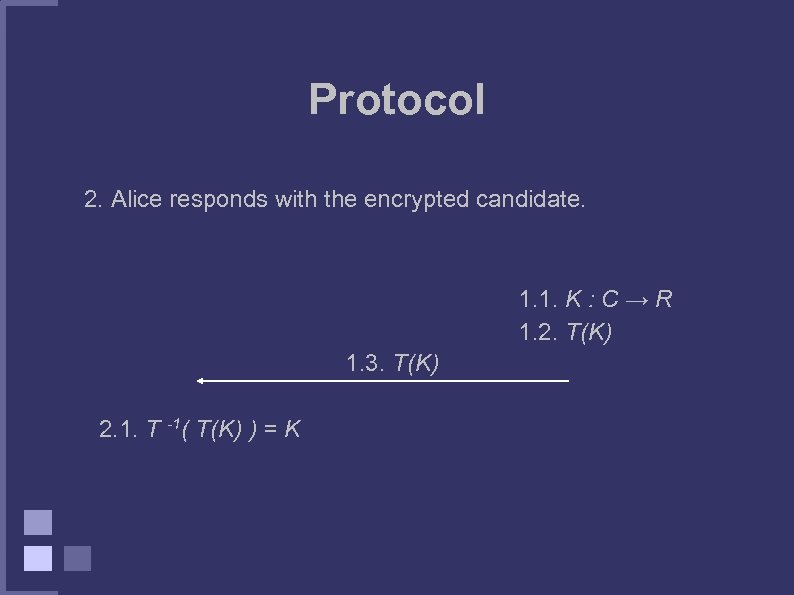 Protocol 2. Alice responds with the encrypted candidate. 1. 1. K : C → R 1. 2. T(K) 1. 3. T(K) 2. 1. T -1( T(K) ) = K
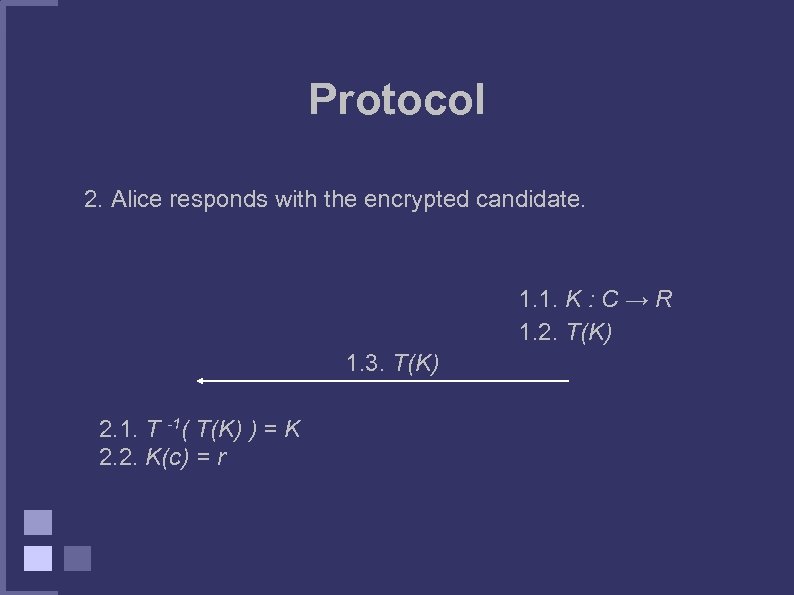 Protocol 2. Alice responds with the encrypted candidate. 1. 1. K : C → R 1. 2. T(K) 1. 3. T(K) 2. 1. T -1( T(K) ) = K 2. 2. K(c) = r
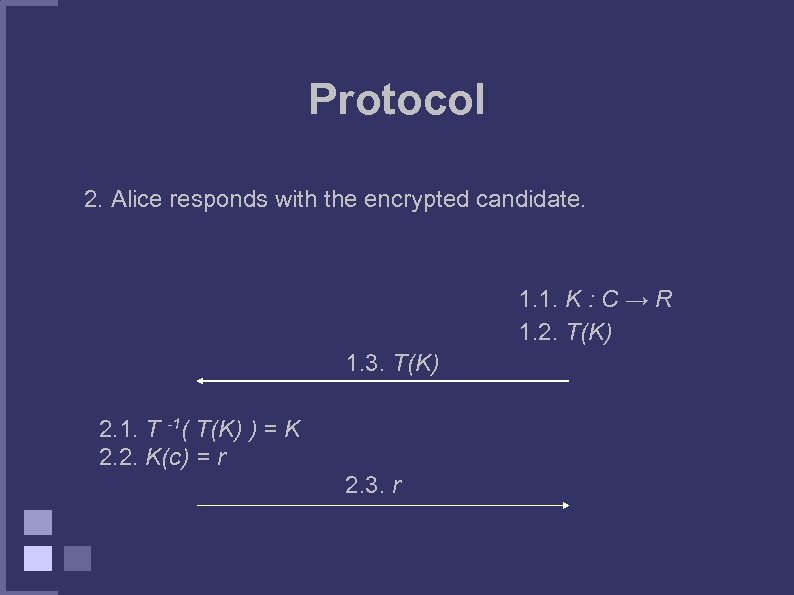 Protocol 2. Alice responds with the encrypted candidate. 1. 1. K : C → R 1. 2. T(K) 1. 3. T(K) 2. 1. T -1( T(K) ) = K 2. 2. K(c) = r 2. 3. r
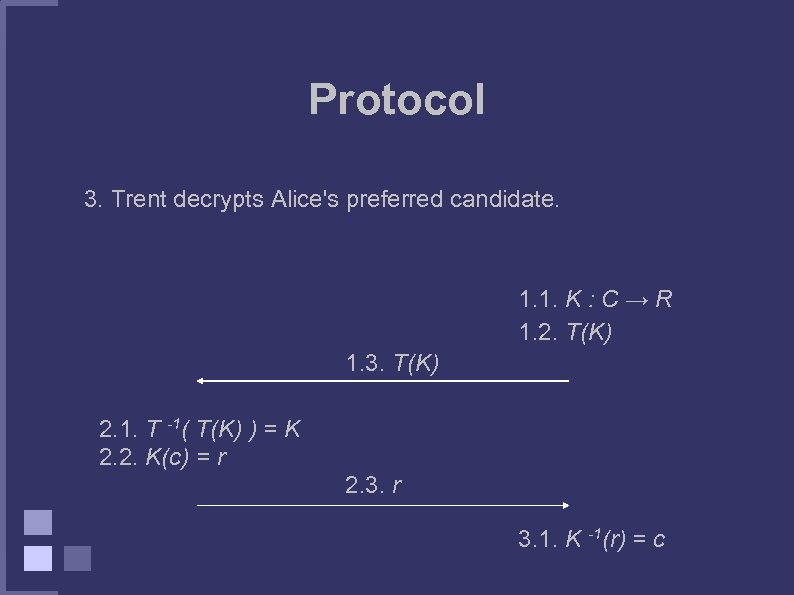 Protocol 3. Trent decrypts Alice's preferred candidate. 1. 1. K : C → R 1. 2. T(K) 1. 3. T(K) 2. 1. T -1( T(K) ) = K 2. 2. K(c) = r 2. 3. r 3. 1. K -1(r) = c
 Examples Text CAPTCHA 3 D Animation CAPTCHA Audio CAPTCHA
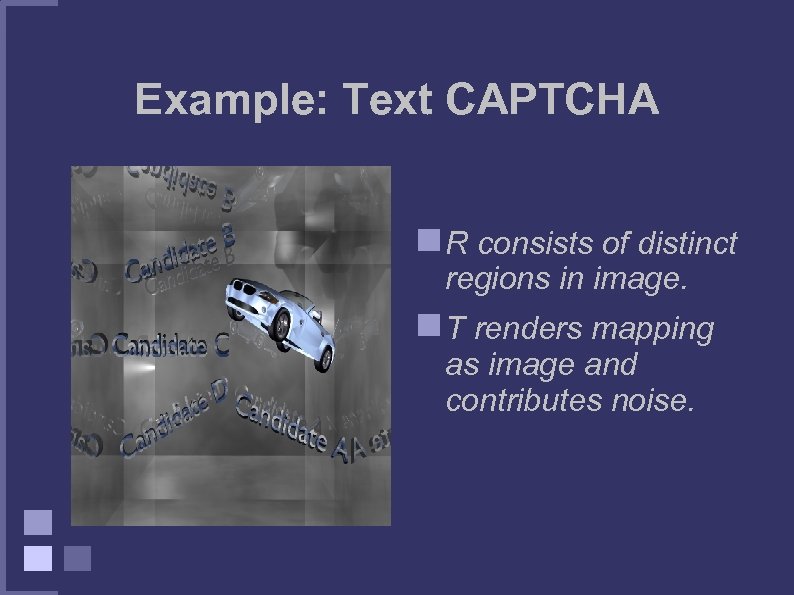 Example: Text CAPTCHA R consists of distinct regions in image. T renders mapping as image and contributes noise.
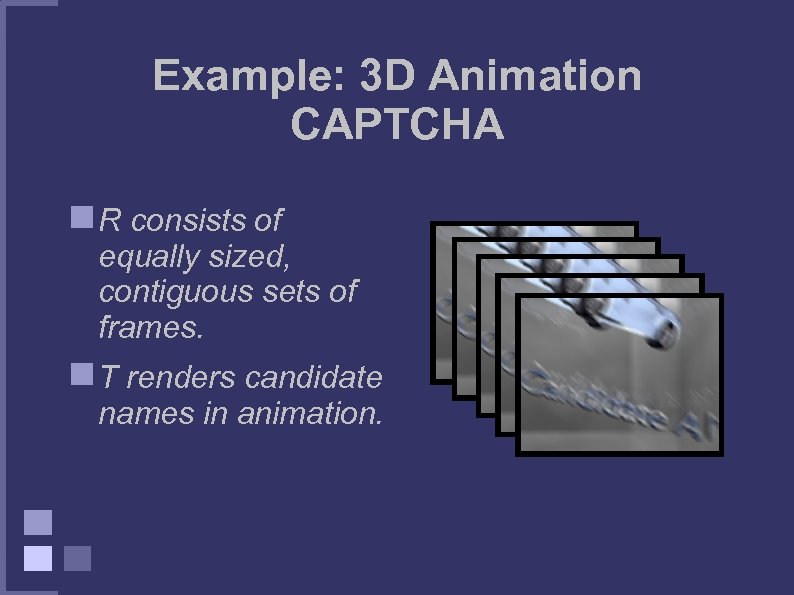 Example: 3 D Animation CAPTCHA R consists of equally sized, contiguous sets of frames. T renders candidate names in animation.
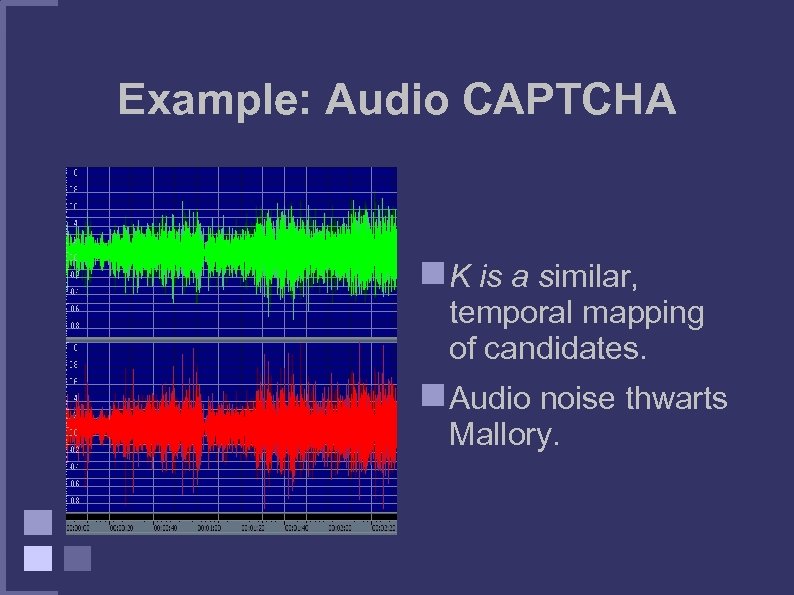 Example: Audio CAPTCHA K is a similar, temporal mapping of candidates. Audio noise thwarts Mallory.
 Analysis Fabricated votes Human adversaries Selective denial of service
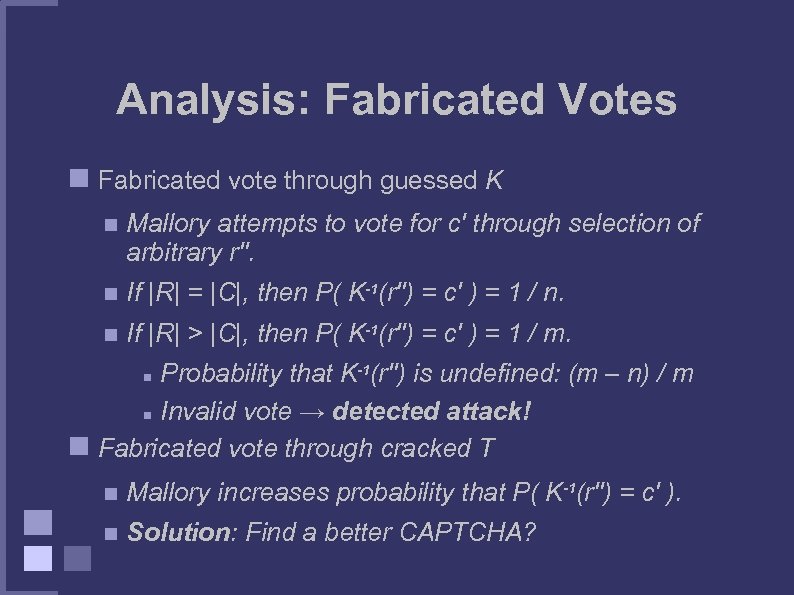 Analysis: Fabricated Votes Fabricated vote through guessed K Mallory attempts to vote for c' through selection of arbitrary r''. If |R| = |C|, then P( K-1(r'') = c' ) = 1 / n. If |R| > |C|, then P( K-1(r'') = c' ) = 1 / m. Probability that K-1(r'') is undefined: (m – n) / m Invalid vote → detected attack! Fabricated vote through cracked T Mallory increases probability that P( K-1(r'') = c' ). Solution: Find a better CAPTCHA?
 Analysis: Human Adversary Transmission of T(K) to a human collaborator Time-dependent protocol Increased likelihood of detection Architectural solutions
 Analysis: Selective Do. S: Mallory discards Alice's vote if it is likely that c ≠ c'. Mallory must learn Alice's preference. Alice and Mallory's location Alice's previous votes Solution: Single ballot Fabricated ballot Detection of selective denial of service Educated guessing
 Conclusion Human interaction required – no efficient automated attacks Easy detection of large-scale attacks Comparison to traditional voting systems Future work Usability data Broader applications, using this protocol (possibly combined with KHAP) to form a trusted path
 Questions?
 Questions?